Marcos Orders Critical Minerals Industry Push
President Marcos signed Executive Order 122 to develop a critical minerals industry, reorganizing the Mining Industry Coordinating Council. The order aims to boost value-added processing and sustainable mining, drawing significant media coverage.
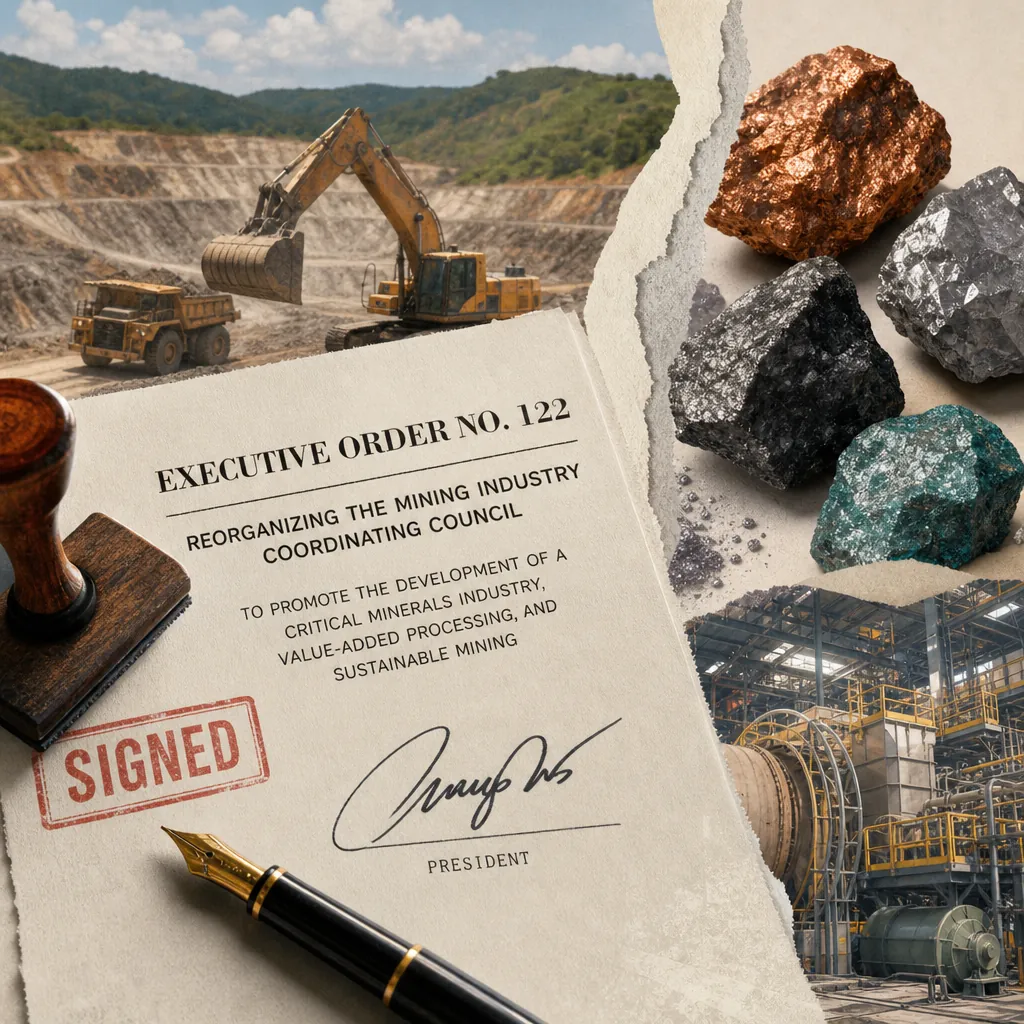
President Ferdinand Marcos Jr. signed Executive Order 122 on August 21, directing the establishment of a unified policy framework for the country's critical minerals industry. The order, which also reorganizes the Mining Industry Coordinating Council (MICC), is designed to support the Philippines' clean energy transition, digital transformation, and advanced technologies by promoting value-added processing and downstream industries. The announcement drew heavy coverage across online news outlets, with multiple articles capturing the development.
The order tasks the Department of Environment and Natural Resources (DENR) and the Department of Finance (DOF) to co-chair the council, with the Mines and Geosciences Bureau implementing the framework. Marcos emphasized the need to "promote value-added processing and downstream industries, enhance investments and competitiveness, ensure responsible and sustainable mining practices and harmonize government policies and programs." This move signals a strategic shift toward leveraging the country's mineral resources for economic growth and technological advancement.
In a related development, Marcos also directed all national government agencies to support the celebration of Philippine Creative Industries Month this September, under the theme "We Are a Creative Nation." Memorandum Circular 130, signed on August 18, aims to promote the country's creative goods and services, highlighting the sector's contribution to nation-building.
Key themes
- Critical minerals policy framework established: Executive Order 122 creates a unified policy for the critical minerals industry, aiming to boost value-added processing and downstream industries. The order reorganizes the Mining Industry Coordinating Council, co-chaired by the DENR and DOF, to harmonize government policies and ensure sustainable mining practices.
- Focus on clean energy and digital transformation: The policy is tied to the country's clean energy transition and digital transformation, positioning critical minerals as essential inputs for advanced technologies. This aligns with global demand for minerals like nickel, copper, and cobalt, which are vital for batteries and electronics.
- Government agencies directed to support creative industries: Memorandum Circular 130 mandates all national agencies to back Philippine Creative Industries Month in September, promoting the sector's economic and cultural contributions. The DTI is tasked to organize activities with the private sector and academe.
- Mining industry coordination strengthened: The reorganization of the MICC aims to improve coordination among government bodies, enhancing investment competitiveness and responsible mining. The council's new structure is expected to streamline approvals and monitoring of mining projects.
- Media coverage concentrated on policy announcements: The captured articles show a focus on government directives, with multiple outlets covering the critical minerals order and creative industries month. This indicates high interest in policy developments affecting the mining and creative sectors.
- Potential for increased foreign investment: By promoting downstream industries, the policy could attract foreign investors seeking to process minerals locally, adding value before export. This may boost the economy but requires careful environmental management.
- Balancing economic growth and sustainability: The order emphasizes responsible and sustainable mining practices, addressing concerns about environmental impact. This balance is critical for public acceptance and long-term viability.
How the narratives stack
Dominant: The dominant narrative is the government's push to develop a critical minerals industry, as evidenced by the extensive coverage of Executive Order 122. This story leads the captured set, with two articles from Philstar Online detailing the order's provisions and the reorganization of the MICC. The policy's implications for clean energy and technology make it a significant development for the mining sector.
Counter-narrative: A counter-narrative emerges from the broader media landscape, focusing on the challenges of the mining industry, such as environmental concerns and community opposition. While not directly captured in the articles, this perspective is a known counterpoint to government initiatives, emphasizing the need for strict environmental safeguards.
Emerging: An emerging narrative is the potential for the Philippines to become a key player in the global critical minerals supply chain, particularly for electric vehicle batteries and renewable energy technologies. This is supported by the policy's emphasis on downstream processing, which could position the country as a processing hub.
Under-covered: The under-covered story is the specific role of the Mines and Geosciences Bureau in implementing the framework and the timeline for concrete actions. While the order names the bureau, details on how it will operationalize the policy are sparse, leaving uncertainty about execution.
Platform insights
- Facebook: Facebook is likely a primary platform for public discussion, given its widespread use in the Philippines. Posts about the critical minerals order may generate comments from environmental groups and industry stakeholders, with engagement measured in likes and shares. However, no specific engagement figures are available in the captured data.
- X (formerly Twitter): X is a platform for real-time news sharing and expert commentary. Government announcements often trend here, with users sharing links to articles and expressing opinions. The critical minerals order could spark discussions on economic policy and environmental trade-offs.
- YouTube: YouTube may host news segments or explainer videos about the policy, with view counts indicating public interest. However, no such content is captured in the provided articles.
- Reddit: Reddit communities focused on mining, environment, or Philippine politics might discuss the order, with upvotes and comments reflecting sentiment. The platform's anonymity allows for candid opinions, but no specific threads are captured.
Key voices and communities
- Government officials: President Marcos and the secretaries of DENR and DOF are central voices, framing the policy as a step toward economic modernization. Their statements are quoted in the articles, providing official rationale.
- Mining industry stakeholders: Mining companies and industry associations are likely to support the policy, seeing it as an opportunity for growth. They may advocate for streamlined regulations and investment incentives.
- Environmental groups: These groups are likely to voice concerns about the environmental impact of increased mining activity, calling for strict enforcement of sustainability standards. Their perspective is not captured in the articles but is a critical counterpoint.
- Economic analysts: Analysts may comment on the policy's potential to attract foreign investment and boost exports, while also noting risks such as commodity price volatility and governance challenges.
- Local communities: Communities near mining sites are directly affected by mining operations. Their voices are often underrepresented in national media, but they are key stakeholders in the conversation about sustainable mining.
Narrative streams
Executive Order 122: A New Framework for Critical Minerals
President Marcos signed Executive Order 122 on August 21, creating a unified policy framework for the critical minerals industry. The order reorganizes the Mining Industry Coordinating Council (MICC), co-chaired by the DENR and DOF, to harmonize government policies and promote value-added processing. Marcos stated the need to "promote value-added processing and downstream industries, enhance investments and competitiveness, ensure responsible and sustainable mining practices and harmonize government policies and programs".
The order is a response to the growing global demand for critical minerals like nickel, copper, and cobalt, which are essential for clean energy technologies and digital infrastructure. By encouraging local processing, the Philippines aims to capture more value from its mineral resources rather than exporting raw ores. This could create jobs and boost economic growth, but it also raises environmental concerns.
The read for the sector: Mining companies will see new opportunities for investment in processing facilities, but they must navigate stricter environmental regulations and community expectations. The government's commitment to sustainability will be tested as projects scale up.
Creative Industries Month: A Parallel Push for Economic Diversification
In a separate directive, President Marcos ordered all national government agencies to support Philippine Creative Industries Month (PCIM) in September, under the theme "We Are a Creative Nation." Memorandum Circular 130, signed on August 18, aims to promote the country's creative goods and services, highlighting their contribution to nation-building.
The Department of Trade and Industry (DTI) is tasked to organize activities with the private sector and academe. This initiative reflects a broader strategy to diversify the economy beyond traditional sectors like mining and agriculture, recognizing the creative industry's potential for job creation and cultural export.
The read for the sector: Creative industries, including film, design, and digital content, will gain government support and visibility, potentially attracting investment and talent. This complements the mining policy by fostering a more balanced economic portfolio.
Media Coverage and Public Perception
The captured articles show a concentration of coverage on government policy announcements, with multiple outlets reporting on the critical minerals order and creative industries month. This suggests that policy developments are a key driver of media attention in the mining sector. However, the sample is limited to online news, and the actual coverage may be broader, including print and broadcast.
The read for the sector: Public perception of the mining industry is shaped by government messaging, but environmental and social concerns remain prominent. Communicators must address these concerns proactively to maintain social license to operate.
Conversation trajectory
- Short-term (next 1-3 months): Expect further details on the implementation of Executive Order 122, including specific programs from the Mines and Geosciences Bureau. Watch for announcements of new mining projects or processing facilities, as well as reactions from environmental groups.
- Medium-term (6-12 months): The reorganization of the MICC may lead to streamlined permitting processes, potentially attracting foreign investment. Monitor for updates on the critical minerals list and any incentives for downstream industries.
- Long-term (1-2 years): The success of the policy will depend on global commodity prices and the country's ability to balance economic growth with environmental protection. Watch for shifts in mining regulations and community relations.
- Trigger events: Key triggers include the release of the implementing rules and regulations, the first major investment announcement under the new framework, and any environmental incidents that could spark public backlash.
Response guidance
- For mining companies: Emphasize commitment to sustainable practices and community engagement. Highlight how the new policy supports value-added processing and job creation, while addressing environmental safeguards.
- For government agencies: Communicate the benefits of the critical minerals industry for clean energy and technology, using clear examples. Provide regular updates on implementation to maintain public trust.
- For environmental groups: Use the policy's sustainability language to advocate for strict enforcement and transparency. Engage in public consultations to ensure community voices are heard.
- For industry associations: Facilitate dialogue between government and industry to shape regulations. Share success stories of responsible mining to counter negative perceptions.
- For communicators: Tailor messages to different platforms, using data and expert quotes to build credibility. Monitor public sentiment and respond to concerns promptly.
See the full picture behind today's signals.
This report draws from Media Meter's MediaWatch, our real-time monitoring engine tracking 2,470+ Philippine sources across print, broadcast, digital, and social. Explore how the platform turns raw coverage into decision-grade intelligence, then see how it's configured for teams like yours — whether you're in PR agencies, corporate comms, government, or marketing.
Want more? Browse our Report Library for sector and crisis intelligence, or request a demo and we'll have your brand set up before the call.
Want this kind of intelligence on your brand?
This brief is built on the same MediaWatch methodology that runs continuously across every brand we monitor. See your competitive landscape, Impact Score, and narrative trajectory in a 30-minute demo.