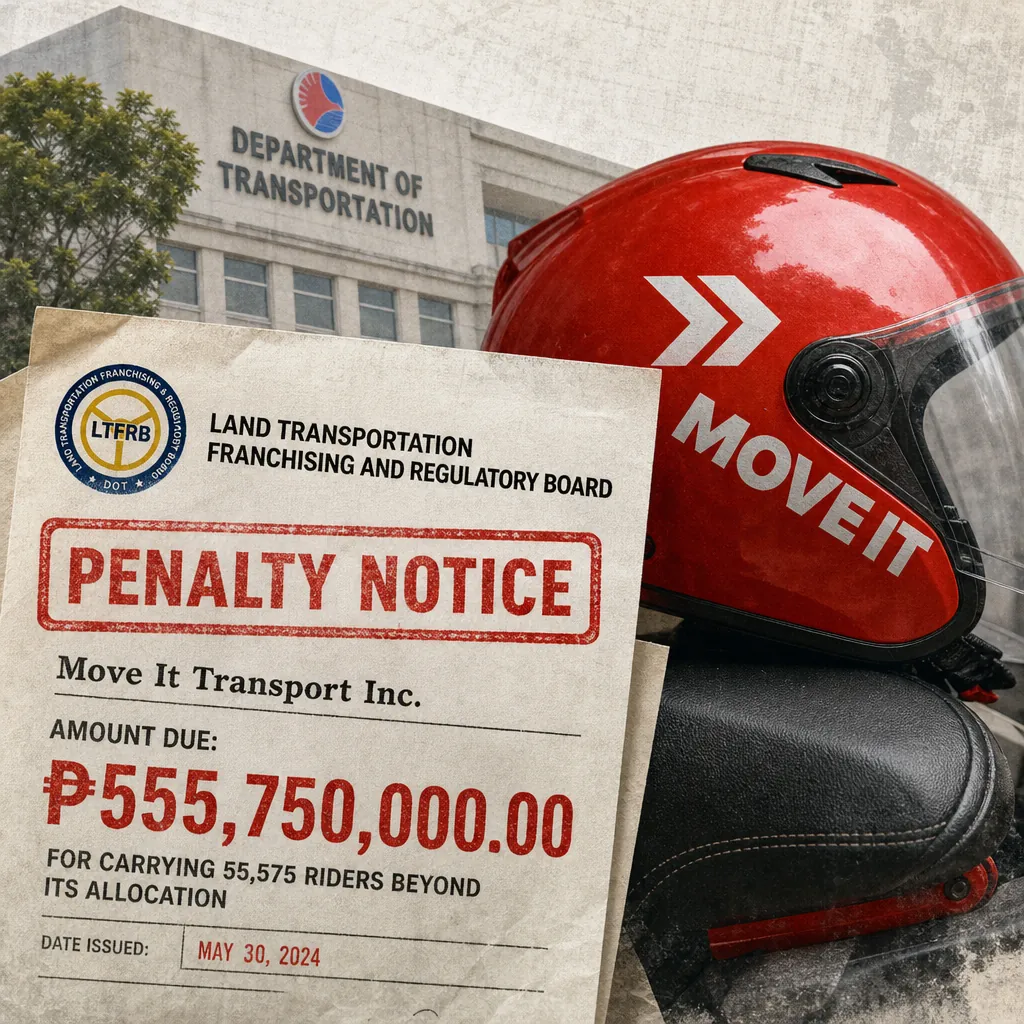
Move It Fined P555.75M as DOTr Weighs Rider Cap Review
The Land Transportation Franchising and Regulatory Board fined motorcycle taxi platform Move It P555.75 million for carrying 55,575 riders beyond its allocation, prompting the Department of Transportation to review how rider caps are set. The same day, the Land Transportation Office revoked licenses in separate road-safety cases and Toyota marked 60 years of the Corolla.
The Conversation
A P555.75-million penalty against motorcycle taxi platform Move It, and the government's sudden willingness to rethink the rider caps that produced it, set the terms of the day's transport conversation. The Land Transportation Franchising and Regulatory Board (LTFRB) found that Move It had 73,321 active riders on its platform against an authorized allocation of 17,746 — an excess of 55,575 riders — and imposed the fine in an October 9 decision that the company is now contesting51. On Thursday, Transportation Secretary Vivencio Dizon said his department would meet with the LTFRB to reassess how many riders should be allocated to Metro Manila and other areas, a review that commuter groups had been demanding since the penalty was announced13.
The story ran on two tracks that reinforced each other. The first was regulatory: a government agency enforcing a cap written before the pandemic against a platform that had grown far past it. The second was political: a commuter coalition and a tricycle operators' group both used the fine to argue that the cap itself is the problem, not the platform's expansion. The Coalition of Filipino Commuters said in a statement carried by the Manila Standard that motorcycle taxis "are no longer just an alternative" but "how people get to work and school on time," citing Japan International Cooperation Agency transport studies estimating Metro Manila generates 16 million trips daily48. The National Confederation of Tricycle Operators and Drivers Associations of the Philippines (NACTODAP) took the opposite tack on enforcement, with president Ariel Lim telling a Quezon City press conference that the LTFRB must actually collect the fine and show "ngipin" — teeth — in implementing it77.
The day's coverage also carried a separate cluster of Land Transportation Office (LTO) enforcement actions that, taken together, sketch a regulator moving aggressively on driver accountability: the revocation of a motorcycle rider's license for hitting a pedestrian in Pasig City6, the recommended four-year revocation of an optometrist's license over a hit-and-run in Iloilo City17, and the revocation of two taxi drivers' licenses in a "gas-and-run" case37. None of these drew the volume of the Move It story, but they share its underlying logic — that the government is using license actions, not just fines, to set behavior on the road.
Key themes
- Move It fined P555.75 million for 55,575 riders beyond its cap. The LTFRB's October 9 decision found 73,321 active riders against an authorized 17,746, and the company has filed a motion for reconsideration51. The gap between those two numbers is the entire regulatory dispute in one line.
- The Department of Transportation will review rider cap allocations with the LTFRB. Secretary Dizon said the agencies would "assess the supply and demand situation" and determine "how many should really be allocated for Metro Manila and other areas," language that opens the door to raising caps set before the pandemic13.
- Commuter groups argue the cap is outdated, not the platform's growth. The Coalition of Filipino Commuters cited 16 million daily trips in Metro Manila and said motorcycle taxis fill gaps left by congestion and limited public transport48. NACTODAP, representing tricycle operators, instead demanded the LTFRB enforce the fine, calling the overboarding a violation of regulation77.
- The LTO revoked licenses in three separate road-safety cases. A motorcycle rider who hit a pedestrian in Pasig lost his license and was barred from reapplying for two years6; an optometrist in Iloilo faces a four-year revocation recommendation for a hit-and-run17; two taxi drivers were barred for two years over a gas-and-run racket37.
- Toyota marked 60 years of the Corolla with 57 million units sold worldwide. The E10 debuted on November 5, 1966, and the nameplate has run through 12 generations to become the world's best-selling car by cumulative sales3542. The anniversary coverage drew the heaviest newspaper space in the set, worth an estimated P1.58 million in advertising-equivalent value35.
- Suzuki Philippines entered the electric vehicle market with the e Vitara. The brand's first battery electric vehicle was launched with a track activity at Batangas Racing Circuit, positioning Suzuki against a segment it had not previously competed in55.
- The EDSA busway remains closed to private cars during rehabilitation. The DOTr clarified that only public utility buses may use the inner lane, after an earlier announcement suggested private vehicles might be allowed during the second phase of EDSA rehabilitation from Nepa Q-Mart to Boni Avenue56.
- The DOTr plans an EDSA Busway-style service to relieve LRT-2 crowding. Twenty buses will run a trial from Antipolo to Cubao and Legarda to serve the roughly 4,000 commuters who cannot board at Masinag station between 6 and 8 a.m., where waits run 30 to 45 minutes70.
How the narratives stack
Dominant: The Move It penalty and the government's review of rider caps dominated the day's transport coverage in this set. The story appeared in a broadsheet transport page48, an online news item on the DOTr review13, a Manila Times report on the appeal51, and a Filipino-language Philstar piece on enforcement demands77. The coverage value of these items is modest individually — the Manila Standard transport page carried an estimated P199,329 in advertising-equivalent value, the Manila Times appeal story P291,332 — but the story's dominance here rests on the number of distinct outlets and the fact that it generated follow-on government action, not on any single item's value. The fine itself is the largest regulatory penalty against a motorcycle taxi platform reported in this set.
Counter-narrative: NACTODAP's demand that the LTFRB actually collect the fine cuts against the commuter coalition's argument that the cap should be lifted. Lim's position is that the problem is enforcement, not the cap: the platform carried 55,575 riders beyond its authorization and should pay77. This is a genuine split within the transport sector — tricycle operators see motorcycle taxis as competitors and want the rules enforced, while commuter groups see them as essential service and want the rules changed. The government's review sits between the two.
Emerging: The LTO's license revocations in three unrelated cases — Pasig pedestrian hit, Iloilo hit-and-run, gas-and-run — suggest a pattern of the agency using administrative penalties rather than criminal prosecution to set road behavior. The Pasig case relied on CCTV footage and a Show Cause Order issued October 196; the Iloilo case produced a resolution dated October 27 finding the driver administratively liable for reckless driving and failure to render assistance17. Whether this represents a sustained enforcement posture or a cluster of unrelated cases is not yet clear from the items captured here.
Under-covered: The Suzuki e Vitara launch, the EDSA busway clarification, and the LRT-2 bus trial each appeared in a single item in this set. The e Vitara is Suzuki's first battery electric vehicle and marks the brand's entry into a segment where it had no presence55; the EDSA busway clarification resolved a confusion created by the DOTr's own earlier announcement56; the LRT-2 bus trial addresses a specific bottleneck at Masinag station where 4,000 commuters are turned away each morning70. These are consequential for commuters and for the vehicle market but drew less coverage than the Move It penalty in the items reviewed.
Platform insights
The monitoring writeup for this window did not capture social platform activity, so this section is limited to what the news items themselves reveal about where the conversation lived. The Move It story generated statements from organized groups — the Coalition of Filipino Commuters and NACTODAP — that were reported through press conferences and statements to media rather than through social posts in this set4877. The LTO cases were reported through official advisories and resolutions61737. The Toyota Corolla anniversary generated feature coverage in broadsheets and online3542, and the Suzuki e Vitara launch was covered as a motoring media event55. No engagement figures — likes, shares, views, or comments — were available for any item in this set, so the relative public response across platforms cannot be assessed from the material here.
Key voices and communities
The Coalition of Filipino Commuters argued that motorcycle taxis are essential transport for Metro Manila workers and students, citing 16 million daily trips and calling the existing caps outdated48. The group's framing positions the cap as a barrier to mobility rather than a safety measure.
NACTODAP, the national confederation of tricycle operators and drivers, demanded enforcement of the Move It fine and questioned the platform's accreditation and training systems77. Its president, Ariel Lim, and national campaigner Ronald Gustillo raised the issue of rider qualification and documentation, not just rider count.
The Department of Transportation and the LTFRB are the two agencies at the center of the dispute. Dizon's public statement that the cap would be reviewed13 and the LTFRB's October 9 decision51 represent the government's two hands: one enforcing the existing rule, the other signaling it may change.
The Land Transportation Office drove a separate enforcement narrative through license revocations in Pasig, Iloilo, and the gas-and-run case61737. LTO chief Markus Lacanilao's statement in the gas-and-run case — "It is wrong to flee after fueling up without paying" — framed the agency's actions as protecting workers' earnings37.
Toyota and Suzuki anchored the vehicle-market side of the conversation. Toyota's Corolla anniversary coverage emphasized 57 million units sold over 60 years3542, while Suzuki's e Vitara launch marked the brand's first battery electric vehicle55.
Narrative streams
Move It's P555.75-million penalty and the fight over rider caps
The LTFRB's October 9 decision found Move It carrying 73,321 active riders against an authorized allocation of 17,746 — an excess of 55,575 — and imposed a P555.75-million penalty51. The company filed a motion for reconsideration, saying it respects the board's authority and is "committed to working toward a sustainable and adaptive regulatory framework for motorcycle taxis"51. The LTFRB is now under acting leadership of Greg Pua Jr.51.
The regulatory framework at issue is the rider cap system, which sets a maximum number of riders each motorcycle taxi platform may serve in a given area. The caps were established before the pandemic, when motorcycle taxis were still a pilot program, and have not been adjusted as the services grew. The Coalition of Filipino Commuters argued that the restrictions "no longer reflect current public transport conditions, particularly in Metro Manila where commuters continue to face limited transport options and severe congestion"48. The group cited Japan International Cooperation Agency studies estimating 16 million daily trips in Metro Manila, arguing that limiting motorcycle taxi services could further strain the transport system48.
NACTODAP's intervention added a different dimension. Lim said the LTFRB must show it can enforce the fine, and Gustillo questioned Move It's system for accrediting, training, and regulating its riders77. That argument shifts the focus from the number of riders to the quality of their onboarding — a point that could survive even if the cap is raised.
For the sector, the outcome of the review matters more than the fine itself. If the DOTr and LTFRB raise the caps, Move It and its competitors gain room to grow without penalty, and the regulatory framework shifts from a fixed allocation to a demand-based one. If the caps stay and the fine is enforced, the platforms face a hard ceiling on rider growth in Metro Manila, and the question becomes how they manage rider acquisition within it. The review is scheduled to happen at a meeting between the two agencies, but no date was given13.
The LTO's license revocations set a pattern of administrative enforcement
Three separate LTO actions reported in this set share a common approach: the agency is using license revocation, not just fines, to penalize drivers involved in serious incidents. In Pasig City, a motorcycle rider who hit a woman crossing the pedestrian lane at C. Raymundo Avenue corner Kalaningan Street, Barangay Caniogan, at around 5 a.m. had his license revoked and was barred from obtaining any type of license for two years6. The LTO issued a Show Cause Order on October 19 based on CCTV footage, and the rider surrendered his license and appeared at the Intelligence and Investigation Division hearing6.
In Iloilo City, the LTO-6 recommended a four-year revocation for a 29-year-old optometrist over an October 11 hit-and-run in La Paz district. The driver's Honda Accord crashed into a sari-sari store and then struck a parked Kawasaki Bajaj motorcycle, and the LTO found him administratively liable for reckless driving and failure to render assistance under the Land Transportation and Traffic Code17. In the gas-and-run case, two taxi drivers had their licenses revoked and were barred for two years after filling up at gas stations and driving off without paying37. LTO chief Lacanilao said the agency acts swiftly "to ensure that those proven to have violated the rules are held accountable"37.
The read for the sector is that the LTO is building a record of administrative enforcement that does not depend on criminal prosecution. For transport operators and drivers, the practical consequence is that a license is now at risk in cases that might previously have ended with a fine or a court case. For insurers and fleet operators, the pattern matters because it raises the cost of a serious incident beyond the immediate liability — a revoked license removes a driver from the workforce for two to four years.
Toyota's Corolla at 60: 57 million units and the shape of a global nameplate
Toyota released the E10, the first-generation Corolla, on November 5, 1966, during a period of rapid economic growth in Japan. The company's 2026 anniversary announcements put cumulative sales at more than 57 million units across 12 generations, making it the world's best-selling car nameplate35. The original E10 was designed by chief engineer Tatsuo Hasegawa, a former aeronautical engineer who applied aviation aerodynamics and weight precision to the car's structure42.
The anniversary coverage in this set was substantial: the Manila Times supplement piece carried an estimated P1.58 million in advertising-equivalent value, the largest single item in the set35, and a Head Topics piece added the Philippine angle on the E10's local impact42. The Corolla's Philippine history is not detailed in these items beyond a reference to the E10's local impact, but the nameplate's presence in the market over six decades is the context for Toyota's current position.
The read for the sector is that the Corolla anniversary is a reminder of how long product cycles in the mass-market car business can run, and how much of Toyota's current position rests on nameplates that predate most of its competitors. For dealers and financiers, the anniversary is a marketing hook; for competitors, it is a benchmark for what sustained manufacturing consistency looks like over 60 years.
Suzuki's e Vitara launch puts the brand in the EV market
Suzuki Philippines Inc. launched the all-new e Vitara, the brand's first battery electric vehicle, with a track activity at Batangas Racing Circuit55. The e Vitara is a significant step for a brand long associated with practical small cars, hatchbacks, MPVs, and compact SUVs, and it now carries the task of introducing Suzuki buyers to electric mobility55. The track session was brief — a few laps — but it offered an early look at how Suzuki approached its first EV, with a cabin designed for the electric era and a more assertive exterior than previous Suzuki crossovers55.
The read for the sector is that Suzuki's entry into the EV market changes the competitive set for affordable electric vehicles in the Philippines. Suzuki's strength has been in the lower price bands, and an electric vehicle from that position could reach buyers who have not considered an EV at higher price points. The item does not give pricing or volume targets, so the scale of the launch is not yet clear.
EDSA busway and LRT-2: two fixes for the same congestion
The DOTr clarified that private vehicles remain prohibited from using the EDSA busway's inner lane during the rehabilitation of the thoroughfare, and that only public utility buses are allowed56. The clarification followed an earlier DOTr announcement that private vehicles would be allowed on the busway during the second phase of EDSA rehabilitation from Nepa Q-Mart in Cubao to Boni Avenue in Mandaluyong56. The Management Association of the Philippines had opposed the proposal to allow private vehicles for two weeks56.
Separately, Transportation Secretary Dizon said the DOTr, in coordination with the Metropolitan Manila Development Authority, would deploy 20 buses for a trial run replicating the EDSA Busway system along the Antipolo-to-Legarda route to ease overcrowding on LRT-270. The trial targets the Masinag station bottleneck, where around 4,000 commuters cannot board between 6 and 8 a.m. and waits run 30 to 45 minutes70. LRT-2 average daily ridership exceeded 200,000 passengers from August to October 2026, according to Light Rail Transit Authority data70.
The read for the sector is that both moves address the same problem — too many commuters for the available rail capacity — with bus-based solutions. For bus operators, the LRT-2 trial is a new route opportunity; for private motorists, the busway clarification removes a brief uncertainty about lane access during rehabilitation. The free jeepney rides announced by the DOT, DOTr, and LTFRB for the ASEAN Summit period, running from November 5 to 14 with 30 modern jeepneys on two routes, add another layer of temporary transport adjustment49.
Conversation trajectory
The LTFRB's response to Move It's motion for reconsideration — observation window: the next 2–4 weeks. The company filed the motion after the October 9 decision, and the board's action on it will determine whether the P555.75-million fine stands, is reduced, or is set aside51. If the board denies the motion, the case likely moves to the next level of appeal, and the enforcement question NACTODAP raised becomes live77.
The DOTr–LTFRB meeting on rider caps — observation window: the next 4–6 weeks. Dizon said the agencies would meet to assess supply and demand, but no date was given13. The outcome will signal whether the government intends to adjust the caps or keep them and enforce them. A decision to raise caps would change the growth math for every motorcycle taxi platform in Metro Manila.
The LRT-2 bus trial — observation window: the trial period, which was not specified in the item. The deployment of 20 buses from Antipolo to Cubao and Legarda will be judged on whether it reduces the 4,000-commuter overflow at Masinag station during the 6–8 a.m. peak70. If the trial succeeds, the EDSA Busway model could be extended to other rail corridors.
The ASEAN Summit transport arrangements — observation window: November 5–14 for the free jeepney rides, and November 16–18 for the summit itself. The free rides on two routes with 30 modern jeepneys are a temporary measure, but the summit will bring about 10,000 delegates and 21 foreign leaders, according to Acting Tourism Secretary Ma. Bernardita Angara-Mathay61. Traffic and transport management during the summit will be a live test of the capital's capacity.
Toyota's Corolla anniversary as a marketing moment — observation window: the remainder of 2026. The anniversary coverage is already substantial, and Toyota's Philippine arm is likely to use it in year-end campaigns. The item does not announce any Philippine-specific anniversary offers, so the commercial follow-through is uncertain.
Trigger events to watch: the LTFRB's ruling on Move It's motion; the DOTr–LTFRB meeting on rider caps; the start of the LRT-2 bus trial; the ASEAN Summit in Manila on November 16–18; and any LTO action in the Pasig, Iloilo, or gas-and-run cases that moves to the next stage.
Response guidance
Motorcycle taxi platforms: Prepare for a regulatory environment where the cap may change but enforcement is certain in the interim. The NACTODAP argument about rider accreditation and training77 is the one that survives a cap increase, so platforms should be able to show documentation on how riders are onboarded, trained, and monitored. A public commitment to rider quality is more durable than an argument about rider count.
Commuter groups and transport advocates: The demand-based argument has been made and received a government response13. The next step is to put specific numbers on the table — how many riders Metro Manila needs, by area, and on what basis — so the review has something to work with beyond the general claim that the caps are outdated.
Tricycle operators and drivers: NACTODAP's enforcement demand77 positions the group as a defender of the rules, but it also sets it against commuter groups that want the caps lifted. The group should be clear about whether it opposes all cap increases or only unregulated growth, because the two positions lead to different outcomes in the review.
Vehicle dealers and manufacturers: The Corolla anniversary35 and the e Vitara launch55 are both marketing moments, but they point in different directions — one toward the durability of established nameplates, the other toward the entry of a mass-market brand into electric vehicles. Dealers should expect customer questions about EV range, charging, and pricing following the e Vitara launch, and should have answers ready.
Fleet and transport operators: The LTO's license revocations61737 raise the cost of a serious incident beyond the immediate liability. Operators should review their driver vetting and incident-response procedures, because a revoked license removes a driver from the workforce for two to four years and can leave a vehicle idle.
All transport-sector communicators: The day's coverage was dominated by enforcement actions and regulatory reviews, not by product launches. The tone that works is factual and specific — names, numbers, dates, and what the agency or company said. Claims that the cap is outdated or that enforcement is unfair are both being made by credible groups4877, and the government has not yet resolved the question. Communicators should avoid predicting the outcome of the review and focus on what their organization is doing within the current rules.
See the full picture behind today's signals.
This report draws from Media Meter's MediaWatch, our real-time monitoring engine tracking 2,470+ Philippine sources across print, broadcast, digital, and social. Explore how the platform turns raw coverage into decision-grade intelligence, then see how it's configured for teams like yours — whether you're in PR agencies, corporate comms, government, or marketing.
Want more? Browse our Report Library for sector and crisis intelligence, or request a demo and we'll have your brand set up before the call.
Want this kind of intelligence on your brand?
This brief is built on the same MediaWatch methodology that runs continuously across every brand we monitor. See your competitive landscape, Impact Score, and narrative trajectory in a 30-minute demo.