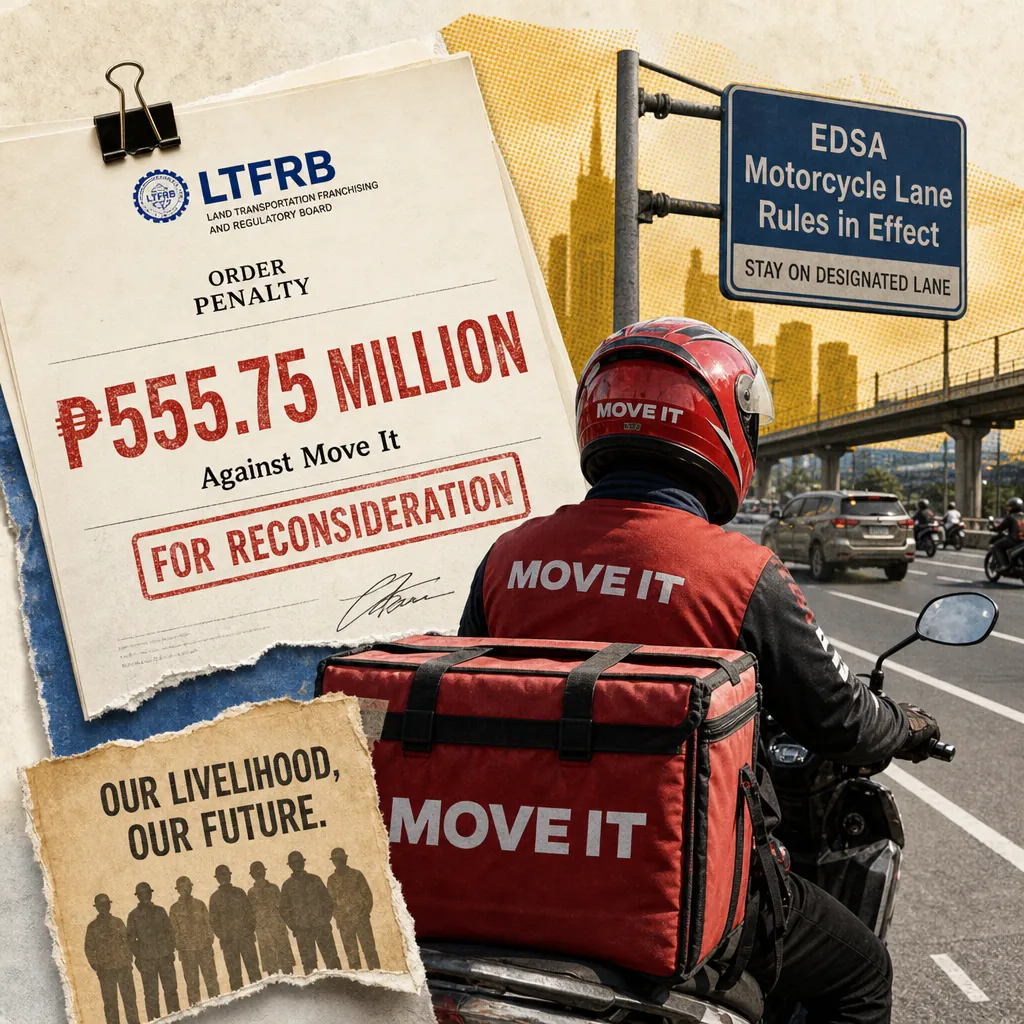
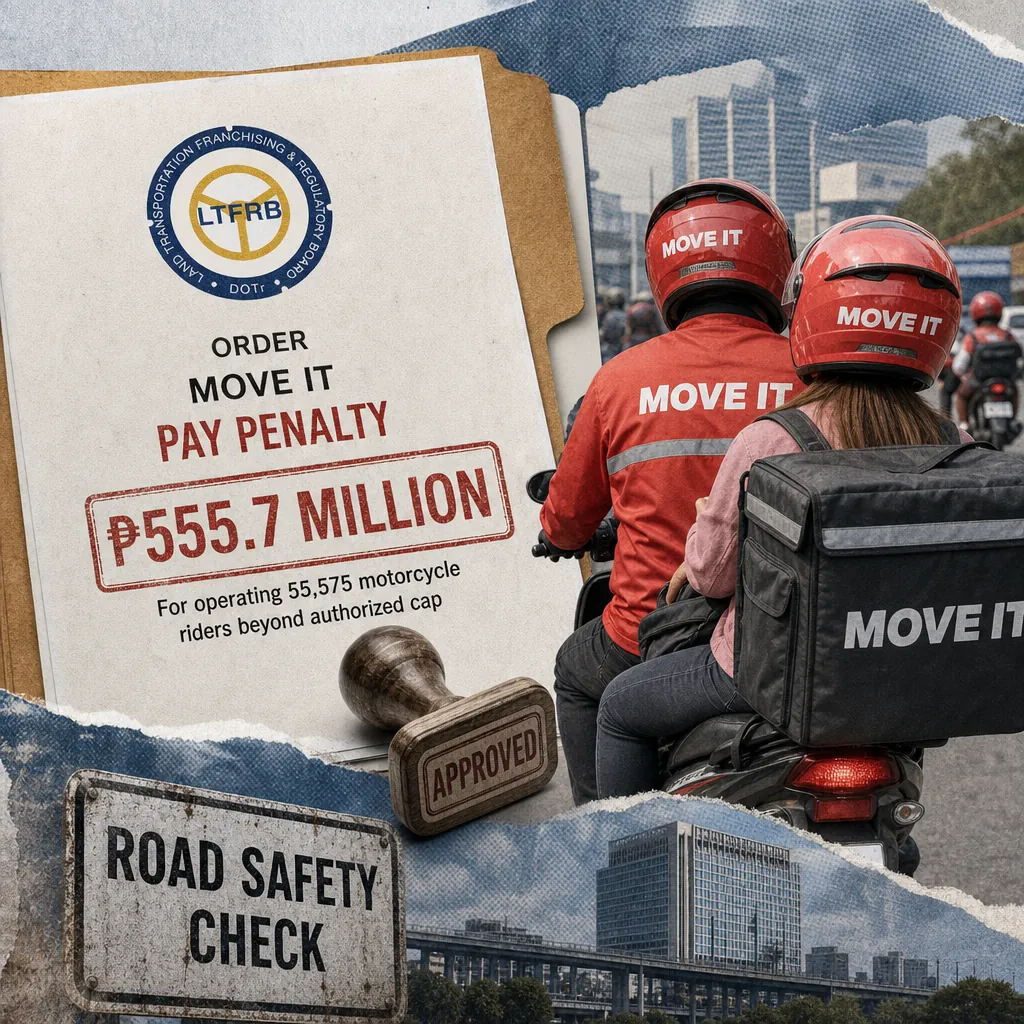
LTFRB Fines Move It P555.75M for 55,575 Excess Riders
The Land Transportation Franchising and Regulatory Board fined Move It ₱555.75 million for carrying 55,575 riders beyond its authorized allocation, drawing praise from transport groups and calls to redistribute the excess riders. The same day, the Department of Transportation deployed 20 discounted buses to ease crowding on LRT-2 and ordered two Cebu jeepney operators to explain why they skipped passengers.
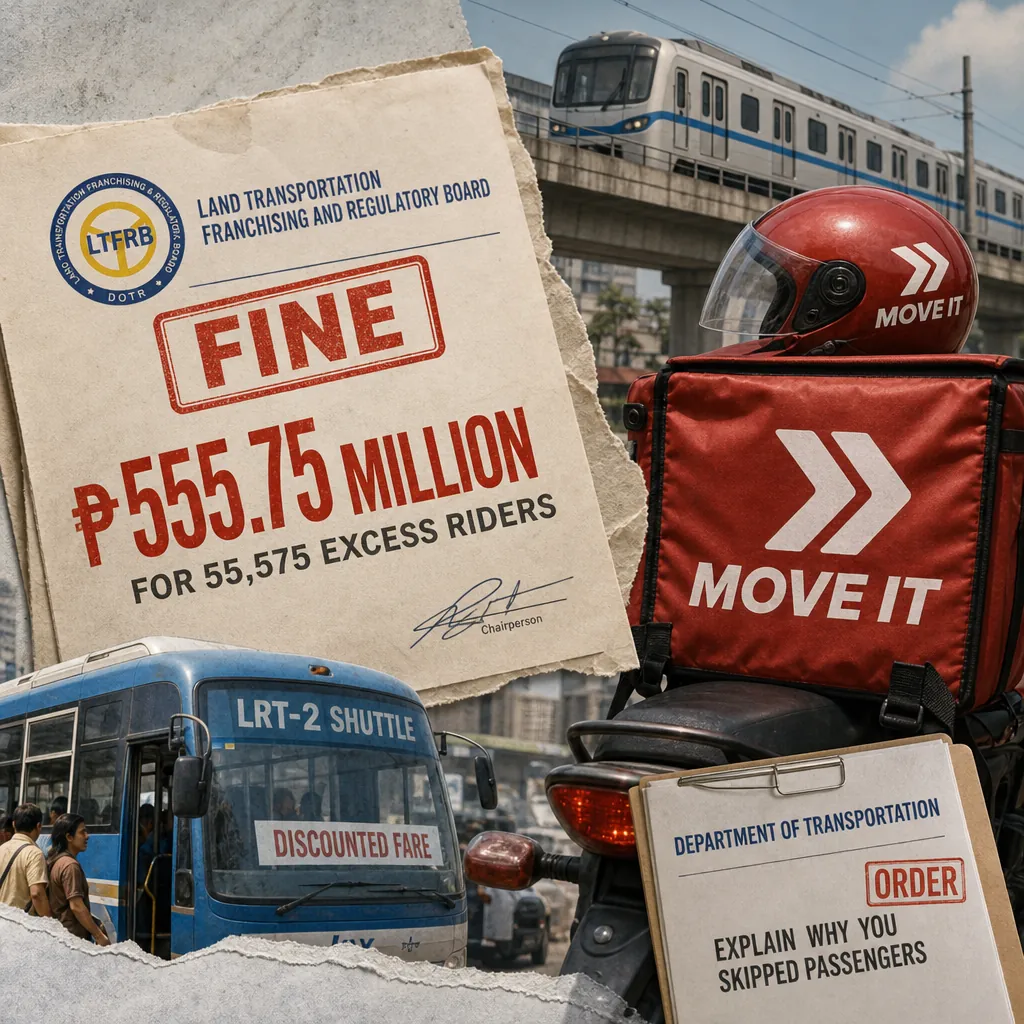
The Land Transportation Franchising and Regulatory Board (LTFRB) fined motorcycle-taxi operator Move It ₱555.75 million for carrying 55,575 riders more than its authorized allocation, a decision that transport and consumer groups publicly endorsed on Wednesday while pressing regulators to redistribute the excess riders to rival platforms rather than leave them without work4061. The penalty, issued in an October 9 decision, works out to ₱10,000 for each rider beyond the 17,746 Move It was allowed to field in Metro Manila; the company had 73,321 active riders on its books4061. Move It has filed a motion for reconsideration asking the board to review the ruling1.
The fine landed alongside a second, quieter transport story: the Department of Transportation (DoTr) put 20 augmentation buses on the Light Rail Transit Line 2 (LRT-2) corridor on Wednesday, offering a 20 percent fare discount, after Secretary Vince Dizon inspected Antipolo Station and found only about 10 train sets running on the 25-year-old line3666. Up to 4,000 passengers were being left behind between 6 a.m. and 8 a.m. each day, with waits of 30 to 45 minutes just to board, Dizon said36. In Cebu, the LTFRB's regional office issued show-cause orders against two modernized jeepney operators accused of passing waiting commuters on the 01K route despite the government's Libreng Sakay free-ride program2.
The three stories share a common thread: the state is tightening its grip on who may carry passengers, how many vehicles may do it, and under what conditions. For riders and commuters, the immediate question is whether enforcement protects them or simply removes capacity from already strained routes. For operators, it is whether the franchise rules are stable enough to plan around.
Key themes
- Move It fined ₱555.75 million for 55,575 excess riders. The LTFRB found the company had 73,321 active riders against an authorized 17,746 in Metro Manila, and imposed ₱10,000 per excess rider4061. The company is contesting the ruling1.
- Eight transport and consumer groups back the penalty and want the excess riders reassigned. The coalition — including the National Confederation of Tricycle Operators and Drivers Associations of the Philippines (Nactodap), Digital Pinoys, and the Lawyers for Commuters Safety and Protection — said the fine protects commuter safety and rider livelihoods, and urged regulators to distribute the 55,000-plus riders among other platforms140.
- A lawmaker wants the rider cap scrapped entirely. 1-Rider Rep. Rodrigo "Rodge" Gutierrez backed Transportation Secretary Vince Dizon's call to remove the cap, saying the fixed limits are "no longer responsive" to urban transit demand and urging passage of a pending Motorcycle Taxi Law6.
- LRT-2 gets 20 discounted buses as train shortage persists. Only about 10 train sets are operational on the line, which Dizon attributed to years of deferred maintenance and chronic underfunding; the buses run from Antipolo to Cubao with a separate service to Legarda for students3666.
- Cebu jeepney operators ordered to explain skipped passengers. The LTFRB regional office issued show-cause orders on Oct. 31 against JP and Sons Transport Group Inc. and Aleja Fua Rent a Car Corp. after video showed 01K modern jeepneys passing waiting commuters at a mall in Barangay Mabolo during evening rush hour2.
- The DoTr wants the MMDA's road-clearing enforcer. Secretary Dizon said he wants Gabriel Go, who heads the Metropolitan Manila Development Authority's Special Operations Group-Task Force for Road Clearing, to join the department to help with busway and mass-transit enforcement; Go has not confirmed whether he accepted46.
- A fatal motorcycle crash in Rizal and a license revocation in Iloilo round out the road-safety picture. An 18-year-old student died when his motorcycle hit a concrete planter on Manila East Road in Binangonan, Rizal, on Nov. 265; the Land Transportation Office in Western Visayas recommended a four-year license revocation for an optometrist who fled the scene of a La Paz, Iloilo City crash56.
How the narratives stack
Dominant. The Move It penalty dominates the captured set. It generated the most items — five separate stories across Inquirer Online, Manila Times Online, and Philstar Online, in English and Filipino — and the widest range of voices: the regulator, the company, a broad coalition of rider and consumer groups, and a lawmaker164061. The coverage value of the individual items is substantial: the Manila Times report on the coalition's praise carried an estimated ₱471,944 in advertising-equivalent value, and the Inquirer story on the rider-transfer call carried ₱447,552401. That figure is the estimated cost of buying the same space as advertising, not a count of readers. The dominance is a property of this captured set; the monitoring scope shapes which outlets appear.
Counter-narrative. The LRT-2 bus deployment and the Cebu show-cause orders present the regulator and the DoTr as responsive to commuter complaints rather than merely punitive. Dizon's inspection at Antipolo Station and the immediate rollout of discounted buses is a service story, not an enforcement story3666. The Cebu case shows the LTFRB acting on a local news report and video footage, which frames enforcement as complaint-driven and local2. Neither story drew the same volume of coverage as the Move It fine in this set, but both carry the same institutional message: the state is watching operators.
Emerging. The push to scrap the rider cap is the story with the most forward momentum. Gutierrez's statement and Dizon's earlier call to expand the rider pool point toward a legislative fight over the Motorcycle Taxi Law6. If the cap falls, the entire basis for the Move It penalty — the 17,746-rider allocation — disappears. That would not automatically erase the fine, which covers past conduct, but it would change the regulatory environment for every platform. The DoTr's recruitment of the MMDA's Gabriel Go is a smaller emerging signal about enforcement capacity moving between agencies46.
Under-covered. The road-safety stories — the Binangonan fatality and the Iloilo license revocation — placed low in this set, each carried by a single item6556. They matter because they show the human cost of the same roads the motorcycle-taxi debate is about. The Binangonan crash involved a motorcycle with a passenger, the exact mode of transport at the center of the cap debate, and the Iloilo case shows the Land Transportation Office using license revocation as a sanction for hit-and-run driving. Neither story was actively suppressed; it simply drew less coverage than the franchise fight.
Platform insights
The monitoring writeup for this window did not include social-media engagement data, so this section is limited to what the news coverage itself shows about where the conversation lived.
- Facebook. Senator Robin Padilla used a video message on his Facebook account to ask supporters not to rally at the Department of Justice on Friday, Nov. 6, when he faces an obstruction of justice complaint filed by the Criminal Investigation and Detection Group48. The post is a direct-to-audience move that bypasses traditional media, and it shows how elected officials use the platform to manage crowds and optics around legal proceedings.
- X. Vice President JD Vance used a lengthy post on X to blame the Republican midterm losses on the Iran war, a statement that was picked up by multiple outlets in this set5557. The post is an example of a single social-media statement becoming the primary news event of the day for political coverage, though it sits outside the transport sector.
- Reddit and YouTube. No transport-related activity on these platforms appeared in the supplied material.
Key voices and communities
Motorcycle rider and transport coalitions. The coalition behind the statement of support for the LTFRB includes Nactodap, the National Public Transport Coalition, Digital Pinoys, the Lawyers for Commuters Safety and Protection, Kapatiran ng Dalawang Gulong (Kagulong), the Motorcycle Taxi Rider Organization (Metro), Samahang Manibela Mananakay at Nagkaisang Terminal ng Transportasyon (Manibela), and the Pilipino Society and Development Advocates for Commuters and Consumers40. Their framing is dual: the fine protects commuters from unvetted "ghost riders" and protects legitimate riders from being undercut. Their demand that the excess riders be redistributed to other platforms is a livelihoods argument, not a punishment argument1.
Move It and its riders. The company's motion for reconsideration is the only public response from Move It in this set1. The 55,575 riders beyond the cap are the group most directly affected by the outcome: if the fine stands and the excess riders are removed, they lose their platform access unless another operator absorbs them.
Lawmakers and the DoTr. Rep. Gutierrez and Secretary Dizon are pushing in the same direction — away from fixed caps and toward a statutory framework for motorcycle taxis6. Dizon's authority as Transportation Secretary gives the push administrative weight; Gutierrez's position as deputy majority leader and second-ranking member of the House Transportation Committee gives it legislative momentum6.
Commuters on LRT-2 and Cebu's 01K route. These are the people whose daily experience — 30-to-45-minute waits at Antipolo, jeepneys passing them by in Mabolo — generated the service stories362. They are not organized as a group in the coverage, but their complaints, amplified by local news video, are what triggered official action.
Narrative streams
The Move It fine and the fight over who may ride
The LTFRB's October 9 decision found Move It with 73,321 active riders against an authorized 17,746, a gap of 55,57561. At ₱10,000 per excess rider, the penalty reached ₱555.75 million40. The board's rationale, as reported, centers on "ghost riders" — riders operating outside the authorized allocation, which the regulator treats as a safety and accountability problem because those riders have not been through the same vetting40. Move It has asked the board to reconsider1.
The coalition's statement of support, issued Wednesday, praised the LTFRB and vowed to monitor enforcement40. But the same groups also called on regulators to distribute the excess riders among other motorcycle-taxi platforms, arguing that the riders should not bear the cost of the company's overreach1. That position puts the coalition in an unusual spot: it supports the penalty against the company while defending the livelihoods of the riders the company hired beyond the cap.
The read for the sector is that the penalty sets a precedent for how the LTFRB will treat allocation breaches across all transport modes. Operators that have been lax about rider accreditation now face a per-head penalty that scales with the size of the breach. For riders, the risk is that enforcement removes capacity from the road before any redistribution mechanism exists. For rival platforms, the opportunity is a pool of 55,000-plus trained riders who may need a new home.
The context matters here. Motorcycle taxis were legalized only on a pilot basis, and the rider cap was designed to let regulators study safety and pricing before opening the market fully. The cap is the instrument the LTFRB used to keep the pilot manageable. If the cap is scrapped — as Dizon and Gutierrez want — the penalty's factual basis becomes a historical artifact, but the precedent for penalizing over-allocation remains6.
The cap debate moves to Congress
Rep. Gutierrez's statement on Wednesday was explicit: "This is exactly one of the main reasons we have been pushing for the immediate passage of the Motorcycle Taxi Law," he said, adding that "the old, fixed caps are no longer responsive" to demand6. He was backing Dizon's earlier call to expand the pool of motorcycle-taxi drivers, which Dizon framed as a response to gridlock and congestion6.
The legislative path is not automatic. A Motorcycle Taxi Law would need to set a new framework for accreditation, pricing, and safety enforcement, and it would need to reconcile the interests of existing operators, riders, and commuters. The coalition that praised the LTFRB fine has not endorsed scrapping the cap in this set; its focus is on redistribution and safeguards40. That leaves Gutierrez and Dizon pushing expansion while the rider groups push for protection within the current system.
The read for the sector is that the regulatory framework is in play for the first time since the pilot began. Platforms that built their businesses around the cap — whether by staying within it or by exceeding it — face a period of uncertainty about the rules that will govern rider counts, pricing, and franchise terms. The passage of a law would likely reset the terms for everyone, and the fine against Move It would become a case study in how the transition is enforced.
LRT-2's train shortage and the bus bridge
The DoTr's deployment of 20 buses on LRT-2 is a direct response to a capacity problem that has been building for years. Only about 10 train sets are operational on the line, and Dizon attributed the shortage to deferred maintenance and chronic underfunding of the 25-year-old rolling stock36. The crowding worsened after a 50 percent fare discount was introduced to help workers during the ongoing fuel crisis, which increased demand on a system that could not meet it36.
The buses run from Antipolo to Cubao with a 20 percent fare discount, and a separate service runs to Legarda for students66. The first phase is a bridge, not a fix. The underlying problem — not enough trains — remains. Dizon's inspection at Antipolo Station and the immediate rollout suggest the department is trying to show visible action while the longer-term rolling-stock issue is addressed.
The read for the sector is that rail capacity is now a political as well as an operational issue. The fare discount was a relief measure; the bus bridge is a mitigation measure; neither adds train sets. Commuters on LRT-2 will judge the response by whether waits shorten, and the department's credibility on mass transit depends on whether the bus service is sustained beyond the initial phase. For bus operators, the augmentation contract is a new revenue stream tied to rail failure, which is a fragile basis for planning.
Cebu's 01K route and the limits of Libreng Sakay
The LTFRB's regional office in Cebu issued show-cause orders on Oct. 31 against JP and Sons Transport Group Inc. and Aleja Fua Rent a Car Corp. after a local news report featured video of commuters waiting at a designated stop in Barangay Mabolo during evening rush hour while 01K modern jeepneys passed them by2. The route connects Urgello Street in Cebu City to Parkmall in Mandaue City, passing through Colon Street and several universities and shopping areas2.
The operators must explain why their vehicles allegedly refused to pick up passengers despite the government's Libreng Sakay program, which provides free rides on certain public transport routes2. The program is a subsidy intended to ease the cost of commuting; operators who participate receive compensation for the fares they forgo. Skipping passengers undermines the program's purpose and, if proven, could expose the operators to sanctions.
The read for the sector is that the Libreng Sakay program's effectiveness depends on operator compliance at the route level, and local video evidence is now a trigger for national regulatory action. For commuters in Cebu, the show-cause orders are a test of whether the free-ride promise is enforced. For operators, the case is a reminder that participation in subsidy programs comes with service obligations that are being monitored.
Road safety on the same roads
Two road-safety items in the set show the human stakes of the transport debate. In Binangonan, Rizal, an 18-year-old student died and his passenger was injured when their motorcycle hit a concrete planter on Manila East Road late on Nov. 265. In Iloilo City, the Land Transportation Office Region 6 recommended a four-year license revocation for a 29-year-old optometrist who allegedly fled the scene after his car struck a roadside store and a parked motorcycle with a sidecar in La Paz on Oct. 1156.
The Binangonan case involves a motorcycle with a passenger — the same mode of transport at the center of the cap debate — and it underscores why regulators emphasize rider accreditation and safety. The Iloilo case shows the license revocation process as a sanction for hit-and-run driving, with the LTO's Intelligence and Investigation Unit building the administrative case under the Land Transportation and Traffic Code56.
The read for the sector is that safety enforcement is happening on multiple fronts, and the motorcycle-taxi debate is not only about livelihoods and congestion. Every fatality involving a motorcycle adds pressure on regulators to tighten accreditation, which is the same lever they used against Move It. For riders, the message is that the state's attention to who is allowed to carry passengers is unlikely to ease.
Conversation trajectory
Move It's motion for reconsideration. The LTFRB has not set a date for ruling on the motion, but a decision within the next several weeks would determine whether the fine stands or is reduced1. Watch for the board's response and any statement from Move It about rider reassignment. If the fine is upheld, the next question is how the 55,575 excess riders are handled — whether they are removed, absorbed by other platforms, or given a transition period.
The Motorcycle Taxi Law. Rep. Gutierrez's push for immediate passage is a legislative signal, but the bill's status is not specified in the coverage6. Watch for committee hearings or floor action in the House of Representatives over the next legislative session. If the cap is scrapped, the regulatory basis for future fines of this kind changes, and platforms will need to re-accredit riders under a new framework.
LRT-2 service. The 20-bus augmentation is a first-phase deployment66. Watch for whether the DoTr extends the service, adds more buses, or announces a procurement or rehabilitation plan for the train sets. The next data point would be any reported change in waiting times at Antipolo and other stations.
Cebu show-cause orders. The operators have a set period to respond to the Oct. 31 orders, though the coverage does not specify the deadline2. Watch for the LTFRB regional office's ruling and whether it imposes sanctions or accepts the operators' explanations.
Trigger events. The LTFRB's ruling on Move It's motion, any House hearing on the Motorcycle Taxi Law, the next LRT-2 service update, and the Cebu operators' responses are the checkable moments ahead.
Response guidance
For motorcycle-taxi platforms: Prepare for a rider-accreditation audit. The Move It penalty shows the LTFRB will count active riders against authorized allocations and impose per-head fines. Platforms should reconcile their rider rolls now and have a plan for absorbing or releasing excess riders if the cap is enforced or changed.
For rider groups and coalitions: The redistribution demand is the leverage point. Push for a named mechanism — a timeline, an allocation formula, a transition fund — rather than a general call to distribute riders. The coalition's dual position, supporting the fine while defending the riders, is coherent only if the redistribution plan is specific.
For commuters and commuter advocates: The LRT-2 bus bridge and the Cebu show-cause orders are service stories that can be tracked with concrete metrics: waiting times, buses deployed, operator responses. Report those metrics publicly to keep pressure on the agencies.
For operators participating in Libreng Sakay: Service compliance is being monitored with video evidence. Ensure dispatch and pickup practices at designated stops are documented, and respond to show-cause orders with specific operational explanations rather than general denials.
For policymakers: The cap debate and the fine are linked. If the intent is to scrap the cap, the legislative process should address how existing penalties and rider allocations are transitioned. Leaving the fine in place while removing the cap creates a confusing signal for operators and riders alike.
For road-safety advocates: The Binangonan and Iloilo cases are local stories with national relevance. Use them to press for enforcement of helmet laws, rider training, and hit-and-run penalties, and connect them to the broader motorcycle-taxi safety debate without conflating the two.
See the full picture behind today's signals.
This report draws from Media Meter's MediaWatch, our real-time monitoring engine tracking 2,470+ Philippine sources across print, broadcast, digital, and social. Explore how the platform turns raw coverage into decision-grade intelligence, then see how it's configured for teams like yours — whether you're in PR agencies, corporate comms, government, or marketing.
Want more? Browse our Report Library for sector and crisis intelligence, or request a demo and we'll have your brand set up before the call.
Want this kind of intelligence on your brand?
This brief is built on the same MediaWatch methodology that runs continuously across every brand we monitor. See your competitive landscape, Impact Score, and narrative trajectory in a 30-minute demo.