Peso Nears P63 as BSP Signals Another Rate Hike
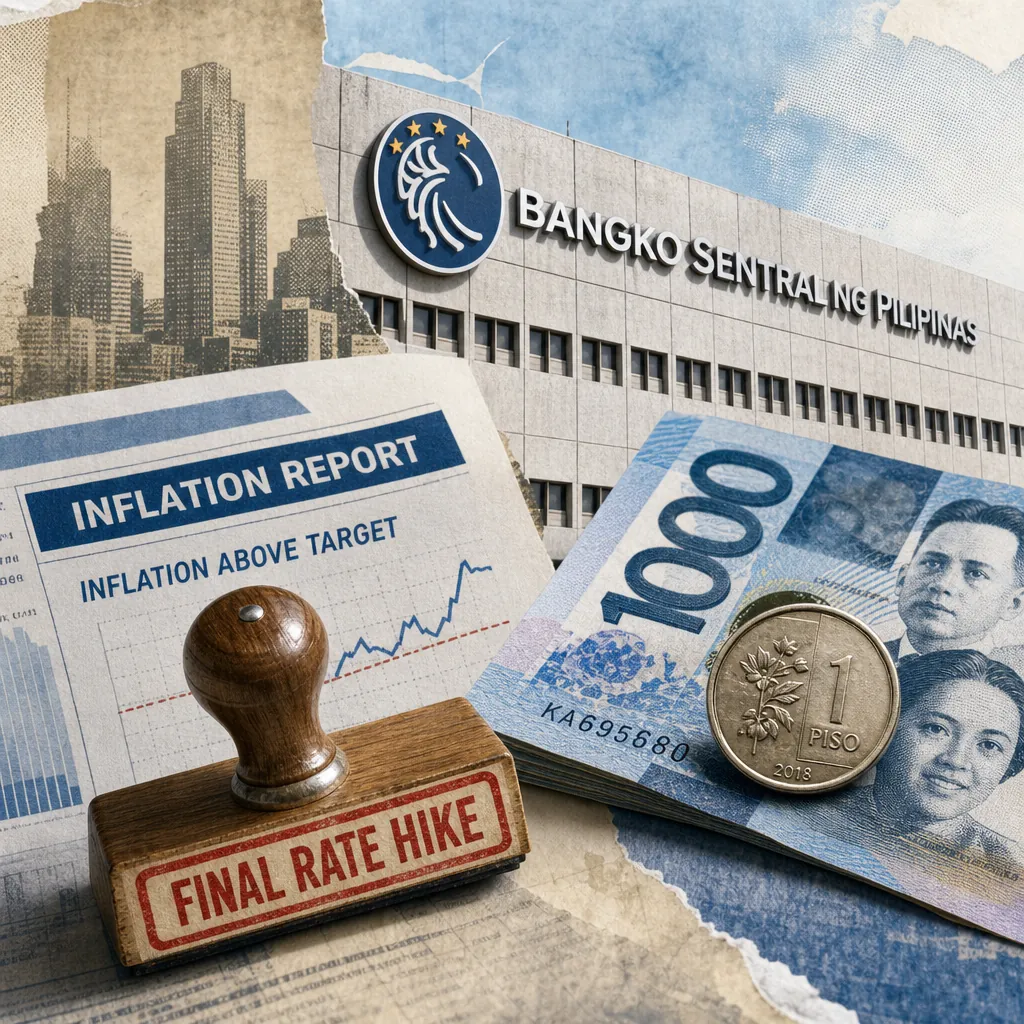
The peso is testing a record low against the dollar while UnionBank and ANZ expect the Bangko Sentral ng Pilipinas to raise its policy rate to 5.25 percent by year-end. Mitsubishi's P44.5-billion investment in Ayala and Mynt's record P92.32-billion IPO approval also drew heavy coverage.
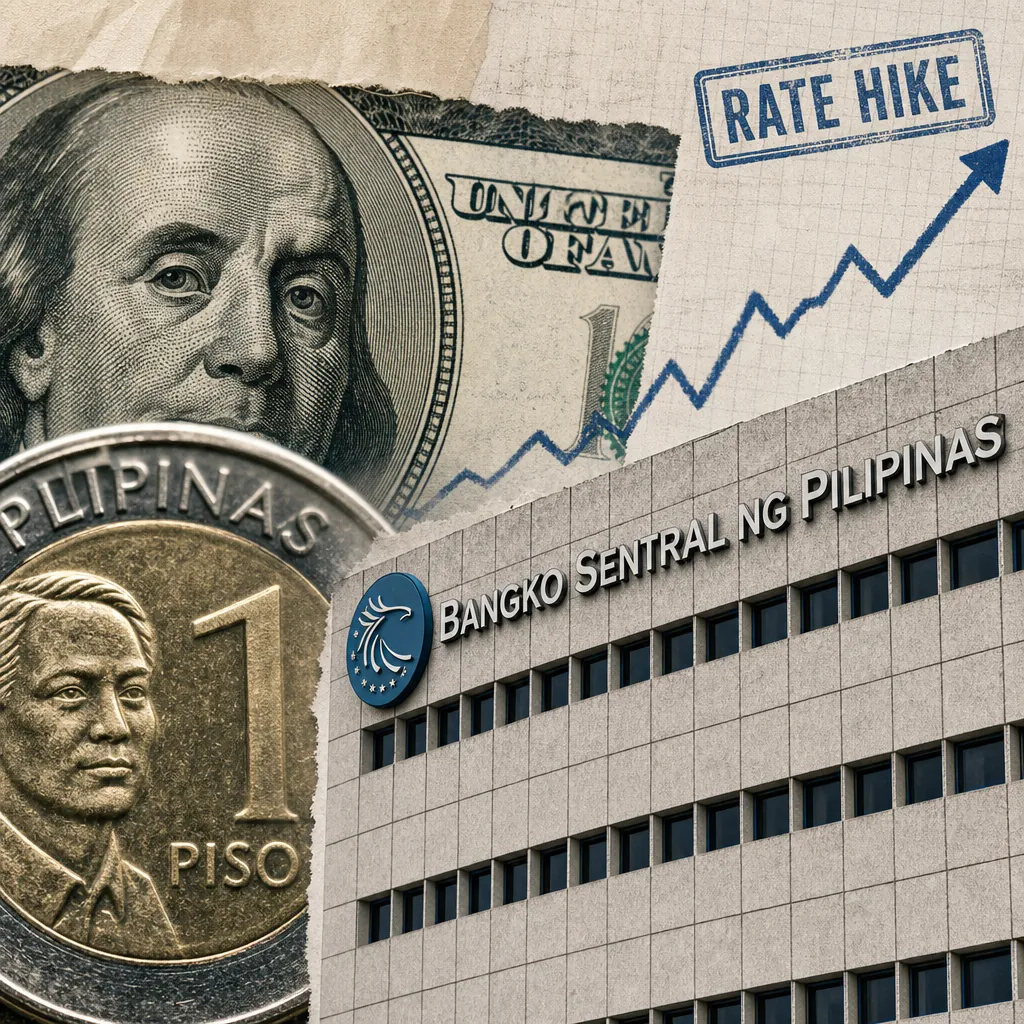
The peso may breach P63 to the dollar for the first time in history this week, with UnionBank of the Philippines projecting a trading range of P62.50 to P63.20, as elevated global oil prices and the US Federal Reserve's hawkish stance continue to weigh on the local currency 49. The peso's slide dominated the day's financial coverage, with the story running across BusinessWorld, Philstar, and Head Topics, and it carried direct consequences for the Bangko Sentral ng Pilipinas (BSP), the country's central bank, which now faces pressure to raise interest rates again at its October policy meeting 1464.
Two separate research notes published Monday pointed to another 25-basis-point increase from the current 5 percent policy rate, which would bring the benchmark to 5.25 percent by year-end. UnionBank chief economist Ruben Carlo Asuncion sees an October hike potentially paving the way for a year-end pause, while ANZ Research projects the 5.25-percent rate by December 64. The BSP raised its target reverse repurchase rate to 5.0 percent in August, and a further hike would bring cumulative tightening to 100 basis points this year 14. A basis point is one-hundredth of a percentage point; the policy rate influences borrowing costs for households and businesses across the economy.
The peso story was the day's most consequential financial development, but it was not the only one. Mitsubishi Corp. signed a definitive agreement to invest about P44.5 billion in Ayala Corp., raising its economic ownership in the Philippines' oldest conglomerate from 4.7 percent to 15 percent and its voting stake to 20 percent 317. The transaction was priced at P650 per common share and includes a voluntary tender offer for up to approximately 30 million shares 3. Ayala expects to receive about P20 billion in proceeds, which it plans to use to reduce debt, continue its share buyback program, and support future growth initiatives 17.
Separately, the Securities and Exchange Commission (SEC) cleared GCash operator Mynt Inc. to pursue an initial public offering of up to P92.32 billion, putting the fintech company on track for what could become the largest IPO in Philippine stock market history 47. The transaction would also make Mynt the first company to use the SEC's lower public-float requirement for exceptionally large issuers, a regulatory change intended to make large listings more feasible without requiring the domestic market to absorb an unusually large block of shares at once 47.
Key themes
- Peso may breach P63 for the first time as Fed tightening and oil prices weigh on the currency. UnionBank's market report said the peso could trade between P62.50 and P63.20 this week, with the P63.00 level described as "key near-term resistance" 49. The US Federal Reserve raised rates last week for the first time in three years, hiking by 25 basis points to the 3.75%-4% range, and markets are pricing in further hikes 49.
- BSP expected to raise policy rate to 5.25 percent by year-end, with analysts split on timing. UnionBank and ANZ Research both project another 25-basis-point increase, but differ on whether it comes in October or December 64. University of Asia and the Pacific economist Marco Antonio C. Agonia sees two more increases this year, citing the minimum wage hike, Fed policy, and the "Super El Niño" weather pattern as inflationary pressures 35.
- Mitsubishi's P44.5-billion investment raises its Ayala stake to 15 percent. The Japanese trading house's economic ownership will rise from 4.7 percent, reinforcing its position as one of Ayala's largest long-term strategic shareholders 3. Ayala Chairman Jaime Augusto Zobel de Ayala said the transaction "reflects the strength of a relationship built over many years and a deep alignment in values, long-term thinking, and responsible business stewardship" 17.
- SEC clears Mynt's P92.32-billion IPO, potentially the largest in Philippine history. The GCash operator received approval for a minimum initial public float of 12 percent, below the standard 15 percent requirement for large issuers under SEC Memorandum Circular No. 11 47. The offering consists of up to 1.61 billion primary shares and 6.42 billion secondary shares, with a separate overallotment option of up to 1.20 billion secondary shares 31.
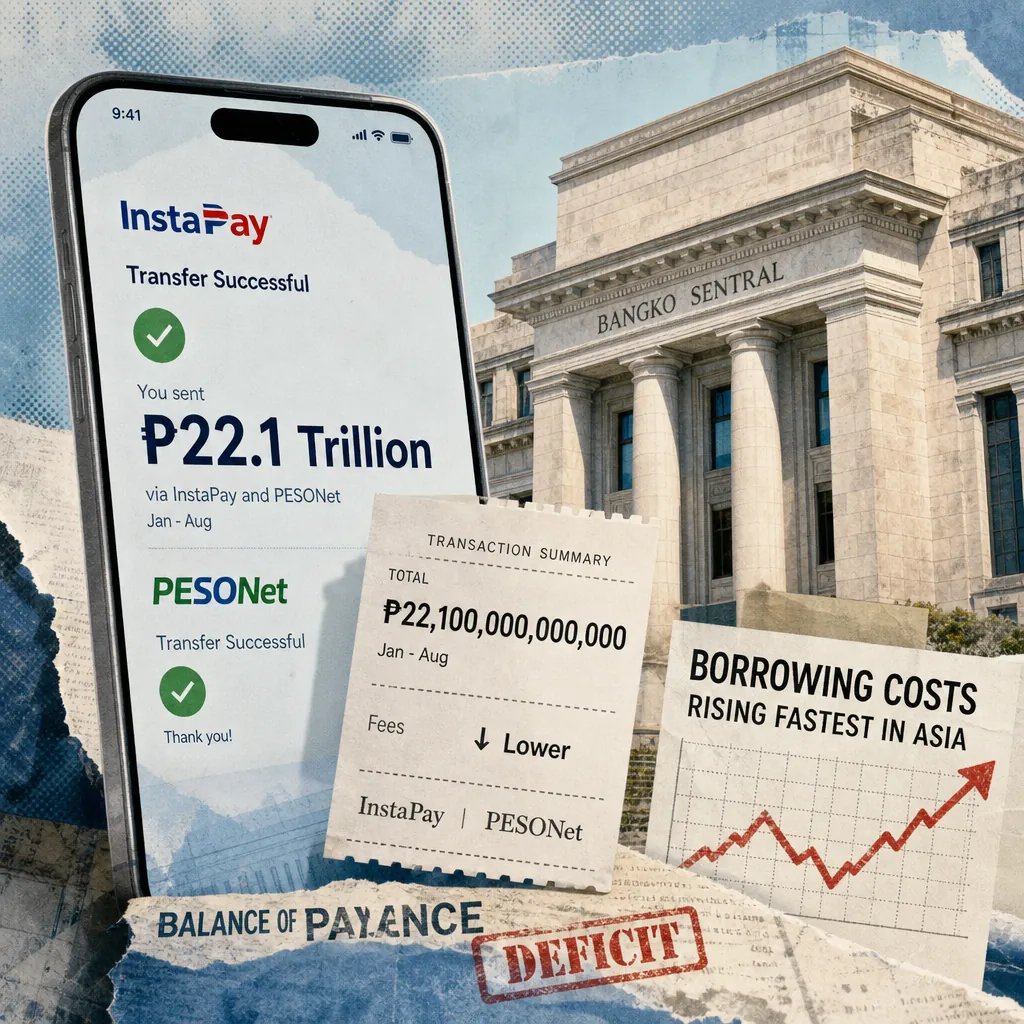
- Cashless transactions via InstaPay and PESONet top P22 trillion in first eight months. The combined value of transfers reached P22.124 trillion, up 44.72 percent from P15.288 trillion in the same period last year, while transaction volume more than doubled to 5.768 billion from 2.385 billion 59. InstaPay transactions jumped 59.9 percent in value to P11.078 trillion, while PESONet rose 32.14 percent to P11.046 trillion 59.
- Philippine banks' bad loans ratio at 3.3 percent, highest among Asean-5 peers. The BSP's Q2 2026 Report on Economic and Financial Developments noted the gross non-performing loan ratio was higher than Thailand, Indonesia, Malaysia, and South Korea 60. Ateneo De Manila University economist Leonardo A. Lanzona Jr. warned of a possible lag effect from war-driven bad loans that could only become evident in late-2026 or 2027 data 60.
- BMI cuts Philippine growth outlook to 3.3 percent, below government target. The Fitch Solutions unit said the economy entered the third quarter with less momentum than anticipated due to delays in public infrastructure projects and weak household spending 3044. BMI said weaker-than-expected public capital expenditure could shave about 0.2 percentage point off its full-year forecast, bringing growth to 3.1 percent 30.
- Security Bank targets Apple Pay and Google Pay availability by second half of 2027. President and CEO Victor Lee said the bank is changing its core credit card system to prepare for the integration, noting that about 80 percent of its wealth customers use Apple devices 1545. Lee said the bank needs to remain relevant to customers as cashless transactions grow 45.
How the narratives stack
Dominant: The peso's slide toward P63 and the prospect of another BSP rate hike dominated the day's financial coverage. The story ran across multiple outlets and carried the highest coverage value in the captured set, with the BusinessWorld report on the peso's potential record low drawing an estimated P324,398.88 in advertising-equivalent value 49 and the Philstar report on the looming rate hike carrying P415,096.20 64. The Manila Times report on UnionBank's projection drew P308,632 14, while the Head Topics pickup of the peso story carried P293,400 46. The narrative was consistent across outlets: the peso faces structural headwinds from elevated oil prices and the Fed's tightening, and the BSP may be forced to respond with another rate increase. The consequence for ordinary Filipinos is direct: a weaker peso makes imported goods more expensive, and a higher policy rate raises borrowing costs for mortgages, car loans, and business credit.
Counter-narrative: The Mitsubishi-Ayala deal and Mynt's IPO approval offered a contrasting story of foreign capital and domestic corporate ambition. Mitsubishi's P44.5-billion investment in Ayala was covered by both Inquirer and Manila Times, with the Inquirer report drawing P297,108 in advertising-equivalent value 3 and the Manila Times report carrying P372,988 17. The Mynt IPO story, covered by BusinessWorld and Daily Guardian, drew P334,863.36 and P315,882 respectively 3147. These stories present a different read on the Philippine economy: despite currency weakness and growth concerns, large foreign investors and domestic companies are still committing significant capital. The Mynt IPO, if completed at the maximum offer price of P10 per share, would be the largest in Philippine history and would test the depth of the local stock market 31.
Emerging: The BSP's own financial performance and the growth of digital payments received less attention but carry implications for the sector. The BSP saw its net income nearly double to P100.9 billion in the January-to-April period, as a sharp decline in expenses more than offset a drop in revenue 2. Total revenue fell 12.4 percent year-on-year to P80.6 billion, while total expenses dropped 17.9 percent to P55.6 billion 2. Meanwhile, InstaPay and PESONet transfers topped P22 trillion in the first eight months, up 44.72 percent in value and more than double in volume 59. The growth of digital payments is relevant to the BSP's rate decisions because it affects the velocity of money in the economy and the transmission of monetary policy.
Under-covered: Several stories with significant sector implications received less coverage in the captured set. The BSP's Q2 report on bad loans, which showed the Philippines' 3.3 percent non-performing loan ratio was the highest among Asean-5 peers, was covered only by BusinessMirror 60. The warning from Ateneo economist Leonardo Lanzona about a lag effect in war-driven bad loans that could emerge in late-2026 or 2027 data did not appear in other outlets in the set 60. Similarly, the BSP's short-term securities auction, which showed the 28-day bills fetching a higher average yield of 5.0801 percent, was covered only by BusinessWorld 58. These stories matter because they provide early signals about credit quality and liquidity conditions that could affect the BSP's policy decisions.
Platform insights
Facebook: The day's financial stories generated discussion on Facebook, particularly around the peso's slide and its impact on ordinary Filipinos. Comments on news pages focused on the rising cost of imported goods and the difficulty of budgeting for households already stretched by inflation. The Mitsubishi-Ayala deal also drew attention, with some users questioning whether foreign investment benefits the broader economy or primarily enriches established conglomerates.
X: The peso story dominated X, with users sharing the P63 threshold as a symbolic marker of currency weakness. The conversation was more analytical than on Facebook, with users discussing the relationship between Fed policy, oil prices, and the BSP's options. The Mynt IPO also generated discussion among retail investors, who debated whether the offering's heavy weighting toward secondary shares made it less attractive 31.
Reddit: Discussions on Philippine finance subreddits focused on the practical implications of another rate hike for mortgage holders and small business owners. Users shared personal experiences with rising borrowing costs and debated whether the BSP should prioritize currency stability or growth. The Mynt IPO was also discussed, with some users expressing interest in participating and others cautioning about the secondary share structure.
YouTube: Financial commentary channels posted analysis of the peso's slide and the BSP's likely response, with some creators explaining basis points and policy rates for general audiences. The Mitsubishi-Ayala deal was covered by business news channels, which highlighted the long history of the partnership and the strategic rationale for the increased investment.
Key voices and communities
UnionBank of the Philippines research team: The bank's MktsFocUs report provided the day's most specific forecast, projecting the peso could trade between P62.50 and P63.20 and describing P63.00 as "key near-term resistance" 49. UnionBank chief economist Ruben Carlo Asuncion also weighed in on the rate outlook, seeing an October increase potentially paving the way for a year-end pause 64. The bank's analysis shaped much of the day's coverage.
ANZ Research: The Australia-based bank's projection of a 5.25-percent policy rate by December provided a counterpoint to UnionBank's more cautious timeline, highlighting the uncertainty among analysts about the pace of BSP tightening 64.
University of Asia and the Pacific economist Marco Antonio C. Agonia: Agonia told BusinessWorld that the BSP will likely hike by 25 basis points in October to "curtail the inflationary impact of recent events and anchor inflation expectations," citing the minimum wage increase, Fed hike, and food price pressures as the dominant themes 35.
Ateneo De Manila University economist Leonardo A. Lanzona Jr.: Lanzona warned of a lag effect in war-driven bad loans that could only become evident in late-2026 or 2027 data, a concern that received less attention than the currency and rate stories 60.
Ayala Corp. Chairman Jaime Augusto Zobel de Ayala: Zobel de Ayala framed the Mitsubishi investment as "much more than a capital investment," saying it "reflects the strength of a relationship built over many years and a deep alignment in values, long-term thinking, and responsible business stewardship" 17.
Narrative streams
Peso weakness and the BSP's tightening dilemma
The peso's slide toward P63 to the dollar is the most immediate financial story of the day, with UnionBank projecting a trading range of P62.50 to P63.20 and warning that a sustained break above P63.00 could pave the way for fresh record highs 49. The currency has been under pressure from elevated global oil prices and the US Federal Reserve's hawkish stance; the Fed raised rates last week for the first time in three years, hiking by 25 basis points to the 3.75%-4% range, and markets are pricing in further increases 49. A stronger dollar makes imports more expensive for the Philippines, which is a net oil importer, feeding into domestic inflation.
The BSP faces a difficult choice. Raising rates would support the peso by making peso-denominated assets more attractive, but it would also slow economic growth by increasing borrowing costs. UnionBank said the BSP "may face pressure to tighten further if peso weakness accelerates amid another local inflation surge" 14. The bank expects a 25-basis-point hike at the October Monetary Board meeting, which would bring the policy rate to 5.25 percent and cumulative tightening to 100 basis points this year 14. ANZ Research also projects a 5.25-percent rate by December, though the two banks differ on whether the increase comes in October or later 64.
The read for the sector is that banks and borrowers should prepare for a higher-for-longer interest rate environment. Households with variable-rate mortgages and businesses with floating-rate loans will see their debt servicing costs rise if the BSP hikes again. Banks may also face pressure on their net interest margins if funding costs rise faster than lending rates. The BSP's own financial performance illustrates the stakes: its net income nearly doubled to P100.9 billion in the January-to-April period, but total revenue fell 12.4 percent year-on-year to P80.6 billion, with interest income dropping 6 percent to P75.4 billion 2. The central bank's profitability is not a policy objective, but it affects its ability to remit dividends to the national government.
Mitsubishi deepens its bet on Ayala with P44.5-billion investment
Mitsubishi Corp.'s agreement to invest about P44.5 billion in Ayala Corp. will raise its economic ownership from 4.7 percent to 15 percent and its voting stake to 20 percent, reinforcing its position as one of the conglomerate's largest long-term strategic shareholders 3. The transaction was priced at P650 per common share and includes a combination of primary and secondary shares, as well as a voluntary tender offer for up to approximately 30 million common shares 3. Ayala expects to receive about P20 billion in proceeds, which it plans to use to strengthen its balance sheet through debt reduction, continue its share purchase program covering Ayala and its listed subsidiaries, and support future growth initiatives 17.
The deal deepens a partnership that has spanned more than five decades. Ayala is the Philippines' oldest conglomerate, with interests spanning banking (Bank of the Philippine Islands), real estate (Ayala Land), telecommunications (Globe Telecom), and energy (AC Energy). Mitsubishi is a Japanese trading house with global operations in energy, metals, machinery, chemicals, and food. The increased investment signals confidence in the Philippine economy despite currency weakness and growth concerns, and it provides Ayala with capital to reduce debt and fund expansion.
The read for the sector is that foreign strategic investors remain willing to commit large sums to Philippine conglomerates, particularly when they have long-standing relationships and can take a long-term view. For Ayala, the proceeds reduce leverage and provide flexibility to invest in growth areas. For other Philippine conglomerates, the deal may prompt questions about whether they have similar opportunities to attract foreign capital. The transaction also has implications for corporate governance: Mitsubishi's increased voting stake gives it more influence over Ayala's strategic direction, though the Zobel de Ayala family remains the controlling shareholder.
Mynt's record IPO tests the depth of the Philippine stock market
The SEC's approval of Mynt Inc.'s initial public offering of up to P92.32 billion puts the GCash operator on track for what could become the largest IPO in Philippine stock market history 47. The transaction would also make Mynt the first company to use the SEC's lower public-float requirement for exceptionally large issuers, a regulatory change intended to make large listings more feasible without requiring the domestic market to absorb an unusually large block of shares at once 47. Mynt secured approval for a minimum initial public float of 12 percent, below the standard 15 percent requirement for large issuers under SEC Memorandum Circular No. 11 47.
The offering consists of up to 1.61 billion primary shares and 6.42 billion secondary shares, with a separate overallotment option of up to 1.20 billion secondary shares 31. The heavy weighting toward secondary shares means most of the proceeds will go to existing shareholders rather than to the company. Toby Allan C. Arce, head of sales trading at Globalinks Securities and Stocks Inc., said this "does not necessarily weaken the investment case, but investors may distinguish between capital being raised to fund Mynt's future growth and proceeds going to existing shareholders" 31. Mynt has set a maximum offer price of P10 per share 31.
GCash is the Philippines' largest mobile wallet, with millions of users who use it for payments, transfers, and financial services. The IPO would give the public a chance to own a stake in the country's leading fintech company and would provide Mynt with capital to invest in growth. The read for the sector is that the IPO will test investor appetite for large Philippine listings and could set a precedent for other fintech companies considering going public. If successful, it could encourage more technology companies to list on the Philippine Stock Exchange, deepening the market and giving investors more options. If the offering struggles, it could signal that the market is not ready for listings of this size.
Digital payments growth continues as InstaPay and PESONet top P22 trillion
Cashless transactions continued to grow in the first eight months of 2026, with transfers made via InstaPay and PESONet amounting to over P22 trillion as of August, according to BSP data 59. The combined value of P22.124 trillion was up 44.72 percent from P15.288 trillion in the same period last year, while transaction volume more than doubled to 5.768 billion from 2.385 billion 59. InstaPay, which is designed for real-time, low-value transfers, saw its transaction value jump 59.9 percent to P11.078 trillion, with volume ballooning 145.96 percent to 5.681 billion 59. PESONet, which handles larger, batch-processed transfers, saw its value increase 32.14 percent to P11.046 trillion 59.
The growth of digital payments is relevant to the BSP's monetary policy because it affects how quickly money moves through the economy. Faster payments can increase the velocity of money, which can be inflationary if the money supply is growing. The BSP uses its short-term securities and term deposit facility to mop up excess liquidity; at Friday's auction, the 28-day bills fetched bids of P42.668 billion, well above the P30-billion offer, with accepted yields narrowing to a range of 5 percent to 5.1 percent 58. The weighted average accepted rate rose 1.49 basis points to 5.0801 percent from 5.0652 percent the previous week 58.
The read for the sector is that banks and fintech companies should continue to invest in digital payment infrastructure, as the shift away from cash is accelerating. Security Bank's plan to make its cards available on Apple Pay and Google Pay by the second half of 2027 is one example of how banks are responding 1545. President and CEO Victor Lee said about 80 percent of the bank's wealth customers use Apple devices, making the integration particularly relevant to that business 15. The growth of digital payments also creates opportunities for companies like Mynt, whose GCash platform is a key part of the ecosystem.
Bad loans ratio at 3.3 percent, highest among Asean-5 peers
The Philippine banking system's gross non-performing loan ratio remained steady at 3.3 percent as of end-June 2026, but it was higher than those of Thailand, Indonesia, Malaysia, and South Korea, according to the BSP's Q2 2026 Report on Economic and Financial Developments 60. Non-performing loans, also known as "bad" or "soured" loans, are credit accommodations that are past due or in default. A higher ratio indicates that a larger share of the bank's loan portfolio is not being repaid on time.
Ateneo De Manila University economist Leonardo A. Lanzona Jr. warned of a possible lag effect in war-driven bad loans that could only become evident in late-2026 or 2027 data 60. The reference to "war-driven" bad loans suggests that geopolitical conflicts or trade tensions may be affecting the ability of some borrowers to repay. The lag effect means that the current 3.3 percent ratio may not fully reflect the deterioration in loan quality that could emerge in future quarters.
The read for the sector is that banks should continue to monitor their loan portfolios closely and maintain adequate provisions for potential losses. A rising bad loans ratio could force banks to tighten lending standards, which would slow credit growth and weigh on economic activity. The BSP's report noted that loan quality improved, but the comparison with regional peers suggests that Philippine banks may be more vulnerable to economic shocks than their counterparts in neighboring countries.
BMI cuts growth outlook as infrastructure delays and weak spending weigh
BMI, a unit of Fitch Solutions, said the Philippine economy may have entered the third quarter with weaker momentum than expected, raising downside risks to its 2026 growth forecast of 3.3 percent 44. The forecast is below the government's 3.5- to 4.5-percent target range and would require the economy to expand by at least 3.9 percent in the second half of the year after gross domestic product grew by just 2.6 percent in the first half 44. BMI said weaker-than-expected public capital expenditure in the third quarter could shave about 0.2 percentage point off its full-year forecast, bringing growth to 3.1 percent 30.
The slowdown in public infrastructure spending is linked to the flood control investigation, which BMI said has "re-intensified" 30. The National Bureau of Investigation (NBI) served a subpoena on the Department of Public Works and Highways (DPWH) Davao regional office on Monday, directing it to produce documents related to some 50 allegedly questionable flood-control and road projects in the region 10. The subpoena seeks records covering 37 contracts, most of them in Davao City and Davao del Sur, and orders DPWH-Davao director Juby Blancaver Cordon to appear before NBI Director Melvin Matibag in Pasay on Sept. 24 63. The projects were found to involve possible violations of Article 217 of the Revised Penal Code on malversation and Republic Act 3019, the Anti-Graft and Corrupt Practices Act 63.
The read for the sector is that the investigation into flood control projects is having a chilling effect on public infrastructure spending, which is a key driver of economic growth. Construction companies, suppliers, and workers who depend on government projects may face delays in payments and reduced demand for their services. The slowdown in public spending also puts pressure on the BSP to support growth through monetary policy, but the central bank's ability to cut rates is constrained by the peso's weakness and inflation risks.
Conversation trajectory
Over the next week: The peso's movement will be closely watched, with UnionBank's projection of P62.50 to P63.20 providing a range to monitor 49. If the peso breaches P63, it would be a psychological milestone that could trigger further depreciation as importers and investors adjust their expectations. The BSP may intervene in the foreign exchange market to slow the peso's decline, though intervention is costly and may not be effective against strong global forces.
Over the next two to four weeks: The BSP's October Monetary Board meeting will be the key event for interest rate policy. UnionBank expects a 25-basis-point hike at that meeting, which would bring the policy rate to 5.25 percent 14. ANZ Research also projects a 5.25-percent rate by December 64. The BSP's decision will depend on the peso's trajectory, oil prices, and the latest inflation data. A hike in October would likely be followed by a pause in December, according to UnionBank 14.
Over the next one to three months: The Mynt IPO is expected to proceed following the SEC's approval, with the offering price and timing to be determined 47. The IPO will test investor appetite for large Philippine listings and could set a precedent for other fintech companies. The heavy weighting toward secondary shares may affect demand, as investors weigh the benefits of owning a stake in GCash against the fact that most proceeds will go to existing shareholders 31.
Over the next three to six months: The NBI's investigation into flood control projects will continue, with DPWH-Davao director Juby Blancaver Cordon scheduled to appear before NBI Director Melvin Matibag on Sept. 24 63. The investigation could lead to charges against contractors and government officials, and it may affect public infrastructure spending in the coming quarters. BMI's growth forecast of 3.3 percent for 2026 assumes that public capital expenditure will recover; if the investigation causes further delays, the forecast could be revised downward 3044.
Trigger events to watch: The BSP's October policy meeting, the release of July-August capital outlay data (which BMI said could confirm its assessment of weaker public spending) 30, the peso's movement against the P63 threshold, and the Mynt IPO pricing and listing date. Any of these events could shift the narrative in a new direction.
Response guidance
For banks and financial institutions: Prepare customers for the possibility of another rate hike by explaining how it affects their loans and deposits. Use plain language to describe basis points and policy rates, and provide examples of how a 25-basis-point increase translates into higher monthly payments for a typical mortgage or car loan. Highlight the availability of fixed-rate products for borrowers who want to lock in current rates.
For corporate communicators: The Mitsubishi-Ayala deal and Mynt IPO are opportunities to discuss the strength of Philippine conglomerates and the depth of the local capital market. Emphasize the long-term nature of strategic investments and the confidence that foreign investors have in the Philippine economy, while acknowledging the challenges posed by currency weakness and global uncertainty.
For fintech companies: The growth of digital payments via InstaPay and PESONet is a positive story that can be used to promote the benefits of cashless transactions. Highlight the convenience, speed, and security of digital payments, and address concerns about trust and fraud by explaining the safeguards in place. The Mynt IPO may generate interest in fintech investments, providing an opportunity to educate customers about the sector.
For government agencies: The NBI's investigation into flood control projects is a sensitive topic that requires careful communication. Emphasize the importance of transparency and accountability in public spending, and provide regular updates on the progress of the investigation. Avoid speculating about the outcome or naming individuals who have not been charged.
For all communicators: The peso's slide and the prospect of higher interest rates are topics that affect everyone, from households to businesses. Avoid alarmist language and focus on providing practical information that helps people make informed decisions. Use clear, jargon-free language to explain economic concepts, and provide context for why the peso is weakening and what the BSP is doing about it.
See the full picture behind today's signals.
This report draws from Media Meter's MediaWatch, our real-time monitoring engine tracking 2,470+ Philippine sources across print, broadcast, digital, and social. Explore how the platform turns raw coverage into decision-grade intelligence, then see how it's configured for teams like yours — whether you're in PR agencies, corporate comms, government, or marketing.
Want more? Browse our Report Library for sector and crisis intelligence, or request a demo and we'll have your brand set up before the call.
Want this kind of intelligence on your brand?
This brief is built on the same MediaWatch methodology that runs continuously across every brand we monitor. See your competitive landscape, Impact Score, and narrative trajectory in a 30-minute demo.