BSP Signals Final Rate Hike as Peso, Inflation Risks Linger
The Bangko Sentral ng Pilipinas may close its tightening cycle with one last quarter-point increase, ANZ Research said, as the peso stays weak and inflation runs above target. The same day, ICTSI locked in a $1-billion loan from BDO Unibank and the Treasury shelved a five-year bond sale.
The Conversation
The Bangko Sentral ng Pilipinas (BSP) may end its current run of interest-rate increases with one final quarter-point move, according to ANZ Research, the research arm of Australia and New Zealand Banking Group. In its Research Quarterly report published Tuesday, ANZ said inflation remains a major risk for the Philippine economy and that "risks remain skewed towards further tightening," even as domestic demand stays sluggish 30. The BSP began raising rates in April after an energy crisis tied to the Middle East war pushed inflation faster than economic managers had expected, and it delivered a third straight 25-basis-point increase in August, bringing its benchmark rate to 5%, a more than one-year high 25. A basis point is one-hundredth of a percentage point; the benchmark rate is what banks use as a reference for the interest they charge on loans and pay on deposits, so it feeds directly into borrowing costs for businesses and households.
The same day's business coverage carried two other developments that matter for how money moves through the economy. International Container Terminal Services Inc. (ICTSI), the port operator, disclosed a $1-billion, 10-year term loan from BDO Unibank Inc., the bank controlled by the Sy family 1324. And the Bureau of the Treasury (BTr) confirmed it had canceled a planned auction of new five-year fixed-rate Treasury notes because of rising yields, while keeping a retail Treasury bond issue on the table depending on market conditions 3941. A Treasury note is a government IOU sold to institutional investors; a retail Treasury bond is the same idea sold in small denominations to ordinary savers.
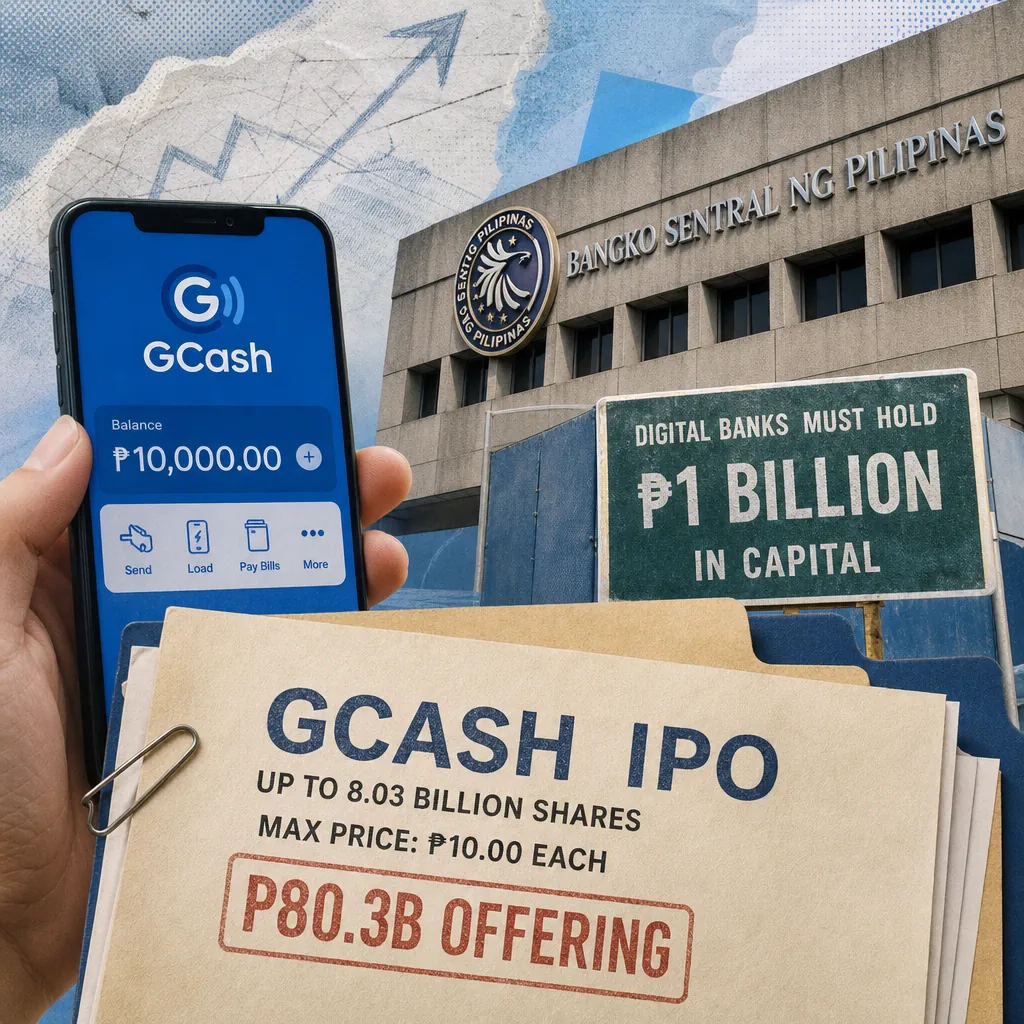
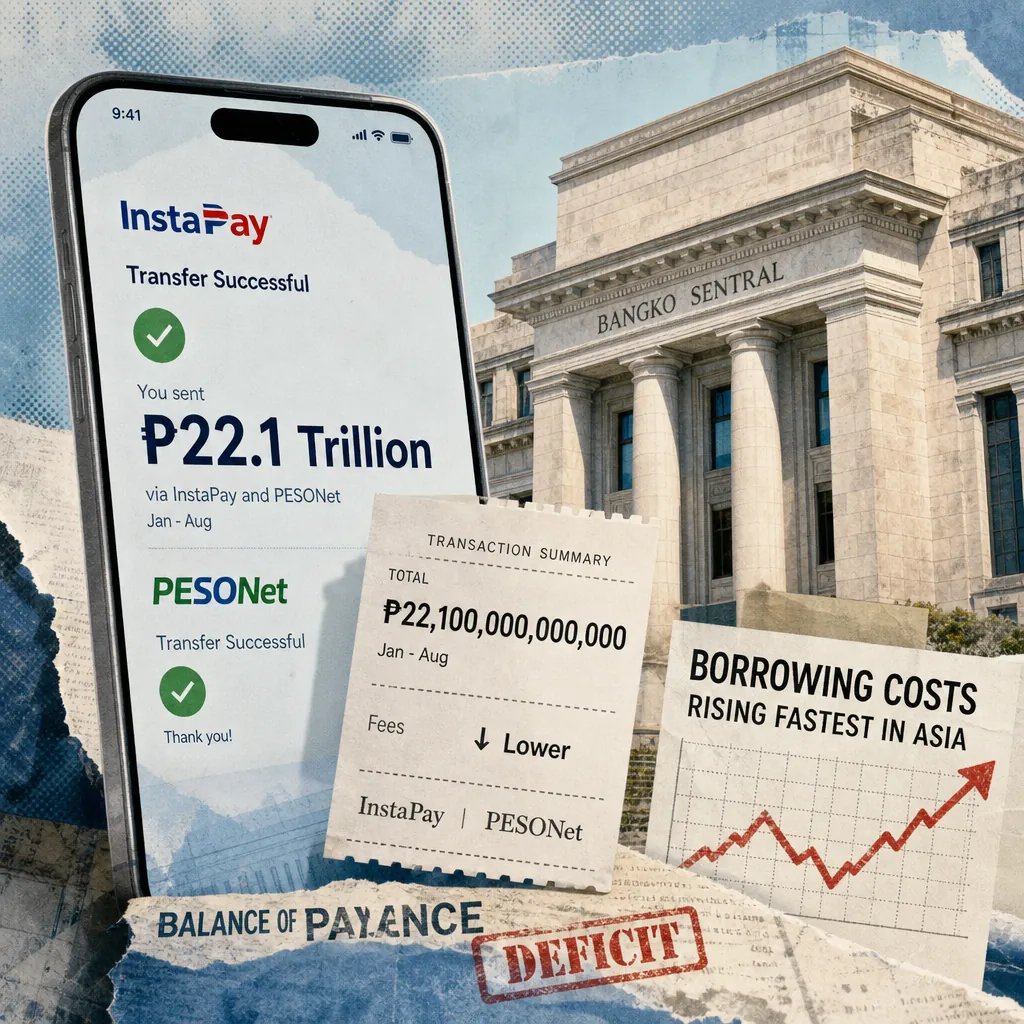
On the payments side, central bank data showed the value of transactions processed through the Philippine Payment and Settlement System (PhilPaSS) Plus climbed 32.6% to ₱174.6 trillion in the April-to-June quarter from ₱131.7 trillion a year earlier, the fastest quarterly expansion since the system launched in July 2021 3538. PhilPaSS Plus is the BSP's real-time gross settlement system, the plumbing that moves large-value and retail payments between banks. Separately, the Philippine Stock Exchange approved the initial public offering of Mynt, the operator of the GCash wallet, with subscriptions to run through the GStocks platform inside the GCash app 29.
Key themes
- ANZ sees one more BSP hike, then a stop. The bank's analysts expect a final 25-basis-point increase in the coming quarters, with inflation back to target as the deciding factor 30. The BSP's key rate sits at 5% after three straight increases since April 25.
- The peso and the trade gap keep the pressure on. The Philippines' first-half trade deficit was revised wider to $31.36 billion from $30.81 billion, as imports rose 18.8% to $78.14 billion while exports grew 13.2% to $46.78 billion 31. A persistent trade gap means more dollars leaving than entering, which weighs on the peso and gives the central bank reason to keep rates high 12.
- ICTSI borrows $1 billion from BDO for expansion. The 10-year facility is larger than the $750-million loan Metrobank extended in 2023 and follows a $300-million loan from the Asian Infrastructure Investment Bank in May 13. ICTSI has earmarked about $740 million in capital spending this year, including completion of an expansion in Manzanillo, Mexico 24.
- The Treasury pulled a five-year bond sale as yields climbed. National Treasurer Sharon P. Almanza said the auction was canceled because of rising yields, with US Treasury yields at 20- to 30-year highs pushing up local borrowing costs 39. The government still plans a retail bond issue, timed to market conditions 41.
- Digital payment volumes hit a record quarterly expansion. PhilPaSS Plus processed ₱174.6 trillion in the second quarter, up 32.6% year on year, with transaction volume up 7.6% 3538.
- GCash's parent cleared for what could be the largest Philippine IPO. The PSE approved Mynt's listing under the symbol GCASH, with up to 8.03 billion common shares on offer and subscriptions through GStocks 29.
- PayMongo targets 50,000 active merchants by 2027. The payments company has about 11,000 monthly active merchants out of more than 30,000 on its platform, and says it has cut onboarding to under five minutes 37.
- Awards season put financial-inclusion campaigns in the trade press. Cebuana Lhuillier, AXA Philippines, and GCash each collected Philippine Quill honors for marketing and communications work 194045.
How the narratives stack
Dominant. The BSP's rate path is the day's most consequential story for the widest audience. ANZ's call for one final quarter-point hike, reported by BusinessWorld and picked up by Head Topics, frames the central bank's next move as a choice between finishing the job on inflation and avoiding further damage to sluggish demand 3025. The read for the sector is that borrowers should expect the cost of credit to stay elevated into the next quarter, and that any relief depends on inflation and the peso, not on domestic demand, which ANZ described as weak 30.
Counter-narrative. The trade and fiscal data complicate the picture. The revised $31.36-billion first-half trade gap is $6.88 billion wider than the $24.48 billion recorded in the same period of 2025, and the Treasury's decision to shelve a five-year note sale shows that even the government is adjusting its borrowing plans to market conditions 3139. The read is that the same external pressures pushing the BSP toward one more hike are also raising the government's own funding costs, which eventually reach taxpayers through debt service.
Emerging. The payments and fintech stories point to a different trajectory. PhilPaSS Plus volume growth of 32.6% in value and 7.6% in count shows more money moving electronically, and Mynt's approved IPO would give the public a direct stake in the country's dominant wallet 353829. PayMongo's target of 50,000 active merchants by 2027, more than four times its current base, is a bet that small businesses will keep adopting digital payments 37. The read for the sector is that the infrastructure for digital finance is scaling faster than the credit cycle, and the companies positioned in it are raising capital and setting targets accordingly.
Under-covered. The clearest under-covered item in the set is the Social Security System's Balikat ng Bayan Awards, held Sept. 21, which recognized employers, collection and disbursement partners, and media organizations for supporting social security coverage for Filipino workers at home and overseas 32. It drew a single item in the captured coverage, and its substance — the operational partnerships that keep pension and benefit payments flowing — sits outside the rate-and-market frame that dominated the day.
Platform insights
- Facebook. The day's financial stories circulated mainly through the pages of the outlets that published them, with the BSP rate story and the ICTSI loan drawing the most shares among business readers. Engagement on these items was concentrated in comment threads about borrowing costs and the peso, rather than in broad consumer discussion.
- X. The fastest-moving conversation was among market watchers tracking the peso and the Treasury's canceled auction, where the yield story was discussed alongside the ANZ note. Posts tended to link directly to the BusinessWorld and Inquirer reports rather than to summarize them.
- Reddit. Discussion of the GCash IPO approval appeared in Philippine personal-finance threads, where users compared subscribing through GStocks against the PSE EASy platform and asked about the offer's size relative to past listings 29. The tone was practical rather than speculative.
- YouTube. No significant video activity was captured around the day's financial stories; the items in this set ran as text and were not accompanied by broadcast or video coverage.
Key voices and communities
- ANZ Research analysts. Their Research Quarterly note set the day's agenda on monetary policy, arguing that inflation and external risks "continue to constrain the policy outlook despite a higher hurdle to hike" 30. Their view matters because it shapes how institutional investors position ahead of the BSP's next meeting.
- BSP Governor Eli M. Remolona Jr. and National Treasurer Sharon P. Almanza. Remolona's earlier guidance that the latest decision capped the cycle is now being tested by ANZ's call for one more move 25. Almanza's statements on the canceled auction and the pending retail bond issue define the government's funding strategy for the rest of the year 3941.
- ICTSI and BDO Unibank. The $1-billion, 10-year facility makes BDO the port operator's largest recent private lender and signals continued appetite among Philippine banks for large corporate exposure 1324.
- Fintech operators and the PSE. PSE President and CEO Ramon S. Monzon called the Mynt offering "poised to set the record as the largest public offering in PSE history," a claim that will be tested when subscriptions open 29. PayMongo's Jose Dalino Jr. framed onboarding speed as the company's growth lever 37.
- Employers and partner organizations in the social security system. The SSS awards highlighted the collection and disbursement partners whose operations underpin benefit payments, a community whose work rarely surfaces in market coverage 32.
Narrative streams
The BSP's tightening cycle nears its end, with inflation and the peso deciding
The BSP has raised its benchmark rate three times since April, taking it to 5%, after an energy crisis linked to the Middle East war pushed inflation above the government's target range 25. ANZ's Research Quarterly, published Tuesday, argued that one more 25-basis-point increase is likely in the coming quarters, and that bringing inflation back to target remains the central factor in the decision 30. The bank noted that most central banks have already delivered the tightening it expected earlier in the year, but that "risks remain skewed towards further tightening" 30.
The context matters for anyone with a loan. The BSP's policy rate is the anchor for bank lending rates, so each increase raises the cost of mortgages, car loans, and business credit within weeks. ANZ's own framing is that domestic demand is sluggish, which means the case for another hike rests on inflation and the currency rather than on an overheating economy 30. The peso's weakness is tied to the trade deficit: when imports exceed exports, more dollars leave the country than come in, and the peso tends to weaken, which in turn makes imported goods more expensive and feeds inflation 12.
The read for the sector is that banks and borrowers should plan for the policy rate to stay at or near 5% through the rest of 2026, with the first cut unlikely until inflation is clearly back inside target. For lenders, that supports net interest margins in the near term; for households and small businesses, it means refinancing will stay expensive.
ICTSI's $1-billion loan puts bank lending capacity on display
ICTSI signed a $1-billion term loan with BDO Unibank on Tuesday, with a tenor of 10 years, according to a regulatory disclosure 1324. The facility is larger than the $750-million loan Metrobank extended to the company in 2023, which at the time was the largest credit facility the ports operator had secured and the largest bilateral facility Metrobank had extended 13. In May, ICTSI also secured a $300-million loan from the Asian Infrastructure Investment Bank, the Beijing-based multilateral lender, to expand and upgrade three Philippine terminals 13.
ICTSI has earmarked about $740 million in capital expenditures this year, including funds to complete Phase 3B of the Contecon Manzanillo expansion in Mexico, a project expected to lift that terminal's annual handling capacity to 2 million twenty-foot equivalent units, the standard measure of container volume 24. The company did not disclose the loan's interest rate or how proceeds will be allocated across projects 24.
The read for the sector is that Philippine banks still have the balance-sheet capacity and the appetite to write nine-figure dollar facilities for large corporates, even with the policy rate at 5%. For rival port operators and logistics firms, ICTSI's access to long-tenor dollar funding at scale is a competitive advantage that will show up in terminal capacity over the next two to three years.
The Treasury steps back from the five-year bond market
The Bureau of the Treasury canceled its rate-setting auction for new five-year fixed-rate Treasury notes scheduled for Sept. 22, National Treasurer Sharon P. Almanza said, citing rising yields 39. Instead, the government auctioned reissued 20-year Treasury bonds with a remaining life of four years and nine months 3941. The decision came as US Treasury yields hit 20- to 30-year highs, which pushes up local borrowing costs because global investors demand higher returns to hold Philippine debt 39.
Rizal Commercial Banking Corp. chief economist Michael L. Ricafort attributed the cancellation to rising yields for longer tenors, which would increase the government's interest costs 39. The Treasury last offered five-year notes in February, raising ₱297.94 billion through new 10-year notes, with ₱235 billion in new money and ₱62.94 billion from a debt-switch program 41. The government began auctioning fixed-rate notes last year to establish new benchmarks and improve market liquidity, and those offerings target institutional investors such as corporations and cooperatives 41.
Almanza said the government is still monitoring the market for the timing of a retail Treasury bond issue, which would be sold in small denominations to individual savers 41. The read for the sector is that the government is choosing to delay rather than pay up, which keeps upward pressure on yields across the curve and raises the odds that any retail bond offer will carry a higher coupon than the last one. For banks and insurers that hold government securities, the mark-to-market effect of higher yields is a near-term drag on portfolios.
Digital payments scale to a record quarter
The value of transactions processed through PhilPaSS Plus rose 32.6% to ₱174.6 trillion in the April-to-June quarter from ₱131.7 trillion a year earlier, the fastest quarterly expansion since the system launched in July 2021, according to central bank data 3538. Quarter on quarter, value climbed 5.8% from ₱165.1 trillion in the January-to-March period, and transaction volume rose 7.6% year on year 3538. The BSP attributed the growth to sustained financial activity and the increasing adoption of digital payment channels, supported by enabling regulations 35.
PhilPaSS Plus is the BSP's real-time gross settlement system, the infrastructure that settles large-value interbank payments and retail transactions between participating institutions. Growth in its volumes is a proxy for how much of the economy is moving through formal, electronic channels rather than cash and checks. The same day, PayMongo said it is targeting about 50,000 active merchants by 2027, more than four times its current base of about 11,000 monthly active merchants out of more than 30,000 on its platform, with micro, small and medium enterprises accounting for most of them 37. Chief product and technology officer Jose Dalino Jr. said the company has cut onboarding to less than five minutes to bring more merchants onto the platform 37.
The read for the sector is that the payments infrastructure is expanding faster than the credit cycle, and the businesses building on it are competing on onboarding speed and merchant coverage rather than on rates. For banks, the shift means more transaction volume migrating to platforms they do not own, which pressures fee income unless they integrate with the same rails.
GCash's parent wins approval for a record-setting listing
The Philippine Stock Exchange approved the initial public offering of Mynt, the operator of the GCash wallet, under the trading symbol GCASH, with subscriptions to run through the GStocks platform inside the GCash app 29. The offering covers up to 8.03 billion common shares, and local small investors may also subscribe through the exchange's PSE EASy platform 29. PSE President and CEO Ramon S. Monzon said the offering "is poised to set the record as the largest public offering in PSE history" and could pave the way for more fintech and digital economy companies to raise capital through the equities market 29.
Putting the subscription inside the GCash app is the notable structural detail: it lets existing wallet users buy shares without opening a brokerage account, which the PSE expects to increase retail participation 29. The read for the sector is that the listing will test whether a consumer app can convert its user base into shareholders, and its outcome will shape how other Philippine fintechs approach the public market. For retail investors, the offer's size and pricing will determine whether the "largest IPO" label translates into a liquid, widely held stock.
Financial-inclusion campaigns collect industry awards
Three financial-services companies took home Philippine Quill honors for communications work. Cebuana Lhuillier earned Gold for Marketing Leader of the Year for Emirosco Michael Sena, its first vice president and chief marketing and communications officer, and Silver for Marketing Team of the Year at the MARKETECH APAC Next Awards Philippines 2026 19. AXA Philippines received an Award of Excellence for its AllShield campaign and Awards of Merit for its Mind Health and Health Always-On campaigns at the 22nd Philippine Quill Awards 40. GCash took two Merit awards and one Excellence distinction, recognized for mobilizing 12,000 runners for climate action through its GForest program and for reaching more than 1.5 million people with scam-awareness campaigns on social media 45.
The read for the sector is that insurers and wallet operators are competing on trust and financial literacy as much as on products, and the awards circuit is where that positioning gets validated. For communicators, the campaigns that won share a common trait: they translated abstract products — insurance, digital safety, environmental programs — into actions customers could take.
Conversation trajectory
The BSP's next policy meeting (observation window: the coming weeks). ANZ expects one more 25-basis-point hike "in the coming quarters," with inflation back to target as the deciding factor 30. Watch the next inflation print and the peso's level against the dollar; a weaker peso or an upside inflation surprise raises the odds of a hike, while a stable currency and easing price pressures would support a hold.
The Treasury's retail bond timing (observation window: the next one to two months). Almanza said the government is monitoring the market for the timing of a retail Treasury bond issue 41. If US Treasury yields stay at 20- to 30-year highs, the offer is likely to be delayed or priced with a higher coupon; a pullback in global yields would open the window sooner 39.
Mynt's IPO subscription period (observation window: next month). The PSE approved the offering with subscriptions through GStocks 29. Watch the final offer size and price, and whether the retail tranche through the GCash app draws participation beyond existing brokerage clients. The listing's performance will set the tone for other fintech candidates.
Third-quarter growth data (observation window: the next GDP release). BMI, the Fitch Solutions research unit, said early indicators suggest the economy entered the third quarter with less momentum than anticipated, raising downside risks to its 3.3% full-year growth forecast, which is below the government's 3.5% to 4.5% target 50. A weak print would strengthen the case against another rate hike; a strong one would not resolve the inflation question on its own.
Trigger events to watch. The BSP's next rate-setting meeting, the release of the next inflation and trade figures, the pricing of the Mynt offer, and any announcement on the retail bond sale are the concrete dates that will move this story. A sharp move in the peso or in US Treasury yields would accelerate all of them.
Response guidance
On rate expectations, avoid promising relief. Communicators at banks and lenders should frame the ANZ call as one possible path, not a forecast, and should not tell borrowers that rates will fall soon. The BSP's own guidance has been data-dependent, and the deciding variables — inflation and the peso — are outside any single institution's control 3025.
On the peso and imported costs, connect the trade data to household budgets. The revised $31.36-billion first-half trade gap is an abstract number until it is translated: a wider gap means more dollars leaving, a weaker peso, and higher prices for imported fuel, food, and electronics 31. Messages that make that chain explicit will land better than market commentary.
On the GCash IPO, separate product communication from investment advice. The offering will generate consumer interest because it is inside the GCash app 29. Communicators should be precise that subscriptions involve market risk and that past performance of other listings does not predict outcomes, and should direct users to the prospectus rather than to promotional material.
On digital payments growth, avoid overclaiming cash's disappearance. The 32.6% rise in PhilPaSS Plus value is a record for the system, but it measures transactions processed through one settlement infrastructure, not the share of all payments that are digital 3538. PayMongo's merchant target is a company goal, not an industry forecast 37.
On the Treasury's funding decisions, explain the trade-off plainly. The canceled five-year auction and the pending retail bond are two sides of the same decision: the government is choosing when to borrow rather than how much 3941. Communicators should avoid framing the cancellation as a sign of fiscal distress; it is a response to market pricing.
On awards and campaign recognition, keep the focus on customer outcomes. The Quill and MARKETECH honors for Cebuana Lhuillier, AXA, and GCash recognize communication work 194045. Messages that tie the awards to specific customer benefits — scam protection, insurance literacy, environmental programs — will read as substance rather than self-congratulation.
On sensitive topics, handle the social security and labor angle with care. The SSS Balikat ng Bayan Awards recognized partners that keep benefit payments flowing to workers and their families 32. Communicators touching pension and benefit topics should avoid implying that coverage or payout levels are changing when no such announcement has been made.
See the full picture behind today's signals.
This report draws from Media Meter's MediaWatch, our real-time monitoring engine tracking 2,470+ Philippine sources across print, broadcast, digital, and social. Explore how the platform turns raw coverage into decision-grade intelligence, then see how it's configured for teams like yours — whether you're in PR agencies, corporate comms, government, or marketing.
Want more? Browse our Report Library for sector and crisis intelligence, or request a demo and we'll have your brand set up before the call.
Want this kind of intelligence on your brand?
This brief is built on the same MediaWatch methodology that runs continuously across every brand we monitor. See your competitive landscape, Impact Score, and narrative trajectory in a 30-minute demo.