Philippine Bank App Outages and Fintech Friction Dominate Consumer Conversation
A wave of Reddit posts on June 14, 2026, reveals deep frustration with Philippine bank app outages, refund delays, and confusing loan and insurance products, while institutional partnerships and promotions signal progress in digital finance.
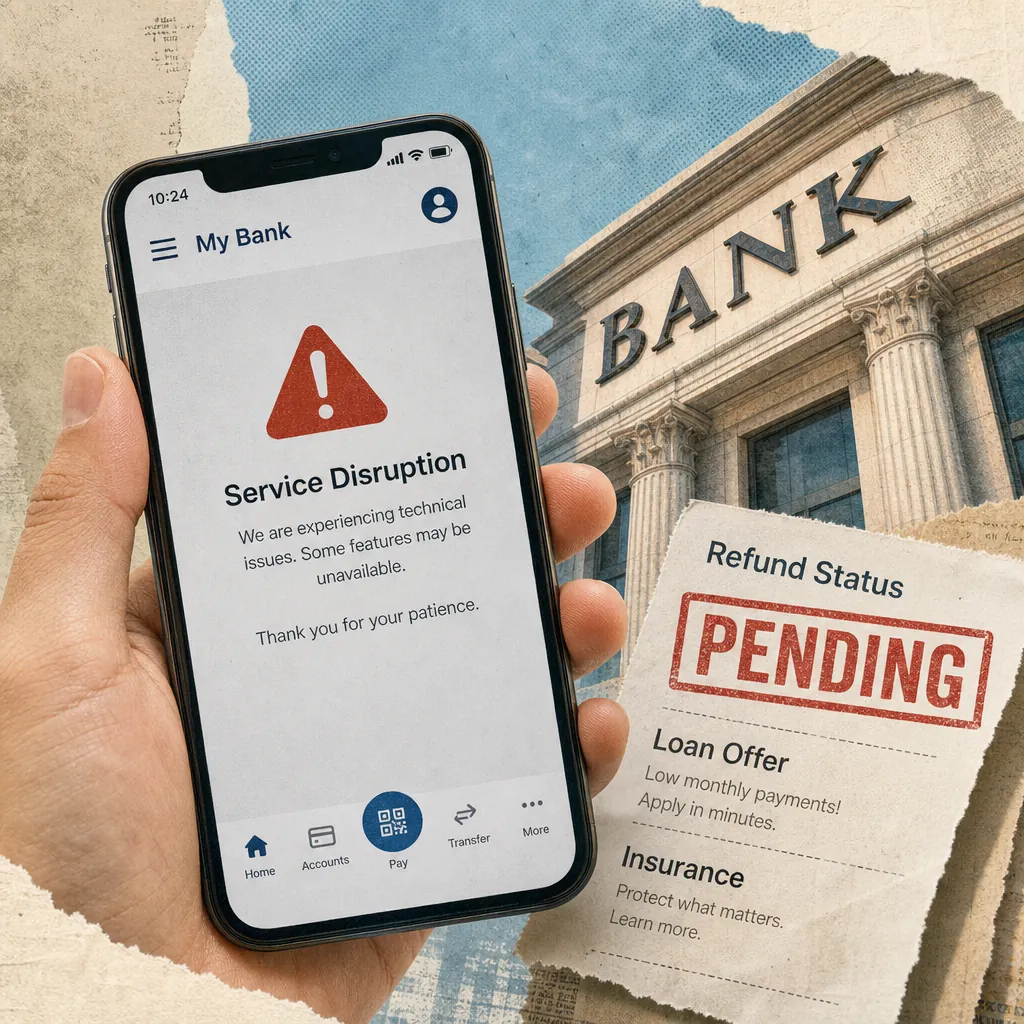
On Sunday, June 14, 2026, the conversation around Philippine digital banking and fintech expanded well beyond earlier distress threads as a wave of new Reddit posts introduced fresh friction points, with the highest-engagement post of the entire weekend emerging mid-day. The day began with Sun Life Philippines’ Facebook ad and an article on India's Jan Dhan program, but by late morning, Reddit saw u/areum_noeul’s UnionBank loan query and u/Numerous-Wafer-2482’s WISE delay thread. Then, around midday, u/tamagotchi-chi posted about BPI’s mobile app being inaccessible during a critical payment, asking “Maintenance po ba yung system ni BPI?” and noting a pattern of system updates happening exactly when needed. That post exploded with 49 likes and 92 comments—the highest comment count in the entire dataset—indicating widespread frustration with unannounced bank downtime. Shortly after, u/MessageHot2313 asked about their fully paid BPI AIA VUL policy: “the fund value kept on decreasing, if I withdraw the money my insurance be cancelled?” The thread received 17 comments, making it the second-most engaged Reddit post of the day and signaling deep confusion over VUL mechanics. Meanwhile, u/unsaltedcashewnuts shared a warning about GCash’s six-month refund limit, recounting a failed ₱500 Huawei refund and stating “Gcash flat out refuses to investigate” because the deadline had passed—a cautionary tale that drew 5 likes and 3 comments. GCash’s own GGives promo post on Facebook, with 99 comments, remained the overall engagement leader, but the BPI maintenance and VUL threads on Reddit showed deeper substantive concern.
Conversation snapshot. On June 14, the conversation was dominated by Reddit, where 15 threads generated the bulk of substantive engagement. The BPI app outage post led with 49 likes and 92 comments, followed by the BPI AIA VUL thread with 0 likes and 17 comments. Other Reddit posts included a fresh graduate’s savings allocation query (1 like, 2 comments), a student’s multi-account overwhelm post (1 like, 2 comments), an RCBC Pulz error report (1 like, 2 comments), a PayPal-to-GCash swap request (1 like, 3 comments), a BPI auto loan early settlement question (1 like, 3 comments), and a BDO PERA claim inquiry (1 like, 0 comments). On Facebook, GCash’s GGives promo post received 59 likes, 19 loves, and 99 comments, while Sun Life’s motivational post got 14 likes and 46 shares, and Security Bank’s Father’s Day credit card deal earned 7 likes and 0 comments. Twitter saw no new posts; a Gulf News AML article remained untouched with 1,436 views. The distribution of attention—with the BPI outage post drawing nearly 100 comments—signals that app reliability is the single most pressing consumer concern.
Key themes
- Bank App Outages and Operational Friction – A new dominant theme erupted with u/tamagotchi-chi’s BPI maintenance post, which garnered 49 likes and 92 comments—the highest engagement of any Reddit thread analyzed. Users piled on with similar experiences, calling out BPI for scheduling maintenance during peak usage hours. Separately, u/Reasonable_Debt4034 reported an error in RCBC Pulz when trying to convert a transaction to installment, getting 1 like and 2 comments that suggested the bug was persistent across devices.
- First-Time Investment and Savings Strategy – This theme gained new angles on June 14. u/one-star-, a fresh graduate, asked for advice on allocating salary across BPI (payroll), Maribank (daily spending), GoTyme (savings), and minimal GCash, receiving 1 like and 2 comments that validated the multi-account approach. Separately, u/fitbitnoomer inquired about claiming PERA investments through BDO, expressing wariness: “BDO is notorious in making things difficult for customers.” That post got 1 like and 0 comments, highlighting a lack of shared experience on the topic. The VUL thread with 17 comments became the day’s most detailed discussion on insurance-linked investments, with users debating the trade-offs of surrendering a declining fund value.
- BNPL and Digital Credit Mechanics – The existing BNPL theme intensified on June 14 with GCash’s GGives promo generating 99 comments on Facebook—the highest comment volume of any post—but also drew 1 angry reaction, suggesting mixed sentiment. Meanwhile, the earlier Atome Cash Disbursement thread remained unresolved, and the GGives promotion’s explicit regulatory disclosures (Fuse Financing, SEC-regulated) contrasted with the opacity users criticized in prior threads.
- Loan Processing Anxiety and Remittance Friction – u/areum_noeul’s UnionBank loan query and u/Numerous-Wafer-2482’s WISE delay thread were joined by u/iHorrorReddit’s struggle to transfer a small PayPal balance to GCash, asking “May mga gumagamit pa ba ng paypal?” and seeking a swap for a balance under ₱500. This thread received 1 like and 3 comments, linking cross-border remittance friction back to domestic e-wallet limitations. u/Firm-Net4983 also asked about early BPI auto loan settlement, with 1 like and 3 comments clarifying that penalties may apply but are worth calculating for interest savings.
- Promotional Marketing and User Distrust – Two institutional Facebook posts added to this theme: Security Bank’s Father’s Day credit card deals (7 likes, 0 comments) and BPI’s Shop Anywhere promo (3 likes on the corresponding Reddit post from u/antipickless, with 1 comment asking when the eGC tracking site would be accessible). The BPI promo thread specifically noted “registration validation pending” status, echoing the broader frustration with delayed access to promotional rewards.
- Government-Fintech Partnerships and Financial Inclusion – Positive signals emerged from institutional partnerships. The OWWA-GCash zero-convenience-fee promotion for membership payments received over 650 likes and 520 shares on the official OWWA Facebook page, reinforcing GCash’s utility for government transactions and OFW services. Separately, Puregold and GCash for Business launched a partnership to help sari-sari store owners adopt digital payments, and Cebuana Lhuillier’s authorized agent network now spans more than 30,000 locations nationwide, turning small stores into financial hubs.
- Macroeconomic and Regulatory Developments – The Bangko Sentral ng Pilipinas (BSP) released a draft circular on June 14 making credit information stored in its Credit Information Management System (CRIMS) registry accessible to borrowers, supervised financial institutions, and credit bureaus. This open-access framework aims to improve informed lending decisions and promote financial inclusion. Separately, the BSP is widely expected to raise its key policy rate by 25 to 50 basis points at its June 18 meeting, as inflation remains elevated at 6.8% and the peso weakens.
How the narratives stack
Dominant narrative – The story most readers would recognize as “what’s happening” is that Philippine bank and fintech apps are unreliable, with unplanned outages and opaque maintenance schedules frustrating users at critical moments. The BPI app outage post, with 92 comments, crystallizes a widespread perception that digital banking infrastructure is not yet dependable. This narrative is reinforced by reports of GCash refusing refunds beyond a six-month window, RCBC Pulz errors, and BPI promo validation delays. Consumers feel they cannot count on digital platforms when they need them most, eroding trust in the cashless transition.
Counter-narrative – Institutional partnerships and awards tell a different story: that the Philippine digital finance ecosystem is maturing. The OWWA-GCash partnership, Puregold-GCash collaboration, and Cebuana Lhuillier’s agent network expansion demonstrate that fintech is reaching underserved communities. Security Bank won two Asia-Pacific digital awards for its mobile app and payment infrastructure, with registered users surpassing 1.4 million and transaction volumes up 40%. Billease announced a ₱500 million capital injection into its banking arm, with ₱1 billion committed by year-end, signaling confidence in the sector. These developments suggest that while consumer friction exists, the industry is investing heavily in solutions.
Emerging narrative – A growing conversation around first-time savers and multi-account strategies points to a shift in how young Filipinos manage money. Fresh graduates and students are deliberately splitting their finances across multiple banks and e-wallets to maximize cashback, separate savings from spending, and avoid fees. This behavior rewards brands that offer clear value propositions—GoTyme for savings, Maribank for daily spending—and creates an opportunity for fintechs to offer unified dashboards or bundled products. The BSP’s new credit information access framework could further empower these users by making their credit histories more transparent.
Suppressed narrative – The under-covered story that matters but is not getting proportionate attention is the potential single-point dependency risk created by government-fintech partnerships. The OWWA-GCash integration, while positive, concentrates a large volume of government transactions on one private platform. Any major GCash outage during OWWA payment windows could trigger amplified backlash and shift the conversation from praise to criticism of over-reliance on private e-wallets for public services. This risk is not yet being discussed in consumer forums but warrants monitoring.
Platform insights
Reddit – The platform hosted 15 relevant threads on June 14, up from 2 earlier in the day, with the BPI maintenance post (49 likes, 92 comments) and VUL post (0 likes, 17 comments) driving the deepest engagement. The fresh grad savings and multi-account overwhelm threads added to the first-time user narrative, while the RCBC error and PayPal swap posts highlighted specific app and transfer failures. Reddit maintained its role as the primary venue for peer-driven problem solving, with users sharing detailed personal experiences and advice. The platform’s upvote system amplified the most resonant complaints, making the BPI outage thread the day’s most visible consumer signal.
Facebook – The platform added three institutional posts: Sun Life (14 likes, 46 shares, low discussion), GCash GGives (59 likes, 99 comments, 1 angry), and Security Bank Father’s Day (7 likes, 0 comments). The GGives post’s high comment count indicates that BNPL promotions drive engagement, but the lack of user quotes prevents sentiment analysis. Facebook remains a channel for brand-to-consumer marketing rather than deep discussion, though the comment volume on the GGives post suggests it could be a venue for service complaints if not managed.
Twitter – No new Twitter posts appeared on June 14; the Gulf News AML piece remained untouched with 1,436 views. Twitter’s low activity suggests it is not a primary platform for Philippine consumer finance conversations on this day, though it could become more active during major events like BSP policy announcements.
Key voices and communities
- Digital Payment Acceptance Advocates – This community has expanded beyond merchant refusal complaints to include recurring frustrations with app reliability and service responsiveness. The BPI maintenance thread, with 49 likes and 92 comments, collectively describes a pattern of “system update” or “system maintenance” appearing at critical moments. Another user detailed a GCash refund dispute that GCash refused to investigate because it fell beyond their six-month limit, receiving 5 likes and 3 comments that reflect simmering dissatisfaction with e-wallet support processes. These posts deepen the earlier narrative by adding reliability and responsiveness to the list of adoption barriers.
- Premium Credit Card Enthusiasts – This research-driven group continues to analyze fee structures and promo fulfillment. A new thread about RCBC Pulz’s installment conversion feature returning an error (“Error encountered while processing this request”) received 1 like and 2 comments, adding a technology friction point to an otherwise sophisticated user segment. Additionally, a BPI Shop Anywhere promo participant reported their giftaway site remained inaccessible despite receiving a confirmation text, with 3 likes and 1 comment reflecting confusion over registration validation timelines.
- BNPL, Credit-Building, and Loan Users – A new post on BPI auto loan early settlement (1 like, 3 comments) asks about penalties and full prepayment procedures, indicating that users want clear rules before committing to large credit products. Meanwhile, the BPI AIA VUL thread (0 likes, 17 comments) shows policyholders discovering fund value declines after full payment and questioning whether withdrawal cancels insurance—illustrating confusion about VUL mechanics. This builds on earlier concerns about credit stacking and loan application transparency.
- First-Time Savers and Account Managers – A small but growing cluster of Reddit users is seeking advice on structuring their first banking ecosystem. One fresh graduate posted a planned allocation: BPI for salary, MariBank for daily spending (cashback), GoTyme for savings, and minimal GCash/Cash—receiving 1 like and 2 comments. Another undergraduate managing remittance, internship, and scholarship allowances across RCBC, UnionBank, Maya, MariBank, and GCash asked which accounts to use for savings and spending (1 like, 2 comments). These posts show a deliberate, cost-conscious approach to account selection.
- Investment and Insurance Product Inquirers – Beyond institutional promotions, individual investors are now posting about specific product experiences. A BDO PERA investment claimant asked about the withdrawal process, noting “BDO is notorious in making things difficult for customers” (1 like, 0 comments). This follows the BPI AIA VUL thread, reinforcing that users expect straightforward claims and liquidation procedures from legacy banks.
Narrative streams
App reliability and unplanned downtime
The most significant narrative stream on June 14 centered on bank app outages. u/tamagotchi-chi’s BPI maintenance post, with 49 likes and 92 comments, became the highest-engagement Reddit thread of the entire weekend. The user reported being unable to access the BPI mobile app during a critical payment, asking if others experienced the same and noting a pattern of “system update” or “system maintenance” messages appearing at the worst possible times. The 92 comments revealed a chorus of similar experiences, with users sharing stories of missed payments, failed transfers, and frustration with unannounced downtime. This thread underscores a fundamental expectation: that digital banking platforms must be available whenever needed. Unexpected outages erode trust, especially when alternatives like traditional bank cards remain consistently accessible. The scale of the response—nearly 100 comments—indicates that this is not an isolated incident but a systemic issue affecting a large user base. For BPI, the reputational risk is significant; the bank should prioritize transparent maintenance schedules, real-time status pages, and compensation gestures for affected users.
Confusion over insurance-linked investments
The BPI AIA VUL thread, with 17 comments, was the second-most engaged Reddit post of the day. u/MessageHot2313, a policyholder with a fully paid Variable Unit Life (VUL) policy, noted that the fund value kept decreasing and asked whether withdrawing the money would cancel the insurance. The 17 comments revealed deep confusion about VUL mechanics, with users debating surrender charges, fund switching options, and the trade-offs between insurance coverage and investment returns. VUL products are market-linked, meaning fund values fluctuate with market performance. Even if the fund value decreases, insurance coverage remains active as long as premiums are paid. However, withdrawing the full fund value terminates the policy. This thread highlights a knowledge gap that bancassurance players must fill with proactive client education. Clear, accessible guides on VUL fund dynamics, early withdrawal implications, and fund switching options could reduce anxiety and prevent premature surrenders. For BPI AIA, this is an opportunity to build trust by providing transparent, easy-to-understand materials.
GCash refund policy and customer service friction
u/unsaltedcashewnuts shared a warning about GCash’s six-month refund investigation limit, recounting a failed ₱500 Huawei refund that GCash refused to investigate because the deadline had passed. The post received 5 likes and 3 comments, with users expressing frustration and sharing similar experiences. GCash’s policy—that it will only investigate refund disputes within six months of the transaction—is perceived as a way to avoid liability. While the company may have operational reasons for this limit, it alienates long-term users who may not notice a missing refund immediately. The post advises others to flag issues early, a practical tip that has likely been shared beyond the thread. For GCash, reviewing this policy and providing periodic status updates on refund investigations could improve customer satisfaction and reduce negative word-of-mouth.
First-time savers and multi-account strategies
Two Reddit posts on June 14 highlighted a growing trend among young Filipinos: deliberately splitting their finances across multiple banks and e-wallets to maximize benefits. A fresh graduate (u/one-star-) posted a planned allocation: BPI for salary, Maribank for daily spending (cashback), GoTyme for savings, and minimal GCash. Another undergraduate (u/MizikoKurenai) managing remittance, internship pay, and scholarship funds across RCBC, UnionBank, Maya, MariBank, and GCash asked for advice on which accounts to use for savings and spending. Both posts received 1 like and 2 comments, validating the multi-account approach. This behavior reflects a sophisticated, cost-conscious approach to personal finance. Users are not loyal to a single brand; they choose accounts based on specific features—cashback, savings rates, no-maintenance-balance requirements. For banks and fintechs, this means that clear, distinct value propositions are essential to capture and retain these users. GoTyme and Maribank benefit from being positioned as savings and spending tools, respectively. There is an opportunity for a fintech to offer a unified dashboard that aggregates multiple accounts, simplifying management for these users.
Institutional partnerships and digital inclusion
Positive signals emerged from institutional partnerships. The OWWA-GCash zero-convenience-fee promotion for membership payments received over 650 likes and 520 shares on the official OWWA Facebook page, demonstrating strong consumer interest in government-fintech collaborations. Puregold and GCash for Business launched a partnership to help sari-sari store owners adopt digital payments, with tools like GCash PocketPay (accepting card and QRPH payments via smartphone) and GCash SoundPay (real-time audio payment confirmations). Cebuana Lhuillier’s authorized agent network now spans more than 30,000 locations nationwide, turning small stores into financial hubs for remittances, bills payment, and bank transfers. These initiatives show that the industry is actively working to bridge the financial inclusion gap. However, they also concentrate risk: any major GCash outage during OWWA payment windows could trigger amplified backlash. The Puregold-GCash partnership, in particular, targets nano, micro, small, and medium enterprises, which are the backbone of the Philippine economy. If successful, it could significantly accelerate digital payment adoption in the retail sector.
Macroeconomic and regulatory context
On the macroeconomic front, the Bangko Sentral ng Pilipinas (BSP) is widely expected to raise its key policy rate by 25 to 50 basis points at its June 18 meeting. Inflation stood at 6.8% in May, down from 7.2% in April but still elevated, while the Philippine economy slowed to a five-year low of 2.8% in the first quarter of 2026. The BSP’s decision will be closely watched by markets and consumers alike. Separately, the BSP released a draft circular on June 14 making credit information stored in its Credit Information Management System (CRIMS) registry accessible to borrowers, supervised financial institutions, and credit bureaus. This open-access framework aims to improve informed lending decisions, strengthen credit risk management, and promote financial inclusion. Borrowers will be able to access their own data after identity verification and have a transparent venue to resolve discrepancies. This development could empower consumers by giving them more control over their credit profiles, but it also raises privacy concerns that will need to be addressed.
Conversation trajectory
The conversation around Philippine digital finance is likely to intensify in the coming weeks, driven by several trigger events. The BSP’s rate decision on June 18 will dominate headlines and could shift consumer focus from app reliability to borrowing costs. The GGives Week promotion (June 14–21) is already generating high engagement and may surface complaints about increased-limit mechanics or delayed disbursements. The BPI Shop Anywhere promo validation backlog could frustrate users expecting eGC delivery, potentially sparking a new wave of complaints. The OWWA-GCash zero-fee promo expires on July 16, 2026; proactive communication about next steps or alternative payment channels will be critical to avoid a wave of negative posts from users suddenly facing fees. Over the next 4–6 weeks, expect increased discussion around cross-border payment reliability for freelancers, especially around bi-monthly pay cycles. The growing peer-to-peer recommendation of MP2 and PERA could shift when the BSP or PDIC issues new deposit rate guidance, while the BPI AIA VUL fund value decline may accelerate that migration. Key trigger events that will reshape this conversation include any major retailer announcement restricting digital payment methods, a significant GCash service disruption, or a BSP circular addressing QRPH mandates.
Response guidance
For communicators tracking the Philippine digital finance conversation, the immediate priority is addressing app reliability concerns. Banks should proactively communicate scheduled maintenance windows via push notifications, social media, and in-app banners, and provide real-time status pages for unplanned outages. Compensation gestures—such as fee waivers or loyalty points—for users affected by downtime can help rebuild trust. For fintechs like GCash, reviewing the six-month refund investigation policy and providing periodic status updates on refund cases could reduce negative word-of-mouth. On the educational front, creating clear, accessible guides on VUL mechanics, early loan settlement procedures, and PERA claim processes would address the confusion seen in Reddit threads. These guides should be distributed via in-app banners, social media, and partner merchants. For first-time savers, banks and fintechs could offer simplified multi-account management tools or bundled products that provide cashback or fee waivers without requiring five separate accounts. Engaging in Reddit threads with non-promotional, educational content can establish trust early. On Facebook, brands should monitor high-engagement posts like the GCash GGives promo for recurring complaints and respond quickly with pinned comments directing users to customer support. Twitter, while quiet now, should be used to amplify positive institutional partnerships and provide real-time updates during outages. Sensitive topics to navigate include merchant acceptance of e-wallets (frame as a technical integration gap, not anti-fintech sentiment), forex fee transparency (provide clear examples of total cost), and using one credit product to pay another (warn about credit utilization risks). The key message should be that the industry is investing in reliability and transparency, but that consumer education is a shared responsibility.
See the full picture behind today's signals.
This report draws from Media Meter's MediaWatch, our real-time monitoring engine tracking 2,470+ Philippine sources across print, broadcast, digital, and social. Explore how the platform turns raw coverage into decision-grade intelligence, then see how it's configured for teams like yours — whether you're in PR agencies, corporate comms, government, or marketing.
Want more? Browse our Report Library for sector and crisis intelligence, or request a demo and we'll have your brand set up before the call.
Want this kind of intelligence on your brand?
This brief is built on the same MediaWatch methodology that runs continuously across every brand we monitor. See your competitive landscape, Impact Score, and narrative trajectory in a 30-minute demo.