Philippine economy faces headwinds as BSP widens deficit forecasts, consumer confidence slumps
The Bangko Sentral ng Pilipinas revised its balance of payments deficit projections upward for 2026 and 2027, citing elevated oil prices and tighter financial conditions, while a separate survey showed consumer confidence at its lowest since the pandemic. The day's coverage also featured a push to lift the Metro Manila ecozone moratorium, a rebound in property prices, and a sluggish stock market outlook.
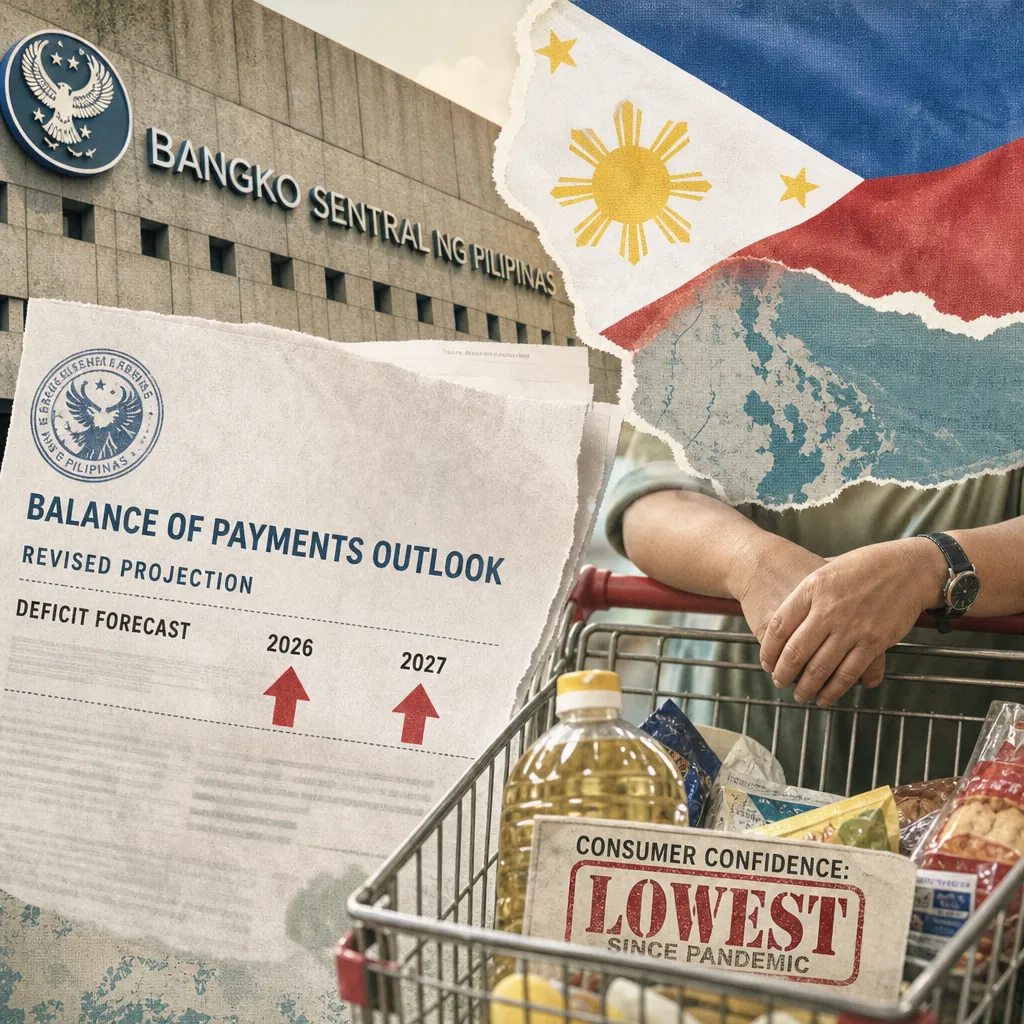
The Bangko Sentral ng Pilipinas (BSP) released a batch of economic data late Friday that painted a challenging picture for the Philippine economy. The central bank widened its balance of payments (BOP) deficit forecasts for 2026 and 2027, citing persistent external pressures, while a separate consumer survey showed confidence plunging to its lowest level since the pandemic. The day's coverage also featured a push to lift the Metro Manila ecozone moratorium, a rebound in property prices, and a sluggish stock market outlook.
The BSP now expects the country's balance of payments — the difference between foreign currency inflows and outflows — to post a deficit of $10.7 billion in 2026, equivalent to 2.1 percent of gross domestic product (GDP). That is wider than the $7.8-billion gap, or 1.5 percent of GDP, forecast three months earlier. For 2027, the deficit is projected at $11 billion, also up from the previous $8.5-billion estimate. The central bank attributed the deterioration to "cost-driven trade imbalances and tighter financial conditions," with elevated oil and refined product prices feeding through transport, production, and food costs, compressing real incomes. [1][2][3][4]
Meanwhile, the BSP's Consumer Expectations Survey for the second quarter of 2026 showed confidence at -42 percent, a sharp drop from -15.8 percent in the first quarter and the lowest reading since the fourth quarter of 2020, when the economy was still reeling from the COVID-19 pandemic. The BusinessMirror editorial described this as a "confidence cliff," noting that Filipino households are "feeling the squeeze" and do not believe the government has their back. [5]
On a more positive note, the Department of Trade and Industry (DTI) and the Department of Finance (DOF) endorsed the lifting of Administrative Order No. 18, a Duterte-era policy that barred the Philippine Economic Zone Authority (PEZA) from accrediting new economic zones in Metro Manila. Trade Secretary Cristina Roque said the proposal has been endorsed to President Marcos for approval. The move is expected to encourage more investments in the information technology and business process management (IT-BPM) sector. [6][7][8]
In the property market, the BSP's Residential Property Price Index (RPPI) showed nationwide home prices rose 5.6 percent quarter-on-quarter in the first three months of 2026, reversing two consecutive quarters of decline. However, the number of residential real estate loans granted contracted by 23.9 percent from the previous quarter, as tighter bank lending standards and cautious consumers weighed on demand. [9][10][11]
The stock market ended the week little changed, with the Philippine Stock Exchange index (PSEi) at 6,072.24, down 1.03 percent week-on-week. Analysts expect the market to move sideways in the near term, with investors awaiting fresh catalysts and preparing for a wave of large initial public offerings, including those of Mynt and Vitro REIT, which could collectively raise around P120 billion. [12][13]
Key themes
- BSP widens BOP deficit forecasts — The central bank revised its balance of payments deficit projections upward for 2026 and 2027, citing elevated oil prices, weaker capital inflows, and tighter global financial conditions. The BOP deficit is now expected to reach $10.7 billion this year and $11 billion next year, equivalent to 2.1 percent of GDP in both years. [1][2][3][4]
- Consumer confidence at pandemic-era low — The BSP's Consumer Expectations Survey showed confidence plunging to -42 percent in the second quarter of 2026, the lowest since the fourth quarter of 2020. The decline was attributed to the Middle East conflict, rising fuel costs, and weak government support. [5]
- Push to lift Metro Manila ecozone moratorium — The DTI and DOF endorsed the lifting of Administrative Order No. 18, which has barred PEZA from processing new ecozone applications in Metro Manila since 2019. The proposal now awaits President Marcos' approval. [6][7][8]
- Property prices rebound, but loan demand slumps — The BSP's RPPI showed nationwide home prices rose 5.6 percent quarter-on-quarter in Q1 2026, reversing two consecutive quarters of decline. However, residential real estate loans contracted by 23.9 percent from the previous quarter, indicating weak demand. [9][10][11]
- Stock market range-bound amid headwinds — The PSEi ended the week at 6,072.24, down 1.03 percent week-on-week. Analysts expect the market to trade sideways as investors weigh geopolitical tensions, inflation risks, and upcoming mega IPOs. [12][13]
- Analysts say lower growth targets more realistic — The Development Budget Coordination Committee (DBCC) lowered its GDP growth target for 2026 to 3.5-4.5 percent from 5-6 percent earlier. Analysts said the revised targets better reflect current economic conditions, though downside risks remain. [14]
- Capital Economics sees sluggish recovery — The think tank forecast Philippine GDP growth at just 3 percent in 2026, below the government's downgraded target, citing weak confidence, tight fiscal policy, and lingering shocks. [15]
- BSP pushes for fair digital transaction fees — Under Circular 1238, the BSP will require banks and e-wallet operators to ensure that fees for person-to-person electronic payments across institutions are not "materially different" from fees within the same institution, promoting transparency. [16]
How the narratives stack
Dominant — Within the captured set, the dominant narrative is the deteriorating external position and consumer confidence. The BSP's revised BOP deficit forecasts and the consumer confidence survey generated the most coverage, with multiple outlets carrying the stories. The BusinessMirror editorial framed the confidence slump as a "confidence cliff" demanding an urgent policy response. [1][2][3][4][5]
Counter-narrative — The push to lift the Metro Manila ecozone moratorium offers a counter-narrative of potential investment and growth. Proponents argue that allowing new ecozones in the capital region will attract IT-BPM investments and create jobs, countering the prevailing gloom. [6][7][8]
Emerging — The property market rebound, though accompanied by weak loan demand, is an emerging narrative. The BSP data showed a sharp quarterly price increase, but the contraction in housing loans suggests the recovery may be fragile. [9][10][11]
Suppressed — The story of microinsurance and financial inclusion for the poor received limited coverage. The Manila Bulletin carried a piece on the Mutual Microinsurance Network Seminar, highlighting efforts to scale the mutual microinsurance model for the poorest, but this narrative was overshadowed by macroeconomic concerns. [17]
Platform insights
- Facebook — The BDO Travel Sale post on Facebook generated engagement, with users sharing and commenting on travel deals. The event, held at SMX Convention Center Aura and SM City Cebu, drew consumers seeking discounted airfares and tour packages. [18]
- X (formerly Twitter) — The impeachment trial of Vice President Sara Duterte continued to trend, with users discussing the prosecution's request to present evidence and the unsealing of tax records. The hashtag #ImpeachmentTrial was active. [19]
- YouTube — No significant activity related to the day's economic stories was observed on YouTube within the captured set.
- Reddit — No significant activity related to the day's economic stories was observed on Reddit within the captured set.
Key voices and communities
- Bangko Sentral ng Pilipinas (BSP) — The central bank is the primary source of economic data and forecasts. Its statements on the BOP deficit, consumer confidence, and property prices drove the day's coverage.
- Department of Trade and Industry (DTI) and Department of Finance (DOF) — Trade Secretary Cristina Roque and Finance Secretary Frederick Go are key voices in the push to lift the ecozone moratorium, signaling a policy shift toward attracting investments.
- Analysts and economists — Voices from ANZ Research, Capital Economics, Pantheon Macroeconomics, and local brokerages provided context and interpretation of the economic data, offering forecasts and risk assessments.
- BusinessMirror editorial board — The editorial on the "confidence cliff" represents a critical voice, urging policymakers to address the erosion of public trust.
- Philippine Economic Zone Authority (PEZA) — Director General Tereso Panga is a key voice advocating for the lifting of the ecozone moratorium, emphasizing the potential for IT-BPM growth.
Narrative streams
BSP widens BOP deficit forecasts
The BSP's revised balance of payments projections dominated the economic news. The central bank now expects the BOP deficit to reach $10.7 billion in 2026 and $11 billion in 2027, wider than previous forecasts. The BOP measures the country's transactions with the rest of the world; a deficit means more dollars flow out than in. The BSP attributed the widening to "cost-driven trade imbalances and tighter financial conditions," with elevated oil prices feeding through the economy. The Inquirer noted that the Middle East conflict weighs on dollar inflows from investments and overseas remittances. [1][2][3][4]
Consumer confidence at pandemic-era low
The BSP's Consumer Expectations Survey for the second quarter of 2026 showed confidence at -42 percent, a steep drop from -15.8 percent in the previous quarter. The BusinessMirror editorial described this as a "confidence cliff," noting that Filipino consumers are caught between external pressures (the Middle East conflict driving up fuel costs) and internal factors (weak government support). The editorial called for an urgent policy response. [5]
Push to lift Metro Manila ecozone moratorium
Trade Secretary Cristina Roque announced that the DTI and DOF have endorsed the lifting of Administrative Order No. 18, which has barred PEZA from processing new ecozone applications in Metro Manila since 2019. The moratorium was imposed by then-President Rodrigo Duterte to encourage development in the countryside. PEZA Director General Tereso Panga said the proposal now awaits President Marcos' approval. The move is expected to boost the IT-BPM sector, which has been constrained by the lack of new ecozones in the capital. [6][7][8]
Property prices rebound, loan demand slumps
The BSP's Residential Property Price Index (RPPI) showed nationwide home prices rose 5.6 percent quarter-on-quarter in Q1 2026, reversing two consecutive quarters of decline. The recovery was led by Metro Manila, where prices jumped 10.4 percent quarter-on-quarter. However, the number of residential real estate loans granted contracted by 23.9 percent from the previous quarter, as tighter bank lending standards and cautious consumers weighed on demand. The BSP attributed the slowdown to continued consumer pessimism. [9][10][11]
Stock market range-bound amid headwinds
The Philippine Stock Exchange index (PSEi) ended the week at 6,072.24, down 1.03 percent week-on-week. Analysts said the market is moving sideways as investors await fresh catalysts while weighing geopolitical tensions, inflation risks, and higher interest rates. The upcoming initial public offerings of Mynt and Vitro REIT, which could collectively raise around P120 billion, are expected to absorb liquidity. [12][13]
Analysts say lower growth targets more realistic
The Development Budget Coordination Committee (DBCC) lowered its GDP growth target for 2026 to 3.5-4.5 percent from 5-6 percent earlier, citing the Middle East conflict, weak consumer and business confidence, and El Niño. Analysts said the revised targets better reflect current conditions. Miguel Chanco of Pantheon Macroeconomics said the government's earlier expectations were "too high." Capital Economics forecast even slower growth of 3 percent in 2026, below the government's downgraded target. [14][15]
Conversation trajectory
- Over the next 1-2 weeks: The market will likely remain range-bound as investors digest the BSP data and await the July 6 resumption of the impeachment trial of Vice President Sara Duterte, which could introduce political uncertainty. The BSP's next policy meeting will be closely watched for any rate decisions.
- Over the next 1-3 months: The lifting of the Metro Manila ecozone moratorium, if approved, could boost investor sentiment and attract IT-BPM investments. However, the impact on the broader economy will take time to materialize. The BOP deficit is expected to remain under pressure, and consumer confidence may stay weak unless fuel prices decline further.
- Trigger events: A firm US-Iran peace accord could lower oil prices and improve the outlook for domestic consumption. Conversely, an escalation of the Middle East conflict or a resurgence of El Niño could worsen inflation and economic growth.
Response guidance
Communicators in the financial sector should acknowledge the headwinds while highlighting policy responses and opportunities. Key messages should focus on the BSP's proactive monitoring of external risks, the government's efforts to attract investments through ecozone reforms, and the resilience of the property market. Avoid downplaying consumer pessimism; instead, emphasize steps being taken to address cost-of-living concerns. The impeachment trial is a sensitive topic; communicators should steer clear of partisan commentary and focus on institutional processes.
See the full picture behind today's signals.
This report draws from Media Meter's MediaWatch, our real-time monitoring engine tracking 2,470+ Philippine sources across print, broadcast, digital, and social. Explore how the platform turns raw coverage into decision-grade intelligence, then see how it's configured for teams like yours — whether you're in PR agencies, corporate comms, government, or marketing.
Want more? Browse our Report Library for sector and crisis intelligence, or request a demo and we'll have your brand set up before the call.
Want this kind of intelligence on your brand?
This brief is built on the same MediaWatch methodology that runs continuously across every brand we monitor. See your competitive landscape, Impact Score, and narrative trajectory in a 30-minute demo.