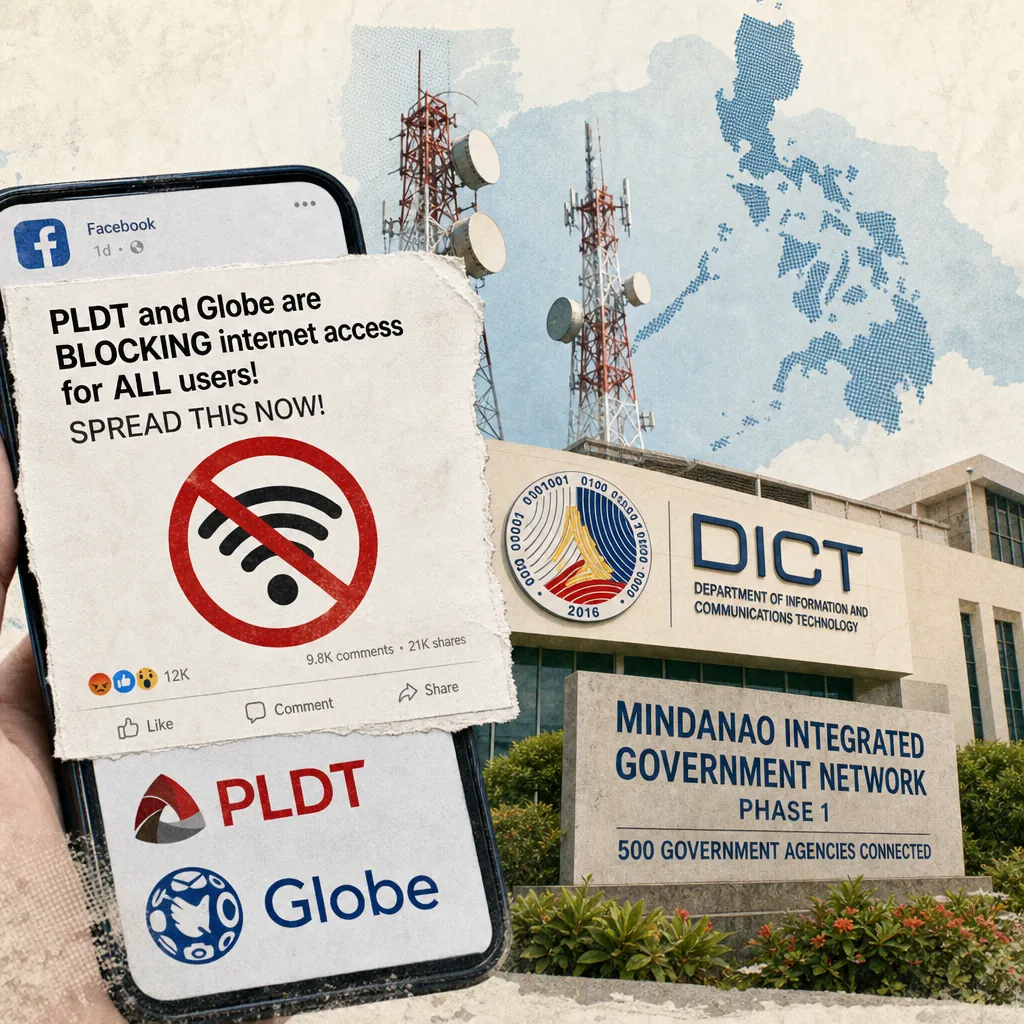
Philippine telcos shift focus from coverage to digital economy value
A strategic analysis of the Philippine telecommunications sector's transition from network expansion to capturing economic value, featuring the DICT's Mindanao fiber backbone launch, PLDT's digital agriculture push, and industry commentary on the end of the connectivity race.
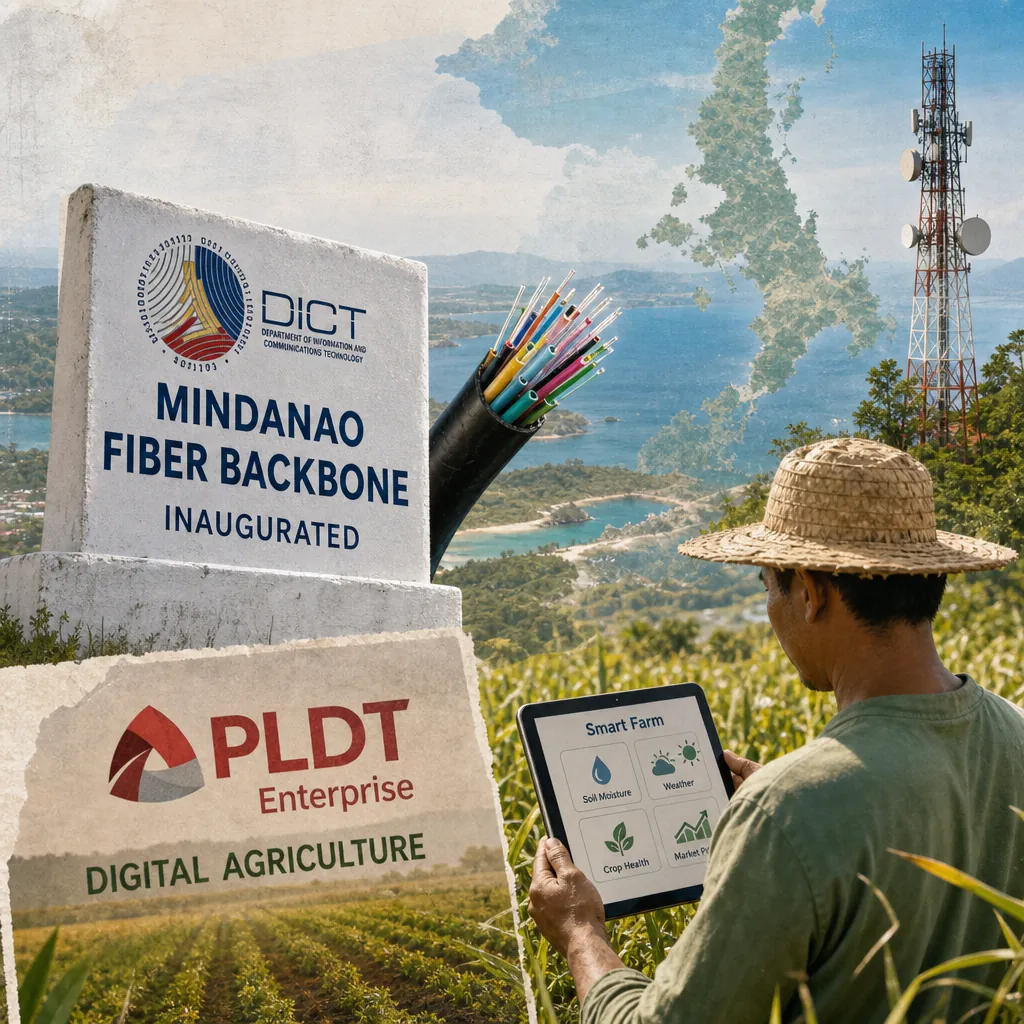
The Philippine telecommunications conversation on June 20–21, 2026, was dominated by a single strategic signal: the industry is moving past the era of pure network expansion and into a phase where the value of connectivity — measured in economic output, government service delivery, and sector-specific applications — takes center stage. The day's most significant development was the Department of Information and Communications Technology (DICT) launching Phase 1 of the Mindanao Integrated Government Network (MIGN), connecting 500 government offices across several cities and municipalities to a national fiber backbone. This was accompanied by a Manila Times analysis arguing that the "telco wars are no longer about connectivity", and a Philstar report on PLDT and Smart's push for digital agriculture adoption in ASEAN. Together, these items paint a picture of an industry whose public conversation is shifting from who has the most towers to how connectivity translates into measurable outcomes.
Conversation snapshot. The DICT's MIGN launch announcement on Inquirer Online generated the most direct engagement among the day's telco-related items, though specific like, share, and comment figures were not available in the monitoring data. The Manila Times analysis piece, published without visible engagement metrics, nonetheless represents a significant framing contribution — it is the kind of long-form industry commentary that shapes how journalists, analysts, and policymakers talk about the sector. The Philstar article on digital agriculture, featuring a PLDT and Smart executive, similarly carried no public engagement figures but signals the industry's deliberate effort to position itself in the agricultural modernization conversation. The absence of high-volume, viral-style engagement on these items is itself notable: the conversation is happening in policy and business media, not in the mass-market social feeds where outage complaints typically spike.
Key themes
- Government fiber backbone as a milestone. The DICT's launch of Phase 1 of the Mindanao Integrated Government Network (MIGN) under the National Fiber Backbone Project (NFBP) connected 500 government agencies and facilities in cities including Cagayan de Oro, Butuan, Davao City, Koronadal, and Pagadian. The NFBP is the Marcos administration's flagship program to build a unified digital infrastructure linking Luzon, Visayas, and Mindanao. The MIGN launch is the first major Mindanao-specific deliverable of that program, and the DICT framed it as enabling faster government services, stronger disaster response, and more efficient public administration.
- The end of the connectivity race. A Manila Times analysis argued that Philippine telecommunications competition has moved beyond building towers, signing subscribers, and pricing data aggressively. The piece noted that the Philippine mobile ecosystem already contributes roughly 8.5 percent of gross domestic product (GDP) — above the global benchmark — but that the DICT has set an ambitious target of 12 percent. Achieving that, the analysis said, requires capturing greater economic value from the time Filipinos already spend on their devices, not just expanding coverage. The piece cited the GSMA Digital Nations Summit held in Manila in November 2025 as the venue where these numbers were presented.
- Digital agriculture as a use case. PLDT and Smart, through assistant vice president and head of stakeholder engagement Stephanie Orlino, participated in the first episode of Grow Asia's Digital Learning Series, focusing on how digital foundations, reinforced with trust, relevance, and continuity, are keys to moving from access to sustained adoption among farmers. The report emphasized that in ASEAN countries, it is critical to meet smallholder farmers halfway and provide community-wide support, not just internet and devices. This positions the telcos as partners in agricultural modernization, a sector that remains a major employer and political priority across the region.
- Meralco's high-bill controversy as a parallel. While not a telco story, the Manila Electric Company (Meralco) faced a viral complaint from talent manager Cacai Mitra, whose electric bill reached ₱94,355.21. Meralco responded by saying it had reached out to Mitra and was reviewing her account. The incident is relevant to the telco sector because it demonstrates the reputational risk that utility companies face when billing surprises go viral — a dynamic that applies equally to internet and mobile service providers.
- Zoom's evolution as a benchmark. A Manila Times column traced Zoom's transformation from a simple video-calling tool to an "agentic" AI workspace called ZoomMate, launched on June 1, 2026. The piece noted that Zoom wants to go from being the place where you talk to being the place where the talking turns into finished work. This is relevant to Philippine telcos because it illustrates the global trend that the Manila Times analysis referenced: connectivity alone is no longer the value proposition; the value is in what the connection enables.
- Infrastructure and trust as dual requirements. The PLDT and Smart executive's remarks at the Grow Asia event explicitly linked infrastructure with trust, relevance, and continuity. This theme echoes the Manila Times analysis's argument that the next phase of competition will be about capturing economic value, not just providing access. It suggests that telcos are increasingly aware that their role in the digital economy depends on being seen as reliable partners, not just utility providers.
How the narratives stack
Dominant narrative — The connectivity race is over; the value race has begun. The strongest signal from the day's coverage is that Philippine telecommunications has entered a new strategic phase. The Manila Times analysis made this argument explicitly, and the DICT's MIGN launch and PLDT's digital agriculture push both illustrate it in practice. The narrative is that the industry has largely achieved its goal of widespread coverage, and the next challenge is to convert that connectivity into economic growth, government efficiency, and sector-specific outcomes. This is a story of maturation, not crisis.
Counter-narrative — Coverage gaps persist, and the race is not finished. The DICT's MIGN launch, while a milestone, connected only 500 government offices — a fraction of the total. The Manila Times analysis itself acknowledged that the coverage race "is not finished." Rural and remote areas, particularly in Mindanao, still lack reliable connectivity. The counter-narrative is that declaring the end of the connectivity race risks overlooking the millions of Filipinos who remain unconnected or under-connected, and that the industry's focus on value capture could come at the expense of continued expansion.
Emerging narrative — Telcos as enablers of sectoral transformation. The PLDT and Smart digital agriculture story, combined with the DICT's government network launch, points to an emerging narrative in which telcos position themselves not as standalone service providers but as infrastructure partners for specific sectors — agriculture, government, education, health. This is a more sophisticated value proposition than "fastest speeds" or "widest coverage," and it aligns with the DICT's target of growing the digital economy to 12 percent of GDP. If this narrative gains traction, it could reshape how telcos are perceived by policymakers and the public.
Suppressed narrative — Consumer pain points and service quality. The day's telco conversation was almost entirely strategic and policy-oriented. There was no significant discussion of network outages, slow speeds, customer service failures, or billing disputes — the kinds of consumer complaints that typically dominate social media. The Meralco high-bill controversy, while not a telco story, is a reminder that utility billing issues can go viral quickly. The absence of consumer pain points from the telco conversation may reflect a genuinely quiet period, but it could also mean that the monitoring window simply missed them. Either way, the consumer experience narrative is not getting proportionate attention relative to its potential impact on brand reputation.
Platform insights
The telco conversation on June 20–21, 2026, was concentrated in online news outlets rather than social media platforms. The DICT announcement appeared on Inquirer Online, the strategic analysis on Manila Times Online, and the digital agriculture story on Philstar Online. These are traditional news websites, not social feeds, and their engagement patterns are different: they are read, shared, and cited by journalists, analysts, and policymakers, but they do not generate the same volume of likes, comments, or shares as a viral Facebook post. The absence of significant social media activity around telco topics during this window suggests that the conversation is currently being driven by institutional voices — government agencies, industry analysts, and corporate communications — rather than by consumer complaints or grassroots advocacy. This is a relatively low-volume, high-signal environment, where a single well-placed article can shape the narrative more effectively than dozens of social media posts.
Key voices and communities
- Government agencies — DICT. The Department of Information and Communications Technology is the primary institutional voice driving the day's telco narrative. Its announcement of the MIGN Phase 1 launch positions the agency as the executor of the Marcos administration's digital infrastructure agenda. The DICT's framing emphasizes unity, efficiency, and disaster resilience — values that resonate with both policymakers and the public.
- Industry analysts and business media — Manila Times. The Manila Times analysis piece represents the voice of business journalism and industry analysis. It is not a government press release or a corporate announcement; it is an independent assessment of where the industry stands. This voice carries weight with investors, regulators, and industry insiders, and its argument that the connectivity race is over is likely to be cited in future discussions.
- Corporate stakeholders — PLDT and Smart. PLDT and Smart's participation in the Grow Asia Digital Learning Series shows the company actively engaging in sector-specific conversations beyond its core business. By sending a senior executive to speak about digital agriculture, PLDT and Smart are positioning themselves as partners in national development, not just commercial service providers. This is a deliberate effort to shape the narrative around the company's role in the digital economy.
- Consumer advocates and viral complainants — Cacai Mitra. While not a telco story, the Meralco high-bill controversy illustrates the power of individual consumer complaints to go viral and force a corporate response. Cacai Mitra, a talent manager and sister of singer Regine Velasquez-Alcasid, posted her shock at a ₱94,355.21 electric bill on Facebook, tagging Meralco. The post gained traction, and Meralco issued a statement saying it had reached out to her. This dynamic — a single post by a person with some public profile, amplified by social media — is a template for how telco billing or service complaints could escalate.
Narrative streams
The Mindanao fiber backbone launch
The DICT's launch of Phase 1 of the Mindanao Integrated Government Network (MIGN) on June 20, 2026, connected 500 government agencies and facilities across Cagayan de Oro, Butuan, Davao City, Koronadal, and Pagadian. The MIGN is part of the National Fiber Backbone Project (NFBP), the Marcos administration's program to build a unified digital infrastructure linking Luzon, Visayas, and Mindanao. The DICT framed the launch as a major milestone in fulfilling President Marcos's vision of seamless connectivity that enables faster government services, stronger disaster response, and more efficient public administration.
For the telecommunications sector, the MIGN launch is significant because it demonstrates government demand for connectivity — and government willingness to invest in it. The NFBP is a public-sector infrastructure project, but it relies on partnerships with private telcos for last-mile connectivity and maintenance. The launch signals that the government is serious about expanding digital infrastructure in Mindanao, which could create opportunities for telcos to bid for contracts or partner on service delivery. It also sets a benchmark: if the government can connect 500 offices, it raises expectations for private-sector coverage in the same areas.
The strategic pivot from coverage to value
The Manila Times analysis, headlined "The Philippine telco wars are no longer about connectivity," argued that the industry has reached a point where coverage is no longer the primary differentiator. The piece cited GSMA data showing that the Philippine mobile ecosystem contributes roughly 8.5 percent of GDP, above the global benchmark, but noted that the DICT has set a target of 12 percent. Achieving that, the analysis said, requires capturing greater economic value from the time Filipinos already spend on their devices — through digital services, e-commerce, fintech, and sector-specific applications.
The analysis also noted that the revenue model of selling data plans is "running out of road," implying that telcos need to find new sources of growth. This is a sobering message for an industry that has long relied on subscriber growth and data consumption increases. It suggests that the next phase of competition will be about partnerships, platforms, and value-added services — areas where telcos have historically struggled to compete with over-the-top players like Facebook, Google, and Netflix.
For the sector, this narrative stream is important because it frames the strategic challenge ahead. It is not a crisis — the industry is healthy by global standards — but it is a signal that the easy growth is over. Telcos that fail to adapt risk becoming dumb pipes, while those that successfully pivot to value-added services could capture a larger share of the digital economy.
Digital agriculture as a use case
PLDT and Smart's participation in the Grow Asia Digital Learning Series is a concrete example of the pivot the Manila Times analysis described. Stephanie Orlino, the company's assistant vice president and head of stakeholder engagement, spoke about how strong digital foundations, reinforced with trust, relevance, and continuity, are keys to moving from access to sustained adoption among farmers. The report emphasized that in ASEAN countries, it is critical to meet smallholder farmers halfway and provide community-wide support, not just internet and devices.
This narrative stream positions PLDT and Smart as enablers of agricultural modernization — a sector that employs a large share of the Philippine workforce and is a political priority. By engaging in this conversation, the company is building relationships with agricultural stakeholders, government agencies, and international development organizations. It is also generating positive media coverage that associates the brand with national development rather than just commercial service.
For the sector, the digital agriculture story illustrates how telcos can create value beyond connectivity. It also highlights the importance of partnerships: PLDT and Smart are not trying to build agricultural apps themselves; they are providing the connectivity and expertise that enable others to build them. This is a model that could be replicated in other sectors — health, education, logistics — and it aligns with the DICT's goal of growing the digital economy.
Conversation trajectory
The telco conversation is likely to continue shifting from coverage metrics to value metrics over the next 6–12 months. The DICT's target of 12 percent digital economy GDP share provides a clear benchmark, and government announcements like the MIGN launch will keep the infrastructure narrative alive. However, the real test will be whether telcos can demonstrate tangible outcomes — more farmers using digital tools, more government services delivered online, more businesses adopting digital payments. If they can, the narrative will reinforce the idea that the industry is maturing successfully. If they cannot, the conversation could shift back to coverage gaps and service quality complaints.
Next 4–6 weeks: The impeachment trial of Vice President Sara Duterte, set to begin in July, will dominate Philippine news and likely crowd out telco coverage. The sector should expect a quieter period in terms of public attention, which could be an opportunity to seed positive stories about network upgrades, digital agriculture partnerships, or 5G milestones without competing for headlines.
Next 3–6 months: The DICT is expected to announce further phases of the National Fiber Backbone Project, potentially extending connectivity to more government offices and remote areas. Each announcement will generate a news cycle and reinforce the government's digital infrastructure narrative. Telcos that are visibly involved in these projects — either as partners or as beneficiaries of improved backbone connectivity — will benefit from the positive framing.
Trigger events that would reshape the conversation: A major network outage affecting a large area or a significant number of subscribers would immediately shift the conversation back to service quality and consumer complaints. Similarly, a regulatory development — such as a new SIM registration deadline, a spectrum auction, or a policy change on data caps — could generate a spike in public discussion. The Meralco high-bill controversy is a reminder that a single viral post can force a corporate response and dominate the news cycle for a day or two. Telcos should have rapid-response protocols in place for such scenarios.
Response guidance
For communicators in the Philippine telecommunications sector, the current conversation environment presents an opportunity to shape the narrative around value and impact rather than just coverage and speed. The following approaches are recommended:
- Amplify government partnerships. The DICT's MIGN launch and the NFBP more broadly are positive stories that associate telcos with national development. Communicators should proactively highlight their company's role in these projects — whether through direct contracts, last-mile connectivity, or technical expertise. This positions the brand as a partner to government, not just a commercial operator.
- Invest in sector-specific storytelling. The PLDT and Smart digital agriculture story is a model for how to generate positive coverage in non-telco media. Communicators should identify two or three sectors — agriculture, health, education, logistics — where their company is making a difference and develop case studies, executive bylines, and media pitches around them. This diversifies the brand's media presence beyond the business and tech pages.
- Prepare for the consumer pain point narrative to resurface. The current quiet period on consumer complaints is unlikely to last. Communicators should have pre-approved response templates for common scenarios — outage acknowledgment, billing dispute, speed complaint — and ensure that customer service teams are empowered to respond quickly on social media. The Meralco incident shows that a slow or tone-deaf response can amplify a single complaint into a reputational issue.
- Monitor the impeachment trial's impact on news cycles. From July onward, the impeachment trial of Vice President Sara Duterte will dominate Philippine news. Telco communicators should plan their media outreach around this reality: pitch stories that are timely and relevant but avoid competing directly with trial coverage. The quiet period could be used to build relationships with journalists and prepare materials for when the news cycle shifts.
- Track the DICT's 12 percent GDP target. This target is likely to become a recurring reference point in industry coverage. Communicators should ensure their company's messaging aligns with it — for example, by citing the company's contribution to the digital economy in press releases and executive speeches. This positions the company as a contributor to a national goal, not just a commercial entity.
See the full picture behind today's signals.
This report draws from Media Meter's MediaWatch, our real-time monitoring engine tracking 2,470+ Philippine sources across print, broadcast, digital, and social. Explore how the platform turns raw coverage into decision-grade intelligence, then see how it's configured for teams like yours — whether you're in PR agencies, corporate comms, government, or marketing.
Want more? Browse our Report Library for sector and crisis intelligence, or request a demo and we'll have your brand set up before the call.
Want this kind of intelligence on your brand?
This brief is built on the same MediaWatch methodology that runs continuously across every brand we monitor. See your competitive landscape, Impact Score, and narrative trajectory in a 30-minute demo.