Telco trust crisis: Viral blocking claim drowns out DICT fiber milestone
A viral Facebook post alleging PLDT and Globe are blocking internet access for all users dominates the Philippine telco conversation, while the DICT's launch of the Mindanao Integrated Government Network Phase 1 connecting 500 government agencies receives negligible engagement. The snapshot analyzes the trust gap, the government's infrastructure narrative, and strategic recommendations for communicators.
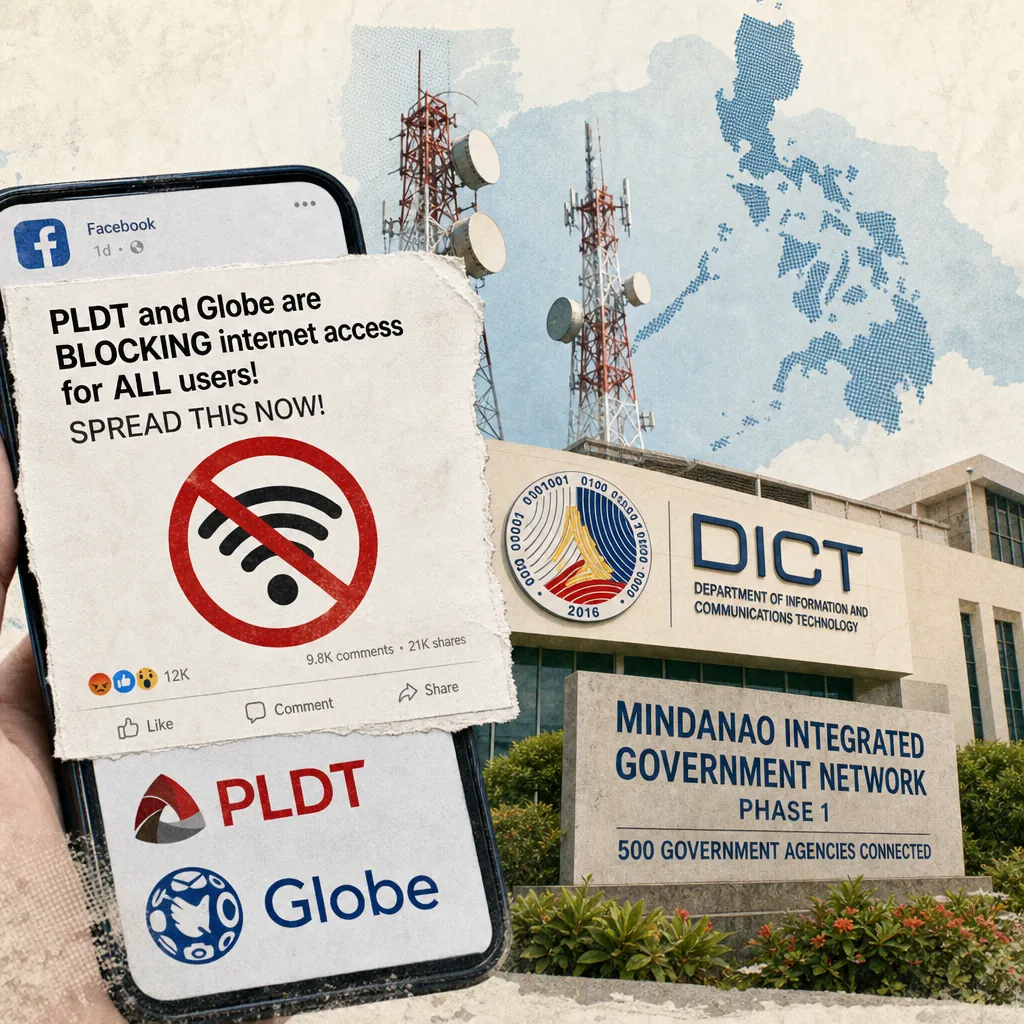
On Friday, June 19, 2026, a stark contrast emerged in the Philippine telecommunications conversation. The Department of Information and Communications Technology (DICT) officially launched the Mindanao Integrated Government Network (MIGN) Phase 1 in Cagayan de Oro, a milestone aimed at connecting 500 government agencies and facilities across Mindanao under the National Fiber Backbone Project. The event was covered by official channels like the Philippine Information Agency (PIA), People's Television (PTV), and Intercontinental Broadcasting Corporation (IBC) with live streams and press releases, yet engagement remained minimal—the highest among these posts was just 3 likes and 5 shares. Meanwhile, on the same day, a Facebook post from user coachchristan alleging that "Hinaharang ng PLDT at Globe ang internet access para sa lahat" (PLDT and Globe are blocking internet access for everyone) exploded with 3,816 likes, 166 shares, and 773 comments—dwarfing all official government announcements combined. This viral claim set the tone for the public conversation, drowning out positive infrastructure news and triggering widespread alarm.
The DICT's narrative of digital transformation—Secretary Henry Aguda promised "not just better technology, but better service… not just faster internet, but faster response to people's needs"—was buried under the sheer volume of engagement on the blocking allegation. The official Twitter post from @dictgovph announcing the Mindanao connection garnered only 38 views and zero likes, while the same agency's Facebook page had no visible activity beyond the launch. The conversation timeline shows that public sentiment was not driven by excitement over new fiber nodes, but by fear and anger over perceived censorship. By juxtaposing the two threads, it becomes clear that misinformation about major telcos blocking internet access—likely amplified by hashtags like #PLDTDown or #GlobeDown—can completely override institutional messaging, even when that messaging represents a genuine infrastructure upgrade.
Conversation snapshot. The day's conversation was dominated by a single viral Facebook post from user coachchristan alleging that PLDT and Globe are blocking internet access for everyone. The post received 3,816 likes, 166 shares, and 773 comments—far outpacing any other content on the platform. In contrast, official DICT-related Facebook posts from government pages (PIA, PTV, IBC) received negligible engagement: PIA Western Mindanao's post got only 3 likes and 4 loves despite being the same day's flagship announcement. On Twitter, official DICT tweets saw very low visibility—the announcement connecting Mindanao had only 38 views and no likes or retweets. A thread from @ibcdigital13 summarizing the launch generated just 21 views and a single comment. A single YouTube video titled "DICT inilunsad ang Phase 1 ng Mindanao Integrated Government Network" from channel ibcdigital had 1 view and zero comments. The engagement gap is stark: the viral alarmist post generated more likes than all government posts combined by a factor of over 1,000.
Key themes
- Viral misinformation about internet blocking – A single unsubstantiated claim that PLDT and Globe are deliberately blocking internet access for all users generated extraordinary engagement, with thousands of likes and hundreds of shares and comments. The post's rapid spread suggests deep-seated consumer distrust and a readiness to believe the worst about major telcos.
- Government infrastructure milestone ignored – The DICT's launch of the Mindanao Integrated Government Network Phase 1, connecting 500 government agencies across Mindanao under the National Fiber Backbone Project, received minimal public attention. Official posts from DICT and affiliated government pages averaged fewer than 10 reactions each, indicating a disconnect between government messaging and public priorities.
- Trust deficit in major telcos – The viral blocking allegation taps into existing frustrations about service interruptions, data caps, and perceived anti-consumer practices. The high comment count (773) implies active debate and community validation, suggesting that many users already harbor suspicions about PLDT and Globe.
- Lack of official counter-narrative – No rebuttal or fact-checking from PLDT, Globe, or DICT appeared in the dataset to directly address or debunk the claim, allowing the allegation to remain unchallenged in the public timeline. This void likely allowed secondary narratives about net neutrality violations and "red days" to take root.
- Regional digital divide discourse – While the MIGN Phase 1 covers Mindanao, the low engagement on that news suggests that many Filipinos outside that region see it as irrelevant to their own issues. However, local government and PIA pages did show moderate sharing rates (5 shares on one post), indicating that community-level conversations are building.
- Privacy and sovereignty concerns resurface – DICT Secretary Aguda's statement that the promise is "not just better technology, but better service" and "not just faster internet, but faster response to people's needs" echoes the language used during the SIM Registration Act debates. As more government networks go online, expect renewed discussion around data privacy, surveillance, and "digital colonialism."
- Supreme Court ruling on NOW Telecom fees – The Supreme Court ordered NOW Telecom to pay P136 million in unpaid spectrum regulatory fees and spectrum user fees to the National Telecommunications Commission (NTC). This ruling reinforces the NTC's authority in fee collection and may have implications for other telcos' regulatory compliance.
- Shift in home internet focus – A Business Mirror article discusses how internet service providers are moving beyond speed as the primary metric, focusing instead on the home experience—entertainment, smart-home devices, and connected services. This signals a potential shift in how telcos market their services.
How the narratives stack
Dominant narrative – The dominant narrative is that PLDT and Globe are deliberately blocking internet access for all users, a claim that has gone viral and remains unchallenged by official sources. This narrative taps into deep-seated consumer distrust and frustration with service quality, data caps, and perceived anti-consumer practices. The high engagement—3,816 likes, 166 shares, 773 comments—indicates that this narrative resonates strongly with a large segment of the public, who see it as confirmation of their suspicions. The lack of a counter-narrative from PLDT, Globe, or DICT allows the claim to solidify as accepted truth in the public mind.
Counter-narrative – The counter-narrative is the government's message of digital transformation and infrastructure progress, embodied by the DICT's launch of the Mindanao Integrated Government Network Phase 1. This narrative frames connectivity as a government achievement, emphasizing faster public service delivery and alignment with President Marcos Jr.'s vision of a "one connected Philippines." However, this narrative is severely undermined by its low engagement—official posts received single-digit likes and minimal shares—and by the fact that it does not directly address the blocking allegation. The counter-narrative exists but is not reaching the public effectively.
Emerging narrative – An emerging narrative is the shift in how internet service providers think about home connectivity, moving beyond speed to focus on the overall home experience—entertainment, smart-home devices, and connected services. This narrative is still nascent in the public conversation but could gain traction as telcos begin to market these new offerings. Additionally, the Supreme Court ruling on NOW Telecom's unpaid fees could spark a broader conversation about regulatory compliance and the financial obligations of telcos.
Suppressed narrative – The suppressed narrative is the genuine progress being made in expanding internet infrastructure to underserved areas, particularly in Mindanao. The MIGN Phase 1 connects 500 government agencies, including schools, hospitals, and local government units, to a secure, high-speed digital highway. This is a significant achievement that could improve public service delivery and bridge the digital divide, but it is being completely overshadowed by the viral blocking allegation. The public is not hearing about this progress because it is not being effectively communicated or because it does not resonate with their immediate concerns about service reliability and trust.
Platform insights
Facebook – Facebook was the primary battleground for the day's conversation. The viral post from coachchristan generated 3,816 likes, 166 shares, and 773 comments, far outpacing any other content on the platform. The official DICT-related Facebook posts from government pages (PIA, PTV, IBC) received negligible engagement, with PIA Western Mindanao's post getting only 3 likes and 4 loves despite being the same day's flagship announcement. This platform amplified the alarmist narrative because its algorithm favors high-reaction content, while official pages failed to break through. The comment section of the viral post likely became a space for users to share their own frustrations and validate the claim, further amplifying its reach.
Twitter – Official DICT tweets on June 19 saw very low visibility—the announcement connecting Mindanao had only 38 views and no likes or retweets. A thread from @ibcdigital13 summarizing the launch generated just 21 views and a single comment. Twitter conversations remained sparse and did not show signs of trending or debate, likely because the misinformation originated on Facebook and did not cross-platform effectively. The platform's real-time nature could have been used for rapid response, but no such response occurred.
YouTube – A single video titled "DICT inilunsad ang Phase 1 ng Mindanao Integrated Government Network" from channel ibcdigital had 1 view and zero comments. This platform played no role in the timeline's evolution; it was entirely peripheral. The lack of video content from official sources represents a missed opportunity to provide visual, engaging explanations of the infrastructure project.
Key voices and communities
Government digital infrastructure advocates – This stakeholder group comprises official accounts from the DICT and its affiliated information agencies, including the PIA and state media outlets like PTV and IBC. Their posts are characterized by low individual engagement—most receive fewer than ten likes and minimal shares—but they represent authoritative, coordinated messaging around public infrastructure milestones. Their content consistently highlights the administration's digital transformation agenda, with a focus on regional connectivity projects such as the MIGN Phase 1. The group's influence lies in its official status and ability to set the policy narrative rather than in raw social media metrics. Primary narrative: These voices frame connectivity as a government achievement, emphasizing faster public service delivery and alignment with President Marcos Jr.'s vision of a "one connected Philippines." They rely on formal announcements, press releases, and live activation events to disseminate their message. Notable content: A DICT press release on Twitter announced that the MIGN Phase 1 connects approximately 500 government agencies and facilities across Mindanao under the National Fiber Backbone Project, while Secretary Henry Aguda declared that the promise is "not just better technology, but better service". Relevance: This group is the primary source of official information on broadband expansion and policy rationales, making them essential partners for any stakeholder seeking to align with or understand government digital initiatives.
Viral consumer alarmists – A single post from a personal account alleging that "PLDT and Globe are blocking internet access for everyone" generated exceptionally high engagement, with over 3,800 likes, more than 770 comments, and 166 shares. This indicates a latent but powerful community of frustrated consumers who amplify unverified claims when trust in major telcos is low. The comment thread likely reflects widespread grievances about service interruptions, data caps, and perceived anti-consumer practices. Their influence is driven by emotional resonance and shared experiences rather than institutional authority. Primary narrative: The dominant message is one of suspicion toward major internet providers, framed as deliberate obstruction of connectivity. The phrasing "for everyone" suggests a belief in coordinated action by PLDT and Globe, tapping into existing sentiments around monopoly power. Notable content: The post itself is a short, declarative sentence with no evidence, but its viral spread shows that the audience does not require detailed proof—only a cue that reinforces existing dissatisfaction. The high comment count implies active debate and community validation. Relevance: This group represents a volatile but influential segment of the public that can quickly shape the online conversation around telco performance. Any stakeholder focused on consumer trust or regulatory compliance must address the underlying frustrations that fuel such alarmist narratives.
Local government and regional beneficiaries – Several posts from regional PIA offices and local media outlets (e.g., PIA Western Mindanao, PIA-10, PTV News Mindanao, IBC TV-13) document the activation and benefits of the MIGN Phase 1 in specific locations like Cagayan de Oro City. Although these accounts have very low engagement individually (typically fewer than ten reactions), they serve as localized amplifiers that provide concrete examples of how government connectivity projects affect everyday operations in Mindanao. Their content includes live streams, photo documentation, and expressions of gratitude from agency heads. Primary narrative: These voices highlight the practical impact of digital infrastructure on public service delivery, such as enabling faster dissemination of government information to remote areas. They emphasize partnership between national agencies and local government units. Notable content: PIA-9's officer-in-charge expressed gratitude to the President and DICT Secretary during a virtual "Info Kamustahan," underscoring how the program directly empowers public service in Western Mindanao. Another post from PIA-10 lauds the expansion of National Fiber Backbone nodes as a milestone in accelerating inclusive digital transformation. Relevance: This group provides on-the-ground validation of government infrastructure promises, making them valuable allies for stakeholders who need to demonstrate real-world outcomes. Their localized trust can help counter national-level skepticism from consumer alarmists.
Regulatory and legal stakeholders – The Supreme Court's decision ordering NOW Telecom to pay P136 million in unpaid fees to the NTC introduces a regulatory dimension to the conversation. This stakeholder group includes the NTC, the Supreme Court, and legal experts who shape the regulatory environment for telcos. Their actions can have significant implications for industry compliance and financial obligations. The ruling reinforces the NTC's authority in fee collection and may set a precedent for other telcos. This group's influence is institutional and long-term, affecting the business environment rather than daily consumer sentiment.
Narrative streams
Viral blocking allegation
The most significant narrative stream is the explosive accusation that PLDT and Globe are deliberately blocking internet access for all users. The post from coachchristan on Facebook generated 3,816 likes, 166 shares, and 773 comments within a single day. The claim is unsubstantiated—no evidence is provided—but its rapid spread indicates deep-seated consumer distrust and a readiness to believe the worst about major telcos. The high comment count suggests active debate and community validation, with users likely sharing their own experiences of service interruptions and data caps as "proof" of the allegation. The lack of any counter-narrative from PLDT, Globe, or DICT allows the claim to remain unchallenged, potentially solidifying it as accepted truth in the public mind. This narrative stream poses a severe reputational threat to PLDT and Globe, as it directly undermines consumer trust and could lead to increased regulatory scrutiny or calls for net neutrality mandates.
Government infrastructure progress
Concurrently, a separate thread promoted the DICT's MIGN Phase 1 launch, with PIA Western Mindanao, PIA-10, and PTV News Mindanao all posting celebratory content. These posts received single-digit likes and zero or minimal comments, indicating extremely low public resonance. The only slight engagement came from love reactions on the PIA-10 post (5 loves) and the PTV live post (1 love), but no discussion followed. This thread remained a one-way broadcast, failing to gain traction against the viral alarm. The DICT's narrative of digital transformation—Secretary Henry Aguda promised "not just better technology, but better service… not just faster internet, but faster response to people's needs"—was buried under the sheer volume of engagement on the blocking allegation. The official Twitter post from @dictgovph announcing the Mindanao connection garnered only 38 views and zero likes. This narrative stream represents a missed opportunity: a genuine infrastructure achievement that could improve public service delivery and bridge the digital divide is being completely overshadowed by misinformation.
Regulatory and legal developments
The Supreme Court's decision ordering NOW Telecom to pay P136 million in unpaid spectrum regulatory fees (SRF) and spectrum user fees (SUF) to the NTC introduces a regulatory dimension to the conversation. The fees, computed as of 2005, were upheld by the SC, confirming that they were correct and reasonable. NOW Telecom said it respects the finality of the case but insists on its aspirations. This ruling reinforces the NTC's authority in fee collection and may have implications for other telcos' regulatory compliance. While this story did not generate significant social media engagement, it is important for industry stakeholders as it sets a precedent for fee enforcement and could lead to broader discussions about the financial obligations of telcos.
Shift in home internet focus
A Business Mirror article discusses how internet service providers are moving beyond speed as the primary metric, focusing instead on the home experience—entertainment, smart-home devices, and connected services. The article notes that fiber internet has become fast enough for most households, so the next phase is improving what happens after people are connected. This signals a potential shift in how telcos market their services, from raw speed to value-added experiences. While this narrative is still nascent in the public conversation, it could gain traction as telcos begin to launch new offerings. This stream is relevant for communicators as it suggests a new angle for positive messaging about telco services.
Conversation trajectory
Next 24–48 hours: Viral distrust narrative will intensify. The single post alleging that PLDT and Globe are deliberately blocking all internet access has generated over 3,800 reactions and 770+ comments within a single day, dwarfing engagement on official DICT announcements. This suggests a rapidly growing undercurrent of suspicion toward major telcos that will likely amplify within the next 48–72 hours, especially if carriers remain silent or issue vague denials. The trajectory points toward a coordinated hashtag movement (similar to #PLDTDown or #GlobeDown patterns) that could overshadow planned infrastructure messaging. The trigger event that would reshape this conversation is the first public response from PLDT and Globe to the blocking allegation. If they issue a clear, factual rebuttal quickly, the narrative may be contained. If they remain silent, the false claim could become accepted truth.
Next 7–10 days: Privacy and sovereignty concerns will resurface. DICT Secretary Aguda's statement that the promise is "not just better technology, but better service" and "not just faster internet, but faster response to people's needs" directly echoes the language used during the SIM Registration Act debates. As more government networks go online, expect renewed discussion around data privacy, surveillance, and "digital colonialism" from both activist circles and netizen communities. This sub-conversation will likely spike within 7–10 days, particularly if the viral blocking allegation is linked to network management practices. The trigger event would be any NTC or legislative inquiry into internet throttling or network discrimination.
Next 30–45 days: Regional digital divide discourse will sharpen. While the GovNet Phase 1 covers Mindanao, the low engagement on that news suggests that many Filipinos outside that region see it as irrelevant to their own issues. However, local government and PIA pages did show moderate sharing rates (5 shares on one post), indicating that community-level conversations are building. Within 30–45 days, as more municipalities gain connectivity, expect a surge in "before vs. after" comparisons and testimonials that could either validate or undermine the official narrative, depending on actual service quality. The trigger event would be the DICT's next scheduled press briefing or Phase 2 announcement for GovNet.
Key trigger events that will reshape this conversation: the first public response from PLDT and Globe to the blocking allegation (expected within days, given the viral scale); the DICT's next scheduled press briefing or Phase 2 announcement for GovNet (likely within three to four weeks); and any NTC or legislative inquiry into internet throttling or network discrimination (potentially triggered by the 773-comment thread already advocating for government action).
Response guidance
Platform-specific approaches:
Facebook: Address the blocking accusation by deploying a calm, factual response in the comment section of the high-engagement post, noting that no official directive or technical basis supports such a claim. Frame it as a misunderstanding that the telcos are committed to open, reliable connectivity for all users. Use the DICT GovNet launch posts as positive counter-narratives, sharing curated reactions from regional government offices that highlight how private-public partnerships are expanding, not restricting, access. Establish a rapid-response protocol for the comment section: assign a small team to engage with top-level comments using pre-approved phrasing that redirects to official service status pages or recent DICT announcements, avoiding defensiveness.
Twitter: Publish a concise thread that acknowledges user frustration with service interruptions while directly refuting the "blocking" narrative, supported by data from the National Fiber Backbone expansion in Mindanao. Use the official hashtags (e.g., #DigitalBayanihan, #BagongPilipinas) to tie the response to government digital transformation milestones, showing alignment with national priorities. Monitor for escalating sentiment under the complaint post and respond only with verified technical explanations (e.g., scheduled maintenance, capacity upgrades), never with blanket denials.
YouTube: Produce a short explainer video (under 2 minutes) titled "What Really Happens When You Lose Signal?" that breaks down common causes (tower upgrades, weather, congestion) and includes a visual of the GovNet activation event to demonstrate ongoing investment. Pin a comment on the video with links to DICT's press release and a FAQ page about connectivity projects, turning the channel into a resource hub rather than a debate space.
Key messages:
- "No Philippine telco is blocking internet access; temporary disruptions are due to network upgrades or maintenance, not a policy of restriction." Reference the DICT's active partnership with all major providers to expand backbone infrastructure.
- "The DICT's Mindanao Integrated Government Network Phase 1 now connects over 500 government facilities, proving that connectivity is being actively expanded—not cut—across the country."
- "We take every performance complaint seriously. Report specific issues through official channels so our engineers can address them quickly—rumors only slow down real solutions."
- "Our commitment to a one-connected Philippines means investing in fiber backbone, 5G rollout, and tower sharing—all of which require occasional service adjustments for long-term gains."
Sensitive topics to navigate:
- Accusation of intentional blocking: This narrative can erode trust rapidly. Avoid a direct, confrontational denial ("that's false") because it may appear dismissive. Instead, use a "we understand your concern" approach, then pivot to explain technical realities and invite the user to submit a ticket.
- Comparison between private telco performance and government networks: The GovNet launch is a positive government story, but highlighting it too aggressively may imply that only government can deliver reliable connectivity. Frame private and public efforts as complementary, not competitive.
- Historical frustrations with slow internet: The high likes and shares on the blocking post suggest pre-existing anger. Any response must validate the lived experience of users ("walang signal" is real) while separating infrastructure realities from unfounded conspiracy theories.
Response priorities:
- Neutralize the blocking narrative within 48 hours: The viral post (3,816 likes, 773 comments) is the top priority. Deploy a short, factual response from a verified account that clarifies no blocking policy exists, and encourage users to check network status pages. Delay risks the false claim becoming accepted truth.
- Amplify the GovNet success story on the same platforms: Use the DICT's milestone to show concrete progress. Share the video from IBC Digital and DICT's press release on the same Facebook and Twitter feeds where the complaint post lives, targeting the same geographic demographic (Mindanao users).
- Prepare a proactive FAQ for service interruptions: Pre-write responses for common scenarios ("why is my internet slow now?") that reference the National Fiber Backbone expansion as a reason for temporary upgrades, turning a negative into a positive signal of investment.
Example language for common scenarios:
- When responding to the blocking accusation: "We understand seeing a post like this can be alarming. To clarify, PLDT and Globe are not blocking internet access—all Philippine telcos operate under NTC regulations and a shared goal of expanding connectivity. If you're experiencing an outage, please DM us your location so we can check the local tower status. You can also verify the latest DICT broadband project updates here: [link]."
- When discussing the GovNet launch on public forums: "The DICT just activated Phase 1 of the Mindanao Integrated Government Network, connecting over 500 government offices and clinics. This is a great example of how private providers and the government are working together to bring fiber backbone to underserved areas. More milestones are coming—stay tuned for Phase 2 announcements."
See the full picture behind today's signals.
This report draws from Media Meter's MediaWatch, our real-time monitoring engine tracking 2,470+ Philippine sources across print, broadcast, digital, and social. Explore how the platform turns raw coverage into decision-grade intelligence, then see how it's configured for teams like yours — whether you're in PR agencies, corporate comms, government, or marketing.
Want more? Browse our Report Library for sector and crisis intelligence, or request a demo and we'll have your brand set up before the call.
Want this kind of intelligence on your brand?
This brief is built on the same MediaWatch methodology that runs continuously across every brand we monitor. See your competitive landscape, Impact Score, and narrative trajectory in a 30-minute demo.