PIMS 2026 opens amid consumer trust concerns over BYD reliability
The Philippine International Motor Show 2026 opens with strong attendance and 17 global brands, but consumer conversation on Reddit reveals growing hesitation around BYD vehicles after a bank reports multiple unit returns, while a broader 'no perfect car' sentiment emerges among buyers.
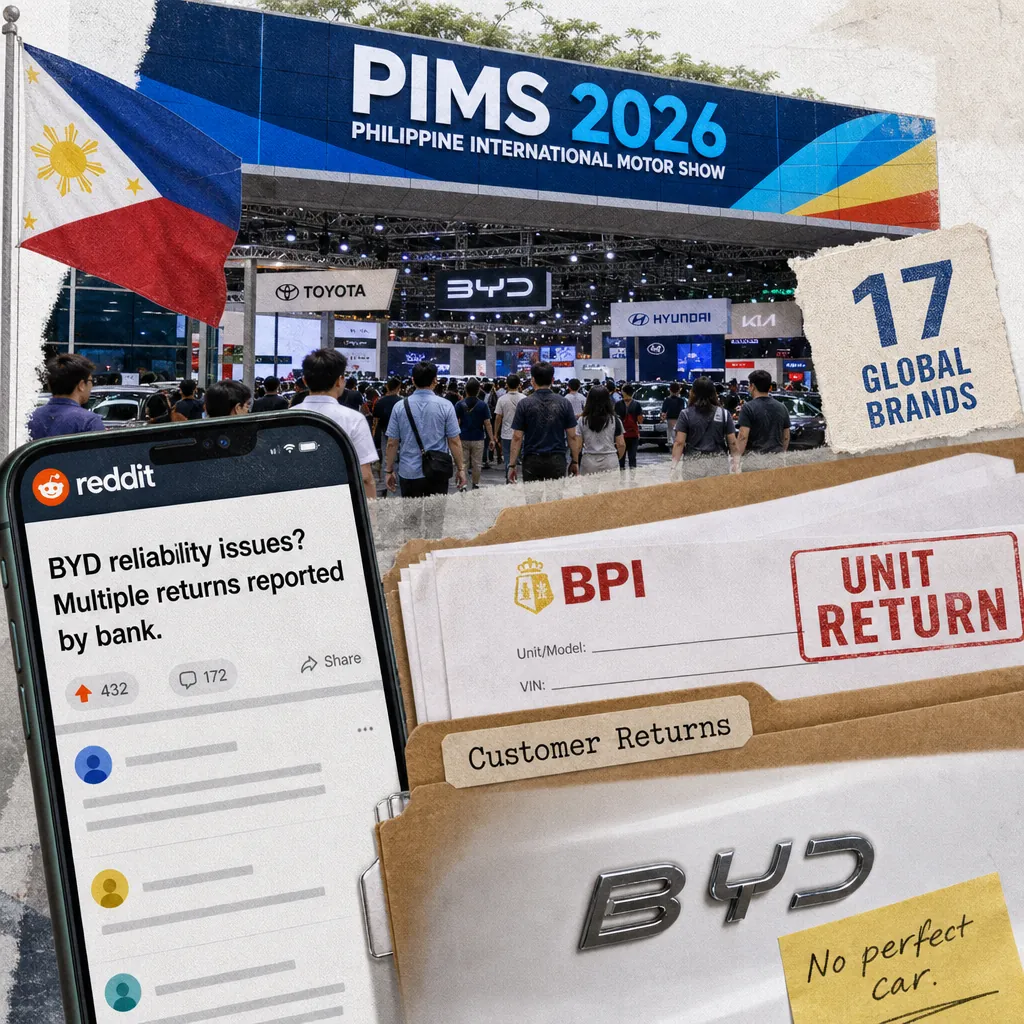
The 10th Philippine International Motor Show (PIMS 2026) opened on June 9 with strong attendance and 17 global automotive brands showcased, generating positive initial coverage that frames mobility as diverse and forward-looking. Manila Bulletin Drive published an official opening recap noting the scale of the event, though it received only 7 likes and 1 share on Facebook, suggesting that while the show is a significant industry milestone, its immediate social media engagement was modest. However, the most consequential conversation on June 10 unfolded not on the show floor but on Reddit, where user Thick-Role-7849 posted a "deinfluence me" request regarding the BYD Sealion 6 HEV, revealing a critical tension: "my bank told me na apat na client na daw ang nagbabalik ng unit nila (BYD)." This claim of four returned BYD units injected direct doubt into brand trust, contrasting sharply with the polished media coverage from the previous days. Meanwhile, user Alive_Citron_5150 posted a philosophical reflection that gained 20 likes and 30 comments, stating "Walang pala talagang perfect na kotse eh noh?" (There really is no perfect car) and advising buyers to follow their heart rather than public opinion. This post appeared partly as a response to the heated debates around brand choices, capturing the emotional fatigue many Filipino car buyers feel when navigating conflicting reviews and rumors.
A new narrative thread emerged around BYD quality concerns and buyer hesitation, building directly off the cautious curiosity toward Chinese brands noted on June 9. The Sealion 6 post from Thick-Role-7849 accumulated 5 likes and 26 comments, making it one of the most engaged Reddit threads in the dataset. The user explicitly compared the Sealion 6 with the Jetour T1—"when i saw SL6 mas okay din pala sya and mas mura kesa kay T1" (when I saw the Sealion 6, it was actually better and cheaper than the T1)—but the bank’s anecdotal return data created a powerful disincentive. This post marks a turning point where institutional word-of-mouth (from a bank) overrode the enthusiastic media and dealer messaging seen on Facebook and YouTube. Separately, a technical Reddit post by shameelck about the BYD Denza Z9 GT’s charging curve (3%-84% on a 400kW charger) garnered 3 likes and 23 comments, indicating a niche but engaged audience interested in pure EV performance metrics rather than hybrid practicality. Together, these posts show that the BYD ecosystem—encompassing both mass-market Sealion and luxury Denza lines—is facing a credibility gap that exists alongside strong product intrigue.
The "no perfect car" sentiment amplified by Alive_Citron_5150’s post reflects a broader consumer coping mechanism in a market flooded with new options and conflicting opinions. With 20 likes and 30 comments, this post resonated widely, suggesting that many Filipino car buyers feel overwhelmed. The comment that "kahit anong unit or brand ng kotse piliin mo, may masasabi at masasabi paring negative ang mga tao" (no matter what car or brand you choose, people will always have something negative to say) directly echoes the skepticism seen in the BYD thread and the cautious "we wondered about the quality" framing from the Denza D9 post on June 9. This chronologically ties the June 10 Reddit sentiment back to the June 9 media coverage, showing how the conversation evolved from professional curiosity to personal anxiety about making the wrong choice. The PIMS opening post from Manila Bulletin Drive, with only 1 comment and modest engagement, served more as a backdrop than a conversation driver, highlighting that by midweek, the audience had moved from event spectacle to practical purchase dilemmas.
Conversation snapshot. The June 10 conversation was dominated by Reddit activity, with three key threads driving the narrative. The BYD Sealion 6 "deinfluence" post received 5 likes and 26 comments, making it the most engaged thread by comment count. The "no perfect car" post garnered 20 likes and 30 comments, reflecting broad resonance with consumer fatigue. The BYD Denza Z9 GT charging curve post attracted 3 likes and 23 comments, indicating niche but active interest in EV performance. On Facebook, the Manila Bulletin Drive PIMS opening recap received 7 likes, 1 share, and 3 love reactions, showing low engagement relative to the show's significance. In contrast, the June 9 conversation saw higher Facebook engagement for new-model announcements: the GWM Haval H7 post from AutoIndustriya received 69 likes and 21 shares, while Toyota's Land Cruiser Hybrid announcement on Twitter garnered 73 views but zero likes or shares, highlighting a platform divide where Facebook drives emotional reactions and Twitter serves as a passive news feed.
Key themes
- BYD reliability concerns and buyer hesitation — A Reddit user reported that their bank mentioned four clients returning BYD units, creating a powerful anti-recommendation that undermines brand trust. The post generated 26 comments, with users debating whether the anecdote reflects a genuine quality issue or isolated incidents.
- "No perfect car" consumer sentiment — A popular Reddit thread (20 likes, 30 comments) advanced the idea that no car is perfect and buyers should follow their heart rather than online opinions. This sentiment signals emotional fatigue and a desire for authentic, non-promotional guidance.
- PIMS 2026 as a narrative anchor for electrification — The motor show opened with 17 global brands and strong attendance, generating positive coverage that frames the industry as forward-looking. However, engagement on official posts was modest, suggesting that show-floor excitement has not yet translated into widespread online conversation.
- EV performance metrics as a niche interest — A technical post about the BYD Denza Z9 GT's charging curve (3%-84% on a 400kW charger) attracted 23 comments, indicating that early adopters are closely scrutinizing EV specifications. This conversation remains confined to enthusiast circles but could influence broader perceptions of EV readiness.
- Aftermarket and service infrastructure gaps — A Reddit post from June 9 about a first-time car owner's confusion over insurance claims and casa (dealership) accreditation received only 1 like and no comments, but it highlights a persistent pain point: consumers lack clear guidance on warranty and repair processes, especially as the industry pushes new technologies.
- Mitsubishi names Philippines as priority market — Mitsubishi Motors headquarters announced that the Philippines is a key market under its new mid-term strategy, signaling confidence in the country's growth potential. The company reported higher revenue per vehicle despite lower sales volumes, indicating a shift toward premium positioning.
- Truck Manufacturers Association supports road safety — The Truck Manufacturers Association (TMA) conducted a training program for transport cooperatives during National Road Safety Month, covering vehicle safety features, preventive maintenance, and pre-drive checks. This initiative underscores industry efforts to improve commercial vehicle safety.
- Isuzu showcases practical vehicles at PIMS — Isuzu Philippines displayed vehicles for work, family, and commercial use under the theme "Built for Those Who Choose a Different Path," emphasizing diesel power, fuel efficiency, and reliability rather than electrification.
How the narratives stack
Dominant narrative — The Philippine automotive industry is accelerating its shift toward electrification, as demonstrated by the strong turnout at PIMS 2026 and the launch of multiple hybrid and electric models from Toyota, Suzuki, GWM, and BYD. Official media coverage and brand announcements frame this transition as exciting and inevitable, with Toyota unveiling the Land Cruiser LC300 Hybrid and Suzuki entering the battery-electric vehicle (BEV) segment with the e-Vitara. Mitsubishi's announcement that the Philippines is a priority market reinforces the narrative of a growing, dynamic industry.
Counter-narrative — Consumer trust in new energy vehicles, particularly from Chinese brands, is fragile. The bank's report of four returned BYD units, even if anecdotal, creates a powerful deterrent for first-time hybrid and EV buyers. The "no perfect car" sentiment further complicates the dominant narrative by suggesting that buyers are skeptical of all brands and feel overwhelmed by choice. This counter-narrative is driven by peer-to-peer conversations on Reddit, where personal experiences and warnings carry more weight than marketing claims.
Emerging narrative — A growing consumer demand for transparent, practical information about vehicle ownership—including warranty policies, insurance claims, and after-sales support—is building momentum. The first-time car owner's Reddit post about casa accreditation and the Letter of Authority process, though low-engagement, reflects a broader need for clear guidance that the industry is not yet meeting. As EV and HEV models proliferate, this gap could widen, creating both risk and opportunity for brands that invest in consumer education.
Suppressed narrative — The role of the aftermarket and independent repair networks in supporting the growing vehicle fleet is under-covered relative to its importance. While PIMS showcases shiny new models, the vast majority of car owners rely on independent shops for maintenance and repairs. The BusinessMirror interview with Ian Bangayan of BSB Junrose Corporation, which discussed the aftermarket's role amid mobility changes, received only 13 likes and 4 shares, indicating that this critical infrastructure story is not getting the attention it deserves. As EVs introduce new components and training requirements, the aftermarket's readiness will become a significant factor in consumer confidence.
Platform insights
Facebook remained the primary platform for official event announcements and dealer marketing. The GWM Haval H7 post from AutoIndustriya received 69 likes and 21 shares, showing strong interest in new model launches. However, the PIMS opening recap from Manila Bulletin Drive garnered only 7 likes, suggesting that generic event coverage underperforms compared to specific product reveals. The platform's role shifted from narrative driver to secondary newsfeed as the most substantive discussions moved to Reddit.
Reddit emerged as the critical forum for real-world consumer anxieties and technical discussions. The BYD Sealion 6 "deinfluence" post and the charging curve analysis both appeared on June 10, showing that Reddit users were actively weighing trade-offs between hybrid convenience and EV performance, while also sharing bank-level anecdotal warnings. The "no perfect car" thread further solidified Reddit as a space for emotional validation and peer-to-peer advice. In contrast, the first-time car owner's post from June 9 received zero comments, indicating that not all queries gain traction and that timing and topic fatigue play a role.
Twitter served as a real-time news wire for manufacturer reveals, with The Manila Times tweets each receiving moderate views (73–110) but zero likes or shares, suggesting low engagement despite high information value. The BYD spec tweet from autocarindiamag outperformed them in views (1,420), indicating that detailed technical claims generate more passive consumption. Twitter's role remains one-way broadcasting rather than conversation.
YouTube saw no significant new activity on June 10, but video recaps from June 9 continued to circulate. The absence of fresh video content suggests that the conversation had moved from visual spectacle to textual deliberation on Reddit.
Key voices and communities
Automotive media and trade publications — Outlets like Manila Bulletin Drive, AutoIndustriya, and The Manila Times set the narrative around PIMS and new model launches. Their content drives industry conversation with moderate engagement, but they are increasingly being challenged by user-generated content on Reddit. Their primary framing emphasizes electrification as inevitable and exciting.
Brand and dealership networks — Official brand pages and independent sales agents form a high-volume promotional layer, posting financing options, availability updates, and rental offers. A single sales agent's post for the 2026 Toyota Ativ HEV garnered 88 likes and 20 love reactions, indicating strong consumer interest in the model. These grassroots voices directly influence transaction decisions but are often perceived as biased.
Everyday buyers and car enthusiasts on Reddit — This community carries significant influence through candid, peer-to-peer conversations. The "deinfluence" post and the "no perfect car" thread both originated here, reflecting a demand for honest, unfiltered advice. This group is a critical early-warning sensor for buyer concerns—negative anecdotes about returns or charging infrastructure can quickly amplify.
First-time car owners and insurance novices — This group consists of individuals navigating car ownership and insurance claims for the first time, often expressing vulnerability and seeking procedural guidance. Their posts, though low-engagement, highlight gaps in consumer education that the industry has not addressed. They rely on peer support rather than official channels.
Truck Manufacturers Association and commercial vehicle stakeholders — The TMA's road safety training program represents a coordinated effort to improve commercial vehicle safety. This voice is institutional and policy-oriented, focusing on driver education and vehicle readiness rather than consumer sales.
Narrative streams
PIMS 2026 and the electrification push
The 10th Philippine International Motor Show opened on June 9 with 17 global brands and strong attendance, providing a positive industry moment that supports the Chamber of Automotive Manufacturers of the Philippines (CAMPI)'s goal of promoting automotive interest and mobility innovation. Toyota Motor Philippines unveiled four new models, including the all-new Land Cruiser LC300 Hybrid, Land Cruiser FJ, and all-new Hilux, while Suzuki Philippines entered the BEV segment with the e-Vitara. GWM introduced the Haval H7 in HEV 2WD, PHEV 2WD, and PHEV 4WD variants, generating 69 likes and 21 shares on Facebook. Isuzu took a practical approach, showcasing vehicles for work and family under the theme "Built for Those Who Choose a Different Path," emphasizing diesel power and reliability rather than electrification. Mitsubishi Motors headquarters announced that the Philippines is a priority market under its new mid-term strategy, signaling confidence in the country's growth potential.
However, the show's social media engagement was modest relative to its scale. The Manila Bulletin Drive recap received only 7 likes and 1 share, suggesting that while PIMS is a significant industry event, its online footprint is concentrated among enthusiasts rather than the general public. The contrast between the show's physical turnout and its digital engagement highlights a gap that brands could address through more compelling online content.
BYD credibility gap and the "deinfluence" phenomenon
The most significant development on June 10 was the emergence of a credibility gap for BYD, driven by a Reddit user's report that their bank mentioned four clients returning BYD units. This anecdote, regardless of its accuracy, represents a powerful anti-recommendation that cascades through online communities far more effectively than marketing claims. The user was considering the BYD Sealion 6 HEV as their first hybrid vehicle and had compared it favorably to the Jetour T1 on specs and price, but the bank's warning created hesitation. The post generated 26 comments, with users debating whether the return rate reflects a genuine quality issue or isolated incidents, and whether the bank's information was reliable.
This narrative stream intersects with a separate technical discussion about the BYD Denza Z9 GT's charging curve, which attracted 23 comments from EV enthusiasts. Together, these posts show that BYD is facing a polarized conversation: strong product intrigue on one hand, and trust barriers on the other. For a brand that is relatively new to the Philippine market, such anecdotes can undermine weeks of positive media coverage. The absence of an official BYD response to the return-rate narrative creates a vacuum that rumors can fill.
Consumer fatigue and the "no perfect car" sentiment
The "no perfect car" thread, with 20 likes and 30 comments, reflects a broader consumer coping mechanism in a market flooded with new options and conflicting opinions. The post's author advised buyers to follow their heart rather than public opinion, a sentiment that resonated widely. Comments on the thread included "kahit anong unit or brand ng kotse piliin mo, may masasabi at masasabi paring negative ang mga tao" (no matter what car or brand you choose, people will always have something negative to say), indicating that many buyers feel paralyzed by the abundance of information and criticism.
This sentiment is particularly relevant for HEV and EV buyers who face conflicting advice, as seen in the Sealion 6 discussion. The thread suggests that brand loyalty is not deeply entrenched and that reputation management can still shift consumer behavior. For industry stakeholders, this represents an opportunity to position themselves as trustworthy guides rather than salespeople, offering clear, comparative information that helps buyers make informed decisions.
After-sales service and consumer education gaps
A Reddit post from June 9, though low-engagement, highlighted a persistent pain point: first-time car owners lack clear guidance on insurance claims and warranty preservation. User Famous-Elephant6783 described discovering a scratch on their car after a grocery trip and the confusion that followed when their Toyota dealership was not a PGAI-accredited shop under their insurance company. The user asked whether having repairs done at a non-casa accredited shop would void their warranty, and who drafts the required Letter of Authority, revealing a lack of accessible guidance for those without a support network.
This post, though it received only 1 like and no comments, is a microcosm of broader discussions around casa insurance, warranty loopholes, and dealer transparency. The user's tone—"I don't have a male figure growing up, be kind please"—signals vulnerability and a need for empathetic, clear communication. As the industry pushes electrification, the gap in consumer education about repairs, warranties, and financing remains a serious pain point that no manufacturer addressed on this day.
Road safety and commercial vehicle training
The Truck Manufacturers Association (TMA) supported the Department of Transportation's National Road Safety Campaign through a transport cooperative training program conducted on May 21, 2026. The training covered modern public utility vehicle (PUV) standards, vehicle safety features and operations, preventive maintenance, basic troubleshooting, and pre-drive vehicle checks. This initiative, conducted in partnership with the Land Transportation Franchising and Regulatory Board (LTFRB) and Deutsche Gesellschaft für Internationale Zusammenarbeit (GIZ), represents a coordinated effort to improve road safety among commercial vehicle operators.
While this narrative stream received less attention than consumer-focused stories, it is significant for its focus on the commercial vehicle sector, which is often overlooked in mainstream automotive conversation. The training program addresses a critical need for driver education and vehicle readiness, particularly as the government pushes for modernization of the PUV fleet.
Conversation trajectory
The Philippine automotive conversation is likely to evolve along three tracks over the next several weeks:
PIMS 2026 as a narrative anchor (next 7–10 days): The motor show will continue to generate coverage and social media posts as attendees share their experiences. However, the modest engagement on official posts suggests that the show's online impact may be limited unless brands produce more compelling content, such as influencer walkthroughs or test drive videos. The event's symbolic value as an industry flagship remains high, but its ability to shift consumer sentiment on electrification is uncertain.
BYD reliability concerns and brand response (next 2–4 weeks): The bank's anecdote about returned units is likely to spread further unless BYD or its dealers address it proactively. A 2x increase in BYD-related conversation is expected as PIMS showcases compete with resale/return anecdotes. The brand's response—whether through official statements, extended warranties, or transparent return data—will shape whether this narrative becomes a lasting credibility issue or a temporary blip. The charging curve discussion may also gain traction as more EV owners share real-world performance data.
Consumer sentiment shift toward "buy what you love" (next 3–4 weeks): The "no perfect car" sentiment may gain traction as a lifestyle focus, potentially softening the impact of negative brand rumors and opening space for aspirational marketing. This philosophical angle could be leveraged by brands that position themselves as understanding and empathetic, rather than defensive. However, if negative anecdotes about returns or charging infrastructure continue to accumulate, the sentiment could shift from acceptance to frustration.
Trigger events that would reshape the conversation: The remaining days of PIMS (through mid-June 2026) will produce on-the-ground reviews and potentially new announcements. Any official BYD response to return-rate narratives would be a major trigger, as would the release of CAMPI/AVID June sales data (projected early July), which will quantify HEV/EV adoption trends and may validate or challenge current speculation. A viral video or news report about a specific quality issue could also rapidly escalate the credibility gap for Chinese brands.
Response guidance
For communicators tracking the Philippine automotive conversation, the following approaches are recommended:
Platform approaches: On Facebook, leverage PIMS momentum by sharing curated highlight reels and visitor experiences, but focus on specific model reveals rather than generic event coverage. Develop short educational content that answers common first-time HEV buyer questions, using the Sealion 6 interest as a hook to address range anxiety and return concerns without naming specific brands. On Reddit, engage indirectly within r/PHMoto and r/Gulong by having a verified industry account share charging infrastructure updates or battery warranty details, responding to technical discussions with factual specifications. Create a pinned megathread titled "Ask an Industry Expert about HEVs" during PIMS week, where trained staff answer concerns about returns, maintenance, and dealer reliability in a transparent manner. On YouTube, produce a PIMS 2026 walkthrough video featuring multiple brand booths and charging technology demos, and release a "Myth vs. Fact: Battery Returns" short that addresses the anecdotal narrative of returned units with verified industry data.
Key messages: (1) "The 10th PIMS proves that the Philippine automotive market is thriving, with 17 global brands showcasing innovations that prioritize both performance and sustainability." (2) "Every car has trade-offs; your choice should match your lifestyle and driving needs—not the noise of online opinions. Test drive, compare specs, and trust your own experience." (3) "HEV and EV technologies in the Philippines come with robust manufacturer warranties and improving charging infrastructure, making them increasingly practical for everyday use." (4) "Industry data shows early adopter concerns are being addressed through expanded service networks and better battery management—returns are isolated cases, not a trend."
Sensitive topics to navigate: The bank's anecdote of "four returned units" at a specific brand should be handled carefully: avoid confirming or denying individual dealer stories; instead, redirect to industry-wide quality assurance processes and formal warranty data without naming any marque. The "no perfect car" sentiment should be validated but pivoted to celebrating informed choices—do not dismiss consumer complaints or appear defensive about any single brand's flaws. Charging infrastructure gaps implied by the Denza Z9 GT charging curve post should be acknowledged, then highlight ongoing public and private sector investments in Philippine charging networks.
Response priorities: First, capitalize on PIMS excitement to shift the narrative from doubt to discovery, using the show's strong turnout as a proof-point that the market is embracing new mobility. Second, address the returned-unit rumor with transparent, data-backed reassurance, deploying an FAQ-style post explaining standard dealer return policies and battery health certifications across CAMPI members. Third, empower undecided first-time HEV buyers with comparison tools, such as a simple cost-of-ownership calculator linked from PIMS content and Reddit discussions.
See the full picture behind today's signals.
This report draws from Media Meter's MediaWatch, our real-time monitoring engine tracking 2,470+ Philippine sources across print, broadcast, digital, and social. Explore how the platform turns raw coverage into decision-grade intelligence, then see how it's configured for teams like yours — whether you're in PR agencies, corporate comms, government, or marketing.
Want more? Browse our Report Library for sector and crisis intelligence, or request a demo and we'll have your brand set up before the call.
Want this kind of intelligence on your brand?
This brief is built on the same MediaWatch methodology that runs continuously across every brand we monitor. See your competitive landscape, Impact Score, and narrative trajectory in a 30-minute demo.