Telcos Hit P100K Daily Fines as Cable Cut Hits Internet
The telecom regulator defended P100,000-a-day penalties against major carriers for poor mobile broadband even as an undersea cable failure between the Philippines and Singapore disrupted connections. PLDT closed its P2.94-billion buyout of Radius Telecoms and Globe extended Starlink roaming to Japan.
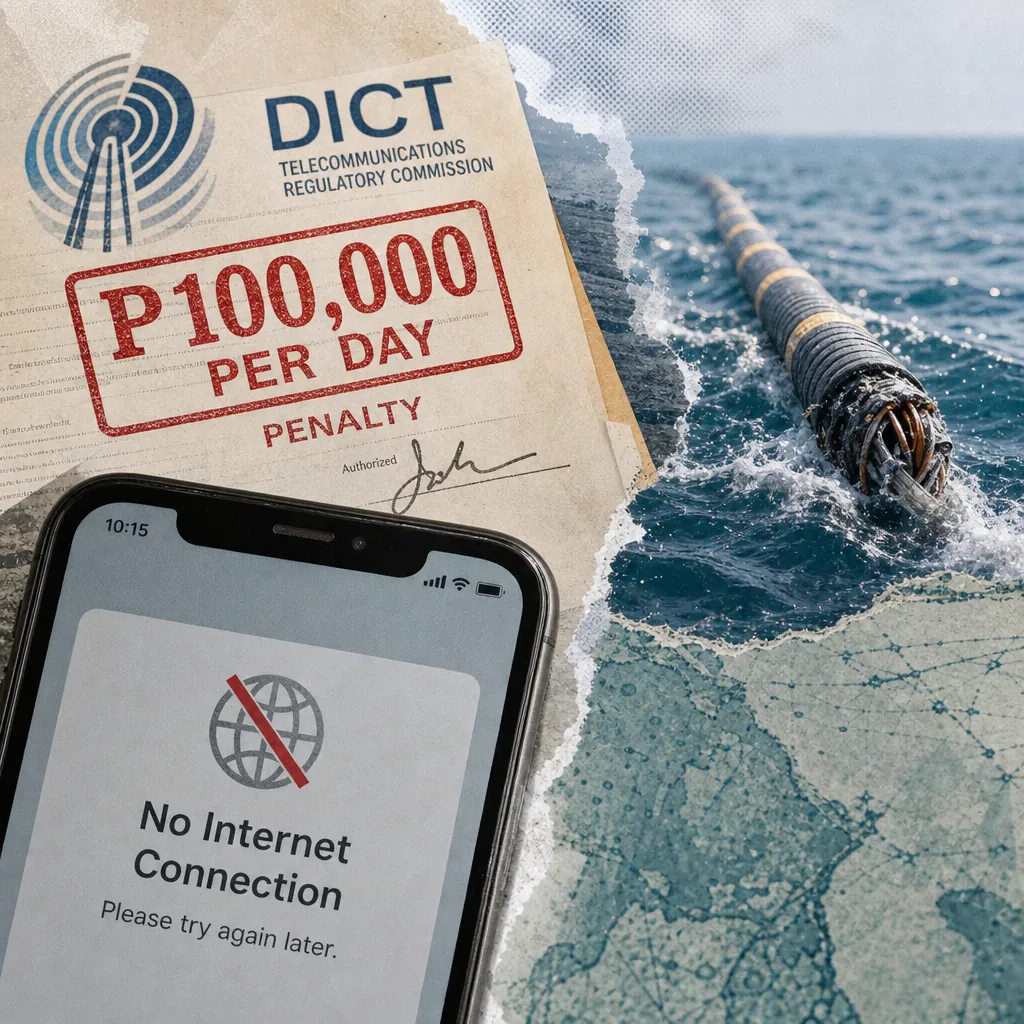
A failed undersea cable and a regulator standing its ground against the country's biggest carriers defined the day in Philippine telecommunications. On Friday evening, October 2, one of the submarine cable segments linking the Philippines to Singapore went offline, and the University of the Philippines Diliman Network Helpdesk warned that because most local internet providers route their traffic through these pipelines, users should expect slower speeds and intermittent connections, particularly on sites hosted abroad1. The outage-tracking site Downdetector logged a rise in complaints across several providers1. The same day, the National Telecommunications Commission (NTC) publicly defended the P100,000-per-day fines it has imposed on three major operators over what it calls poor mobile broadband service, after the industry's own lobby group pushed back10.
The two stories are not directly connected, but together they sketch the same problem from opposite ends: a network that is being asked to perform better at the exact moment its physical and regulatory foundations are under strain. The cable cut is a reminder that Philippine internet quality depends heavily on infrastructure the country does not fully control — submarine cables that carry the bulk of international traffic. The NTC's penalties are an attempt to force improvement on the domestic side, where the regulator says service has fallen short of standards it set earlier this year.
Corporate news added two more threads. PLDT Inc. finalized its takeover of fiber operator Radius Telecoms Inc., paying P2.94 billion for the 65.1-percent stake it did not already own, making Radius a wholly owned subsidiary1116. And Globe Telecom activated Starlink Mobile in Japan as a roaming service for Filipino travelers, its first direct-to-device international rollout38. The items captured here ran almost entirely on online news platforms, so the medium mix reflects the monitoring's reach rather than a claim about where the story lived across all media.
Key themes
- An undersea cable failure slowed internet connections nationwide. A submarine cable segment between the Philippines and Singapore went offline on the evening of October 2, and the UP Diliman Network Helpdesk advised users to expect higher latency and intermittent performance because most upstream providers route through those pipelines1.
- The NTC refused to back down on P100,000 daily fines. The regulator said it followed due process in issuing show-cause orders to three major operators over poor mobile broadband, and that the penalties can still be contested107.
- Telecom operators questioned the penalties through their industry chamber. The Philippine Chamber of Telecommunication Operators (PCTO) raised concerns about the NTC's process, and the regulator acknowledged those concerns while maintaining its authority1033.
- PLDT completed its P2.94-billion acquisition of Radius Telecoms. The buyout of the remaining 65.1-percent stake from Meralco's Paragon Vertical Corp. makes Radius a wholly owned PLDT subsidiary1116.
- Globe extended Starlink roaming to Japan. The service, called GoRoam Japan, lets Filipino travelers connect in areas where traditional coverage is limited, through a partnership with Japanese carrier KDDI38.
- Telcos want a bigger role in drafting the Konektadong Pinoy Act's rules. Operators warned that gaps in the law's design could affect investment, security, and the promise of universal internet access8.
- A columnist flagged constitutional problems in platform-accountability bills. The Manila Times column argued that pending legislation on age and identity verification collides with privacy standards and may not solve the problems it targets28.
- Mynt, the parent of GCash, priced the country's largest-ever IPO. The fintech company set its offer at P6.60 per share, valuing it at roughly P441.5 billion and raising about P53 billion1734.
How the narratives stack
Dominant: The NTC's defense of its P100,000 daily fines dominated the telecom conversation in the items captured here, drawing coverage across multiple outlets including the Manila Times, Inquirer, Philstar, and Head Topics710338. The regulator's statement was a direct response to pushback from the PCTO, the industry chamber representing telecom operators. NTC Deputy Commissioner Andres Castelar Jr. said the show-cause orders give operators the opportunity to explain their side, present evidence, and challenge the findings and proposed penalties7. The regulator also said network expansion and other investment priorities do not excuse noncompliance7. The fines stem from Memorandum Circular 001-01-2026, a set of mobile broadband service standards issued after a public hearing in which operators were allowed to participate and submit comments733. The NTC said it had repeatedly notified operators of service deficiencies nationwide and given them time to correct them7.
Counter-narrative: The undersea cable outage offered a competing explanation for why service might be poor — infrastructure failure rather than operator negligence1. The UP Diliman Network Helpdesk advisory made clear that the problem was upstream, in the submarine cables that connect Philippine providers to the global internet, not in the last-mile networks the NTC is penalizing. This distinction matters because it complicates the regulatory narrative: if a significant share of service quality depends on international infrastructure, then fines on domestic operators address only part of the problem. The cable cut also affected multiple providers simultaneously, which is consistent with a shared upstream failure rather than individual network mismanagement1.
Emerging: PLDT's completed acquisition of Radius Telecoms and Globe's Starlink expansion into Japan point to a sector consolidating and extending its reach111638. PLDT paid P2.94 billion for 4.65 million Radius common shares at P631.52 each, with 60 percent paid upfront11. The deal had been approved by the PLDT board in May and signed in June, subject to Philippine Competition Commission and NTC approvals11. Globe's GoRoam Japan service, meanwhile, uses Starlink's direct-to-device technology to reach areas where traditional coverage is limited, in partnership with KDDI Corp.38. Both moves suggest operators are positioning for a market where coverage and reliability are increasingly competitive differentiators — the same qualities the NTC is now enforcing through fines.
Under-covered: The Konektadong Pinoy Act's implementing rules received only a passing mention in the items captured here, despite the law's significance for universal internet access8. The law, whose name translates roughly to "Connected Filipino," is intended to expand internet access nationwide, but operators are pressing for a bigger role in drafting its implementing rules, warning that gaps in its design could affect investment, security, and the promise of universal access8. A separate opinion column raised constitutional concerns about pending platform-accountability bills, arguing that identity verification requirements collide with privacy and that age-assurance measures could become identity-collection tools28. The column cited warnings from the Computer Professionals Union and Agham about a Department of Information and Communications Technology draft circular that they say reaches for a maximally intrusive tool instead of a narrowly tailored one28. These stories placed lower in the captured set but carry long-term consequences for how the internet is governed and accessed in the Philippines.
Platform insights
The monitoring writeup for this window did not include social-media engagement data, so this section draws on the observable distribution of coverage across the items captured rather than on likes, shares, or views.
- Online news platforms: Every item in the captured set ran on an online news platform, spanning national outlets like Inquirer Online, Philstar Online, Manila Times Online, GMA News Online, ABS-CBN News Online, and Manila Bulletin Online, as well as regional and niche sites like Panay News, Daily Guardian, Maharlika News, and Bulgar Online. The telecom-specific stories — the NTC fines, the cable outage, the PLDT-Radius deal, and the Globe-Starlink expansion — appeared across the business sections of the major outlets, suggesting the story had broad editorial pickup within the captured set.
- Facebook: No direct Facebook engagement data was available in the writeup. However, the NTC's statement and the cable outage were the kind of service-affecting news that typically generates user complaints and sharing on the platform, and Downdetector's complaint tracking suggests users were actively reporting problems during the outage1.
- X (formerly Twitter): No direct X engagement data was available. The cable outage and the NTC fines are both stories that lend themselves to real-time commentary, particularly from tech-focused users and telecom industry observers, but the captured material does not include post-level metrics.
- Reddit: No Reddit activity was captured in the writeup. Philippine tech and telecom discussions on the platform often center on service quality and consumer complaints, but the monitoring for this window did not surface specific threads.
Key voices and communities
The National Telecommunications Commission: The regulator was the most prominent institutional voice in the captured set, defending its enforcement actions and asserting its legal authority to penalize operators for service-standard violations71033. Deputy Commissioner Andres Castelar Jr. served as the primary spokesperson, emphasizing that show-cause orders are part of due process and that operators can contest the penalties710.
The Philippine Chamber of Telecommunication Operators (PCTO): The industry chamber representing telecom operators raised concerns about the NTC's process, prompting the regulator's public defense1033. The PCTO's pushback reflects the industry's position that the penalties are disproportionate or procedurally flawed, though the captured items do not detail the chamber's specific arguments beyond the fact of its complaint.
PLDT Inc.: The country's largest telecom company by revenue made news on two fronts — completing the Radius acquisition and, through its affiliate Globe, participating in the Mynt IPO pricing111617. PLDT's move to consolidate fiber assets signals a strategic focus on fixed-line infrastructure as competition intensifies.
Globe Telecom Inc.: Globe announced the Starlink Japan roaming service and, as the holder of roughly 34 percent of Mynt, disclosed the GCash parent's IPO pricing3817. Globe's partnership with Starlink positions it at the forefront of satellite-based connectivity, a technology that could eventually serve areas where terrestrial networks are uneconomical.
The University of the Philippines Diliman Network Helpdesk: The academic network team provided the technical advisory on the cable outage, giving the public a clear explanation of why their connections were slow1. Its statement that most upstream providers connect through the affected pipelines helped frame the outage as an infrastructure problem rather than a provider-specific failure.
Narrative streams
The NTC holds firm on P100,000 daily fines for poor mobile broadband
The National Telecommunications Commission on Friday rejected the telecom industry's objections to the daily penalties it has imposed on three major operators, saying it followed due process and that the fines are within its legal mandate107. The penalties — P100,000 per day — were issued under Memorandum Circular 001-01-2026, a set of service standards for mobile broadband that the NTC issued after a public hearing733. The circular sets minimum performance requirements for mobile internet speeds and reliability, and the NTC says operators were repeatedly notified of deficiencies nationwide and given time to correct them7.
The dispute escalated when the Philippine Chamber of Telecommunication Operators (PCTO) questioned the penalties, prompting the NTC's public response10. Deputy Commissioner Andres Castelar Jr. said the show-cause orders — legal notices requiring operators to explain why they should not be penalized — give companies the opportunity to present evidence and challenge the findings7. He also said that network expansion and other investment priorities do not excuse noncompliance with service standards7. The NTC acknowledged the PCTO's concerns but maintained that both the issuance of show-cause orders and the setting of service standards are within its mandate10.
For the sector, the standoff creates a new compliance risk: operators now face a recurring daily penalty that accrues until service improves, and the regulator has signaled it will not accept investment plans as a substitute for meeting standards. The fines also set a precedent for how the NTC will enforce service quality, which could affect how operators prioritize network upgrades versus other capital expenditures. The coverage of the NTC's defense drew substantial newspaper attention, with the story appearing across the Manila Times, Inquirer, Philstar, and Head Topics, reflecting its importance to the business community710338.
An undersea cable failure disrupts internet connections nationwide
On the evening of October 2, one of the undersea cable segments connecting the Philippines to Singapore went offline, causing disconnections and slow internet speeds across multiple providers1. The UP Diliman Network Helpdesk issued an advisory warning that because most upstream internet service providers route their traffic through these major pipelines, users should expect increased latency and intermittent performance, especially when accessing sites hosted offshore1. Downdetector, a website that tracks user-reported outages, logged a rise in complaints across several providers1.
The outage highlights a structural vulnerability in the Philippine internet ecosystem: the country's connectivity depends heavily on submarine cables that land in a limited number of locations and are subject to physical failures, maintenance, and geopolitical risk. When one of these cables goes down, the effects ripple across all providers that rely on it, regardless of the quality of their last-mile networks. The UP advisory's language — "increased latencies and intermittent performance" — describes the technical symptoms: latency is the delay before data starts transferring, and higher latency means slower-loading pages and laggy video calls1.
For the sector, the cable cut is a reminder that service quality is not solely a function of domestic network investment. The NTC's fines target operator performance, but a significant share of that performance depends on international infrastructure that operators do not control. This creates a potential tension: operators could argue that upstream failures beyond their control should be factored into any assessment of service quality, while the regulator could counter that operators are responsible for redundancy and failover capacity. The story ran primarily on Inquirer Online, which carried the initial report and the UP advisory1.
PLDT completes P2.94-billion buyout of Radius Telecoms
PLDT Inc. finalized its acquisition of Radius Telecoms Inc. on Friday, paying P2.94 billion for the 65.1-percent stake held by Paragon Vertical Corp., a subsidiary of Meralco's e-Meralco Ventures Inc.1116. The deal, approved by the PLDT board in May and signed in June, makes Radius a wholly owned subsidiary of PLDT11. PLDT paid for 4.65 million Radius common shares at P631.52 each, with 60 percent of the purchase price paid upfront11. The transaction had been subject to approvals from the Philippine Competition Commission, which reviews mergers and acquisitions for anti-competitive effects, and the NTC11.
Radius Telecoms is a fiber network operator that was previously controlled by Manila Electric Co. (Meralco), the country's largest electric distribution utility, which is also led by businessman Manuel V. Pangilinan11. Pangilinan's simultaneous leadership of PLDT and Meralco — and now PLDT's absorption of a Meralco-controlled fiber asset — concentrates fiber infrastructure under one corporate umbrella. The acquisition gives PLDT greater control over the physical fiber network that carries internet traffic, which could improve its ability to manage capacity and service quality, but also raises questions about competition in the wholesale fiber market.
For the sector, the deal signals continued consolidation in Philippine telecom infrastructure. PLDT's move to own Radius outright simplifies its network architecture and could reduce its reliance on third-party fiber providers. Competitors may face higher costs if they need to lease fiber capacity from a company that is now a direct competitor. The story was covered by Inquirer Online and Manila Times Online, both of which carried the corporate disclosure details1116.
Globe extends Starlink roaming to Japan
Globe Telecom activated Starlink Mobile in Japan on Friday, extending roaming service to Filipino travelers through a partnership with Japanese carrier KDDI Corp.38. The service, called GoRoam Japan, allows subscribers to connect to the internet in areas where traditional coverage is limited, using Starlink's direct-to-device technology, which connects mobile phones directly to satellites rather than through ground-based cell towers38. The service also includes terrestrial roaming, giving subscribers connectivity in covered areas and dead zones38.
Globe head of consumer mobile business Eric Tanbauco said the company aims to be at the forefront of connectivity innovation, such as direct-to-device services38. The Japan launch is Globe's first international Starlink activation, and it positions the company as an early mover in satellite-based mobile connectivity in the region. Starlink, operated by SpaceX, has been expanding its direct-to-device service globally, and telecom operators are increasingly partnering with satellite providers to fill coverage gaps in remote or underserved areas.
For the sector, the Globe-Starlink partnership points to a future where satellite and terrestrial networks are complementary rather than competing. If direct-to-device technology matures, it could eventually serve domestic coverage gaps in the Philippines, particularly in remote islands where building cell towers is uneconomical. The story ran on Philstar Online38.
Telcos seek a larger role in drafting Konektadong Pinoy Act rules
Telecom operators are pressing for a bigger role in drafting the implementing rules and regulations of the Konektadong Pinoy Act, warning that gaps in the law's design could affect investment, security, and the promise of universal internet access8. The law, whose name translates to "Connected Filipino," is intended to expand internet access nationwide, but the details of how it will be implemented are still being worked out. Operators argue that their input is essential to ensure the rules are practical and do not inadvertently discourage the investment needed to build networks in underserved areas.
The Konektadong Pinoy Act is part of a broader legislative push to improve digital connectivity in the Philippines, where internet speeds and coverage lag behind regional peers. The law's implementing rules will determine how aggressively the government pushes for universal access, what obligations are placed on operators, and how funding for rural connectivity is allocated. The operators' push for a larger role in drafting those rules reflects their concern that poorly designed regulations could impose costs without achieving the goal of broader access.
For the sector, the outcome of the implementing-rules process will shape the investment climate for years. If operators succeed in shaping the rules to their liking, they may be more willing to invest in rural infrastructure; if the rules are seen as too burdensome, they could slow deployment. The story appeared in Head Topics Online8.
Platform-accountability bills face constitutional questions
A Manila Times opinion column raised concerns about pending legislation on digital platform accountability, arguing that identity verification requirements collide with privacy and that age-assurance measures could become identity-collection tools28. The column cited warnings from the Computer Professionals Union and Agham about a Department of Information and Communications Technology draft circular that they say reaches for a maximally intrusive tool instead of a narrowly tailored one, raising concerns under the International Covenant on Civil and Political Rights' necessity and proportionality standard28.
The bills are part of a broader effort to regulate digital platforms, including social media companies, for content moderation, child safety, and data privacy. The column argued that the current legislative proposals cannot address the four major problems they are meant to solve, and that each bill carries a flaw that deserves scrutiny before becoming law28. The reference to the short-lived blocking of Discord — a messaging platform popular with gamers — illustrates the tension between platform regulation and free expression28.
For the sector, the platform-accountability debate matters because telecom operators and internet service providers are often caught between government demands for control and user expectations of privacy and open access. If the bills pass in their current form, they could impose new compliance costs on platforms and potentially on the networks that carry their traffic. The column ran on Manila Times Online28.
Mynt prices the Philippines' largest-ever IPO
Mynt, the fintech company that operates the GCash mobile wallet, set its final initial public offering price at P6.60 per share on Friday, valuing the company at approximately P441.5 billion1734. The IPO is the largest in Philippine history, with proceeds from the sale of 8.03 billion shares expected to total around P53 billion, or about $843.7 million17. If the overallotment option for up to 1.20 billion additional shares is fully exercised, total proceeds could reach roughly P60.9 billion, or about $969.8 million17.
Globe Telecom, which holds roughly 34 percent of Mynt, announced the pricing17. At P6.60 per share, Mynt is selling at about 8.38 times its earnings, according to a Philstar column34. The company's market capitalization of P441.5 billion makes it the fifth-largest company on the Philippine Stock Exchange, behind Bank of the Philippine Islands and ahead of Ayala Corp.34. The IPO is comparable in scale to Monde Nissin's $1-billion debut in 202117.
For the sector, the Mynt IPO is a landmark event that underscores the growing importance of fintech and digital payments in the Philippine economy. GCash's dominance in mobile wallets gives Mynt a strong market position, and the IPO proceeds will give the company capital to expand its services, potentially into lending, insurance, and investments. The listing also raises the profile of the Philippine tech sector, which has attracted increasing investor attention in recent years. The story was covered by Yahoo Philippines and Philstar Online1734.
Conversation trajectory
Over the next 1–2 weeks: The undersea cable outage will likely be resolved or mitigated as providers reroute traffic through alternative cables, but the incident may prompt renewed discussion about the Philippines' need for redundant international connectivity. Watch for statements from the Department of Information and Communications Technology or the NTC about cable diversity and redundancy requirements. The NTC's standoff with the PCTO may also escalate if operators formally contest the fines through legal channels or if the regulator issues additional show-cause orders.
Over the next 4–6 weeks: The Konektadong Pinoy Act's implementing rules will continue to be drafted, and the telecom industry's push for a larger role in that process will be a key dynamic to watch. If operators feel shut out of the rule-making, they may escalate their advocacy through industry associations or public statements. The Mynt IPO is expected to list on the Philippine Stock Exchange in the coming weeks, and its trading debut will be a test of investor appetite for Philippine tech stocks.
Over the next 2–3 months: The NTC's enforcement of mobile broadband standards will face its first real test if operators challenge the fines in court or if the regulator imposes additional penalties. The outcome will set a precedent for how aggressively the government regulates service quality in the telecom sector. Meanwhile, PLDT's integration of Radius Telecoms will proceed, and the market will watch for any impact on fiber pricing and competition.
Trigger events to watch: The NTC's next statement on the fines or any new show-cause orders; the resolution of the undersea cable outage and any government response; the filing of the Konektadong Pinoy Act's implementing rules; the Mynt IPO listing date and first-day trading performance; and any court rulings on the platform-accountability bills or the NTC's enforcement actions.
Response guidance
For telecom operators: Prepare clear, factual communication about the undersea cable outage that explains the difference between upstream infrastructure failures and last-mile network performance. Customers experiencing slow connections during the outage may conflate the two, and operators should be ready to explain what they control and what they do not. On the NTC fines, avoid public confrontation with the regulator; instead, use the show-cause process to present evidence and negotiate timelines for compliance. Publicly committing to specific service improvements with measurable targets can help rebuild trust.
For the NTC and government agencies: The cable outage is an opportunity to demonstrate that the government understands the difference between infrastructure failures and operator negligence. A clear public statement distinguishing the two would help prevent the fines from being seen as unfair during a period when service problems have an external cause. On the Konektadong Pinoy Act, engaging operators early in the implementing-rules process can reduce the risk of later disputes and improve the rules' practicality.
For consumer-facing brands and platforms: The cable outage and the NTC fines are both stories that affect how consumers perceive internet reliability. Brands that depend on connectivity — e-commerce, streaming, fintech — should be prepared to communicate about service disruptions during infrastructure failures and to explain what they are doing to maintain service. The Mynt IPO will draw attention to GCash, and the company should be ready for increased scrutiny of its operations, fees, and security.
For communicators covering the sector: The distinction between infrastructure failures and regulatory enforcement is the key framing challenge in this window. Avoid conflating the cable outage with the NTC fines; they are separate stories with different causes and different implications. When reporting on the fines, explain what a show-cause order is and what due process means in this context, so readers understand that the penalties are not yet final and can be contested.
Sensitive topics to handle carefully: The platform-accountability bills touch on privacy and free expression, and communicators should avoid taking positions that could be seen as either anti-privacy or anti-child-safety. The Konektadong Pinoy Act's implementing rules involve trade-offs between universal access and investment incentives, and framing the debate as a choice between the two oversimplifies the issue. The Mynt IPO involves financial disclosures and investor expectations, and communicators should stick to confirmed figures and avoid speculation about post-IPO performance.
See the full picture behind today's signals.
This report draws from Media Meter's MediaWatch, our real-time monitoring engine tracking 2,470+ Philippine sources across print, broadcast, digital, and social. Explore how the platform turns raw coverage into decision-grade intelligence, then see how it's configured for teams like yours — whether you're in PR agencies, corporate comms, government, or marketing.
Want more? Browse our Report Library for sector and crisis intelligence, or request a demo and we'll have your brand set up before the call.
Want this kind of intelligence on your brand?
This brief is built on the same MediaWatch methodology that runs continuously across every brand we monitor. See your competitive landscape, Impact Score, and narrative trajectory in a 30-minute demo.