AI-Led Creative Is Coming to Your Pitch: Prove It Works
AI-led creative is already shipping in Philippine campaigns. Why volume is not proof of impact, and how to set a share-of-voice baseline before the work lands.

AI-led creative is already running in Philippine campaigns, and almost none of it has been graded by anyone other than the people who made it. Across Asia Pacific, 75% of organisations told Adobe's 2026 trends research that generative AI lifted content volume and speed, while only 45% of marketers in WARC and TikTok's survey saw quality improve. Set the share-of-voice baseline before the work ships.
Patrick Miciano rose from associate creative director to executive creative director (ECD) at DDB Manila within four years, which OLIVER says made him the youngest ECD in Philippine advertising history at the time. MARKETING-INTERACTIVE reported on 29 October that OLIVER, the in-house marketing transformation company inside The Brandtech Group, has promoted him to chief creative officer for Asia Pacific (APAC), with a brief to drive AI-powered growth for OLIVER and Brandtech clients across the region.
That is a Filipino talent story worth telling on its own terms. It is also the clearest preview yet of the AI-led creative pitch that will arrive in Philippine marketing reviews over the next two years, carried this time by regional leadership that learned the craft in Manila. Which raises a flatter question than the appointment itself. When volume and speed are the offer, who tells you whether the work moved anything?
A DDB Manila creative now directs APAC creative at an AI-first shop
The job is larger than the headline. In APAC alone, OLIVER runs more than 1,100 employees across 70 dedicated content studios, supporting over 500 brands including Unilever, Google, adidas and Manulife. Set that against the global footprint in the same report, more than 4,500 professionals embedded across 1,500 businesses in over 40 countries, and roughly a quarter of the company's people sit in the region Miciano now covers. Those are company-supplied figures reported by the trade press, and other trade outlets have described his title and market remit differently, so both the title and the AI mandate rest on that single report.
The production machinery behind the mandate carries a number too. The Brandtech Group's own site says Pencil, its generative AI platform, "has made more than 1 million ads across 5,000 brands", with more than 1 billion in media spend having flowed through the platform, and lists the Philippines among the group's locations. That is a company claim, global and group-level, with no APAC breakdown published and no period stated for the spend figure.
Miciano put craft and clock speed side by side, saying AI is reshaping the industry and that he is excited to "help accelerate our creative momentum at a moment when craft and speed matter more than ever". Worth noticing which of those two words a client gets billed for.
What an AI-led creative mandate actually promises
Strip the language back and the promise is throughput. Across Asia Pacific, 75% of organisations say generative AI has improved the volume and speed of content ideation and production and 71% say it has enabled non-creative teams to produce content, according to Adobe's 2026 AI and Digital Trends report, with Singapore highest at 80% on faster ideation and creation and Australia and New Zealand at 76% on speed and volume. Read the provenance with the finding. Adobe sells creative and AI tooling and commissioned the research, fieldwork ran October to November 2025 through Oxford Economics, and the APAC executive samples were 250 in Australia and New Zealand, 250 in India and 100 in Singapore inside a global base of 3,000. The Philippines is not in that sample.
The buy side wants the throughput. The World Federation of Advertisers found 96% of major brands now using generative or agentic AI in marketing, against 45% in 2023, with 80% using it for content creation. The base matters more than the percentage: 54 senior respondents at 46 of the world's largest brand owners, not a cross-section of the market. An advertiser body rather than a vendor is reporting it, which is why the direction holds even at that sample size.
Volume at the craft layer is already visible in Manila. Some agencies now generate jingle concepts with AI, then hire human musicians to recreate the output. "They come to us to copy what they prompted," voice artist Ericka Peralejo told BusinessMirror's report on automation in the creative economy. Talent fees have not fallen. The assignments have. Peralejo puts her voice-work income at roughly 30% of her usual annual earnings, her own estimate and explicitly not an industry figure, and short-form vertical-video briefs that dried up were later found to be using AI voices. The machine is not replacing the musician. It is booking her later in the process, for fewer hours.
The macro data in the same report neither contradicts her nor confirms her. Philippine Statistics Authority figures put the creative economy at P2.12 trillion in 2025, 7.6% of GDP and up 6.9% from P1.98 trillion, while creative-industry employment slipped 0.4% to 8.71 million. A sector adding almost 7% in value while shedding jobs is the shape of a productivity shift, and the report notes these figures do not measure AI displacement. The Department of Labor and Employment says it is exploring fair-use guidelines and equitable contracting standards for AI-generated content. No Philippine agency or in-house team has publicly adopted an AI-led production model under its own name: the practice is documented, the shops are not.
Investment-trained leadership changes the questions in a review
A second APAC appointment landed the same week, from a different angle. VaynerMedia named Anita Munro as APAC managing director from January 2027, succeeding Tim Lindley after six years in which the agency grew to eight regional offices and added clients including Grab, Cathay Pacific and SharkNinja. Munro arrives from WPP Media Thailand, where she was chief executive, and before that from the group's regional chief investment officer role, where she chaired its APAC investment council. The weight of that record sits on investment and media buying rather than on content.
Two appointments in one week are a coincidence, not an industry shift, and this piece will not pretend otherwise. What they share is worth naming as analysis rather than as finding: regional creative and agency leadership is increasingly going to people whose mandate is speed, scale and measurable outcomes rather than craft reputation alone. Two data points cannot carry more than that, and the Philippine market has imported enough trend narratives built on less.
The consequence shows up in the review room. Leadership trained on investment arrives fluent in the language of return, which sharpens both the questions a Philippine brand team gets asked and the ones it should be asking back. An agency that can quantify what the work returned pitches better than one that can only describe it. The number in that pitch is usually produced by the same people who produced the work.
Who grades the work when the maker also supplies the numbers?
The evidence on whether AI-assisted creative performs differently is thinner than the adoption figures imply, and most of what exists comes from companies that sell something adjacent to the answer.
The volume-quality gap is the most quotable data point available. WARC and TikTok's creative survey found 88% of marketers reporting higher creative volume since adopting generative AI against only 45% reporting a significant improvement in quality, a 43-point spread between making more and making better. The base is 400 marketers involved in creative and content production decisions in the UK, US, Australia and Brazil, surveyed in May 2026. TikTok sponsored the work and the Philippines is not in the sample.
Ad testing complicates that usefully. Kantar's LINK database analysis, covering hundreds of ads that used generative AI and run with Affectiva and iMotions, found seamless, non-obvious AI use putting over 40% of those ads in the top tier for branded cut-through while obvious AI use performed worse. Generative AI ads scored lower on branding on average and drew stronger emotional reactions with lower net positivity. Kantar's 2024 Media Reactions work put 41% of consumers saying AI-generated ads bother them against 29% of marketers, a 12-point gap between the people making ads and the people sitting through them. Kantar sells creative testing, so read this as directional rather than settled.
The closest thing to non-vendor evidence points somewhere less convenient. A field experiment on the Google Display Network by Anindya Ghose at NYU Stern with Hyesoo Lee, Vilma Todri and Panagiotis Adamopoulos at Emory found fully AI-generated ads raising click-through by up to 19% against human expert-crafted ads, while AI-modified ads showed no significant improvement. Telling consumers an ad was made with generative AI cut click-through by 31.5%, a larger move than any quality effect measured in either direction. One field experiment, a relative lift, click-through rather than brand or sales outcomes, and no Philippine leg, so carry it as early evidence.
Read together, the three say that AI-made work is not automatically weaker, that visibly AI-made work tends to brand worse, and that disclosure moves the numbers harder than quality does. None of which tells a Philippine marketer anything reliable about their own campaign.
The local market has already named its grading standard, and not through a measurement vendor. At the MMA SMARTIES Philippines 2026 awards on 6 October at Shangri-La The Fort, a two-stage evaluation put a Grand Jury of marketers only, chief executives and chief marketing officers, in front of each campaign with what the organisers describe as "a strict focus on measurable business impact". Rohit Dadwal, chief executive of MMA APAC and global head of SMARTIES, was explicit that AI was not the headline of the winning work: "It was the enabler that made relevance possible at a scale that was not previously achievable." Best in Show went to GAMEJOY for Jollibee Foods Corporation with Octopus&Whale, and Jollibee took advertiser of the year. The announcement is a PR Newswire release carried by The Manila Times and reports no campaign metrics, so what it evidences is the criterion, not a result.
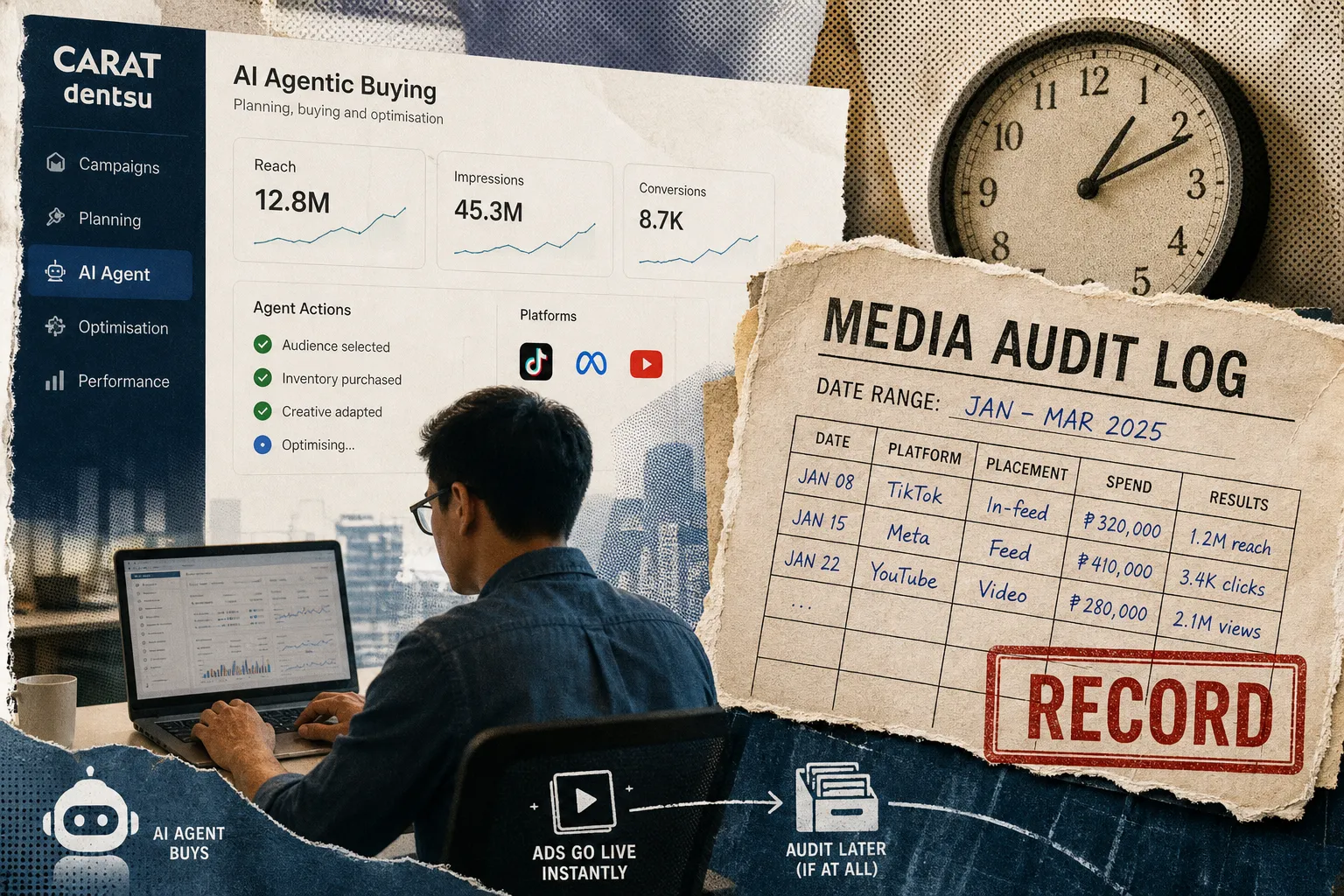
That is the argument arriving from inside the industry rather than from a monitoring company. When production volume is the offer, the party best placed to show the work succeeded is the party that made it, and that conflict stops being a procurement nicety once the volume is large enough to move a budget line.
One lever sits outside the brand's control. No Philippine disclosure duty for AI-assisted advertising could be verified on the public record as of 3 November 2026, which is a statement about what is verifiable rather than a ruling that nothing applies, and an editor checking directly with the Ad Standards Council may well find otherwise. Given what the NYU experiment found disclosure does to click-through, settling your own position before a regulator or a client settles it for you is the cheaper sequence.
Set the share-of-voice baseline before the AI-accelerated work lands
A named Philippine brand has already shipped a campaign built on AI-made creative. HONOR Philippines ran its Miss Universe Philippines partnership across content shoots, social storytelling, candidate-led content and on-ground activations, with the candidates themselves using AI editing and AI image-to-video features to produce the content after the brand's training team demonstrated them. "We did not want to present AI as something complicated," brand marketing head Joepy Jean Libo-on told MARKETECH APAC's report on the partnership. The coverage names no agency and reports no results, which is the finding rather than a criticism of the campaign. Nobody outside the brand can tell whether it moved anything.
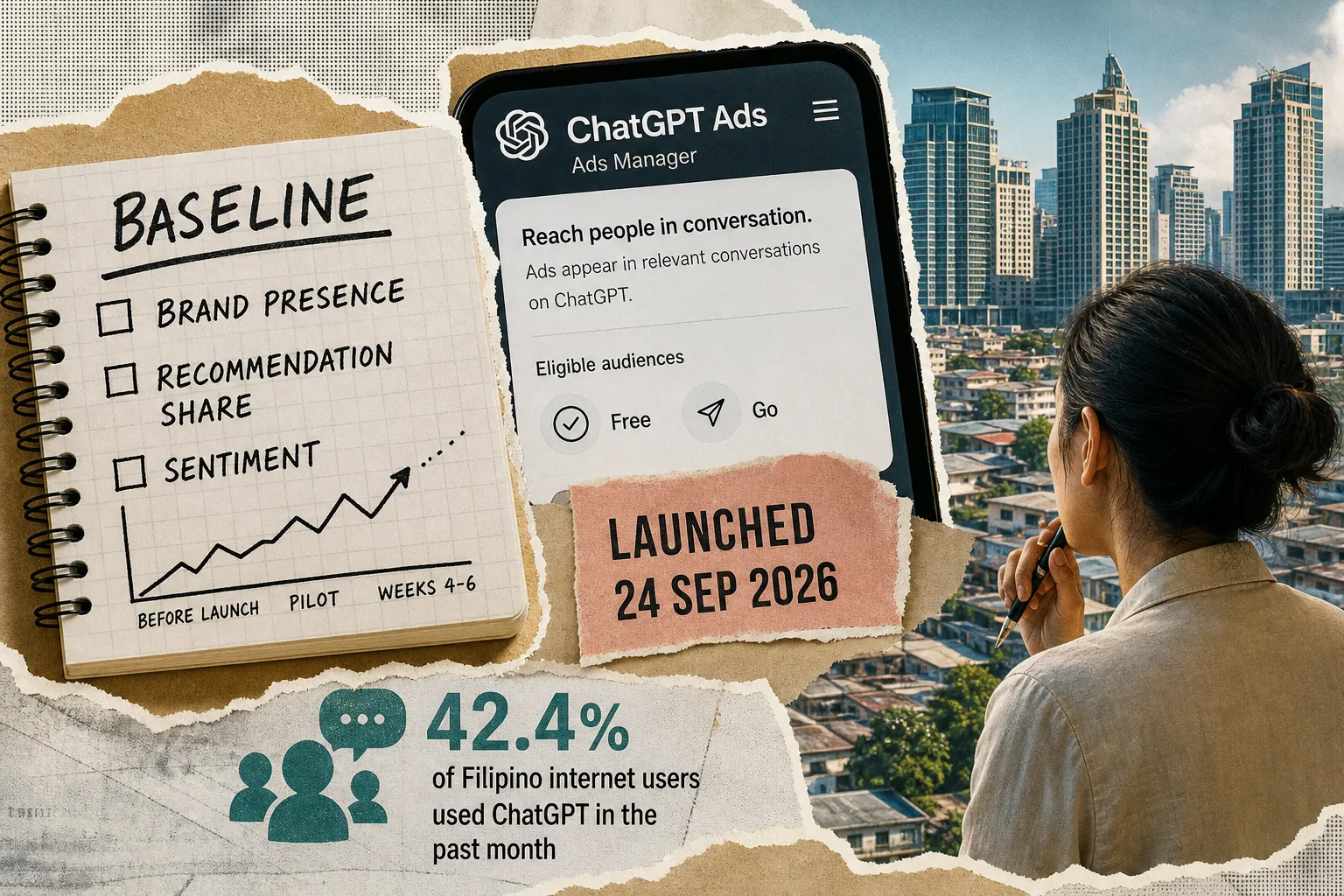
The exposure side at least has Philippine numbers attached. At a Manila forum on AI visibility for around 100 industry leaders, Greenpark put monthly ChatGPT use among Philippine internet users at 42.4%, described as nearly double the global average, and said nearly one in three Google searches in the Philippines now returns an AI-generated answer ahead of traditional results, projected to reach around 60% within 12 to 18 months. The 60% is a projection and should be carried as one. The figures were presented at an event promoting Greenpark's own visibility tool rather than published as independent research, and they are roughly seven months old. The recommendation from that stage was the one this article reaches by another route: audit AI visibility by tracking share of voice and sentiment. Media Meter's work on how brands surface in AI answers covers that mechanism in more depth.
Sequence is the whole argument. A share-of-voice and sentiment read taken after an AI-accelerated campaign launches cannot separate the creative's effect from the volume effect of producing more of it, because both arrive in the data as a rise in mentions. Baselines are dull work. They are also the one input in this chain that cannot be bought retroactively.
A usable pre-launch baseline is narrower than it sounds. Fix the competitive set and the date range, then take independent share-of-voice and sentiment measurement across the national, provincial and vernacular coverage the campaign will touch, with the method and the source footprint written down so the second read is comparable rather than merely newer. Automated sentiment across Filipino, Taglish and the vernaculars in between is directional rather than settled, so treat the sentiment line as a trend indicator and the volume and share-of-voice lines as the harder numbers. Real-time monitoring across national and regional media is what makes the during-campaign read possible, and competitive intelligence drawn from social data is where the conversation shows up before the coverage does.
If AI-accelerated production starts reaching Filipino, Bisaya and other vernacular variants, cultural calibration failures would surface there first, in audience conversation rather than in a brand-lift study. Nothing in this cycle's research shows that happening yet, so hold it as a watch item. For Philippine agencies the mirror image is a position worth holding: what an AI production model cannot replicate is locally calibrated measurement and insight, evidenced rather than asserted, which is what in-house marketing teams will shortly be asking for by name. Once the creative itself is AI-led, the independent read is the one that still carries weight in a review: the Media Meter newsletter carries the running version of what Philippine audiences are saying, week to week.
Key takeaways
- Treat the OLIVER appointment as a pipeline signal rather than a threat. AI-accelerated production is being built regionally and will reach Philippine pitch rooms with Manila credentials attached, so the buying question is how to grade it.
- Keep adoption evidence and effectiveness evidence apart. Across Asia Pacific 75% of organisations report faster, higher-volume content from generative AI, while the performance evidence is thin, mostly vendor-produced and pointing in two directions at once.
- Commission the measurement from someone who did not make the work. The SMARTIES marketer jury's "measurable business impact" test is the standard a Philippine board will reach for, and a producer's own numbers cannot meet it.
- Take the share-of-voice, sentiment and competitive-set read before launch, with the method and source footprint documented. After launch, a rise in mentions is indistinguishable from a rise in output.
About Media Meter
Media Meter helps Philippine marketing teams know first and prove impact, with monitoring and measurement calibrated for the local media landscape rather than imported from a global template. See how Media Meter works.