Getting Cited in AI Overviews Starts With Media Monitoring
AI Overviews trigger on 29% of Philippine searches. Learn what actually earns a citation, and how media monitoring tracks it.

Discover why earned media coverage, not owned content, now determines whether your brand gets AI overviews cited, and what that means for how monitoring teams should work.
AI Overviews have moved from experiment to default across a growing share of searches, appearing on roughly 48% of all queries as of April 2026, up from 31% just over a year earlier, and reaching an estimated 2 billion monthly users. The Philippines specifically sees this more than most markets: a large-scale analysis of over 100 million search queries found AI Overviews trigger on 29.1% of Philippine keywords, well above the 20.5% rate in the United States and roughly 19% in the UK and Canada. For a Philippine brand, this isn't a future consideration. It's already a bigger share of the search experience than in most of the markets driving the global conversation about it. That shift has changed what "visibility" even means: a citation inside an AI-generated answer now sits above the traditional blue links, capturing attention before a user ever scrolls to organic results.
Most SEO teams are still optimizing for rank. The research increasingly says that misses the point. Organizations that treat citation as a media visibility problem, not a technical on-page problem, are the ones actually winning placement in these answers, and media monitoring is the discipline built to see whether that's happening.
In this Article
- Earned Media Now Drives the Large Majority of AI Citations
- Unlinked Brand Mentions Count Even Without a Hyperlink
- The Citation Pipeline Extracts Passages, Not Whole Pages
- Video Is an Emerging, Underused Citation Source
- Query Type Determines Which Kind of Coverage Gets Cited
- Citation Visibility Decays Without Ongoing Coverage
- Outlet Authority Shapes Which Coverage Actually Gets Cited
- AI Citation Tracking Is Becoming Its Own Monitoring Category
- Strategic Intelligence for AI Search Visibility
- Frequently Asked Questions
1. Earned Media Now Drives the Large Majority of AI Citations
Multiple independent studies converged on a striking, consistent finding in 2026: earned, third-party media coverage accounts for roughly 84 to 85% of all AI citations across ChatGPT, Claude, and Gemini, with journalism alone contributing around 27%, while press releases sent out through paid distribution services contribute a negligible 0.04%. Separately, how often a brand is simply mentioned online correlates with AI Overview visibility at 0.664, roughly three times stronger than the correlation for backlinks, meaning links from other sites, at 0.218, according to an Ahrefs study of 75,000 brands.
Competitive intelligence advantage: Organizations tracking their own earned coverage volume against competitors' through media monitoring can see, in near real time, which brand is accumulating the raw material AI systems actually cite, well before that gap shows up as a visibility problem in search results.
2. Unlinked Brand Mentions Count Even Without a Hyperlink
Traditional SEO built its entire value system around the hyperlink, the clickable link from one website to another that search engines have long treated as a vote of confidence. AI citation research suggests that's no longer the whole picture: a brand mentioned in a trusted publication influences citation likelihood even when the mention carries no link back to the brand's own site. Original research, contributed expert commentary, and data-led stories in trusted outlets all add up over time, building a track record of mentions that compounds, independent of how many actual links point back to the brand's site.
Strategic monitoring application: Standard link audits, the kind that only count clickable links, miss this entirely. Media monitoring, built to track mentions rather than links, is the only practical way to see the full scope of a brand's earned-media footprint feeding AI systems.
3. The Citation Pipeline Extracts Passages, Not Whole Pages
Google's AI Overviews work through a process called retrieval-augmented generation, or RAG. In plain terms, the system searches the web for relevant passages, pulls the most useful ones, and then writes a new answer based on what it found, rather than simply linking to a single best page the way traditional search does. Ranking in the top 10 for a query correlates strongly with citation eligibility, with one large-scale analysis finding the typical cited page sits around the second position. But a meaningful share of citations, other research puts it as high as 60%, come from pages outside the top 20 search results entirely. Citation is driven by whether a specific passage fully and clearly answers the question, not by how high the page ranks overall.
Market intelligence connection: This means a brand can be well-covered in the media and still invisible in AI answers if that coverage isn't structured for extraction. Monitoring which competitor mentions actually convert into citations, versus which sit unused, reveals where a brand's earned coverage strategy needs sharper framing.
4. Video Is an Emerging, Underused Citation Source
Text-based news coverage isn't the only earned-media channel feeding AI answers. YouTube content accounts for approximately 16% of all citations made by AI chatbots like ChatGPT and Gemini, with one Ahrefs analysis finding 18.2% of non-ranking AI Overview citations were YouTube URLs specifically. Product reviews, expert interviews, and conference talks from third parties all generate citations independently of text coverage.
Strategic monitoring application: Media monitoring programs built around news and social mentions alone are missing a real and growing citation channel. Tracking broadcast and video mentions, not just text, is becoming part of a complete AI-visibility picture.
5. Query Type Determines Which Kind of Coverage Gets Cited
Not all earned coverage is equally citable for every kind of question. Research from Muck Rack found industry-trend questions drive journalism citations at more than double the rate of how-to questions, while press releases appear almost exclusively in industry-trend-style answers, at roughly 3.5 times the rate they appear in best-of or comparison queries.
Market intelligence connection: Mapping which query types are actually driving category-level AI citations lets a monitoring team advise communications on what kind of story to pitch, an expert commentary piece, a data-led report, or a straightforward announcement, rather than treating all earned coverage as interchangeable.
6. Citation Visibility Decays Without Ongoing Coverage
AI citation is not a one-time achievement. One 2026 industry report found only about 30% of brands remain visible across consecutive AI answers to the same question, and pages not refreshed roughly every three months are three times more likely to lose citations they previously held.
Competitive intelligence advantage: Treating AI citation as a static outcome misses this decay entirely. Monitoring citation presence on a recurring basis, the same discipline already applied to tracking share of voice (how much of a category's conversation mentions your brand versus competitors), is what catches a visibility loss before it becomes a pattern competitors can exploit.
7. Outlet Authority Shapes Which Coverage Actually Gets Cited
The same story earns dramatically different AI citation value depending on where it runs. One analysis found a 239% median citation lift when identical content moved from a brand's own site to a third-party news outlet, and AI systems appear to weight the authority of the domain publishing the content, not just the quality of the content itself.
Strategic monitoring application: This makes outlet selection a measurable strategic decision, not a subjective PR judgment call. Media monitoring that tracks citation share by outlet shows a communications team exactly which publications are actually shaping AI answers in their category, information a standard media list cannot provide on its own.
8. AI Citation Tracking Is Becoming Its Own Monitoring Category
The monitoring industry itself is already moving toward this convergence. Established platforms have begun shipping features specifically for this: tools that show how AI systems reference a brand, competitors, and topics over time, surfacing the exact articles and publishers an AI model draws its answers from, alongside more familiar metrics like brand visibility share and sentiment accuracy in AI-generated descriptions.
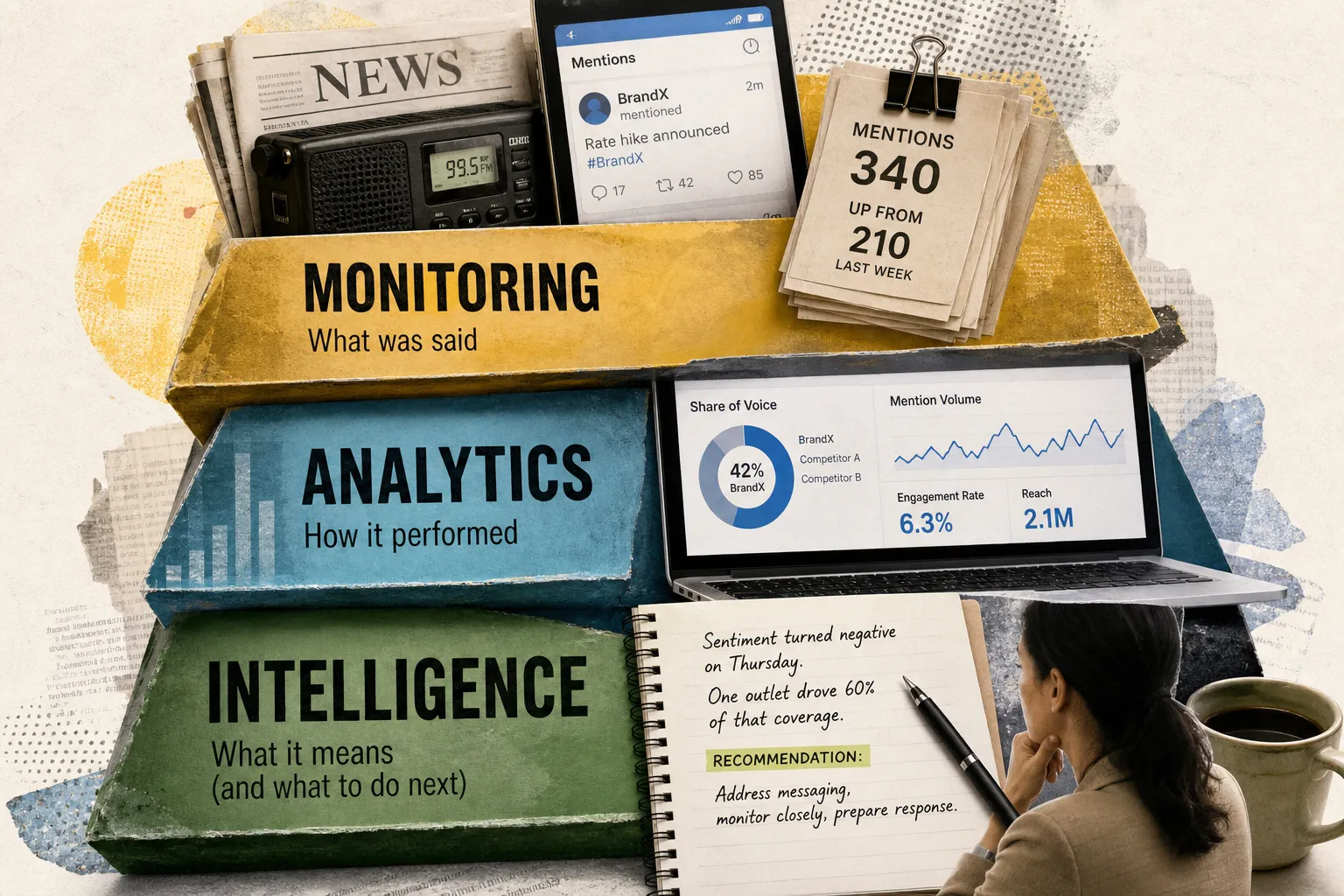
Market intelligence connection: For a media monitoring or insights team, this isn't a future capability to plan around. It's the same work already being done, tracking mentions, benchmarking share of voice, checking sentiment, now applied to a new surface where the stakes are arguably higher. An AI citation shapes the answer a user reads before they ever see a traditional search result.
Strategic Intelligence for AI Search Visibility
Getting cited in AI Overviews is no longer a pure content or technical SEO exercise. The evidence points clearly toward media visibility as the dominant lever, which puts monitoring teams in a genuinely central role rather than a supporting one.
Monitor earned coverage volume and mix. Track how much third-party coverage a brand is accumulating relative to competitors, and whether that coverage skews toward the outlet types and story formats that research shows actually get cited.
Track AI citation share of voice directly. Where tooling allows, monitor how often a brand appears in AI-generated answers to category-relevant questions compared to named competitors, not just how often it appears in traditional search results.
Identify which query types drive category citations. Different question types pull from different kinds of coverage. Knowing whether a category's AI visibility is being won through industry-trend journalism, comparison content, or expert commentary shapes what a communications team should actually be pitching.
Detect citation drift before it compounds. Since citation visibility measurably decays without fresh coverage, recurring monitoring catches a quiet loss of AI visibility the same way it would catch a quiet decline in earned media share of voice.
Track how your brand and your competitors are actually being cited across AI-generated answers before the visibility gap becomes permanent. With AI Overviews already triggering on nearly 3 in 10 Philippine searches, a higher rate than the US, UK, or Canada, the brands winning this space in your category are being decided now. Media Meter's real-time monitoring reveals earned media patterns, outlet authority, and share-of-voice shifts across Philippine media. Contact us for inquiries or view our sample media reports to see how media intelligence supports AI search visibility.