Media Monitoring: Fashion's Hidden Signal
See how media monitoring catches fashion trends before they go viral, from weak signals to visual listening, with examples from the Philippines.

Ever noticed how a style seems to appear out of nowhere, and then everyone is wearing it within a couple of weeks? On Philippine social media, that's barely an exaggeration. It didn't come out of nowhere, though. Someone was watching for it long before it had a name.
Here's what makes this interesting: the fashion industry has always leaned on runway shows, street style, and the instincts of trend forecasters to call what's next. That's still valuable. But the brands that consistently move first aren't just watching the runway. They're running media monitoring across social platforms, blogs, forums, and news coverage, picking up the quiet signal before the trend becomes the story everyone is already covering.
What Is Media Monitoring in Fashion?
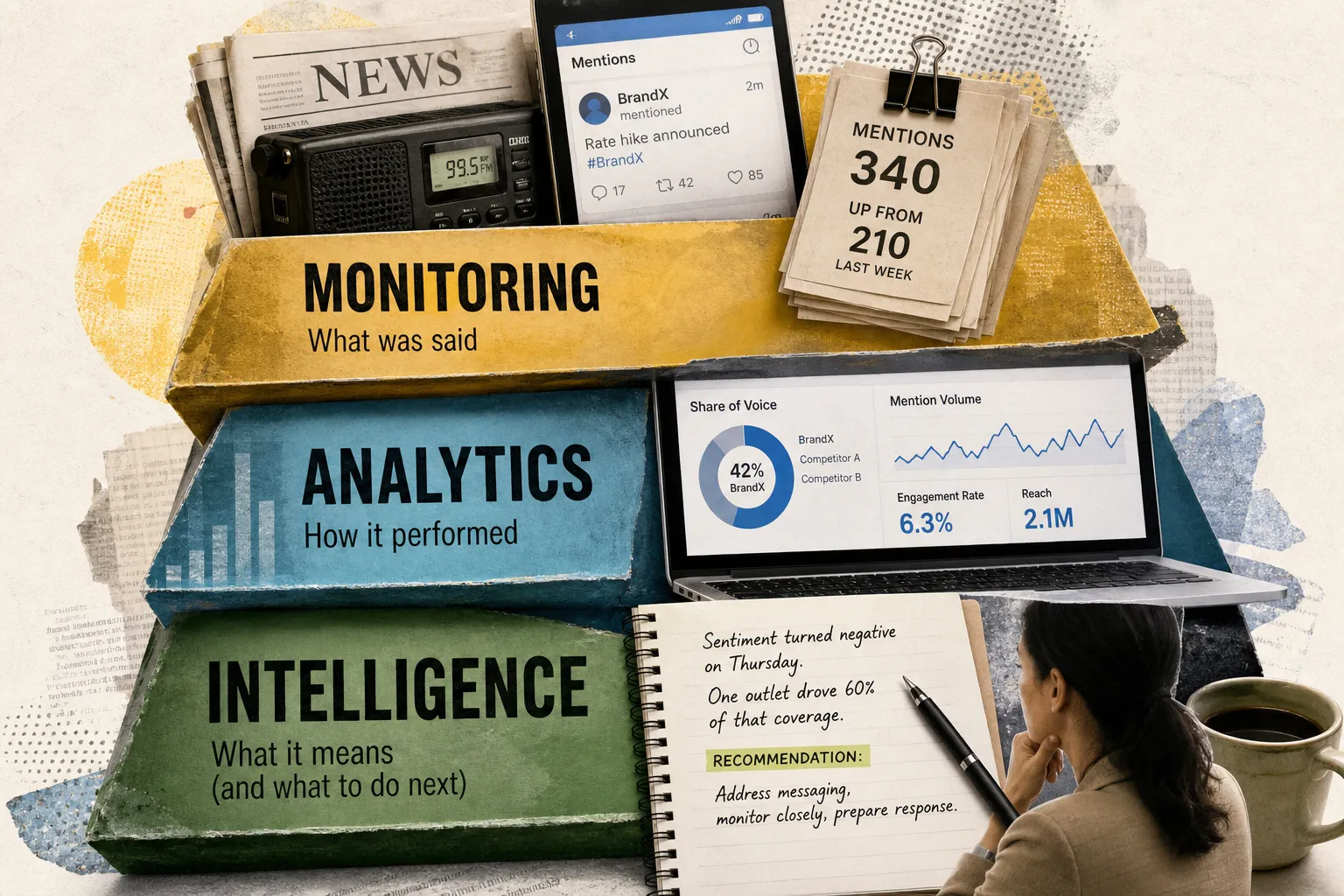
Media monitoring is the ongoing tracking of what's being said, shown, and shared about a brand, product, or category, across news sites, social platforms, forums, and broadcast content. In fashion, that means watching for shifts in language, imagery, and behavior across the same channels a trend will eventually break out on, before it breaks out.
For fashion specifically, monitoring goes beyond counting mentions of a brand name. It means tracking colors, silhouettes, styling choices, and the smaller creators who tend to move first, so a shift in taste shows up as data before it shows up on a shelf.
Why Fashion Trends Need a Signal, Not a Spotlight
Most brands only notice a trend once it's already everywhere: the hashtag is trending, every creator in the niche is styling it, and by then, the window to move first has closed. The brands that stay ahead aren't guessing. They're listening quietly and constantly, long before a trend becomes obvious enough for everyone to see it at once.
That timing gap matters even more in the Philippines. Trend cycles on platforms like TikTok Shop are widely reported to move faster locally than most global benchmarks assume, though exact timelines vary enough by source that they're worth verifying case by case rather than quoting as a fixed rule. A brand that waits for a trend to feel "confirmed" is often waiting until it's already fading.
7 Hidden Signals Media Monitoring
- Weak-Signal Language Before the Hashtag Exists
- Micro-Influencer Emergence
- Visual and Image-Based Listening
- Cross-Platform Pattern Overlap
- Dupe and Colorway Demand
- Local Resale and Thrift Acceleration
- Sentiment Shifts Around Saturation
1. Weak-Signal Language Before the Hashtag Exists
Long before a trend has a name, it shows up as small, repeated shifts in language: a sudden cluster of questions, a workaround people keep mentioning, or a phrase that starts appearing across unrelated posts. These weak signals rarely show up as a viral spike. They show up as a pattern, which is exactly why most brands miss them until it's too late to act early. If your monitoring setup only alerts you to spikes in volume, you're built to catch trends after they've already peaked, not before.
2. Micro-Influencer Emergence
The creators most likely to introduce a fashion trend before it hits the mainstream aren't the ones with millions of followers. Micro-influencers, generally creators with 10,000 to 100,000 followers, tend to drive higher engagement and conversion than larger accounts, often introducing styling-heavy or "get ready with me" content in a specific niche before it reaches the mainstream. Tracking which of these smaller accounts is gaining traction functions as an early-warning list, and it's often the right group to seed product into first. If an account with 30,000 followers is already styling something new, that's frequently a stronger signal for you than waiting on the celebrity with millions who picks it up later.
3. Visual and Image-Based Listening
Text alone misses most of what's happening on visual-first platforms like Instagram and Pinterest. Image-based listening lets brands read aesthetics directly, analyzing color, silhouette, and styling choices even when captions never mention the trend by name. On the more advanced end, fashion-forecasting vendors report using computer vision to scan millions of images a day, detecting thousands of visual attributes and forecasting trend growth many months in advance. Those figures come from the vendors themselves, so they're worth treating as a claim to verify rather than an industry-wide standard, but the underlying approach, reading the image instead of the caption, is a real and growing practice. If your monitoring only reads captions and hashtags, you're missing the trend cycle's fastest-moving layer.
4. Cross-Platform Pattern Overlap
A single spike on one platform is often just noise. Real momentum shows up when the same idea starts appearing across platforms in different formats: a styling trend on TikTok, the same silhouette showing up in Pinterest boards, then the same language surfacing in Reddit style forums. That overlap, not the size of any single spike, is what separates a genuine emerging trend from a one-platform blip. Don't judge a trend's strength by how loud it is on one platform. Judge it by how many different platforms are saying the same thing at once.
5. Dupe and Colorway Demand
When search and conversation volume builds around a "dupe" of a specific item or color, it's revealing unmet demand at a particular price point. This pattern started in beauty and fashion and has since spread into food and tech accessories, which tells you something about how consistent the underlying behavior is across categories. For a fashion brand, tracking dupe conversations is a direct map of what people want but can't yet afford or access at full price. A spike in "dupe" searches for your product, or a competitor's, is a demand signal you can act on before anyone launches an actual dupe.
6. Local Resale and Thrift Acceleration
In the Philippines, ukay-ukay culture offers a genuinely local version of this same signal. Facebook, Instagram, and TikTok have become the primary channels ukay-ukay vendors use to reach younger buyers, who actively follow influencers doing thrift-find content and shape what gets picked over next. Local designers have also started reworking thrifted fabric into modern, runway-ready pieces, which means a resale trend can move into original design faster than a brand relying only on international trend reports would expect. If you're building for the Philippine market, what's trending in Metro Manila ukay-ukay finds this month is a legitimate early input for your next collection, not just a side conversation about sustainability.
7. Sentiment Shifts Around Saturation
A trend doesn't just rise. It can also curdle, and the signal for that shift usually shows up in sentiment before it shows up in sales. When the same item or aesthetic keeps reappearing across too many creators at once, audiences can start to read it as oversaturated rather than exciting, even while the raw mention count stays high. Watching sentiment alongside volume is what catches that turn before it costs a brand its next campaign. Rising mentions and rising enthusiasm are not the same thing. Monitoring both is the only way to know which one you're actually looking at.
The Real Impact: What Brands Do Once They Catch the Signal
Catching a signal early only matters if it changes what a brand does next. In practice, that usually looks like:
- Fast product bets. Brands convert an early signal into a limited drop or an assortment adjustment while interest is still building, aiming to launch before the trend saturates the feed.
- Creator seeding. Once a brand identifies which mid-tier creators are moving first, sending product to that specific group tends to accelerate adoption more efficiently than a broad influencer campaign.
- Inventory and markdown planning. Real-time demand signals help retailers stock the right sizes and colors ahead of a spike, which is standard practice for reducing both overstock of items nobody wants and stockouts of items everyone suddenly does.
- Sentiment-triggered messaging changes. Catching a negative sentiment shift early lets a brand adjust its messaging or design response before a design or campaign complaint escalates into a bigger story.
- Competitor visibility tracking. Watching whether a rival's product keeps appearing in creator content before it ever shows up in search data reveals a competitive move that keyword tracking alone would miss entirely.
What This Means for Your Brand
For media monitoring and media relations analysts, this means building alerts around language and imagery, not just brand-name mentions, since the earliest fashion signals almost never mention a brand directly. Pairing sentiment tracking with creator activity is what turns a dashboard into an actual early-warning system, rather than a mention counter that only confirms what already went viral.
For brand managers and marketing specialists, the real value is timing. Knowing which mid-tier creators are moving first gives you a shortlist worth seeding before a trend saturates, and a data-backed reason to greenlight a limited drop instead of waiting for a trend to feel "safe" enough to act on.
For social media managers, it comes down to a practical filter. A trend showing up on one platform is a maybe. The same idea surfacing across TikTok, Pinterest, and niche forums at the same time is a much stronger signal, and a better basis for what actually gets approved for the content calendar.
Whichever seat you're in, the pattern holds: the earlier you can read the signal, the more of the trend cycle you actually get to act on.
The Future of Fashion Trend Monitoring
Visual and AI-assisted monitoring is only going to expand. As computer vision tools get better at reading garments directly from images and video rather than relying on captions, brands that build monitoring around visual signals now will have a longer head start once that approach becomes standard practice. Cross-platform pattern matching is also maturing past simple mention counts, moving toward genuinely tracking how an idea evolves as it moves from one platform to the next.
For Philippine brands specifically, the ukay-ukay and resale-driven signal is likely to keep growing in importance as digital thrift communities keep scaling, giving local retailers and designers a homegrown early-warning system that international trend reports simply don't capture.
Stay Ahead of the Conversation
Fashion moves fast. On Philippine social media, it moves faster than most global trend cycles account for. Whether you're tracking a competitor's next drop, watching sentiment around your last campaign, or trying to catch a trend before the hashtag exists, real-time media monitoring turns a guessing game into a repeatable process.
Want to see how your brand's fashion or lifestyle content shows up across Philippine media? With Media Meter's real-time brand mention tracking, you'll know exactly where and how your brand appears, and how sentiment around it is shifting, before the next trend cycle moves on without you. Contact us for inquiries or view our sample media reports to see how we help fashion and lifestyle brands stay ahead of the stories that matter.