Apple Pay Debuts in PH; BSP Rate Hike Expected
Apple Pay launches in the Philippines with four banks, while BSP signals a possible rate hike and hot money inflows slow. Financial literacy and digital payments dominate the day's conversation.
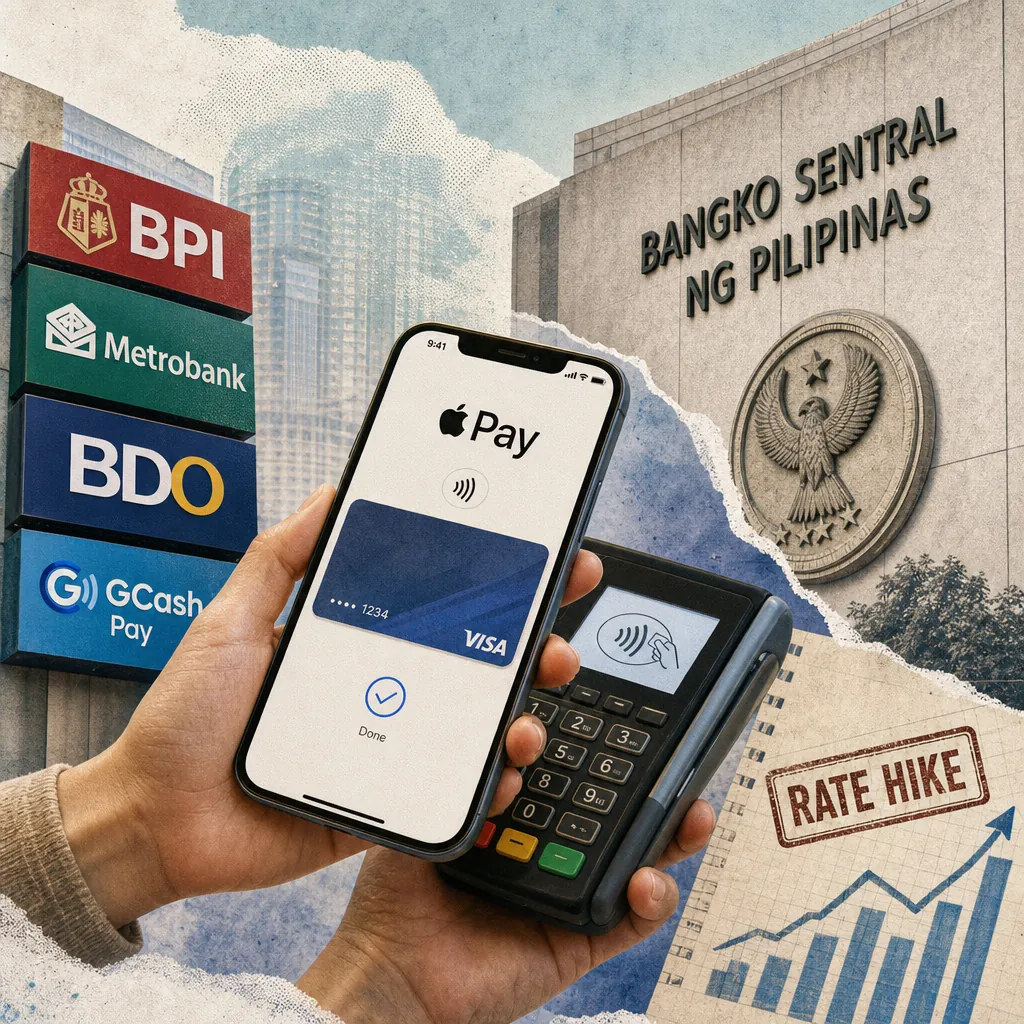
The day's conversation in the Philippine financial sector was anchored by two major developments: the official launch of Apple Pay in the country and signals from the Bangko Sentral ng Pilipinas (BSP) that it may raise interest rates again. These stories dominated both news coverage and social media discussions, reflecting a broader shift toward digital payments and a cautious economic outlook.
Apple Pay, the mobile payment service from tech giant Apple, became available to Philippine consumers on Tuesday, August 4. The launch was announced jointly by Apple, Visa, and Mastercard, with four banks initially supporting the service: Chinabank, GoTyme Bank, Metrobank, and UnionBank. This marks a significant milestone in the country's journey toward a cashless society, as consumers can now use their iPhones, Apple Watches, and other Apple devices to make contactless payments at stores, in apps, and online. The news was covered extensively across online news outlets, with BusinessWorld, Inquirer, and Head Topics all running stories. The coverage was substantial, with BusinessWorld's article alone carrying an estimated advertising-equivalent value of over ₱550,000, reflecting the high level of interest in this development.
On the macroeconomic front, the BSP is widely expected to raise its benchmark interest rate by another 25 basis points at its August 27 meeting, according to a report from Bank of America Global Research. This would be the third consecutive hike, bringing the rate to 5%. The move is aimed at taming inflation, which remains above the central bank's target range. The BSP has already raised rates by 50 basis points this year, and another hike would signal a continued tightening cycle. This story was also widely covered, with BusinessWorld and Head Topics both publishing articles on the forecast.
In addition to these two major stories, the day's conversation included a range of other financial topics. The BSP reported that foreign portfolio investments, often called "hot money," saw a net inflow of $170 million in June, the second straight month of inflows, though lower than May's figure. This suggests that foreign investors are cautiously returning to Philippine markets, but the overall first-half figure remains a net outflow of $4 billion, a reversal from the same period last year. The BSP also announced a partnership with the online financial community KasKasan Buddies to promote financial literacy, and a bill was filed in Congress that would allow Filipinos to use digital transaction histories for credit scoring. These stories, while less prominent than the Apple Pay launch, contributed to a rich and varied conversation about the future of finance in the Philippines.
Key themes
- Apple Pay's Entry into the Philippine Market: The launch of Apple Pay was the day's biggest consumer-facing story. It represents a major step forward for digital payments in the country, offering a new level of convenience and security for iPhone users. The initial support from four banks is expected to expand, and the move is likely to accelerate the shift away from cash.
- BSP's Tightening Cycle: The central bank is expected to raise interest rates again in August, continuing its fight against inflation. This has implications for borrowers, businesses, and the overall economy, as higher rates can slow down economic growth.
- Hot Money Flows and Investor Sentiment: The BSP's data on foreign portfolio investments showed a second month of net inflows, but the amounts are still modest compared to outflows earlier in the year. This reflects a cautious but improving investor sentiment toward the Philippines.
- Financial Literacy and Inclusion: The BSP's partnership with KasKasan Buddies and the proposed Open Finance bill highlight a growing focus on making financial services more accessible and understandable for all Filipinos. These initiatives aim to leverage digital technology to bring more people into the formal financial system.
- Corporate Earnings and Business Performance: Several Philippine companies reported their quarterly results, with mixed outcomes. For example, Maynilad's profit rose 17%, while Petron's first-half profit fell 27% due to Middle East tensions. These reports provide insight into the health of the corporate sector.
- Recognition for Philippine Firms: Seven Philippine companies made Forbes Asia's "Best Under A Billion" list, which recognizes high-performing small and midsized firms. This is a positive signal for the country's business environment and entrepreneurial ecosystem.
- Consumer Finance and Spending: Stories about credit scoring, savings consciousness, and the "Ghost Month" tradition reflect a broader conversation about how Filipinos manage their money. These topics resonate with everyday consumers and highlight cultural and behavioral factors that influence financial decisions.
How the narratives stack
Dominant: The launch of Apple Pay and the BSP's expected rate hike are the two dominant narratives of the day. Apple Pay's entry into the market is a tangible, consumer-facing development that signals the Philippines' growing embrace of digital payments. The BSP's rate hike, on the other hand, is a more consequential macroeconomic event that affects borrowing costs, investment, and inflation. Both stories received extensive coverage across online news outlets, with high advertising-equivalent values, indicating their importance to the financial sector.
Counter-narrative: While the dominant narratives focus on progress and policy, there is a counter-narrative of caution and concern. The slowdown in hot money inflows, the expected GDP growth slowdown, and the ongoing impact of inflation and global uncertainties (such as the Middle East conflict) paint a more sober picture. This narrative suggests that while the Philippines is making strides in digital finance, the broader economic environment remains challenging.
Emerging: An emerging narrative is the use of alternative data for credit scoring. The proposed Open Finance bill, which would allow lenders to use digital transaction histories to assess creditworthiness, could revolutionize access to credit for millions of Filipinos who lack traditional credit histories. This is a forward-looking story that could have a significant impact on financial inclusion.
Suppressed: A story that received relatively little attention in the day's coverage is the BSP's partnership with KasKasan Buddies for financial literacy. While this is a positive development, it was overshadowed by the Apple Pay launch and rate hike news. The partnership has the potential to improve financial education among Filipinos, but it did not generate the same level of engagement as other stories.
Platform insights
- Facebook: Facebook was a key platform for sharing news articles and engaging with financial content. Posts from banks like BPI, which celebrated Alex Eala's tennis victory, and from news outlets like Inquirer and BusinessWorld, generated significant engagement. The platform's demographic skews older, but it remains a primary source of news for many Filipinos.
- X (formerly Twitter): X was active with discussions on the Apple Pay launch and the BSP's rate hike. Financial analysts and economists used the platform to share their insights and react to the news. The hashtag #FinancePH was used to aggregate financial news and discussions, indicating a vibrant community of finance enthusiasts.
- Reddit: Reddit's r/Philippines and r/phinvest communities discussed the implications of Apple Pay and the rate hike. Users shared personal experiences with digital payments and debated the pros and cons of the BSP's monetary policy. The platform's anonymous nature allows for candid discussions and diverse perspectives.
- YouTube: YouTube was used by financial content creators to produce explainer videos on Apple Pay and the BSP's rate decision. These videos often include detailed analysis and tutorials, catering to viewers who prefer visual and in-depth content. The engagement on these videos, measured by likes and comments, indicates a strong interest in understanding these topics.
Key voices and communities
- Financial Analysts and Economists: This group includes professionals from banks, research firms, and academic institutions. They provide expert commentary on macroeconomic data, interest rates, and market trends. Their insights are often quoted in news articles and shared on social media, making them influential in shaping the narrative.
- Banking and Fintech Executives: Leaders from banks like GoTyme, UnionBank, and BPI, as well as fintech companies, are key voices in the conversation about digital payments and financial inclusion. Their announcements and statements are closely followed by the media and the public.
- Government Regulators: The BSP, through its officials like Deputy Governor Bernadette Romulo-Puyat, plays a central role in setting monetary policy and promoting financial literacy. Their actions and statements are newsworthy and often spark discussions about the economy.
- Consumer Advocates and Financial Educators: This group includes organizations and individuals who focus on helping Filipinos make better financial decisions. They often comment on issues like credit scoring, savings, and the impact of interest rates on households.
- Everyday Consumers and Investors: The general public, particularly those active on social media, contribute to the conversation by sharing their experiences with digital payments, asking questions about interest rates, and expressing their views on the economy. Their engagement, measured by likes, shares, and comments, provides a gauge of public sentiment.
Narrative streams
Apple Pay's Philippine Debut: A Leap Toward Cashless
The launch of Apple Pay in the Philippines on August 4 was a landmark event for the country's digital payments landscape. Apple, Visa, and Mastercard jointly announced that eligible cardholders from Chinabank, GoTyme Bank, Metrobank, and UnionBank could now add their cards to Apple Wallet and use them for contactless payments. This move brings the Philippines in line with other countries in the region where Apple Pay is already available.
The coverage was extensive, with multiple online news outlets running stories. BusinessWorld's article, which detailed the launch and quoted Apple's vice president Jennifer Bailey, carried an estimated advertising-equivalent value of over ₱550,000, indicating the high level of media attention. The Inquirer also ran a similar story, and Head Topics picked up the news, further amplifying its reach.
For consumers, Apple Pay offers a new level of convenience and security. Instead of pulling out a physical card, they can simply double-click the side button on their iPhone and hold it near a payment terminal. The service uses Face ID or Touch ID for authentication, and each transaction generates a unique dynamic security code, making it more secure than traditional magnetic stripe cards.
The launch is expected to accelerate the shift toward cashless payments in the Philippines, which has been growing steadily in recent years. According to the BSP, digital payments now account for a significant portion of retail transactions, and the central bank has set a goal of converting 50% of retail transactions to digital by 2023. Apple Pay's entry is likely to boost this trend, especially among the tech-savvy younger generation.
However, the initial rollout is limited to four banks, and it may take time for other banks to join. This could create a temporary divide between those who can use Apple Pay and those who cannot. Nevertheless, the overall trajectory is clear: the Philippines is moving toward a more digital and cashless future.
BSP's Tightening Cycle: Inflation Fight Continues
The Bangko Sentral ng Pilipinas (BSP) is expected to raise its benchmark interest rate by another 25 basis points at its August 27 meeting, according to a report from Bank of America Global Research. This would be the third consecutive hike, bringing the rate to 5%. The move is aimed at curbing inflation, which has been running above the BSP's target range of 2-4%.
The BSP has already raised rates by 50 basis points this year, with hikes in April and June. The central bank's Monetary Board has been cautious in its approach, but persistent inflationary pressures, particularly from food and energy prices, have necessitated further action.
Bank of America's report suggests that if July inflation settles below 7%, the BSP may proceed with one more hike and then signal that it has reached its target. This would bring the total tightening to 75 basis points for the year. The report also notes that inflation expectations have eased from worst-case scenarios as oil prices subside, but rice and wage inflation remain key risks.
The rate hike has significant implications for the economy. Higher interest rates make borrowing more expensive, which can slow down consumer spending and business investment. However, they also help to control inflation by reducing the amount of money in circulation. The BSP's primary mandate is to maintain price stability, and it has shown a willingness to act decisively to achieve this goal.
The coverage of this story was also substantial, with BusinessWorld and Head Topics both publishing articles on the forecast. The BusinessWorld article, which quoted BofA economists, carried an estimated advertising-equivalent value of over ₱415,000. This indicates that the rate hike is a major concern for businesses and investors, as it affects the cost of capital and the overall economic outlook.
Hot Money Flows: A Cautious Return
The BSP's data on foreign portfolio investments (FPIs), often referred to as "hot money," showed a net inflow of $170 million in June, the second straight month of inflows. This was lower than the $232 million net inflow in May but significantly higher than the $18 million in June of the previous year. The data suggests that foreign investors are cautiously returning to Philippine markets, despite lingering volatility.
However, the first-half figure remains a net outflow of $4 billion, a reversal from the nearly $2 billion net gain seen in the same period last year. This indicates that the overall trend is still negative, and the recent inflows are not enough to offset earlier outflows.
Hot money is called so because it can enter and leave a country quickly, making it a volatile source of funding. These investments are typically in liquid instruments like stocks and bonds, and they are highly sensitive to changes in global sentiment and domestic conditions. The BSP's data shows that foreign investors were net buyers of government securities in June but sold local stocks at a faster pace, reflecting a flight to safer investments.
The coverage of this story was spread across several outlets, including BusinessWorld, Inquirer, and Head Topics. The BusinessWorld article, which provided detailed analysis, carried an estimated advertising-equivalent value of over ₱361,000. This story is important because it reflects the level of confidence that foreign investors have in the Philippine economy, and it can influence the exchange rate and the stock market.
Financial Literacy and Inclusion: A Growing Focus
The BSP's partnership with KasKasan Buddies, one of the Philippines' largest online financial communities, is part of a broader effort to improve financial literacy among Filipinos. The central bank's digital financial education platform, PisoLit, will co-develop social media content and learning sessions with the community. This initiative aims to reach a wider audience, particularly the younger generation, and help them make better financial decisions.
In addition, a bill filed in Congress, House Bill No. 9149, seeks to allow Filipinos to use digital transaction histories to prove creditworthiness when applying for loans. This would help those with little or no credit history, such as freelancers and small business owners, gain access to credit. The bill also creates a Consumer Data Commission to oversee implementation.
These initiatives reflect a growing recognition that financial inclusion is not just about access to banking services, but also about education and empowerment. By leveraging digital technology, the BSP and other stakeholders hope to bring more Filipinos into the formal financial system and help them build a more secure financial future.
The coverage of these stories was less prominent than the Apple Pay launch or the rate hike, but they are significant in the long term. The BSP's partnership with KasKasan Buddies was covered by BusinessWorld, and the credit scoring bill was covered by the Inquirer. These stories highlight the ongoing efforts to make the financial system more inclusive and accessible.
Corporate Earnings: Mixed Results Reflect Economic Challenges
The day's coverage also included several corporate earnings reports, which provided insight into the health of the Philippine business sector. Maynilad, a water utility, reported a 17% rise in second-quarter profit, driven by lower financing costs. DigiPlus, a digital entertainment company, saw its second-quarter profit more than double, thanks to strong performance in its electronic gaming and casino operations. However, Petron, an oil company, reported a 27% fall in first-half profit, as the Middle East conflict and other factors weighed on its business.
These mixed results reflect the broader economic challenges facing the Philippines, including inflation, global uncertainties, and the impact of the government's infrastructure spending slowdown. Companies in sectors that are less sensitive to these factors, such as utilities and digital entertainment, are performing well, while those in more cyclical industries, like oil and gas, are struggling.
The coverage of these earnings reports was spread across various outlets, including BusinessWorld and Head Topics. While they did not generate as much attention as the Apple Pay launch or the rate hike, they are important for investors and analysts who are trying to gauge the overall health of the corporate sector.
Recognition for Philippine Firms: A Positive Signal
Seven Philippine companies made Forbes Asia's 2026 "Best Under A Billion" list, which recognizes 200 high-performing small and midsized publicly listed firms across the Asia-Pacific region. The Philippine companies are A. Soriano Corp., Apex Mining Co., Inc., Asia United Bank, Far Eastern University, Pryce Corp., STI Education Systems Holdings, Inc., and Vivant Corp.
The list is based on a composite score that considers debt, sales, earnings-per-share growth, and returns on equity. The inclusion of these companies is a positive signal for the Philippine business environment, as it highlights the presence of well-managed and growing firms in the country.
The coverage of this story was relatively brief, but it was picked up by BusinessWorld and Head Topics. The BusinessWorld article provided details on the companies' sales figures, with Asia United Bank posting the highest sales at $505 million. This recognition could help boost investor confidence in these companies and the Philippine market as a whole.
Conversation trajectory
- Short-term (next 1-2 weeks): The BSP's rate hike decision on August 27 will be a major focus. The release of second-quarter GDP data on August 7 will also be closely watched, as it will provide a clearer picture of the economy's health. If the GDP growth comes in below expectations, it could put pressure on the BSP to pause its tightening cycle.
- Medium-term (next 1-3 months): The expansion of Apple Pay to more banks is likely to be announced in the coming months. This will further accelerate the adoption of digital payments. The implementation of the Open Finance bill, if passed, could also have a significant impact on the financial sector, as it would allow for more innovative uses of consumer data.
- Long-term (next 6-12 months): The trajectory of inflation will be a key determinant of the BSP's monetary policy. If inflation remains elevated, the BSP may need to continue raising rates, which could slow down economic growth. On the other hand, if inflation subsides, the BSP could shift to a more accommodative stance. The ongoing global uncertainties, such as the Middle East conflict and US trade policies, will also influence the Philippine economy.
Trigger events to watch: The BSP's rate decision on August 27, the release of July inflation data, the second-quarter GDP report, and any announcements from Apple about expanding Apple Pay to more banks.
Response guidance
For communicators in the financial sector, the following guidance is relevant:
- Emphasize the benefits of digital payments: With Apple Pay's launch, there is an opportunity to educate consumers about the convenience and security of digital payments. Banks and fintech companies should highlight how these services can make everyday transactions easier and safer.
- Address consumer concerns about interest rates: As the BSP raises rates, consumers may be worried about higher borrowing costs. Communicators should provide clear and simple explanations of how rate hikes affect loans, savings, and investments, and offer practical advice on managing finances in a higher-rate environment.
- Promote financial literacy: The BSP's partnership with KasKasan Buddies and the proposed credit scoring bill are positive developments. Communicators can support these initiatives by creating content that helps Filipinos understand their finances better and make informed decisions.
- Be transparent about economic challenges: While the Philippines is making progress in digital finance, the economy faces headwinds. Communicators should be honest about these challenges while also highlighting the opportunities and resilience of the Filipino people.
- Leverage social media: The conversation about finance is increasingly happening on social media. Communicators should engage with platforms like Facebook, X, and Reddit to reach a wider audience and participate in discussions. Using hashtags like #FinancePH can help amplify messages.
- Monitor sentiment: It is important to track public sentiment on issues like interest rates and digital payments. This can help communicators tailor their messages and address concerns before they escalate.
- Highlight success stories: The recognition of Philippine firms in Forbes' list and the achievements of individuals like Alex Eala can serve as positive stories that inspire confidence in the economy. Communicators should leverage these stories to build a positive narrative.
- Prepare for potential crises: Given the economic uncertainties, communicators should have crisis communication plans in place. This includes being ready to respond to negative news, such as a disappointing GDP report or a sudden market downturn, with clear and reassuring messages.
By following these guidelines, communicators can effectively navigate the evolving financial landscape and build trust with their audiences.
See the full picture behind today's signals.
This report draws from Media Meter's MediaWatch, our real-time monitoring engine tracking 2,470+ Philippine sources across print, broadcast, digital, and social. Explore how the platform turns raw coverage into decision-grade intelligence, then see how it's configured for teams like yours — whether you're in PR agencies, corporate comms, government, or marketing.
Want more? Browse our Report Library for sector and crisis intelligence, or request a demo and we'll have your brand set up before the call.
Want this kind of intelligence on your brand?
This brief is built on the same MediaWatch methodology that runs continuously across every brand we monitor. See your competitive landscape, Impact Score, and narrative trajectory in a 30-minute demo.