DOTr budget hearing: e-trikes, Mindanao Railway in focus
The Department of Transportation's proposed 2027 budget drew congressional scrutiny, with a lawmaker seeking an extra P30 billion for the Mindanao Railway and the agency announcing regulation of e-trikes. The day's coverage also touched on a police misconduct case and a celebrity's Ferrari purchase.
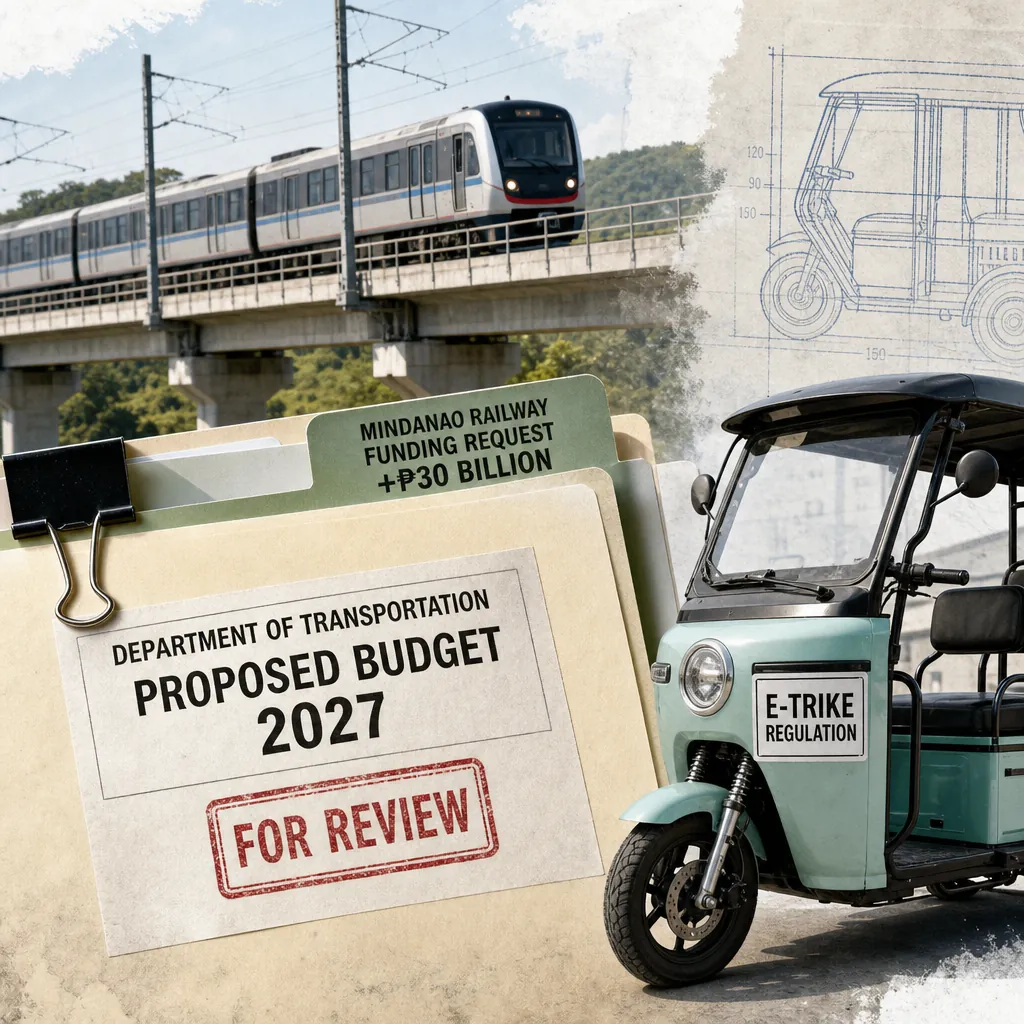
The Department of Transportation (DOTr) took center stage in the day's news as lawmakers scrutinized its proposed 2027 budget, with one congressman calling for an additional P30 billion to fund projects like the Mindanao Railway and the agency announcing plans to regulate electric tricycles (e-trikes). The budget hearings, held before the House committee on appropriations, drew attention to the agency's funding gaps and its regulatory plans for a growing segment of the transport sector. Meanwhile, a separate story on police misconduct and a celebrity's luxury car purchase rounded out the day's coverage, offering a glimpse into how transportation intersects with public safety and social media culture.
Key themes
- DOTr's proposed 2027 budget is P300.96 billion, a 52.52% increase from 2026 — The agency's proposed budget under the National Expenditure Program (NEP) is P300.960 billion, up from P197.331 billion in the 2026 NEP and P137.846 billion in the 2026 General Appropriations Act. The increase is meant to support infrastructure projects, but lawmakers noted that many projects remain unfunded.1
- Lawmaker seeks additional P30 billion for Mindanao Railway — Cagayan de Oro 2nd District Rep. Rufus Rodriguez called for an extra P30 billion to support the DOTr's projects, particularly the Mindanao Railway, which he said is not fully funded in the proposed budget.1
- DOTr to regulate e-trikes to ensure safety and roadworthiness — Transportation Secretary Giovanni Lopez announced that the department will issue a department order to regulate e-trikes, covering driver qualifications, vehicle registration, and roadworthiness. The move comes amid concerns that e-trike drivers are vulnerable to extortion due to lack of franchises.4
- E-trike regulation falls under local government jurisdiction — During the budget briefing, Caloocan City Rep. Edgar Erice cited Section 447 of the Local Government Code, which mandates local government units to regulate tricycle operations, subject to DOTr guidelines. Secretary Lopez acknowledged this and said the department order will provide the framework.4
- Police misconduct case draws attention to accountability — A separate story involved a police captain from Cavite accused of manipulating an assault case against his brother, a police officer who allegedly assaulted a college student. The National Police Commission (Napolcom) is investigating.2
- Celebrity's Ferrari purchase sparks social media buzz — Social media personality Sachzna Laparan shared her purchase of a Ferrari at age 28, drawing mixed reactions online. Some netizens celebrated her hard work, while others questioned the source of her wealth.3
- China's e-commerce shift to instant retail offers lessons for transport — An article on China's e-commerce evolution highlights how delivery price wars have reshaped consumer expectations, with goods like electronics and medicine now delivered within an hour. This trend has implications for last-mile logistics and transport planning.5
How the narratives stack
- Dominant: The DOTr budget hearing dominates the captured coverage, with two separate articles focusing on the agency's proposed 2027 budget and its regulatory plans. The budget increase and the call for additional funding for the Mindanao Railway are the most significant developments, as they directly affect infrastructure spending and transport policy.14
- Counter-narrative: The police misconduct story offers a counter-narrative to the day's transport focus, highlighting issues of accountability within law enforcement. While not directly related to transportation, it underscores the broader context of public safety and governance that transport policies operate within.2
- Emerging: The e-trike regulation story is an emerging narrative, as it signals a shift toward formalizing a sector that has largely operated informally. The DOTr's move to regulate e-trikes could have significant implications for drivers, local governments, and the electric vehicle industry.4
- Under-covered: The China e-commerce article, while not about the Philippines, points to a global trend in instant retail that could influence local logistics and transport planning. This story received less attention in the captured set but offers valuable insights for the sector.5
Platform insights
- Facebook: Sachzna Laparan's post about her Ferrari generated significant engagement, with many netizens expressing happiness for her achievement. The post's caption, which emphasized hard work and no privileges, resonated with followers, sparking discussions about success and wealth.3
- X (formerly Twitter): The DOTr budget hearing and the police misconduct case likely trended on X, as users shared updates and opinions on government spending and police accountability. However, the monitoring data does not specify engagement figures for these topics.
- YouTube: No significant YouTube activity was noted in the captured coverage, but the DOTr budget hearing may have been streamed or covered by news channels, potentially reaching a wider audience.
Key voices and communities
- Government officials: Rep. Rufus Rodriguez and Transportation Secretary Giovanni Lopez are key voices, shaping the narrative around the DOTr budget and e-trike regulation. Their statements during the House briefing are central to the day's news.14
- Lawmakers: Rep. Edgar Erice raised concerns about e-trike drivers' vulnerability to extortion, highlighting the need for regulation. His citation of the Local Government Code adds legal context to the discussion.4
- Regulatory bodies: The National Police Commission (Napolcom) is a key voice in the police misconduct story, with Commissioner Rafael Vicente Calinisan revealing details of the alleged manipulation.2
- Social media personalities: Sachzna Laparan's post about her Ferrari drew attention, with netizens and other personalities commenting on her achievement. Her story resonates with audiences interested in entrepreneurship and success.3
- Industry analysts: The China e-commerce article quotes analysts on the shift to instant retail, offering a broader perspective on consumer expectations and logistics trends.5
Narrative streams
DOTr budget increase and the push for Mindanao Railway funding
The Department of Transportation's proposed budget for 2027 is P300.960 billion under the National Expenditure Program (NEP), a 52.52% increase from the 2026 NEP of P197.331 billion and a 118.33% jump from the 2026 General Appropriations Act of P137.846 billion. The NEP is the President's proposed spending plan submitted to Congress for approval. During the House committee on appropriations briefing, Cagayan de Oro 2nd District Rep. Rufus Rodriguez called for an additional P30 billion to support the agency's projects, particularly the Mindanao Railway. Rodriguez expressed support for the agency's funding but noted that many projects remain unfunded. The Mindanao Railway is a major infrastructure project aimed at connecting key cities in Mindanao, and its funding is critical for the region's economic development. The read for the sector is that the DOTr's budget increase signals a continued commitment to infrastructure, but the call for additional funds highlights the gap between proposed allocations and actual project needs. For transport stakeholders, this means potential delays or scaled-down projects if funding is not secured.1
DOTr to regulate e-trikes: a step toward formalization
The Department of Transportation (DOTr) announced plans to regulate electric tricycles (e-trikes) to ensure driver qualifications, vehicle roadworthiness, and registration. Secretary Giovanni Lopez made the announcement during the House budget briefing, responding to a query from Caloocan City Rep. Edgar Erice about the plight of e-trike drivers, many of whom are prone to extortion because they lack franchises to ply routes. Erice cited Section 447 of the Local Government Code, which mandates local government units to regulate tricycle operations, subject to DOTr guidelines. Lopez acknowledged that regulation falls under local government jurisdiction but said the agency will release a department order to provide a framework. This move is significant because e-trikes have proliferated in many cities as an affordable and eco-friendly mode of transport, but their informal status has left drivers vulnerable and raised safety concerns. The read for the sector is that formalizing e-trike operations could improve safety and working conditions for drivers, but it also imposes new requirements that may be burdensome for small operators. Local governments will need to balance regulation with the livelihoods of drivers who depend on e-trikes for income.4
Police misconduct case: accountability in the spotlight
A separate story involved a police captain from Cavite accused of manipulating an assault case against his brother, Police Senior Master Sergeant Don Carlos Almonidovar, who allegedly assaulted and threatened to kill a college student. The National Police Commission (Napolcom) revealed that the case investigator only filed grave threats and physical injuries against Almonidovar, which Commissioner Rafael Vicente Calinisan described as "watered down." The victim, a 20-year-old college student identified only as alias "Ace," reported the assault to the Napolcom. The case highlights issues of accountability within the police force and the challenges victims face in seeking justice. While not directly related to transportation, this story underscores the broader governance context in which transport policies operate. The read for the sector is that public trust in institutions is essential for effective policy implementation, and incidents like this can erode confidence in government agencies, including those overseeing transport.2
Celebrity Ferrari purchase: social media and the culture of success
Social media personality and entrepreneur Sachzna Laparan shared her purchase of a Ferrari at age 28, posting photos on Facebook with the caption, "Feeling grateful to be driving my own Ferrari at 28." In a separate post, she emphasized that her success came from hard work, with "NO rich parent. NO inheritance. NO connections. NO privileges." The posts drew mixed reactions, with many netizens celebrating her achievement and others questioning the source of her wealth. This story, while not directly about transportation, reflects the cultural significance of cars as status symbols and the role of social media in shaping perceptions of success. The read for the sector is that consumer attitudes toward car ownership are influenced by social media trends, which can affect demand for luxury vehicles and, by extension, the automotive industry.3
China's instant retail shift: implications for logistics and transport
An article from DealStreetAsia discusses how China's e-commerce sector has entered a new phase, with a delivery price war reshaping consumer expectations. After a year of heavy subsidies by companies like Meituan, Alibaba, and JD.com, consumers in major cities now expect goods such as electronics, flowers, and medicine to be delivered within an hour. This "instant retail" trend has emerged as the new battleground in online shopping, with companies betting on converting frequent app visits into purchases of higher-margin non-food items. The article quotes analysts who say that "quick commerce has fundamentally reshaped consumer expectations around convenience and reliability. It is an irreversible lifestyle shift." While this story is about China, it has implications for the Philippines, where e-commerce and delivery services are growing. The read for the sector is that transport and logistics providers must adapt to rising consumer expectations for faster delivery, which may require investments in last-mile infrastructure and technology.5
Conversation trajectory
- DOTr budget deliberations (next 4-6 weeks): The House committee on appropriations will continue deliberating the DOTr's proposed budget. The call for an additional P30 billion for the Mindanao Railway may gain traction, but the final allocation will depend on congressional negotiations. Watch for further hearings and amendments to the NEP.1
- E-trike regulation (next 3-6 months): The DOTr's department order on e-trike regulation is expected to be released soon. Its implementation will depend on local government units, which may face challenges in enforcing new rules. Watch for pilot programs or public consultations.4
- Napolcom investigation (next 1-3 months): The investigation into the police misconduct case is ongoing. The outcome could affect public trust in the police and may lead to reforms in how assault cases are handled.2
- China's instant retail trend (ongoing): The shift toward instant retail in China is likely to influence global e-commerce trends, including in the Philippines. Watch for local companies adopting similar delivery models, which could impact transport and logistics.5
Trigger events: The release of the DOTr department order on e-trikes; the House committee's approval of the DOTr budget; the Napolcom's findings on the police misconduct case; and any major announcements from Philippine e-commerce players about instant delivery services.
Response guidance
- For transport agencies: Communicate clearly about the budget allocation and the status of major projects like the Mindanao Railway. Address public concerns about unfunded projects by providing timelines and funding sources. Use plain language to explain how the budget will benefit commuters and the economy.
- For e-trike stakeholders: Engage with the DOTr and local governments during the rule-making process. Highlight the benefits of regulation for driver safety and income stability, but also raise concerns about compliance costs. Provide input on how to make registration and franchising accessible to small operators.
- For law enforcement and governance bodies: Be transparent about the investigation into the police misconduct case. Reassure the public that accountability mechanisms are in place and that victims' rights are protected. Avoid defensive messaging that could further erode trust.
- For automotive and social media influencers: When sharing personal achievements like car purchases, be mindful of the potential for backlash. Frame success stories in a way that acknowledges systemic factors, such as access to capital and opportunities, to avoid alienating audiences.
- For logistics and e-commerce companies: Monitor consumer expectations for faster delivery and consider investments in last-mile infrastructure. Communicate any changes in delivery times or fees clearly to manage customer expectations.
See the full picture behind today's signals.
This report draws from Media Meter's MediaWatch, our real-time monitoring engine tracking 2,470+ Philippine sources across print, broadcast, digital, and social. Explore how the platform turns raw coverage into decision-grade intelligence, then see how it's configured for teams like yours — whether you're in PR agencies, corporate comms, government, or marketing.
Want more? Browse our Report Library for sector and crisis intelligence, or request a demo and we'll have your brand set up before the call.
Want this kind of intelligence on your brand?
This brief is built on the same MediaWatch methodology that runs continuously across every brand we monitor. See your competitive landscape, Impact Score, and narrative trajectory in a 30-minute demo.