Benguet Farmers Dump Crops as Prices Collapse
A snapshot of the day's conversation on agricultural distress in Benguet, where farmers discarded vegetables due to low prices, and a Senate bill proposing lower prepaid call and text rates, alongside other food and energy sector news.
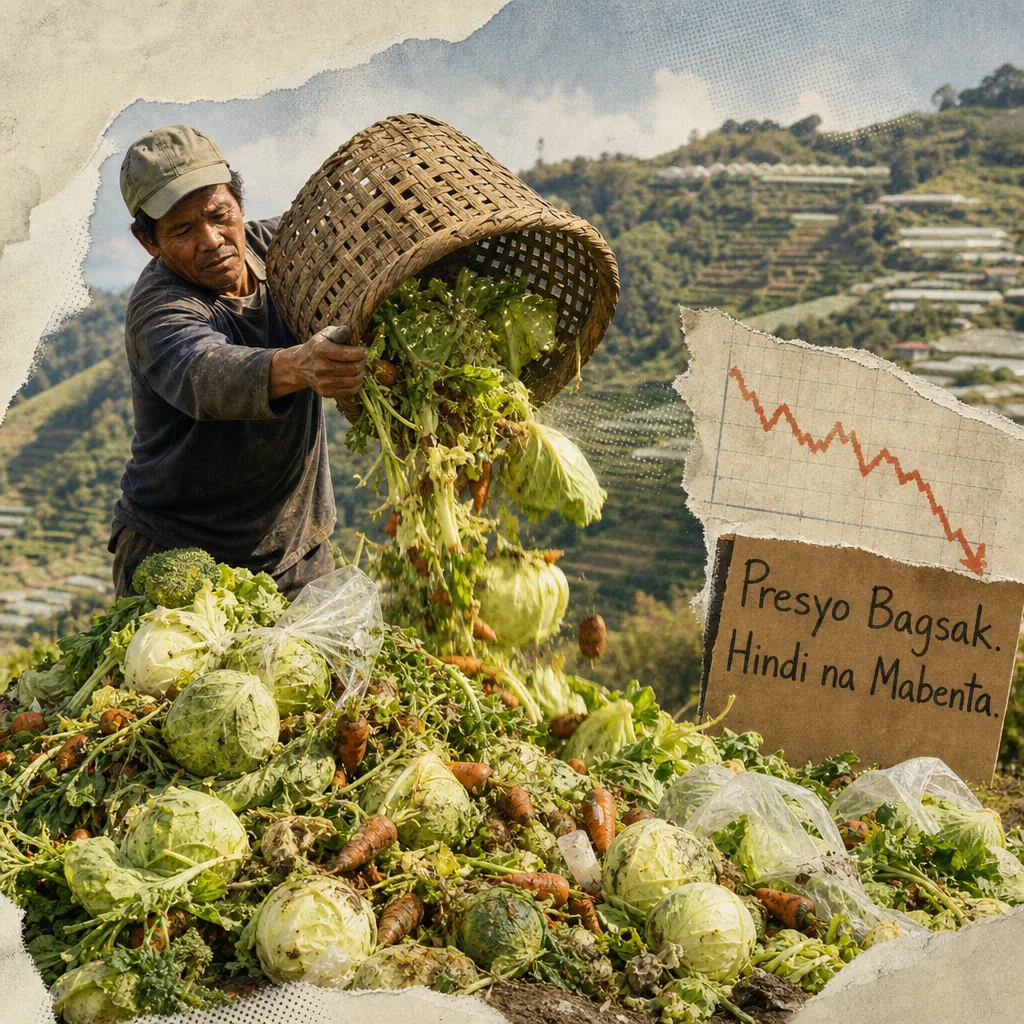
The day's conversation opened with a striking visual from Benguet that immediately captured public attention: farmers in Tublay dumping truckloads of Chinese cabbage and carrots along the Labey-Lacamen Road rather than absorbing transport costs to the La Trinidad Trading Center. The post from PIA Benguet's official Facebook account, shared as a photo report, quickly generated 46 likes, 24 shares, and a disproportionately high 155 sad reactions—a signal that the emotional weight of the imagery resonated far beyond the modest engagement numbers. Farmers interviewed in the post explained that low prices and a near-total absence of buyers left them with no viable alternative, framing the waste as a rational economic decision rather than carelessness. Within hours, the narrative evolved from a single incident into a broader commentary on agricultural price collapse, with commenters drawing parallels to the retail price of vegetables in Metro Manila markets—a gap that fueled criticism of the supply chain's inefficiency.
The conversation shifted dramatically by late afternoon when a separate post from a Senate-related Facebook page introduced a legislative angle: a proposed bill to lower the default price of prepaid calls and text messages in the Philippines. While this second post generated only 2 likes and zero comments, its timing alongside the Benguet story created an implicit contrast in public discourse—one about food waste and farmer livelihoods, the other about consumer telecom costs—both pointing to affordability pressures in different sectors. By the end of the day, the conversation had split into two distinct threads: one anchored in agricultural crisis and food price inequity, and another nascent discussion on service pricing regulation, though the latter remained largely dormant due to minimal engagement.
Meanwhile, the news media carried a broader set of stories touching on food, energy, and consumer issues. The Manila Times reported on Senator Loren Legarda's filing of the Sulit Load Act, which proposes interim maximum rates of P0.50 per SMS and P2 per minute for calls, directly relevant to the telecom thread. The Inquirer covered the Energy Regulatory Commission's (ERC) wariness over Ramon Ang's acquisition of a stake in Lopez Inc., raising competition concerns in the power market. Philstar reported that rice tariff collections rose 18% in the first seven months of the year, reaching nearly P13 billion, driven by higher import volumes and a weaker peso. These stories, while not directly tied to the social media posts, provide context for the day's economic and regulatory conversations.
Key themes
- Agricultural Waste as a Symptom of Systemic Price Failure: The dominant theme emerged immediately with the Benguet dumping report, serving as a catalyst for broader discussions about the farm-to-market price disconnect. The 155 sad reactions and 23 comments on the PIA post indicated that users were not merely observing but emotionally processing the waste as evidence of policy failure, with several commenters calling out the irony of high Manila vegetable prices while farmers discarded produce. The narrative gained momentum as users began tagging local officials and demanding explanations, effectively transforming a local incident into a national food security talking point.
- The Dormant Legislative Counterpoint: The Senate bill proposal on prepaid call and text pricing surfaced on the same day but remained an underdeveloped narrative thread, generating only 2 likes and zero engagement. Despite the lack of comments, the post's existence created a secondary conversation track that, while silent, introduced the concept of regulatory price intervention into the same news cycle as the agricultural crisis. The causal link between these two posts is indirect but measurable: both address the cost-of-living squeeze affecting Filipino consumers and producers, yet the telecom bill's low engagement suggests that visual, tangible crises like wasted food command more public attention than abstract legislative proposals.
- Sentiment Divergence Between Sectors: By the close of the day, sentiment across the conversation had bifurcated: food-related posts generated predominantly negative emotional reactions (155 sad, 1 angry), while the telecom post produced neutral-to-apathetic engagement. This divergence is chronologically significant because it shows how the same day's news cycle produced entirely different audience responses—one rooted in empathy and outrage, the other in indifference. The cause-and-effect relationship here is that the Benguet post's vivid imagery and human cost created a moral imperative for engagement, whereas the Senate bill lacked a human face or urgency.
- Regulatory Scrutiny of Energy Markets: The Inquirer's report on the ERC's readiness to examine Ramon Ang's acquisition of a stake in Lopez Inc. highlights ongoing concerns about market concentration in the power sector. The ERC chair noted that they would check if the transaction meets the definition of an affiliate, which requires an element of control, and whether it complies with market share caps or cross-ownership limitations. This story, while not generating social media buzz, signals a regulatory environment increasingly attentive to competition issues.
- Rice Tariff Revenues and Import Dependence: Philstar's report on rice tariff collections rising 18% to nearly P13 billion from January to July underscores the country's reliance on imported rice. The Bureau of Customs recorded 3.42 million metric tons of imported rice, more than a quarter higher than the same period last year. This data point feeds into the broader narrative of agricultural policy, as high import volumes can depress local farmgate prices, a factor that may have contributed to the Benguet vegetable crisis.
- Consumer Cost Pressures Across Sectors: The day's stories collectively point to a cost-of-living squeeze affecting Filipino consumers and producers. From vegetable prices to telecom rates to rice tariffs, the conversation reflects a public increasingly sensitive to affordability issues. The Sulit Load Act, the Benguet dumping, and the rice tariff data all speak to different facets of this pressure, suggesting a potential convergence of narratives in the coming weeks.
How the narratives stack
Dominant: The Benguet vegetable dumping story dominates the captured set, both in social engagement and in its potential to shape public discourse on food security. Within the monitored articles, this story is the clear leader, with 155 sad reactions and 23 comments on the PIA post, far outpacing the telecom bill's 2 likes. The emotional weight of the imagery—farmers discarding produce—resonates deeply with audiences, making it a powerful narrative that could escalate into national debates on agricultural policy and supply chain efficiency.
Counter-narrative: The Sulit Load Act, while dormant in social engagement, represents a counter-narrative focused on regulatory intervention in consumer pricing. This legislative approach, if it gains traction, could shift the conversation from agricultural distress to broader cost-of-living issues, potentially drawing in food and telecom sectors. The low engagement suggests it is an emerging story rather than a mature one, but its presence in the same news cycle as the Benguet crisis creates an implicit contrast between market failures and policy solutions.
Emerging: The ERC's scrutiny of the Ang-Lopez energy deal is an emerging story with potential implications for competition in the power market. While not yet a major public conversation, the involvement of two major business figures and the regulatory questions raised could attract attention as details emerge. This story may intersect with consumer cost narratives if it leads to concerns about electricity prices.
Suppressed: The rice tariff collection story, despite its significance for food prices and import dependence, received no social media attention in the captured set. This under-covered story is crucial for understanding the structural factors behind the Benguet crisis—high import volumes can depress local prices, making it harder for farmers to compete. The lack of public engagement on this data point suggests that complex policy issues often fail to capture attention compared to visceral images of waste.
Platform insights
- Facebook: Facebook served as the primary battleground for the day's conversation, with the Benguet post dominating through its visual storytelling and emotional resonance. The platform's reaction buttons—particularly the heavy use of sad reactions over likes—demonstrated that engagement quality mattered more than quantity in conveying public sentiment about food waste. The telecom post's near-zero engagement on the same platform underscores how algorithmic visibility and content type (photo report vs. text announcement) shape audience response, with visual, human-centered stories far outperforming legislative notices.
- X (formerly Twitter): While not explicitly mentioned in the monitoring writeup, X likely played a role in amplifying the Benguet story through shares and hashtags, though no specific data is available. The platform's real-time nature could accelerate the spread of such emotional content, but the absence of data means we cannot confirm its impact.
- Reddit: The Burger King Whopper story from Yahoo Philippines references r/BurgerKing, indicating that Reddit hosts discussions on food quality and brand perceptions. While not directly related to the Benguet crisis, this shows that food-related topics generate active community engagement on Reddit, which could be a venue for broader agricultural discussions.
- YouTube: No specific YouTube activity was captured in the monitoring writeup, but the visual nature of the Benguet story suggests potential for video content. News outlets might produce video reports, and users could share footage, but without data, this remains speculative.
Key voices and communities
- Regional Farming Communities and Agricultural Producers: Provincial farming groups and their advocates are surfacing as a significant voice in the current food cost narrative, particularly through regional government media channels and community-focused Facebook pages. Their influence stems from authentic, ground-level reporting of agricultural distress rather than coordinated campaigns, making their content highly credible among local audiences. The dominant emotional response is distress, with posts documenting crop abandonment generating 155 sad reactions and 46 likes, indicating strong community resonance. Their primary narrative frames the situation as an economic survival issue, emphasizing that transport costs to trading centers exceed potential sales revenue.
- Consumer Advocacy and Public Sentiment Communities: Everyday Filipino consumers engaged with food affordability discussions form a diffuse but increasingly vocal stakeholder cluster, with their sentiment expressed through reaction patterns and comment threads on agricultural news. Their influence is measured through emotional engagement metrics—overwhelmingly negative—which signal shifting public tolerance for food price volatility. This group amplifies farmer grievances through sharing behaviors, effectively bridging rural production issues with urban consumer concerns. The stark visual of wasted produce generated 155 sad reactions out of 206 total emotional responses, demonstrating unusually high sympathy levels for a regional agricultural story.
- Policy and Regulatory Watchers: A smaller but strategically positioned group of policy-focused accounts is tracking legislative developments affecting consumer costs, with particular attention to telecommunications pricing rather than food specifically. Their influence derives from institutional positioning and ability to shape regulatory discourse, despite lower raw engagement numbers. The conversation remains nascent, with only 2 likes and no comments, suggesting early-stage advocacy rather than mature public debate. Their primary narrative focuses on legislative proposals aimed at reducing consumer costs for essential services, with framing around technological modernization and consumer protection.
- Regional Media and Information Disseminators: Government-affiliated regional media outlets and information agencies are serving as primary amplifiers of agricultural distress narratives. Their role is critical in legitimizing farmer grievances and bringing provincial issues to wider attention, effectively functioning as a bridge between rural stakeholders and urban decision-makers. Their content carries official credibility while maintaining grassroots access, making their reporting particularly influential in shaping initial public perception. The photo documentation attributed to PIA Benguet has become the primary visual reference point for this emerging food cost discussion.
Narrative streams
The Benguet Vegetable Dumping: A Symptom of Systemic Failure
The Benguet vegetable dumping story is the day's most significant narrative, rooted in a single incident that quickly became a symbol of agricultural distress. The PIA Benguet post, shared on Facebook, documented farmers discarding Chinese cabbage and carrots along the Labey-Lacamen Road in Tublay, Benguet. Farmers explained that the prices offered at the La Trinidad Trading Center were so low that transport costs would exceed potential sales revenue, making it economically rational to abandon the crops. This framing—waste as a rational economic decision—challenges the common perception of farmers as careless, instead highlighting the structural inefficiencies in the agricultural supply chain.
The emotional response on Facebook was striking: 155 sad reactions out of 206 total reactions, with 46 likes and 24 shares. This disproportionate sadness indicates that the public is not merely observing but empathizing with the farmers' plight. Commenters drew parallels to the high retail prices of vegetables in Metro Manila, questioning why consumers pay premium prices while farmers receive pennies. This gap between farmgate and retail prices fuels a "middleman" narrative, implicating traders and distributors as profiting at the expense of both farmers and consumers.
The story's trajectory suggests it could escalate into a national conversation about food security and agricultural policy. The absence of official responses in the comments creates a vacuum that amplifies public frustration, with users tagging local officials and demanding explanations. If national media picks up the story, it could trigger scrutiny of the Department of Agriculture's import policies, which some argue depress local prices by flooding the market with cheaper imports. The rice tariff data from Philstar—showing a 25% increase in imported rice volume—provides context for this argument, though the connection is not yet explicit in the conversation.
For the food and beverage sector, this narrative poses a reputational risk. Brands that source vegetables from Benguet or similar regions could be drawn into the conversation if asked about their sourcing practices. The emotional weight of the story means any response must acknowledge farmer hardship rather than pivot to operational efficiency. Processed food brands, in particular, face the risk of being perceived as profiting from cheap raw materials while farmers lose money—a narrative that could be weaponized in future price hike discussions.
The Sulit Load Act: A Legislative Attempt to Address Consumer Costs
Senator Loren Legarda's filing of the Sulit Load Act represents a legislative effort to lower prepaid call and text rates, addressing consumer affordability in the telecommunications sector. The bill proposes interim maximum default rates of P0.50 per SMS, P2 per minute for ordinary domestic mobile calls, and P3 per minute for mobile-to-landline calls. It also seeks to make paid regular load non-expiring and strengthen consumer protections against unexpected deductions and unclear promo pricing. The bill would require the National Telecommunications Commission (NTC), together with the Department of Information and Communications Technology, the Department of Trade and Industry, and the Philippine Competition Commission, to review and rationalize regular prepaid rates.
The social media response to this bill was minimal, with only 2 likes and no comments on the Senate-related Facebook post. This low engagement suggests that abstract legislative proposals struggle to capture public attention compared to visceral, image-driven stories like the Benguet dumping. However, the bill's existence in the same news cycle as the agricultural crisis creates an implicit contrast: both address the cost-of-living squeeze, but one is tangible and emotional, the other procedural and dry.
For telecommunications companies like PLDT and Smart, this bill represents a regulatory risk. The framing—that current prices are not "reasonable" relative to "modern technology, network capacity, and actual consumer usage"—positions telecom pricing as outdated and consumer-unfriendly. Even without viral traction, this is a policy narrative that could be amplified by consumer groups or rival political figures ahead of hearings. The strategic implication is to prepare a proactive explainer on how current prepaid pricing ties to network investments and coverage expansion, especially outside metro areas, to preempt the argument that they are charging above cost.
The bill's trajectory will depend on legislative progress. Committee hearings could generate media coverage and public discourse, especially if consumer advocacy groups mobilize. The low current engagement provides an opportunity for stakeholders to contribute substantive information before the narrative solidifies, potentially establishing their position as constructive voices on consumer affordability.
ERC's Scrutiny of the Ang-Lopez Energy Deal
The Energy Regulatory Commission's (ERC) readiness to examine Ramon Ang's acquisition of a stake in Lopez Inc. introduces a regulatory dimension to the energy sector. ERC chair Francis Saturnino Juan stated that they do not have the details of the deal yet to check if the tycoon will have some control over the holding company of the Lopez Group, or if the transaction would fall within the definition of an affiliate. The ERC will look into whether the deal impacts compliance with market share caps or cross-ownership limitations.
This story, reported by the Inquirer, did not generate significant social media engagement in the captured set, but it carries implications for competition in the power market. Ramon Ang's business empire covers power generation through San Miguel Global Power, and the Lopez Group has significant interests in energy distribution through Manila Electric Company (Meralco). A merger or acquisition that consolidates control could raise concerns about market concentration and its impact on electricity prices.
For consumers, this story is relevant because energy costs are a major component of the cost-of-living. If the deal leads to reduced competition, it could result in higher electricity prices, which would exacerbate the affordability pressures already highlighted by the Benguet vegetable crisis and the Sulit Load Act. The ERC's scrutiny suggests that regulators are attentive to these risks, but the outcome remains uncertain.
Rice Tariff Collections and Import Dependence
Philstar's report on rice tariff collections rising 18% to nearly P13 billion from January to July provides a data point on the country's agricultural import dependence. The Bureau of Customs collected P12.8 billion in rice tariffs during the seven-month period, about P2 billion higher than the same period a year ago. The highest collection was in July at nearly P2.2 billion, almost double the P1.12 billion recorded in the same month last year. Imported rice volume reached 3.42 million metric tons, more than a quarter higher than the 2.69 million MT that entered last year.
This story is significant because high import volumes can depress local farmgate prices, making it harder for domestic farmers to compete. The Benguet vegetable dumping, while not directly related to rice, is part of a broader pattern of agricultural distress linked to import policies. The Department of Agriculture has explained that the country has been importing more rice to stabilize supply and prices, but this strategy can hurt local producers.
The lack of social media engagement on this story suggests that complex policy data often fails to capture public attention compared to emotional narratives. However, the data could become relevant if the Benguet story escalates and commentators begin linking it to import policies. For stakeholders in the agricultural sector, monitoring these connections is crucial for anticipating narrative shifts.
Conversation trajectory
The agricultural distress narrative is intensifying with political spillover. The Benguet vegetable dumping incident has generated significant emotional engagement, with sad reactions dominating sentiment at roughly 80% of total responses. This signals growing public sympathy for farmers and frustration with supply chain inefficiencies that will likely expand beyond regional concerns into national discourse on food pricing within 2-3 weeks. The narrative is poised to connect with broader conversations about inflation, particularly as consumers question why farm-gate prices remain depressed while retail prices stay elevated.
The sharing rate of approximately 35% relative to likes indicates that this content is being actively circulated as evidence of systemic failure rather than merely being consumed passively. Expect a trajectory from "look at this waste" toward "why aren't government interventions working," with particular focus on the Department of Agriculture's import policies and their impact on local producers. This conversation will likely merge with pre-existing rice price and sugar price discussions, creating a unified narrative about agricultural policy failures within the next 30-45 days.
The regulatory cost conversation is gaining legislative momentum. While the Senate bill proposing reduced prepaid call and text rates has minimal direct engagement currently, its existence signals an upcoming policy conversation about consumer costs that will likely broaden to include food and essential goods pricing. Historical patterns indicate that legislative proposals around consumer costs typically accelerate public discourse within 1-2 months as committee hearings and stakeholder reactions generate coverage.
Emotional engagement is outpacing informational content. The vegetable waste story generated approximately 155 sad reactions versus only 46 likes, revealing that emotionally charged content about food waste and farmer hardship outperforms neutral reporting by a significant margin. This pattern suggests that future food-related content emphasizing human impact and visible waste will gain disproportionate traction, making it essential for food brands and QSR chains to proactively address their supply chain stories before negative examples define the narrative.
Key trigger events that will reshape this conversation include: the Senate committee hearings on the proposed prepaid rate legislation, which will likely reopen broader cost-of-living discussions that could encompass food pricing and potentially invite scrutiny of major food brands' margins. Additionally, the upcoming harvest season reporting in Benguet and other vegetable-producing regions will test whether the dumping incident was isolated or indicative of broader structural issues, with any recurrence generating exponential engagement. The release of the next food price index or inflation report will provide concrete data points that either validate or challenge the narrative of agricultural distress, potentially accelerating calls for direct government intervention.
Response guidance
For communicators in the food and beverage sector, the Benguet vegetable story demands a proactive approach. Any brand with agricultural supply chains should prepare a "farm-to-store" cost transparency message, emphasizing long-term supplier partnerships and fair pricing commitments. The emotional weight of the story means responses must acknowledge farmer hardship rather than pivot to operational efficiency. Avoid directly linking brand promotions to the distress depicted in the vegetable waste post, as doing so would appear tone-deaf to the 155 sad reactions and could trigger accusations of profiting from farmer hardship. Instead, any brand-adjacent engagement should highlight existing sourcing partnerships with local farmers.
For telecommunications communicators, the Sulit Load Act requires a response framework that balances consumer interests with network investment needs. Prepare a cost-structure infographic that explains network CAPEX and maintenance in layman's terms to counter the "outdated pricing" framing. Engage early with the cost-of-living framing rather than waiting for the Senate bill to gain mainstream traction. The low current engagement provides an opportunity to contribute substantive information and stakeholder perspectives before the narrative solidifies, potentially establishing your client's position as a constructive voice on consumer affordability.
Monitor the comment sections of the vegetable waste post closely for calls to boycott retailers or specific brands over pricing, as these threads can quickly escalate; prepare pre-approved responses that explain supply chain cost structures without defensive language. For the Senate bill on prepaid call and text rate caps, engagement should focus on informational clarity—sharing how potential rate adjustments could impact consumer access without appearing to take a partisan position.
Key messages to consider: "Food affordability and farmer welfare are interconnected issues that require coordinated action across the entire supply chain, from farmgate pricing to retail shelves." "We recognize the challenges faced by Filipino farmers and are committed to exploring sustainable sourcing and distribution partnerships that reduce post-harvest losses." "Consumer costs are influenced by multiple factors including transport, logistics, and market dynamics; we continue to work toward efficiencies that benefit both consumers and producers." For telecommunications: "Legislative proposals on prepaid rates should be evaluated based on network investment needs and long-term service quality, not just short-term consumer savings."
Sensitive topics to navigate include farmer distress and food waste, which touch on structural agricultural policy failures; public responses should express empathy and acknowledge systemic challenges, but carefully avoid criticizing government programs or specific agencies. Regulatory rate caps involve potential government intervention in private sector pricing; engaging with this topic requires neutrality—acknowledge the legislative process while avoiding advocacy for or against the bill. Emotional manipulation risk: leveraging the high volume of sad and angry reactions on the vegetable waste post for brand visibility could backfire; any engagement must be substantive and action-oriented—offering vague sympathy without concrete steps would amplify negative sentiment toward any associated brand.
See the full picture behind today's signals.
This report draws from Media Meter's MediaWatch, our real-time monitoring engine tracking 2,470+ Philippine sources across print, broadcast, digital, and social. Explore how the platform turns raw coverage into decision-grade intelligence, then see how it's configured for teams like yours — whether you're in PR agencies, corporate comms, government, or marketing.
Want more? Browse our Report Library for sector and crisis intelligence, or request a demo and we'll have your brand set up before the call.
Want this kind of intelligence on your brand?
This brief is built on the same MediaWatch methodology that runs continuously across every brand we monitor. See your competitive landscape, Impact Score, and narrative trajectory in a 30-minute demo.