Bulacan Water Shutdown Halts Classes in Eight Towns
A two-day closure of Aqueduct No. 6 cuts water to eight Bulacan towns and cities, prompting class and work suspensions, while a newly built P9.75-million Surigao evacuation center sheds its cladding before turnover.
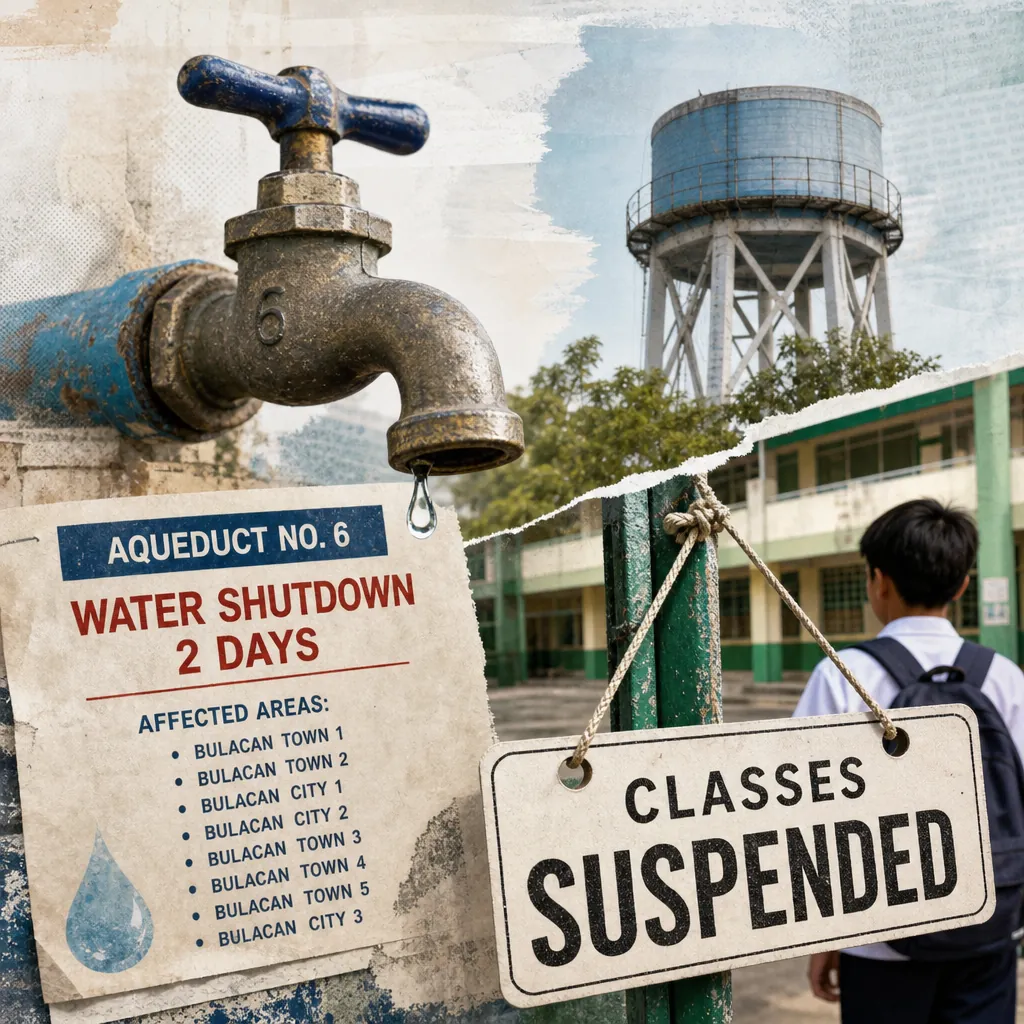
Eight Bulacan towns and cities lost piped water for two days beginning Tuesday, October 13, after the Metropolitan Waterworks and Sewerage System (MWSS) shut down Aqueduct No. 6 to carry out alignment work on its successor, Aqueduct No. 7.1 The affected areas were Balagtas, Bulakan, Plaridel, Marilao and Santa Maria, and the cities of Malolos, Meycauayan and San Jose del Monte — communities that draw their supply from the Bulacan Bulk Water System Project, which is fed by Angat Dam.1 By Monday evening, at least eight local government units in the province had suspended classes for Tuesday, several of them shifting to alternative modes of learning rather than cancelling instruction outright.17
The shutdown was announced in advance, and that notice became the day's most useful piece of information. Bulacan Governor Daniel Fernando said the early warning would give residents time to store water and conserve reserves.1 San Ildefonso Mayor Florida Robes went further, suspending government work and classes in public and private schools through October 12 to manage consumption while repairs were underway.1 Manuel Lukban Jr., head of the provincial disaster risk reduction and management office, told the Inquirer the maintenance would strengthen preparations for El Niño, the periodic warming of the Pacific that brings drier conditions and lower rainfall to the Philippines.1
The story ran on two tracks that rarely intersected. On the news side, Inquirer.net carried the detailed account by Carmela Reyes-Esrtope, tying the interruption to the aqueduct work and relaying local officials' advice.1 On social media, the water providers themselves did the communicating: the Santa Maria Water District and Maynilad Water Services, Inc. posted service notices on Facebook on October 12, with Maynilad listing stationary water-tank locations and saying mobile tankers could deliver clean water to affected areas during maintenance from October 13 to 14.2 A Manila Bulletin post on X carried the same service-notice material.3 The engagement on those posts was modest — this was utility housekeeping, not a public argument — but the practical effect was that residents got their instructions from the same platforms they use for everything else.
Key themes
- A two-day aqueduct shutdown cuts water to eight Bulacan towns and cities. MWSS closed Aqueduct No. 6 from October 13 to 14 to align Aqueduct No. 7, interrupting service in Balagtas, Bulakan, Plaridel, Marilao, Santa Maria, Malolos, Meycauayan and San Jose del Monte.1
- At least eight local governments suspended classes for October 13. San Jose del Monte suspended all public and private classes at all levels and government work; Balagtas, Bocaue, Bulakan, Guiguinto and Malolos shifted to alternative delivery modes of learning.17
- Advance notice was the centerpiece of the official response. Governor Fernando said the warning gave residents time to store water, and San Ildefonso suspended work and classes through October 12 to manage consumption.1
- Maynilad positioned tankers and stationary tanks for affected customers. The utility posted tank locations on Facebook and said mobile tankers could deliver clean water during the October 13–14 maintenance.2
- A newly built P9.75-million evacuation center in Surigao del Sur shed its exterior cladding before turnover. Resident Angel Montenegro Daray posted video of crumpled metal sheets on the ground, and the collapse drew calls for a technical audit.10
- The Surigao collapse occurred without severe weather or seismic activity, according to the resident who filmed it. "There was no rain, no earthquake, and no strong wind," Daray said, which is why the failure drew scrutiny rather than being written off as storm damage.10
- The Surigao story circulated on Facebook and X but produced no named contractor, cause, or repair plan. A Facebook post carrying the headline drew 9 likes, 7 shares and 2 comments; a Twitter post linking to the report drew no comments or shares.6
- Flood-control work in Hagonoy, Bulacan continued on a separate track. Public Works Secretary Vince Dizon inspected dredging along Iba-Wawa Creek and a mobile pump installation at the Iba Pumping Station, two weeks after a previous inspection, on orders from President Ferdinand Marcos Jr.42
How the narratives stack
Dominant. The Bulacan water interruption is the day's clearest service story, and it dominated because of consequence rather than volume: eight localities, a two-day window, and a school and work calendar rearranged around it. The coverage in this set is thin — essentially one detailed news account plus utility notices — but the operational footprint is wide.1217 The MWSS is the government agency responsible for water supply and sewerage services in Metro Manila and adjacent provinces, and its aqueduct system carries raw water from Angat Dam; closing one aqueduct to align another is routine capital work, but it lands on households that have no alternative source. The class suspensions are the tell: local governments do not cancel instruction over a plumbing repair unless the repair genuinely interrupts daily life.17
Counter-narrative. The Surigao evacuation center collapse pushes against the assumption that a completed public building is a safe one. A P9.75-million facility in Barangay Esperanza, Carmen, Surigao del Sur, lost portions of its exterior metal cladding before it was formally handed over, and the resident who filmed it said the failure happened early Sunday morning with no rain, earthquake, or strong wind.10 That detail is what makes the story more than a construction mishap: if the cladding failed under ordinary conditions, the question is whether the defect is isolated or systemic. The available account does not identify the builder or explain the cause, and no repair plan, investigation finding, or turnover date has been stated.67 The story is circulating on Facebook and X alongside an online report, but the public response is small — 9 likes, 7 shares and 2 comments on the Facebook post, and no comments or shares on the Twitter post.6 That gap between the seriousness of the claim and the size of the reaction is itself worth noting: a public building failing before handover is a procurement and inspection question, and it has not yet been treated as one.
Emerging. Flood-control work in Hagonoy, Bulacan, is the third water-adjacent thread, and it is the one with a named official and a visible site. Dizon inspected dredging along Iba-Wawa Creek and the installation of a mobile pump at the Iba Pumping Station, which is meant to move floodwaters toward the Labangan Channel and on to the Angat River.42 Marcos ordered the repair of flood-control structures and the start of construction of the pumping station to mitigate severe flooding in Hagonoy and neighboring towns.42 This is a different kind of water story from the aqueduct shutdown — one is a planned interruption, the other is an attempt to reduce chronic flooding — but both sit in the same province and the same week, and both involve the same governor, Daniel Fernando, who appeared at the inspection alongside Hagonoy Mayor Ma. Rosario Sy-Alvarado Mendoza.42
Under-covered. The Surigao collapse is the story in this set that placed lowest relative to its potential consequence. It has a named resident, a specific peso figure, a video, and a clear question — who built it and why did it fail — and it has produced no follow-up in the items captured here.6710 The Bulacan water shutdown, by contrast, has a known cause, a known schedule, and a known remedy. The evacuation center has none of those, which is precisely why it warrants more attention than it received.
Platform insights
- Facebook. The platform carried the practical layer of the water story: Maynilad's post listed stationary water-tank locations and said mobile tankers could deliver clean water to affected areas during the October 13–14 maintenance.2 The Santa Maria Water District posted service notices the same day.2 The Surigao collapse also surfaced here, with a post carrying the headline drawing 9 likes, 7 shares and 2 comments.6 The pattern is consistent: Facebook is where utilities and local governments put instructions, and where residents encounter them without having to seek them out.
- X. The platform carried the same service-notice material through a Manila Bulletin post, and a separate post linking to the Surigao report repeated that parts of the center had collapsed before turnover.36 That second post drew no comments or shares.6 X functioned as a relay for headlines rather than a place where the Surigao story generated discussion.
- Reddit. Two property listings appeared on r/PhilippineRealEstate on October 12 — a lot for sale in Colinas Verdes, San Jose del Monte, Bulacan, and a pre-selling four-bedroom house in Pampanga.45 Neither identifies a major developer or describes a dispute, and neither is evidence of a broader market trend. They are individual sales, and they matter here only because one of them sits in a province that spent the day managing a water interruption.
Key voices and communities
Bulacan local governments and water districts. Governor Daniel Fernando, San Ildefonso Mayor Florida Robes, and the Santa Maria Water District set the tone: advance notice, conservation advice, and calendar adjustments.12 Their framing is administrative rather than alarmist, and it worked — the suspensions were announced before the taps ran dry.17
Maynilad Water Services. The utility, which serves parts of Cavite, used Facebook to publish tank locations and tanker availability, positioning itself as a source of practical help during the maintenance window.2 Its relevance here is that it demonstrated the standard playbook for a planned interruption: tell people where to get water before they need it.
Residents and local media in Surigao del Sur. Angel Montenegro Daray, whose home sits directly across from the evacuation center, filmed the collapsed cladding and gave the account its most specific detail — that the failure happened without severe weather or seismic activity.10 The Inquirer carried the report, and the story's reach has so far depended on that resident's footage rather than on official statements.10
The Department of Public Works and Highways and the Marcos administration. Public Works Secretary Vince Dizon's inspection in Hagonoy put the national government's flood-control program on the record, with the Iba Pumping Station as the visible commitment.42 The framing is that flooding in Bulacan is being addressed through dredging, pumping, and structural repair.
Property watchers on Reddit. The two listings on r/PhilippineRealEstate are a reminder that the same province managing a water shutdown is also a live property market, and that buyers and sellers are tracking infrastructure conditions alongside prices.45
Narrative streams
A two-day aqueduct closure forces eight Bulacan localities to rearrange their week
The Metropolitan Waterworks and Sewerage System closed Aqueduct No. 6 to carry out alignment work on Aqueduct No. 7, interrupting service from October 13 to 14 in Balagtas, Bulakan, Plaridel, Marilao, Santa Maria, Malolos, Meycauayan and San Jose del Monte.1 The affected communities rely on the Bulacan Bulk Water System Project, which draws from Angat Dam, the reservoir that supplies much of the province's treated water.1 The Inquirer's account, by Carmela Reyes-Esrtope, reported the closure and relayed local officials' advice to store water and conserve supplies.1
The response was organized around the calendar. At least eight local government units suspended classes for Tuesday, October 13.17 San Jose del Monte suspended all public and private classes at all levels and work in government offices; Balagtas, Bocaue, Bulakan, Guiguinto and Malolos suspended in-person classes and shifted to alternative delivery modes of learning.17 San Ildefonso went further and suspended government work and classes through October 12, before the shutdown even began, to manage consumption while repairs were underway.1 Governor Fernando said the advance notice would give residents time to store water and conserve their reserves, and water service was expected to resume after the repairs were completed.1
For households in the affected towns, the practical effect is a two-day scramble for stored water and a disrupted school week, with the burden falling hardest on families who cannot easily buy bottled water or travel to a tanker point. For the water agencies, the episode is a test of whether advance notice and tanker deployment are enough to keep a planned interruption from becoming a service failure. Maynilad's Facebook post, listing stationary tank locations and offering mobile tankers, is the template the sector has settled on: publish the schedule, publish the water points, and let residents plan.2 The Manila Bulletin post on X carried the same service-notice material to a different audience.3
The context matters for why this is treated as routine. Bulacan's water interruptions recur as a local service issue, with notices describing affected communities and timing, and the province sits downstream of Angat Dam, which makes its supply dependent on aqueduct maintenance schedules set elsewhere.13 Lukban, the provincial disaster risk reduction and management office head, framed the maintenance as strengthening preparations for El Niño, the dry-weather pattern that lowers reservoir levels and strains supply.1 That framing is the read for the sector: utilities and local governments are treating aqueduct maintenance as part of drought readiness, not just as a repair job, and the communication playbook — early notice, tanker locations, class suspensions — is now the expected standard.
A P9.75-million evacuation center fails before anyone moves in
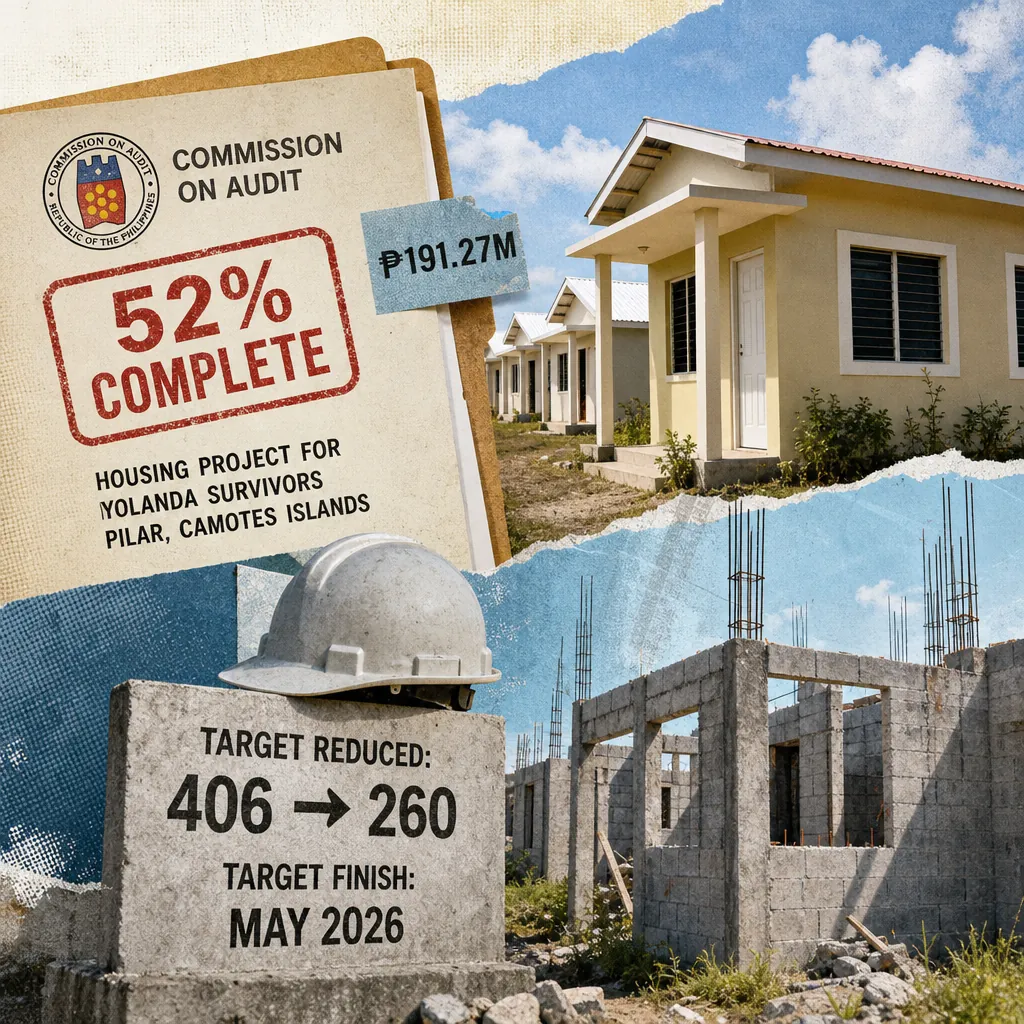
A newly built P9.75-million evacuation center in Barangay Esperanza, Carmen, Surigao del Sur, lost portions of its exterior metal cladding before its formal turnover, prompting calls for an immediate technical audit.10 The flaw came to light after resident Angel Montenegro Daray, whose home sits directly across the site, posted video footage showing sheets of exterior metal cladding peeled off and crumpled on the ground.10 According to Daray, the collapse occurred early Sunday morning in the absence of any severe weather disturbance or seismic activity.10 "There was no rain, no earthquake, and no strong wind," Daray said.10
The story's circulation has been modest. A Facebook post carrying the headline drew 9 likes, 7 shares and 2 comments, and a Twitter post linking to the report drew no comments or shares.6 The Inquirer's report is the substantive account, and it is the item that carries the peso figure and the resident's quote.10 No further account of the collapse or response from those responsible for the project appears in the dated items described here, and no repair plan, investigation finding, or turnover date has been stated.67
For the construction and public-works sector, the significance is in the timing. An evacuation center is a building whose entire purpose is to shelter people during the worst conditions a region faces, and this one failed before it was handed over, under ordinary weather.10 The absence of a named contractor or an inspection finding is the gap that matters: without knowing who built it and what the audit shows, it is impossible to say whether this is an isolated defect or a sign of a wider delivery problem in public construction.67 The next meaningful development would be confirmation of the responsible contractor and any inspection results, which would determine whether the story stays local or becomes a procurement question.
The broader context is that the Philippines ranks first among 193 United Nations member states in the World Risk Report 2026, with a disaster-risk score of 46.69, driven by what the report calls an "extreme overlap of multiple hazards."72 The country recorded the highest exposure scores in five of seven factors assessed, including storms at 89.71, earthquakes at 73.15, tsunamis at 69.66, coastal flooding at 58.14 and sea-level rise at 60.17.72 Evacuation centers are part of how the country manages that exposure, which is why a failure before turnover is more than a construction story. The read for the sector is that public-works clients and contractors should expect scrutiny of inspection records and turnover documentation, and that the credibility of the evacuation-center program depends on answering the question the Surigao collapse raised.
Flood-control work in Hagonoy continues as the province manages water on two fronts
The Department of Public Works and Highways intensified dredging and pumping operations in flood-prone Hagonoy, Bulacan, as President Ferdinand Marcos Jr. ordered repairs to flood-control structures and construction of the Iba Pumping Station.42 Dredging continues along Iba-Wawa Creek, while a mobile pump is being installed at the Iba Pumping Station to speed the movement of floodwaters toward the Labangan Channel, which connects to the Angat River.42 Public Works Secretary Vince Dizon inspected the operations on Monday with Governor Fernando and Hagonoy Mayor Ma. Rosario Sy-Alvarado Mendoza, two weeks after his previous inspection of the site.42
Dizon said Marcos had ordered the repair of flood-control structures and the start of construction of the pumping station to mitigate severe flooding in the area, and the measures come as Hagonoy and neighboring towns continue to grapple with recurring floods that damage homes.42 The inspection is a follow-through event rather than a new commitment, which is itself informative: the two-week gap between visits suggests a schedule being tracked rather than a single announcement.
For residents of Hagonoy and the surrounding towns, the practical question is whether dredging and a mobile pump reduce the frequency and depth of flooding, and that will only be answerable after the pumping station is built and a flood season has passed. For the national government, the inspection puts the flood-control program on the record in a province that is simultaneously managing a water-supply interruption, which is a reminder that Bulacan's water problems run in both directions — too little supply in the dry season, too much water on the ground in the wet one.142 The read for the sector is that infrastructure communication in Bulacan now has to hold both messages at once: conservation during maintenance, and confidence that flood-control work is progressing.
The day's wider business and policy backdrop
The water and construction stories sat alongside a broader set of developments that shape the operating environment. The House of Representatives passed the P7.2-trillion budget bill for 2027 on final reading, 62 days after receiving the executive's spending plan, with 281 lawmakers voting in favor and 13 against.16 The manner of the amendments drew backlash after lawmakers approved P116.32 billion in budget realignments that critics said could expand political patronage, and an independent budget monitoring group estimated total legislative adjustments at P198.9 billion.16 Budget realignments matter to infrastructure because they determine which projects are funded and at what level, and the scale of the adjustments is the reason the passage drew criticism rather than routine coverage.
The House also passed on final reading a bill prohibiting children aged 13 and below from creating social media accounts while restricting access for those under 18, with 287 lawmakers voting in favor and three against.23 The measure, known as the Safe and Friendly Environment for Kids in Digital Spaces Act, now faces a legislative showdown because the House and Senate have passed differing versions, with the Senate version mandating a total ban on social media access for minors under 18.23 The restrictions align the Philippines with a global regulatory push alongside Australia, Malaysia and Greece.23
On the corporate side, San Miguel Global Power Holdings Corp. reported new gains of P2.19 billion after selling about a 0.33-percent stake in Manila Electric Co. to Manuel V. Pangilinan, with 3.77 million common shares priced at P580.99 each.15 The transaction closed a day after San Miguel and Pangilinan-led Metro Pacific Investments Corp. sealed a P12.4-billion deal to acquire 21.4 million Meralco shares, raising MPIC's direct and indirect interest in the power company to 49.4 percent from 47.5 percent.15 Meralco serves millions of customers, and the ownership shift concentrates more of the power giant under Pangilinan's group.
First Gen Corp. secured a supply deal to energize 189 Jollibee Foods Corp. outlets with renewable energy, sourcing electricity from its geothermal facilities in Ormoc City and Kananga in Leyte.44 The government's retail aggregation program, which lets households and smaller consumers in a shared area consolidate their demand to meet the threshold for supply deals, enabled the arrangement, and the covered stores include Jollibee, Greenwich, Chowking, Red Ribbon, Burger King and Panda Express outlets.44 Global Aerospace Technology Philippines Inc. is expanding to the First Philippine Industrial Park in Batangas, complementing its existing facility at the Cavite Technopark Special Economic Zone in Naic, to manufacture aerospace parts for export to markets including the United States and the United Kingdom.26 The Philippine Economic Zone Authority, which administers the country's export-processing zones, said the expansion demonstrates growing confidence in the Philippines as a manufacturing base.26
On the financial side, the Philippine Stock Exchange Index ended Friday at 5,700.99, up 1.61 percent for the session as bargain hunting lifted all sectors, and closed Monday at 5,743.18, up 0.74 percent or 42.19 points.4179 F. Yap Securities expects a 25-basis-point increase in the Bangko Sentral ng Pilipinas' policy rate, with September headline inflation accelerating to 7.2 percent from 6.1 percent in August and core inflation climbing to 4.7 percent from 4.1 percent.41 The central bank's policy meeting is set for October 22.41 The national government's debt service bill fell nearly 89 percent to P76.12 billion in August from P664.72 billion a year earlier, as the absence of a massive bond maturity settlement sharply reduced principal repayments, bringing the eight-month tally to P1.442 trillion, down 6.4 percent from the same period last year.62
Conversation trajectory
Over the next 48 hours (October 13–14), watch for the resumption of Bulacan water service. The shutdown is scheduled to end after repairs are completed, and the first signal will be whether service returns on time or whether the alignment work runs long.1 If it runs long, expect additional class suspensions and a second round of tanker deployment.17
Over the next one to two weeks, watch for a named contractor or inspection finding in the Surigao evacuation center collapse. The report does not identify the builder or explain the cause, and the next meaningful development would be confirmation of the responsible contractor and any inspection results.67 If no official statement follows, the story is likely to remain a local item rather than a procurement question.
Over the next two to four weeks, watch the October 22 Bangko Sentral ng Pilipinas policy meeting. A 25-basis-point rate increase is expected, and the decision will shape borrowing costs for infrastructure and property developers.41 The September inflation reading of 7.2 percent headline and 4.7 percent core is the baseline against which the decision will be judged.41
Over the next month, watch the Senate-House negotiations on the minors' social media bill. The two chambers have passed differing versions, and the House has designated negotiators to work out the difference between its age-restriction approach and the Senate's total ban for under-18s.23 The outcome will determine how platforms operating in the Philippines handle minor accounts.
Trigger events to watch. The resumption of Bulacan water service after October 14; any statement from Surigao del Sur officials or the project owner on the evacuation center; the October 22 central bank meeting; and the next inspection of the Hagonoy flood-control works, which has been running on a two-week cadence.164142
Response guidance
For water utilities and local governments: publish the schedule before the shutdown, not during it. The Bulacan response worked because the notice came first — Governor Fernando's advice to store water and San Ildefonso's pre-emptive work and class suspension gave residents time to act.1 Utilities should pair every interruption notice with specific water-point locations and tanker schedules, as Maynilad did on Facebook.2
For utilities communicating on social media: put the practical information in the post itself. Maynilad's Facebook post listed stationary tank locations and mobile tanker availability, which is the information residents need and can act on.2 Service notices that only announce a shutdown without saying where to get water generate follow-up questions rather than confidence.
For local governments managing school and work calendars: decide early and announce together. At least eight Bulacan local government units suspended classes for October 13, several shifting to alternative delivery modes rather than cancelling instruction.17 Coordinated announcements across municipalities reduce confusion for families who commute across boundaries.
For construction firms and public-works agencies: prepare for inspection questions on turnover documentation. The Surigao evacuation center failed before handover, and the absence of a named contractor or inspection finding is the gap that keeps the story open.610 Firms working on public buildings should expect scrutiny of cladding, structural, and turnover records, and should be ready to state who built what and when.
For communicators in flood-prone areas: keep the flood-control message and the water-supply message separate. Hagonoy's dredging and pumping work addresses too much water; the aqueduct shutdown addresses too little supply.142 Combining them into a single "water situation" message muddles both, and residents need to know which problem each measure addresses.
For property and real-estate communicators: treat infrastructure conditions as part of the location story. The two Reddit listings in Bulacan and Pampanga are individual sales, not market signals, but they show that buyers are tracking local infrastructure.45 Developers marketing in provinces with recurring service interruptions should be prepared to answer questions about water reliability and flood exposure.
For anyone handling sensitive public-safety stories: do not let a serious claim go unanswered. The Surigao collapse drew 9 likes, 7 shares and 2 comments on Facebook and no engagement on X, which is a small response to a public building failing before turnover.6 Silence from the project owner or local officials leaves the question open, and the longer it stays open, the more likely it is to be answered by speculation rather than inspection results.
See the full picture behind today's signals.
This report draws from Media Meter's MediaWatch, our real-time monitoring engine tracking 2,470+ Philippine sources across print, broadcast, digital, and social. Explore how the platform turns raw coverage into decision-grade intelligence, then see how it's configured for teams like yours — whether you're in PR agencies, corporate comms, government, or marketing.
Want more? Browse our Report Library for sector and crisis intelligence, or request a demo and we'll have your brand set up before the call.
Want this kind of intelligence on your brand?
This brief is built on the same MediaWatch methodology that runs continuously across every brand we monitor. See your competitive landscape, Impact Score, and narrative trajectory in a 30-minute demo.