Flood control corruption cases dominate Aug 28 news
The August 28 conversation centered on monsoon flooding in Luzon and a wave of corruption charges against officials over flood control projects, with the Ombudsman filing cases and the public responding with high engagement.
The day's conversation opened with the enhanced southwest monsoon battering Luzon, but by evening the dominant thread had shifted to corruption charges over flood control projects. A bridge collapse in Angeles City, Pampanga, captured on video and posted to Facebook, drew 686 reactions and 141 comments as residents shared their own footage of rising floodwaters.1 The Philippine Coast Guard confirmed search and rescue operations for three missing passengers after a motorbanca capsized in Mapanuepe Lake, Zambales, a post that drew 34 sad reactions and 4 care reactions.3 By mid-morning, the Philippine Daily Inquirer reported 719 evacuees across 10 evacuation centers in Cabangan, Zambales, a post that became the emotional anchor of the day with 955 sad reactions and 144 care reactions.4
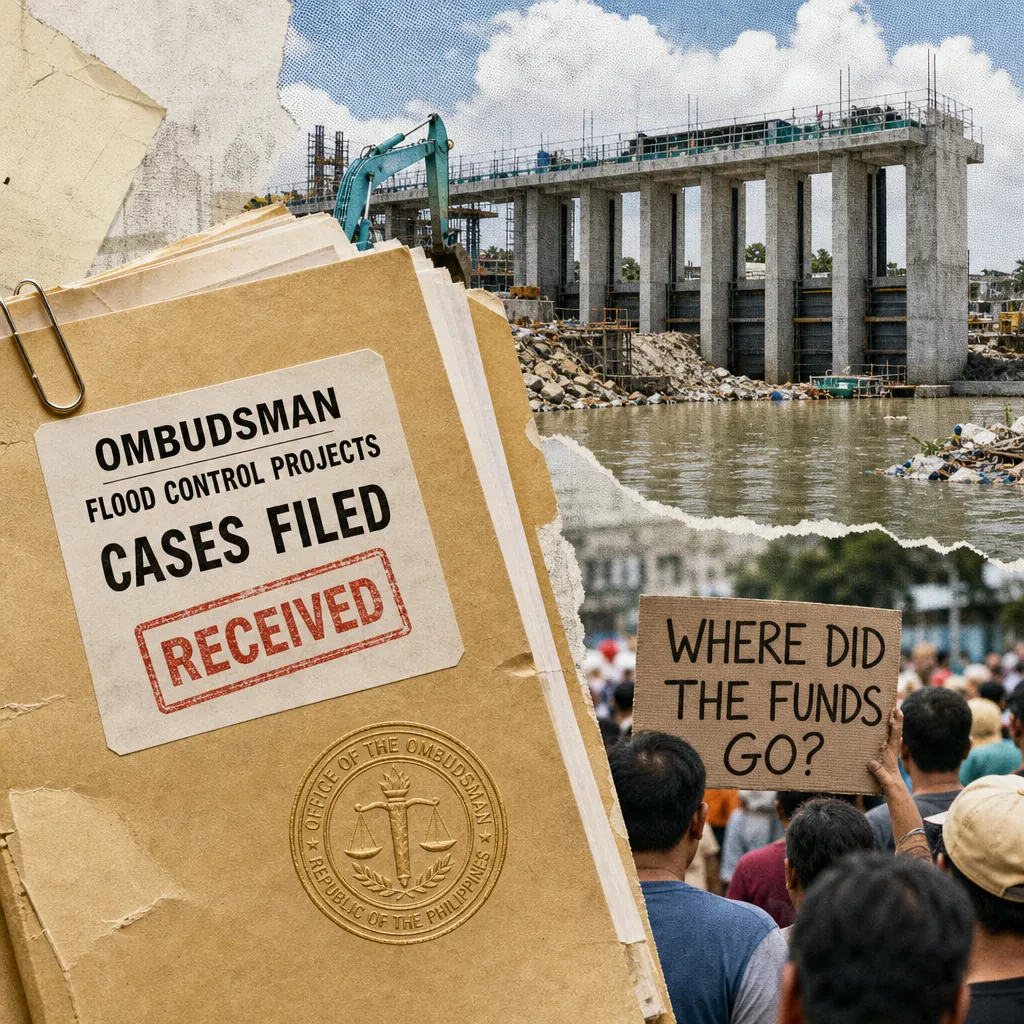
While the flooding narrative was visceral and immediate, a parallel stream of corruption news was building. The Ombudsman confirmed it had gathered 42 witnesses against Leyte Rep. Martin Romualdez over flood control projects, a development shared via YouTube with 292 views.18 Later, the Ombudsman filed graft and malversation charges against fugitive former Ako Bicol party-list Rep. Zaldy Co and several ex-DPWH officials over a P77-million "ghost" flood control project in Balagtas, Bulacan.37 The public response to these corruption stories was notably different from the flooding coverage: the Romualdez witness count drew muted engagement, but a post about Senator Robinhood Padilla's remarks on OVP confidential funds exploded with 182 likes, 85 comments, and 70 "haha" reactions.36
The two narratives—flooding and corruption—converged in a way that framed the day's news. The flooding exposed infrastructure vulnerabilities, while the corruption charges raised questions about whether government investment in flood control had been effective or had been siphoned off. A Reddit post resurfaced about the 2018 groundbreaking of a P4.7-billion Pampanga Flood Control Project, implicitly questioning whether that investment had translated into protection.6 The Department of Public Works and Highways announced it was planning a new flood control project on the Pampanga River, a forward-looking statement that arrived amid evidence of active flooding and damage.9
Key themes
- Monsoon flooding displaces 719 people in Zambales, with more feared missing: The Philippine Daily Inquirer reported 719 evacuees across 10 evacuation centers in Cabangan, Zambales, with at least seven villages affected.4 The post drew 955 sad reactions, the highest emotional engagement of the day, signaling public empathy for displaced families.
- Bridge collapse in Angeles City draws 686 reactions, highlighting infrastructure vulnerability: A video of a bridge collapsing in Barangay Anunas, Angeles City, under rushing floodwater earned 686 reactions and 141 comments.1 The visual evidence of structural failure became a focal point for criticism of flood control preparedness.
- Ombudsman files charges over P77-million ghost flood control project: The Ombudsman filed graft and malversation charges against fugitive former Rep. Zaldy Co and several ex-DPWH officials over a flood control project in Balagtas, Bulacan that was certified 100% complete despite a physical inspection finding nothing existed.40 The case was raffled to the Sandiganbayan's Fourth and Fifth Divisions.37
- Ombudsman has 42 witnesses against Rep. Martin Romualdez over flood control projects: The Ombudsman confirmed it had gathered 42 witnesses for plunder, graft, bribery, and money laundering complaints against Leyte Rep. Martin Romualdez.35 The defense camp countered with claims of recanted testimonies, but the Ombudsman pushed back.19
- Public mocks Senator Padilla's defense of OVP confidential funds: A post about Malacañang and civil society group Atom calling out Senator Robinhood Padilla for equating historical pseudonyms with aliases in OVP confidential fund receipts drew 182 likes, 85 comments, and 70 "haha" reactions.36 The mockery signaled public dismissal of the defense.
- Supreme Court ruling against Romblon officials draws 143 likes and 93 shares: The Supreme Court's final ruling against former Romblon officials for a P13.95-million backhoe loader purchase generated the highest engagement of any corruption story that day, with 143 likes, 93 shares, and 59 comments.26 The mix of 35 "haha" and 18 "sad" reactions suggested civic anger and resignation.
- DPWH announces new Pampanga River flood control planning amid active flooding: The Department of Public Works and Highways announced it was beginning planning for a massive flood control project on the Pampanga River.9 The announcement arrived while flooding was still active, creating a narrative juxtaposition between future promises and current failures.
- PAGASA monitors two low-pressure areas, signaling multi-day weather threat: PAGASA's monitoring of two low-pressure areas indicated the weather system was not a one-day event but a developing multi-day threat.5 This forward-looking content created a hook for preparedness messaging.
How the narratives stack
Dominant: The flood control corruption scandal is the dominant narrative of the day, driven by the Ombudsman's filing of charges against Zaldy Co and the confirmation of 42 witnesses against Martin Romualdez.3540 Within the captured set, this story drew the most sustained attention across platforms, with the Co case appearing on Reddit, Twitter, and Facebook, and the Romualdez case generating discussion about witness credibility and political motivations.373839 The public's connection of these cases to the day's flooding—where infrastructure failures were visible—amplified the sense of systemic failure.
Counter-narrative: The defense camp's pushback against the Romualdez case forms a counter-narrative. Sen. Rodante Marcoleta publicly declared it "improbable" for him and former congressman Mike Defensor to have conspired with former security aide Orly Guteza, a statement that collected 52 likes and 11 comments.20 The Ombudsman's rebuttal drew only 6 "haha" reactions and 3 comments, suggesting public skepticism about the defense's credibility.19 This counter-narrative is weak but present, and it could gain traction if the defense successfully frames the case as politically motivated.
Emerging: The OVP confidential funds controversy is emerging as a separate but related narrative. The post about Senator Padilla's remarks drew the highest engagement of any political story that day, with 182 likes and 70 "haha" reactions.36 The mockery suggests the public is processing this as both a serious accountability issue and a source of political entertainment. This narrative is likely to resurface at each new procedural milestone in the impeachment trial of Vice President Sara Duterte.
Under-covered: The Supreme Court's final ruling against Romblon officials for the P13.95-million backhoe loader purchase drew strong engagement (143 likes, 93 shares) but received less coverage in the captured set than the Romualdez and Co cases.26 This story represents a concrete enforcement outcome that the public responded to positively, and it could serve as a counterpoint to the broader corruption narrative if amplified.
Platform insights
- Facebook: This platform was the primary source of raw, visceral imagery and the main battlefield for narrative evolution. The highest engagement came from posts that humanized the crisis, particularly the Inquirer's evacuation update with 955 sad reactions and 168 shares.4 The platform also hosted the most engaging corruption story of the day—the Romblon ruling with 143 likes and 93 shares—and the Padilla mockery post with 182 likes and 70 "haha" reactions.2636 Facebook audiences responded most strongly to emotional storytelling about displaced families and to content that allowed them to express derision toward political figures.
- Twitter: The platform functioned as an official information relay, with news organizations distributing updates from PAGASA, the PCG, and DPWH in concise, factual formats.59 View counts were modest, with the Co story drawing 693 and 980 views but virtually no engagement.3839 Twitter's role was to circulate official statements and weather advisories, ensuring reliable information flowed alongside the more visceral Facebook content. The platform was a passive distribution channel rather than a site of active discussion.
- Reddit: A single post on the 2018 Pampanga flood control project became the analytical anchor for the day's conversation, with 22 upvotes and 5 comments providing a space for more reflective discussion about government efficacy.6 The Co case appeared in two near-identical posts with 22 and 25 likes each, suggesting coordinated distribution.37 Reddit's contribution was to contextualize the day's events within a longer timeline of policy decisions, offering a more detached but valuable perspective.
- YouTube: The platform played a minor but notable role, hosting the Ombudsman's 42-witness announcement as a video with 292 views and zero engagement.18 A separate "It's Showtime" segment about PhilHealth anomalies drew 1,034 views, but its entertainment framing diluted any serious policy discussion.27 YouTube was not yet a significant driver of the conversation.
Key voices and communities
- Local disaster response and evacuation coordinators: Municipal and barangay-level disaster risk reduction offices surfaced as the central organizing voices in the flooding conversation, documenting rescue and evacuation efforts in Zambales.11 Their content was visual and operational, with coordination from police units and the Philippine Coast Guard shaping the authoritative tone of updates.2 Their influence stemmed from their position as first-hand sources of ground conditions, making them reference points for regional and national media outlets.
- Community members and affected residents: Residents in directly affected areas constituted a highly engaged but less formalized voice, sharing on-the-ground footage and personal accounts of flooding and infrastructure damage.1 Their content generated strong engagement, particularly when documenting dramatic events such as bridge collapses. This group's influence lay in the authenticity of their documentation, which often preceded official reports.
- National media and wire aggregators: Established media organizations and their digital extensions provided the connective layer between local events and national political awareness, curating daily summaries and linking disaster updates to policy contexts.10 Their reach and authority amplified local incidents into national conversation, with their content typically receiving high trust but moderate direct engagement.
- Infrastructure and policy watchdogs: A smaller but influential cluster of accounts focused on the systemic dimensions of flooding, connecting infrastructure failures to long-term planning decisions and budget allocations.6 Their content referenced historical projects and their outcomes, often drawing attention to gaps between promises and implementation. This group exercised influence through context-setting rather than real-time reporting.
- Institutional accountability and oversight communities: This group, driven by the convergence of corruption probes, a Senate impeachment trial, and budget deliberations, included government watchdog bodies, legal analysts, and politically engaged citizens.1819 Their dominant frame was institutional credibility under strain, and their sustained focus on corruption, budget utilization, and impeachment directly influenced the political risk profile of any client with government exposure.
Narrative streams
Monsoon flooding exposes infrastructure vulnerabilities in Luzon
The enhanced southwest monsoon, strengthened by two low-pressure areas, brought severe flooding to Central Luzon on August 28. The earliest posts showed a bridge collapsing in Barangay Anunas, Angeles City, under the force of rushing floodwater, a video that earned 686 reactions and 141 comments.1 Almost simultaneously, reports emerged of mandatory evacuations in Cabangan, Zambales, where police-led operations moved residents from flooded barangays.2 By mid-morning, the Philippine Coast Guard confirmed it was conducting search and rescue operations for three missing passengers after a motorbanca capsized in Mapanuepe Lake in San Marcelino, Zambales.3
The Philippine Daily Inquirer published a comprehensive update showing the scale of displacement, with 719 evacuees across 10 evacuation centers and at least seven villages affected in Cabangan alone.4 This post became the emotional anchor of the conversation, accumulating 955 sad reactions and 144 care reactions, far exceeding any other engagement metrics for the day. The image of families crowded into evacuation centers shifted the public discourse from documentation of the event toward concern for vulnerable populations.
A post detailing a house being swept away when a dike gave way in Barangay Sta. Fe further illustrated the structural damage being inflicted.12 The visual of a home being destroyed served as a powerful indictment of flood control preparedness. The conversation's progression from documenting events to questioning government efficacy happened organically within hours, suggesting that public frustration can consolidate quickly when infrastructure failures are accompanied by high-visibility rescue operations and visible displacement.
The read for the sector: For government agencies responsible for disaster response and infrastructure, the day's conversations emphasize the importance of acknowledging immediate suffering before offering long-term solutions. Audiences processed the emotional content of rescue and evacuation posts far more actively than statements about future planning.14 The DPWH announcement about future flood control planning, posted later the same day, inadvertently created a narrative juxtaposition: the agency was promising action while residents were still dealing with the consequences of previous inadequacies.9
Ombudsman files charges over P77-million ghost flood control project
The most significant corruption development of the day came when the Ombudsman filed graft and malversation charges against fugitive former Ako Bicol party-list Rep. Zaldy Co and several ex-DPWH officials over a P77-million flood control project in Balagtas, Bulacan.37 The case was raffled to the Sandiganbayan's Fourth Division for malversation and the Fifth Division for graft, adding procedural clarity that appealed to those seeking concrete legal developments.37
A detailed Facebook post from the Daily Guardian chronicled the alleged "implied conspiracy," including claims that DPWH official Henry Alcantara collected kickbacks "delivered in advance to Co" to ensure project insertion into the National Expenditure Program.40 The Ombudsman's own language about "repeated approvals" was cited as evidence of deliberate misconduct rather than error. The progression from "charges filed" to "specific schemes described" marked a shift from general outrage to focused scrutiny of procedural failures.
The Daily Guardian also noted that Co was reportedly "seeking asylum in France," a detail that created an implicit narrative of impunity that contrasted with the otherwise vigorous legal actions taken by the Ombudsman.40 The story appeared on Twitter with 693 and 980 views but minimal engagement, suggesting that while the topic was newsworthy, the platform's users were more passive consumers than active commenters on this specific development.3839
The read for the sector: For the Department of Public Works and Highways and the administration's infrastructure agenda, this case directly threatens the credibility of the "Build Better More" program. The public's focus on the alleged role of a former lawmaker in ensuring projects were "inserted into the National Expenditure Program" implicates the legislative and executive budget process, potentially casting doubt on the integrity of the entire national budget cycle.40 This is a critical moment to differentiate between isolated criminal acts and systemic policy failures, a distinction that has not yet emerged in the public discourse.
Ombudsman's 42 witnesses against Romualdez fuel accountability debate
The Ombudsman confirmed it had gathered 42 witnesses for plunder, graft, bribery, and money laundering complaints against Leyte Rep. Martin Romualdez related to flood control projects.35 This development was initially shared via a YouTube video from inquirerdotnet with 292 views, but the narrative quickly shifted to the defense camp's counter-moves.18
A Facebook post from NewsWatchPH detailed how the Ombudsman "pumalag" (fought back) against claims that recanted testimonies from the so-called "Maleta Boys" and former security aide Orly Guteza weakened the case, with the post drawing 6 "haha" reactions and 3 comments, suggesting public skepticism about the defense's credibility.19 Sen. Rodante Marcoleta publicly declared it "improbable" for him and former congressman Mike Defensor to have conspired with Guteza, a statement that collected 52 likes and 11 comments, with commenters largely split between mocking the improbability claim and demanding further investigation.20
The Romualdez thread reached its emotional peak late afternoon when broadcaster Ramon Tulfo alleged that two senator-judges were poised to join the majority bloc in exchange for being "lubayan" (left alone) on their cases, a claim that drew 9 "haha" reactions and 1 comment but little substantive engagement, indicating either fatigue or disbelief among the audience.21
The read for the sector: The Ombudsman's strategy of publicly releasing witness counts appears designed to counter recantation narratives, but the audience's muted response to the Romualdez rebuttal—only 3 comments—suggests that the public is either fatigued or unconvinced by both sides.1918 The emergence of Tulfo's unverified senator-judge bribery claim within hours of Marcoleta's denial shows how rapidly speculation can enter the political discourse, requiring analysts to flag such claims immediately for verification.21
Public mocks Padilla's defense of OVP confidential funds
The conversation around the Office of the Vice President's confidential funds took a sharp turn when the Inquirer posted a story about Malacañang and the civil society group August Twenty-One Movement (Atom) publicly calling out Senator Robinhood Padilla. The post, which carried the hashtag #VPonTrial, criticized Padilla for equating pseudonyms used by Filipino patriots with the "odd-sounding" aliases found in OVP confidential fund receipts.36
This post exploded with 182 likes, 85 comments, and a notable 70 "haha" reactions, indicating that users were not just engaged but actively mocking the senator's argument.36 The sentiment here was sharply polarized, with the Malacañang-Atom alignment serving as a lightning rod that reframed the day's earlier corruption news into a broader political battle over accountability and the vice president's conduct. The 70 "haha" reactions against a backdrop of only 1 "angry" reaction indicated that the public sentiment was not just critical but dismissive of the senator's defense.
The read for the sector: For clients like Malacañang, engaging in rhetorical battles with senators is a double-edged sword; the public may side with Malacañang, but the mockery can amplify the original scandal's visibility. The dual framing of this issue—as both a serious accountability matter and a source of political entertainment—typically signals sustained conversation longevity and is likely to resurface at each new procedural milestone, particularly as the Sandiganbayan cases involving similar fund misuse proceed.35
Supreme Court ruling against Romblon officials draws strong public approval
The Supreme Court's final ruling against former Romblon officials for a P13.95-million backhoe loader purchase was the day's most resonant corruption story in terms of engagement, generating 143 likes, 93 shares, and 59 comments.26 The reaction buttons showed 35 "haha" and 18 "sad" responses, suggesting a mix of civic anger and resignation.
The high share count indicated that constituents and news consumers amplified such rulings as validation of the justice system. This story demonstrated that public engagement with corruption cases spikes when there is a definitive judicial outcome; the 93 shares on this post far exceeded any other corruption-related content that day.26
The read for the sector: For agencies like DILG and clients involved in anti-corruption initiatives, this ruling presents a clear reputation opportunity. Amplifying such decisive judicial outcomes can help shift public focus from allegations against leadership to institutional successes, a strategy that aligns with the high positive engagement observed for that story.26 This is particularly timely given the Ombudsman's 42-witness case development, which will likely dominate headlines in the coming weeks.18
Conversation trajectory
- Infrastructure accountability narrative to intensify within 3-5 days: The conversation is rapidly transitioning from immediate crisis coverage to questions about why flood control systems failed, particularly in Pampanga where a bridge collapse and damaged dike have become focal points.112 A Reddit post referencing a 2018 groundbreaking of a P4.7-billion Pampanga flood control project is gaining traction, suggesting public scrutiny will intensify around project completion timelines and effectiveness.6 Expect this accountability angle to dominate as weather conditions improve and damage assessments become available, making this the primary reputational risk window for DPWH and relevant LGU stakeholders.
- Flood control corruption scandal to consolidate as a unified narrative over 2-4 weeks: The conversation is consolidating around flood control anomalies as a single, expanding storyline rather than isolated cases. Within a single day, separate complaints involving a sitting House leader, a fugitive former party-list representative, and multiple DPWH officials were all circulating with significant engagement.3540 Expect this narrative to intensify as additional questionable projects are referred by DPWH, with the conversation increasingly framing these as institutional failures rather than individual misconduct.40
- OVP confidential funds controversy to resurface at each procedural milestone: The conversation surrounding the Vice President's office confidential funds is evolving from procedural oversight into a polarized political battleground. The controversy involving Senator Padilla's remarks generated one of the highest engagement volumes of the day, with reaction indicators showing substantial amusement responses.36 This dual framing typically signals sustained conversation longevity and is likely to resurface at each new procedural milestone, particularly as the Sandiganbayan cases involving similar fund misuse proceed.35
- Search and rescue limitations becoming a secondary narrative within 48-72 hours: The Philippine Coast Guard's admission that bad weather hampered SAR operations for missing passengers has introduced a "response capability" sub-theme that could expand into broader questions about disaster preparedness.8 With 34 sad reactions and 4 care reactions on the motorbanca capsizing post, emotional engagement is building around preventable tragedies.3 This narrative will likely peak within 48-72 hours if rescue outcomes remain unresolved.
- Weather monitoring content gaining traction for preemptive engagement over the next week: PAGASA's monitoring of two low-pressure areas is receiving modest but meaningful attention, with one post generating 243 views.5 The dual-LPA situation suggests sustained weather-related conversation for at least another week, with potential for escalation if either system develops into a tropical depression.
Trigger events to watch:
- Release of damage assessment reports from affected LGUs (likely within 72 hours), which will shift focus to recovery funding and rehabilitation needs.4
- Potential development of the two monitored LPAs into tropical depressions, which would extend the disaster response narrative and test continuity of government messaging.5
- DPWH flood control planning announcement details, which will either mitigate or amplify infrastructure criticism depending on specificity and timeline commitment.9
- Next Sandiganbayan hearing schedule for the Romualdez and Co cases, which will likely generate simultaneous coverage across all major platforms.3538
- Ombudsman's confirmation of additional DPWH project referrals, which could substantively expand the scandal's scope.40
Response guidance
Lead with search and rescue updates: The immediate humanitarian priority is the missing passengers in Mapanuepe Lake. Issue a time-sensitive statement confirming the ongoing PCG operations, the number of personnel involved, and the coordination with local authorities.38 This should be the first public response due to the critical nature of saving lives.
Provide a consolidated flood situation overview: Reinforce public trust by issuing a single, comprehensive situational report that covers the affected barangays in Cabangan and Pampanga, the confirmed number of evacuees, and the location of evacuation centers.47 Distribute this across all platform channels to standardize messaging.
Preempt the infrastructure accountability narrative: Within the first 24 hours, acknowledge the DPWH flood control planning for the Pampanga River while referencing existing project history, to demonstrate continuity and responsiveness rather than allowing social media to set the frame of failure and inaction.96 Proactive acknowledgment of the bridge collapse and dike failure—paired with concrete remediation timelines—will be essential to prevent the narrative from becoming purely accusatory.
Amplify the Ombudsman's independence and efficacy as a government success story: With the investigation yielding court filings, highlight these actions as proof that the system works against corruption, regardless of the accused's political affiliation.3540 This reframes the story from "government corruption" to "government justice," potentially mitigating the broader reputational damage to the administration.
Prepare rapid-response templates for the Romualdez investigation: With 42 witnesses now on record, this is a separate but related narrative with significant political blowback potential.35 Prepare a rapid-response framework that can quickly separate fact-finding from partisan attacks, ensuring clients are not forced into a defensive posture should the opposition attempt to link this case to the broader flood control investigation.36
Monitor public health stories closely: The combination of leptospirosis cases in Metro Manila hospitals and the DOH investigation into a child's death following measles-rubella vaccination creates a compounding risk for health communications.2829 While individual post engagement remains modest, the juxtaposition of these stories with the ongoing PhilHealth anomaly discussions on mainstream entertainment platforms signals potential for viral amplification.27 Prepare evidence-based responses addressing vaccination safety and disease prevention protocols within the next 3-5 days to preempt potential narrative consolidation around systemic health failures.
Avoid direct engagement with unverified allegations: The emergence of Tulfo's senator-judge bribery claim shows how rapidly speculation can enter the political discourse.21 Do not engage with unverified allegations about senator-judge conduct; instead, emphasize institutional process integrity without taking sides on specific allegations.
Use Facebook for emotional storytelling and Twitter for factual updates: On Facebook, prioritize the highest-engagement posts showing the collapsed bridge and the evacuation update, deploying rapid field-level responses that confirm incidents and outline immediate responses.14 On Twitter, push concise, fact-based updates from official Ombudsman and Sandiganbayan channels, focusing on procedural milestones rather than commentary on the accused individuals.3839
Engage with Reddit's analytical community: The 2018 flood control project post represents a distinct engagement opportunity where community memory is long.6 Consider a measured response from the relevant agency acknowledging historical efforts while focusing on present-day improvements under current infrastructure programs. Since Reddit tends to host more critical scrutiny, avoid defensive language and instead provide factual progress updates with clear milestones.
See the full picture behind today's signals.
This report draws from Media Meter's MediaWatch, our real-time monitoring engine tracking 2,470+ Philippine sources across print, broadcast, digital, and social. Explore how the platform turns raw coverage into decision-grade intelligence, then see how it's configured for teams like yours — whether you're in PR agencies, corporate comms, government, or marketing.
Want more? Browse our Report Library for sector and crisis intelligence, or request a demo and we'll have your brand set up before the call.
Want this kind of intelligence on your brand?
This brief is built on the same MediaWatch methodology that runs continuously across every brand we monitor. See your competitive landscape, Impact Score, and narrative trajectory in a 30-minute demo.