Cebu office vacancies hit 17% as POGO exit lingers, while DA lifts farmland conversion ban
A daily snapshot of Philippine real estate conversation on July 3, 2026, covering Cebu office vacancies, the lifting of the farmland conversion moratorium, security incidents at Cebu IT Park, and developer sustainability moves.
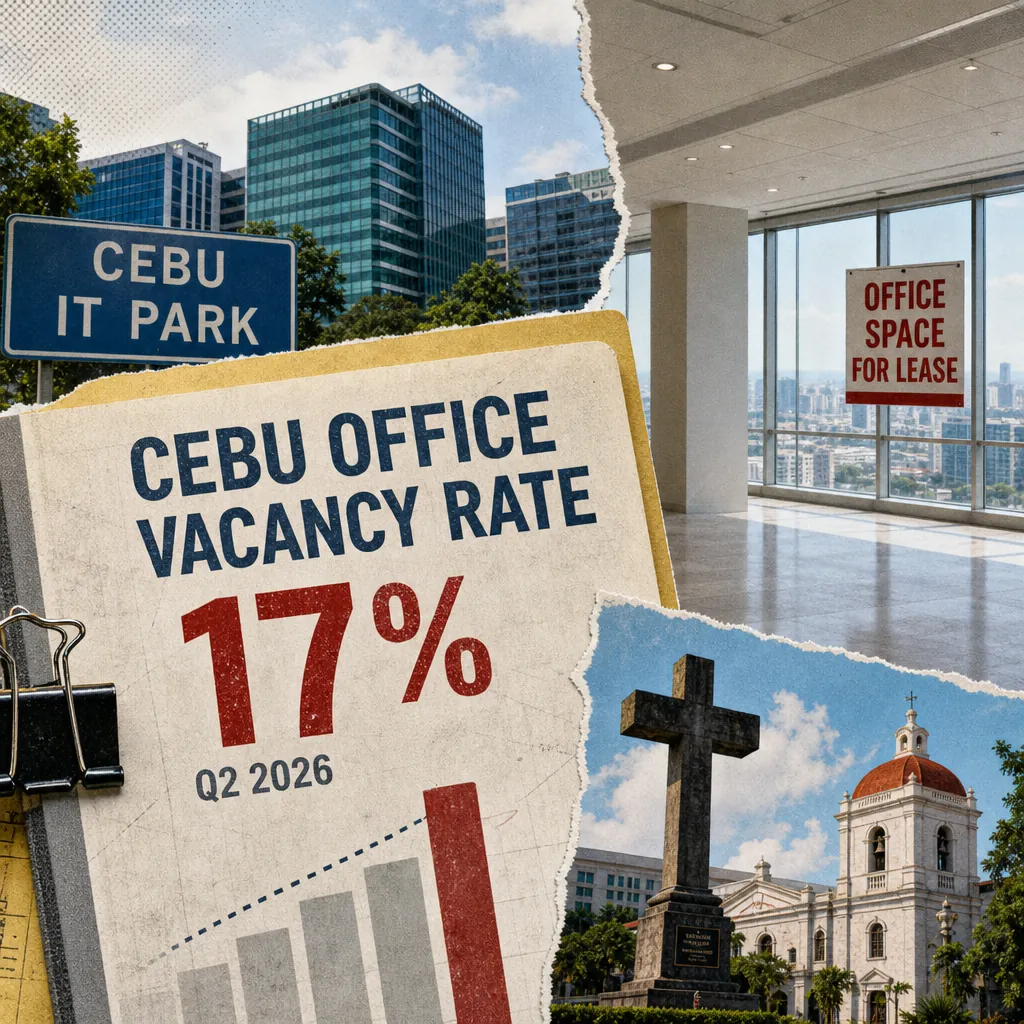
The Philippine real estate conversation on July 3, 2026, was shaped by two major policy developments and a security incident that together painted a picture of a sector navigating structural shifts. The Department of Agriculture (DA) lifted its five-month moratorium on farmland conversion, reopening the door for commercial, industrial, and infrastructure projects on agricultural land. At the same time, a Colliers Philippines report showed Cebu's office vacancy rate hitting 17 percent, dragged down by the lingering exit of Philippine offshore gaming operators (POGOs) and weak demand in secondary locations. These two stories—one opening up land supply, the other revealing soft demand in a key market—set the day's dominant narrative: a real estate sector adjusting to post-pandemic realities, with policy levers and market forces pulling in different directions.
Meanwhile, a bomb threat at a mall in Cebu IT Park on July 3 triggered a multi-agency response, with the mall remaining operational under limited entry. The incident generated significant social media engagement—362 likes, 378 shares, and 140 comments across posts from CDN Digital, Proud Bisaya Bai, and GMA Regional TV News—with strong emotional reactions (275 sad, 161 wow) reflecting public anxiety over safety in a key mixed-use hub. The all-clear was later declared, but the event added a security dimension to the conversation around Cebu's commercial property market.
On the policy front, the DA's Department Circular No. 32 resumed processing of land conversion applications after a suspension that began in January 2026 to safeguard farmlands and strengthen regulatory oversight. The circular exempts renewable energy projects, government socialized housing, and agro-industrial zones from the moratorium, signaling a calibrated approach that balances food security with development needs. The move was covered by the Inquirer Online with an estimated advertising-equivalent value of ₱229,976, indicating significant media weight.
On the corporate side, Federal Land Inc. announced it had shifted four residential projects in Pasay City's Met Park township to 100-percent renewable energy through a multi-year supply deal with ACEN Renewable Energy Solutions (ACEN RES). The projects—Six Senses Residences, Mi Casa, Palm Beach Villas, and Palm Beach West—will draw power under the government's Green Energy Option Program (GEOP) and Retail Aggregation Program (RAP), which allow eligible consumers to source renewable power. The story, covered by the Inquirer Online with an estimated AVE of ₱234,248, positions sustainability as a growing differentiator in the residential market.
ARTHALAND also released a digital film, "Escape Plant," for its Sevina Park development in Biñan, Laguna, using a whimsical narrative of plants leaving the city to find room to grow. The film, covered by the Inquirer Online with an estimated AVE of ₱357,424, is part of a broader marketing push for the 8.1-hectare masterplanned mixed-use development.
On the infrastructure front, the Department of Public Works and Highways (DPWH) began Phase 2 of the EDSA rehabilitation on July 3, with roadworks from Orense, Makati to Monumento, Caloocan running until July 23. The schedule includes northbound asphalt overlay from Guadalupe bus station to Avida Town Center on July 6-8, explicitly naming the Ayala Land development as a landmark. The Inquirer Online coverage carried an estimated AVE of ₱198,648. Separately, the Department of Transportation (DOTr) announced a temporary closure of the southbound lane of East Service Road toward Bicutan starting July 18 for construction of the North-South Commuter Railway Extension (NSCR) project.
On the financial side, the Philippine Stock Exchange index (PSEi) climbed above 6,100 on bargain hunting, closing at 6,188.03, up 1.02 percent. The broader market also advanced, with easing inflation expectations and the Philippines' new upper-middle-income status lifting sentiment. The story, covered by multiple outlets including the Inquirer Online and Philstar Online, carried a combined estimated AVE of over ₱400,000.
Key themes
- DA lifts farmland conversion moratorium, opening land for development – The Department of Agriculture resumed processing applications for reclassification of agricultural land after a five-month suspension, exempting renewable energy, socialized housing, and agro-industrial projects. The move signals a policy shift toward accommodating development while maintaining food security safeguards.
- Cebu office vacancy hits 17% as POGO exit lingers – Colliers Philippines reported that Metro Cebu's office vacancy rate stood at about 17 percent in Q2 2026, with prime hubs like Cebu IT Park and Cebu Business Park performing better than secondary locations. The lingering impact of former POGO tenants continues to weigh on the commercial property sector.
- Bomb threat at Cebu IT Park mall sparks security concerns – A bomb threat at a mall in Cebu IT Park on July 3 prompted a multi-agency response, with the mall remaining operational under limited entry. The incident generated high social media engagement and emotional reactions, highlighting vulnerability in a key business district.
- Federal Land shifts four projects to 100% renewable energy – The property developer signed a multi-year supply deal with ACEN RES to power four residential projects in Pasay City's Met Park township under the government's GEOP and RAP programs. The move underscores growing corporate commitment to sustainability.
- EDSA rehab Phase 2 begins, naming Avida Town Center as landmark – The DPWH started roadworks on EDSA from Makati to Caloocan, with the schedule explicitly referencing Avida Town Center as a location for northbound asphalt overlay. The development exposes the Ayala Land brand to construction-related accessibility concerns.
- PSEi climbs above 6,100 on bargain hunting – The benchmark index rose 1.02 percent to 6,188.03, driven by bargain hunting and improving macroeconomic sentiment, including easing inflation expectations and the Philippines' new upper-middle-income status.
- ARTHALAND launches creative marketing for Sevina Park – The developer released a digital film, "Escape Plant," using a whimsical narrative to promote its 8.1-hectare mixed-use development in Biñan, Laguna. The campaign reflects a trend toward storytelling in real estate marketing.
How the narratives stack
Dominant – Within the captured set, the dominant narrative is the dual policy-market story: the DA's lifting of the farmland conversion ban and the Colliers report on Cebu office vacancies. These two developments, covered by major online news outlets with significant AVE (₱229,976 and ₱370,935 respectively), frame the day's conversation around structural shifts in land supply and office demand. The DA circular opens up new development possibilities, while the Cebu vacancy data tempers optimism with a reminder of lingering softness in the commercial sector.
Counter-narrative – The bomb threat at Cebu IT Park introduces a security dimension that could undermine confidence in the very business district that Colliers identifies as a prime hub. While the incident was resolved without casualties, the high emotional engagement on social media (275 sad reactions) suggests that safety concerns resonate strongly and could affect tenant and investor sentiment. This counter-narrative is particularly relevant for developers with projects in Cebu IT Park, such as Megaworld and Ayala Land.
Emerging – Sustainability is emerging as a distinct narrative thread, with Federal Land's renewable energy deal and ARTHALAND's creative marketing for Sevina Park signaling that developers are increasingly using green credentials and lifestyle storytelling to differentiate themselves. The Federal Land story, covered by the Inquirer Online with an estimated AVE of ₱234,248, positions renewable energy as a selling point for residential projects. This trend is likely to grow as more developers adopt similar strategies.
Suppressed – The consumer distress signals that appeared in social media monitoring—such as the Reddit thread about a buyer seeking guidance on the Maceda Law after 43 months of payments, and the GMA Resibo segment on dirty water in a Laguna subdivision—are largely absent from the mainstream news coverage captured here. These grassroots concerns about build quality, turnover delays, and financial overextension remain under-covered by traditional media, even as they simmer in online communities.
Platform insights
- Facebook – Facebook was the primary platform for real estate-related posts, including official announcements from government agencies (DA, DPWH, DOTr), developer pages (Federal Land, ARTHALAND), and regional news outlets (CDN Digital, Proud Bisaya Bai). The bomb threat at Cebu IT Park generated the highest engagement, with one post from CDN Digital accumulating 431 likes and 423 shares. Government posts on infrastructure projects (EDSA rehab, NSCR closure) received moderate engagement, with likes in the low hundreds. Developer marketing posts, such as ARTHALAND's film launch, saw lower engagement but carried significant AVE in news coverage.
- Twitter/X – Twitter served primarily as a news aggregator, with outlets like the Inquirer and Philstar tweeting headlines about the DA circular, Cebu vacancies, and the PSEi rally. The bilyonaryo_ph account, which had previously driven conversation around Ayala Land's buyback, was not active on real estate topics on July 3. No significant user-driven conversation emerged on Twitter, with most tweets receiving single-digit likes and retweets.
- Reddit – Reddit continued to host consumer-focused discussions, though none of the threads from the monitoring writeup (e.g., the Maceda Law query, the Amaia Nuvali crack complaint) were captured in the supplementary media. The platform remains a niche but influential space for buyer due diligence and peer support, particularly around financial distress and legal remedies.
- YouTube – No real estate-specific YouTube content appeared in the supplementary media, though the ARTHALAND film "Escape Plant" was published on YouTube and may generate engagement over time. The platform remains underutilized for real estate conversation compared to Facebook and Reddit.
Key voices and communities
- Government agencies and officials – The Department of Agriculture, Department of Public Works and Highways, and Department of Transportation were the most prominent government voices on July 3, issuing policy announcements and infrastructure advisories. Their posts carry official weight and are widely shared by news outlets, making them key shapers of the regulatory and infrastructure narrative.
- Property market analysts and media – Colliers Philippines, through its market study on Cebu office vacancies, provided data-driven analysis that framed the day's commercial real estate conversation. The Inquirer Online and Philstar Online were the primary media outlets covering real estate news, with their articles carrying the highest AVE in the captured set.
- Major developers – Federal Land and ARTHALAND were the most visible developers on July 3, with Federal Land's renewable energy deal and ARTHALAND's Sevina Park film generating positive coverage. Ayala Land's Avida brand was mentioned indirectly through the EDSA rehab schedule, which referenced Avida Town Center as a landmark.
- Regional news and safety monitoring accounts – CDN Digital, Proud Bisaya Bai, and GMA Regional TV News drove the conversation around the Cebu IT Park bomb threat, with their posts generating the highest social media engagement of the day. These accounts are critical for monitoring security incidents in key business districts.
- Consumer and community voices – While not captured in the supplementary media, the monitoring writeup identified Reddit users and Facebook commenters as a key stakeholder group raising concerns about build quality, turnover delays, and financial distress. These voices remain influential in online communities but are under-covered by mainstream media.
Narrative streams
DA lifts farmland conversion moratorium
The Department of Agriculture's Department Circular No. 32, issued on July 3, lifted the moratorium on reclassification of agricultural land that had been in place since January 2026. The moratorium was originally imposed to safeguard farmlands against undue conversion and prevent threats to food security, and to strengthen the DA's regulatory oversight. During the suspension, a technical working group reviewed and updated guidelines on the issuance of DA certification for land use reclassification.
The circular exempts renewable energy projects, government socialized housing projects, and agro-industrial zones from the moratorium, indicating a calibrated approach that prioritizes food security while accommodating development needs. The move is significant for real estate developers, as it opens up more land for commercial, industrial, and infrastructure projects, potentially easing supply constraints in growth areas.
The story was covered by the Inquirer Online with an estimated advertising-equivalent value of ₱229,976, reflecting its importance as a policy signal. For context, the DA's move comes amid ongoing debates about food security and land use, with the Philippines facing challenges from climate change, population growth, and urbanization. The circular is likely to be welcomed by developers but may face scrutiny from agricultural advocates concerned about the loss of farmland.
Cebu office vacancy hits 17% as POGO exit lingers
Colliers Philippines released its Q2 2026 market study showing that Metro Cebu's office vacancy rate stood at about 17 percent, significantly higher than the single-digit vacancies seen in the region's premier business districts. The report highlights a two-speed market: prime hubs such as Cebu IT Park and Cebu Business Park continue to post relatively healthy occupancy levels, benefiting from steady demand from BPO firms and shared services companies. However, other office submarkets in Cebu have been recording substantially higher vacancies, pulling up the overall rate.
The lingering impact of former Philippine offshore gaming operator (POGO) tenants continues to weigh on the commercial property sector, as many POGO firms vacated office space following the government's crackdown and the industry's decline. The report notes that weak demand in secondary locations is also a factor, as tenants gravitate toward prime, well-connected hubs.
The story, covered by Philstar Online with an estimated AVE of ₱370,935, is the highest-value single article in the captured set. It provides a data-driven counterpoint to the positive narrative around Cebu's property market resilience that appeared in social media monitoring, where a regional news page highlighted "Cebu's property market continues to move on multiple engines at once—outsourcing expansion, remittance-driven demand, and large-scale infrastructure plans—even as the national economy slows." The Colliers report suggests that while the long-term outlook remains positive, the market is still absorbing the shock of the POGO exit.
Bomb threat at Cebu IT Park mall
On July 3, a bomb threat at a mall in Cebu IT Park prompted a multi-agency response from the Cebu City DRRMO and police. The mall remained operational but implemented limited entry during the investigation. The all-clear was later declared by authorities after a thorough search found no device.
The incident generated significant social media engagement, with posts from CDN Digital, Proud Bisaya Bai, and GMA Regional TV News accumulating 362 likes, 378 shares, and 140 comments. Emotional reactions were predominantly negative, with 275 sad and 161 wow reactions, reflecting public anxiety over safety in a key mixed-use hub.
The bomb threat is particularly relevant for developers with projects in Cebu IT Park, such as Megaworld (which developed the mall) and Ayala Land (which has projects in the area). The incident could affect tenant and investor confidence, especially in the BPO sector, which relies on a secure environment for operations. However, the rapid resolution and all-clear declaration may limit lasting damage if developers and authorities communicate effectively about safety measures.
Federal Land shifts to 100% renewable power
Federal Land Inc., the property developer behind Met Park township in Pasay City, announced that it had shifted four residential projects to 100-percent renewable energy through a multi-year supply deal with ACEN Renewable Energy Solutions (ACEN RES). The projects—Six Senses Residences, Mi Casa, Palm Beach Villas, and Palm Beach West—will draw power under the government's Green Energy Option Program (GEOP) and Retail Aggregation Program (RAP).
The GEOP allows electricity users with a minimum monthly demand of 100 kilowatts to buy power directly from renewable suppliers, while the RAP lets multiple facilities combine their electricity requirements to qualify for the program. The deal is part of a broader trend of developers incorporating sustainability into their projects, driven by both consumer demand and regulatory incentives.
The story, covered by the Inquirer Online with an estimated AVE of ₱234,248, positions Federal Land as a leader in green development. For context, ACEN Corp. is the Ayala Group's renewable energy arm, and the deal strengthens the link between Ayala's property and energy businesses. The move also aligns with the government's push for renewable energy under the Renewable Energy Act and the Philippine Energy Plan.
EDSA rehab Phase 2 begins, naming Avida Town Center
The Department of Public Works and Highways (DPWH) began Phase 2 of the EDSA rehabilitation on July 3, with roadworks from Orense, Makati to Monumento, Caloocan running until July 23. The schedule includes northbound asphalt overlay from Guadalupe bus station to Avida Town Center on July 6-8, explicitly naming the Ayala Land development as a landmark.
The rehabilitation involves asphalt overlaying, concrete reblocking, and drainage and sidewalk improvement activities, with work scheduled during off-peak hours (10 p.m. to 4 a.m. on weekdays, with extended weekend hours). The story, covered by the Inquirer Online with an estimated AVE of ₱198,648, is primarily an infrastructure advisory but carries implications for Avida Town Center's accessibility during the construction period.
For Ayala Land, the explicit mention of Avida Town Center in the DPWH schedule is a double-edged sword: it provides free brand placement but also exposes the development to potential negative sentiment from commuters and residents affected by the roadworks. The owning developer could use this as an opportunity to coordinate traffic management messaging with the DPWH and highlight long-term connectivity improvements.
PSEi climbs above 6,100 on bargain hunting
The Philippine Stock Exchange index (PSEi) rose 1.02 percent or 62.31 points to close at 6,188.03 on July 3, extending its gains for a third straight day. The broader All Shares index also increased by 0.83 percent or 27.91 points to 3,370.94.
According to Philstocks Financial Inc., investors continued accumulating beaten-down stocks amid improving local and global economic conditions. Luis Limlingan, head of sales at Regina Capital Development Corp., said "investors continued to add positions as market conditions appeared less volatile. Macroeconomic developments from the previous day also continued to influence investor reaction and positioning". Lower global oil prices also buoyed sentiment as they could ease inflationary pressures.
The rally was supported by the Philippines' new upper-middle-income status, as classified by the World Bank, which boosted confidence in the economy. The story was covered by multiple outlets, including the Inquirer Online (AVE ₱207,192) and Philstar Online (AVE ₱199,572), reflecting broad interest in the market's performance.
Conversation trajectory
Over the next 2-4 weeks, the conversation is likely to be shaped by several trigger events. The EDSA rehabilitation (July 3-23) will generate daily traffic-related posts, particularly around Avida Town Center, which could amplify negative sentiment about accessibility. The NSCR project closure starting July 18 will add to infrastructure-related discussion. The DA's lifting of the farmland conversion ban may prompt further analysis from property market analysts and advocacy groups, with potential pushback from agricultural stakeholders.
Over the next 1-2 months, the Cebu office vacancy story may deepen as more data emerges on BPO demand and POGO-related space absorption. The bomb threat at Cebu IT Park, while resolved, could resurface in discussions about mall safety and business continuity, especially if similar incidents occur. Developers' sustainability moves, such as Federal Land's renewable energy deal, are likely to be followed by similar announcements from competitors, creating a positive narrative around green development.
Key trigger events to watch: the release of Q2 2026 GDP data (which will affect real estate demand), any major delayed turnover reports from high-profile projects, and the next DHSUD or Pag-IBIG policy announcement on housing loans. The ongoing rainy season and geohazard advisories could also amplify concerns about flooding and landslide risks in subdivisions, particularly in Laguna, Bulacan, and Cavite.
Response guidance
For communicators in the real estate sector, the day's conversation offers several strategic entry points. The DA's lifting of the farmland conversion ban provides an opportunity for developers to frame their projects as contributing to economic growth and infrastructure development, while acknowledging the importance of food security. Messaging should emphasize compliance with the new guidelines and the exemptions for socialized housing and renewable energy.
The Cebu office vacancy story requires a nuanced response: developers with projects in prime hubs like Cebu IT Park can highlight their healthy occupancy levels, while those in secondary locations should address vacancy concerns proactively by showcasing tenant retention efforts and upcoming infrastructure improvements. The bomb threat at Cebu IT Park underscores the need for crisis communication plans tied to security incidents; developers should have rapid-response teams to reassure tenants and residents, leveraging relationships with local news and emergency authorities.
Sustainability is a growing differentiator, as seen in Federal Land's renewable energy deal. Developers should consider similar partnerships and communicate them clearly to buyers and investors. The EDSA rehab reference to Avida Town Center offers a rare, direct linkage between infrastructure announcements and a developer's property; the owning developer could use this as a positive framing—aligning their project with government road improvement efforts—or as a cooperative opportunity to coordinate traffic management messaging with the DPWH.
Sensitive topics to navigate include the security implications of the Cebu IT Park bomb threat, which should be addressed with factual updates and reassurance rather than speculation. The farmland conversion issue may attract criticism from agricultural advocates; developers should be prepared to explain how their projects comply with the new guidelines and contribute to food security through agro-industrial components.
See the full picture behind today's signals.
This report draws from Media Meter's MediaWatch, our real-time monitoring engine tracking 2,470+ Philippine sources across print, broadcast, digital, and social. Explore how the platform turns raw coverage into decision-grade intelligence, then see how it's configured for teams like yours — whether you're in PR agencies, corporate comms, government, or marketing.
Want more? Browse our Report Library for sector and crisis intelligence, or request a demo and we'll have your brand set up before the call.
Want this kind of intelligence on your brand?
This brief is built on the same MediaWatch methodology that runs continuously across every brand we monitor. See your competitive landscape, Impact Score, and narrative trajectory in a 30-minute demo.