DICT Chief Aguda Resigns; Globe Users Report Outages
Ombudsman Jesus Crispin Remulla said Malacañang accepted the resignation of Information and Communications Technology Secretary Henry Aguda, three days after the Palace denied it. Separately, Globe At Home subscribers in Pampanga and elsewhere described internet connections that stayed down after payment and after a stated restoration date.
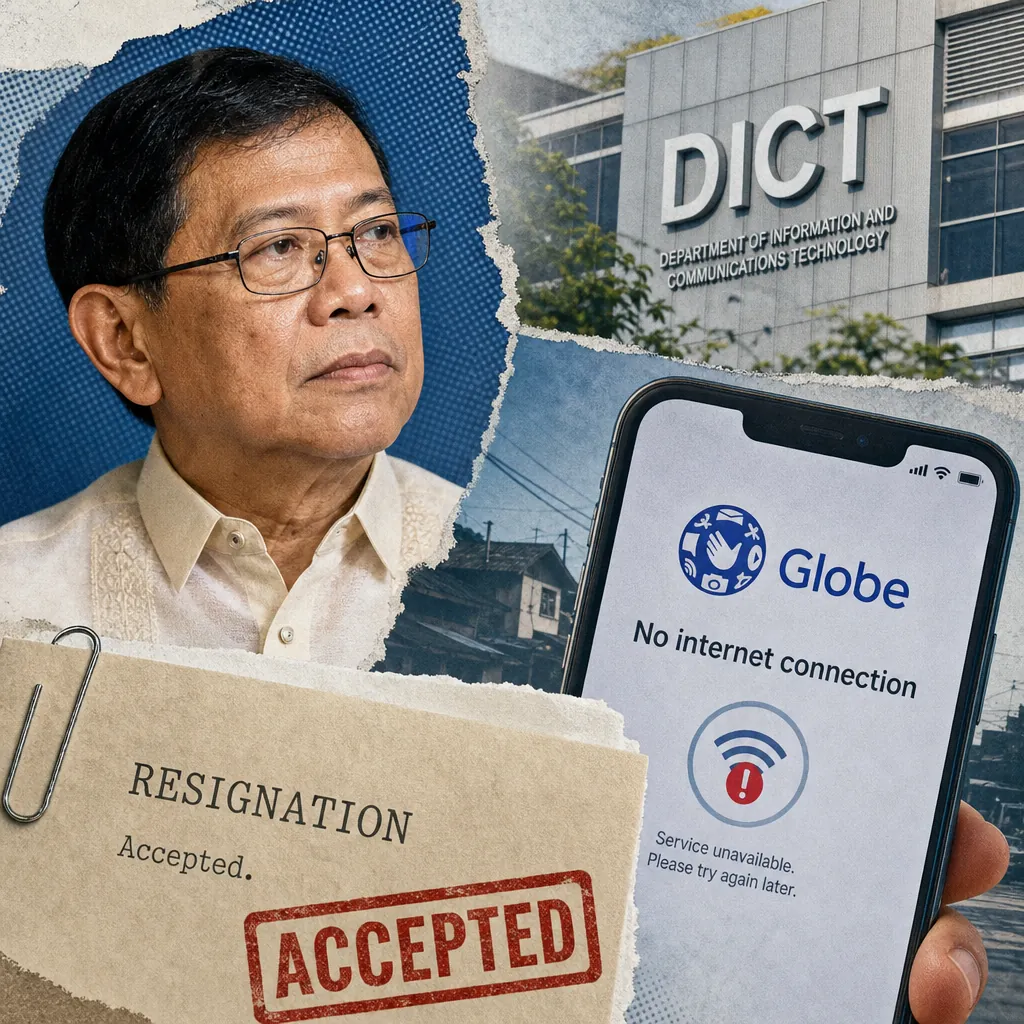
The resignation of Information and Communications Technology Secretary Henry Aguda was confirmed on October 10 by Ombudsman Jesus Crispin Remulla, who said on DZRH radio that Malacañang had accepted it — three days after the Palace said no such resignation had reached it. The Department of Information and Communications Technology (DICT) is the government department that sets policy for telecommunications, internet, and digital services in the Philippines, so who leads it matters to every phone and broadband subscriber in the country. Remulla's announcement, carried by the Manila Times, Philstar, and the Inquirer, reversed the official line from October 7, when Palace Press Officer Undersecretary Claire Castro said Aguda would stay on because the Palace had received no information about a resignation.474935 Aguda himself had said on October 7 that he remained at the President's service.3
The resignation discussion is tied to the DICT's recent regulatory moves, including an effort to block the chat platform Discord over concerns about violent content, which drew objections from people who use the app for work and other purposes.647 Remulla said the department "started off on the wrong foot," and TV Patrol reported that he also raised a possible DICT problem involving alleged "ghost internet" — a term used in Philippine congressional hearings for state-funded internet projects that were paid for but never delivered.949 The Inquirer's initial report noted that Malacañang had not confirmed the resignation at publication, while later posts on X and Facebook stated flatly that it had been accepted.578 A Facebook reel said Aguda was out and that possible replacements had emerged, but named no successor.12
On the consumer side, Globe At Home subscribers described connections that stayed broken after they had done what the company asked. A Reddit user said service remained unusable after they paid a late bill and their connection was cut for an hour; the Globe One app showed the account as connected while the Wi-Fi displayed "Sign In Required."1 A second Reddit user in Angeles City, Pampanga, said their Globe At Home line stayed down after an outage Globe had advised would run from October 2 to October 4, 2026, and that repeated troubleshooting and rescheduled technician visits had not restored it; the user said the outage was affecting work and classes.20 A third post, on a general tech-support forum, described packet loss during Zoom meetings despite reported download and upload speeds of 400 Mbps to 1 Gbps — a separate problem that did not name a provider.2 None of the three posts establishes a network-wide outage, and Globe has not responded in the material reviewed.
Key themes
- Malacañang accepted Aguda's DICT resignation, Remulla said, three days after the Palace denied it. The Ombudsman announced the acceptance on DZRH radio on October 10; Palace Press Officer Claire Castro had said on October 7 that Aguda would remain because no resignation had been received.474935
- The resignation is tied to the DICT's Discord-blocking effort and an Ombudsman investigation. Remulla said the department "started off on the wrong foot," and reports connected the departure to the DICT's push to regulate online platforms, including a move to block Discord.647
- Globe At Home customers reported connections that stayed down after payment and after a stated restoration date. One user paid a late bill and still could not connect; another in Angeles City said service remained out after Globe's October 2–4 outage advisory.120
- The Globe complaints are individual accounts, not evidence of a wider outage. Neither post identifies a network-wide failure, and no second independent item in the material raises the Angeles City outage.20
- PLDT and Smart announced a rewards-program tie-up with Capillary Technologies. The October 7 announcement covers mobile, broadband, and partner platforms but names no launch date and does not say whether existing points will transfer.13
- Converge won two Asian Experience Awards for organizing broadband plans around customer behavior rather than speed. The company took the Philippines Product Experience of the Year – Technology award for its "Live to the Power of X" campaign and a Digital Experience award for a business-to-business podcast.34
- The Senate passed a bill restricting social media use by minors, 16–1. Senate Bill 2424, the Safe Media Access and Responsible Technology for Kids in Digital Spaces (SMART KIDS) Act, would suspend or remove accounts used by minors and require age-assurance measures; Senator Risa Hontiveros cast the lone vote against.3751
- A Philippine startup became the first local partner in Anthropic's Claude network. Apper Digital Inc. was promoted to the select tier of the partner program for Claude, the AI assistant built by Anthropic, giving it access to a program that provides as much as $100 million in assistance.53
How the narratives stack
Dominant: The DICT leadership change dominated the news items captured here. Remulla's October 10 radio statement was picked up by the Manila Times, Philstar, the Inquirer, TV Patrol, and the Philippine Tribune, and it reversed a Palace position stated three days earlier.47493578 The story carries consequence beyond personnel: the DICT writes the rules for internet service, data privacy, and platform regulation in the Philippines, and its current agenda includes both the Discord-blocking effort and the Ombudsman's investigation.47 Within the items reviewed, this was the most heavily covered telecommunications development of the day, with the Manila Times and Philstar reports alone accounting for roughly ₱640,000 in estimated advertising-equivalent value — the notional cost of buying the same space as paid advertising, not a measure of readership.3547
Counter-narrative: The Globe At Home complaints sit against the industry's public messaging. While the DICT story ran on policy and personnel, PLDT and Smart were promoting a rewards partnership and online-safety work, and Converge was collecting awards for customer-experience design.131834 A Facebook item said PLDT and Smart were listening to young people's concerns about cyberbullying, scams, and artificial intelligence risks as they strengthen online safeguards.18 The Globe posts describe the opposite experience: a paid account that would not reconnect and a repair visit that kept being rescheduled.120 The two are not contradictory — corporate messaging and individual service failures coexist — but the gap is where subscriber frustration accumulates.
Emerging: The SMART KIDS Act passed the Senate 16–1 on October 8 and now moves to the House of Representatives.3751 The bill would suspend or remove social media accounts used by anyone under 18 and require platforms to adopt age-assurance measures. A Daily Tribune column questioned whether a ban is workable, noting that the Philippines has content regulators for television and film — the Movie and Television Review and Classification Board (MTRCB) — but no equivalent for digital media.37 A Philstar editorial made the same point: the risks to children are real, but a total ban may not be the most effective protection, because children's needs differ.51 If enacted, the measure would change how platforms verify age and how telecom and internet providers handle minors' accounts.
Under-covered: The cost of paying bills online drew little attention in the items reviewed. A Manila Times column documented convenience fees on everyday digital transactions: a ₱2 fee on a ₱179 mobile load package bought through GCash, ₱6 to ₱15 to pay a Meralco bill depending on the payment method, and ₱15 to pay a PLDT bill by credit or debit card.46 The column argued these charges provide little value in an increasingly digital economy. It is a consumer-cost story that sits directly alongside the Globe billing complaints but drew a fraction of the coverage the DICT resignation received.
Platform insights
- Reddit: The service complaints lived almost entirely on Reddit, in the r/InternetPH and r/techsupport communities. One user described paying a late Globe bill and still seeing "Sign In Required" on the Wi-Fi while the Globe One app showed the account as connected.1 Another, in Angeles City, described a connection that stayed down after Globe's October 2–4 outage advisory and technician visits that were repeatedly rescheduled.20 A third described packet loss on Zoom despite 400 Mbps to 1 Gbps speeds.2 These are detailed, first-person troubleshooting accounts rather than broad complaints, and the threads function as peer support — users comparing fixes — more than as protest.
- Facebook: The platform carried the resignation story through news pages and reels. The Philippine Tribune's page and a separate reel repeated Remulla's claim that the Palace had accepted the resignation, and the reel said possible replacements had emerged without naming any.812 A Bilyonaryo page item carried PLDT and Smart's online-safety messaging about cyberbullying, scams, and AI risks.18 Facebook's role here was amplification of broadcast and news content rather than original reporting.
- X: TV Patrol's account posted Remulla's claim that the Palace had accepted Aguda's resignation, giving the story a fast, short-form distribution channel that outpaced the Palace's own confirmation.7 The platform also carried the Wilbert Ross reaction to a fashion-designer rumor, which the actor addressed in a post tagged to Vice Ganda.59
- YouTube: Broadcast clips did the heavy lifting. A TV Patrol clip carried Remulla's remarks on the resignation and the alleged "ghost internet" problem, and an earlier clip from October 7 carried Aguda's statement that he remained at the President's service.93 A separate clip announced the PLDT–Smart–Capillary rewards partnership.13 Sports channels carried TNT basketball coverage, including Coach Chot Reyes's update on Rondae Hollis-Jefferson's recovery from an Achilles tendon injury.2122
Key voices and communities
Government officials and the Palace. Ombudsman Jesus Crispin Remulla drove the day's biggest story from a radio studio, announcing on DZRH's "Executive Session" that the Palace had accepted Aguda's resignation.4749 His framing — that the DICT "started off on the wrong foot" — set the tone for coverage. Palace Press Officer Undersecretary Claire Castro's October 7 statement that Aguda would stay created the contradiction that later reports had to resolve.49 The Office of the Ombudsman is the government body that investigates and prosecutes misconduct by public officials, which is why Remulla's word carried weight even before the Palace confirmed.
Globe At Home subscribers. The customers posting on Reddit are the most concrete consumer voice in the material. One described a paid account that would not reconnect; another described a Pampanga outage that outlasted Globe's own advisory.120 Their posts are specific about dates, locations, and troubleshooting steps, which makes them useful as individual case records even though they do not establish a pattern.
Telecom corporate communicators. PLDT, Smart, and Converge all appeared in the material with forward-looking messaging. PLDT and Smart announced the Capillary rewards tie-up and promoted online-safety work with young people.1318 Converge won two Asian Experience Awards for organizing broadband plans around customer activities — gaming, streaming, time-of-day use, and connected families — rather than speed and price alone.34 PLDT and Smart also appeared through the Digital Farmers Program, a Department of Agriculture–Agricultural Training Institute initiative that teaches farmers to use digital tools for market prices and crop decisions; a 55-year-old farmer from Kiblawan, Davao del Sur, described using technology to check prices and reach buyers.56
Senators and youth advocates. The SMART KIDS Act vote put Senator Robin Padilla, the bill's sponsor, and Senator Risa Hontiveros, its lone opponent, at the center of the minors-and-social-media debate.3751 The youth group Samahan ng Progresibong Kabataan (SPARK) appeared in a separate political story, criticizing Senator Mark Villar's move to the Senate majority bloc and calling it an attempt to avoid accountability amid the impeachment case against Vice President Sara Duterte.36
Sports and entertainment communities. TNT basketball coverage generated the largest volume of brand mentions in the material, but almost all of it treated "TNT" as a basketball team, not a telecommunications brand. Philstar reported TNT's 116–98 win over San Miguel, with Nick Hornsby scoring 23 points in his Philippine Basketball Association (PBA) debut, and SunStar Cebu reported that Coach Chot Reyes said Rondae Hollis-Jefferson was still far from game shape after an Achilles injury.1522 The PBA is the country's professional basketball league. This is a persistent measurement problem for the TNT brand: search and monitoring terms that catch the team's name will keep surfacing sports content.
Narrative streams
Aguda's resignation ends a three-day contradiction over who leads the DICT
The sequence matters more than the single announcement. Aguda's reported resignation first surfaced on October 6 through social media posts, including one by lawyer and blogger Jesus Falcis, and Newsbytes.PH reported he had submitted it, citing industry sources who linked the move to departmental controversies.35 On October 7, the Palace denied it: Castro said Aguda would remain because no resignation had been received, and Aguda said he was "focused on carrying out my responsibilities and ensuring the continuity of the department's work."4749 On October 10, Remulla said on DZRH that the resignation had been submitted and accepted.49 The Inquirer reported Remulla's account while noting the Palace had not confirmed it; later posts stated the acceptance as fact.578
Aguda was appointed DICT secretary in March 2025, succeeding Ivan Uy.47 The department's recent record includes the Discord-blocking effort, which the Manila Bulletin's Balita desk connected to the resignation discussion, and an ongoing Ombudsman investigation.647 Remulla's mention of "ghost internet" points to a separate controversy over state-funded internet projects that were paid for but never delivered — a recurring subject in congressional hearings on the DICT's spending.9
For telecommunications companies, the practical effect is a leadership vacuum at the agency that writes their rules. The DICT sets policy on spectrum, internet infrastructure, data privacy, and platform regulation; a change of secretary can slow pending decisions and reopen settled ones. The material does not establish who will lead the department or when the Palace will formally confirm the resignation, so the effect on DICT's telecommunications priorities remains unclear.12 Companies with pending regulatory matters — spectrum allocations, permit approvals, platform-compliance questions — face a period where the counterpart agency's direction is uncertain.
Globe At Home customers describe connections that stayed down after payment and after repair promises
The most detailed consumer account came from Angeles City, Pampanga. Globe issued an outage advisory for an area there on October 2 and said service was restored on October 4. A resident later said their Globe At Home connection remained down after that date, that troubleshooting had not restored it, and that a technician visit had been rescheduled more than once; the resident said the outage was affecting work and classes.20 A separate Reddit user described a different failure mode: after paying a late bill and being disconnected for an hour, the connection stayed unusable, with the Globe One app showing the account as connected while the Wi-Fi displayed "Sign In Required."1 A third post described packet loss on Zoom despite high reported speeds, without naming a provider.2
These are individual accounts. Neither Globe post identifies a network-wide outage, and no second independent item in the material raises the Angeles City case.20 The distinction matters: a single unresolved repair is a customer-service failure, while a pattern of them is a network or process problem. What the posts do show is a specific failure mode — the account state and the actual connection disagreeing — that makes self-service troubleshooting useless, because the app tells the customer everything is fine while the connection says otherwise.1
For Globe, the exposure is reputational and operational. Home broadband is a subscription business where churn follows unresolved repairs, and the complaints here are about the repair process as much as the outage: a paid bill that did not restore service, and a technician visit that kept moving.120 The read for the sector is that restoration advisories create a commitment — when service does not return by the stated date, the advisory becomes evidence against the provider rather than a courtesy. Competitors benefit indirectly: every unresolved repair is a moment when a subscriber considers switching.
PLDT and Smart consolidate rewards while promoting safety and farm digitization
PLDT and Smart Communications announced on October 7 a partnership with Capillary Technologies to combine their customer rewards programs across mobile, broadband, and partner platforms.13 The announcement did not name a launch date, did not say whether existing points or rewards balances will transfer, and did not describe how customers will use the unified program or how partner platforms will participate.13 That leaves the practical questions — what happens to points already earned, and when the change takes effect — unanswered.
Alongside the rewards news, PLDT and Smart's public messaging emphasized safety and inclusion. A Facebook item said the companies were listening to young people's concerns about cyberbullying, scams, and artificial intelligence risks as they strengthen online safeguards.18 The Digital Farmers Program, run by the Department of Agriculture–Agricultural Training Institute with PLDT and Smart, was profiled through Edgar Villanueva, a 55-year-old farmer from Kiblawan, Davao del Sur, who now uses digital tools to check market prices, reach buyers, and monitor weather and soil conditions.56 The Agricultural Training Institute is the DA's training arm; the program is a corporate-social-responsibility initiative that also builds rural data usage.
For PLDT and Smart, the rewards consolidation is a retention play: loyalty programs are how subscription businesses reduce churn, and unifying them across mobile and broadband makes it harder for a customer to leave one service without losing accumulated value. The unanswered questions are the risk. Customers who have earned points under the old programs will want to know whether those points survive the transition, and the announcement as reported does not say.13 Until it does, the partnership is a promise without terms.
Converge's awards show a shift from selling speed to selling fit
Converge ICT Solutions won two awards at the Asian Experience Awards 2026: the Philippines Product Experience of the Year – Technology award for its "Live to the Power of X" campaign, and the Philippines Digital Experience of the Year – Telecommunications award for a business-to-business podcast produced by its Converge Global Business Group.34 The campaign organized broadband offerings around what customers actually do online — GameChanger for gaming, a Netflix Bundle for entertainment, Time of Day for customers with varying schedules, and Super FiberX for connected families — rather than leading with speed, bandwidth, and price.34
The strategic logic is that speed has become hard to differentiate. When multiple providers advertise similar fiber speeds, the differentiator shifts to whether a plan matches a household's actual usage. Converge's approach packages the same underlying connectivity into plans named for activities, which makes the purchase decision about lifestyle rather than megabits. The awards are industry recognition rather than customer evidence, but they signal where the company wants to compete.
For the sector, the read is that product design is moving toward segmentation by behavior. Providers that can identify what a household does online — gaming, streaming, remote work, multiple devices — can price more precisely and reduce the discounting that erodes margins when plans look identical. The risk is complexity: more plan names can confuse buyers as easily as guide them, and the campaign's success depends on whether customers actually recognize themselves in the categories.
The SMART KIDS Act passes the Senate and moves to the House
The Senate passed Senate Bill 2424, the Safe Media Access and Responsible Technology for Kids in Digital Spaces (SMART KIDS) Act, on October 8 by a vote of 16–1, with Senator Risa Hontiveros the only senator opposed.37 The bill, sponsored by Senator Robin Padilla, would restrict access to social media and other "high-risk digital services" for anyone under 18, order the suspension or removal of accounts owned or used by minors, and require platforms to adopt age-assurance measures to verify users' real ages.51
The debate is about whether a ban is the right tool. A Daily Tribune column noted that the Philippines has content regulators for television and film — the Movie and Television Review and Classification Board (MTRCB) — but no equivalent for digital media, and asked whether social media can realistically be removed from Filipino life.37 A Philstar editorial acknowledged the real risks of online scams, bullying, grooming, and harmful content, but argued that a total ban may not be the most effective protection because children's needs differ.51 The bill now goes to the House of Representatives, where its scope and enforcement mechanisms will be negotiated.
For telecommunications and internet providers, the bill would create new compliance obligations. Age-assurance requirements would push platforms and possibly connectivity providers to verify users' ages, which raises questions about data collection and privacy. If the measure becomes law, providers would need systems to identify and act on minors' accounts — a significant operational change for services that currently have no age gate. The sector's interest is in how "high-risk digital services" is defined and who bears the cost of verification.
A Philippine startup joins Anthropic's partner network as AI adoption spreads
Apper Digital Inc. said it was promoted to the select tier of Anthropic's partner network for Claude, the AI assistant built by Anthropic, becoming the first Philippine company to earn that distinction.53 The tier gives Apper access to a program that provides as much as $100 million in assistance. Apper CEO and founder Diwa del Mundo said the inclusion guarantees clients that the company has been reviewed by Anthropic, and that local firms could turn to Apper if they need Claude in their operations.53 Anthropic launched the Claude Partner Network in March to support AI adoption.
The significance for the telecommunications sector is indirect but real: AI tools are increasingly embedded in customer service, network operations, and business processes, and local partners are how Philippine companies access them without building their own integrations. A local partner in a major AI vendor's network lowers the barrier for telecom operators and enterprises considering AI deployment. The read for the sector is that AI procurement is becoming a local-vendor decision rather than a direct-to-global-vendor one, which changes who telecom companies negotiate with and what support they can expect.
Conversation trajectory
Watch for a formal Palace confirmation or a successor announcement within one to two weeks. Remulla's statement came from a radio interview, and the Palace had not confirmed it at the time of the Inquirer report.5 A Facebook reel said possible replacements had emerged but named none.12 The trigger is an official Palace or DICT announcement; until then, the department's direction on pending telecommunications policy remains uncertain.
Expect the SMART KIDS Act to draw industry comment as it moves through the House over the coming weeks. The bill passed the Senate 16–1 and now faces House deliberation, where age-assurance requirements and the definition of "high-risk digital services" will be contested.3751 The trigger is a House committee hearing or a counterpart bill; telecom and platform companies will want to shape the compliance burden before it is set.
Globe's handling of the individual complaints will determine whether they stay isolated. The Angeles City case and the paid-bill case are single accounts, and no second independent item raises either.120 If more subscribers post similar accounts — particularly about connections that stay down after a stated restoration date — the story shifts from customer-service noise to a pattern. The trigger is a cluster of posts from the same area or the same failure mode within the next week or two.
The convenience-fee story has room to grow if consumer groups or regulators pick it up. The Manila Times column documented fees on mobile load, utility bills, and airline tickets, including ₱2 on a GCash load purchase and ₱15 to pay a PLDT bill by card.46 The trigger would be a statement from the Department of Trade and Industry, the Bangko Sentral ng Pilipinas, or a consumer group; none appears in the material reviewed.
PLDT and Smart's rewards consolidation will face customer questions once terms are published. The announcement named no launch date and did not say whether existing points transfer.13 The trigger is the program's terms and conditions or a launch date; until then, the unanswered questions are the story.
Response guidance
On the DICT leadership change, separate confirmed facts from reported claims in every customer-facing statement. The Palace had not confirmed the resignation at the time of the Inquirer report, and the confirmation came from the Ombudsman rather than the Palace.547 Communications should attribute the resignation to Remulla's statement and note that official confirmation is pending, rather than stating it as settled. For companies with pending DICT matters, prepare for a period of slower decision-making and avoid public positioning on the department's regulatory agenda until a successor is named.
On service complaints, treat restoration advisories as commitments with deadlines. The Angeles City case turned on a connection that stayed down after Globe's stated October 4 restoration date.20 Providers should ensure that advisory dates reflect realistic restoration times, and that support channels can see the same account state the customer sees — the paid-bill case showed the app reporting "connected" while the Wi-Fi required sign-in, which makes self-service useless.1 Where a repair is rescheduled, proactive notification with a new date is better than silence.
On the SMART KIDS Act, engage on implementation rather than principle. The bill's age-assurance requirements would create new compliance obligations for platforms and connectivity providers.51 Companies should prepare positions on how age verification would work, what data would be collected, and who bears the cost, and raise them in House deliberations rather than waiting for the final rules. Public messaging that acknowledges the risks to children while arguing for workable enforcement will land better than blanket opposition.
On convenience fees, expect scrutiny and prepare plain-language explanations. The fees documented include ₱2 on a GCash load purchase, ₱6 to ₱15 on Meralco bill payments, and ₱15 on PLDT card payments.46 Companies that charge them should be able to explain what the fee covers and why it differs by payment method, because the column's framing — that the charges provide little value in a digital economy — is likely to recur.
On rewards-program changes, publish the terms before customers ask. The PLDT–Smart–Capillary announcement left open whether existing points transfer and when the program starts.13 Loyalty programs are retention tools, and uncertainty about accumulated value works against retention. Publishing transfer rules and a launch date early prevents the announcement from becoming a source of complaints.
On brand monitoring, separate the TNT basketball team from the TNT telecommunications brand. Most of the TNT mentions in the material were about the PBA team's games and players, not the mobile brand.1522 Communications teams tracking brand sentiment should filter sports coverage out of telecom metrics, or the numbers will overstate the brand's presence in consumer conversation.
See the full picture behind today's signals.
This report draws from Media Meter's MediaWatch, our real-time monitoring engine tracking 2,470+ Philippine sources across print, broadcast, digital, and social. Explore how the platform turns raw coverage into decision-grade intelligence, then see how it's configured for teams like yours — whether you're in PR agencies, corporate comms, government, or marketing.
Want more? Browse our Report Library for sector and crisis intelligence, or request a demo and we'll have your brand set up before the call.
Want this kind of intelligence on your brand?
This brief is built on the same MediaWatch methodology that runs continuously across every brand we monitor. See your competitive landscape, Impact Score, and narrative trajectory in a 30-minute demo.