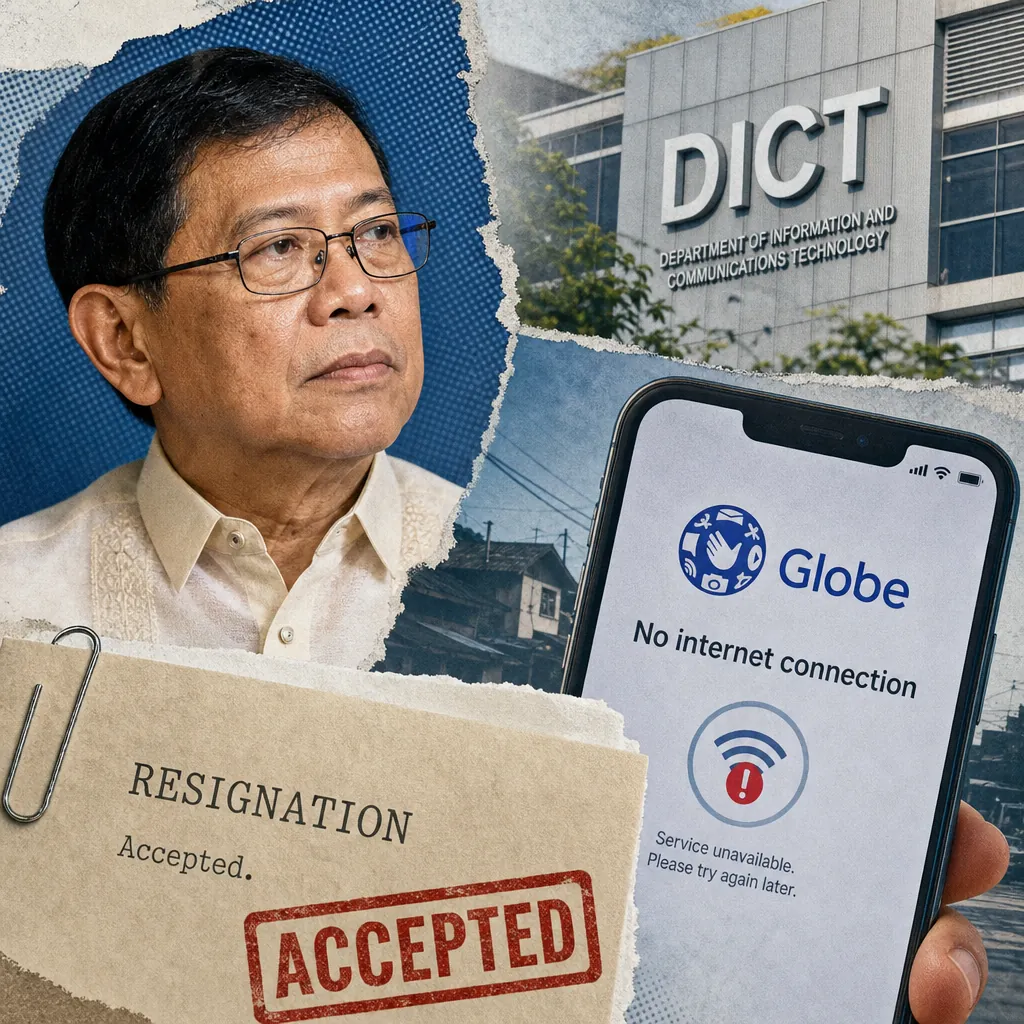
DICT Chief Quits as Ombudsman Probes Ghost Internet
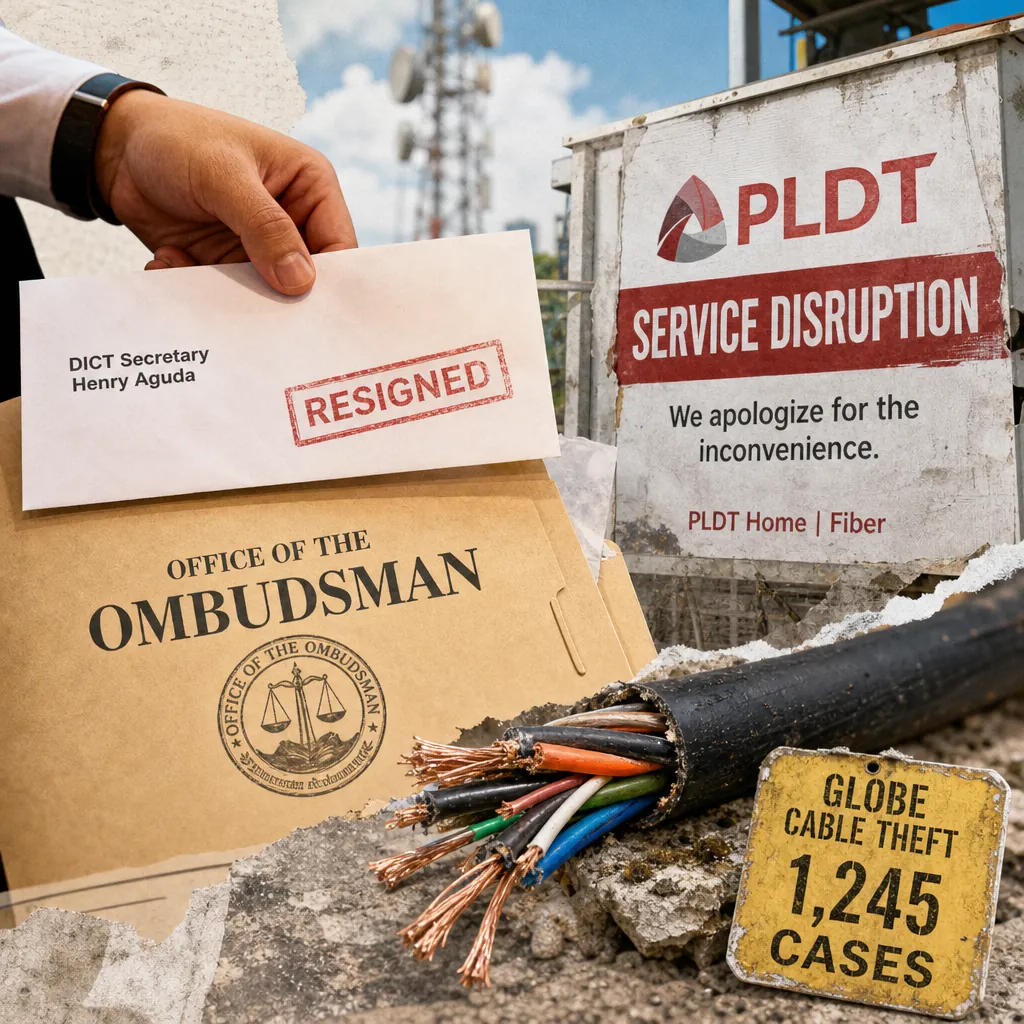
Information and Communications Technology Secretary Henry Aguda resigned as the Ombudsman investigates alleged ghost connectivity projects, while a Quezon City subscriber reported a month-long PLDT outage and Globe counted 1,245 cable-theft cases.
The Conversation
Henry Aguda resigned as Secretary of the Department of Information and Communications Technology (DICT), the government department that runs the country's digital transformation and connectivity programs, and President Ferdinand Marcos Jr. confirmed on Sunday, October 11, 2026, that he had accepted it. Speaking at a Kapihan media interview in Singapore, the President said the Palace had held back the announcement while it looked for a replacement, and that Ombudsman Jesus Crispin Remulla had disclosed the resignation first. "Yes, but we were holding it back until we found the … replacement," Marcos said. "But the Ombudsman already spilled the beans before we were able to."24 The resignation is tied to the Ombudsman's investigation into alleged "ghost internet" projects — claims that some DICT connectivity sites were never made operational and that equipment and services were substandard. Those remain allegations, not findings.7
The story ran across radio, television, social media, and the business pages. Remulla first confirmed the resignation on DZRH radio on October 1056; Marcos confirmed it the next day in Singapore, and news accounts and social posts repeated the confirmation through Sunday.91011 The same interview produced a second Cabinet change: Lino Cayetano, general manager of the state-run People's Television Network, was named to head the Presidential Communications Office (PCO), the government's lead communications arm, replacing Dave Gomez, whose appointment had been bypassed by the Commission on Appointments, the body that vets senior government appointments.2745 The twin departures drew questions because they came as Marcos's net satisfaction rating fell to -11, classified as "poor," in September 2026 from -7 in June, according to a Social Weather Stations survey conducted from September 21 to 27; 35 percent of respondents were satisfied, 46 percent dissatisfied, and 20 percent undecided.38
On the consumer side, a Reddit user in Quezon City reported that PLDT home internet had been out since September 20, following earlier interruptions from September 1 to 13 and on September 15. The subscriber said daily calls produced scripted replies without a repair, despite complaints filed with the National Telecommunications Commission (NTC), the government telecommunications regulator, the Department of Trade and Industry, and the DICT. The same user said the NTC had emailed PLDT about the complaint but service remained unavailable, and that Globe and Smart signals were weak or absent inside the home, making work-from-home difficult.1 Two other Reddit posts that day raised narrower equipment questions: one asked for router advice because Wi-Fi faded about 18 feet from the modem, and another said the modem's fourth local-area-network port did not detect a Cignal box and that telephone service was not working.23 These are individual reports, not evidence of service conditions across Quezon City or the wider customer base.1
Key themes
- DICT loses its secretary while an Ombudsman probe examines ghost connectivity projects. Henry Aguda's resignation was confirmed by President Marcos on October 11, three days after the Palace said he would stay in the post.30 The Ombudsman's investigation concerns claims of non-operational project sites and substandard equipment and services, which have not been presented as findings.7
- No successor has been named for the DICT. Marcos said the Palace intended to delay the announcement until a replacement was identified, but no successor appeared in his Sunday remarks.12 The department responsible for the government's digital transformation and connectivity programs is therefore operating without an announced permanent head.9
- A Quezon City subscriber reported a month-long PLDT outage. The Reddit user said service had been down since September 20, after earlier September interruptions, and that daily calls and complaints to the NTC, DTI, and DICT had not restored it.1
- Globe counted 1,245 cable-theft and pilferage cases as of September 2026. The company and its tower partners said the thefts caused service outages nationwide and undermined investment in coverage and network quality, and it called for stronger government action to protect critical infrastructure.26
- The Philippines restated a target of about 1.5 gigawatts of power capacity for AI infrastructure by 2033. The goal, part of the Philippines AI+ Infrastructure Masterplan 2026–2033 launched on September 8, represents a roughly 30-fold increase from 50 megawatts and is backed by a projected $34.4 billion in public and private investment.35
- A text-message scam impersonating the MMDA circulated as the No Contact Apprehension Policy returned. News5's Frontline Pilipinas warned on October 8 about messages posing as the Metropolitan Manila Development Authority, the agency responsible for traffic management in Metro Manila, as the traffic-enforcement policy resumed. The report did not link the messages to any telecommunications provider or describe how they reach recipients.4
- Iloilo City pushed a regional startup push, with a festival set for October 22 to 24. The 3rd Western Visayas Innovative Startup Fest aims to turn university research and grassroots innovations into businesses, as Iloilo entered StartupBlink's Global Startup Ecosystem Index at 744th worldwide and fifth among Philippine cities.25
- TNT opened a nationwide karaoke competition powered by its 5G network. The competition, Sayaoke, will run online auditions and weekly showdowns streamed on TikTok Live, with auditions recorded through the Vivaoke app.44
How the narratives stack
Dominant: The DICT leadership change and the Ombudsman's ghost-internet investigation dominated the captured set. Within the items reviewed here, the story appeared in a broadsheet front page33, in online news from Inquirer, BusinessMirror, Daily Tribune, Panay News, Philstar, and rmn.ph243338304539, and in television and social posts91011. The breadth reflects the story's consequence: the DICT runs the government's connectivity programs, and its head left while those programs are under investigation. The Manila Standard front page carried the resignation alongside the PCO change, a placement that signals how the story was treated as a top-of-page development.33
Counter-narrative: The consumer service picture ran on a different track. A single Reddit subscriber's month-long PLDT outage1 and Globe's count of 1,245 cable-theft cases26 describe what customers experience when networks fail, but neither drew the volume of coverage the Cabinet story did. Globe's disclosure is the more concrete of the two: it is a company-reported figure covering January through September 2026, and it links theft directly to outages and to investment that would otherwise expand coverage.26 The subscriber report is one person's account and cannot be generalized.1
Emerging: Two forward-looking items point to where the sector's growth is being planned. The AI infrastructure masterplan's 1.5-gigawatt target by 203335 and Iloilo's startup push ahead of its October 22–24 festival25 both concern building new capacity and new companies rather than fixing existing networks. Neither has produced measurable results yet.
Under-covered: The MMDA impersonation-text warning received little follow-through in the captured set. News5 aired the warning on October 8, but no item here reports an arrest, a provider response, or a count of affected recipients.4 The story matters because it involves messages that appear to come from a government agency, but the available account does not establish how the messages are delivered or whether any network or customer data was involved.4
Platform insights
- Reddit: The consumer service discussion lived almost entirely on r/InternetPH, where a subscriber documented a month-long PLDT outage with dates, escalation steps, and regulator complaints.1 Two other threads that day asked narrower equipment questions — Wi-Fi range about 18 feet from a modem, and a modem port that failed to detect a Cignal box.23 The pattern is diagnostic rather than campaign-driven: users post timelines and ask for troubleshooting help, and the threads function as a de facto complaint log.
- Facebook: The DICT resignation spread through news pages and official accounts. The Philippine STAR page framed the PCO change as "yet another leadership change"7, Cebu Daily News Digital posted the confirmation10, and the Presidential Communications Office account carried Marcos's Kapihan remarks12. A video reel of the confirmation also circulated.8 Facebook carried the announcement to general audiences rather than adding analysis.
- X: GMA News posted the resignation confirmation to its X account11, where the item circulated among users already following the Ombudsman probe. The platform's role in the captured set was to relay the headline quickly rather than to host extended discussion.
- YouTube: Two television items carried the story: the Ombudsman's DZRH radio remarks56 and a television report noting the Ombudsman's concerns about alleged ghost internet in DICT projects.9 News5's Frontline Pilipinas warning about MMDA impersonation texts also ran on YouTube.4 Video gave the story its first airing before the Palace confirmed it.
Key voices and communities
Government officials and agencies. President Marcos confirmed the resignation and the PCO appointment in Singapore2445; Ombudsman Remulla disclosed the resignation on radio and linked it to his investigation56; and the DICT itself, through Undersecretary Sarah Maria Sison, presented the AI infrastructure masterplan at the Global ICT Leadership Forum in Seoul on September 30.35 These voices set the official record, and their statements are the primary source for what is confirmed.
Telecommunications subscribers. The r/InternetPH community produced the day's most detailed consumer account, including the escalation path through the NTC, DTI, and DICT.1 This community matters because it documents service failures in public where individual complaints otherwise stay private, and because its posts are the only subscriber-side evidence in the captured set.
Telecommunications companies. Globe used a press release to press for government action on cable theft, reporting 1,245 pilferage cases as of September 2026 and warning that each affected site can disrupt mobile and data services.26 Smart Communications, through officer-in-charge Lloyd R. Manaloto, framed connectivity as central to entertainment and self-expression in announcing the TNT Sayaoke competition.44 Both are company framings, and both place the companies' priorities — infrastructure protection and network marketing — in public view.
Regional innovation and startup organizers. The Department of Science and Technology's Region 6 office, through director Engr. Rowen R. Gelonga, said the region's priority is to move beyond developing ideas and build enterprises capable of creating employment, ahead of the Western Visayas Innovative Startup Fest.25 This group represents the push to build new technology businesses outside Metro Manila.
Entertainment and lifestyle audiences. Items about e-wallet savings13, celebrity interviews162028, and the Ben&Ben concert40 drew large audiences in the captured set, and their presence shows how much of the day's connectivity-adjacent conversation sits in entertainment and personal-finance content rather than in policy news.
Narrative streams
Aguda resigns as Ombudsman investigates ghost connectivity projects
Henry Aguda's resignation as DICT Secretary was confirmed by President Marcos on October 11, 2026, during a Kapihan interview in Singapore, after Ombudsman Jesus Crispin Remulla disclosed it on DZRH radio the day before.5624 The Ombudsman is the government's independent investigator of wrongdoing by public officials; his probe concerns alleged "ghost internet" projects under the DICT's Free Wi-Fi program — claims that some sites were never made operational and that equipment and services were substandard.33 Marcos linked the resignation to the investigation: "I think that is because of the investigation that he [Remulla] is conducting. It's related, I think, to the progress of the investigation that he is conducting on the ghost connectivity projects."33
The timing drew attention because it reversed the Palace's position three days earlier. Palace Press Officer Undersecretary Claire Castro had said Aguda would remain DICT secretary, explaining that Malacañang had received no information indicating otherwise.30 Remulla's radio confirmation ended that uncertainty: "Nag-resign. Tinanggap na 'yung resignation," he said when asked whether Aguda had stepped down.30 Marcos said the Palace had wanted to wait until a replacement was chosen, and no successor was named in his Sunday remarks.12 The DICT is the department responsible for the government's digital transformation and information and communications technology programs, including the Free Wi-Fi program at the center of the probe, so the vacancy sits directly over the projects under scrutiny.9
For telecommunications operators, the practical effect is uncertainty about who will run the department that sets connectivity policy, awards spectrum and permits, and manages programs that overlap with private networks. The investigation's concerns have not been presented as findings, so operators should separate confirmed facts — the resignation, the probe's existence — from allegations when briefing internal teams or partners.7 The absence of a named successor and of a public timetable for the probe means project decisions tied to the DICT cannot yet be judged.7
A Quezon City subscriber reports a month without PLDT service
A Reddit user in Quezon City said PLDT home internet had been out since September 20, 2026, after earlier interruptions from September 1 to 13 and on September 15. The subscriber said daily calls brought scripted replies without a repair, despite complaints filed with the NTC, the DTI, and the DICT, and said the NTC had emailed PLDT about the complaint while service remained unavailable.1 The NTC is the government agency that regulates telecommunications services and handles consumer complaints; the DTI handles trade and consumer protection; the DICT runs connectivity policy. Escalating to all three is the standard path for a subscriber who cannot get a repair, and the post describes that path failing.
The same subscriber reported weak or absent Globe and Smart signals inside the home, which they said made working from home difficult.1 That detail matters because it removes the usual fallback: when one fixed-line provider fails, a mobile connection from another network is the substitute, and the post says that substitute was not available indoors. The material gives no confirmed restoration date and no public response from PLDT, so the near-term service trajectory is unclear.1 Two other posts that day raised narrower equipment questions — Wi-Fi fading about 18 feet from a modem, and a modem port that did not detect a Cignal box — but do not establish broader outages.23
For the sector, the episode is a reminder that service-level failures become public-relations problems when escalation channels do not produce repairs. The account is a single subscriber's report and cannot be generalized to Quezon City or to PLDT's customer base.1 What it does show is the shape of the complaint: a dated timeline, documented escalation, and a public post when the process stalls.
Globe counts 1,245 cable-theft cases and asks government to act
Globe reported 1,245 cases of telecommunications equipment theft and pilferage as of September 2026, recorded by the company and its tower company partners, and said the incidents caused service outages nationwide with more continuing to be reported.26 Each affected site can mean disrupted mobile and data services for customers who rely on connectivity for work, education, business, emergency communications, and access to digital services, and repeated theft also undermines investment intended to expand coverage and improve network quality.26 "This is no longer simply a matter of stolen equipment. When critical telecommunications infrastructure is damaged or taken, communities can lose connectivity and the investments being made to improve networks," the company said.26
The figure is a company-reported count covering January through September 2026, not an independent audit, and it measures incidents of theft and pilferage rather than customers affected. Its significance is that it quantifies a problem the company says is growing and that it uses the count to press for stronger government action to protect critical infrastructure.26 For operators, the disclosure puts a number behind a cost that usually stays inside operations budgets: stolen cable and equipment means repair crews redeployed, coverage plans delayed, and customers offline. For regulators and local governments, it is a request to treat telecom infrastructure as critical infrastructure deserving protection, which would change how theft cases are prioritized and prosecuted.
The Philippines restates a 1.5-gigawatt target for AI infrastructure
The government reiterated a target of expanding power capacity supporting artificial intelligence infrastructure from 50 megawatts to about 1.5 gigawatts by 2033, a roughly 30-fold increase, under the Philippines AI+ Infrastructure Masterplan (PAIIM) 2026–2033, backed by a projected $34.4 billion in public and private investment.35 The plan was launched on September 8, 2026, and DICT Undersecretary Sarah Maria Sison presented it on September 30 at the 12th Global ICT Leadership Forum in Seoul, where she outlined areas for cooperation with South Korea, including AI adoption in government, AI computing facilities and data centers, digital twins for resilience, talent development, and trusted AI.35
A gigawatt is a measure of generating capacity — roughly the output of a large power plant — so the target describes how much electricity the country expects to need for AI computing, not how much data-center space exists today. The plan's logic is that AI computing requires large, reliable power, and that countries able to supply it can attract data-center and cloud investment. For the telecommunications sector, the target matters because data centers and AI computing sit on the same fiber and connectivity infrastructure that carriers build and operate, and because the DICT — currently without a confirmed secretary — is the agency presenting the plan.35 The investment figure is a projection, not committed spending, and the 2033 horizon means results will not be measurable for years.
Iloilo builds a regional startup pipeline ahead of an October festival
Western Visayas is stepping up efforts to turn university research, homegrown inventions, and grassroots innovations into commercially viable businesses, with the 3rd Western Visayas Innovative Startup Fest scheduled for October 22 to 24, 2026, at the SM Iloilo Terminal Market in Iloilo City.25 The event will bring together entrepreneurs, investors, researchers, government officials, and industry leaders. Iloilo City entered StartupBlink's Global Startup Ecosystem Index at 744th worldwide and fifth among Philippine cities, and Department of Science and Technology Region 6 director Engr. Rowen R. Gelonga said the region's priority is to move beyond developing innovative ideas and establish enterprises capable of creating employment.25
The push matters because technology employment in the Philippines is heavily concentrated in Metro Manila, and regional startup ecosystems need investors, mentors, and customers to keep founders from relocating. The festival is a scheduled, checkable event: whether it produces funded companies or partnerships will be visible after October 24. For telecommunications operators, regional startup growth is a future market for connectivity, cloud, and payment services, and the DOST's involvement signals government willingness to fund the early stages.25
A text scam impersonating the MMDA circulates as the no-contact traffic policy returns
News5's Frontline Pilipinas warned on October 8, 2026, that text messages impersonating the Metropolitan Manila Development Authority (MMDA), the government agency responsible for traffic management in Metro Manila, were circulating as the No Contact Apprehension Policy (NCAP) resumed.4 NCAP is a traffic-enforcement program that uses cameras to cite vehicles for violations without officers stopping them at the roadside; its return gives scammers a plausible hook, because drivers may expect official notices about violations.
The warning concerns impersonation and does not identify a telecommunications provider, describe a network or customer-data breach, or say whether the messages use text sender spoofing — the technique of making a message appear to come from a legitimate sender.4 No further development or timing for action on the scam appears in the related items, so its course is unclear.4 For the sector, the item is a reminder that scam messages borrowing government authority create pressure on carriers even when no provider link is established, and that attributing message delivery or protective action to a named provider would go beyond what is known.4
TNT opens a nationwide karaoke contest streamed on TikTok
TNT is searching for the country's next karaoke star through Sayaoke, a nationwide singing competition that will connect performers from Luzon, Visayas, and Mindanao through live singing battles powered by TNT 5G.44 The competition begins with online auditions recorded through the Vivaoke app, TNT's official audition platform featuring Viva's library of original Pilipino music, before moving to weekly showdowns streamed on TikTok Live.44 "Connectivity is an important part of how Filipinos experience entertainment, pursue their passions, and connect with one another," said Lloyd R. Manaloto, first vice president and officer-in-charge of Smart Communications Inc.44
The contest is a marketing exercise that doubles as a network demonstration: streaming live auditions and battles requires upload capacity, and the format puts the network's performance in front of an audience in real time. For the sector, it shows how carriers are using entertainment formats and social platforms to market 5G, a service whose adoption depends on consumers finding uses for higher speeds. The item ran in a broadsheet entertainment section, placing network marketing in front of a general readership rather than a technology audience.44
Conversation trajectory
Watch for a named DICT secretary, over the next two to four weeks. President Marcos said the Palace had delayed the resignation announcement while searching for a replacement, and no successor was named in his Sunday remarks.12 A named appointee would clarify who runs the department overseeing the Free Wi-Fi program under investigation; continued silence would extend the uncertainty over project decisions.7
Watch for Ombudsman statements or filings on the ghost-internet probe, over the next one to three months. The investigation's concerns have been described broadly, without identifying specific projects or findings.7 Any formal finding or charge would move the story from allegation to established fact and would likely name projects and contractors, which matters to operators and suppliers who work with the DICT.
Watch for PLDT's response to the subscriber complaint, over the next one to two weeks. The material reports no public response from PLDT and no confirmed restoration date.1 A repair, a statement, or an NTC action would resolve the individual case; continued silence would leave the complaint as the only public record.
Watch for government action on cable theft, over the next one to two quarters. Globe's 1,245-case count and its call for stronger protection of critical infrastructure set up a test of whether regulators or local governments respond with enforcement measures.26 Any new policy, task force, or prosecution data would show whether the request produced action.
Watch for the Western Visayas Innovative Startup Fest outcomes, after October 24, 2026. The festival's stated goal is to turn research and inventions into enterprises that create jobs.25 Announcements of funding, partnerships, or new companies after the event would indicate whether the regional push is producing results.
Trigger events: a Malacañang announcement naming the next DICT secretary; an Ombudsman filing or public report on the ghost-internet probe; an NTC or PLDT statement on the Quezon City complaint; a government response to Globe's cable-theft request; and the close of the Iloilo startup festival on October 24.
Response guidance
Separate confirmed facts from allegations in all DICT-related communications. The resignation and the existence of the Ombudsman probe are confirmed; the ghost-internet claims are allegations that have not been presented as findings.7 Brief internal teams and external partners on that distinction, and avoid speculating about which projects or contractors are involved until official statements identify them.
Prepare for policy continuity questions while the DICT has no confirmed secretary. Operators, suppliers, and partners with pending permits, spectrum matters, or program participation should identify which decisions depend on the department's leadership and flag timelines that could slip.9 A named successor would resolve most of this; until then, treat project schedules as provisional.
Treat subscriber service complaints as public records once they are posted. The Quezon City account includes dates, escalation steps, and regulator contacts, which makes it citable by media and other customers.1 Customer-care teams should be able to identify escalated cases before they become public posts, and communications teams should have a response ready for cases that do.
Support infrastructure-protection messaging with specific numbers. Globe's 1,245-case count gives the cable-theft issue a concrete figure that media can report.26 Operators making similar cases should publish counts with the period covered and the service impact, because a number without a baseline invites skepticism.
Keep scam warnings distinct from network incidents. The MMDA impersonation warning does not identify a provider or establish a data breach.4 Communications on scam risks should state what is known — that messages are circulating and impersonating an agency — and avoid implying a network compromise that has not been established.
Use entertainment and community formats for 5G messaging where the audience already is. The TNT Sayaoke competition pairs a network demonstration with a format built for social platforms.44 Carriers marketing 5G should consider where target audiences already spend time and design formats that show the network working rather than describing speeds in the abstract.
Track the AI infrastructure plan as a demand signal, not a commitment. The 1.5-gigawatt target and $34.4 billion investment projection describe intended capacity and spending by 2033.35 Operators and data-center investors should treat them as planning assumptions to monitor against actual power contracts and construction, not as booked demand.
See the full picture behind today's signals.
This report draws from Media Meter's MediaWatch, our real-time monitoring engine tracking 2,470+ Philippine sources across print, broadcast, digital, and social. Explore how the platform turns raw coverage into decision-grade intelligence, then see how it's configured for teams like yours — whether you're in PR agencies, corporate comms, government, or marketing.
Want more? Browse our Report Library for sector and crisis intelligence, or request a demo and we'll have your brand set up before the call.
Want this kind of intelligence on your brand?
This brief is built on the same MediaWatch methodology that runs continuously across every brand we monitor. See your competitive landscape, Impact Score, and narrative trajectory in a 30-minute demo.