DICT's P2.7B eGovPH budget draws public skepticism
A daily snapshot of Philippine digital infrastructure conversations, highlighting public skepticism over the DICT's eGovPH budget request, positive reception of free Wi-Fi rollouts, and broader infrastructure inequality narratives.
The day's conversation on Philippine digital infrastructure unfolded across social media and news outlets, revealing a public that is both hopeful about connectivity expansion and deeply skeptical of government spending. On August 6, the most substantive discussions centered on the Department of Information and Communications Technology's (DICT) budget request for its eGovPH super app, the rollout of free public Wi-Fi in Cotabato, and a viral Facebook post that humorously highlighted infrastructure inequality between public and private schools. These threads, while distinct, collectively painted a picture of a citizenry attuned to the gaps between official promises and on-the-ground realities.
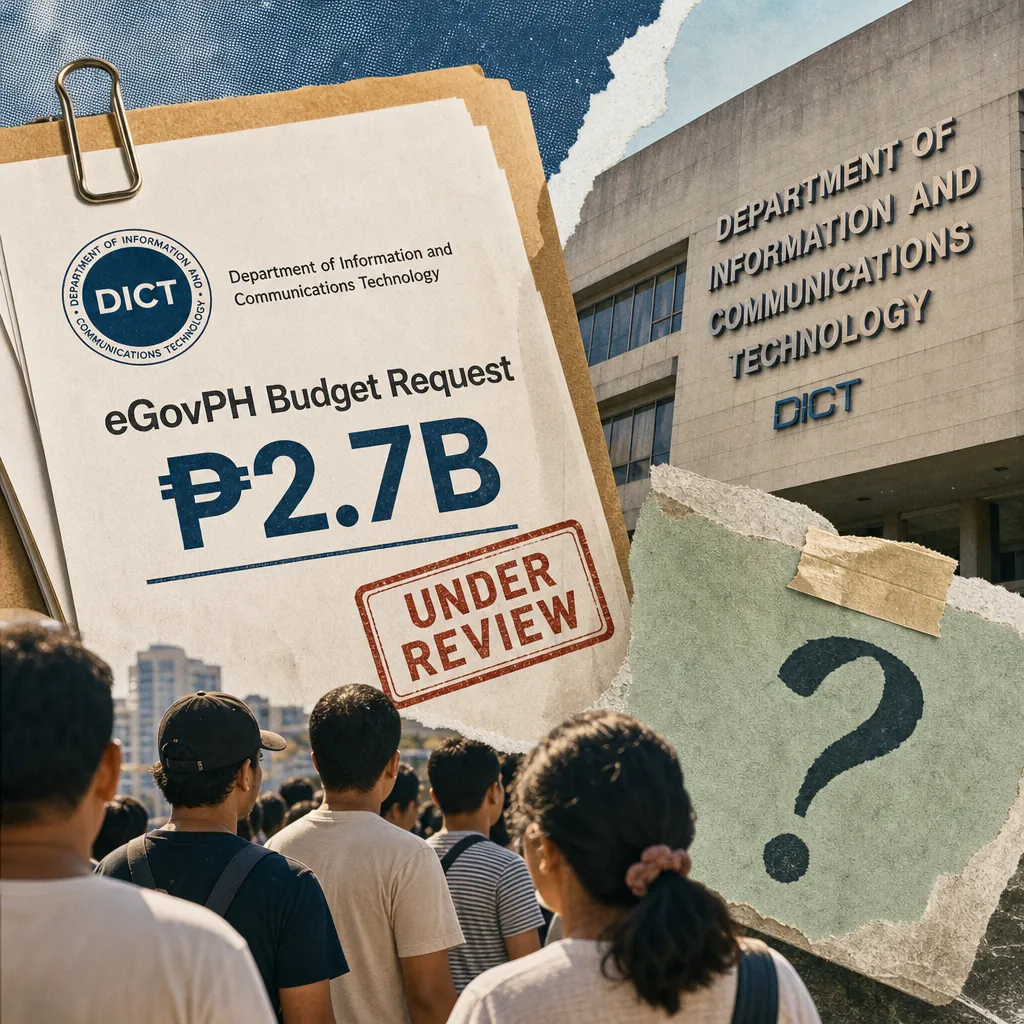
On social media, the DICT's P2.7-billion budget request for eGovPH—a one-stop government app for digital ID, job applications, and medical assistance—drew visible skepticism. A Facebook post about the budget received a sarcastic "haha" reaction, while a separate post about the free Wi-Fi rollout in 160 sites across South Cotabato and North Cotabato earned "love" and "wow" reactions, indicating stronger approval for tangible connectivity infrastructure over administrative digitalization. The contrast was telling: the public seems to favor direct, visible improvements to internet access over investments in bureaucratic tools that have experienced outages.
The most viral post of the day, however, came from Facebook with the caption "Iba daw kasi daanan ng private school 🤣" (roughly, "They say it's because private schools have a different road"), amassing 206 likes, 41 love reactions, and 22 comments. While humorous, the post's mixed reactions—including one sad and four angry—revealed underlying frustration about unequal access to quality infrastructure based on economic status. This sentiment, though not directly about telecommunications, resonates with broader concerns about service inequality that could extend to perceptions of telecom companies' urban-rural coverage gaps.
Meanwhile, the news media carried several stories that complemented these social conversations. The Inquirer reported on the DICT's budget request, quoting Secretary Henry Aguda as saying, "We're ready for the congressional deliberations, and we don't expect any trouble getting this budget executed next year." The same outlet covered the Cotabato Wi-Fi rollout, which was officially launched in Koronadal City. Additionally, the Bangko Sentral ng Pilipinas (BSP) announced plans to require banks to use the National ID Authentication Services (NIDAS) for customer verification, a move that ties into the broader digital identity ecosystem. These stories, along with coverage of the OPPO Reno16 Series launch and various entertainment and crime items, formed the day's media landscape.
Key themes
- Public skepticism toward government digital spending: The eGovPH budget request drew muted but telling skepticism on social media, with a "haha" reaction on Facebook suggesting doubts about the allocation. This theme reflects a broader wariness toward government spending on digital services, which could extend to telecom regulatory projects if not clearly communicated.
- Positive reception of tangible connectivity initiatives: The free public Wi-Fi rollout in Cotabato received favorable engagement, with "love" and "wow" reactions on Facebook. This indicates strong public appetite for government initiatives that expand internet access, especially in underserved areas.
- Infrastructure inequality as a recurring grievance: The viral private school post and the Reddit exposé on Davao's unfinished flood control project both tapped into frustrations about unequal access to quality public services. This theme parallels common complaints about telecom coverage disparities between urban and rural areas.
- Household-level infrastructure anxiety: A Reddit post about a warm light switch with sparks and a faint smoke smell drew immediate safety advice, illustrating heightened consumer vigilance about essential services. This pattern suggests users are increasingly likely to report and amplify service failures, including internet outages.
- Government digital initiatives as a double-edged sword: While the Wi-Fi rollout was praised, the eGovPH budget request was scrutinized. This contrast underscores the need for government and telecom stakeholders to communicate measurable outcomes rather than just budget sizes.
- Regional development disparities: The Davao infrastructure critique, which gained moderate traction on Reddit, framed local development as superficial, with projects described as inadequate or "ghost projects." This sentiment could indirectly affect perceptions of telecom investments in Mindanao.
- Digital identity as a foundational service: The BSP's push for banks to use the National ID Authentication Services (NIDAS) highlights the growing importance of digital identity in the Philippines, which relies on robust connectivity and cybersecurity infrastructure.
How the narratives stack
Dominant: The dominant narrative of the day was the public's mixed reaction to government digital infrastructure initiatives, specifically the DICT's budget request and the Wi-Fi rollout. This narrative was driven by both social media engagement and news coverage. On social media, the eGovPH budget post drew skepticism, while the Wi-Fi rollout earned approval. In the news, the Inquirer's coverage of both stories carried significant advertising-equivalent value—the budget story was worth an estimated ₱272,160 in ad space, and the Wi-Fi rollout ₱443,016—indicating heavy coverage. This narrative is dominant because it directly addresses the core tension of the day: the public's desire for connectivity versus its distrust of government spending.
Counter-narrative: A counter-narrative emerged from the viral private school post and the Davao infrastructure exposé, which highlighted systemic inequality and government neglect. While not directly about digital infrastructure, these stories reinforced a perception that government-delivered benefits are unevenly distributed, favoring those with private alternatives. This counter-narrative challenges the government's messaging of progress and could undermine trust in digital initiatives if not addressed.
Emerging: An emerging narrative is the integration of digital identity into financial services, as seen in the BSP's NIDAS proposal. This story, covered by BusinessWorld and Head Topics, suggests a future where the National ID becomes a foundational layer for banking and other services. This could be a positive development for connectivity and digital inclusion, but it also raises concerns about data privacy and cybersecurity.
Suppressed: A story that received little attention in the captured set but is significant is the Siklab rocket launch project, which was presented at a news forum and covered by Philstar. While not directly related to telecommunications, the project involves the DICT and the Philippine Space Agency, and its success could have implications for satellite-based connectivity. However, this story was overshadowed by more immediate concerns about budgets and Wi-Fi rollouts.
Platform insights
- Reddit: Reddit hosted the most detailed and critical analysis of the day. The Davao infrastructure exposé received 44 likes and 4 comments in its later repost, while the electrical safety thread drew 8 comments from concerned users offering advice. Reddit served as a venue for long-form personal testimony and community problem-solving, making it the most substantive platform for gauging authentic citizen frustration. Users shared specific grievances and technical assistance, indicating a community that values depth over brevity.
- Facebook: Facebook demonstrated the broadest emotional range, as evidenced by the differential reactions to DICT stories—the eGovPH budget received a sarcastic "haha" reaction while the free Wi-Fi rollout earned "loves" and "wows." The viral private school post drew 206 likes, 41 loves, and 22 comments, showing that humor and satire resonate strongly with local audiences. Facebook discussions leaned toward user-generated humor and passive engagement through reaction buttons rather than deep analytical commentary, yet the volume of engagement signals that infrastructure inequality resonates strongly with the general public.
- Twitter: Twitter served primarily as an information dissemination channel, with the eGovPH budget story recording 1,263 views and the Cotabato Wi-Fi rollout 1,150 views without generating visible engagement or commentary. This suggests Twitter users consumed the DICT updates passively, potentially indicating that government connectivity initiatives are not yet generating the passionate public discourse on this platform that telecom service issues often attract.
Key voices and communities
- Regional residents and displaced communities: This group consists of individuals from provinces and smaller municipalities, particularly in the Davao region, who actively share lived experiences regarding infrastructure, flooding, and public services. Their presence is concentrated on Reddit and Facebook, where their posts generate moderate engagement—approximately 40 to 45 likes per personal account—but their credibility stems from first-hand accounts rather than volume. Their primary narrative frames local development as superficial, with infrastructure projects described as inadequate or "ghost projects." One resident expressed that "lahat ng tao doon halos proud to praise the duterte family for their 'progression' to which they equate to asphalted roads," while separately noting the lack of functional flood control in flood-prone areas.
- Digital governance and connectivity advocates: This group includes policy-focused observers and institutional communicators who actively track and amplify news about the DICT and national digital initiatives. Their presence is primarily on Twitter and Facebook, where they share official news links, with one such post receiving over 1,200 views on Twitter and multiple shares on Facebook. Their influence is characterized by consistency rather than high-engagement spikes, often serving as a bridge between government announcements and public awareness. Their messaging emphasizes progress in digital infrastructure, including budget requests for the eGovPH app and free public Wi-Fi rollouts across underserved provinces.
- Skeptical local commentators and consumer watchdogs: This group comprises everyday social media users who use humor and skepticism to highlight perceived inequities in public services and infrastructure. Their primary platform is Facebook, where their content achieves notably higher engagement than average—one post amassed 206 likes, 41 love reactions, and 22 comments. They are not institutional voices but rather influential community members whose reach extends through local networks. Their messaging often uses satire to point out service disparities, as exemplified by the post "Iba daw kasi daanan ng private school 🤣" which critiques public versus private infrastructure quality.
Narrative streams
The eGovPH budget request: A test of public trust
The Department of Information and Communications Technology (DICT) is seeking ₱2.7 billion in the 2027 national budget to expand the eGovPH super app, a one-stop platform for government services such as digital ID, job applications, and medical assistance. The request comes after multiple outages earlier this year due to a surge in users, as reported by the Inquirer. The proposed funding will cover cloud hosting, cybersecurity, and artificial intelligence capabilities, according to DICT Secretary Henry Aguda, who expressed confidence in the budget's approval during congressional deliberations.
On social media, the announcement drew a mixed response. A Facebook post about the budget received 5 likes, 2 shares, and one "haha" reaction, indicating public skepticism about the allocation. This skepticism is not unfounded: the app has experienced reliability issues, and the public may question whether additional funds will translate into better service. The contrast with the free Wi-Fi rollout, which received "love" and "wow" reactions, suggests that the public prefers tangible connectivity infrastructure over administrative digitalization projects.
For the telecommunications sector, this narrative is significant because it reflects a broader public wariness toward government spending on digital services. If the eGovPH budget is perceived as wasteful, it could extend to telecom regulatory projects or mandated fees. Communicators should emphasize accountability metrics and service delivery outcomes rather than defending budget size.
Free Wi-Fi in Cotabato: A positive step with limited visibility
The DICT's Free Internet Access in Public Spaces (FIAPS) program expanded to 160 sites in South Cotabato and North Cotabato, providing free internet in schools, barangay halls, health centers, and other public facilities. The rollout was officially launched Thursday in Koronadal City, with 75 sites in South Cotabato's second district and 85 in North Cotabato's second district. This initiative is part of the government's effort to improve internet access in underserved communities.
On social media, the announcement received favorable engagement, with 1 like, 5 shares, 2 loves, and 1 wow on Facebook. The higher share-to-like ratio suggests users view this as actionable information worth disseminating to their networks. However, the modest engagement (single-digit likes and a few shares) indicates that the rollout currently lacks the visibility needed to shift broader perceptions of government competence.
For telecom stakeholders, this program represents both a potential competitive threat and a collaborative opportunity. The public's positive reception signals strong appetite for government-led connectivity initiatives, and private companies could position their own investments as complementary to these efforts. Amplifying the Wi-Fi rollout with testimonials from local residents could counter the "elite-only" perception that surfaced in the private school post.
Infrastructure inequality: The viral private school post
The most engaged post of the day was a Facebook post with the caption "Iba daw kasi daanan ng private school 🤣" ("They say it's because private schools have a different road"), which amassed 206 likes, 41 love reactions, and 22 comments. The post humorously commented on the perceived disparity in infrastructure quality between public and private institutions. While lighthearted, the mixed reactions—including one sad and four angry—revealed underlying frustration about unequal access to quality infrastructure based on economic status.
This narrative, while not directly about telecommunications, reflects a broader public awareness about service inequality that can influence perceptions of telecom companies' own service differentiation between postpaid and prepaid customers, or between urban and rural coverage. The conversation evolved from mere observation to implicit criticism of systemic privilege, mirroring the kind of class-based grievances that often surface in discussions of data pricing or network prioritization.
For communicators, this theme underscores the importance of the "equitable access" angle. Proactively sharing stories of connectivity enabling education or business in underserved areas could counter the two-tier perception and reinforce inclusive digital progress.
The Davao infrastructure exposé: A window into regional grievances
A Reddit post from a user returning to Tagum, Davao, detailed extensive infrastructure failures, including an unfinished flood control project in Magupising that redirected water toward residential areas. The post, which garnered 42 likes and 4 comments initially and was later reposted with 44 likes, represented the most emotionally charged and detailed citizen-generated content of the day. The poster concluded, "davao, you deserve so much better than this," capturing the prevailing sentiment of citizens holding authorities accountable for failed infrastructure promises.
This narrative, while focused on physical infrastructure, has implications for telecommunications. When public infrastructure projects are perceived as failed or corrupt, skepticism can transfer to all government-regulated services, including tower deployment and broadband expansion initiatives. The post also criticized the Duterte family legacy, implicitly questioning whether government priorities—including digital initiatives—genuinely serve constituents or merely sustain political narratives.
For telco clients, this narrative signals potential demand for connectivity as an equalizer. Positioning network investments in such regions as directly addressing citizen grievances could resonate. However, the risk is that negative sentiment about public infrastructure could bleed into broader perceptions of state capacity, affecting how regulatory news is received.
Digital identity and financial services: The BSP's NIDAS proposal
The Bangko Sentral ng Pilipinas (BSP) is planning to require banks and other supervised financial institutions to integrate the National ID Authentication Services (NIDAS) into their customer due diligence protocols. NIDAS, co-developed by the Philippine Statistics Authority (PSA) and the DICT, is a digital verification service that allows institutions to verify clients using the National ID. The BSP stated that "NIDAS integration is a necessary regulatory measure to support the broader use and adoption of the National ID as the country's foundational identity system."
This development is part of a broader push to make the National ID a foundational layer for digital services, including banking. It has implications for connectivity and cybersecurity, as the system relies on robust internet infrastructure. The story was covered by BusinessWorld and Head Topics, with the BusinessWorld article carrying an estimated advertising-equivalent value of ₱348,235.
For the telecommunications sector, this is an emerging opportunity. As digital identity becomes more central to financial services, the demand for reliable connectivity and secure data transmission will grow. Telecom companies could position themselves as partners in this ecosystem, highlighting their role in enabling secure digital transactions.
Conversation trajectory
Over the next 2-4 weeks, expect the conversation around government digital spending to intensify as congressional budget deliberations progress. The eGovPH budget request will likely be scrutinized through the lens of the Davao infrastructure failures, with critics framing it as another potential "ghost project." Communicators should prepare a rapid-response narrative that pairs the budget request with tangible user outcomes, referencing existing free Wi-Fi deployments as proof of execution capability.
Within 4-8 weeks, the onset of the wet season could accelerate infrastructure failure narratives and connectivity complaints. The public's heightened vigilance about household safety, as seen in the electrical issue post, suggests that similar urgency will apply to connectivity complaints during weather disruptions. Telecom companies should proactively communicate their network reliability and disaster-preparedness measures before monsoon-related disruptions generate negative coverage.
The continued rollout of municipal Wi-Fi projects will create periodic positive news cycles that may counterbalance negative infrastructure narratives. However, the modest engagement on the Cotabato rollout suggests that these stories need amplification to shift perceptions. Leveraging local testimonials and highlighting the tangible benefits of connectivity could help.
Trigger events to watch include: the congressional budget deliberations for the DICT (expected within 4-8 weeks), which will amplify both support and criticism of digital spending priorities; the onset of the wet season, which typically accelerates infrastructure failure narratives and connectivity complaints; and the continued rollout of municipal Wi-Fi projects, which could create positive news cycles. Additionally, the viral nature of the Davao infrastructure critique suggests potential for similar exposés in other regions, which could reshape public perception of national infrastructure management.
Response guidance
For communicators in the telecommunications and digital infrastructure sectors, the following guidance is based on the day's conversations:
- Monitor regional sentiment clusters around infrastructure and public services, particularly in Mindanao-focused communities where connectivity and physical infrastructure complaints converge. This provides early detection of narrative shifts that may eventually expand to national discourse.
- Develop a factual positioning framework that connects private sector infrastructure investments to national digital goals without directly engaging with politically charged narratives about specific administrations. Emphasize measurable outcomes and collaborative efforts.
- Establish a measured response cadence for threads that mix infrastructure frustration with digital service expectations. Acknowledge public experience while providing context on ongoing network improvements. Avoid appearing dismissive of public frustrations.
- Leverage the "equitable access" angle in communications by proactively sharing stories of connectivity enabling education or business in underserved areas. This counters the two-tier perception raised by the private school post and reinforces inclusive digital progress.
- Prepare crisis communication templates addressing potential infrastructure failures before the wet season peaks. Frame any disruptions within broader industry challenges rather than isolated failures, and highlight transparent reporting on outage response times and restoration efforts.
- When addressing skepticism about public digital programs, emphasize accountability metrics and service delivery outcomes rather than defending budget size. For example, "The push for e-government services is a significant undertaking that requires reliable connectivity everywhere. Private sector capital investment and government programs must work hand-in-hand to ensure no community is left behind in the digital transition."
- Sensitive topics to navigate include regional development disparities, public budget scrutiny, and trust in digital services. Avoid engaging with political attribution; instead, focus on forward-looking commitments to multi-sector coordination for infrastructure completion and maintenance.
See the full picture behind today's signals.
This report draws from Media Meter's MediaWatch, our real-time monitoring engine tracking 2,470+ Philippine sources across print, broadcast, digital, and social. Explore how the platform turns raw coverage into decision-grade intelligence, then see how it's configured for teams like yours — whether you're in PR agencies, corporate comms, government, or marketing.
Want more? Browse our Report Library for sector and crisis intelligence, or request a demo and we'll have your brand set up before the call.
Want this kind of intelligence on your brand?
This brief is built on the same MediaWatch methodology that runs continuously across every brand we monitor. See your competitive landscape, Impact Score, and narrative trajectory in a 30-minute demo.