Senate allows budget hearings alongside sessions
The Senate approved holding plenary sessions and budget hearings simultaneously, while keeping the impeachment trial separate. The House advanced a bill extending barangay and SK terms to five years, and the BIR prepared to remove VAT from electricity system loss charges.
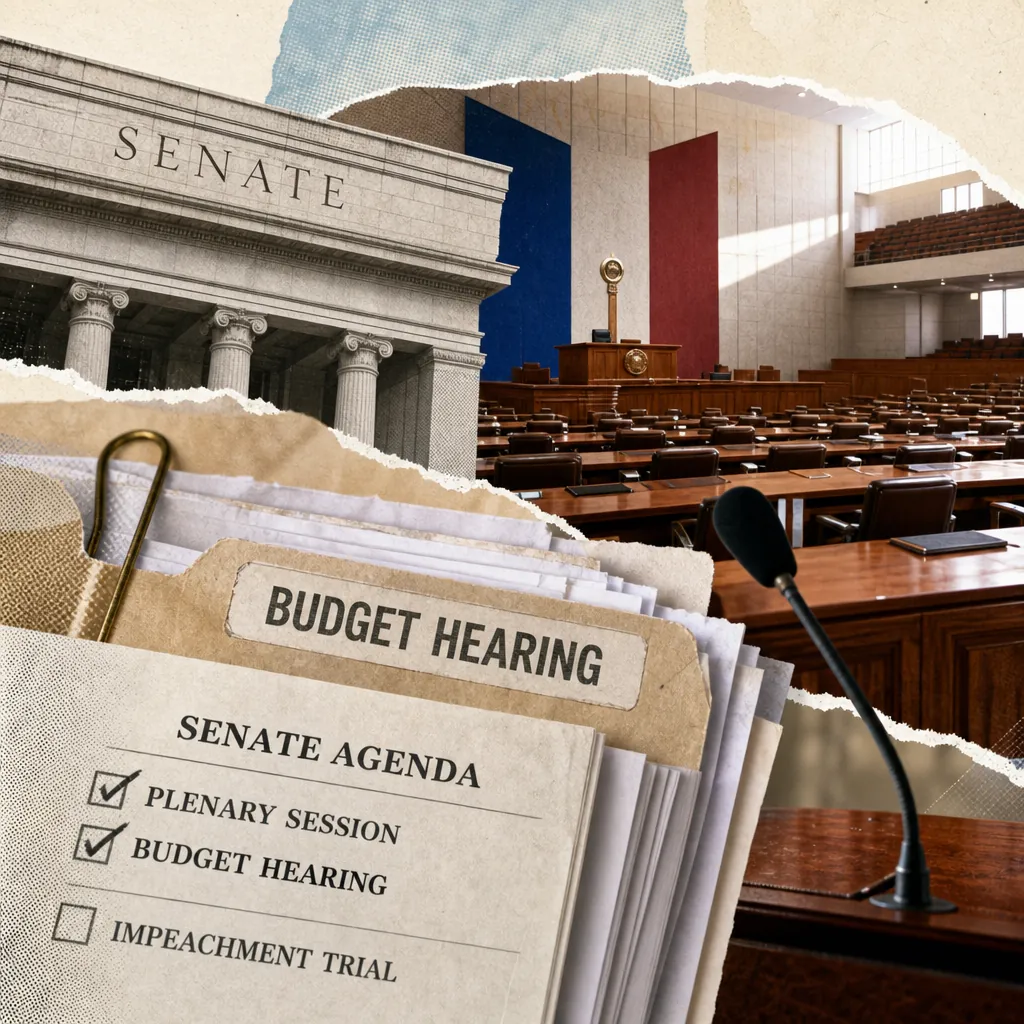
The Senate voted to allow its plenary sessions and committee hearings on the proposed 2027 national budget to run at the same time, a procedural change meant to speed up budget deliberations without forcing senators to choose between attending sessions and budget meetings. Senate Majority Leader Migz Zubiri moved to suspend Rule 14, which had barred holding committee hearings while the chamber was in session, and the chamber approved it. Under the new arrangement, senators attending budget hearings will not be marked absent from the session. But the rule suspension does not extend to the impeachment trial of Vice President Sara Duterte: Zubiri said senators must remain present as judges in that trial, so no committee hearing, including budget deliberations, may be scheduled to overlap with it. 10 20
The move comes as the Senate prepares to deliberate the 2027 national budget, the annual government spending plan, while also serving as the impeachment court for Duterte, who faces charges brought by the House of Representatives. The decision reflects the logistical challenge of running a legislature that must simultaneously conduct its regular lawmaking and budget work and sit as a trial court. The Senate's rules had previously treated plenary sessions and committee meetings as mutually exclusive, a constraint that becomes harder to manage when a single chamber carries both legislative and judicial duties.
Separately, the House of Representatives advanced a bill that would extend the term of barangay and Sangguniang Kabataan (SK) officials from four years to five. House Bill No. 10971 passed its second reading on Wednesday, September 2, after lawmakers debated whether the extension was necessary ahead of the next barangay and SK elections. Barangays are the smallest administrative units in the Philippines, and SK is the youth council. Negros Occidental Representative Javier Miguel Benitez proposed an amendment to cut the consecutive term limit from three terms to two, arguing that longer terms should come with stricter limits on how long any single official can stay in power. 11
The day's legislative activity also included the Bureau of Internal Revenue (BIR) preparing to remove the value-added tax (VAT) from the system loss charge on electricity bills. BIR Commissioner Charlito Martin Mendoza said the agency would issue a Revenue Memorandum Circular 15 days after the Energy Regulatory Commission (ERC) publishes Resolution No. 26, Series of 2026, which formally classifies the system loss charge as a government-mandated pass-through cost. System loss refers to electricity that is generated but never reaches consumers, typically because of technical losses in transmission and distribution. Mendoza argued that consumers should not be taxed on electricity they never actually received, and that removing the VAT from this pass-through charge should lower electricity bills. 36 28
The Senate's scheduling decision, the House term-extension bill, and the BIR's VAT move all point to a busy legislative and regulatory period. The impeachment trial of Vice President Duterte continues to shape how the Senate organizes its work, while the House pushes forward with its own legislative agenda. For the public, the practical effects are likely to be felt in the form of a faster budget process and, eventually, lower electricity bills, though the timeline for the VAT removal depends on the ERC's publication schedule.
Key themes
- Senate suspends Rule 14 to run budget hearings alongside sessions — The chamber approved Majority Leader Migz Zubiri's motion to allow plenary sessions and Senate Committee on Finance hearings on the 2027 national budget to proceed simultaneously, so senators attending budget hearings are not marked absent. The suspension does not apply to the impeachment trial of Vice President Sara Duterte, where senators must remain present as judges. 10 20
- House bill extending barangay and SK terms to five years passes second reading — House Bill No. 10971 would amend Republic Act No. 12232, which currently sets a four-year term. Lawmakers debated the extension, with Negros Occidental Representative Javier Miguel Benitez proposing to cut the consecutive term limit from three terms to two. 11
- BIR prepares to remove VAT from electricity system loss charges — Commissioner Charlito Martin Mendoza said the agency will issue a Revenue Memorandum Circular 15 days after the ERC publishes Resolution No. 26, Series of 2026, which classifies system loss as a pass-through cost. The move is expected to lower electricity bills by removing tax on electricity that never reached consumers. 36 28
- Impeachment trial of Vice President Sara Duterte continues to structure Senate work — The trial entered its 21st day on Wednesday, September 2, with former Department of Education (DepEd) official Michael Poa testifying that he had no role in handling confidential funds during Duterte's tenure as DepEd secretary. The trial's scheduling demands are why the Senate kept it separate from budget hearings. 22 10
- Prosecution panel says bribery case against Duterte remains strong — Manila Representative Joel Chua, lead prosecutor, clarified that the bribery allegations are not weak, and that the panel is only considering dropping that article to expedite proceedings, similar to what was done in the impeachment trial of former Chief Justice Renato Corona. 1
- President Marcos inspects Sto. Cristo Dam, cites debris and possible illegal logging — Marcos said the dam in Pampanga was not damaged but became clogged with debris, including logs that may have come from illegal logging upstream. A temporary barrier will be put up to prevent debris from blocking the dam again. 3
- SWS survey finds zero net gainers in quality of life — The Social Weather Stations (SWS) reported that 33% of adult Filipinos said their quality of life improved over the past 12 months, 33% said it worsened, and 34% said it stayed the same, resulting in a net gainers score of zero, which SWS rates as "fair." This is 26 points higher than the -26 recorded in March 2026. 12
- Government agencies push technology adoption across sectors — The Bureau of Fisheries and Aquatic Resources (BFAR) announced it will use GIS-based systems and satellite data to combat illegal fishing at the SAFET Conference 2026 in Cebu from September 8 to 10. The Department of Trade and Industry (DTI) and Converge launched an AI hub for micro, small and medium enterprises (MSMEs). 15 23
How the narratives stack
Dominant — The Senate's decision to allow budget hearings to run alongside plenary sessions, while keeping the impeachment trial separate, is the day's most operationally significant development. It reflects how the chamber is managing its dual role as legislature and impeachment court. The decision was reported by multiple outlets, including Tuguegarao Bomboradyo and rmn.ph, both of which carried the story in Filipino. 10 20 The practical effect is that budget deliberations for the 2027 national budget can proceed more quickly, since senators no longer have to choose between attending sessions and attending budget hearings. The explicit carve-out for the impeachment trial underscores how the trial continues to shape the Senate's calendar.
Counter-narrative — The House's push to extend barangay and SK terms to five years offers a contrasting view of how the two chambers are spending their time. While the Senate manages the logistics of the impeachment trial and budget, the House is advancing its own legislative agenda. The bill passed its second reading despite debate over whether the extension is necessary, with Representative Benitez arguing for a shorter consecutive term limit. 11 This suggests the House is not slowing down its regular legislative work even as it prosecutes the impeachment case against Duterte.
Emerging — The BIR's preparation to remove VAT from system loss charges is an emerging regulatory story with direct consumer impact. The move follows a directive from President Marcos to provide relief to electricity consumers. The BIR will issue its circular 15 days after the ERC publishes its resolution, meaning the timeline depends on the ERC's publication schedule. 36 28 If implemented, the change would lower electricity bills by removing the 12% VAT on the portion of the bill that covers electricity lost in transmission and distribution.
Under-covered — The SWS survey finding that the Philippines has a net gainers score of zero on quality of life received relatively little attention compared to the legislative stories. The survey, conducted from June 20 to 29 among 1,200 adult Filipinos, found that equal shares of the population (33% each) said their quality of life improved and worsened over the past year. 12 The zero net score is a notable improvement from the -26 recorded in March 2026, but it still means that as many Filipinos feel worse off as feel better off. The regional breakdown shows Metro Manila at -13, the worst of any region, while Balance Luzon is at +4, Mindanao at +3, and the Visayas at -1. This story deserves more attention than it received, as it speaks to the lived experience of ordinary Filipinos.
Platform insights
- Facebook — The impeachment trial of Vice President Sara Duterte continues to generate discussion on Facebook, where news outlets and commentators share updates and analysis. The trial's 21st day, featuring testimony from former DepEd official Michael Poa, drew coverage from provincial radio outlets like Bombo Radyo Cauayan, which maintain active Facebook presences. 22 The platform remains the primary space where Filipinos encounter and discuss political news, though the Manila Times' editorial warning against banning Meta suggests concerns about the platform's role in spreading disinformation. 6
- X (formerly Twitter) — The platform saw activity around the Senate's scheduling decision and the House's barangay term bill, with journalists and political commentators sharing updates. The SWS survey finding of zero net gainers also circulated, with users debating what the number means for the administration's economic record. 12 X tends to host more opinionated and analytical commentary compared to Facebook's broader news-sharing behavior.
- YouTube — The platform carried the impeachment trial's proceedings and related commentary. The trial's 21st day was covered by news outlets that stream or post segments of the hearings. 22 YouTube also hosts longer-form analysis of political developments, including the Senate's budget scheduling decision and the implications for the 2027 budget.
- TikTok — While not a primary platform for hard news, TikTok saw entertainment-related activity that intersected with public figures. Actress Kylie Padilla has become one of the platform's most popular Filipino livestreamers, regularly winning gift battles against South Korean TikTokers. 42 This highlights how TikTok has become a space where celebrities engage directly with fans through live commerce and entertainment, a trend that brands like nubia Philippines are tapping into with live-selling events. 7
Key voices and communities
- Senate leadership — Senate Majority Leader Migz Zubiri is the key voice driving the chamber's scheduling decisions. His motion to suspend Rule 14 reflects the Senate's effort to manage its workload during the impeachment trial. His statement that senators must remain present as impeachment judges shows how the trial constrains the chamber's flexibility. 10 20
- House prosecution panel — Manila Representative Joel Chua, the lead prosecutor in the impeachment case against Vice President Duterte, is a central voice defending the strength of the bribery allegations. His clarification that the panel is only considering dropping the bribery article to expedite proceedings, not because it is weak, addresses concerns about the case's viability. 1
- BIR and ERC officials — BIR Commissioner Charlito Martin Mendoza is the key voice on the VAT removal from system loss charges. His explanation that consumers should not be taxed on electricity they never received frames the policy as a matter of fairness. The ERC's role in classifying system loss as a pass-through cost is the trigger for the BIR's action. 36
- Local government advocates — Lawmakers debating the barangay and SK term extension represent the voices of local government stakeholders. Representative Javier Miguel Benitez's proposal to cut the consecutive term limit from three to two terms reflects a concern about concentrating power in local officials. 11
- Social Weather Stations — The survey firm's quality-of-life data provides an independent measure of how Filipinos perceive their economic situation. The zero net gainers score, while improved from March, still indicates that a third of the population feels worse off than a year ago. 12
Narrative streams
Senate allows budget hearings to run alongside plenary sessions
The Senate approved Majority Leader Migz Zubiri's motion to suspend Rule 14, which had prohibited holding committee hearings while the chamber was in plenary session. The change allows the Senate Committee on Finance to conduct hearings on the proposed 2027 national budget at the same time as regular sessions, so senators attending budget hearings will not be marked absent. 10 20
The decision addresses a practical problem: the Senate must deliberate the national budget, the annual law that authorizes government spending, while also serving as the impeachment court for Vice President Sara Duterte. The impeachment trial, which began in August, requires senators to sit as judges, a role that demands their presence. By allowing budget hearings to overlap with sessions, the Senate can advance its budget work without sacrificing either responsibility.
Zubiri was explicit that the suspension does not apply to the impeachment trial. "Kailangang laging present ang mga senador bilang mga impeachment judge sa paglilitis," he said, meaning senators must always be present as impeachment judges during the trial. 10 This carve-out ensures that budget hearings cannot be used as a reason to miss trial proceedings.
The move was reported by provincial and regional outlets, including Tuguegarao Bomboradyo and rmn.ph, both of which covered the story in Filipino. 10 20 The coverage suggests the decision is seen as significant for how the Senate manages its workload during a period of intense political activity.
Read for the sector: For government communicators and those tracking the legislative calendar, the Senate's scheduling flexibility means the 2027 budget process can proceed in parallel with the impeachment trial. This could shorten the overall timeline for budget approval, but it also means senators face a heavier workload. The explicit separation of the impeachment trial from all other Senate business reinforces that the trial remains the chamber's top priority.
House advances five-year term for barangay and SK officials
The House of Representatives passed on second reading House Bill No. 10971, which would extend the term of barangay and Sangguniang Kabataan (SK) officials from four years to five. The bill seeks to amend Republic Act No. 12232, the law that currently sets the four-year term. 11
Barangays are the smallest administrative divisions in the Philippines, and SK is the youth council that represents young people in local governance. Extending the term to five years would align local officials' terms with the national government's election cycle, potentially reducing the frequency of elections and the associated costs.
The bill's passage came after lawmakers debated whether the extension is necessary ahead of the next barangay and SK elections. Negros Occidental Representative Javier Miguel Benitez proposed an amendment to cut the consecutive term limit from three terms to two, arguing that longer terms should be balanced by stricter limits on how long any individual can serve. "My amendment is plain: cut the consecutive term limit for barangay officials from three terms to two. If we give our barangay officials more years, we should also ensure that they do not stay in power for too long," Benitez said. 11
The debate reflects a tension between stability and accountability. Proponents of the five-year term argue that longer terms give local officials more time to implement their programs. Critics worry that longer terms, combined with the existing three-term limit, would allow officials to stay in power for up to 15 years.
The bill now moves to the third reading, where the House will vote on final passage. If approved, it will be transmitted to the Senate for consideration.
Read for the sector: For local government units and their stakeholders, the five-year term would change the rhythm of local elections and governance. Officials would have more time to plan and execute long-term projects, but communities would wait longer between opportunities to change their leadership. The proposed two-term limit amendment, if adopted, would cap an official's service at 10 years, a significant change from the current 12-year maximum.
BIR prepares to remove VAT from electricity system loss charges
The Bureau of Internal Revenue (BIR) announced it is preparing to remove the value-added tax (VAT) from the system loss charge on electricity bills. BIR Commissioner Charlito Martin Mendoza said the agency will issue a Revenue Memorandum Circular 15 days after the Energy Regulatory Commission (ERC) publishes Resolution No. 26, Series of 2026, which formally classifies the system loss charge as a government-mandated pass-through cost. 36
System loss refers to electricity that is generated but never reaches consumers, typically because of technical losses in transmission and distribution lines. Under current rules, consumers pay for this lost electricity through a system loss charge on their bills, and that charge is subject to the 12% VAT.
Mendoza argued that consumers should not be taxed on electricity they never actually received. "Hindi dapat sinisingil ng VAT ang mga konsyumer para sa kuryenteng hindi naman aktuwal na nakararating sa kanilang mga tahanan o negosyo," he said, meaning consumers should not be charged VAT for electricity that did not actually reach their homes or businesses. 36 He explained that a pass-through charge is an amount collected and passed on to the relevant entity, so removing the VAT should lower electricity bills.
The move follows a directive from President Ferdinand Marcos Jr. to provide immediate relief to electricity consumers. The ERC's resolution classifies the allowable system loss as a pass-through cost, which is the legal basis for the BIR's action.
The timeline for implementation depends on the ERC's publication of its resolution. Once published, the BIR has 15 days to issue its circular, after which the VAT removal would take effect.
Read for the sector: For electricity consumers, the VAT removal would mean slightly lower monthly bills, as the 12% tax on the system loss portion would be eliminated. For the energy sector, the change clarifies the tax treatment of system loss charges and could set a precedent for how other pass-through costs are treated. Distribution utilities would need to update their billing systems to reflect the change once the BIR circular is issued.
Impeachment trial enters 21st day with DepEd official testimony
The impeachment trial of Vice President Sara Duterte entered its 21st day on Wednesday, September 2, with former Department of Education (DepEd) official Michael Poa testifying that he had no role in handling confidential funds during Duterte's tenure as DepEd secretary. 22
Poa, who served as Duterte's chief of staff, undersecretary, and spokesperson at DepEd, said the responsibility for confidential funds lay with the special disbursing officer and security officer. He explained that Duterte's management of DepEd was compartmentalized, so he focused only on the duties assigned to him. Poa also said the use of confidential funds began before he became chief of staff in April, so he was not involved in handling them. 22
Confidential funds are allocations that government agencies can spend without the usual public disclosure, typically for intelligence and security purposes. The impeachment case against Duterte includes allegations related to the use of such funds during her time as DepEd secretary and earlier as vice president.
Poa also testified that when he was still spokesperson, he asked Duterte what he should tell the media about the confidential funds. 22 This detail suggests that Duterte was directly involved in managing the public narrative around the funds.
The trial's length — now in its 21st day — reflects the complexity of the case and the number of witnesses. The Senate's decision to keep the trial separate from budget hearings underscores the trial's demands on senators' time.
Read for the sector: For those following the impeachment proceedings, Poa's testimony reinforces the defense's argument that Duterte compartmentalized DepEd operations, distancing senior officials from direct handling of confidential funds. The trial's duration suggests the Senate is conducting a thorough review of the evidence. The outcome will determine whether Duterte is removed from office, a decision with significant implications for the national government's leadership.
Prosecution panel defends strength of bribery case against Duterte
Manila Representative Joel Chua, the lead prosecutor in the impeachment case against Vice President Sara Duterte, clarified that the bribery allegations remain strong. He said the prosecution panel is only considering dropping that article to expedite proceedings, not because it doubts the evidence. 1
"Hindi mahina, lahat po 'yan malakas, hindi naman po namin ipe-presenta 'yan o ilalagay sa article kung sa tingin namin mahina," Chua said, meaning none of the articles are weak, and they would not have included the bribery allegations if they thought they could not be proven before the Senate Impeachment Court. 1
Chua drew a parallel to the impeachment trial of former Chief Justice Renato Corona, where the prosecution panel also dropped an article to speed up proceedings. This suggests the panel is making a strategic decision to focus on the strongest charges rather than spreading its resources across all four articles.
The clarification comes after reports that the panel was considering dropping the bribery case. Chua's statement is intended to reassure the public and the Senate that the decision is about efficiency, not weakness.
The impeachment case against Duterte includes four articles, covering allegations related to confidential funds, bribery, and other offenses. The Senate is currently hearing evidence and testimony.
Read for the sector: For observers of the impeachment process, Chua's clarification indicates that the prosecution is managing its case strategically, prioritizing the strongest evidence. Dropping the bribery article would shorten the trial but would also mean that those specific allegations are not adjudicated. The decision reflects the prosecution's assessment of what is needed to secure a conviction.
Marcos inspects Sto. Cristo Dam, cites debris and possible illegal logging
President Ferdinand Marcos Jr. inspected the Sto. Cristo Dam in Pampanga on Wednesday and said the dam was not damaged but became clogged with debris, including logs that may have come from illegal logging upstream. 3
"Hindi naman pala na-damage 'yung dam. Kung hindi, ang nangyari nabara dahil hindi basura kundi 'yung debris, mga troso na siguro nagpuputol sila na illegal logging sa taas, bumababa rito, nabara ngayon 'yung dam, umikot 'yung tubig," Marcos said, meaning the dam was not damaged but became blocked not by garbage but by debris and logs, possibly from illegal logging upstream, which flowed down and blocked the dam, causing the water to back up. 3
Marcos said a temporary barrier would be put up to prevent debris, logs, and other materials from flowing downstream and blocking the dam again. The inspection was part of the government's response to flooding in the region, which has been exacerbated by clogged waterways.
The mention of possible illegal logging upstream points to a broader environmental problem. Illegal logging contributes to deforestation, which increases the risk of flooding and landslides by reducing the land's ability to absorb water. The debris from logging operations can also clog dams and waterways, as appears to have happened at Sto. Cristo Dam.
The government's response includes both the immediate measure of installing a barrier and the longer-term need to address illegal logging in the area.
Read for the sector: For communities downstream of the dam, the temporary barrier provides some relief from flooding, but the underlying issue of illegal logging remains. The incident highlights the connection between environmental degradation and disaster risk. Government agencies responsible for forest management and law enforcement will need to address illegal logging to prevent similar incidents in the future.
SWS survey finds zero net gainers in quality of life
The Social Weather Stations (SWS) reported that 33% of adult Filipinos said their quality of life improved over the past 12 months, while 33% said it worsened and 34% said it stayed the same. This results in a net gainers score of zero, which SWS rates as "fair." 12
The net gainers score is calculated by subtracting the percentage of "losers" (those who said their quality of life worsened) from the percentage of "gainers" (those who said it improved). A score of zero means the two groups are equal in size.
The zero score is 26 points higher than the -26 recorded in March 2026, indicating a significant improvement in public sentiment over the past several months. However, it still means that a third of the population feels worse off than a year ago.
The survey was conducted from June 20 to 29 among 1,200 adult Filipinos nationwide. The regional breakdown shows significant variation: Metro Manila has the lowest net gainers score at -13, meaning more residents feel worse off than better off. Balance Luzon is at +4, Mindanao at +3, and the Visayas at -1. 12
The Metro Manila figure is particularly notable, as the capital region typically has higher incomes and better access to services. The -13 score suggests that residents of Metro Manila are feeling the economic squeeze more acutely than those in other regions.
Read for the sector: For policymakers, the survey provides a mixed picture. The improvement from March is encouraging, but the zero net score and the negative Metro Manila figure indicate that many Filipinos are still struggling. The regional variation suggests that economic conditions differ significantly across the country, with Metro Manila residents facing particular challenges. These perceptions matter for public support of government policies and for political stability.
Conversation trajectory
- Senate budget hearings to accelerate (observation window: 2–4 weeks) — With Rule 14 suspended, the Senate Committee on Finance can now hold budget hearings in parallel with plenary sessions. This should allow the 2027 national budget deliberations to proceed more quickly. The key date to watch is when the Senate begins its budget plenary debates, which will now be able to run alongside committee hearings. The impeachment trial's schedule will continue to shape the Senate's calendar, but the budget process is no longer constrained by the trial's demands. 10 20
- BIR VAT circular to follow ERC publication (observation window: 2–6 weeks) — The BIR will issue its Revenue Memorandum Circular 15 days after the ERC publishes Resolution No. 26, Series of 2026. The ERC's publication date is not yet known, but once published, the BIR's circular should follow within two weeks. Consumers can expect the VAT removal from system loss charges to take effect shortly after the circular is issued. The exact impact on electricity bills will depend on the size of the system loss charge in each distribution utility's rates. 36
- Barangay and SK term bill to face third reading (observation window: 1–2 weeks) — House Bill No. 10971 passed its second reading and will now face a third reading vote. The Benitez amendment to cut the consecutive term limit from three to two terms will be part of the bill if it was adopted. If the bill passes the third reading, it will be transmitted to the Senate, where it will face a separate legislative process. The timeline for Senate action is uncertain, given the chamber's focus on the impeachment trial and the budget. 11
- Impeachment trial to continue (observation window: ongoing, 2–4 weeks) — The trial entered its 21st day on September 2, and the prosecution is considering whether to drop the bribery article to expedite proceedings. The defense continues to present its case, with witnesses like Michael Poa testifying. The trial's duration will depend on how many more witnesses each side presents and whether the prosecution drops any articles. The Senate's decision to keep the trial separate from all other business suggests it will continue to dominate the chamber's schedule. 22 1
- Trigger events to watch — The ERC's publication of Resolution No. 26, which triggers the BIR's VAT circular; the House's third reading vote on the barangay term bill; the prosecution's decision on whether to drop the bribery article; and the Senate's budget plenary debates, which will now run alongside committee hearings.
Response guidance
- Senate and House communicators: Emphasize the efficiency gains from the Senate's scheduling change and the House's progress on the barangay term bill. Frame these as steps to make government more responsive. Be prepared to explain the procedural details in plain language, as the Rule 14 suspension and the term extension are technical changes that the public may not immediately understand.
- BIR and ERC communicators: Lead with the consumer benefit of the VAT removal — lower electricity bills. Explain clearly what system loss is and why taxing it was problematic. Provide a clear timeline for when the change takes effect, and coordinate messaging between the BIR and ERC to avoid confusion.
- Impeachment trial communicators: The prosecution's consideration of dropping the bribery article is a sensitive topic. Frame any decision as a strategic move to focus on the strongest evidence, not as a sign of weakness. Avoid speculation about the trial's outcome, and stick to the facts of the proceedings.
- Local government communicators: For barangay and SK officials, the five-year term bill is a significant change. Communicate what the bill would mean for their terms and for their communities. Be transparent about the debate over term limits, and explain the rationale for both the extension and the proposed reduction in consecutive terms.
- Economic communicators: The SWS survey's zero net gainers score is a nuanced finding. Acknowledge the improvement from March while being honest about the challenges that remain, particularly in Metro Manila. Use the regional breakdown to tailor messages to different parts of the country.
See the full picture behind today's signals.
This report draws from Media Meter's MediaWatch, our real-time monitoring engine tracking 2,470+ Philippine sources across print, broadcast, digital, and social. Explore how the platform turns raw coverage into decision-grade intelligence, then see how it's configured for teams like yours — whether you're in PR agencies, corporate comms, government, or marketing.
Want more? Browse our Report Library for sector and crisis intelligence, or request a demo and we'll have your brand set up before the call.
Want this kind of intelligence on your brand?
This brief is built on the same MediaWatch methodology that runs continuously across every brand we monitor. See your competitive landscape, Impact Score, and narrative trajectory in a 30-minute demo.