DTI freezes 200 basic goods prices to Dec 31
Trade Secretary Cristina Roque said manufacturers of more than 200 basic necessities and prime commodities committed to hold prices until December 31, 2026, as senators pressed the Agriculture department over a pork price gap and hog raisers staged a three-day sales boycott.
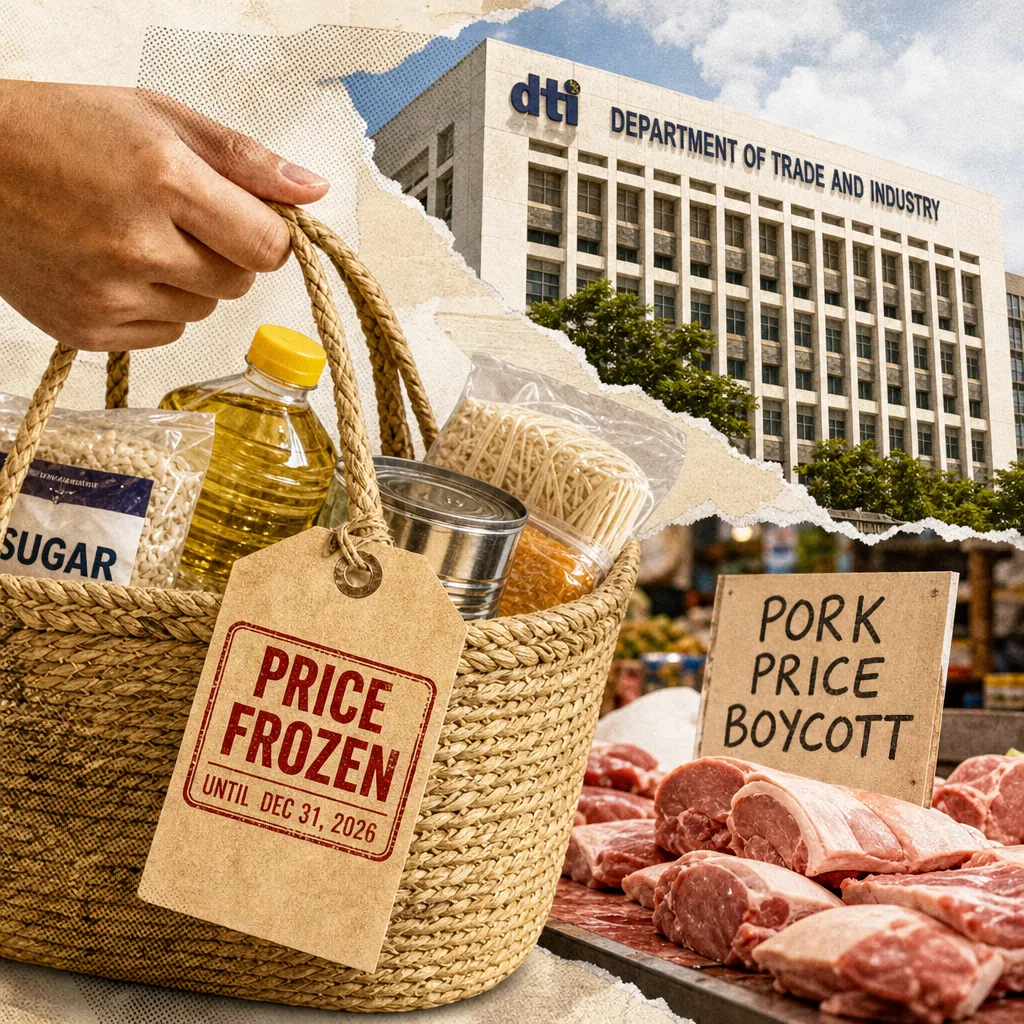
Trade Secretary Cristina Roque told reporters on October 22 that manufacturers of basic necessities and prime commodities have committed to hold prices until December 31, 2026, covering more than 200 product lines the Department of Trade and Industry monitors — canned sardines, milk, coffee, bread, instant noodles, salt, detergent, bottled water, candles, luncheon meat, meat loaf, corned beef, vinegar, fish sauce, soy sauce, toilet soap and batteries among them.11961 The commitment, announced on the sidelines of the National Trade Fair Coconut Philippines, is the day's clearest piece of consumer-price news, and it landed alongside a Senate hearing where a pork price gap of more than ₱200 a kilo was put on the record and a hog-raisers' sales boycott entered its first day.1114
The freeze is voluntary. Roque said "good coordination" between the department and manufacturers allowed it to secure the commitment, and that consumers can find the covered product list in supermarkets and groceries and on the department's website and social media pages.61 Nothing in the material says what happens if a manufacturer breaks the pledge, or whether the department would treat a breach as a violation of the price law it administers. The Department of Trade and Industry (DTI) is the agency that polices suggested retail prices on basic goods and can act against profiteering; a voluntary commitment is a lighter instrument than a price ceiling, and it depends on the same manufacturers who say their costs remain high.61
On the same day, Senate Majority Leader Juan Miguel Zubiri used a hearing on the Department of Agriculture's proposed ₱198.4-billion budget for 2027 to demand action against pork price manipulation, saying farmgate prices had fallen from ₱185 per kilogram in 2024 to between ₱90 and ₱120 this year, below the ₱130 to ₱140 cost of production.11 He pointed to pork belly selling for as much as ₱380 per kilogram in public markets while some Mindanao hog raisers received barely ₱100 per kilogram for live hogs.11 Agriculture Secretary Francisco Tiu Laurel Jr. told the same hearing he could suspend imports of pork shoulder, ham and belly for 60 days or stop issuing new Sanitary and Phytosanitary Import Clearances, the permits that cover meat imports.11 Hog raisers in Oriental Mindoro began a three-day "pork holiday" from October 22 to 24, suspending sales, at the call of AGAP Party-list Rep. Nicanor Briones, who wants higher tariffs on imported pork and stricter import rules.14
Key themes
- DTI secures a no-price-increase pledge on 200-plus basic goods through December 31. Trade Secretary Cristina Roque said manufacturers committed to hold prices on the monitored list of basic necessities and prime commodities, which includes canned sardines, milk, instant noodles, bread and bottled water.11961 The pledge is voluntary and carries no stated penalty.
- A senator put a ₱214-per-kilo gap between farmgate and retail pork on the record. Zubiri said pork belly sold for up to ₱380 per kilogram in public markets while farmgate prices fell to ₱90–₱120, below the ₱130–₱140 cost of production.11 A lawmaker's Facebook post on the same gap drew 1,328 likes and 176 comments, the largest response of any item in this set.42
- The Agriculture department floated a 60-day pork import suspension without a date. Tiu Laurel said he could suspend imports of pork shoulder, ham and belly or stop issuing new import clearances, but gave no timetable, leaving whether it takes effect unclear.11
- Hog raisers in Oriental Mindoro stopped selling for three days. The province's hog raisers joined a nationwide "pork holiday" from October 22 to 24, with one raiser citing high feed costs against low buying prices for their animals.14
- Cebu confirmed 10 ASF deaths and set up a checkpoint. Veterinary officials in Cebu City are mapping hog farms within 500 meters of Barangay Sapangdaku, where 10 pigs confirmed with African swine fever died, and are awaiting results on a second batch of samples.6671
- Canned sardine makers asked for ₱1 more per can. Manufacturers cited high operating and production costs in requests reported by regional newscasts on October 19 and 20, the clearest food-maker price move in the set.2829
- Diesel rose ₱2.60 a liter while gasoline and kerosene fell, and transport groups asked for a ₱2 fare increase. The fuel adjustments took effect October 20; the Department of Energy said relief could come the following week.3234
- A Senate subcommittee approved the ₱198.4-billion Agriculture budget for 2027 as senators questioned why farmers remain poor. Sen. Francis Pangilinan cited an average daily basic pay of ₱387.90 for farmers and said spending should be judged by its impact, not its size.92
How the narratives stack
Dominant. The DTI price freeze is the most consequential item in this set for anyone who buys or sells packaged food. It covers more than 200 product lines across categories that include canned fish, processed milk, instant noodles, bread and bottled water, and it runs through the year-end holidays, when demand peaks.11961 The story ran in at least two outlets in the set — the Manila Times and the Philippine Star — and the Star's version carried the secretary's direct quote: "(There will be) no price increase up to Dec. 31, 2026."119 Its dominance here rests on consequence rather than volume: the pledge sets the pricing environment for the entire packaged-goods aisle for the next ten weeks.
Counter-narrative. The pork story complicates the freeze. Zubiri's numbers describe a market where the farmer loses money and the shopper still pays a high price, which is the opposite of the squeeze a simple supply story would predict.11 The lawmaker's Facebook post made the same point with a specific spread — kasim at ₱166 a kilo farmgate against ₱380 retail, with production cost at ₱182 — and drew 1,328 likes and 176 comments.42 That post is the single most-engaged item in the captured set, which suggests the farm-to-fork price gap travels further with ordinary readers than the freeze announcement did.
Emerging. Two supply-side risks sit under the price freeze. The first is African swine fever: Cebu City confirmed 10 deaths in Barangay Sapangdaku and set up a checkpoint on Wednesday night, while Tabuk City in Kalinga reported an outbreak affecting 36 barangays, 2,247 hog raisers and an estimated ₱211.7 million in losses, with 13,866 hogs affected or dead and 247 culled.6671 The second is the import question: a 60-day suspension of pork imports, if it happens, would tighten supply just as the holiday season lifts demand.11 Neither has materialized into a retail price move yet.
Under-covered. The sardine manufacturers' request for ₱1 more per can got airtime only on regional newscasts — GMA Regional TV's Balitang Bisdak and One Mindanao — and no national outlet in this set picked it up.2829 That matters because canned sardines sit on the DTI's monitored list, so the request runs directly against the freeze the department announced.119 How the department handles a manufacturer asking for an increase while its industry has pledged none is the question the coverage did not answer.
Platform insights
- Facebook. The highest-engagement item in the set is a lawmaker's Facebook post on the pork price gap, which drew 1,328 likes and 176 comments.42 The same platform carried a second, smaller post from Zubiri's account asking who profits from the gap, with 77 likes and 24 shares.13 Facebook is where the pork story reached ordinary readers; the posts are in Filipino, use the "bakit lugi ang mga hog raiser" framing, and invite comment rather than announce policy.
- X. Zubiri's account carried the pork question to a smaller, more political audience, and the post's 24 shares suggest it was passed along rather than debated.13 The platform's role in this set is distribution of a senator's message, not origination.
- YouTube. Regional and national newscasts carried the fuel, sardine and LPG stories as video, including 24 Oras, Saksi, GTV's Balitanghali and GMA Regional TV's One North Central Luzon, One Mindanao and Balitang Bisdak.34362839 The sardine request and the LPG outlook reached audiences mainly through these broadcasts, which is why the sardine story stayed regional in reach.
Key voices and communities
The Department of Trade and Industry and Trade Secretary Cristina Roque. The department is the government's price watchdog for basic goods, and Roque is the official who announced the freeze. Her framing — good coordination with manufacturers, list available in stores and online — presents the pledge as a cooperative achievement.61 The department's next move on the sardine request will show whether the commitment binds manufacturers who say their costs have risen.
Sen. Juan Miguel Zubiri. The Senate Majority Leader turned the Agriculture budget hearing into a pork price forum, telling Tiu Laurel: "Ilabas mo yung galit mo sa mga predatory pricing, pati yung mga smugglers. Labanan mo, huwag ka matakot" (Direct your anger toward those engaging in predatory pricing, as well as the smugglers. Fight back, don't be afraid).11 He followed up on Facebook that evening, and his numbers — ₱380 retail against ₱100 farmgate — are now the reference points for the story.13
Hog raisers and their representatives. The Oriental Mindoro Alliance of United Hog Raisers suspended sales for three days at the call of AGAP Party-list Rep. Nicanor Briones, who wants higher tariffs on imported pork.14 Nelson Mangako, speaking for raisers from Socorro town, said: "Masayado nang kawawa ang kalagayan naming mga hog raisers. Mataas na ang presyo ng feeds, tapos napakababa naman ng bili sa aming mga magbababoy" (The plight of hog raisers is pitiful. Feed prices are high, yet the buying price for our pigs is very low).14 Their boycott is the organized expression of the farmgate collapse Zubiri described.
The Department of Agriculture and Secretary Francisco Tiu Laurel Jr. The department holds the import lever. Tiu Laurel's offer to suspend pork imports for 60 days is the strongest tool mentioned in the set, and it cuts both ways: it could lift farmgate prices for raisers while raising retail pork prices for consumers.11
Senators on the Agriculture budget. Sen. Francis Pangilinan, who chairs the Senate Committee on Agriculture, Food and Agrarian Reform, questioned why farmers still struggle with a roughly ₱200-billion budget, citing an average daily basic pay of ₱387.90 for farmers.92 Sen. JV Ejercito used the same hearing to call for water impounding facilities ahead of a projected Super El Niño, arguing storage would both irrigate farms in dry months and mitigate flooding in the wet season.81
Narrative streams
DTI holds 200-plus basic goods at current prices through December 31
The commitment covers the full list of basic necessities and prime commodities under the department's jurisdiction, which the Philippine Star enumerated as canned sardines, milk, coffee, bread, instant noodles, salt, detergent or laundry soap, bottled water, candles, luncheon meat, meat loaf, corned beef, beef loaf, vinegar, patis, soy sauce, toilet soap and batteries.119 The Manila Times version put the count at over 200 stock-keeping units, the individual product variants a manufacturer sells, and said the list would be posted in supermarkets and groceries as well as on the department's website and social media.61 Roque spoke at the National Trade Fair Coconut Philippines, an event tied to the coconut sector, which is a reminder that the announcement came at a trade promotion event rather than a price-monitoring briefing.119
The freeze is a commitment, not a regulation. The department's power over basic goods runs through the Price Act, which lets it set suggested retail prices and act against illegal price manipulation, but a voluntary pledge from manufacturers is a different instrument: it depends on compliance and carries no stated sanction.61 Roque said prices and production costs remain high "due to various factors" and that coordination with manufacturers is what allowed the department to secure the commitment.61 For packaged-food manufacturers, the pledge fixes the pricing environment through the holiday season, when volumes peak and promotional spending is heaviest. For retailers, it means the shelf price of the monitored list should hold, which removes one source of customer complaint in the final quarter. For shoppers, the practical effect is that the basket of canned fish, noodles, milk and bread should not rise before January — provided manufacturers honor a pledge with no enforcement mechanism attached.
A senator puts a ₱214-per-kilo pork gap on the record and hog raisers stop selling
Zubiri's numbers at the October 21 hearing on the Department of Agriculture's 2027 budget describe a market where the farmer and the shopper are both losing. Farmgate prices fell from ₱185 per kilogram in 2024 to ₱90–₱120 this year, below the ₱130–₱140 cost of production, while pork belly sold for as much as ₱380 per kilogram in public markets.11 A lawmaker's Facebook post the next day put kasim, a pork cut, at ₱166 a kilo farmgate against ₱380 retail, with production cost at ₱182 a kilo, and asked the department to work more closely with the Department of Trade and Industry on prices.42 The post drew 1,328 likes and 176 comments, the largest response of any item in this set.
Tiu Laurel's response was to offer the import lever: a 60-day suspension of imports of pork shoulder, ham and belly, or a halt to new Sanitary and Phytosanitary Import Clearances, the permits that cover meat imports.11 He gave no date, so whether the suspension takes effect is unclear. The same day, hog raisers in Oriental Mindoro began a three-day sales boycott through October 24, heeding Briones' call for higher tariffs on imported pork and stricter import rules.14 Mangako's complaint — high feed prices against low buying prices — is the raiser's version of the same squeeze Zubiri described.14
The policy tension is real and the coverage names it. Higher tariffs on imported pork would protect local raisers but raise costs for vendors, food processors and consumers, and with inflation a leading public concern, further increases carry political cost.76 A sustained decline in farmgate prices may justify a lasting policy response; a seasonal slump calls for a different one, and using a permanent measure on a temporary problem could create more difficulties for the industry and the economy.76 For food processors and retailers that buy pork, the near-term question is whether a 60-day import suspension lands before the holiday demand peak, which would raise input costs at the worst moment. For raisers, the boycott is a pressure tactic with a short clock: three days of suspended sales is a signal, not a supply shock.
African swine fever spreads in Cebu and Kalinga as the pork supply question sharpens
Cebu City veterinary officials confirmed that all 10 pigs initially found with African swine fever in Barangay Sapangdaku had died, and began mapping hog-raising areas within a 500-meter radius of the site while coordinating with barangay officials on which animals need testing.6671 A checkpoint went up in Sapangdaku on Wednesday night to stop potentially infected hogs and pork products from moving to other villages, and authorities are awaiting confirmation on a second batch of samples collected Monday.66 African swine fever is a highly contagious viral disease that kills pigs and has no vaccine, so control depends on culling, movement restrictions and biosecurity.
The outbreak is not confined to Cebu. In Tabuk City, Kalinga, an outbreak affected 36 barangays and 2,247 hog raisers, with 13,866 hogs affected or dead, 247 culled from 28 raisers, and estimated economic losses of ₱211.7 million, according to the city veterinary office's report to the Sangguniang Panlungsod.66 The two reports together describe a disease pressure that sits underneath the farmgate price collapse: when hogs die or are culled, raisers lose their stock, and when movement is restricted, supply chains shorten.
For pork processors and retailers, the ASF reports add a sourcing risk to a market already facing an import question. For raisers, the disease compounds the price problem — a raiser who loses animals to ASF and sells the rest at ₱100 a kilo absorbs both losses at once. The extent of the Cebu outbreak remains uncertain pending the second sample batch, and the material does not say whether the Kalinga outbreak is still active.66
Sardine makers ask for ₱1 more per can while the freeze holds
Canned sardine manufacturers asked for a ₱1 increase in the price of each can, citing high operating and production costs, in requests reported by GMA Regional TV's Balitang Bisdak on October 19 and One Mindanao on October 20.2829 The request is the clearest example in the set of a food manufacturer pushing costs onto shoppers, and it runs directly against the department's freeze, since canned sardines are on the monitored list.119
The sardine story stayed regional. No national outlet in this set carried it, and the department's response to the request does not appear in the material. That gap matters: sardines are a staple protein for low-income households, and a ₱1-per-can increase is small in absolute terms but lands on a product bought frequently. If the department grants the request, the freeze develops an exception; if it refuses, manufacturers who say their costs have risen face a choice between absorbing the increase and selling at a loss. For retailers, the question is whether shelf prices move before January regardless of the pledge.
Fuel prices split, transport groups ask for a ₱2 fare increase, and LPG heads up
Oil companies announced mixed adjustments effective October 20: gasoline and kerosene prices fell while diesel rose by ₱2.60 per liter, with changes taking effect at midnight or 6 a.m. depending on each company's announcement.3230 One regional report put the gasoline rollback at ₱4.30 per liter, and national newscasts said the rollback exceeded ₱4 per liter.3033 Transport groups responded to the diesel increase by asking for a ₱2 increase in minimum fares, with Pasang Masda named among those filing the request.3435 The Department of Energy said motorists can expect relief the following week, and a regional report said another round of diesel and gasoline adjustments could be implemented then.3439
Cooking gas is heading the other way. The Department of Energy's Oil Industry Management Bureau, the office that monitors fuel supply and prices, said liquefied petroleum gas prices are expected to rise when winter begins in other countries and demand increases.3637 Republic Gas Corp., an LPG supplier, has begun a staggered ₱18-per-kilogram increase on its products.38 For food businesses, diesel and LPG are direct input costs — delivery fleets run on diesel and kitchens run on LPG — so the split movement raises operating costs even as gasoline falls. For commuters, the fare petition is the pass-through: a ₱2 increase in minimum fares would offset the diesel rise for drivers and add to household transport costs.
The Agriculture budget clears a Senate panel as senators question its impact
A Senate Finance subcommittee approved the proposed ₱198.4-billion budget of the Department of Agriculture and its attached agencies and corporations for 2027, after senators pressed officials on El Niño-related losses, expensive farm inputs, inadequate water infrastructure and market imbalances.92 Pangilinan, who chairs the Senate Committee on Agriculture, Food and Agrarian Reform, asked why farmers still struggle with a roughly ₱200-billion budget and cited data showing farmers earned an average daily basic pay of ₱387.90, saying spending should be measured by its impact on farmers, not its size.92 Ejercito called for water impounding facilities ahead of a projected Super El Niño, arguing storage would irrigate farms in dry months and mitigate flooding in the wet season.81
The budget hearing is where the pork and farm-income stories converge. The same session produced Zubiri's demand for action on pork price manipulation and the farmgate figures that anchor the pork story.11 For the sector, the approved budget sets the funding envelope for the programs — irrigation, market support, disease control — that determine whether the price problems discussed at the hearing get addressed. The subcommittee approval is a step in the budget process, not the final appropriation; the full Senate and the bicameral conference still have to act.
Conversation trajectory
Watch the sardine request against the freeze, over the next two to four weeks. The department has pledged no increases on the monitored list through December 31, and sardine manufacturers have asked for ₱1 more per can.11929 Whether the department grants, denies or ignores the request will show how binding the voluntary commitment is. A grant would open the freeze to exceptions; a denial would test whether manufacturers absorb costs.
Watch for a dated announcement on the pork import suspension, over the next two to three weeks. Tiu Laurel floated a 60-day suspension of pork shoulder, ham and belly imports but gave no date.11 A formal order before the holiday demand peak would tighten supply and raise retail pork prices; silence would leave the farmgate problem to the tariff debate. The Senate's next move on pork tariffs, which Briones and the hog raisers are pressing, is the companion signal.14
Watch the Cebu ASF sample results, expected within days of October 22. Authorities are awaiting confirmation on a second batch of samples from around Barangay Sapangdaku.66 A wider positive result would expand movement restrictions and culling, adding supply pressure to the pork market; a contained result would leave the Kalinga outbreak as the main disease concern.66
Watch the next fuel price adjustment, expected the week of October 26. The Department of Energy said relief could come the following week, and a regional report said another round of diesel and gasoline adjustments was possible.3439 A diesel rollback would ease the pressure behind the ₱2 fare petition; another increase would strengthen it.
Trigger events. The formal DTI list posting in supermarkets and online will confirm exactly which products are covered.61 Any Department of Agriculture order on pork imports would move retail prices within days. The next Senate session on the agriculture budget, and the bicameral conference that follows, will determine whether the programs discussed at the hearing are funded.
Response guidance
Packaged-food manufacturers on the monitored list: prepare for shelf-price scrutiny through December. The department has published a commitment that prices will not rise, and shoppers can check the list in stores and online.61 Any price movement on a covered product before January will be read against that pledge. Keep records of input-cost changes so that any future adjustment can be explained with specifics rather than assertions.
Sardine and canned-goods producers: decide how to handle a public request for an increase. The ₱1-per-can request was reported on regional newscasts and has not drawn a national response.29 If the request proceeds, expect questions about why a product on the monitored list is seeking an exception. A factual statement on cost movements, with figures, will travel better than a general claim of higher costs.
Pork processors and retailers: model the import-suspension scenario now. A 60-day suspension of pork shoulder, ham and belly imports would raise input costs for processed-meat lines.11 Work out which products are exposed and what a holding line on retail pricing would say, because the ₱380-per-kilogram retail figure and the farmgate-to-retail gap are already public.42
Retailers and market operators: expect inspection talk. Zubiri called for public market inspections, and the department has been asked to work with the trade department on pork prices.1142 Ensure price tags and weighing scales are in order, and brief store managers on how to answer customer questions about the farmgate-to-retail gap.
Communicators across the sector: separate the freeze from the pork dispute in public statements. The two stories involve different products, different agencies and different mechanisms — a voluntary pledge on packaged goods and an import-and-tariff question on pork.11911 Conflating them will produce statements that answer neither. Address the freeze with the product list and the pork question with the import and tariff facts.
Companies sourcing pork or running kitchens: track diesel and LPG as input costs. Diesel rose ₱2.60 per liter on October 20 and LPG is expected to rise with winter demand abroad, with one supplier already implementing a staggered ₱18-per-kilogram increase.303738 Delivery and cooking costs move with these, and the fare petition shows the pass-through is already being contested in public.34
See the full picture behind today's signals.
This report draws from Media Meter's MediaWatch, our real-time monitoring engine tracking 2,470+ Philippine sources across print, broadcast, digital, and social. Explore how the platform turns raw coverage into decision-grade intelligence, then see how it's configured for teams like yours — whether you're in PR agencies, corporate comms, government, or marketing.
Want more? Browse our Report Library for sector and crisis intelligence, or request a demo and we'll have your brand set up before the call.
Want this kind of intelligence on your brand?
This brief is built on the same MediaWatch methodology that runs continuously across every brand we monitor. See your competitive landscape, Impact Score, and narrative trajectory in a 30-minute demo.