Filipino Food on the Global Stage: Ube, Boodle Fights, and the 'Purple Gold Rush'
On July 4, 2026, the Philippine food conversation balanced between global recognition of ube and traditional dishes, local convenience trends like boodle fights, and the ongoing challenge of food supply in earthquake-affected areas.
The conversation around Philippine food on July 4, 2026, unfolded across two distinct planes. On one, Filipino cuisine was being celebrated internationally—from the global spread of ube to the diaspora's everyday dishes like adobo and lumpia. On the other, a more local, convenience-driven narrative emerged around the traditional boodle fight, promoted as a no-cook, anywhere meal option. These threads ran parallel to a humanitarian story: the ongoing earthquake aftershocks in Davao Occidental, which continued to hamper food deliveries to Balut Island, underscoring the fragility of food supply chains in disaster zones. The day's coverage, captured across online news and social media, reflected a sector that is simultaneously gaining global traction and grappling with local realities of price sensitivity and disaster resilience.
Key themes
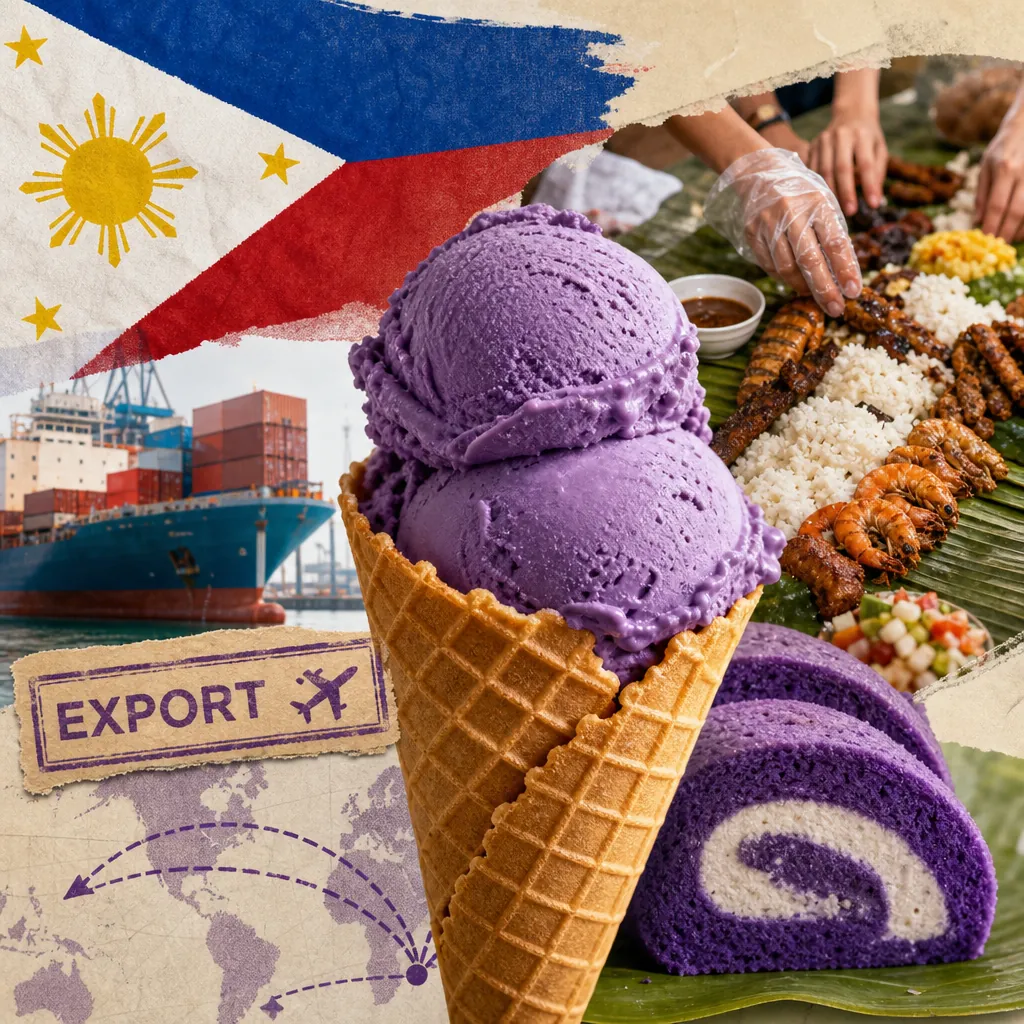
- Global recognition of Filipino cuisine — Multiple articles on July 4 celebrated the rise of Filipino food on the world stage. A Manila Times piece declared that the narrative of Filipino cuisine being "underrated" is now obsolete, citing Anthony Bourdain's praise of Cebu lechon and the global popularity of ube as evidence. The article highlighted how dishes like pancit, lumpia, and adobo travel with the diaspora, while ube has become a major entry point for international markets due to its striking color and versatility.
- Geographical indication for Bohol's Ubi Kinampay — In a move to protect and promote a heritage crop, the provincial government of Bohol filed for geographical indication (GI) registration of Ubi Kinampay, a prized purple yam variety, with the Intellectual Property Office of the Philippines (IPOPHL). The article, published by Inquirer Plus, framed this as part of a global "purple gold rush," noting that ube-flavored products are gaining traction in North America, Europe, and Asia. GI protection would help ensure that only yams grown in Bohol's specific soil and climate can be marketed as Ubi Kinampay, potentially commanding premium prices.
- Convenient boodle fight trend on social media — On Facebook, the page @chubbyguymnl2023 posted two short videos on July 4 promoting boodle fight as a super convenient dining option, with captions emphasizing no cooking required and portability. The first post garnered 148 likes and 13 shares; the second, a shorter version, received 46 likes and 5 shares. The content received no negative reactions, suggesting neutral to positive reception, but the conversation remained isolated to this single account, with no broader discussion or user-generated threads.
- Food safety awareness during holiday gatherings — A U.S.-based outlet, The Fresno Bee, published an article on July 4 warning about food poisoning risks during Fourth of July celebrations. While not Philippine-specific, the post (0 likes, 1 comment) signals ongoing consumer awareness of food safety during large gatherings, a concern that could resonate locally during fiestas and holidays like Noche Buena.
- Disaster-driven food supply challenges — A DZMM Teleradyo video report highlighted that coastal uplift and ongoing aftershocks are hampering food and supply deliveries to Balut Island in Davao Occidental. The video received 772 views and 13 likes, indicating moderate interest. This humanitarian thread links food access directly to earthquake aftermath, a concern that may persist as aftershocks continue.
- Local food entrepreneurship and DTI support — A feature on IAM's Original Malunggay Chips, a micro-enterprise in the Caraga region, showcased how the Department of Trade and Industry (DTI) helped conceptualize packaging and bring the product to market. The story highlights the role of government support in promoting nutritious, affordable snacks made from malunggay (moringa), a common backyard vegetable.
- Japanese cuisine's continued growth in the Philippines — Botejyu, an Osaka-based restaurant chain, marked its 10th year in the Philippines in July 2026. The article traces the brand's history from its 1946 founding in Osaka to its arrival in the Philippines via Viva International Food and Restaurants Inc. in 2016, reflecting the sustained appetite for Japanese comfort food like okonomiyaki and ramen among Filipino consumers.
- Ormoc's Queen pineapple and local food heritage — A travel feature on Ormoc City highlighted the sweetness of its tiny Queen pineapples and the launch of "Homemade: A Taste of Ormoc," a cookbook by Mayor Lucy Torres Gomez. The book contains 77 recipes from local contributors, emphasizing the city's culinary heritage and the fruit's unique quality, which is seldom available outside Leyte.
How the narratives stack
Dominant — Within the captured set, the dominant narrative is the global ascent of Filipino cuisine, particularly the ube phenomenon and the push for geographical indication protection. This story appeared in multiple online news outlets (Manila Times, Inquirer Plus) with significant coverage value—the Manila Times article on Filipino food amplified was worth an estimated ₱344,400 in advertising-equivalent value, while the Inquirer Plus piece on Ubi Kinampay carried ₱441,600. The narrative positions Philippine food as a rising global player, with concrete steps (GI registration) to protect and monetize heritage products.
Counter-narrative — A quieter but persistent counter-narrative is the convenience-focused boodle fight trend on social media. While not as heavily covered in news, the Facebook posts from @chubbyguymnl2023 generated genuine engagement (148 likes, 13 shares) and reflect a consumer desire for easy, shareable meals that require no cooking. This narrative contrasts with the premium, artisanal image of ube and heritage crops, instead emphasizing affordability and practicality—a response to ongoing price sensitivity among Filipino consumers.
Emerging — The intersection of food and disaster response is an emerging narrative, driven by the DZMM Teleradyo report on relief challenges in Balut Island. While only one video in the set, it connects food supply chains to earthquake resilience, a topic that could gain traction as aftershocks continue and as National Disaster Resilience Month activities begin in July. This narrative may also intersect with corporate social responsibility efforts by major food companies.
Suppressed — Notably absent from the conversation is any discussion of food safety in the Philippine context, despite a U.S.-oriented warning from The Fresno Bee. No local food safety authorities (FDA Philippines, DTI) were cited, and no brands addressed spoilage risks during power interruptions or supply chain disruptions. This silence could mask underreported consumer concerns, especially in disaster-affected areas where food handling and storage are critical.
Platform insights
- Facebook — The boodle fight conversation was exclusive to Facebook, originating from the page @chubbyguymnl2023. The platform's visual, share-oriented nature favored the short video format, but the lack of follow-up posts or user-generated threads indicates the content functioned as a one-off promotional push rather than a sustained discussion. In contrast, earthquake-related posts on Facebook generated hundreds of sad and care reactions, dominating the platform's food-adjacent space.
- YouTube — The only food-relevant video on YouTube was the DZMM Teleradyo report on relief delivery challenges to Balut Island. With 772 views and 13 likes, it indicates moderate interest in the humanitarian angle but no broader food conversation. No food vloggers or mukbang creators appeared in the dataset, suggesting that food content on YouTube during this period was minimal.
- Twitter / X — No food-related content appeared on Twitter in the dataset. The platform's real-time nature may have been dominated by earthquake alerts and political news, leaving little room for food discussions.
- Reddit — The lone Reddit post was a detailed analysis of Globe Starlink pricing, which mentioned disaster-response connectivity but not food. The platform's lack of food-related discussion further confirms that the food conversation was narrow and platform-specific.
Key voices and communities
- Filipino food lifestyle content creators — A small but engaged cluster of social media personalities, exemplified by @chubbyguymnl2023, promotes convenient, communal dining experiences like boodle fights on Facebook. Their content emphasizes ease and portability, tapping into the growing demand for shared, photogenic meals. With moderate engagement (148 likes on one post), they influence consumer perceptions of convenience dining and could be leveraged by brands offering ready-to-eat meal kits.
- Government and economic development agencies — The Department of Trade and Industry (DTI) and the Intellectual Property Office of the Philippines (IPOPHL) are key voices in the ube GI registration story. Their actions signal a strategic push to protect and commercialize heritage crops, positioning the Philippines as a player in the global "purple gold rush." The DTI also appears in the malunggay chips feature, highlighting its role in supporting micro-enterprises.
- Local government units and tourism promoters — Mayor Lucy Torres Gomez of Ormoc City and the provincial government of Bohol are active in promoting local food heritage through cookbooks and GI applications. Their efforts aim to boost local economies and preserve culinary traditions, making them important partners for food brands seeking authentic regional connections.
- Disaster-affected communities and relief actors — The DZMM Teleradyo report on Balut Island highlights the voices of relief workers and affected residents. This community is concerned with food security in disaster zones, and their narrative underscores the importance of resilient supply chains. For food companies, this group represents both a reputational opportunity (through donations or logistical support) and a risk (if supply chains fail).
- International media and diaspora — Outlets like Forbes and The Fresno Bee, while not Philippine-specific, contribute to the global conversation around Filipino food and food safety. The diaspora itself is a key community, as dishes like adobo and lumpia travel with overseas Filipinos, creating demand for authentic ingredients and products abroad.
Narrative streams
The global rise of ube and the push for GI protection
The most heavily covered food story on July 4 was the geographical indication (GI) filing for Bohol's Ubi Kinampay, a variety of purple yam renowned for its vibrant violet flesh and rich flavor. The Inquirer Plus article, worth an estimated ₱441,600 in advertising-equivalent value, framed this as part of a global "purple gold rush," noting that ube-flavored products—from ice cream to pastries—are gaining traction in North America, Europe, and Asia. GI protection, if granted by IPOPHL, would mean that only yams grown in Bohol's specific soil and climate can be marketed as Ubi Kinampay, potentially allowing farmers to command premium prices. This move mirrors similar efforts for other heritage products like Davao coffee and Guimaras mangoes, and it positions the Philippines to capitalize on the growing international appetite for ube. The article also quoted a local official emphasizing that GI protection can help preserve traditional farming practices and ensure that the economic benefits of the ube trend reach local communities.
Convenience dining: Boodle fight as a social media trend
On Facebook, the page @chubbyguymnl2023 posted two short videos on July 4 promoting boodle fight as a "super convenient" dining option. The first video, captioned "Boodle fight na super convenient! Di mo na kailangan magluto, kaya pwede anywhere," accumulated 148 likes and 13 shares. A shorter version later that day received 46 likes and 5 shares. The posts received no negative reactions (zero sad, angry, or care counts), suggesting neutral to positive reception. However, the conversation remained isolated to this single account, with no broader discussion or user-generated threads. This indicates that while the convenience narrative resonates with audiences, it has not yet sparked a wider movement. For quick-service restaurants (QSRs) and food manufacturers, this represents an underexplored storytelling opportunity—promoting ready-to-eat meal kits or value meals that fit the boodle fight format could tap into existing positive sentiment around communal dining.
Disaster and food supply: The Balut Island challenge
A DZMM Teleradyo video report on July 4 highlighted that coastal uplift and ongoing aftershocks are hampering food and supply deliveries to Balut Island in Davao Occidental. The video, which received 772 views and 13 likes, reported that "Pahirapan pa rin ang paghahatid ng pagkain at iba pang suplay sa Balut Island sa Davao Occidental dahil sa coastal uplift at patuloy na pagyanig." This humanitarian thread directly links food access to earthquake aftermath, underscoring the vulnerability of supply chains in disaster-prone areas. The report did not mention specific brands or companies, but it serves as a reminder that food companies with exposure to Mindanao-sourced ingredients (e.g., coconut, fish, rice) should assess logistics resilience. It also presents a reputational opportunity for brands to be seen as first responders through food donations or logistical support.
Local food entrepreneurship: Malunggay chips and DTI support
A feature on IAM's Original Malunggay Chips, published by the Manila Times, told the story of Miriam Villarivera, who turned a family snack into a micro-enterprise with help from the Department of Trade and Industry (DTI). The article, worth an estimated ₱607,040 in advertising-equivalent value, highlighted how DTI helped conceptualize packaging and bring the product to market. The chips, made from malunggay (moringa), are positioned as a nutritious, affordable snack for school children and families in the Caraga region. This narrative underscores the role of government support in fostering local food businesses and promoting healthy eating, aligning with broader trends toward natural and functional foods.
Japanese cuisine's decade in the Philippines
Botejyu, an Osaka-based restaurant chain, marked its 10th year in the Philippines in July 2026. The article, published by the Manila Times, traced the brand's history from its 1946 founding in Osaka to its arrival in the Philippines via Viva International Food and Restaurants Inc. in 2016. Botejyu is known for okonomiyaki (savory pancakes) and modern-yaki (a variation combining okonomiyaki and yakisoba). The article noted that the brand was the first to serve okonomiyaki with mayonnaise, now a common accompaniment. This story reflects the sustained appetite for Japanese comfort food among Filipino consumers, a trend that has seen ramen, sushi, and rice bowls become ubiquitous. For competitors and new entrants, the success of Botejyu over a decade suggests that there is room for authentic regional Japanese concepts beyond the mainstream.
Ormoc's Queen pineapple and culinary heritage
A travel feature on Ormoc City highlighted the sweetness of its tiny Queen pineapples and the launch of "Homemade: A Taste of Ormoc," a cookbook by Mayor Lucy Torres Gomez. The book, three years in the making, contains 77 recipes from local contributors, ranging from poultry and seafood to soups and native snacks. The article emphasized that the pineapples are so sweet that even the core is edible, and they are seldom available outside Leyte. This narrative promotes local food tourism and positions Ormoc as a destination for culinary enthusiasts. For food brands, it highlights the potential of regional specialties as unique selling points.
Conversation trajectory
Over the next 2–4 weeks, several factors will shape the food conversation:
- Continued aftershocks in Davao Occidental will keep relief logistics and food availability in headlines, potentially amplifying the humanitarian narrative around food supply chains. The DZMM report on Balut Island may be followed by more coverage of food scarcity and price concerns, especially for staples like rice and canned goods.
- National Disaster Resilience Month (July) will likely feature pronouncements from Malacañang on food stockpiles and price caps, providing a platform for government messaging on food security.
- The impending release of the July food price index by the Philippine Statistics Authority (expected mid-month) will refresh the discourse on inflation, shrinkflation, and budget meals, potentially driving consumer engagement around value-oriented products.
- The ube GI registration process will continue to generate news as IPOPHL evaluates Bohol's application, with possible updates on the timeline and requirements. This could sustain interest in heritage crops and the "purple gold rush" narrative.
- The boodle fight convenience trend may gain traction if other influencers or brands pick up the format, especially if tied to disaster-relief messaging (e.g., "emergency-ready boodle packs"). However, without organic amplification, it may remain a niche conversation.
Key trigger events to watch: a significant aftershock (M5+) that disrupts food supply chains further; a government announcement on rice price caps or food stockpiles; the release of the July inflation data; and any food safety recall or contamination incident that could shift attention to hygiene and regulation.
Response guidance
For communicators in the food and beverage sector, the following approaches are recommended:
- Capitalize on the ube and heritage crop narrative by aligning brands with GI protection efforts or sourcing from Bohol. This positions products as authentic and supports local farmers, resonating with consumers who value provenance and sustainability.
- Leverage the boodle fight trend as a positive community engagement opportunity. Brands can co-create or curate user-generated content around convenient boodle fight setups, emphasizing locally sourced ingredients and family-style dining. This taps into existing positive sentiment and the "kamayan" culture.
- Address food safety concerns preemptively during holiday weekends or disaster situations. Brands can post simple, visual guidelines on proper food handling for large gatherings, using localized hashtags like #LigtasKainan. This builds trust without being alarmist.
- Monitor disaster-affected areas for opportunities to demonstrate corporate social responsibility. Food companies with distribution networks in Mindanao should assess logistics resilience and consider partnerships with relief agencies to provide emergency food packs.
- Engage with micro-influencers who specialize in food vlogging or mukbang to create authentic product placements. The low engagement on generic content suggests that authentic creators who already feature related products (e.g., Lucky Me, Century Tuna) in their boodle fight vlogs can drive more meaningful connections.
Sensitive topics to navigate:
- Price increases vs. shrinkflation: Avoid denying that prices have risen. Instead, frame cost-saving measures transparently—e.g., maintaining portion sizes while absorbing some input cost increases. Acknowledge consumer frustration without promising impossible rollbacks.
- Food safety recalls: If a competitor or related brand faces a recall, do not capitalize on their misfortune. Reiterate your own rigorous protocols and invite regulators to inspect. Never name specific brands.
- Sugar tax / excise tax beverages: Discuss reformulation efforts (e.g., reduced sugar variants) as a response to health trends, not purely as a cost tactic. Avoid political commentary on the tax itself; focus on consumer choice and product improvement.
See the full picture behind today's signals.
This report draws from Media Meter's MediaWatch, our real-time monitoring engine tracking 2,470+ Philippine sources across print, broadcast, digital, and social. Explore how the platform turns raw coverage into decision-grade intelligence, then see how it's configured for teams like yours — whether you're in PR agencies, corporate comms, government, or marketing.
Want more? Browse our Report Library for sector and crisis intelligence, or request a demo and we'll have your brand set up before the call.
Want this kind of intelligence on your brand?
This brief is built on the same MediaWatch methodology that runs continuously across every brand we monitor. See your competitive landscape, Impact Score, and narrative trajectory in a 30-minute demo.