Globe fiber revenue hits P18.9B as telcos push asset sharing
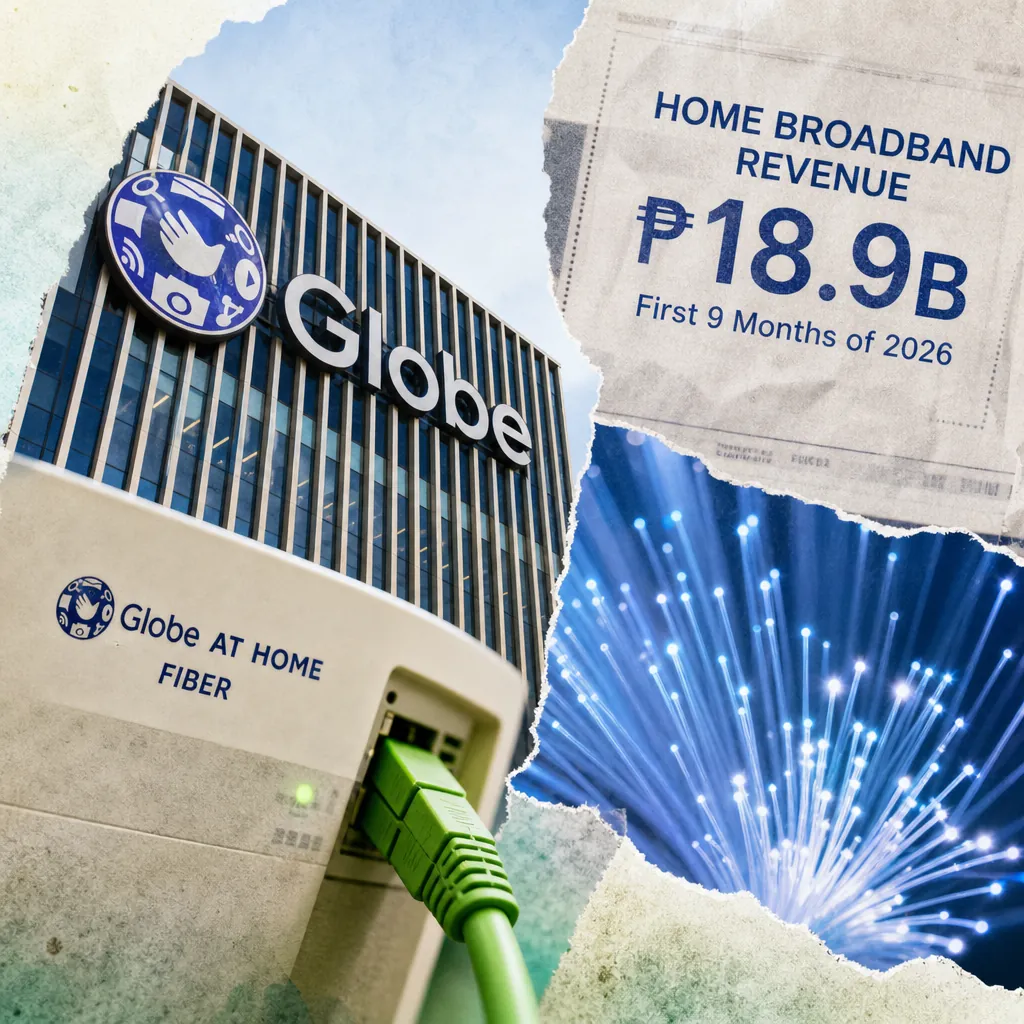
Globe AT HOME's home broadband revenues reached ₱18.9 billion in the first nine months of 2026, with fiber subscribers up 30%, while its chief executive backed industry proposals to co-build network assets and seek government incentives in hard-to-reach areas. A separate data leak at ride-hailing app JoyRide put 420,000 driver registrations in view, raising questions about how many riders the platform actually runs.
The Conversation
Globe Telecom's home broadband unit booked ₱18.9 billion in revenue from January to September 2026, 6% more than the ₱17.8 billion it recorded in the same nine months of 2025, and fiber now carries about 93% of that business 17. The figure, reported by Business Mirror and picked up by the entertainment and lifestyle site LionhearTV, was the most concrete number in a day of Philippine telecommunications news that otherwise ran on policy and regulatory questions 6.
On the same day, Globe president and chief executive Carl Raymond Cruz told reporters at a BusinessWorld forum that the industry should co-build network assets to save on costs, and that the government should offer incentives to carriers that lay fiber and put up cell sites in geographically isolated and disadvantaged areas — communities the industry calls GIDAs, meaning places that are hard to reach logistically, such as islands and mountain towns 20. Cruz's remarks align Globe with a position previously pushed by rival PLDT Inc. and its chairman Manuel V. Pangilinan, who has argued that duplicating each other's towers and cables wastes capital.
A third telecom thread came from a motorcycle riders' group, Kapatiran sa Dalawang Gulong (Kagulong), which asked regulators to investigate ride-hailing platform JoyRide after a data leak exposed about 420,000 driver registrations — roughly twelve times the 35,000 riders and drivers JoyRide reported to the Department of Social Welfare and Development (DSWD) when the agency handed out financial assistance to riders 16. The leak involved as many as 20.5 million customer records and profiles. The same day's captured coverage also included a legal notice from Telstra Converge Inc., formerly Digitel Crossing Inc., asking the National Telecommunications Commission (NTC) to update its corporate name in the agency's records, permits and licenses, with a hearing set for December 14.
Key themes
- Globe's home broadband revenue reached ₱18.9 billion in nine months, up 6% year-on-year. The January-to-September figure compares with ₱17.8 billion in the same period of 2025, and the company says it marks six consecutive quarters of sequential revenue growth 17.
- Fiber subscribers grew 30% year-on-year and fiber now supplies about 93% of broadband revenue. That share was 91% a year earlier, which shows how completely Globe's home business has moved off copper and legacy technologies 17.
- Globe's prepaid fiber product passed 1.2 million users. GFiber Prepaid is the company's no-contract, load-to-use home internet offer, and its scale is the main reason the prepaid segment now registers in the revenue story rather than sitting at the margin 17.
- Globe's chief executive endorsed sharing network assets with rivals. Cruz said telcos always involve massive capital expenditure, and that sharing — especially with government incentives in GIDAs — would be good for the industry 20.
- A JoyRide data leak exposed about 420,000 driver registrations, twelve times the 35,000 the company reported to DSWD. Kagulong said the gap points to possible overboarding, meaning more drivers registered on the platform than the government's rider cap allows 16.
- The rider cap itself is under review. Transportation Secretary Vince Dizon has questioned the cap, according to Business Mirror, which means the rule Kagulong wants enforced may be rewritten at the same time the group is asking for it to be applied 16.
- Telstra Converge asked the NTC to record its new corporate name. The company, formerly Digitel Crossing Inc., holds a congressional franchise under Republic Act No. 9235 and wants the change reflected in the commission's records, authorities, permits and licenses; a hearing is scheduled for December 14.
How the narratives stack
Dominant. Globe's earnings and its chief executive's policy remarks formed the day's main telecom story across the items captured here. The revenue release carried the hard numbers — ₱18.9 billion for nine months, ₱6.4 billion in the third quarter alone, up 2% from the second quarter, fiber at 93% of broadband revenue, prepaid fiber past 1.2 million users 17. The policy remarks gave the numbers a forward direction: Cruz wants the government to treat GIDA coverage as a shared cost problem rather than a race between two or three carriers 20. Business Mirror and Philstar both carried the story, and LionhearTV ran a version aimed at a general consumer audience 6. The dominance here is a property of the items gathered for this window, which leaned toward business and telecom reporting; it is not a claim about how the whole day's coverage was distributed.
Counter-narrative. Kagulong's statement on the JoyRide leak is the day's challenge to the industry's self-presentation. The group's arithmetic is simple: if the platform told DSWD it had 35,000 riders and drivers, and a leak shows 420,000 registrations, then either the reporting was wrong or the platform was running far more drivers than the cap allows 16. JoyRide has not publicly explained the gap in the material reviewed here. The counter-narrative matters because it shifts the terms of the telecom debate from expansion and revenue to data handling and regulatory compliance — the same digital infrastructure, judged by a different standard.
Emerging. Asset sharing between the two dominant carriers is moving from a suggestion by PLDT's Pangilinan to something Globe's chief executive says he would welcome, with a specific ask attached: government incentives for building in GIDAs 20. If it advances, the practical effect would be fewer duplicated towers and fiber runs in places where duplication is most expensive, and a larger role for public money in connecting unserved areas. The Telstra Converge name-change notice is a smaller emerging item — an administrative step, but one that signals the Converge group is consolidating its corporate identity across its licensed entities.
Under-covered. The consumer side of the JoyRide leak — what happens to the 20.5 million customer records and profiles reported exposed, and what recourse riders and passengers have — drew less attention in the captured items than the driver-count question 16. The regulatory mechanics of the rider cap, including who sets it and on what basis, were also reported only in outline.
Platform insights
- Facebook. The JoyRide leak and the Globe revenue story both circulated through Facebook's news-sharing ecosystem, where business pages and rider communities reposted the Business Mirror items. The rider groups' framing — a platform that reported 35,000 drivers to the government while a leak showed 420,000 registrations — travels well on Facebook because it is a single, checkable comparison 16.
- X. Kagulong's statement and the rider-cap question spread on X through transport and commuter accounts, which tend to amplify regulatory questions with a clear number attached. The Globe asset-sharing remarks also circulated among telecom-watchers, though with less volume than the leak story 20.
- Reddit. Philippine technology and commuting communities discussed the JoyRide leak in threads focused on what data was exposed and whether users could delete their accounts, a practical concern that the news coverage did not address in detail 16.
- YouTube. The Globe revenue results and the asset-sharing proposal appeared in business commentary videos and telecom vlogs, generally framed around whether cheaper shared infrastructure would translate into lower home broadband prices 1720.
Key voices and communities
Globe Telecom's management. President and chief executive Carl Raymond Cruz and broadband vice president Abigail Cardino are the day's principal corporate voices. Cardino framed the growth as a nationwide shift across every income bracket toward high-speed home connectivity, which is the company's explanation for why fiber adoption is outpacing the overall market 17. Cruz's contribution was the policy ask: incentives for GIDA build-out and a willingness to share assets 20.
PLDT and Manuel V. Pangilinan. Pangilinan does not appear in the day's items directly, but his earlier argument for co-building assets is the reference point for Cruz's remarks, and Philstar's report frames Globe as coming around to his position 20.
Kapatiran sa Dalawang Gulong (Kagulong). The motorcycle riders' group is the day's most specific critic. Its statement asks regulators to investigate both the leak and the driver-count discrepancy, and it notes that even the 35,000 figure JoyRide gave DSWD was already above the prescribed rider cap 16.
The Department of Transportation. Secretary Vince Dizon's scrutiny of the rider cap is the reason the regulatory picture is unsettled: the cap that Kagulong wants enforced is itself being questioned by the official whose department oversees transport regulation 16.
The National Telecommunications Commission. The NTC appears in the day's items as the forum for the Telstra Converge name-change hearing, a reminder that the commission's records are the legal backbone of every carrier's operating authority.
Narrative streams
Globe's fiber revenue reached ₱18.9 billion as prepaid passed 1.2 million users
Globe AT HOME's revenue for January to September 2026 came in at ₱18.9 billion, 6% above the ₱17.8 billion recorded in the same nine months of 2025 17. In the third quarter alone, broadband revenue was ₱6.4 billion, 2% higher than the second quarter, extending what the company describes as six straight quarters of sequential growth. Fiber subscribers rose 30% year-on-year, and fiber services accounted for about 93% of total broadband revenue, up from 91% a year earlier 17.
The prepaid fiber product, GFiber Prepaid, crossed 1.2 million users. That matters for how the business is structured: prepaid home internet is sold in load-style top-ups rather than annual contracts, so it reaches households that cannot commit to a fixed monthly plan or pass a credit check. Cardino's statement that the growth reflects a shift "across every income bracket" is the company's read on why the prepaid tier is scaling 17.
For the sector, the numbers set a benchmark that PLDT and Converge will be measured against when their own quarterly disclosures arrive. A 93% fiber share also means Globe's remaining copper and legacy revenue is now small enough that further fiber conversion adds less to the top line than it did a year ago; growth from here has to come from new households, higher speeds, or price. The 30% subscriber growth against 6% revenue growth implies average revenue per subscriber is falling, which is consistent with a prepaid-led mix — more customers paying smaller amounts.
Globe backs sharing telco assets and wants incentives for hard-to-reach areas
Speaking on the sidelines of a BusinessWorld forum, Cruz said the connectivity industry should co-build assets to save on costs, and that the government should incentivize carriers that lay fiber lines and set up cellular sites in geographically isolated and disadvantaged areas 20. GIDAs are communities that are hard to reach logistically — islands, mountain towns, and other places where building and maintaining a cell tower costs more than the traffic there can repay. Telcos spend more capital operating and maintaining towers in these areas, which is why Cruz framed incentives as the condition for serving them.
Philstar's report frames the remark as Globe agreeing with PLDT's Pangilinan, who has argued for shared infrastructure. The logic is straightforward: if two carriers each build a tower in the same municipality, both carry the full cost and neither gains a coverage advantage. Sharing the structure — with each carrier installing its own equipment on it — lowers the cost per connected household. The obstacle is competitive: carriers have historically treated network quality as a differentiator, and sharing requires trusting a rival to maintain the asset.
For the sector, the practical question is what form the incentives would take. Tax breaks, subsidized power, or direct co-investment in GIDA sites would change the economics of serving areas that are currently unprofitable. If the government agrees, the build-out in unserved municipalities could accelerate without either carrier having to justify the spending to shareholders on commercial grounds alone. If it does not, the sharing proposal is likely to stay limited to urban areas where both carriers already have infrastructure and the savings are smaller.
A JoyRide data leak showed 420,000 driver registrations against 35,000 reported to DSWD
Kagulong asked regulators to investigate JoyRide for possible overboarding after a data leak exposed about 420,000 driver registrations — roughly twelve times the 35,000 riders and drivers the platform submitted to the DSWD during the agency's financial assistance distribution for riders 16. The leak involved as many as 20.5 million customer records and profiles. Kagulong noted that even the 35,000 figure was already above the prescribed rider cap, and said the leak shows the actual number of registrations may have been significantly higher.
The rider cap is a limit on how many motorcycle-taxi drivers a platform may accredit, set to keep the supply of riders in line with passenger demand and to protect the incomes of those already accredited. Transportation Secretary Vince Dizon has questioned the cap, according to Business Mirror, which puts the rule in play at the moment Kagulong wants it enforced 16.
For the sector, the leak raises two separate problems. The first is data protection: 20.5 million customer records and profiles, if accurate, would be among the larger exposures of Philippine consumer data, and the platform has not publicly accounted for how the data was stored or who could reach it. The second is regulatory truthfulness: the gap between 35,000 and 420,000 registrations goes to whether the platform's reports to government agencies can be relied on. Ride-hailing platforms operate on government accreditation, and a discrepancy of that size invites scrutiny of every figure they submit — driver counts, fare data, and compliance reports alike.
Telstra Converge asked the NTC to record its new corporate name
Telstra Converge Inc., formerly Digitel Crossing Inc., filed a notice of hearing with the National Telecommunications Commission asking the commission to update its corporate name in NTC records, authorities, permits and licenses. The company is a grantee of a congressional franchise under Republic Act No. 9235, the law that grants a franchise to Digitel Crossing to operate telecommunications services; the franchise is tied to the corporate entity, so a name change has to be recorded with the regulator for the authority to remain clean. The hearing is set for December 14, 2026, at the NTC's Legal Branch in Diliman, Quezon City, and will be conducted via Zoom.
For the sector, the notice is administrative, but it matters for anyone tracking the Converge group's corporate structure. Franchise holders must keep their registered identity aligned with the permits they operate under; a mismatch can complicate everything from spectrum assignments to interconnection agreements. The filing also confirms that the Telstra Converge name is being carried through the licensed entity, not just used as a brand.
Conversation trajectory
Watch the rider-cap review over the next four to six weeks. Transportation Secretary Dizon's questioning of the cap, reported alongside the JoyRide leak, means a regulatory decision on driver limits is live 16. If the cap is raised or abolished, the overboarding question loses its legal force and the dispute shifts to data protection; if it is retained, Kagulong's complaint becomes a test case for how strictly platforms report driver counts.
Watch for JoyRide's public accounting of the leak. The platform has not explained the 420,000 registrations in the material reviewed here. A statement clarifying how many drivers it actually has, and what data was exposed, would resolve the central factual question; silence would leave the discrepancy standing and invite the National Privacy Commission to act on its own.
Watch the December 14 NTC hearing on the Telstra Converge name change. The hearing is scheduled and public, which makes it a checkable date for whether the corporate update proceeds without objection.
Watch Globe's and PLDT's next quarterly disclosures for the asset-sharing question. Cruz's remarks at the BusinessWorld forum are a position, not a deal 20. Concrete movement would show up as a joint infrastructure announcement, a government incentive program for GIDA build-out, or a change in either carrier's capital expenditure guidance.
Trigger events. A National Privacy Commission investigation of the JoyRide leak; a Department of Transportation announcement on the rider cap; a Palace or Department of Information and Communications Technology statement on incentives for GIDA coverage; and Globe's full-year 2026 results, which will show whether the 6% revenue growth rate held through the fourth quarter.
Response guidance
Data-breach response for ride-hailing platforms. Publish the number of affected accounts, the categories of data exposed, and the remediation steps taken, and do it before a riders' group does the arithmetic publicly. The 35,000-versus-420,000 gap became the story because the platform had already given the government a number that a leak contradicted 16.
Regulatory reporting discipline. Treat every figure submitted to a government agency — driver counts, fare data, compliance reports — as a public document. When a platform reports to DSWD or the Department of Transportation, assume the number will eventually be compared against internal records.
Asset-sharing messaging for carriers. Frame co-building as a coverage story, not a cost story. Cruz's GIDA incentive argument works because it ties sharing to connecting places that are currently unserved 20; a message centered on capital expenditure savings alone will read as a plea for margin protection.
Consumer-facing broadband messaging. Lead with what the fiber shift changes for a household — faster speeds, prepaid options without contracts — rather than with revenue growth. The 1.2 million prepaid users are the proof point that the product reaches households outside the contract market 17.
Sensitive topic: the rider cap. Platforms should avoid arguing for a higher cap while a leak investigation is open. The two issues are separate in law but will be read together, and a platform that appears to want more drivers on the road while its driver records are under scrutiny will lose the argument on credibility.
Sensitive topic: franchise and corporate-name changes. Keep the legal filings and the public brand aligned. The Telstra Converge notice is routine, but franchise holders should expect questions about why a name change is needed and what it means for service continuity.
See the full picture behind today's signals.
This report draws from Media Meter's MediaWatch, our real-time monitoring engine tracking 2,470+ Philippine sources across print, broadcast, digital, and social. Explore how the platform turns raw coverage into decision-grade intelligence, then see how it's configured for teams like yours — whether you're in PR agencies, corporate comms, government, or marketing.
Want more? Browse our Report Library for sector and crisis intelligence, or request a demo and we'll have your brand set up before the call.
Want this kind of intelligence on your brand?
This brief is built on the same MediaWatch methodology that runs continuously across every brand we monitor. See your competitive landscape, Impact Score, and narrative trajectory in a 30-minute demo.