Globe Fiber Subscribers Up 32%, GFiber Prepaid Hits 1.1M
Globe's wired broadband subscribers grew 32% year-on-year to over 2 million, with GFiber Prepaid reaching 1.1 million. The Philippine Competition Commission launched a market study on concert ticketing, and DOLE is studying policies for delivery riders.
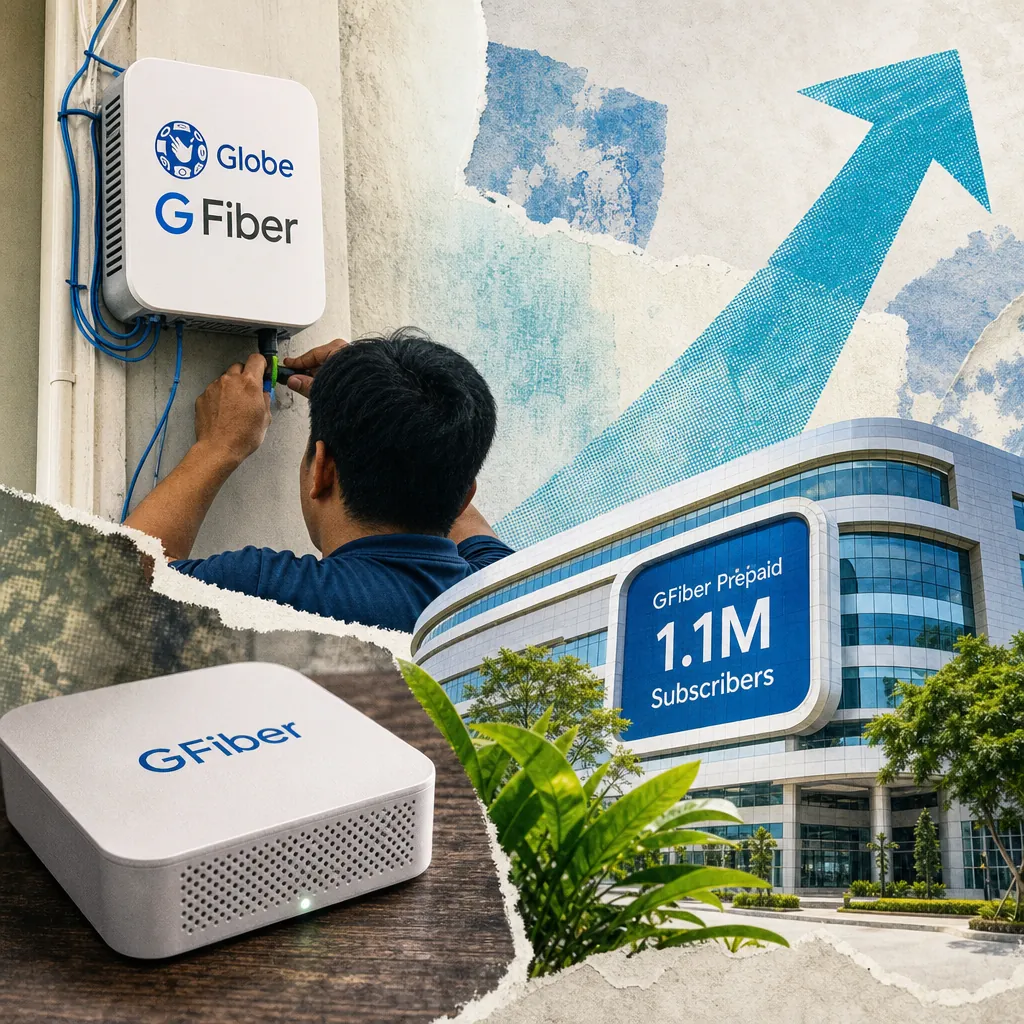
Globe Telecom's broadband business posted strong growth in the first half of 2026, with wired broadband subscribers rising 32% year-on-year to more than 2 million, driven by the shift of Filipino households from legacy fixed wireless services to fiber connectivity. Broadband revenues reached ₱12.4 billion during the period, up 6% from a year earlier, with fiber accounting for 93% of total broadband revenues. A key driver was GFiber Prepaid, which reached 1.1 million subscribers as of end-June 2026, as households sought flexibility in managing their home internet needs. The growth highlights the increasing reliance on connectivity for work, education, entertainment, and everyday digital services.
Meanwhile, the Philippine Competition Commission (PCC) has launched a market study of the local concert ticketing industry, seeking input from Filipinos who have complained about soaring ticket prices. This follows a U.S. federal jury finding Live Nation and Ticketmaster liable for monopolization in April, putting renewed attention on dominant players' influence over ticket prices and competition. The PCC's study is at an initial stage, but it signals potential scrutiny of the Philippine ticketing sector.
The Department of Labor and Employment (DOLE) is studying policies for delivery riders, whose services are vital during bad weather. Labor Secretary Francis Tolentino noted that the Labor Code, drafted in 1974, did not anticipate this type of work, which boomed during the COVID-19 pandemic. DOLE is ready to push for policies that would not require amendments to existing laws, potentially including hazard pay and night shift differential.
Key themes
- Fiber broadband growth accelerates as households shift from legacy services — Globe's wired broadband subscribers grew 32% year-on-year to over 2 million, with fiber now accounting for 93% of broadband revenues. This reflects a structural shift in how Filipinos connect to the internet, driven by the need for reliable connectivity for work, education, and entertainment.
- GFiber Prepaid reaches 1.1 million subscribers, tapping flexibility-seeking households — The prepaid fiber service has become a key growth driver, attracting households that want to manage their internet spending without long-term contracts. This segment is likely to continue growing as more Filipinos seek affordable, flexible connectivity options.
- Philippine Competition Commission launches market study on concert ticketing — Following the U.S. antitrust ruling against Live Nation and Ticketmaster, the PCC is now examining the local ticketing industry, which has grown alongside the country's concert culture. The study could lead to regulatory action if competition concerns are found.
- DOLE studies labor policies for delivery riders — The Department of Labor and Employment is exploring hazard pay and night shift differential for delivery riders, an emerging sector that lacks clear labor policies. This could formalize protections for gig workers who are essential during bad weather.
- BSP and KasKasan Buddies partner to bring financial education to 2 million users — The Bangko Sentral ng Pilipinas (BSP) and KasKasan Buddies (KKB) launched a collaboration to deliver plain-language financial education content through KKB's platform, covering how financial products work and how to guard against risk. This is part of a broader push to improve financial literacy in the Philippines.
- Stock market falls on Middle East concerns, trading remains tepid — The Philippine Stock Exchange index declined 58.84 points to close at 6,238.46, with foreign investors net sellers at ₱2 billion. Average daily trade value was ₱5.86 billion, reflecting poor confidence amid geopolitical uncertainty.
- Alaska Milk appoints new managing director — Marjorie "Marj" Garrovillo, a seasoned Filipina business leader with over 25 years of experience, has been named managing director of Alaska Milk Corporation. Her appointment marks a return to FrieslandCampina, where she previously served as marketing director in Vietnam.
- Psychiatrist groups call for deferral of DepEd live-shooter drills — The Philippine Psychiatric Association and the Philippine Society for Child and Adolescent Psychiatry urged the Department of Education to defer nationwide live-shooter drills, saying they expose learners to "hyper-realistic scenarios of violence" that could be traumatic.
How the narratives stack
Dominant — The dominant narrative in the captured set is the growth of Globe's fiber broadband business, which drew the highest advertising-equivalent value among the items reviewed. The story of 32% subscriber growth and the rise of GFiber Prepaid underscores the accelerating shift to fiber connectivity in the Philippines, a trend with broad implications for the telecom sector and digital economy. This narrative is supported by the detailed financial figures and the strategic importance of prepaid fiber in expanding access.
Counter-narrative — A counter-narrative emerges from the Philippine Competition Commission's market study on concert ticketing. While the telecom story is about growth and expansion, the ticketing study highlights concerns about market power and consumer welfare. The U.S. antitrust ruling against Live Nation and Ticketmaster provides a backdrop, suggesting that similar scrutiny could lead to regulatory changes in the Philippines. This narrative challenges the assumption that market growth alone benefits consumers.
Emerging — The DOLE's study of policies for delivery riders is an emerging narrative that could reshape the gig economy. As delivery services become increasingly vital, especially during bad weather, the lack of clear labor policies is becoming a pressing issue. DOLE's willingness to push for policies without amending existing laws suggests a pragmatic approach that could set a precedent for other gig workers.
Under-covered — The BSP and KasKasan Buddies collaboration on financial education received relatively low coverage value in the captured set, despite its potential to improve financial literacy among millions of Filipinos. This story is under-covered in the sense that it did not generate as much attention as other items, but it represents a significant effort to address a long-standing challenge in the country.
Platform insights
- Facebook — The monitoring writeup did not provide specific engagement figures for Facebook posts, but the platform is likely a major venue for discussions on telecom services, given its widespread use in the Philippines. Posts about fiber internet speeds and pricing often generate significant comments and shares, as consumers share experiences and recommendations.
- X (formerly Twitter) — X is a key platform for real-time discussions on stock market movements and geopolitical events. The stock market decline and Middle East concerns likely trended on X, with analysts and investors sharing their views. The platform's fast-paced nature makes it ideal for breaking news and market commentary.
- YouTube — YouTube is a significant platform for content related to concerts and entertainment, which ties into the ticketing industry narrative. Music videos and concert vlogs often attract high view counts, and the PCC's market study could be discussed in video essays or news segments.
- Reddit — Reddit communities focused on Philippine finance and investing may have discussed the stock market decline and the PCC's ticketing study. Subreddits like r/Philippines and r/phinvest often feature detailed discussions on economic and regulatory topics, providing a space for deeper analysis.
Key voices and communities
- Telecom industry analysts and consumers — Analysts and consumers are key voices in the fiber broadband narrative. Analysts provide context on market trends and competitive dynamics, while consumers share their experiences with fiber vs. legacy services. Their discussions on social media influence perceptions of service quality and value.
- Government regulators and policymakers — The Philippine Competition Commission and the Department of Labor and Employment are central to the ticketing and delivery rider narratives. Their actions and statements shape the regulatory environment and are closely watched by industry stakeholders and the public.
- Financial educators and advocates — The BSP and KasKasan Buddies collaboration brings together financial educators and advocates who are working to improve financial literacy. Their content aims to empower consumers with knowledge about financial products and risk management.
- Psychiatrists and child development experts — The Philippine Psychiatric Association and the Philippine Society for Child and Adolescent Psychiatry are key voices in the debate over live-shooter drills. Their expertise on trauma and child development informs their call for deferral, and they are likely to engage with parents and educators on social media.
- Business leaders and entrepreneurs — Figures like David Sison of Mama Lou's and Marjorie Garrovillo of Alaska Milk represent the entrepreneurial and corporate leadership voices. Their stories and insights on business lessons and leadership are shared across platforms, inspiring others and shaping perceptions of the business environment.
Narrative streams
Globe's fiber broadband growth signals a structural shift in home connectivity
Globe Telecom's broadband business posted strong growth in the first half of 2026, with wired broadband subscribers rising 32% year-on-year to more than 2 million. This growth was driven by the sustained shift of Filipino households from legacy fixed wireless services to fiber connectivity, which offers faster and more reliable internet. Broadband revenues reached ₱12.4 billion during the period, up 6% from a year earlier, with fiber accounting for 93% of total broadband revenues.
The growth of GFiber Prepaid, which reached 1.1 million subscribers as of end-June 2026, is a key driver. The prepaid fiber service attracted households seeking flexibility in managing their home internet needs, with growth supported by higher-value reloads. This suggests that consumers are increasingly willing to pay for quality connectivity, but they want options that fit their budgets and usage patterns.
The read for the sector is that fiber is becoming the standard for home internet in the Philippines, and telecom providers must continue to invest in fiber infrastructure to meet demand. The success of prepaid fiber also indicates a market segment that values flexibility, which could influence pricing and product strategies across the industry.
PCC's market study on concert ticketing could reshape the industry
The Philippine Competition Commission (PCC) has launched a market study of the local concert ticketing industry, seeking input from Filipinos who have complained about soaring ticket prices. This follows a U.S. federal jury finding Live Nation and its subsidiary Ticketmaster liable for monopolization in April, which put renewed attention on the enormous influence that dominant players can wield over ticket prices and competition.
The PCC's study is at an initial stage, but it signals that the Philippine ticketing sector could face scrutiny similar to that in the United States. The study will examine market structure, competition, and consumer welfare, and could lead to recommendations for regulatory changes or enforcement actions.
The read for the sector is that ticketing companies and event organizers should prepare for increased regulatory oversight. They may need to review their pricing practices, exclusive agreements, and market dominance to ensure compliance with competition laws. Consumers, meanwhile, may benefit from more transparent and competitive ticketing markets.
DOLE's study of delivery rider policies could formalize gig worker protections
The Department of Labor and Employment (DOLE) is studying policies for delivery riders, whose services are particularly vital during bad weather. Labor Secretary Francis Tolentino described delivery services as an emerging sector that still lacks clear labor policies. He noted that when the Labor Code was drafted in 1974, this type of work did not exist, and the sector only boomed during the COVID-19 pandemic.
DOLE is ready to push for policies that would not require amendments to existing laws, potentially including hazard pay and night shift differential. This could provide delivery riders with formal protections and benefits, addressing concerns about their working conditions and income security.
The read for the sector is that gig economy platforms and delivery companies should anticipate new labor regulations. They may need to adjust their compensation structures and working conditions to comply with future policies. This could also set a precedent for other gig workers, such as ride-hailing drivers and freelance workers, who may seek similar protections.
BSP and KasKasan Buddies partnership expands financial education reach
The Bangko Sentral ng Pilipinas (BSP) and KasKasan Buddies (KKB) formally launched an educational collaboration on August 4, 2026, bringing PisoLit — BSP's official financial education platform — directly into KKB's community of over 2 million Buddies. BSP Deputy Governor Bernadette Romulo-Puyat said the goal is to help Filipinos understand financial products, know which features fit their needs, and learn how to manage risks through platforms where they're already having these conversations.
Under the collaboration, BSP and KKB will jointly develop and distribute plain-language educational content through KKB's channels, covering how financial products work, which ones fit specific needs, and how to guard against risk. This follows a string of 2026 partnerships for KKB, including collaborations with CCAP on responsible credit card use, FinTech Alliance PH on digital literacy and scam protection, and CICC on consumer protection against digital fraud.
The read for the sector is that financial education is becoming a priority for regulators and industry players. By partnering with platforms like KKB, BSP is leveraging existing communities to reach a wider audience. This could lead to more informed consumers who are better able to navigate financial products and avoid scams, ultimately contributing to financial stability.
Stock market decline reflects geopolitical uncertainty and weak investor confidence
Share prices fell last week on renewed concerns over the situation in the Middle East, as the United States-Iran ceasefire ended without a deal. The benchmark Philippine Stock Exchange index declined 58.84 points to close at 6,238.46 points. Trading was tepid during the four-day work week, reflecting poor confidence, according to Japhet Louis O. Tantiangco, senior research analyst at Philstocks Financials Inc.
Average value of trade reached ₱5.86 billion, and foreign investors, who cornered 40 percent of the trades, were net sellers at ₱2 billion. Other sub-indices ended mixed, with the Mining and Oil index surging 1,344.27 points to 19,347.20, likely due to rising oil prices amid geopolitical tensions.
The read for the sector is that investor sentiment remains fragile, and geopolitical events can quickly derail market gains. Companies may find it harder to raise capital in such an environment, and investors should be prepared for continued volatility. The surge in mining and oil stocks suggests that commodity-related sectors may benefit from geopolitical instability.
Alaska Milk's new managing director signals continuity and growth ambitions
Alaska Milk Corporation (AMC) has appointed Marjorie "Marj" Garrovillo as its new managing director, a seasoned Filipina business leader with more than 25 years of leadership experience across seven countries and the food, beverage, telecommunications, and consumer goods industries. In her new role, Garrovillo will lead AMC as it strengthens its trusted brands, pursues new growth opportunities, and advances its purpose of providing affordable and accessible nutrition to Filipino families.
The appointment marks Garrovillo's return to FrieslandCampina, where she previously served as marketing director in Vietnam. Before joining AMC, she held senior leadership roles at Smart Communications, Nestlé, Danone, Coca-Cola, AkzoNobel, and Unilever, giving her a broad and deep understanding of consumer markets.
The read for the sector is that Alaska Milk is positioning itself for growth under new leadership, with a focus on strengthening brands and expanding its reach. Garrovillo's experience in both food and telecom sectors could bring fresh perspectives on digital engagement and consumer insights, which may be crucial in a competitive dairy market.
Psychiatrist groups' call to defer live-shooter drills highlights mental health concerns
The Philippine Psychiatric Association (PPA) and the Philippine Society for Child and Adolescent Psychiatry (PSCAP) called for the deferral of the Department of Education's nationwide live-shooter drills, saying the exercises expose learners to "hyper-realistic scenarios of violence." DepEd earlier issued a memorandum ordering schools nationwide to conduct a "Nationwide Simultaneous School Safety Drill for Active Attack Incidents" on Aug. 25.
The groups stressed that while preparedness is crucial, safety exercises must be trauma-informed and based on scientific evidence. They noted that such simulations differ from routine safety drills like earthquake or fire exercises, which are necessary and beneficial.
The read for the sector is that schools and policymakers must balance safety preparedness with mental health considerations. This debate could lead to more nuanced approaches to school safety drills, incorporating input from mental health professionals. It also highlights the growing awareness of trauma-informed practices in education.
Conversation trajectory
- Fiber broadband growth to continue over the next 12 months — Globe's strong first-half performance suggests sustained momentum in fiber adoption. As more households switch from legacy services, competitors like PLDT and Converge are likely to respond with aggressive fiber promotions. Expect continued subscriber growth and potential price competition in the prepaid fiber segment. Observation window: next two quarterly earnings reports.
- PCC ticketing study to conclude within 6-12 months — Market studies typically take several months to complete, including public consultations and data gathering. The PCC may release interim findings or recommendations by mid-2027. If the study finds competition concerns, it could lead to enforcement actions or policy recommendations. Observation window: 6-12 months.
- DOLE delivery rider policies to be announced within 3-6 months — DOLE's study is likely to result in policy proposals or guidelines within the next few months. The department may issue a department order or circular outlining hazard pay and night shift differential for delivery riders. Observation window: next 3-6 months.
- Stock market volatility to persist amid geopolitical tensions — The Middle East situation remains unresolved, and any escalation could trigger further sell-offs. Investors should monitor oil prices and geopolitical news. The Philippine Stock Exchange index may test support levels if foreign selling continues. Observation window: next 1-3 months.
- Financial education partnerships to expand — The BSP's collaboration with KKB is part of a broader trend of public-private partnerships in financial education. Expect more partnerships with fintech companies and community organizations, potentially leading to a more financially literate population. Observation window: next 6-12 months.
- Trigger events to watch — Globe's next quarterly earnings report (likely November 2026) for fiber subscriber updates; PCC's release of the ticketing study's terms of reference or interim findings; DOLE's issuance of any policy on delivery riders; and any major geopolitical development in the Middle East that could affect markets.
Response guidance
- Telecom providers — Emphasize the benefits of fiber connectivity in marketing campaigns, highlighting speed, reliability, and flexibility. For prepaid fiber, focus on affordability and no-contract flexibility. Address common consumer pain points like installation time and customer service.
- Ticketing companies and event organizers — Proactively review pricing practices and ensure transparency. Engage with the PCC's market study by providing data and insights. Communicate to consumers how ticket prices are determined and what steps are being taken to ensure fair access.
- Delivery platforms and gig economy companies — Monitor DOLE's policy developments closely. Prepare to adjust compensation structures and working conditions to comply with potential regulations. Communicate with riders about any changes and ensure they understand their rights.
- Financial institutions and fintech companies — Leverage partnerships like the BSP-KKB collaboration to enhance financial education efforts. Create plain-language content that helps consumers understand products and avoid scams. Highlight the importance of financial literacy in building trust.
- Schools and educational institutions — When implementing safety drills, consider mental health impacts. Consult with mental health professionals and provide support resources for students. Communicate with parents about the purpose and nature of drills to alleviate concerns.
- Investors and market participants — Stay informed about geopolitical developments and their potential impact on markets. Diversify portfolios to manage risk, and consider opportunities in commodity-related sectors that may benefit from geopolitical tensions.
See the full picture behind today's signals.
This report draws from Media Meter's MediaWatch, our real-time monitoring engine tracking 2,470+ Philippine sources across print, broadcast, digital, and social. Explore how the platform turns raw coverage into decision-grade intelligence, then see how it's configured for teams like yours — whether you're in PR agencies, corporate comms, government, or marketing.
Want more? Browse our Report Library for sector and crisis intelligence, or request a demo and we'll have your brand set up before the call.
Want this kind of intelligence on your brand?
This brief is built on the same MediaWatch methodology that runs continuously across every brand we monitor. See your competitive landscape, Impact Score, and narrative trajectory in a 30-minute demo.