Iloilo Well Contamination Raises Health Alarm
Iloilo City has found E. coli and discoloration in shallow wells serving densely populated barangays, prompting expanded testing ahead of a possible Super El Niño. The same day's coverage also carried OFW remittance-fee legislation, Philippine food export gains in Australia, and Metro Retail's nine-month earnings.
The Conversation
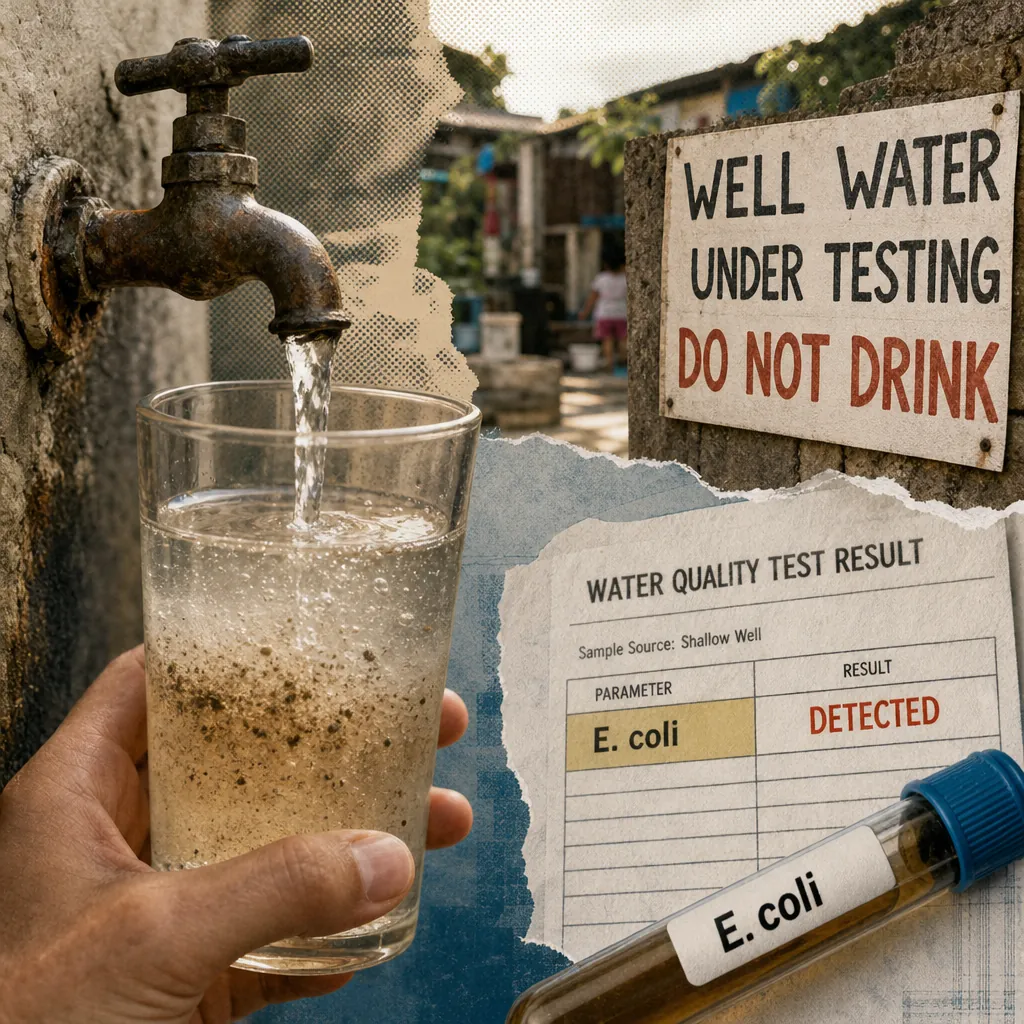
Three shallow wells in Iloilo City's City Proper district have tested positive for E. coli, and the city's General Services Office (GSO) confirmed on Thursday, November 19, that it is expanding sampling across 25 high-risk barangays as it tries to establish how far the contamination reaches1129. The wells sit in Barangay Muelle Loney, where a fourth well is also reported to have a falling water level, and in Barangay Zamora-Melliza, where two privately owned wells and one communal well were found to have discolored water11. GSO head Neil Ravena said inspections in City Proper are ongoing and that laboratory results are still coming in11.
The story ran on two local outlets the same afternoon. Daily Guardian broke the confirmation of E. coli detection and the count of affected wells11; Panay News widened the frame, reporting that the city maintains more than 1,000 shallow wells, that inspection teams are now monitoring sources in 24 barangays, and that one well in Barangay Ingore, La Paz, has already been recommended for abandonment after repeatedly failing laboratory tests despite chlorination2939. Panay News also ran a separate opinion column calling the situation "a public health disaster waiting to happen" and warning that contaminated water does not always look contaminated39.
For a retail and consumer-goods readership, the significance is in what shallow wells are: the household water source for hundreds of families in densely populated, low-income communities that are not connected to a piped utility. The city is racing a possible Super El Niño — a stronger-than-usual warming of the Pacific that in the Philippines typically means drier months and lower groundwater levels — which would push more households onto shallow wells just as those wells are under suspicion29. Bottled water, water-refilling stations, and purification products are the immediate substitutes those households will buy, and the city's testing results over the coming days will determine how large that substitution becomes.
The day's other business and consumer coverage was scattered across unrelated beats. A Parañaque legislator pressed the House of Representatives to pass a bill capping remittance fees for overseas Filipino workers1. The Department of Trade and Industry (DTI) reported $2.48 million in booked and pending food sales from the Philippines' first national pavilion at an Australian trade show1249. Metro Retail Stores Group Inc. posted a 31.9-percent rise in nine-month net income on flat third-quarter sales9. A DTI rural-enterprise program reported a 41.5-percent increase in average annual household income among participating farmers31. And a Philstar business column argued the economy is already in stagflation — slow growth plus rising prices — ahead of the official year-end figures53.
Key themes
- E. coli found in three Iloilo City shallow wells. The GSO confirmed contamination in City Proper and is validating results while sampling continues across 25 high-risk barangays1129.
- The city has over 1,000 shallow wells and only partial testing capacity. Inspection teams are monitoring 24 barangays, and one well in La Paz has already been recommended for abandonment2939.
- A possible Super El Niño raises the stakes. Lower rainfall would push more households onto shallow groundwater as contamination concerns widen29.
- A bill would let three agencies set remittance fees for OFWs. House Bill 8615 would task the Department of Finance, the Bangko Sentral ng Pilipinas, and the Department of Migrant Workers with fixing a minimum fee range1.
- Philippine food exporters booked $2.48 million at Fine Food Australia 2026. About 34 percent, or roughly $843,200, was booked sales; the rest was still under negotiation1249.
- Metro Retail's nine-month net income rose 31.9 percent to P281.3 million. Net sales grew 1.9 percent to P29.25 billion, but third-quarter sales stalled as cost-of-living pressures hit discretionary spending9.
- A DTI rural-enterprise project reports a 41.5-percent income gain. The RAPID Growth Project has reached over 228,439 individuals since 201931.
- A business column says the economy is in stagflation. It cites weak peso, flat revenues, and warnings from business leaders ahead of year-end data53.
How the narratives stack
Dominant. The Iloilo well contamination is the most consequential story in this set because it concerns drinking water for hundreds of households and because the city itself confirmed the finding. It drew two local news reports and an opinion column in the same afternoon112939. Within the captured items, it is the only story with a direct, immediate public-health consequence.
Counter-narrative. The Philstar business column pushes against the official wait-for-year-end posture, arguing that stagflation is already here and that business leaders Jaime Zobel de Ayala and Manny Pangilinan have spoken out about it53. Economic Planning Secretary Arsi Balisacan, the column notes, still wants final figures before using the term. That is a genuine disagreement about timing and labels, not about whether growth is weak.
Emerging. The OFW remittance-fee bill is a policy proposal, not yet law, and its consumer effect depends on how the three agencies would set the fee range1. The food-export result is a first-time trade outcome whose value depends on whether the 66 percent still under negotiation converts to orders1249.
Under-covered. The DTI RAPID Growth Project's reported 41.5-percent income gain reached a single provincial outlet31. It is a substantial claim about rural household incomes and received far less attention in this set than the Iloilo wells or the earnings report.
Platform insights
- Facebook. The Iloilo contamination reports are the kind of local public-health story that spreads through barangay and city Facebook groups, where residents share water advisories and photos of discolored water. The Panay News opinion column's warning that clear water can still carry disease is the message most likely to be forwarded39.
- X. The stagflation column and the remittance-fee bill are the items most likely to draw commentary from policy and business accounts, since both involve named officials and agencies153.
- Reddit. Discussions of the Metro Retail results and the stagflation claim would likely center on whether flat third-quarter sales match readers' own experience of household budgets953.
- YouTube. Local news channels in Iloilo are the likely venue for video reports on the well testing, given the visual nature of water sampling and the city's inspection drive1129.
Key voices and communities
Iloilo City residents and barangay communities. Households in Muelle Loney, Zamora-Melliza, and Ingore are the people directly affected. Their framing is practical: whether the water coming out of their wells is safe to drink, cook with, and bathe in1129.
The Iloilo City government and GSO. Ravena and the GSO are the official voice, confirming contamination while stressing that validation is ongoing11. Their credibility depends on releasing laboratory results promptly.
Panay News. The regional outlet has taken an advocacy stance, running both a news report and an opinion column that calls for urgent action and warns of a public health disaster2939.
Overseas Filipino workers and their families. The remittance-fee bill speaks to OFWs who send money home regularly and to the families who receive it, with Parañaque Rep. Brian Raymund Yamsuan arguing that savings from lower fees would add to what is sent1.
Philippine food exporters and the DTI. The exporters who joined the Australian trade show and the DTI, which organized the pavilion, are the parties tracking whether the $2.48 million in deals converts to repeat orders1249.
Narrative streams
Iloilo City confirms E. coli in three shallow wells and widens testing
The GSO's confirmation that three shallow wells in City Proper tested positive for E. coli is the first official acknowledgment that contamination has reached household water sources in the city11. Ravena said inspections in City Proper are ongoing and that water sampling and laboratory results are still underway11. In Zamora-Melliza, two privately owned wells and one communal well showed discolored water, and the city collected samples for testing and worked with residents on possible causes11.
Panay News reported that the city has more than 1,000 shallow wells and that inspection teams are monitoring sources in 24 barangays, with priority on 25 high-risk barangays where wastewater from septic tanks and drainage canals may be seeping into wells29. The paper also reported that a well in Barangay Ingore, La Paz, has already been recommended for abandonment after repeatedly failing laboratory tests despite chlorination39. That detail matters because it shows the problem is not confined to the wells currently under validation.
The read for the sector is that water retailers, refilling stations, and bottled-water brands should expect a localized demand increase in Iloilo City if more wells fail testing, and that supermarkets and convenience stores in the affected barangays will be the first to see it. The city's testing results over the next several days will determine whether that demand stays localized or spreads across the city's 24 monitored barangays29.
A bill would cap remittance fees for overseas Filipino workers
Parañaque Rep. Brian Raymund Yamsuan urged the House of Representatives to pass House Bill No. 8615, the proposed Overseas Filipino Workers Remittance Protection Act, which would task the Department of Finance, the Bangko Sentral ng Pilipinas, and the Department of Migrant Workers with setting the minimum possible range of remittance fees and related charges after consulting stakeholders1. The bill's Section 5 contains that mandate. Yamsuan argued that savings from lower fees, and from avoiding hidden charges, would add to what OFWs send home, helping families cope with rising prices1.
Remittance fees are the charges money-transfer operators and banks deduct when an OFW sends money to the Philippines. Even a small percentage reduction matters because remittances are a major source of household income for millions of Filipino families. The bill does not itself set a fee; it delegates the setting to three agencies, which means the consumer effect depends on how aggressively those agencies use the authority.
The read for the sector is that remittance channels, banks, and money-transfer operators face a possible regulated ceiling on fees, which would compress margins on OFW transfers and could push operators to compete on speed and service instead of price. For retailers, the effect is indirect: lower fees mean slightly more disposable income in remittance-receiving households, which tends to flow to food and household goods.
Philippine food exporters book $2.48 million at Fine Food Australia 2026
The DTI reported that the Philippines generated $2.48 million in combined booked sales and ongoing negotiations from its debut at Fine Food Australia 2026, the largest food industry trade event in Australia12. About 34 percent of the total, or roughly $843,200, was booked sales, with the remaining 66 percent still under negotiation49. Eleven Philippine food companies participated in the country's first national pavilion at the show, which ran from August 31 to September 3 at the Melbourne Convention and Exhibition Centre49.
Buyers showed strong interest in ube-based products such as powder, yam, and spreads, alongside banana chips, seafood, specialty ingredients, seasonings, and pili nut products12. For producers, including Bicol's pili nut businesses, the negotiations could lead to repeat orders and a foothold in Australian stores and food service outlets if they result in distribution deals49.
The read for the sector is that Philippine food manufacturers have a concrete opening in Australia, but the value depends on converting the 66 percent still under negotiation into orders. Companies that land distribution deals will need to meet Australian food-safety and labeling standards, which is where the DTI's export-support role becomes relevant.
Metro Retail's nine-month income rises 31.9 percent as third-quarter sales stall
Metro Retail Stores Group Inc., the Gaisano-led retailer, reported a 31.9-percent increase in consolidated net income to P281.3 million for the first nine months of 2026, driven by wider gross margins and operating efficiencies9. Net sales grew 1.9 percent to P29.25 billion, supported by a 1.4-percent increase in same-store sales. Food retail sales rose 2.7 percent, while general merchandise sales were flat9.
Sales growth stalled in the third quarter as cost-of-living pressures weighed on discretionary consumer spending9. Blended gross margin expanded to 22.4 percent from 21.7 percent a year earlier, lifting gross profit by 5.1 percent to P6.54 billion, while operating expenses rose 5.3 percent to P6.38 billion on higher global oil prices and foreign exchange pressure9.
The read for the sector is that Metro Retail's profit growth came from margin management, not from selling more. Food held up while general merchandise did not, which tells consumer-goods brands that discretionary categories face a harder sell in provincial malls through the rest of the year. The retailer's 83rd store, noted in its earlier expansion, signals it is still adding footprint even as same-store growth slows9.
A DTI rural-enterprise project reports a 41.5-percent income gain
The DTI's Rural Agro-enterprise Partnership for Agricultural Development and Growth (RAPID Growth) Project has reached over 228,439 individuals and driven a 41.5-percent increase in average annual household income since 2025, according to a provincial report31. Launched in 2019, the project integrates smallholder farmers into commercial agricultural value chains through financial services for coconut farmers, direct capital investments for agricultural cooperatives, and infrastructure linking remote farming communities to markets31. In Cotabato province, the Makilala Multipurpose Cooperative and Sta. Catalina Multipurpose Cooperative introduced specialized financial products under the project31.
The read for the sector is that rural household income gains of this size, if they hold, expand the customer base for packaged food, household goods, and small-format retail in Eastern Visayas and Mindanao. Consumer-goods companies distributing in those regions have a reason to look at cooperative-linked supply chains as a route to market.
A business column says stagflation has already arrived
A Philstar business column argued that "Christmas this year has already been stolen by the stagflation grinch," citing a very slow economy and a weak peso that have limited businesses to flat or marginal revenue growth53. It noted that Economic Planning Secretary Arsi Balisacan still wants final year-end figures before acknowledging stagflation, while Management Association of the Philippines president Donald Lim sees little room for a meaningful rebound before year end53. The column also flagged recent statements by Jaime Zobel de Ayala and Manny Pangilinan on the state of the economy as significant because business leaders rarely speak out53.
Stagflation is the combination of slow economic growth and rising prices, a difficult mix because the usual tools for fighting inflation tend to slow growth further. For retailers, it means consumers trade down, defer discretionary purchases, and concentrate spending on essentials — the same pattern visible in Metro Retail's flat general merchandise sales9.
The read for the sector is that retailers and consumer-goods companies should plan for a holiday season in which volume growth is hard to find and margin discipline matters more than expansion. The official year-end figures will settle the labeling dispute, but the operating environment the column describes is already reflected in the earnings data.
Conversation trajectory
Iloilo City laboratory results (next 3–7 days). The GSO said sampling and laboratory results are still underway11. Watch for additional wells confirmed positive and for any advisory on boiling or avoiding specific sources. If more wells fail, expect a measurable spike in bottled-water and refilling-station demand in City Proper.
Super El Niño forecasts (next 1–3 months). The city's inspection drive is explicitly framed around a possible Super El Niño29. Watch for rainfall forecasts and groundwater-level reports; a dry spell would raise the number of households relying on shallow wells and widen the exposure.
House Bill 8615 (next several months). The bill needs House passage and Senate action before the three agencies can set fees1. Watch for committee hearings and for positions from banks and money-transfer operators, which would bear the fee ceiling.
Fine Food Australia follow-through (next 3–6 months). The 66 percent of deals still under negotiation will either convert or lapse49. Watch for DTI announcements on signed distribution deals and for repeat-order data from the 11 participating companies.
Year-end economic data (December 2026–January 2027). The stagflation dispute will be tested by official growth and inflation figures53. Watch whether the government adopts the term and whether business leaders escalate their public warnings.
Metro Retail's fourth-quarter results (early 2027). The retailer's holiday-quarter sales will show whether the third-quarter stall was a blip or the start of a weaker consumer stretch9.
Response guidance
Water and beverage brands in Iloilo. Prepare localized supply for bottled water and refilling-station capacity in City Proper and the 24 monitored barangays, and coordinate with the city GSO on any advisory so that product messaging does not contradict official guidance1129.
Retailers in affected barangays. Stock water-purification products, and train store staff to direct customers to official city advisories rather than offering health advice. The Panay News warning that clear water can still carry disease is the message to reinforce39.
Remittance operators and banks. Prepare for a possible regulated fee range under House Bill 8615 and communicate clearly on total transfer costs, including charges that consumers may not see upfront1.
Food exporters. Treat the Australian negotiations as a pipeline to be worked, not a result to be announced, and prepare documentation for Australian food-safety and labeling requirements49.
Consumer-goods companies selling through provincial retail. Plan for a holiday season of flat discretionary demand and prioritize food and essential categories, consistent with Metro Retail's third-quarter pattern953.
Companies distributing in Eastern Visayas and Mindanao. Assess cooperative-linked supply chains as a route to rural customers, given the reported income gains under the RAPID Growth Project31.
See the full picture behind today's signals.
This report draws from Media Meter's MediaWatch, our real-time monitoring engine tracking 2,470+ Philippine sources across print, broadcast, digital, and social. Explore how the platform turns raw coverage into decision-grade intelligence, then see how it's configured for teams like yours — whether you're in PR agencies, corporate comms, government, or marketing.
Want more? Browse our Report Library for sector and crisis intelligence, or request a demo and we'll have your brand set up before the call.
Want this kind of intelligence on your brand?
This brief is built on the same MediaWatch methodology that runs continuously across every brand we monitor. See your competitive landscape, Impact Score, and narrative trajectory in a 30-minute demo.