PSEi Hits Six-Year Low as Stagflation Fears Build
Philippine stocks closed at 5,481.88 on November 16, their weakest finish since May 2020, as inflation, slowing growth and remittance resilience pulled the market in different directions. Coverage also tracked the Senate impeachment trial's financial-records fight and a draft SEC anti-money-laundering rule.
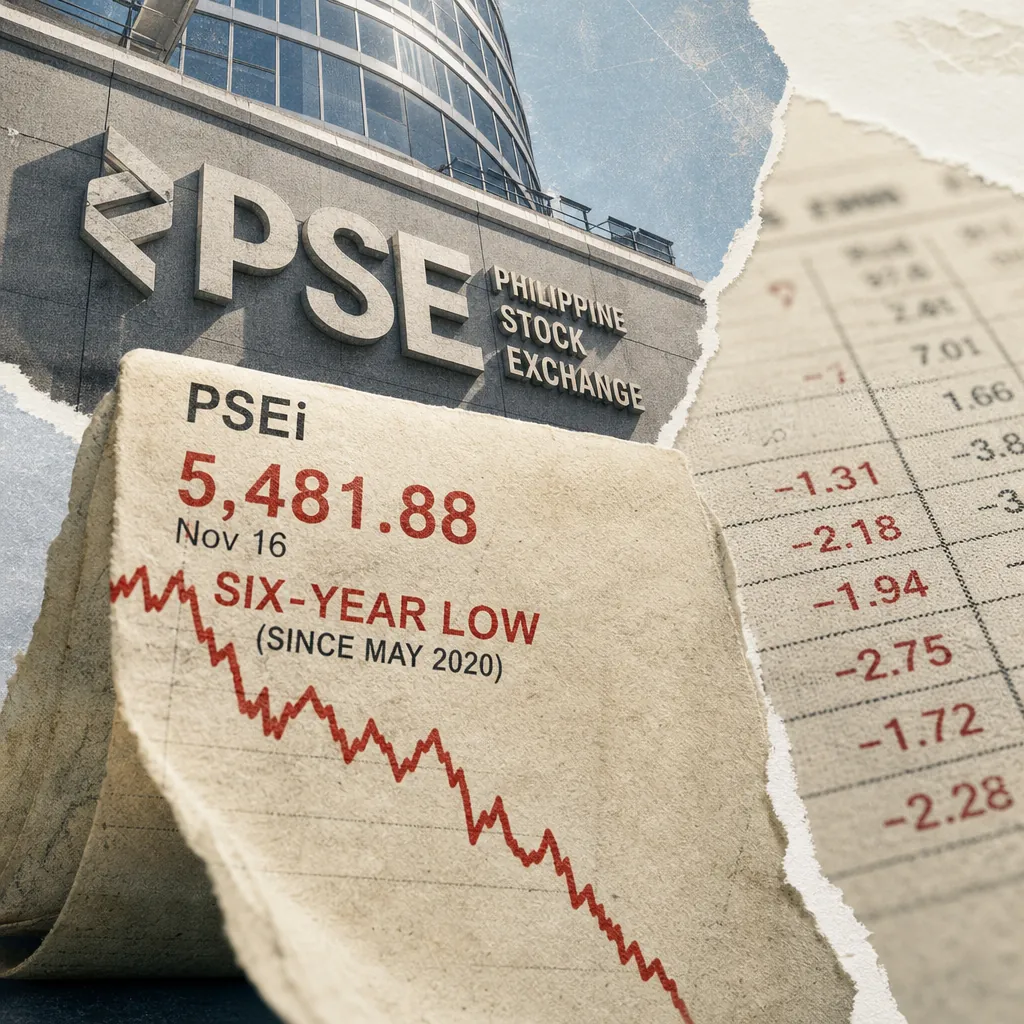
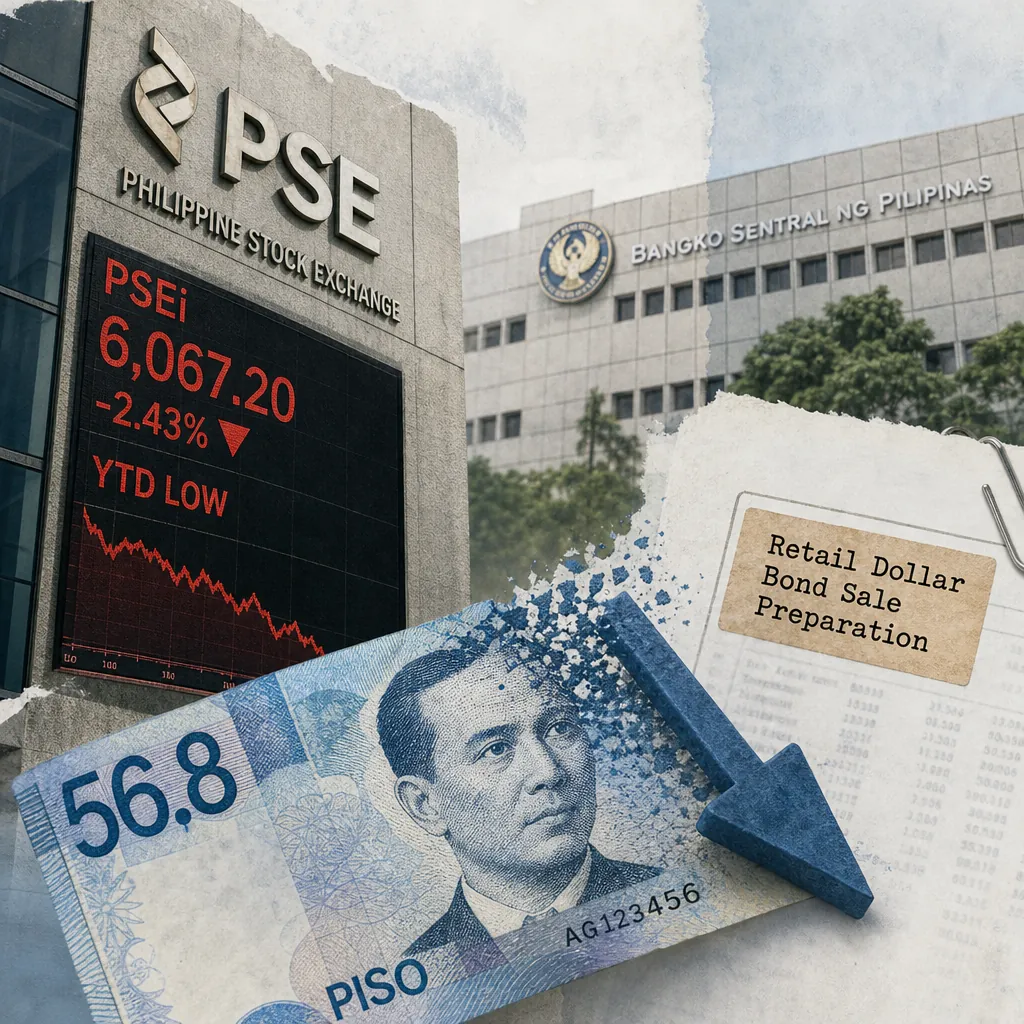
The Philippine Stock Exchange Index (PSEi) — the benchmark basket of 30 companies whose combined prices are used to gauge how the country's largest listed firms are faring — closed at 5,481.88 on Monday, November 16, down 111.61 points or 2 percent, its lowest finish since May 18, 2020, when pandemic lockdowns had frozen much of the economy4264. The index ended that day just 2.53 points above the 2020 trough of 5,479.3521. The broader All Shares index fell 52.15 points, or 1.65 percent, to 3,102.7864. It was the PSEi's third consecutive losing session64.
Brokerages attributed the drop to two pressures pulling in the same direction: inflation that has stayed high and growth that has kept slowing. Philstocks Financial said elevated inflation and decelerating economic output had weighed on investor sentiment42. Luis Limlingan, head of sales at Regina Capital Development Corp., said the market extended its decline as macroeconomic concerns persisted, adding that "Investor sentiment remained subdued amid concerns that the BSP (Bangko Sentral ng Pilipinas) may have limited room for further" easing42. First Metro Securities pointed also to weak global cues, including disappointing Japanese gross domestic product data and soft Chinese retail sales64.
The day's coverage in this set ran along several tracks. The market fall drew the heaviest newspaper attention, with the Inquirer, Philstar and the Manila Times all carrying versions of the story, alongside a blog write-up on Astig Ph214264. Moody's Analytics cut its 2026 growth forecast for the Philippines to 2.4 percent from 3 percent, citing weak domestic demand and a faster-than-expected loss of momentum after another disappointing quarter4. The Bangko Sentral ng Pilipinas (BSP), the country's central bank, reported that cash remittances — money sent home through banks by Filipinos working abroad — rose 2.6 percent year-on-year to $3.2 billion in September, the fastest pace in eight months555. And the Securities and Exchange Commission (SEC) published draft anti-money-laundering rules for brokers, fund managers, lenders and crypto-asset service providers, open for comment until December 117.
Key themes
- The PSEi closed at 5,481.88, its lowest level since May 2020. The 2 percent fall, or 111.61 points, put the index within 2.53 points of its pandemic-era trough and marked a third straight losing session422164.
- Moody's Analytics cut its 2026 Philippine growth forecast to 2.4 percent from 3 percent. The firm cited persistently weak domestic demand and a faster-than-expected loss of momentum after a disappointing third quarter4.
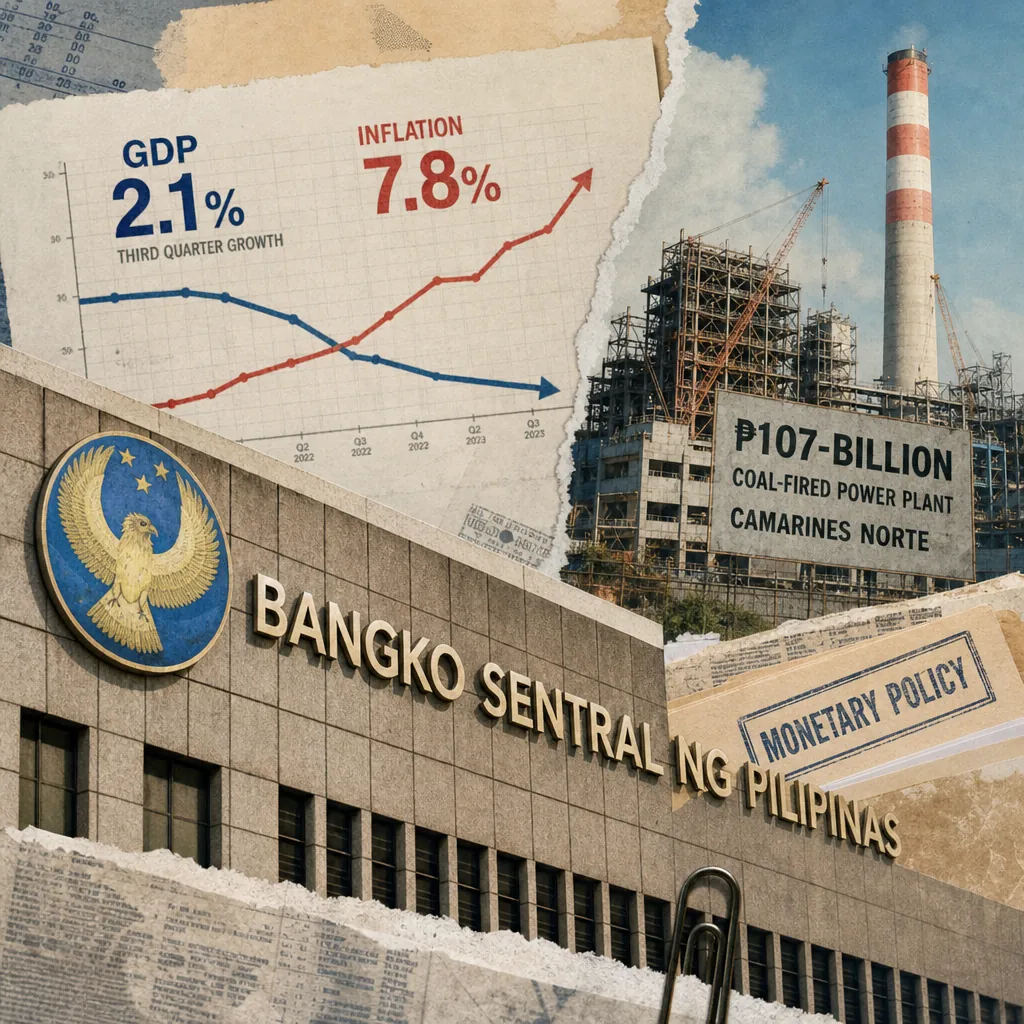
- Third-quarter GDP grew 2.1 percent year-on-year, slower than the upwardly revised 2.4 percent of the prior quarter. That is the fifth consecutive quarter of deceleration, according to a Vera Files analysis445.
- Inflation reached 7.8 percent in October 2026 and unemployment stood at 5.4 percent in September. Those two figures, combined with the slowing growth, are the ingredients of stagflation — rising prices alongside weak growth and joblessness45.
- Cash remittances rose 2.6 percent to $3.2 billion in September, the fastest growth in eight months. The nine-month total of $26.63 billion was up 2.3 percent from a year earlier and covered nearly 73 percent of the BSP's full-year estimate of $36.6 billion55559.
- The SEC drafted tighter anti-money-laundering rules covering brokers, fund managers, lenders and crypto firms. Covered firms would have three months to adopt or update risk-prevention programs, secure board approval and submit them to the commission7.
- The Senate impeachment court subpoenaed four defense witnesses for hearings on November 19 and 20. The witnesses, including an anti-money-laundering lawyer and three government officials, will address the business records of Cale88 Foods Corp., a company linked to Vice President Sara Duterte's husband5256.
- ING expects the Philippines to lead Asia in rate cuts next year. The Dutch bank's Asia-Pacific research head, Deepali Bhargava, said moderating inflation could give most Asian central banks room to ease in the second half of 2027, with the Philippines and Australia offering the strongest cases3.
How the narratives stack
Dominant. The stock market's six-year low dominated the business pages in this set. The Inquirer ran the story twice — once as a breaking item and once as a fuller report — Philstar led its business section with "Stocks plummet to lowest level in over 6 years," and the Manila Times carried the Moody's downgrade as its top business item44264. The Astig Ph blog added a detailed account tying the fall to the diplomatic week and noting the peso weakened in the same session21. The coverage value of the individual items varied widely — the Inquirer's main market story carried an estimated ₱221,508 in advertising-equivalent value, the Philstar version ₱271,932, and the Moody's story ₱316,244 — but the breadth of pickup across outlets is the more telling signal: four separate publications treated the same 2 percent fall as the day's lead business story44264.
Counter-narrative. Remittances provided the day's clearest counterweight. The BSP reported that cash remittances grew 2.6 percent to $3.2 billion in September, the fastest pace since January, when inflows rose 3.5 percent5. Personal remittances — a broader measure that includes cash sent through informal channels and transfers in kind — rose 2.7 percent to $3.55 billion69. The nine-month cash total of $26.63 billion was up 2.3 percent from $26.03 billion in the same period of 202555. A BSP survey of 321 households receiving overseas Filipino worker remittances found that 97.2 percent used the money for food and other household needs, while 63.2 percent allocated some for medical expenses59. The United States remained the largest recorded source of cash remittances from January to September, followed by Singapore and Saudi Arabia59. The counter-narrative is not that remittances offset the market fall — they do not — but that household purchasing power has a floor that the stock market does not. For retailers and consumer-facing businesses, the remittance flow is the more relevant indicator of what families can actually spend this Christmas season.
Emerging. The SEC's draft anti-money-laundering rules are the day's most consequential regulatory signal, though they drew a single item in this set7. The proposal updates the SEC's framework for combating money laundering, terrorist financing and proliferation financing. Covered firms — securities brokers, fund managers, lenders and crypto-asset service providers — would have to tailor prevention programs to their operations and risk profiles, secure board approval and submit the programs to the SEC. Local branches of foreign firms would need approval from their country or regional head. The comment period runs until December 11. The rules matter beyond compliance: they set the standard for how crypto exchanges and lenders verify who their customers are and how they report suspicious transactions, which in turn affects how quickly the Philippines can exit the Financial Action Task Force's grey list — the international watchlist of countries with weak anti-money-laundering controls. The Philippines has been working to exit that list, and tighter SEC rules are part of the case it presents to international assessors.
Under-covered. The ING forecast that the Philippines could lead Asia in rate cuts next year received a single Inquirer item3. Deepali Bhargava, head of Asia-Pacific research at ING, said moderating inflation could give most Asian central banks scope to ease policy in the second half of 2027, with Australia and the Philippines offering the strongest cases for cuts to support growth. "Growth is already slowing in several economies. Lagged effects of past monetary tightening could weigh on activity into 2027," Bhargava said3. The forecast sits awkwardly against the day's market story: the PSEi fell partly on concerns that the BSP has limited room to cut, while ING argues the case for cuts is strengthening. Both can be true — the timing differs — but the tension between the two readings went largely unexplored in the items captured here.
Platform insights
The monitoring writeup for this window did not include social-media engagement data, so this section is limited to what the published items themselves show about how the story travelled.
- Online news portals. The market story moved fastest through the Inquirer, Philstar and Manila Times portals, each publishing multiple versions within hours of the 3 p.m. close42644. The Inquirer ran the same market fall as two separate items — a breaking report and a fuller version — a pattern that suggests the story was being updated through the afternoon rather than filed once.
- Blogs. Astig Ph published a detailed account that placed the market fall against the backdrop of the Philippines' diplomatic week, noting the peso weakened in the same session and that the index closed just 2.53 points above its 2020 low21. The blog format allowed for more context than the wire-style portal reports.
- Specialist and trade outlets. Vera Files published an analysis piece framing the day's numbers as a stagflation problem rather than a single bad trading session, citing the 7.8 percent October inflation, 5.4 percent September unemployment and 2.1 percent third-quarter growth45. The piece is the only item in the set that connects the three data points into a single argument.
Key voices and communities
Brokerages and market analysts. Philstocks Financial, Regina Capital Development Corp. and First Metro Securities provided the day's market commentary, each framing the fall as a response to macroeconomic conditions rather than a single trigger4264. Their language — "stagflation risks," "subdued sentiment," "limited room" — set the tone for how the story was reported across outlets.
Moody's Analytics. The firm's decision to cut its 2026 growth forecast to 2.4 percent from 3 percent gave the market story an independent, institutional anchor4. Moody's Analytics is a subsidiary of Moody's Corporation established in 2007 to handle non-rating financial intelligence, software and risk-management solutions; its sister division, Moody's Ratings, handles credit ratings and currently rates the Philippines sovereign at Baa2 with a stable outlook, one notch above the minimum investment grade4. The distinction matters: the forecast cut came from the analytics arm, not the ratings arm, so it does not by itself change the country's credit rating.
The Bangko Sentral ng Pilipinas. The central bank's remittance data provided the day's most concrete household-level number55569. The BSP's year-end estimate of $36.6 billion in cash remittances, a 2.7 percent increase, is now nearly three-quarters covered with three months to go5.
Vera Files. The outlet's analysis piece argued that "Whether or not we meet every technical definition of stagflation, we are unmistakably in its territory," citing the Iran conflict's pressure on global oil prices and the resulting rise in energy, transport and food costs45. The piece is the set's clearest attempt to explain the underlying causes rather than the market symptom.
The Senate impeachment court and House prosecutors. The day's political-financial story ran through the impeachment trial of Vice President Sara Duterte, where prosecutors argued that her own financial disclosures could prove the allegations against her33. Lanao del Sur Rep. Zia Alonto Adiong, spokesperson for the House prosecution panel, said: "All the evidence that we have provided to the court were prepared, submitted, subscribed to and notarized by the Vice President"33.
Narrative streams
The PSEi's six-year low puts stagflation at the center of the business pages
The 2 percent fall to 5,481.88 was the day's most-covered business story in this set, and the coverage converged on a single explanation: the Philippines is showing the symptoms of stagflation, a condition in which prices rise while growth slows and unemployment stays high4245. Inflation reached 7.8 percent in October 2026, unemployment stood at 5.4 percent in September, and the economy grew 2.1 percent in the third quarter — the fifth consecutive quarter of deceleration45. The immediate triggers, according to Vera Files, include the conflict involving Iran and the resulting pressures on global oil prices, which have raised the cost of energy, transport, food and other essentials, as well as fertilizer prices and agricultural production costs45.
The market's fall was broad. All sectoral indices fell, with mining and oil among the weakest21. The peso weakened in the same session21. First Metro Securities noted that risk appetite was hit by weak global cues, including disappointing Japanese GDP data and soft Chinese retail sales64. The combination matters for ordinary readers because the PSEi is not an abstraction: it is the price that investors are willing to pay for the earnings of the country's 30 largest listed companies, and a six-year low means those investors expect those earnings to be weaker than they have been at any point since the pandemic. For companies that raise money by selling shares — banks, property developers, conglomerates — a lower index makes new capital more expensive. For households, the more direct channel is through pension funds and mutual funds that hold Philippine equities, whose values have fallen with the index.
The read for the sector is that the BSP's room to maneuver is the variable to watch. Limlingan's comment that sentiment was subdued amid concerns the BSP "may have limited room" captures the bind: inflation at 7.8 percent argues against cutting interest rates, but growth at 2.1 percent argues for it4245. ING's forecast that the Philippines could lead Asia in rate cuts in the second half of 2027 suggests the bank expects inflation to moderate enough by then to allow easing3. The gap between the market's current pessimism and ING's medium-term optimism is a timing question, and the next inflation print and the BSP's next policy meeting are the events that will resolve it.
Remittances grew at their fastest pace in eight months, cushioning household spending
Cash remittances rose 2.6 percent year-on-year to $3.2 billion in September, the fastest growth since January's 3.5 percent5. The nine-month total of $26.63 billion was up 2.3 percent from $26.03 billion in the same period of 2025, and accounted for nearly 73 percent of the BSP's year-end estimate of $36.6 billion5. Personal remittances, the broader measure, rose 2.7 percent to $3.55 billion from $3.46 billion a year earlier and $3.37 billion in August69.
The BSP said remittance inflows continued to support household consumption and domestic economic activity, underscoring their importance as a stable source of household income and foreign exchange55. The household-level detail is more revealing: in a BSP survey conducted in the fourth quarter of 2025, 97.2 percent of 321 households receiving overseas Filipino worker remittances said they used the money for food and other household needs, while 63.2 percent allocated some for medical expenses59. Those proportions explain why remittances function as a stabilizer: they go to necessities first, which means they keep flowing into grocery, transport and health spending even when the stock market falls.
The read for the sector is that consumer-facing businesses — retailers, food manufacturers, remittance channels — have a more reliable demand base this Christmas than the market headlines suggest. The BSP expects inflows to strengthen as the Christmas season approaches5. The risk is on the cost side: with inflation at 7.8 percent, a 2.6 percent increase in dollar remittances translates into a smaller increase in what families can actually buy, because the pesos buy less45. The peso's weakness in Monday's session adds a partial offset, since each dollar converts into more pesos, but the net effect depends on how far the currency moves.
The SEC's draft anti-money-laundering rules set a three-month clock for brokers and crypto firms
The SEC has drafted anti-money-laundering rules that would require securities brokers, fund managers, lenders and crypto-asset service providers to adopt or update risk-prevention programs within three months7. The proposal updates the SEC's framework for combating money laundering, terrorist financing and proliferation financing. Covered firms would have to tailor their prevention programs to their operations and risk profiles, secure board approval and submit the programs to the SEC. For local branches of foreign firms, approval should come from the country or regional head or an equivalent officer. Firms would have to keep their programs current and make them available during SEC examinations7. The commission is accepting comments through an online form linked to its November 13 notice until December 117.
The context is the Philippines' standing with the Financial Action Task Force, the international body that sets anti-money-laundering standards and maintains a list of countries with weak controls. The SEC's rules are one of the building blocks the country uses to demonstrate that its financial sector has adequate safeguards. The inclusion of crypto-asset service providers is the most consequential change: crypto exchanges have grown faster than the rules governing them, and the draft brings them into the same compliance framework as brokers and fund managers.
The read for the sector is that compliance costs will rise for smaller brokers and crypto firms that do not already have formal risk programs. A three-month window to adopt, secure board approval and submit a program is tight for firms that have been operating with informal controls. For larger institutions, the rules mostly formalize practices they already follow. The December 11 comment deadline gives the industry a month to shape the final text, and the firms most affected — crypto exchanges and smaller lenders — have the most to gain from engaging.
The impeachment trial's financial-records fight turns on seven years of asset disclosures
The Senate impeachment court subpoenaed four witnesses tapped by Vice President Sara Duterte's defense team for hearings on November 19 and 20, including an anti-money-laundering lawyer and three government officials, to shed light on the business records of Cale88 Foods Corp., a company linked to her husband, Manases Carpio5256. Senate Impeachment Clerk of Court Renato Bantug confirmed the subpoenas were sent electronically52. The defense team has not included Duterte or Carpio on its witness list; ten more witnesses are lined up, and 15 bank officials who were expected to explain financial transactions and bank records have been removed from the list65.
House prosecutors argued Monday that Duterte's own financial records could prove the allegations. Article II, the sole remaining impeachment charge, accuses her of amassing unexplained wealth, maintaining business interests while in public office and failing to fully disclose assets in her Statements of Assets, Liabilities and Net Worth (SALNs)33. The SALN is the annual form on which Philippine public officials must list their assets, liabilities and net worth; it is the primary document the public and courts use to check whether an official's wealth is consistent with their salary. Manila Rep. Joel Chua cited the October testimony of Ronel Buenaventura, executive director of the Anti-Money Laundering Council (AMLC), that Carpio had a 47.5 percent interest in Cale88 Foods Corp. and received approximately ₱319.33 million in inward remittances from mainland China and Hong Kong, part of ₱4.4 billion in transactions from 2007 to 202532.
Separately, House Committee on Higher and Technical Education chairman Jude L. Acidre of Tingog Party-list questioned Duterte's failure to separately identify cash holdings in her SALNs from 2019 to 2025. "Pero seven years hong ganito, eh. Seven years hong hindi nagdedeklara ng cash, hindi nagdedeklara ng bank deposit," Acidre said31. Records presented by the Office of the Ombudsman showed Duterte had separately declared cash on hand and cash in bank in earlier SALNs but stopped listing those categories beginning in 201931.
The read for the sector is that the trial's outcome will shape how aggressively Philippine regulators pursue unexplained-wealth cases against public officials. The AMLC's testimony and the SALN records are the evidentiary spine of the prosecution's case, and the defense's decision to call an anti-money-laundering lawyer as a witness suggests it will contest how the AMLC interpreted the transaction data. For banks and financial institutions, the trial is a reminder that transaction records they file with the AMLC can become public evidence in a political proceeding, which raises the stakes on the accuracy of those filings.
A blog and a trade item show the payments and remittance infrastructure being built around the crisis
Two items in the set looked past the day's market numbers to the infrastructure underneath them. GCash and Enjaz offered zero-fee remittances from Saudi Arabia to GCash wallets until November 30, 2026, along with cashback on Bills Pay and Buy Load fees for eligible users in Saudi Arabia23. The offer matters because remittance fees reduce the amount that reaches families: every peso saved on a transfer fee is a peso that arrives at the household. Saudi Arabia is one of the largest sources of cash remittances to the Philippines, behind the United States and Singapore59.
Separately, a Hype Mania blog item on holiday payment security noted that digital payments made up 64.7 percent of retail payment volume in 2025, according to the BSP, and that in July 2026 the BSP called on supervised financial institutions to tighten authentication, cyber-threat monitoring and incident response in light of new cybersecurity risks11. Eng Sheng Guan, CEO of Fiuu, said the goal during peak sales is not to tighten rules on every checkout but to judge payment risks based on how a specific business operates11. The item is a reminder that the Christmas shopping season is also the period of highest fraud risk for retailers, because sudden jumps in order frequency and first-time shoppers look similar to suspicious activity.
The read for the sector is that the payments layer is where the remittance and retail stories meet. Zero-fee remittances increase the volume flowing through digital wallets, and the BSP's July guidance puts the burden on banks and payment firms to distinguish legitimate holiday spikes from fraud. Retailers and payment processors that tighten authentication too aggressively risk declining legitimate transactions during the highest-volume weeks of the year; those that do too little risk fraud losses. The balance is operational, and the BSP's guidance gives firms room to calibrate rather than a single rule to follow.
Conversation trajectory
The BSP's next policy meeting (observation window: the coming weeks). The central bank's stance on interest rates is the single variable that connects the market fall, the inflation print and ING's rate-cut forecast. If the BSP signals that inflation is moderating enough to consider easing, the market's pessimism could reverse; if it holds rates steady or hints at further tightening, the PSEi's six-year low may not be the bottom. Watch the BSP's public statements for language on the balance between inflation and growth.
The December 11 SEC comment deadline (observation window: through December 11). The draft anti-money-laundering rules will be shaped by industry comments over the next month. Crypto exchanges and smaller brokers have the most to gain from engaging, and the final text will show how far the SEC is willing to tailor the three-month compliance window to firm size.
The November 19–20 impeachment hearings (observation window: this week). The four defense witnesses, including the anti-money-laundering lawyer, will testify on Cale88 Foods Corp.'s business records. Their testimony will either reinforce or complicate the prosecution's narrative that Duterte's SALN omissions were part of a pattern. The removal of 15 bank officials from the defense witness list suggests the defense is narrowing its case to the corporate records rather than the bank transactions.
The Christmas remittance season (observation window: November–December). The BSP expects remittance inflows to strengthen as Christmas approaches5. The October and November remittance data, due in December and January, will show whether the September acceleration continued. If it did, household spending has a cushion going into 2027; if it faded, the retail sector faces a harder first quarter.
Trigger events. A BSP rate decision, a December inflation print above or below 7.8 percent, a Moody's Ratings action on the sovereign rating (distinct from the Analytics forecast cut), and the SEC's final rules are the checkable events that will determine whether the day's pessimism persists or reverses.
Response guidance
Market communications. Financial institutions and listed companies should prepare plain-language explanations of how the PSEi's fall affects ordinary customers — pension values, fund returns, borrowing costs — rather than leaving the interpretation to analysts. The 2 percent fall is a market price change, not a bank failure; the distinction matters for depositor confidence.
Remittance channels. Payment firms and banks should highlight the practical effect of remittance costs on household budgets, particularly during the Christmas season when inflows peak. The GCash-Enjaz zero-fee offer is a competitive move, but the broader message — that lower transfer costs mean more money reaches families — is one the sector can make collectively without endorsing any single provider23.
Compliance teams. Brokers, fund managers, lenders and crypto firms should begin drafting their risk-prevention programs now rather than waiting for the December 11 comment deadline to pass. The three-month window in the draft is short, and firms that submit comments and prepare simultaneously will be better positioned if the final rules keep the timeline7.
Retail and payment security. Retailers entering the 12.12 and Christmas sales period should review their fraud-detection thresholds against the BSP's July guidance on authentication and incident response11. The risk is asymmetric: a declined legitimate transaction during peak season costs a sale, while a missed fraudulent one costs chargebacks and customer trust.
Political-financial reporting. Newsrooms and communications teams covering the impeachment trial should be precise about the distinction between the AMLC's transaction data and the SALN disclosures — the first shows money movements, the second shows what an official declared. Conflating the two weakens the factual record on both sides323331.
See the full picture behind today's signals.
This report draws from Media Meter's MediaWatch, our real-time monitoring engine tracking 2,470+ Philippine sources across print, broadcast, digital, and social. Explore how the platform turns raw coverage into decision-grade intelligence, then see how it's configured for teams like yours — whether you're in PR agencies, corporate comms, government, or marketing.
Want more? Browse our Report Library for sector and crisis intelligence, or request a demo and we'll have your brand set up before the call.
Want this kind of intelligence on your brand?
This brief is built on the same MediaWatch methodology that runs continuously across every brand we monitor. See your competitive landscape, Impact Score, and narrative trajectory in a 30-minute demo.