Palay Farmgate Price Hits P21.27 as El Niño Threatens Harvest
The farmgate price of dry palay rose to P21.27 per kilo in October 2026, nearly 34 percent above the same month last year, while only about one in four Davao Region farmers holds government crop insurance ahead of a strong El Niño. Iloilo City also moves to enforce its ban on single-stick cigarette sales from 2027.
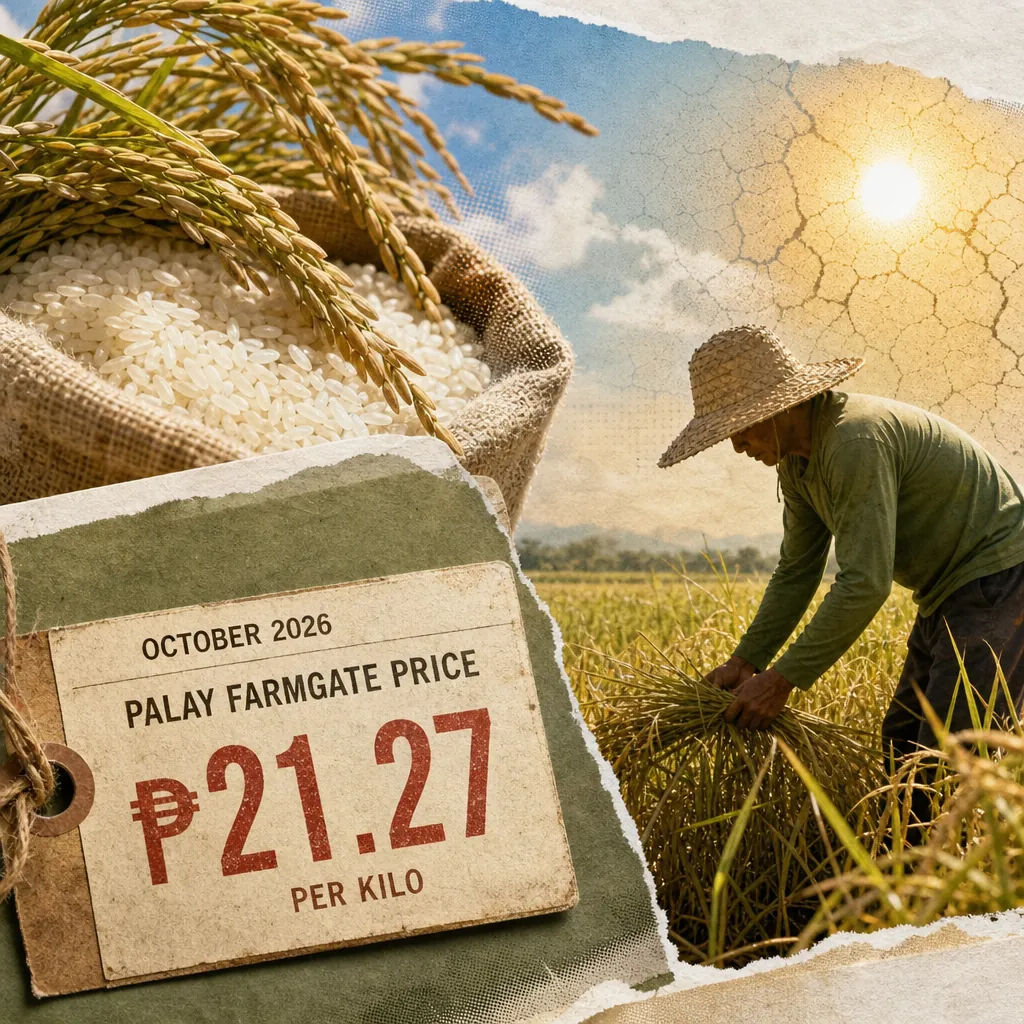
The price farmers received for dry palay, or unhusked rice, climbed to ₱21.27 per kilo in October 2026, the Philippine Statistics Authority (PSA) reported, up 2.1 percent from ₱20.84 in September and nearly 34 percent from ₱15.89 in October 202548. The same week, the Philippine Crop Insurance Corp. (PCIC) disclosed that only 158,447 of the 692,017 registered farmers in the Davao Region — fewer than one in four — are enrolled in the government's free crop insurance, with a strong El Niño forecast to hit yields7. Those two numbers, read together, describe the shape of the country's food-supply problem this season: the price signal is telling farmers to plant, and the safety net that would let them risk it is mostly unused.
Key themes
- Palay farmgate price reaches ₱21.27 per kilo, up nearly 34 percent year on year. The PSA figure measures what farmers are paid at the farm gate, before transport and marketing costs, and it is the highest October reading in recent memory48. Calabarzon posted the steepest regional increase at nearly 58 percent, from ₱12.26 to ₱19.35 per kilo, followed by the Negros Island Region at 47 percent48.
- Only 158,447 of 692,017 Davao Region farmers hold crop insurance. PCIC Region 11 manager Rosalina Grabulan presented the figures, current as of Nov. 15, at the Kapehan sa Dabaw media forum on Nov. 167. The gap means most farmers facing a strong El Niño would absorb crop losses without indemnity.
- A climate think tank calls the Pax Silica partnership with the United States oversimplified. Angelo Kairos Dela Cruz of the Institute for Climate and Sustainable Cities told ABS-CBN's Top Story that the project's effects on Indigenous peoples and the climate need to be laid out before it proceeds46.
- Iloilo City will enforce its ban on single-stick cigarette sales from 2027. Retailers selling tingi-tingi, or cigarettes by the stick, face fines of up to ₱5,000 and possible loss of business permits under Regulation Ordinance No. 2021-25529.
- Sagay City distributes a pest-resistant sugarcane variety to seven farmer associations. The PSR 03-171 variety is meant to help small planters recover from the red-striped soft scale insect, which has damaged cane fields in Negros Occidental55.
- The Panubli-on Regional Trade Fair opens in Iloilo City with more than 170 MSMEs. The Department of Trade and Industry (DTI) Region 6 is targeting at least ₱12 million in cash and booked sales over the five-day fair, with 39 Aklan enterprises among the participants4953.
- A columnist's ₱22-per-meal arithmetic sets off a debate about the food poverty threshold. Political analyst Malou Tiquia's Facebook post, subtracting ₱66 for three meals from a ₱96 daily poverty threshold, drew heated comments from readers who read it as an endorsement rather than a critique52.
How the narratives stack
Dominant. The palay price report and the crop-insurance gap together form the day's most consequential agriculture story across the items captured here. The PSA release is a routine statistical bulletin, but its 34 percent year-on-year increase lands against a backdrop of El Niño warnings and a Department of Agriculture (DA) under public criticism. A separate opinion piece carried by Head Topics called the coming El Niño the worst since 1777-1778 and described the DA's response as "rank incompetence," arguing that domestic agricultural productivity has collapsed into heavy dependence on food imports42. The combination of a price spike and a thin insurance net is the story a reader should carry away.
Counter-narrative. The DTI's Panubli-on trade fair coverage presents the opposite face of the sector: micro, small, and medium enterprises (MSMEs) from six Western Visayas provinces showcasing hablon textiles, piña, specialty coffee, tablea, and coconut products, with the agency projecting ₱12 million in sales49. The Aklan delegation alone brings 39 enterprises, 12 in food and 27 in nonfood53. This is the government's development story — local products reaching institutional buyers ahead of the holidays — and it sits alongside, not against, the price and insurance news.
Emerging. The Pax Silica controversy is the least settled item in the set. Dela Cruz's interview, published by the Daily Guardian, raises questions about Indigenous consent and climate impact that have no official answer yet46. The project is a significant US-Philippines investment partnership, and the think tank's complaint is procedural: that the government has not laid out the risks and benefits to the public. Expect this to grow as the project moves from announcement to implementation.
Under-covered. The Sagay City sugarcane dispersal program received a single item in this set55. It matters because the red-striped soft scale insect has been damaging Negros Occidental cane fields, and the PSR 03-171 variety — developed from VMC 84-947 and PHIL 80-13 — is promoted by the Philippine Sugar Research Institute Foundation (PHILSURIN) for productivity and ratooning ability, the capacity to regrow after harvest. The program's five-lacsa-in, three-lacsa-back structure is a genuine attempt at farmer-to-farmer propagation, and it deserves more attention than it got.
Platform insights
- Facebook. The most engaged agriculture-adjacent conversation in this set ran on Facebook, where Malou Tiquia's post about the ₱22 food poverty threshold drew heated comments from readers who challenged her to prepare a decent meal for that amount52. The reaction shows how quickly a statistical threshold becomes a personal argument about grocery bills when it is posted without context.
- X. Senator Panfilo Lacson used X to question the "honest mistake" defense of Vice President Sara Duterte's asset declarations, a political story that intersects with the agriculture sector only indirectly but dominated the day's political conversation5814. The platform carried the sharpest elite commentary of the day.
- TikTok. A Channel News Asia TikTok post about Singapore's beverage-container refund machines drew more than 68,000 views after a user demonstrated a one-can trick to get ineligible containers accepted18. The engagement was driven by ridicule and questions about whether the scheme encourages a circular economy, a pattern that matters for any deposit-return or subsidy program that depends on public trust.
Key voices and communities
Rice farmers and their cooperatives. The PSA price data and the PCIC enrollment figures speak directly to this group. The farmgate price is what they are paid; the insurance enrollment is what protects them when the harvest fails. The gap between the two is the sector's central vulnerability this season487.
The Philippine Crop Insurance Corp. and the Department of Agriculture. PCIC Region 11 manager Rosalina Grabulan presented the Davao figures at a public forum, which is itself a signal that the agency knows the enrollment gap is a problem7. The DA's Registry System for Basic Sectors in Agriculture (RSBSA) is the master list the agency uses to identify eligible farmers, and the fact that 692,017 farmers are on it while only 158,447 are insured points to a delivery problem, not a data problem.
Climate and environmental advocates. The Institute for Climate and Sustainable Cities is pushing for a fuller public accounting of the Pax Silica partnership46. Its framing — that a project this large requires conversations with affected communities, not just among ASEAN leaders — is likely to shape the debate as the project advances.
Local government units and MSMEs. Iloilo City's anti-smoking task force and the DTI's regional offices are the two most active local actors in this set. The Iloilo City Anti-Smoking Task Force (ICAST) is running an information campaign ahead of the 2027 enforcement date29, while DTI Region 6 is organizing the Panubli-on fair49.
Columnists and opinion writers. The Head Topics piece on the DA and the Daily Guardian column on the ₱22 meal show that opinion writing is doing much of the work of framing the agriculture debate4252. Both pieces use sarcasm and rhetorical questions, which tends to sharpen the argument but also polarize it.
Narrative streams
Palay farmgate price rises 34 percent as El Niño approaches
The PSA's October 2026 farmgate price report is the most concrete data point in the set. Dry palay sold for ₱21.27 per kilo, up from ₱20.84 in September and ₱15.89 in October 202548. The PSA defines farmgate price as what farmers receive at the location of the farm, excluding transport and other marketing costs, so the figure is a measure of farm income, not retail rice prices. The regional breakdown is striking: Calabarzon's farmgate price rose nearly 58 percent year on year, from ₱12.26 to ₱19.35 per kilo, and the Negros Island Region rose 47 percent, from ₱14.63 to ₱21.5148. The National Food Authority (NFA), the state agency that buys palay to support farm incomes and maintain buffer stocks, had earlier raised its buying price, which likely contributed to the upward pressure on farmgate prices.
For farmers, a higher farmgate price is good news in the short term. It means more cash per harvest and a stronger incentive to plant. But the timing is awkward. A strong El Niño is forecast, and the Head Topics opinion piece argues that peak calamity is projected for next year, calling the coming El Niño the worst since 1777-177842. If the harvest fails, the higher price will not help farmers who have nothing to sell. The read for the sector is that the price signal and the weather forecast are pulling in opposite directions, and the farmers who respond to the price signal without insurance are the ones most exposed.
Crop insurance reaches fewer than one in four Davao farmers
The PCIC figures, presented by Rosalina Grabulan at the Kapehan sa Dabaw forum on Nov. 16, show that 158,447 of 692,017 registered farmers in the Davao Region are enrolled in the government's free crop insurance7. The 692,017 figure comes from the DA's RSBSA master list, which the agency uses to identify eligible beneficiaries for its programs. The DA's online RSBSA portal for the Davao Region listed 699,559 unique registrants as of Nov. 16, with 399,652 farmers, 204,023 farmworkers, 111,343 fisherfolk, and 51,292 agri-youth; some registrants belong to more than one sector7.
The gap between registration and enrollment is the story. Free crop insurance exists, and most farmers are on the list that would make them eligible, but fewer than a quarter have signed up. Grabulan did not say why in the Sunstar report, and the reasons could range from lack of awareness to distrust of the claims process to simple administrative friction. What is clear is that the safety net is not reaching the people it was designed for. For the sector, the read is that the government's El Niño response depends on an insurance program that most farmers have not joined, and closing that gap is a communications and delivery problem as much as a funding one.
Iloilo City prepares to enforce single-stick cigarette ban
Iloilo City's anti-smoking task force is warning sari-sari stores, groceries, and convenience stores that from 2027 it will strictly enforce Regulation Ordinance No. 2021-255, the Comprehensive Anti-Smoking and Vaping Ordinance, which requires cigarettes to be sold in original, complete packs of 20 sticks29. Retailers who sell tingi-tingi, the widespread practice of selling cigarettes individually, face fines of up to ₱5,000 and possible loss of their business permits. ICAST head Iñigo Garingalao said the city would gradually implement the ordinance's provisions next year to give businesses time to comply29.
The measure is a public-health intervention aimed at reducing smoking by making it harder to buy a single cigarette, a practice that lowers the cost of trying smoking and sustains daily habits among low-income smokers. For sari-sari store owners, the ban removes a small but steady source of revenue and requires them to stock full packs, which ties up more capital. The read for the sector is that the enforcement date gives retailers roughly a year to adjust their inventory and pricing, and the information campaign is the city's attempt to avoid a wave of violations when enforcement begins.
Sagay City distributes pest-resistant sugarcane variety
Seven farmer associations in Sagay City, Negros Occidental, have received planting materials for PSR 03-171, a high-yielding sugarcane variety developed to help small planters recover from losses caused by the red-striped soft scale insect55. The Sagay City Canepoints Dispersal Program, launched with PHILSURIN at Hacienda Candi-is in Barangay Paraiso, gives beneficiaries five lacsa of planting materials and asks them to return three lacsa after propagation for redistribution to other farmers. One lacsa equals 10,000 sugarcane seed pieces, according to the Sugar Regulatory Administration (SRA), the agency that oversees the sugar industry55.
The structure is designed to multiply the benefit: instead of a one-time handout, the program creates a revolving source of cane points that farmer groups can use to expand access beyond the first recipients. PSR 03-171, developed from VMC 84-947 and PHIL 80-13, is promoted for productivity, resilience, and ratooning ability55. For the sector, the read is that the program addresses both the immediate pest problem and the longer-term need for farmers to have their own source of planting material, which reduces dependence on external suppliers.
Panubli-on trade fair brings 170 MSMEs to Iloilo City
The DTI Region 6 is staging the Panubli-on Regional Trade Fair from Nov. 18 to 22 at SM City Iloilo, with more than 170 MSMEs from Aklan, Antique, Capiz, Guimaras, Iloilo, and Negros Occidental49. The agency is targeting at least ₱12 million in cash and booked sales. The theme, "Búnga: Staying Rooted, Growing Forward," highlights products that combine traditional craftsmanship with innovation, including handwoven hablon, piña, and bariw textiles, home décor, wellness products, specialty coffee, tablea, and native delicacies49. The Aklan delegation comprises 39 enterprises, 12 in food and 27 in nonfood53.
The fair is part of the DTI's broader push to connect MSMEs with institutional buyers ahead of the holiday season, and it is presented with OTOP Philippines, Coconut Philippines, and SM City Iloilo49. For the sector, the read is that the fair is a test of whether regional producers can convert holiday demand into repeat institutional orders, not just one-off retail sales. The ₱12 million target is modest relative to the number of exhibitors, which suggests the agency sees the fair primarily as a market-linkage event rather than a revenue driver.
Pax Silica draws criticism from climate think tank
The Institute for Climate and Sustainable Cities (ICSC) said the Philippines' Pax Silica partnership with the United States suffers from "oversimplification" and needs a fuller public accounting of its risks and benefits46. ICSC executive director Angelo Kairos Dela Cruz told ABS-CBN News Channel's Top Story on Nov. 16 that the project's expected effects on Indigenous peoples and the climate, as well as the government's response to protests against it, require more discussion with affected communities46. "Pax Silica is a significant investment, however, we do think that it suffers greatly from oversimplification," Dela Cruz said. "It will require a lot of conversations, not only among ASEAN leaders, but also among the government officials involved, but more importantly, with the communities affected"46.
The criticism is procedural rather than outright opposition. ICSC is not calling for the project to be cancelled; it is calling for the government to lay out the terms before proceeding. For the sector, the read is that the project's social license depends on whether the government can answer the questions ICSC is raising, and the think tank's intervention gives affected communities a framework for pressing those questions.
The ₱22 meal debate exposes confusion about poverty thresholds
A Facebook post by political analyst Malou Tiquia about the food poverty threshold set off a heated argument, according to a Daily Guardian column52. Tiquia's arithmetic was simple: ₱22 per meal, three meals a day, or ₱66, subtracted from a cited daily poverty threshold of roughly ₱96, leaves ₱30 for everything else. Some readers took her remarks as an endorsement of the ₱22 figure rather than a critique, and others challenged her to prepare a decent meal for that amount52. The column makes an important distinction: the ₱22 figure is derived from a statistical food poverty threshold, not a recommendation for what a meal should cost.
The episode matters because it shows how easily a technical statistic becomes a flashpoint when it is posted without context. For the sector, the read is that agencies and analysts who communicate poverty thresholds need to explain what the number measures and what it does not, or the conversation will be about the number's plausibility rather than the policy it is meant to inform.
Conversation trajectory
Palay prices and El Niño (next 4–6 weeks). The PSA will release November farmgate price data in the second half of December, which will show whether the October increase continued or plateaued. Watch for the DA's El Niño advisories and any NFA buying-price adjustments. If the November figure rises again, expect more commentary on the DA's preparedness, building on the Head Topics critique4248.
Crop insurance enrollment (through the first quarter of 2027). The PCIC figures are a snapshot as of Nov. 15. Watch for any PCIC or DA announcement of an enrollment drive in the Davao Region or nationally. If no such announcement comes before the El Niño peak, the enrollment gap will become a live political issue when crop losses are reported7.
Iloilo City cigarette ban (through 2027). The city says it will gradually implement the ordinance next year. Watch for the first enforcement actions and for retailer reactions, particularly from sari-sari store associations. The ₱5,000 fine and permit-loss provisions give the city strong leverage, but enforcement capacity is the open question29.
Pax Silica (next 2–3 months). The ICSC's criticism is the first organized pushback in this set. Watch for government responses, any congressional hearings, and whether affected communities organize around the think tank's framing46.
Panubli-on trade fair (Nov. 18–22). The DTI's ₱12 million sales target will be testable within the week. Watch for post-fair sales figures and for any announcement of institutional orders49.
Trigger events. A PSA November price release above ₱21.27, a DA El Niño damage report, a PCIC enrollment drive, the first Iloilo City enforcement action, and any government statement on Pax Silica would each move the story.
Response guidance
Rice farmers and cooperatives: check insurance enrollment before the El Niño peak. Farmers in the Davao Region who are on the RSBSA list but not enrolled in PCIC should confirm their status with the municipal agriculture office. The insurance is free, and the enrollment gap is the single largest protection failure in this set7.
DA and PCIC: explain why enrollment is low before the losses arrive. The agencies should publish the reasons for the enrollment gap — awareness, claims friction, or administrative capacity — and pair any enrollment drive with a clear explanation of how claims are filed and paid. A safety net that farmers do not trust will not be used7.
Local government units: give retailers a compliance calendar. Iloilo City's gradual implementation is the right approach, but sari-sari stores need a clear timeline and a list of what changes when. Publish the enforcement schedule and the penalty structure in local languages29.
DTI and MSME organizers: report post-fair sales, not just targets. The ₱12 million target is a projection. Publishing actual cash and booked sales, and the number of institutional buyers who placed orders, would give the fair's participants and future exhibitors a real benchmark49.
Climate and development communicators: answer the Pax Silica questions in public. The ICSC's criticism is an invitation to a fuller accounting, not a rejection. Government agencies involved in the project should publish the environmental and Indigenous-consent assessments and hold community consultations before the next phase46.
Analysts and agencies: contextualize poverty thresholds when posting. The ₱22 meal debate shows that a statistic posted without its definition will be read as a claim about what people should live on. Any public communication of the food poverty threshold should state what it measures and what it does not52.
See the full picture behind today's signals.
This report draws from Media Meter's MediaWatch, our real-time monitoring engine tracking 2,470+ Philippine sources across print, broadcast, digital, and social. Explore how the platform turns raw coverage into decision-grade intelligence, then see how it's configured for teams like yours — whether you're in PR agencies, corporate comms, government, or marketing.
Want more? Browse our Report Library for sector and crisis intelligence, or request a demo and we'll have your brand set up before the call.
Want this kind of intelligence on your brand?
This brief is built on the same MediaWatch methodology that runs continuously across every brand we monitor. See your competitive landscape, Impact Score, and narrative trajectory in a 30-minute demo.