Jollibee signs 35-store Australia franchise deal
Jollibee Foods Corp. signed two exclusive franchise agreements to open 35 stores in Australia over five years, announced with Australian Prime Minister Anthony Albanese during the ASEAN Summit in Manila. The same day's coverage also carried record rice imports, a 33.9% jump in palay farmgate prices, and BPI's call for the central bank to keep raising rates.
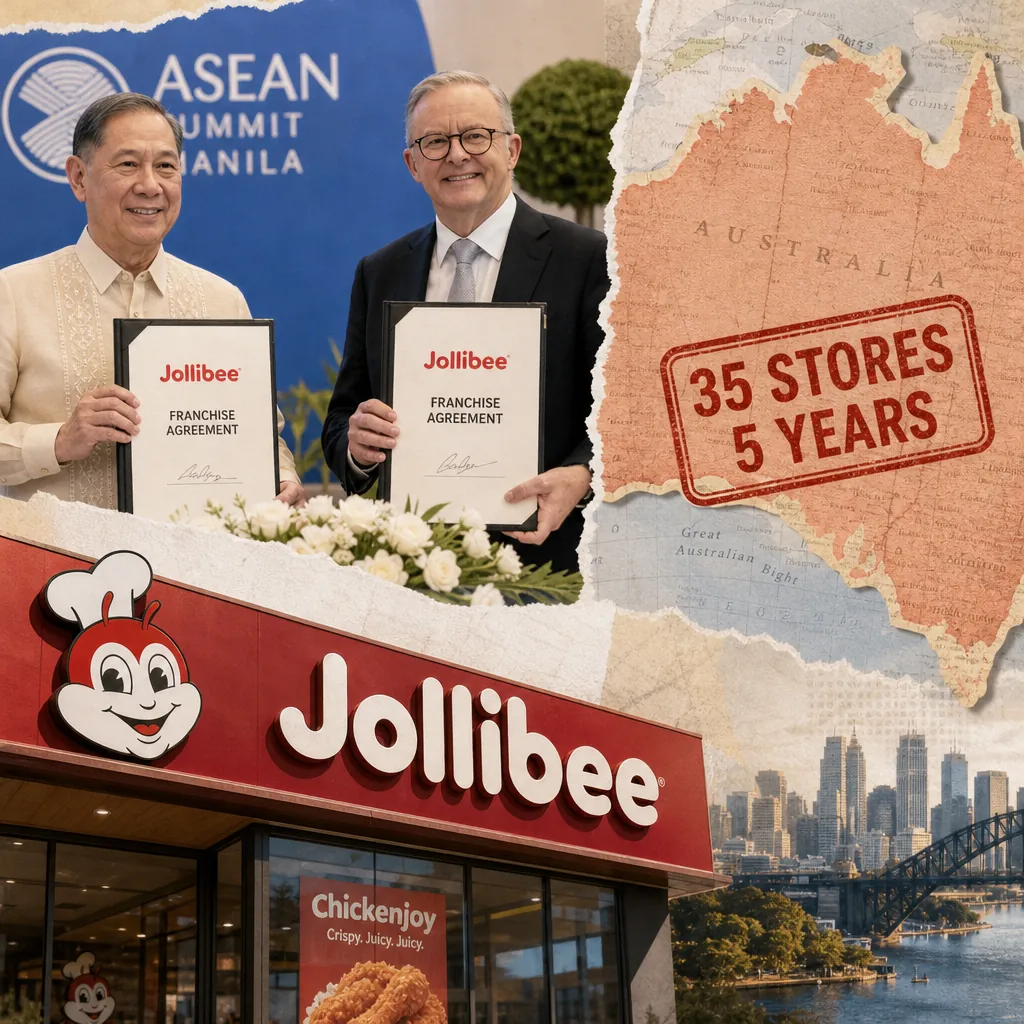
Jollibee Foods Corp. will open 35 restaurants in Australia over the next five years under two exclusive franchise development agreements signed on Sunday, November 15, at a Jollibee branch in Pasay City, with Australian Prime Minister Anthony Albanese standing beside company executives15. Albanese was in Metro Manila for the 49th Association of Southeast Asian Nations (ASEAN) Summit, the annual gathering of the ten-member Southeast Asian bloc, which the Philippines is chairing in 20268. The two partners are Happy Food Group Pty Ltd, which holds Victoria, and Lucky Bee Australia Pty Ltd, which holds designated territories in New South Wales15. Jollibee Global President and Chief Executive Officer Ernesto Tanmantiong signed the agreements; the company did not disclose the financial terms of either contract, though the five-year rollout carries an estimated investment figure reported at ₱2.6 billion15.
The announcement produced the day's most widely picked-up corporate story in the items reviewed here, and it did so across mediums rather than in one corner of the press. A blog item carried the deal terms and the partner names15; The Manila Times covered the visit through Albanese's own Facebook post, in which he called the food "fantastic" and said the chain was "coming to Australia," adding that it would be "a taste of home for so many Filipino-Australians, opening up right across Sydney and Melbourne. Creating hundreds of jobs and bringing a little more Chickenjoy Down Under"16. The Manila Times item drew an estimated ₱169,540 in advertising-equivalent value — the estimated cost of buying the same space as paid advertising, not a count of readers — while the blog item carried an estimated ₱301,4901516.
The rest of the day's business coverage, across the items captured, was dominated by agriculture and macroeconomic strain. The Philippine Statistics Authority (PSA), the government's statistical agency, reported that the average farmgate price of dry palay — unmilled rice, sold by farmers at the farm gate before milling — rose 33.9 percent year on year in October to ₱21.27 per kilogram, from ₱15.89 a year earlier, and was up 2.01 percent from September's ₱20.8424. The Business section of The Manila Times carried that story in print, where it drew an estimated ₱199,484 in advertising-equivalent value24. The Inquirer reported separately that rice imports had reached 4.49 million metric tons as of October 29, already above last year's 3.39 million and within 300,000 tons of the full-year record of 4.8 million set in 2024, as El Niño — the periodic warming of the Pacific that brings drought to the western Pacific — inflicted nearly ₱10 billion in agricultural damage10.
On the corporate side, Cosco Capital Inc., the holding company behind the Puregold grocery chain, reported net income attributable to equity holders of the parent of ₱7.01 billion for the first nine months of 2026, up 9.73 percent from ₱6.39 billion a year earlier, on revenues up 10.22 percent to ₱201.57 billion25. Puregold's net sales rose 11.7 percent to ₱187.71 billion and remained the group's main revenue contributor25. The Manila Standard business page item carried an estimated ₱160,316 in advertising-equivalent value25.
Key themes
- Jollibee signs 35-store Australia franchise deal worth an estimated ₱2.6 billion. Two exclusive territory agreements, with Happy Food Group in Victoria and Lucky Bee Australia in New South Wales, commit the chain to 35 stores over five years, announced at a Pasay City branch with Prime Minister Albanese present15.
- Dry palay farmgate prices rose 33.9 percent year on year in October to ₱21.27 per kilogram. The PSA figure compares with ₱15.89 in October 2025 and ₱20.84 in September 2026; Calabarzon posted the steepest regional increase at 57.8 percent, to ₱19.35 per kilogram24.
- Rice imports reached 4.49 million metric tons by October 29, above last year's 3.39 million. The volume is 300,000 tons short of the 2024 full-year record and 500,000 tons below the Department of Agriculture's own 5-million-ton projection for the year, with Vietnam supplying 62.3 percent of arrivals10.
- BPI urged the Bangko Sentral ng Pilipinas to keep raising rates despite 2.1 percent third-quarter GDP growth. Emilio Neri Jr., the bank's lead economist, argued that pausing now could feed inflation expectations and a wage-price spiral, and that a "calibrated" increase beats deferring further hikes9.
- Cosco Capital's nine-month net income rose 9.73 percent to ₱7.01 billion. Revenue grew 10.22 percent to ₱201.57 billion, led by Puregold's 11.7 percent sales increase to ₱187.71 billion25.
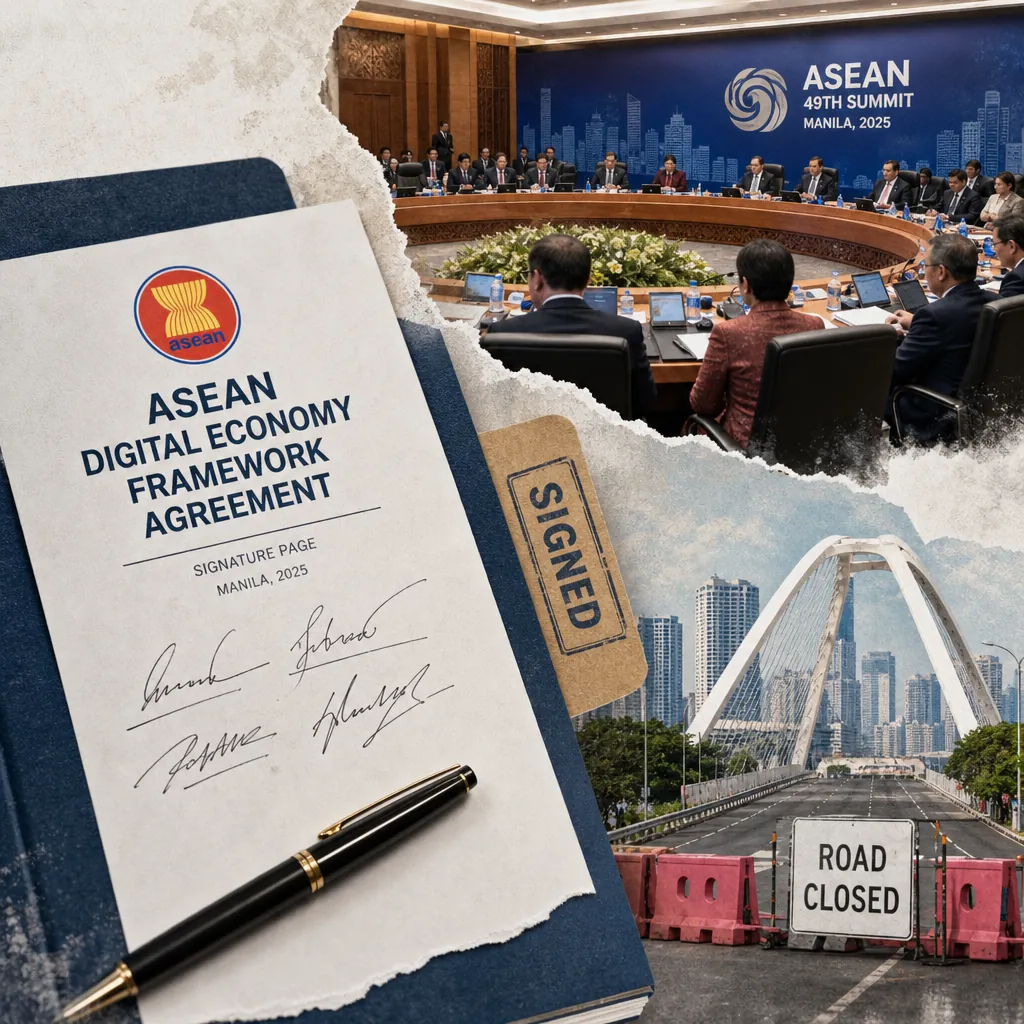
- ASEAN economic ministers signed the Digital Economy Framework Agreement in Manila. The region-wide pact, a priority of the Philippines' 2026 ASEAN chairship, sets a common framework for digital trade, cross-border e-commerce, electronic payments, data protection and cybersecurity cooperation26.
- UnionBank graduated 27 SME founders from its first UB Negosyante BOOSTcamp. The six-week program, run under the bank's GoBeyond Community corporate social responsibility arm and concluded October 24, trained small-business owners in artificial intelligence, digital marketing and financial management31.
- Philippine Startup Week 2026 ran November 9 to 12 in Quezon City as an accredited ASEAN side event. Organized by the Department of Information and Communications Technology with the science and trade departments and the Quezon City government, it placed Filipino founders in front of regional investors under the theme "Beyond Borders: Filipino Startups Navigating Our Future"33.
How the narratives stack
Dominant. The Jollibee-Australia announcement is the day's lead in the items reviewed, and it earned that position on consequence rather than volume. A 35-store commitment across two Australian states is the chain's largest announced franchise expansion in the set, and it arrived with a head of government as witness — a level of political endorsement that no other corporate item in the day's coverage carried1516. The story also crossed mediums: a blog carried the deal structure and partner names, a broadsheet carried the Prime Minister's own social-media framing, and the announcement was timed to the ASEAN Summit, which gave it a diplomatic peg1516. The coverage value attached to the two items — an estimated ₱301,490 and ₱169,540 in advertising-equivalent terms — reflects the space the story occupied, not how many people read it1516.
Counter-narrative. The agricultural data told a harder story than the franchise deal. Palay farmgate prices up 33.9 percent year on year is a gain for farmers and a cost pressure for millers, traders and, eventually, consumers, and it sits alongside import volumes running 1.1 million tons above last year2410. The two facts point in the same direction: domestic supply is short enough that the country is buying more abroad while paying farmers substantially more at home. The Inquirer's report tied the import surge directly to El Niño damage of nearly ₱10 billion10. The Manila Times print item on palay prices carried an estimated ₱199,484 in advertising-equivalent value, and the Inquirer's import story an estimated ₱301,644 — both substantial placements, though the set does not establish that this was the day's heaviest-covered story overall2410.
Emerging. Two institutional stories sat below the fold. The ASEAN Digital Economy Framework Agreement, signed in Manila by economic ministers including Trade Secretary Ma. Cristina Roque, is described as the world's first region-wide digital economy agreement, covering digital trade, cross-border e-commerce, electronic payments, data protection and cybersecurity26. Separately, UnionBank's BOOSTcamp and Philippine Startup Week 2026 both point at the same thing: an organized push to give small Filipino businesses and founders the digital and financial skills — and the regional investor contacts — to scale3133. Neither story drew the engagement of the Jollibee announcement, but both describe infrastructure that will shape how consumer-facing companies operate in the next few years.
Under-covered. The Bangko Sentral ng Pilipinas rate debate received comparatively little space in the items reviewed, appearing in a single Inquirer business item, despite its direct effect on every borrower and every consumer-facing company in the country9. BPI's argument — that the central bank should not stop raising rates just because gross domestic product grew only 2.1 percent in the third quarter, the slowest expansion in over 16 years outside the pandemic period — is a live disagreement about the cost of money, and it was carried in one outlet here9.
Platform insights
- Facebook. The day's most-quoted social post came from a head of government rather than a brand: Prime Minister Albanese used his Facebook account to announce Jollibee's Australian expansion, calling the food "fantastic" and framing the deal as jobs and a taste of home for Filipino-Australians16. The post's function was diplomatic and promotional at once, and The Manila Times built its story around it rather than around the company's own statement16.
- Corporate and trade press online. The franchise deal's mechanics — partner names, territory splits, the five-year timeline, the undisclosed financial terms — were carried by a blog item rather than by the broadsheets, which suggests the detailed deal terms circulated first through online business and enthusiast channels15. The broadsheet coverage focused on the personalities and the diplomatic setting16.
- Business wire and portal pickup. The UnionBank BOOSTcamp story ran in at least three online outlets — BusinessWorld, Head Topics and a Head Topics aggregation — with near-identical copy, indicating a press-release-driven pickup pattern rather than independent reporting2931. The same pattern held for Philippine Startup Week 2026, which appeared in both Head Topics and BusinessWorld with the same theme line and dates3033.
- Print business pages. The palay price and Cosco Capital stories ran in the broadsheet business sections, where they carried the set's larger advertising-equivalent values — an estimated ₱199,484 for the palay item and ₱160,316 for Cosco2425. Print placement of this kind reflects editorial judgment about what business readers need on a Monday morning, and both stories are the kind that feed into analyst notes and corporate planning rather than social conversation.
Key voices and communities
Jollibee Foods Corp. and its franchise partners. Ernesto Tanmantiong, the company's global president and CEO, signed the agreements, and the company framed the deal as a five-year, 35-store commitment across Victoria and New South Wales15. The partners — Happy Food Group Pty Ltd and Lucky Bee Australia Pty Ltd — are the vehicles through which the expansion will actually be built, and their identities matter because franchise development agreements assign territories rather than single outlets15.
The Australian government. Prime Minister Albanese's presence at the signing, and his Facebook post, gave the deal a political weight that a routine franchise announcement would not have had16. His framing — jobs, Filipino-Australian community, "a little more Chickenjoy Down Under" — positioned the expansion as a people-to-people story as much as a commercial one16.
BPI's economics desk. Emilio Neri Jr., lead economist at the Bank of the Philippine Islands, argued in a commentary that the central bank should not pause rate hikes, warning that doing so could fan inflation expectations and produce a wage-price spiral9. His intervention matters because it pushes back against a growing chorus calling for a halt after weak GDP growth9.
The Department of Agriculture and the PSA. The PSA supplied the palay price data, and the Department of Agriculture's 5-million-ton import projection provides the benchmark against which actual arrivals are being measured1024. Agriculture Secretary Francisco Tiu Laurel Jr. also appeared in the day's coverage on a separate matter — African swine fever vaccination — where he said "vaccination must move faster and reach more farms if we are to make our repopulation program work"41.
Small-business and startup organizers. UnionBank's GoBeyond Community and the DICT-led Philippine Startup Week represent the institutional layer trying to build the next generation of consumer-facing companies3133. Albert C. Cuadrante, UnionBank's chief marketing and experience officer, told the BOOSTcamp graduates: "We see you guys not just as business owners, but as builders of the future. More importantly, the businesses you are growing today will become the next generation of companies that will help drive our economy forward"31.
Narrative streams
Jollibee commits to 35 Australian stores over five years
Jollibee Foods Corp. signed two exclusive franchise development agreements on Sunday, November 15, covering 35 stores across Australia over the next five years15. Happy Food Group Pty Ltd will develop Victoria, and Lucky Bee Australia Pty Ltd holds designated territories in New South Wales15. The agreements are territory assignments rather than single-outlet contracts, which means the partners carry the build-out risk and the company collects franchise fees and supply revenue without owning the stores15. The company did not disclose the financial terms of either contract, though the rollout carries an estimated investment of ₱2.6 billion15.
The announcement was staged at a Jollibee outlet in Pasay City with Prime Minister Albanese present, and Albanese used the occasion to sample Chickenjoy, which he called "fantastic," and to post about the deal on Facebook16. His post framed the expansion around the Filipino-Australian community and job creation: "A taste of home for so many Filipino-Australians, opening up right across Sydney and Melbourne. Creating hundreds of jobs and bringing a little more Chickenjoy Down Under"16. The Manila Times covered the visit through that post, and the item carried an estimated ₱169,540 in advertising-equivalent value16. The blog item that carried the deal mechanics drew an estimated ₱301,49015.
For the sector, the deal matters less for its size than for its template. Jollibee has spent years building a global store network, and the Australian entry uses a master-franchise structure that limits capital exposure while extending brand reach into a market with a substantial Filipino diaspora1516. Consumer-facing Filipino brands watching this will note that the announcement was timed to a diplomatic summit and endorsed by a foreign head of government — a level of political cover that lowers the cost of market entry and raises the profile of the brand in both countries. The read for the sector: franchise-led expansion into diaspora markets is now the default route for Philippine consumer brands seeking growth outside a domestic market where rice prices and rate hikes are squeezing household budgets910.
Palay prices jump 33.9 percent while rice imports run above last year
The PSA reported late Friday that the national average farmgate price of dry palay rose 33.9 percent year on year in October to ₱21.27 per kilogram, from ₱15.89 in October 2025, and was up 2.01 percent from September's ₱20.8424. Calabarzon recorded the largest regional increase, up 57.8 percent to ₱19.35 per kilogram from ₱12.26 a year earlier, while the Negros Island Region rose 47.0 percent to ₱21.51 per kilogram, though it fell 1.6 percent month on month from ₱21.8524. The Manila Times carried the story in its Business section, where it drew an estimated ₱199,484 in advertising-equivalent value24.
The price data sits alongside an import surge. The Inquirer reported that the Philippines had imported 4.49 million metric tons of rice as of October 29, above last year's 3.39 million and within 300,000 tons of the full-year record of 4.8 million set in 202410. The volume is 500,000 tons below the Department of Agriculture's projection of 5 million tons for the year10. Vietnam supplied 62.3 percent of arrivals, or 2.79 million tons, with Thailand a distant second at 666,201 tons, or 14.8 percent10. El Niño inflicted nearly ₱10 billion in damage on the agriculture sector, according to government data cited in the report10. The Inquirer item carried an estimated ₱301,644 in advertising-equivalent value10.
For the sector, the combination is a cost story with a long tail. Higher farmgate prices raise the input cost for millers and traders, and import volumes running above last year mean the country is paying for foreign grain at the same time it is paying farmers more at home. Food manufacturers and retailers that buy rice — directly or as an input into processed products — face margin pressure that will show up in pricing decisions over the next two quarters. The read for the sector: consumer-goods companies should plan for rice-derived input costs to stay elevated through the first half of 2027, and should expect the government to keep import channels open even as it talks up domestic production1024.
BPI pushes back against calls to pause rate hikes
Bank of the Philippine Islands lead economist Emilio Neri Jr. argued in a commentary that pausing interest rate hikes now could further stoke inflation and deepen the squeeze on household budgets, and that the central bank should not bear the burden of taming prices alone9. The warning came amid growing calls for the Bangko Sentral ng Pilipinas to halt hikes after gross domestic product grew just 2.1 percent in the third quarter, the slowest expansion in over 16 years outside the COVID-19 period9. Neri said a "calibrated" rate increase would be more appropriate than deferring further hikes, and warned that prematurely halting tightening could fan expectations of future inflation and lead to a wage-price spiral9. The Inquirer business item carried an estimated ₱394,632 in advertising-equivalent value9.
The Bangko Sentral ng Pilipinas is the country's central bank, and it sets the benchmark interest rate that determines the cost of borrowing across the economy. When it raises rates, mortgages, business loans and consumer credit become more expensive, which is meant to cool spending and bring inflation down. The tension in Neri's argument is that the same tool that fights inflation also slows an economy already growing at its weakest pace in over a decade and a half9.
For the sector, the rate path is the single biggest variable in consumer demand. A continued hike cycle keeps credit expensive, which weighs on big-ticket purchases and on the working capital costs of retailers and manufacturers. A pause would ease that pressure but risks letting inflation expectations settle in, which historically makes future rate rises larger and more painful. The read for the sector: consumer-facing companies should model both scenarios, and should treat BPI's commentary as a signal that at least part of the financial establishment expects further tightening despite the weak GDP print9.
Cosco Capital posts 9.73 percent profit growth on Puregold strength
Cosco Capital Inc. reported net income attributable to equity holders of the parent of ₱7.01 billion for the first nine months of 2026, up 9.73 percent from ₱6.39 billion a year earlier25. Nine-month revenues rose 10.22 percent to ₱201.57 billion from ₱182.88 billion25. The grocery retail segment under Puregold Price Club Inc. remained the group's main revenue contributor, with net sales rising 11.7 percent to ₱187.71 billion from ₱168.08 billion25. The company attributed the performance to "a combination of management's strategic initiatives and efficiency measures at all business segments that involved enhancements in the cost of goods sold and services coupled by sustained strategic costs and expense reduction and management"25. The Manila Standard business page item carried an estimated ₱160,316 in advertising-equivalent value25.
Puregold's growth is a useful read on the consumer economy. Grocery retail is the most direct proxy for household spending, and an 11.7 percent sales increase at the country's mass-market grocery chain suggests that volume is holding up even as rice and other food prices rise25. That is consistent with a consumer base that is trading down rather than cutting back — buying more staples, fewer discretionary items, and shopping at value-oriented formats. The read for the sector: mass-market grocery is proving resilient to the price pressures showing up in the palay data, and suppliers that can hold shelf prices steady will keep their position in Puregold's aisles2425.
ASEAN digital economy pact signed in Manila
Economic ministers from the Association of Southeast Asian Nations signed the ASEAN Digital Economy Framework Agreement (DEFA) in Manila, with Trade Secretary Ma. Cristina Roque joining fellow ASEAN Economic Community Council ministers26. The agreement is described as the world's first region-wide digital economy agreement of its kind, and it establishes a common framework for digital trade, cross-border e-commerce, electronic payments, data protection and cybersecurity cooperation26. It was a key priority of the Philippines' 2026 ASEAN chairship26. The Manila Standard business page item carried an estimated ₱380,454 in advertising-equivalent value26.
For the sector, DEFA matters because it sets the rules that will govern how consumer-facing companies sell across borders online. A common framework for e-commerce and electronic payments reduces the friction of selling into neighboring markets, and common data-protection and cybersecurity standards lower the compliance cost of operating regionally26. The read for the sector: Filipino retailers and consumer brands that have been hesitant to sell into Southeast Asia online will face a simpler rulebook within the agreement's implementation period, and those that move early will have an advantage in cross-border logistics and payment partnerships26.
UnionBank and government agencies build the small-business pipeline
UnionBank of the Philippines graduated the inaugural cohort of its UB Negosyante BOOSTcamp, a six-week mentorship and capability-building program designed to help small and medium enterprise owners adopt artificial intelligence, digital marketing and sound financial management31. The program concluded on October 24 under the bank's GoBeyond Community corporate social responsibility arm and brought together 27 SME founders across various industries31. Potato Corner co-founder George Wieneke spoke to the cohort about continuously testing and improving the business31. The BusinessWorld item carried an estimated ₱304,633 in advertising-equivalent value31.
Separately, the Department of Information and Communications Technology, with the Department of Science and Technology, the Department of Trade and Industry and the Quezon City government, opened Philippine Startup Week 2026 at the Quezon City M.I.C.E. Center33. The four-day conference ran November 9 to 12 under the theme "Beyond Borders: Filipino Startups Navigating Our Future" and was accredited as an ASEAN side event in connection with the Philippines' 2026 chairship33. The BusinessWorld item carried an estimated ₱257,542 in advertising-equivalent value33.
For the sector, these two programs address the same gap: the pipeline of small businesses that can grow into the consumer brands and retail suppliers of the next decade. BOOSTcamp's focus on artificial intelligence and digital marketing reflects a recognition that small Filipino businesses increasingly compete online, where the cost of reaching customers is lower but the skills required are higher31. Philippine Startup Week's ASEAN accreditation gives local founders access to regional investors who might otherwise overlook the Philippine market33. The read for the sector: the support infrastructure for small consumer businesses is thickening, and established brands should expect more competition from digitally native entrants that have been trained in exactly the tools — AI, digital marketing, financial management — that scale a consumer business quickly3133.
Conversation trajectory
Watch the Jollibee Australia rollout for store-opening timelines and partner disclosures, over the next two to three quarters. The agreements commit to 35 stores over five years, but the first openings will reveal whether the partners can execute at pace and whether the company discloses the investment split15. A first store opening in Sydney or Melbourne would give the story a second news peg and a fresh round of coverage.
Watch the November inflation print and the BSP's next policy meeting, over the next four to six weeks. BPI's argument for continued tightening will be tested by the next consumer price index release and by the central bank's next rate decision9. If inflation accelerates, the case for a pause weakens; if it decelerates while GDP stays weak, the pressure to halt hikes will grow.
Watch rice import volumes against the 5-million-ton projection through December. The Philippines has imported 4.49 million tons as of October 29, and the Department of Agriculture projected 5 million for the year10. A strong fourth-quarter import pace would push the full-year figure past the 2024 record of 4.8 million tons, which would sharpen the political debate over domestic production and farmer support1024.
Watch the implementation schedule for the ASEAN Digital Economy Framework Agreement, over the next two to three quarters. The agreement has been signed, but the work of aligning e-commerce, payments and data-protection rules across ten countries will take years26. Early signals — working groups, pilot programs, ratification timelines — will indicate how quickly the framework becomes operational for businesses.
Trigger events. A Jollibee announcement of the first Australian store location; the BSP's next rate decision; the PSA's November palay price release, expected in mid-December; the full-year rice import tally from the Bureau of Plant Industry; and the first DEFA implementation milestones from the ASEAN secretariat.
Response guidance
Franchise and expansion announcements. Time major market-entry announcements to diplomatic or trade events where a head of government can lend credibility, and prepare a social-media-ready quote from the visiting official in advance. The Jollibee announcement worked because Albanese's Facebook post carried the story in his own voice, which gave the coverage a human frame that a corporate press release could not16.
Agricultural input costs. Food manufacturers and retailers should prepare plain-language explanations of how farmgate prices and import volumes affect shelf prices, and should avoid attributing price increases to a single cause. The palay data and the import data tell a connected story — short domestic supply, high farmgate prices, heavy foreign buying — and consumers will respond better to a clear explanation than to a vague reference to "market forces"1024.
Interest rate communications. Financial institutions commenting on monetary policy should pair any call for continued tightening with a concrete explanation of what it means for borrowers and savers. BPI's commentary was effective because it named the mechanism — inflation expectations and a wage-price spiral — rather than simply asserting that rates should rise9.
Small-business programs. Corporate social responsibility programs aimed at small businesses should publish participant numbers, program duration and the specific skills taught, as UnionBank did with its 27 founders and six-week curriculum31. Specificity is what separates a credible capability-building program from a photo opportunity.
Digital economy agreements. Companies that sell online across borders should begin mapping their payment, data and logistics operations against the DEFA framework now, before implementation deadlines are set26. Early movers will have more influence over how the rules are interpreted and more time to adjust their systems.
Sensitive topics. The rice price and import story is politically charged, and companies that comment on it should avoid appearing to blame farmers or to advocate for either protection or open imports. The safe ground is to describe the cost pressure factually and to point to the government's own projections as the benchmark1024.
See the full picture behind today's signals.
This report draws from Media Meter's MediaWatch, our real-time monitoring engine tracking 2,470+ Philippine sources across print, broadcast, digital, and social. Explore how the platform turns raw coverage into decision-grade intelligence, then see how it's configured for teams like yours — whether you're in PR agencies, corporate comms, government, or marketing.
Want more? Browse our Report Library for sector and crisis intelligence, or request a demo and we'll have your brand set up before the call.
Want this kind of intelligence on your brand?
This brief is built on the same MediaWatch methodology that runs continuously across every brand we monitor. See your competitive landscape, Impact Score, and narrative trajectory in a 30-minute demo.