Pax Silica Draws Archbishop and Investor Pushback
Cebu Archbishop Alberto Uy questioned the Philippines' participation in the Pax Silica industrial partnership, while Semirara Mining and Power Corp. warned that a Department of Energy asset-surrender rule could deter investors during the ASEAN summit. The day's coverage also carried the Senate impeachment trial of Vice President Sara Duterte and Jollibee's 35-store Australia expansion.

Cebu Archbishop Alberto "Abet" Uy posted a statement on Monday night, Nov. 16, questioning whether the Philippines' participation in Pax Silica would benefit ordinary Filipinos or leave the country trading away water, energy and land while other parties collect the returns14. The same day, Consunji-led Semirara Mining and Power Corp. (SMPC) issued its second strongly worded statement in a week against a Department of Energy (DOE) rule it calls "confiscatory," warning that the policy could scare off investors while Manila hosts the 49th Association of Southeast Asian Nations (ASEAN) Summit2. Two different industries, one shared argument: what the Philippines gives up to attract capital, and who decides.
Pax Silica is the proposed industrial partnership that would place a semiconductor and advanced-manufacturing hub in Tarlac, tied to the broader New Clark City plans. It has become the most contested item on the summit's economic agenda. Uy's intervention matters because the Catholic Church retains broad moral authority in the Philippines, and a Cebu archbishop speaking on land and water use reaches audiences that business-page commentary does not. His statement asked for transparency, environmental protection and national interests, and clarified that he was not against artificial intelligence itself14.
The Semirara dispute runs on a narrower track but carries the same question about investor confidence. The DOE rule, which now covers both assets and legal rights, was the subject of a prebid conference days earlier. SMPC argued that the government is "embarrassing the [Marcos] administration on the world stage" and that "Pax Silica could be aborted in the womb"2. The company has operated the Semirara coal mine for decades, so its objection is not abstract: it is a direct claim about what a new surrender requirement would cost an existing operator.
Key themes
- A Cebu archbishop questions Pax Silica's benefits for ordinary Filipinos. Uy's Nov. 16 social media statement raised concerns about the partnership's long-term effects on the environment, water supply, energy resources and national interests, and asked whether the country would be sacrificing natural resources while other parties reap most of the benefits14.
- Semirara calls the DOE asset-surrender rule "confiscatory" and warns of lost investment. SMPC said the rule now covers both assets and legal rights and could deter investors, issuing the statement days after the DOE's prebid conference2.
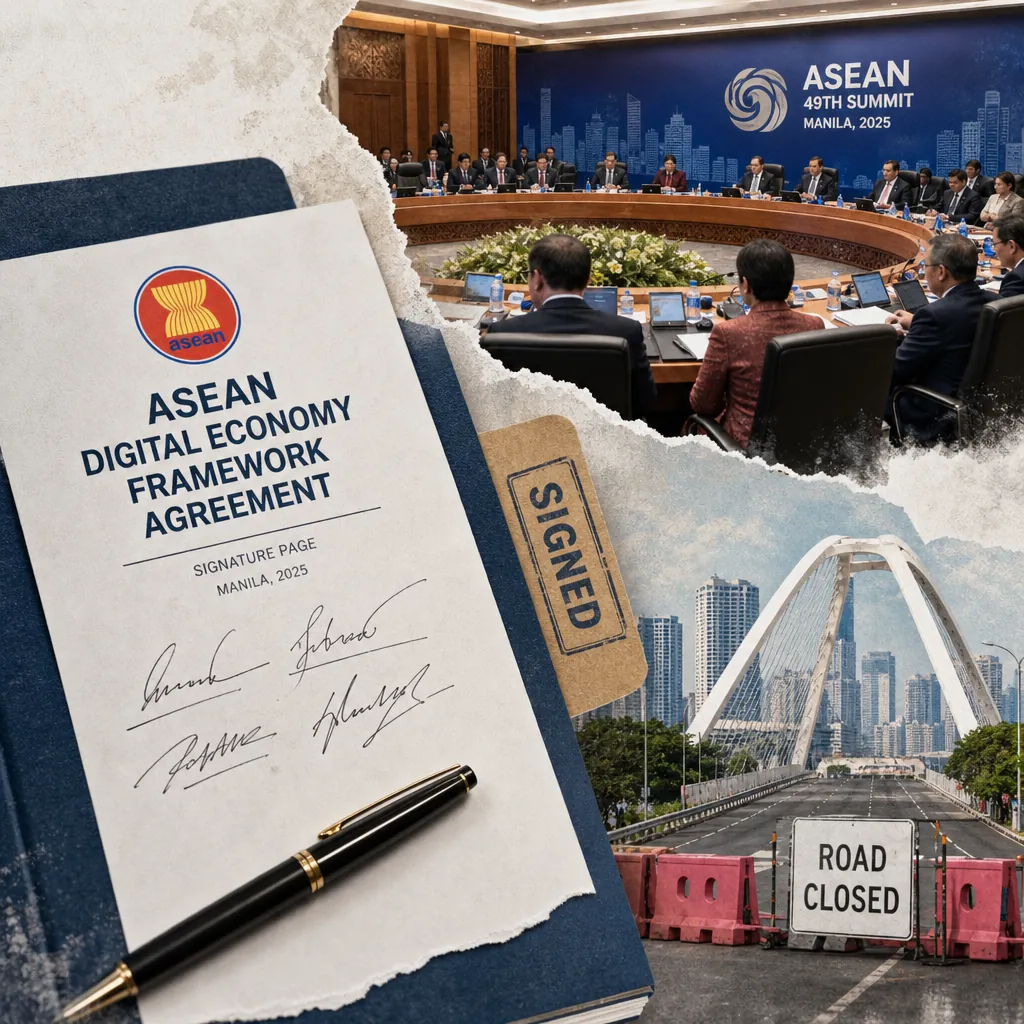
- ASEAN signs the Digital Economy Framework Agreement, with implementation targeted for 2027. Trade Secretary Cristina Roque said the pact, signed under the Philippines' chairship, is "the first in the world" and that member states will now work to ratify it, with concrete initiatives expected when Singapore presides next year3.
- Jollibee signs franchise deals for 35 stores in Australia, a A$60-million commitment. The agreements with Happy Food Group for Victoria and Lucky Bee Australia for New South Wales target about 900 jobs over five years, announced with Australian Prime Minister Anthony Albanese present in Manila4736.
- The Senate impeachment court subpoenas four defense witnesses for Nov. 19 and 20. The witnesses include an anti-money laundering lawyer and three government officials, called to address Article II of the impeachment articles covering Vice President Sara Duterte's statements of assets, liabilities and net worth (SALN) and alleged unexplained wealth3334.
- House prosecutors anchor the unexplained-wealth case on Duterte's own filings. Lanao del Sur Rep. Zia Alonto Adiong said the evidence was "prepared, submitted, subscribed to and notarized by the Vice President," drawing on SALNs, income tax returns, corporate filings, bank records and Anti-Money Laundering Council reports16.
- Police face calls for accountability over arrests at ASEAN protest rallies. The August Twenty-One Movement estimated 200 to 300 protesters, including farmers, students, Indigenous community members and workers, were arrested across Metro Manila during demonstrations marking the summit's opening31.
- Philippine Airlines finalizes contracts for 15 Boeing 787-10s and GE engines. The Nov. 10 signing firms up commitments first announced at the Farnborough International Airshow in July, with options for five more jets and deliveries scheduled over the next decade35.
How the narratives stack
Dominant. The Pax Silica argument dominated the day's business and national coverage in this set. It drew the archbishop's statement14, Semirara's attack on the DOE rule2, a Freeman opinion column describing students walking out of class to protest Trump's arrival and residents in Tarlac worried about losing their homes44, and an Angkas founder's essay on what ASEAN membership means for a sari-sari store45. The story crossed business, religion, local government and opinion pages, which is why it sits at the top. The captured items also show how the summit gave the dispute a stage: Semirara explicitly framed its objection around the Philippines hosting foreign leaders2.
Counter-narrative. The government's case for Pax Silica and for the DOE rule is present mainly by implication. Trade Secretary Roque's briefing on the digital economy pact framed regional agreements as opportunities for Filipino businesses3, and the Freeman column acknowledged possible economic and labor benefits before arguing the end does not justify the means44. No captured item carries a full official defense of the asset-surrender rule, so the government's side is thinner in this set than the opposition's.
Emerging. The impeachment trial's next phase is taking shape. The Senate court issued electronic subpoenas to four defense witnesses for Nov. 19 and 20, including AML Consulting Philippines lawyer Rainer Dela Fuente, Trade Undersecretary Ceferino Rodolfo, Food and Drug Administration official Pilar Marilyn Pagayunan and Center for International Trade Expositions and Missions official Rowena Mendoza3342. The defense has said it will not put Duterte or her husband, Manases Carpio, on the stand, and 15 bank officials were dropped from the witness list42. House prosecutors said the Vice President's own financial disclosures will carry the case16, while a House prosecutor said the P2.14 million in GenCorp payments will face closer scrutiny9.
Under-covered. The water-testing story in Bacolod received a single item in this set. Members of the Negrosanon Initiative for Climate and the Environment (NICE) went in person to the Department of Environment and Natural Resources–Environmental Management Bureau (DENR-EMB) Negros Island Region office on Monday to demand the release of water quality results from Cabura Creek in Barangay Felisa, Bacolod City, 61 days after joint sampling on Sept. 1, 202617. The sampling was meant to determine whether runoff or leachate from the Bacolod City Sanitary Landfill was affecting a creek residents depend on for their livelihood17. It connects directly to the Pax Silica argument about water and land, but it ran in one regional outlet and did not enter the national conversation.
Platform insights
- Facebook. Archbishop Uy's statement was posted on his social media account on Monday night, Nov. 16, and the Inquirer's report treats the post itself as the news event14. The choice of platform matters: a Facebook post from a Cebu archbishop reaches parishioners and local communities directly, without waiting for a press conference or a pastoral letter read at Mass. The post's framing, asking whether the partnership would genuinely benefit ordinary Filipinos, is written for a general audience rather than for policy specialists.
- X. The day's most visible X activity in this set came from outside the Philippines. DJ John Summit used the platform to announce he would never submit to the Grammys again, calling the dance category "music industry fueled pop stars"4. The post is a reminder that X remains where individual creators issue personal ultimatums that then become entertainment news. No comparable Philippine policy figure in this set used X as the primary channel; the archbishop chose Facebook.
- Reddit and YouTube. Neither platform appears in the captured items for this window. The conversation in this set ran through Facebook statements, newspaper websites and opinion columns rather than through forum threads or video.
Key voices and communities
The Catholic Church in Cebu. Archbishop Uy's statement carries weight beyond Cebu because the church is one of the few institutions in the Philippines that can speak to land, water and poverty questions with moral authority that cuts across class. His framing, that he is not against artificial intelligence but against a deal whose benefits are unclear, gives opponents of Pax Silica a language that is not anti-technology14.
Coal and energy operators. Semirara's statement is the loudest corporate voice against the DOE rule2. The company's argument is that a rule covering assets and legal rights changes the terms on which existing operators hold their concessions, and that investors watching the Philippines during a summit will notice. The Japanese business chamber had earlier questioned the DOE-DENR asset-surrender rule, according to the Inquirer's report, which means the objection is not confined to one company2.
House prosecutors and the defense team. The impeachment trial has produced two organized camps with distinct media strategies. Prosecutors speak through statements from Rep. Adiong and Rep. Terry Ridon, emphasizing that the evidence comes from Duterte's own filings169. The defense works through subpoena requests and witness lists, and its decision not to field Duterte or Carpio keeps the Vice President out of the witness chair while the trial continues42.
Protest movements and civil liberties groups. The August Twenty-One Movement (ATOM) is the named group estimating arrests at 200 to 300 during the summit demonstrations31. Its statement, "Hindi lang ito mga datos. Mga kapwa Pilipino sila na naghahangay ng mas maaliwalas na kinabukasan para sa mga pamilya at sa bansa nila," frames the arrested as citizens rather than statistics31. Students who walked out of class to protest Trump's arrival, described in the Freeman column, belong to the same current44.
The business press and opinion writers. The Freeman's two columns and the Angkas founder's essay in The Philippine Star carry the summit debate into regional and national opinion pages4445. The Angkas piece makes the case that ASEAN rules reach a Marikina shop selling to a Jakarta customer, which is the pro-integration argument stated in everyday terms45.
Narrative streams
Archbishop Uy asks who benefits from Pax Silica
Cebu Archbishop Alberto Uy's Monday night statement is the most significant single intervention in the Pax Silica debate captured here. He raised concerns about long-term consequences for the country's environment, water supply, energy resources and national interests, and asked whether the partnership would genuinely benefit ordinary Filipinos or leave the country sacrificing natural resources while other parties reap most of the benefits14. He also clarified that he was not against artificial intelligence, which keeps his objection focused on the terms of the deal rather than on the technology14.
The statement lands in a specific local context. The proposed hub sits in Tarlac, and the Freeman column describes residents there worried about losing their homes and being cut off from a natural site where they grew up44. The same column notes that the broader New Clark City plans mention data centers, but that this does not establish the data centers are part of the hub itself44. That distinction matters for anyone trying to judge the environmental claims: the hub's footprint and the wider development's footprint are not the same thing, and the public record in this set does not settle which facilities are included.
For the semiconductor and advanced-manufacturing sector, the archbishop's statement changes the cost of proceeding quietly. A project that was being negotiated as an investment deal now has a moral frame attached to it, and any company that signs on will be asked publicly what it is doing about water, land and displaced residents. For the church, the statement positions it as a participant in industrial policy, not only in charity. For the government, the statement creates a domestic audience for the summit's economic announcements that will measure them against the question Uy asked: who benefits14.
Semirara and the DOE asset-surrender rule
Semirara Mining and Power Corp. issued its second statement in days against a Department of Energy rule it describes as "confiscatory," saying the rule now covers both assets and legal rights and could scare away investors2. The statement came days after the DOE held its prebid conference, and it was timed to the ASEAN summit: "The DOE is embarrassing the [Marcos] administration on the world stage. It is sabotaging the government's efforts to attract investors. Why would an investor invest here when our neighbors offer better? In this environment, Pax Silica could be aborted in the womb," the company said2.
The rule's mechanics are worth spelling out. An asset-surrender requirement obliges an operator to give up specified assets, and in this version also legal rights, under conditions set by the government. For a coal miner that has run the Semirara site for decades, the question is what happens to equipment, contracts and permits if the government invokes the rule. The Japanese business chamber had already questioned the DOE-DENR asset-surrender rule, which suggests the concern extends beyond one Filipino company2.
The read for the energy sector is that the Philippines' pitch to foreign investors during summit week now carries a visible counter-example. A prospective investor reading Semirara's statement sees an existing operator saying the rules can change after capital is sunk. That raises the risk premium on any long-lived project, from coal to the semiconductor hub itself. The government's position, that the rule serves a public purpose, is not represented in the captured items, so the public argument in this set is one-sided. What is confirmed is that Semirara said it; what is uncertain is whether the DOE will adjust the rule before the next bidding step.
ASEAN's digital pact sets a 2027 start
Trade Secretary Cristina Roque said the Digital Economy Framework Agreement (DEFA), signed on Saturday under the Philippines' chairship, will begin implementation in 2027, with concrete initiatives expected when Singapore presides next year3. "This is the first in the world, so we need to get it going as soon as possible," Roque said at a Monday briefing. "All of us now, in each and every Asean country, are going to make sure that we get it ratified and get it started"3.
DEFA establishes common rules covering digital trade, electronic payments, cross-border data flows and cybersecurity3. In plain terms, it is an attempt to make a payment, a data transfer or an online sale work the same way across 11 Southeast Asian countries instead of requiring a separate legal arrangement in each. The Angkas founder's essay explains why that matters to a small business: when neighbors agree on common rules, a shop in Marikina can sell to a customer in Jakarta almost as easily as to one in Makati45.
The read for the digital and payments sector is that 2027 is now the working date for compliance planning, and ratification in each country is the gate. Companies that operate across borders in Southeast Asia should expect to align payment, data and cybersecurity practices with a single regional standard rather than country-by-country rules. The uncertainty is timing: a signed framework still needs ratification by each member state, and Roque's own phrasing puts the ratification work ahead of implementation3.
Jollibee takes its chicken to Australia
Jollibee Foods Corp. signed exclusive franchise agreements with Happy Food Group for Victoria and Lucky Bee Australia for New South Wales to open 35 stores within five years, an estimated A$60 million or about P2.6 billion in investment, creating roughly 900 jobs47. Global president and CEO Ernesto Tanmantiong announced the plan at a Jollibee store in Manila with Australian Prime Minister Anthony Albanese present, on the sidelines of the ASEAN summit36. "We are proud and excited to mark another milestone in our global journey as we bring Jollibee to Australia," Tanmantiong said47.
The Australian market is competitive and inflation-sensitive, and analysts quoted in the Vietnamese coverage expect the entry to intensify competition with McDonald's and KFC36. Jollibee's international strategy has relied on differentiated menu items and value pricing, and the Australia plan tests whether that formula travels to a market with high labor costs and an established fast-food culture47.
The read for the food and retail sector is that Jollibee is now committing capital to a developed market where its brand recognition depends on the Filipino diaspora and on curious first-time customers. The 900-job figure is the company's estimate for the five-year build-out, not a current headcount. For franchise partners, the agreements shift execution risk to local operators while Jollibee supplies the brand and menu. For competitors in Australia, a new entrant with a value proposition arrives in a market already under grocery and dining inflation pressure36.
The impeachment trial moves to the defense's witnesses
The Senate impeachment court subpoenaed four witnesses named by Vice President Sara Duterte's defense team for hearings on Nov. 19 and 20: AML Consulting Philippines lawyer Rainer Dela Fuente, Trade Undersecretary Ceferino Rodolfo, Food and Drug Administration official Pilar Marilyn Pagayunan and Center for International Trade Expositions and Missions official Rowena Mendoza3342. Senate Impeachment Clerk of Court Renato Bantug confirmed the subpoenas were sent electronically33. The defense will not field Duterte or her husband, Manases Carpio, as witnesses, and 15 bank officials were removed from the list42.
Article II, the sole remaining impeachment charge, accuses Duterte of amassing unexplained wealth, maintaining business interests while in public office and failing to fully disclose assets in her SALN16. House prosecutors say the evidence comes from Duterte's own submissions. "All the evidence that we have provided to the court were prepared, submitted, subscribed to and notarized by the Vice President," said Lanao del Sur Rep. Zia Alonto Adiong, spokesperson for the prosecution panel16. The case draws on SALNs, income tax returns, corporate filings, bank records and Anti-Money Laundering Council reports16.
A separate thread concerns GenCorp Industries Inc. Rep. Terry Ridon said the P2.14 million allegedly paid by GenCorp to Duterte will face further scrutiny, and that it must be decided whether additional records establish the legal basis of the monthly payments and whether the Senate court can properly consider them9. A corporate counsel testified on Nov. 11 that GenCorp issued checks totaling P2,142,369.14 to Duterte between 2022 and 2025, while she was already Vice President9. A Cebuano-language opinion column in The Philippine Star summarized the prosecution's allegation as hidden wealth ranging from P818 million to P1.5 billion, and the defense's answer as "kayamukat," or a fabrication48.
The read for the business community is that the trial is now examining corporate records, not only personal ones. Companies that made payments to officials, and the lawyers who advised them, face questions about documentation that will outlast the trial itself. For the Senate as an institution, the decision on whether to admit additional GenCorp records will set a precedent for what evidence an impeachment court will hear9.
Police face accountability questions after summit protests
Advocacy, labor and human rights organizations accused security forces of using excessive force to silence dissent during demonstrations marking the opening of the 49th ASEAN Summit, and called for investigation and accountability31. The August Twenty-One Movement estimated that 200 to 300 protesters, including farmers, students, Indigenous community members and workers, were arrested across Metro Manila31. The group said authorities curtailed freedom of expression and peaceful assembly to project a favorable image of the country before foreign delegates31.
The Freeman column adds a first-hand note: students walked out of class to protest Trump's arrival, and many expressed concerns about the possible Pax Silica agreement44. The arrests and the walkouts are part of the same week, and both are about who gets to speak while the summit is in town.
The read for civil society and for the security sector is that the summit's policing will be judged after the delegates leave. Arrest figures reported by an advocacy group are estimates, not official counts, and the government's account is not represented in the captured items. What is confirmed is that ATOM made the allegation and demanded an investigation31. What is uncertain is how many of those arrested were charged and on what basis.
Philippine Airlines firms up its widebody order
Philippine Airlines, Boeing and GE Aerospace finalized contracts for 15 Boeing 787-10 aircraft and their GEnx-1B engines, firming up commitments first announced at the Farnborough International Airshow in July35. The contracts were signed Nov. 10 and include options for up to five more jets, with deliveries scheduled over the next decade35. PAL Holdings President and Chief Operating Officer Lucio Tan III said the widebody Dreamliner will help the airline modernize its fleet, boost fuel efficiency and expand its international network35.
The order is a long-cycle bet on international travel demand. Deliveries spread over a decade mean the capacity arrives gradually, and the fuel-efficiency gain is the main operating-cost argument for replacing older widebodies35.
The read for aviation and tourism is that PAL is positioning for international routes rather than domestic volume, and that the order's value depends on demand holding up through the delivery period. For travelers, the practical effect is more long-haul seat capacity later this decade, not next year. For Boeing and GE, the signing converts a July announcement into a firm backlog item35.
Conversation trajectory
Nov. 19–20: impeachment hearings with defense witnesses. The Senate court has subpoenaed four witnesses for these dates, and their testimony on Cale88 Foods Corp. and Duterte's SALN will produce a new round of statements from both camps3342. Watch whether the court rules on admitting additional GenCorp records, which Rep. Ridon flagged as an open question9.
Through the remaining summit days: Pax Silica statements from government and investors. The archbishop's statement and Semirara's objection have created two audiences for any official response. Watch for a DOE statement on the asset-surrender rule and for any Malacañang response to Uy142.
Next year, under Singapore's ASEAN chairship: DEFA ratification and early initiatives. Roque said concrete initiatives are expected when Singapore presides, and each member state must ratify the pact before the 2027 implementation target3. Watch for the first country-level ratification announcements.
Over the next five years: Jollibee's Australia build-out. The 35-store plan depends on franchise partners securing sites and on Australian labor and supply costs47. Watch for the first store opening and for any revision to the store count.
Over the next decade: PAL Dreamliner deliveries. The first aircraft from the 15-jet order will test whether the international network expansion proceeds on schedule35.
Trigger events. A DOE statement on the asset-surrender rule, a Malacañang response to Archbishop Uy, the Senate court's ruling on GenCorp records, and the first DEFA ratification would each move their story from argument to decision.
Response guidance
Pax Silica: prepare for questions about water and land, not only about jobs. Companies associated with the hub should be ready to state, in plain terms, what the project does to local water supply, what land it uses and how displaced residents are compensated. The archbishop's statement set the terms of the public question14, and the Freeman column shows residents in Tarlac already organizing around it44. A jobs-and-investment message alone will not answer it.
DOE rule: separate the policy argument from the summit timing. Energy companies commenting on the asset-surrender rule should make their case on the rule's terms and mechanics rather than on the embarrassment of the timing. Semirara's summit framing2 drew attention, but the durable argument is about what the rule requires and how it affects existing concessions.
Impeachment coverage: rely on documents, not adjectives. Prosecutors have built their public case on the Vice President's own filings16. Defense statements should be specific about which records are disputed and why. Avoid characterizing the trial's overall trajectory; the witness list has already changed once42.
Protest arrests: publish the official count and the charges. With ATOM estimating 200 to 300 arrests31, the security sector's credibility depends on releasing its own figures and the legal basis for each detention. Silence leaves the advocacy estimate as the only number in circulation.
DEFA: explain the 2027 date to small businesses. The digital pact's benefits are concrete for cross-border sellers, but the ratification process is slow. Communicators should set expectations that rules will not change overnight and identify which practices, such as payments and data transfers, will be affected first3.
Jollibee Australia: lead with the local partnership. The announcement's credibility rests on the named franchise partners and the job estimate47. Communications should foreground the local operators and the five-year timeline rather than a general claim of global ambition.
Regional environmental stories: treat the Bacolod water results as a test case. The release of the Cabura Creek results after 61 days17 gives communities a template for demanding environmental data. Companies with operations near waterways should expect similar requests and prepare to release monitoring data proactively.
See the full picture behind today's signals.
This report draws from Media Meter's MediaWatch, our real-time monitoring engine tracking 2,470+ Philippine sources across print, broadcast, digital, and social. Explore how the platform turns raw coverage into decision-grade intelligence, then see how it's configured for teams like yours — whether you're in PR agencies, corporate comms, government, or marketing.
Want more? Browse our Report Library for sector and crisis intelligence, or request a demo and we'll have your brand set up before the call.
Want this kind of intelligence on your brand?
This brief is built on the same MediaWatch methodology that runs continuously across every brand we monitor. See your competitive landscape, Impact Score, and narrative trajectory in a 30-minute demo.