Impeachment trial shifts to afternoons as poverty rate hits record low
The Senate moves the impeachment trial of Vice President Sara Duterte to afternoons to speed proceedings, while a record-low poverty rate of 9.7 percent sparks debate over sustainability. Social media discourse is polarized between political scandal and economic progress.
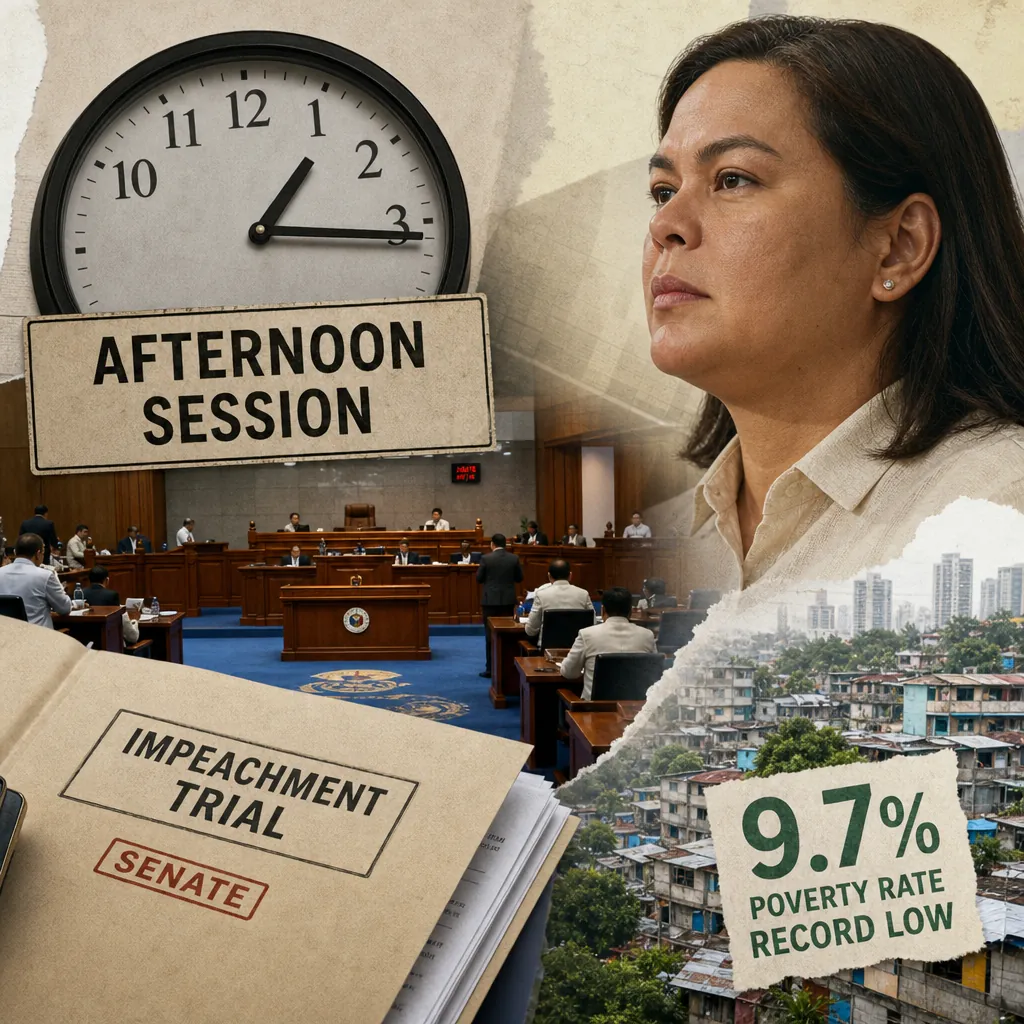
The Senate's decision to move the impeachment trial of Vice President Sara Duterte to afternoon sessions dominated the day's conversation, even as a record-low poverty rate offered the administration a rare piece of good news. On August 21, the Senate reached a consensus to hold legislative sessions in the morning and convene as an impeachment court in the afternoon, a scheduling shift aimed at preventing the historic proceedings from dragging into next year. Senate President Sherwin Gatchalian confirmed the agreement, saying it would be formalized within the week. The move came as the trial has been moving at a pace that could push its completion beyond the Senate's original December target.
Social media reacted with a mix of mockery and skepticism. A Facebook post from a news outlet highlighted House prosecutor Terry Ridon's remarks blaming the defense team for delays, drawing 15 likes but 32 "haha" reactions, signaling public amusement at the defense's strategy. On Reddit, a post from u/Independent_Media captured defense counsel Atty. Kapunan's warning to the impeachment court: "Reminder to the impeachment court, it is not only the Vice President being judged here, it is them as well…". The post gained 56 upvotes, reflecting a shift toward scrutinizing the court's credibility. By midday, u/PoliticalWatchPH posted a scathing critique of the administration's anti-corruption stance, claiming, "It's disgusting how he keeps talking anti corruption but hasn't put any corrupt official behind bars yet! It's Janet Napoles pork barrel scam all over again," earning 141 upvotes and sparking a 99-comment debate.
Amid the political turmoil, a counter-narrative emerged around socioeconomic progress. A Reddit post sharing a Manila Bulletin report on the Philippines hitting a record-low poverty rate of 9.7 percent in 2025 became a significant conversation driver, accumulating 106 upvotes and 59 comments. The post detailed how DEPDev Secretary Arsenio Balisacan credited sustained economic growth and targeted social protection. However, commenters quickly injected skepticism, questioning whether the gains would be sustainable amid political instability and debating the fiscal trade-offs of "ayuda" programs. This juxtaposition of political scandal and economic milestone created a polarized but deeply engaged public dialogue throughout the day.
Key themes
- Senate moves impeachment trial to afternoons to meet December target: The Senate agreed to shift legislative sessions to the morning and hold trial hearings in the afternoon, a scheduling change aimed at preventing the proceedings from spilling into next year. Senate President Sherwin Gatchalian confirmed the consensus, saying it would be implemented within the week.
- Public mocks defense delays with disproportionate "haha" reactions: A Facebook post highlighting House prosecutor Terry Ridon's remarks blaming the defense team for delays drew 15 likes but 32 "haha" reactions, signaling public amusement rather than sympathy. The mockery suggests skepticism toward the defense's strategy.
- Defense counsel warns the court itself is on trial: Atty. Kapunan's statement that "it is not only the Vice President being judged here, it is them as well" resonated on Reddit, gaining 56 upvotes. The framing shifts accountability onto the Senate and positions the impeachment process itself as the subject of public judgment.
- Anti-corruption critique draws parallels to Napoles scam: A Reddit post accusing the administration of failing to put corrupt officials behind bars earned 141 upvotes and 99 comments, with users drawing direct comparisons to the Janet Napoles pork barrel scam. The post anchored the trial to historical scandals, reflecting deep-seated distrust.
- Record-low poverty rate of 9.7 percent sparks sustainability debate: The announcement that the Philippines achieved a 9.7 percent poverty rate in 2025, down from 15.5 percent in 2023, drew 106 upvotes on Reddit. However, commenters questioned the sustainability of gains achieved through heavy state spending, with RCBC chief economist Michael Ricafort warning about ballooning national debt.
- PhilHealth reform priorities draw warm public reception: New PhilHealth chief Dr. Beverly Lorraine Ho's focus on no-balance billing and cutting red tape drew 148 likes and 32 "love" reactions on Facebook, indicating strong public approval for healthcare access improvements. The positive reception contrasts with the cynicism toward other government actions.
- AI job displacement of 1.9 million BPO workers raises accountability questions: A Reddit post from u/MaharlikaWatch raised the issue of AI job losses affecting 1.9 million BPO workers, asking who is accountable when machines get it wrong. Though modest at 10 likes, the post sparked a deeper philosophical debate about regulatory responsibility and the future of employment.
- Institutional responsiveness stories gain traction: Posts highlighting government agencies actively responding to citizen needs, such as DSWD relief repacking coverage, drew 892 likes and 189 shares on Facebook. This indicates public appetite for tangible government action stories that could serve as counter-programming to critical political narratives.
How the narratives stack
Dominant: The impeachment trial of Vice President Sara Duterte dominated the day's conversation, with the Senate's scheduling shift and the defense's warning that the court itself is on trial generating the most engagement. Within the captured set, this story drew the most social media attention, with the anti-corruption critique earning 141 upvotes and the defense counsel's warning gaining 56. The trial's dominance reflects its consequence for the administration's stability and the public's deep engagement with institutional processes.
Counter-narrative: The record-low poverty rate of 9.7 percent served as a powerful counter-narrative, offering the administration a rare policy win. The announcement drew 106 upvotes on Reddit, showing strong public interest in positive economic news. However, the conversation quickly shifted from celebration to skepticism, with commenters questioning the sustainability of gains achieved through heavy state spending. This counter-narrative is significant because it provides the administration with a positive story to amplify, even as the impeachment trial consumes the news cycle.
Emerging: The AI job displacement narrative tied to the Maharlika Investment Fund is emerging as a significant concern. The fund's CEO publicly acknowledged that 1.9 million Filipino BPO jobs are at risk from AI, and the conversation has evolved beyond simple job-loss fears to a more sophisticated argument about accountability. A Reddit post from u/MaharlikaWatch raised the question of who is accountable when AI-driven systems fail, drawing parallels to the 1993 Highland Towers collapse in Malaysia. This narrative is still developing but poses a direct threat to the fund's legitimacy as a job-creating vehicle.
Under-covered: The PhilHealth reform story under new chief Dr. Beverly Lorraine Ho received warm public reception but drew less attention than the political and economic stories. The focus on no-balance billing and cutting red tape drew 148 likes and 32 "love" reactions, indicating genuine public approval. This story is under-covered relative to its positive reception, suggesting an opportunity for the administration to amplify institutional reform narratives.
Platform insights
- Facebook: Conversations began early and were heavily reactive, with emotional engagement high on political posts (72 "haha" reactions on the Ridon piece) and sympathetic engagement strong on institutional content (32 "love" reactions on PhilHealth news). The platform showed a split focus where political bickering and positive institutional updates coexisted, with the UNTV volunteer news post earning 892 likes and 189 shares, demonstrating a strong public appetite for civic engagement and relief efforts.
- Reddit: This platform served as the analytical hub, where users sought deeper context and framing. The poverty and impeachment threads both gained significant upvote counts and sustained comment chains, allowing for more nuanced, critical examination of government claims. The platform's culture facilitated the shift from simple reactions to complex, historical comparisons, as seen in the corruption thread referencing the Napoles scam.
- YouTube: Output was limited but acted as a broadcast channel for official institutional updates. The INQToday video on Senate schedules and the shared links from UNTV News served more as authoritative sources for Reddit and Facebook discussions rather than generating direct organic debate, with the Senate video only collecting 10 likes. This platform functioned as an information anchor rather than a conversation starter.
Key voices and communities
- Impeachment Trial Observers and Political Commentary Communities: Active political discussion communities on Reddit and Facebook closely tracked the impeachment proceedings, with particular focus on procedural delays and the conduct of both prosecution and defense teams. This group demonstrates sustained engagement with institutional processes, as evidenced by substantial interaction on posts dissecting the strategic moves of the House prosecution panel. The audience skews toward politically literate users who frequently reference historical corruption cases and institutional accountability frameworks in their commentary.
- Institutional Credibility and Economic Development Analysts: A distinct stakeholder cluster engages deeply with governance performance metrics, particularly economic data releases and agency reform announcements. This group spans Reddit's policy discussion spaces and Facebook communities following institutional news, with demonstrated interest in poverty statistics, agency leadership changes, and public sector efficiency. Their commentary typically reflects analytical engagement rather than partisan positioning, focusing on the substantive implications of policy developments.
- Security and Public Safety Information Consumers: Communities following law enforcement and public safety developments constitute a distinct stakeholder group, with significant presence on Facebook platforms. Their attention focuses on official statements regarding incidents, investigative progress, and agency responsiveness. This group demonstrates high engagement with authoritative institutional communications, particularly from DILG and DSWD channels.
- Technology and Economic Disruption Watchers: A niche but influential community on Reddit engages deeply with technology-driven economic transformation and accountability frameworks. Their focus involves the Maharlika Investment Fund and its implications for the BPO sector, particularly the CEO's public acknowledgment that AI could displace approximately 1.9 million Filipino BPO jobs. This group brings cross-sector perspectives, linking historical engineering liability cases to emerging questions about AI accountability.
Narrative streams
Senate shifts impeachment trial to afternoons to meet December target
The Senate's decision to move the impeachment trial of Vice President Sara Duterte to afternoon sessions represents a significant procedural development aimed at expediting the historic proceedings. Senate President Sherwin Gatchalian confirmed that senator-judges have formally agreed to the adjustment, which will see regular legislative sessions held in the morning to pave the way for open-ended, marathon trial hearings in the afternoon. "Although there is already a consensus, we will implement it within the week," Gatchalian said. The shift is necessary because the trial has been moving at a pace that could push its completion beyond the Senate's original target of finishing by December.
The scheduling change reflects the Senate's struggle to balance its dual functions as an impeachment court and legislative chamber. By dedicating afternoons to the trial, the Senate aims to give the proceedings longer and more predictable hearing hours. This move is significant because it signals the Senate's commitment to completing the trial within a reasonable timeframe, potentially reducing the political uncertainty that has surrounded the proceedings.
For the sector, the scheduling shift means the impeachment trial will likely intensify in the coming weeks, with longer daily hearings potentially generating more news coverage and public discourse. Communications teams should prepare for an extended period of political attention on the trial, which may crowd out other government messaging.
Public mocks defense delays, shifting scrutiny to the court itself
Social media reactions to the impeachment trial revealed a notable shift in public sentiment, with users increasingly scrutinizing the credibility and impartiality of the prosecution and the court itself. A Facebook post highlighting House prosecutor Terry Ridon's remarks blaming the defense team for delays drew 15 likes but 32 "haha" reactions, signaling public mockery of the defense's strategy. The disproportionate number of "haha" reactions compared to likes suggests that users found the blame-game amusing rather than persuasive.
On Reddit, defense counsel Atty. Kapunan's warning to the impeachment court resonated strongly: "Reminder to the impeachment court, it is not only the Vice President being judged here, it is them as well…". The post gained 56 upvotes, reflecting a shift toward scrutinizing the court's integrity. This framing positions the impeachment process itself—rather than the respondent—as the subject of public judgment, which could accelerate as trial scheduling decisions become final.
The mockery and skepticism suggest that the public is not simply taking sides in the trial but is questioning the legitimacy and fairness of the process itself. This poses a reputational risk for the Senate and the broader judicial system, as public trust in institutional processes is essential for their credibility.
For the sector, the shift in public sentiment means that communications teams should avoid commenting on the trial process to prevent feeding political narratives. Instead, they should focus on non-controversial legislative or service-oriented wins to provide an alternative, functional narrative of governance.
Anti-corruption critique draws parallels to Napoles scam, reflecting deep distrust
A Reddit post from u/PoliticalWatchPH accusing the administration of failing to put corrupt officials behind bars became a significant conversation driver, earning 141 upvotes and sparking a 99-comment debate. The post claimed, "It's disgusting how he keeps talking anti corruption but hasn't put any corrupt official behind bars yet! It's Janet Napoles pork barrel scam all over again," directly comparing current leadership to the infamous pork barrel scam. Users drew parallels to the Janet Napoles case, with some noting that "same people involved that time are even still in office today".
The post anchored the impeachment trial to historical scandals, reflecting deep-seated distrust in the administration's anti-corruption agenda. The comparison to the Napoles scam is particularly potent because it evokes a well-known case of massive government corruption that resulted in the imprisonment of several lawmakers. By drawing this parallel, users are suggesting that the current administration is repeating the same patterns of corruption and impunity.
This narrative poses a significant reputational risk for the administration, as it undermines the credibility of its anti-corruption messaging. The viral nature of the post, with 141 upvotes and 99 comments, indicates that this sentiment resonates with a substantial portion of the public.
For the sector, the persistence of the corruption narrative means that communications teams must proactively address accountability claims by documenting institutional processes and timelines transparently. Engaging with the public through process-oriented responses that highlight ongoing investigations and judicial independence may help redirect the conversation toward procedural legitimacy.
Record-low poverty rate of 9.7 percent sparks sustainability debate
The announcement that the Philippines achieved a record-low poverty rate of 9.7 percent in 2025 became a significant conversation driver, offering the administration a rare policy win. The figure represents a drop from 15.5 percent in 2023, lifting 6.5 million people out of poverty. DEPDev Secretary Arsenio Balisacan credited sustained economic growth and targeted social protection programs for the achievement. The announcement was made ahead of the 2028 target, making it a notable milestone.
However, the conversation quickly shifted from celebration to skepticism, with commenters questioning the sustainability of gains achieved through heavy state spending. RCBC chief economist Michael Ricafort warned about "wider budget deficit" and "ballooning outstanding debt," framing the poverty reduction as potentially debt-financed. Commenters drew a direct line between the poverty statistics and the ongoing impeachment case, questioning whether the gains would be sustainable amid political instability. The conversation evolved from factual praise into a broader debate about the fiscal trade-offs of "ayuda" programs, echoing the article's own warning about ballooning national debt.
The dual-track discourse—one celebrating the administration's economic management, another scrutinizing the sustainability of gains—reflects a public desire for holistic progress that ties economic wins directly to the credibility of the ruling administration. The skepticism suggests that the administration cannot simply rest on the poverty rate milestone but must address underlying concerns about fiscal responsibility.
For the sector, the poverty rate milestone is a double-edged sword. It provides concrete evidence for economic development narratives, but the administration must proactively address the "debt-financed" counter-argument by highlighting structural reforms and the role of education as the "biggest equalizer" as recommended by economists. The narrative should be framed as a continuous journey requiring investment and reform, rather than a finished victory lap.
PhilHealth reform priorities draw warm public reception
New PhilHealth chief Dr. Beverly Lorraine Ho's focus on no-balance billing and cutting red tape drew overwhelmingly positive engagement on Facebook, with 148 likes and 32 "love" reactions. The warm reception indicates genuine public approval for healthcare access improvements, contrasting with the usual sentiment toward government agencies. The reform priorities include eliminating balance billing, cutting red tape, and expanding programs like Yakap to protect families from unexpected medical costs.
The positive reception suggests that proactive, patient-centric reform messaging can break through cynicism. This is a stark contrast to the skepticism surrounding other government actions, indicating that the public is receptive to tangible improvements in service delivery. The PhilHealth reform story represents a primary reputation opportunity for the administration, as it demonstrates a commitment to addressing citizens' needs.
For the sector, the PhilHealth reform narrative offers a template for effective institutional communications. By focusing on concrete benefits and patient-centric reforms, the administration can build trust and counter negative perceptions. The warm reception suggests that content highlighting concrete agency actions, particularly those addressing urgent public needs, maintains strong resonance.
AI job displacement of 1.9 million BPO workers raises accountability questions
A Reddit post from u/MaharlikaWatch raised the issue of AI job losses affecting 1.9 million Filipino BPO workers, asking a provocative question about accountability: "The real fault line isn't skill, it's who's accountable when the machine gets it wrong". Though modest at 10 likes, the post sparked a deeper philosophical debate about regulatory responsibility and the future of employment. The conversation has evolved beyond simple job-loss fears to a more sophisticated argument about accountability—specifically, who is legally and financially responsible when AI-driven systems fail.
The discourse draws parallels to the 1993 Highland Towers collapse in Malaysia, with one commentator questioning "if AI is doing the designing, who should we sue if Highland Tower 2.0 happens?". The framing emphasizes regulatory moats and professional licensing as protections against unbounded technological risk. This "signature on the line" framing, comparing AI to a structural engineering disaster, is resonating with professional audiences and poses a direct threat to the Maharlika Investment Fund's legitimacy as a job-creating vehicle.
The Maharlika Investment Fund's CEO publicly acknowledged that 1.9 million Filipino BPO jobs are at risk from AI, putting a number on the potential displacement. This number is now part of the public lexicon, demanding a proactive response from any large employer in the digital economy. The conversation is no longer theoretical; it has become a concrete policy debate about the future of work.
For the sector, the AI job loss narrative is a canary in the coal mine. It signals a public appetite for discussions about automation, liability, and the future of work. Companies in BPO-adjacent or tech-reliant industries should proactively articulate their reskilling programs, partnerships with TESDA, and plans for human oversight in AI deployment. Silence here will be interpreted as complicity in the job loss narrative.
Conversation trajectory
The impeachment trial narrative is intensifying with defense-blame framing, and the conversation is shifting from procedural updates toward attributing delays to the Vice President's defense team. The Senate's scheduling shift to afternoon sessions will likely accelerate the trial's pace, potentially generating more news coverage and public discourse in the coming weeks. The "court on trial" framing, emphasized by defense counsel Atty. Kapunan, will likely gain traction as trial scheduling decisions become final within the next 2-3 weeks.
The poverty milestone conversation is becoming a contested political asset, with the announcement of a 9.7 percent poverty rate generating dual-track discourse. This tension will likely intensify as budget deliberations approach, particularly in comment sections where skepticism about "ayuda" dependency is emerging alongside praise for targeted social protection. The upcoming national budget deliberations will provide a forum for fiscal scrutiny of poverty reduction claims against debt and deficit figures.
The Maharlika fund's AI job displacement warning is triggering liability discourse that will likely expand across policy and labor-focused platforms over the coming weeks as the clip continues circulating. Any formal policy response to the AI job displacement projection could transform the discussion from speculative commentary into concrete policy debate.
Institutional responsiveness narratives are gaining traction, with posts highlighting government agencies actively responding to citizen needs generating significantly higher engagement than typical institutional content. This indicates public appetite for tangible government action stories, which could serve as counter-programming to more critical political narratives if strategically amplified.
Key trigger events that will reshape this conversation include: the Senate's final decision on impeachment trial scheduling (anticipated within days, with potential to reignite procedural criticism or shift focus to substantive hearings); the upcoming national budget deliberations where poverty reduction claims will face fiscal scrutiny against debt and deficit figures; and any formal policy response to the AI job displacement projection, which could transform the Maharlika discussion from speculative commentary into concrete policy debate.
Response guidance
Impeachment trial messaging: Avoid commenting on the trial process to prevent feeding political narratives. Instead, double down on non-controversial legislative or service-oriented wins, like the PhilHealth reforms or disaster response efforts, to provide an alternative, functional narrative of governance for the public to engage with. Prepare pre-approved response templates for comment sections on impeachment-related posts, focusing on redirecting attention to the legal process rather than partisan debate.
Poverty rate narrative: Immediately pivot the "poverty reduction" story from a static achievement to a forward-looking sustainability plan. Use the DEPDev secretary's own words about preventing backsliding and the economist's call for education and technology as the next steps, to frame the narrative as a continuous journey requiring investment and reform, rather than a finished victory lap. This preempts the "fiscal recklessness" attack by focusing on future productivity gains.
AI and future of work: Prepare a "Future of Work" communication kit that addresses the AI and automation question head-on. Given the Maharlika CEO's public 1.9M job loss figure, clients in BPO-adjacent or tech-reliant industries should proactively articulate their reskilling programs, partnerships with TESDA, and plans for human oversight in AI deployment. Silence here will be interpreted as complicity in the job loss narrative.
Institutional responsiveness: Amplify content highlighting concrete agency actions, particularly those addressing urgent public needs. The DSWD relief repacking coverage and PhilHealth reform announcements demonstrate that proactive, patient-centric messaging can break through cynicism. Leverage the positive community engagement by amplifying the collaborative tone through short-form video snippets and behind-the-scenes content that highlights the operational response.
Platform-specific approaches: On Facebook, deploy a responsive comment strategy that acknowledges public concerns while directing users toward concrete benefit details. On Reddit, engage in the poverty rate discussion by sharing data-driven infographics that contextualize the 9.7 percent figure alongside targeted social protection programs, directly addressing skeptics who question sustainability. On YouTube, optimize video titles and descriptions with neutral keywords that surface official updates, reducing reliance on speculative commentary.
See the full picture behind today's signals.
This report draws from Media Meter's MediaWatch, our real-time monitoring engine tracking 2,470+ Philippine sources across print, broadcast, digital, and social. Explore how the platform turns raw coverage into decision-grade intelligence, then see how it's configured for teams like yours — whether you're in PR agencies, corporate comms, government, or marketing.
Want more? Browse our Report Library for sector and crisis intelligence, or request a demo and we'll have your brand set up before the call.
Want this kind of intelligence on your brand?
This brief is built on the same MediaWatch methodology that runs continuously across every brand we monitor. See your competitive landscape, Impact Score, and narrative trajectory in a 30-minute demo.