Jollibee Franchise Denial Tops Food Sector Talk
Vice President Sara Duterte's denial of owning a Jollibee franchise drew the widest response, while the trade department assured stable basic-goods prices ahead of a strong El Niño and vendors formed a network against market privatization.
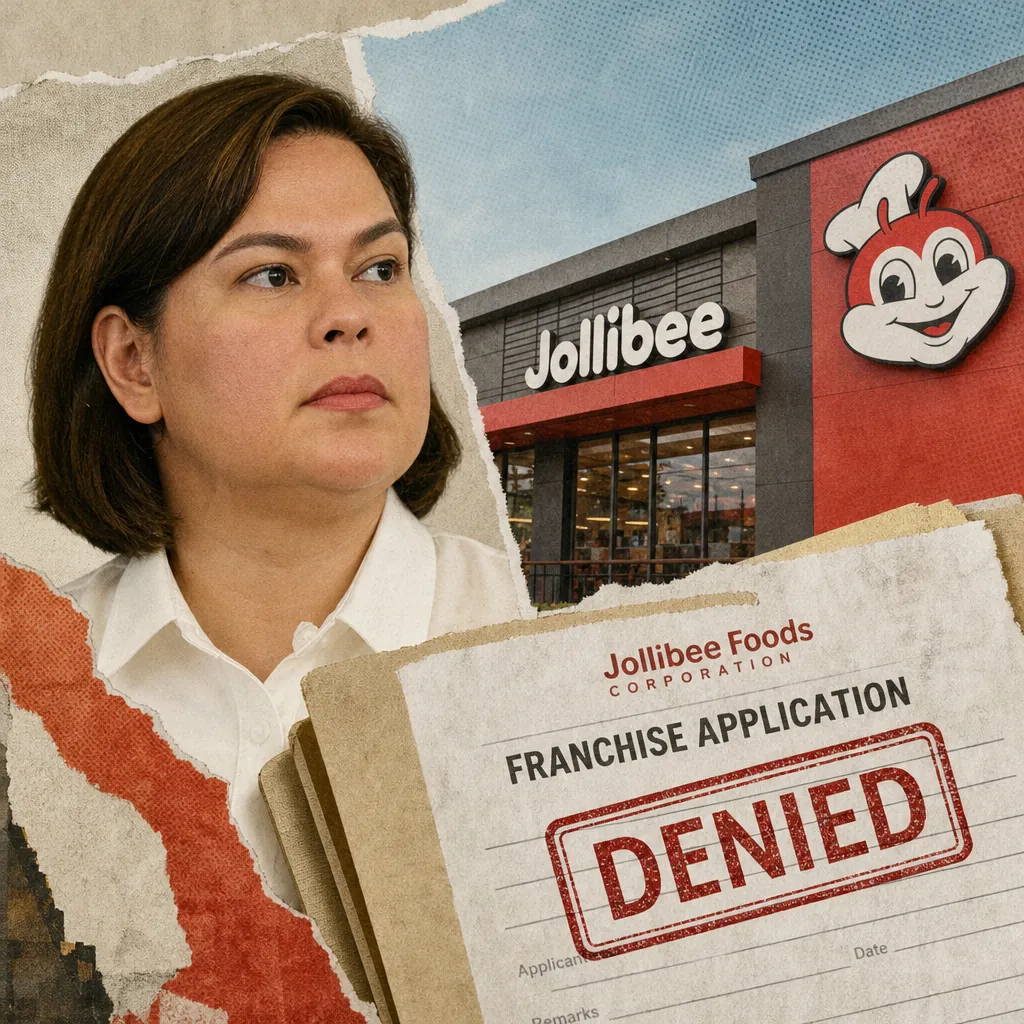
Vice President Sara Duterte's statement on Saturday, October 17, that she does not own a Jollibee franchise or any other franchise drew the widest and most varied response of anything in the food-and-beverage conversation that day, pulling a national brand into an impeachment proceeding it has said nothing about. The denial, released by the Office of the Vice President, followed testimony at her Senate impeachment trial by forensic financial analyst Alexander Cabrera, who said on October 9 that GenCorp Industries Inc. had registered and operated Jollibee franchises, with official receipts identifying five branches in Davao City44. Duterte said she had previously invested in a company within a legitimate business organization and accused a Rappler report of spreading misinformation42. The statement traveled from X and Facebook into national outlets — Inquirer.net, the Daily Tribune, The Philippine Star and One News all carried it49419567 — and regional radio translated it for local audiences, with Bombo Radyo La Union running an Ilocano version47. A Facebook post reproducing the full statement and mocking Cabrera's testimony drew 619 likes46; a widely shared post of the Inquirer summary drew 197 laughing reactions against two angry ones, plus 103 comments50.
The same day, the Department of Trade and Industry (DTI), the agency that monitors retail prices of basic necessities and prime commodities, said prices and supplies of basic goods remain stable ahead of a strong Super El Niño, the weather pattern that brings prolonged dry spells and threatens farm output. "Wala po tayong price increase ngayon para sa basic necessities at prime commodities" ("We have no price increase today for basic necessities and prime commodities"), the agency said, and it urged the public not to panic-buy or hoard, saying mineral water supply is sufficient1. GMA News, PTV and GMA's 24 Oras and Unang Balita carried the assurance2376. President Ferdinand Marcos Jr. said rice supply is adequate but that more will be imported as a precaution6. The 24 Oras segment drew 876 views and 13 likes on YouTube as of October 156.
Away from the capital, the day's food news ran through public markets and local prices. A man posing as a customer walked off with about 20 kilograms of chicken from a Quezon City public market in the early hours of October 151617; the next day the National Meat Inspection Service (NMIS), the agency that inspects meat before sale, seized more than three tons of "hot meat" — meat slaughtered and sold outside official inspection — from a public market in Malolos, Bulacan18. On October 16 and 17, the Gabriela Women's Party, a party-list group, convened a two-day Nationwide Public Markets Summit with the Center for Women's Resources, Defend Jobs Philippines and Kadamay, ending with the formation of the Save Public Markets Network to oppose privatization of public markets19. In Davao, the regional meat inspection office reported the region free of African swine fever and described supplies as safe and stable3031, while Davao Today reported pork prices there had dropped over the past year and that the agency was urging buyers to check certificates33. TV5's Frontline Express warned on October 16 that a weakening peso could push holiday prices higher20, and groups marked World Food Day the same day by calling for cheaper food21.
Key themes
- Duterte's Jollibee denial drew the day's heaviest social response. The statement and its reproductions collected hundreds of reactions each — 619 likes on one Facebook copy, 197 laughing reactions and 103 comments on another — far more than any other food item in the set4650. The brand named in the dispute has issued no public statement.
- The DTI committed to no price increase on basic goods during the El Niño period. The agency said prices and supplies are stable and told the public not to hoard, with mineral water singled out as sufficient1. No price ceiling adjustment or new suggested retail price list was announced.
- Rice imports will rise as a precaution, per the President. Marcos said supply is adequate but that the government will import more ahead of a Super El Niño, making import announcements the next scheduled development6.
- A weaker peso is flagged as a holiday price risk. TV5 reported on October 16 that the peso's slide raises the cost of imports and fuel and could lift retail prices before Christmas, without naming a specific increase or the size of the currency's fall20.
- Public-market vendors organized against privatization. The Save Public Markets Network, formed at the October 16–17 summit, lists joint action against market privatization as its first purpose19. No food company has commented on it.
- Meat inspection dominated local food-safety news. The Malolos seizure of more than three tons of hot meat18 and the Davao region's ASF-free status with a certificate-check advisory3033 both put the NMIS at the center of the day's supply-trust story.
- Jollibee ran a value meal and a festival push at once. The ₱99 Chicken Fillet meal combinations, offered from September 9, put a full meal under ₱1002829, while the #JolliMassKara2026 campaign tied the brand to Bacolod's MassKara Festival crowds2223.
- Senate hearings took up fuel pricing and sugar-based bioethanol. A committee examined the gap between how fast oil price increases are applied and how slowly rollbacks follow34, while the Sugar Regulatory Administration pushed to expand sugarcane output for bioethanol, citing distillery capacity of 550 million liters against production of about 350 million35.
How the narratives stack
Dominant. The Jollibee franchise denial is the story that dominated the captured set, both in the number of items it generated and in the size of the public response. It produced posts across Facebook and X, translations into Ilocano and Cebuano, and pickup by at least five national outlets4941956742. The engagement pattern is telling: the posts that traveled were not neutral reports but reproductions of the statement and commentary on it, with humor (laughing reactions) outweighing anger by a wide margin on the most-shared summary50. One Facebook user posed the question that framed much of the reaction — whether her declared GenCorp stockholding contradicts the denial — asking "The SALN or Sara?"45. The Statement of Assets, Liabilities, and Net Worth (SALN) is the annual declaration public officials must file listing their assets and liabilities. The dominance here is a property of the items gathered for this window; the story's reach into national broadsheets and online outlets is confirmed, but the volume of coverage across all Philippine media that day is not something this set can establish.
Counter-narrative. Against the political story sits the DTI's price-stability assurance, which ran across broadcast — GMA News, PTV, 24 Oras, Unang Balita — rather than social platforms12376. Its framing is reassurance: no increase today, supply sufficient, don't hoard. The counter-narrative to that reassurance is the peso story from TV5, which points the other way — import and fuel costs rising, holiday prices under pressure20 — and the World Food Day calls for cheaper food21. The two positions are not contradictory on their face: the DTI speaks to current prices, TV5 to pressures building toward Christmas. What the set does not contain is any figure showing how far the peso has fallen or how much of that has reached shelves.
Emerging. The Save Public Markets Network is the newest organized voice in the set, formed only on October 16–17 and with no company response yet19. Its anti-privatization stance puts it in potential conflict with any food brand or retailer whose expansion runs through public-market access. Separately, the Senate's twin tracks — oil deregulation amendments and the sugar bioethanol expansion — are early-stage policy signals on input costs, with no hearing date set for the next round3435.
Under-covered. The Malolos hot-meat seizure is the story that placed lowest relative to its public-health weight. More than three tons of uninspected meat was taken from a public market, with chicken galantina among the items that had skipped required slaughterhouse inspection and some meat found stored on the market floor rather than in cold storage1893. It drew a fraction of the attention given to the franchise denial, and no national outlet in this set followed it up with a supply-chain or enforcement angle.
Platform insights
- Facebook. Facebook carried both the political and the promotional conversation. The Duterte denial generated the largest single-post reactions in the set — 619 likes on a statement reproduction46, 197 laughing reactions and 103 comments on an Inquirer summary50 — and regional pages translated it for local audiences47. On the brand side, Jollibee's MassKara post drew 52 likes, 52 love reactions and 11 shares22, its National Pasta Day post drew 244 likes, 25 comments and 39 shares with laughing and heart reactions outweighing a few sad or angry ones37, and a lechon mukbang video featuring Euleen Castro drew 820 likes10. The Gabriela summit announcement ran on the party's page19.
- X. X was where the franchise story broke and where brand-level customer chatter surfaced. The denial was first carried by dzRH's account40, and one user's remark on the Dutertes' dispute with Rappler — "Grabe ang bubog ng mga Duterte sa Rappler, 'no?" (the Dutertes are so prickly about Rappler, aren't they?) — captured the tone of the commentary48. Jollibee's MassKara message was cross-posted to X and collected more than 1,000 views23. Customer posts about the Coke Time Meal with the BTS tie-in drew single- and double-digit likes, with one Wackwack branch post reaching 1,378 views and 73 likes2524, and a user calling the new Pistachio Choco Sundae "masarap" (delicious)26.
- YouTube. Broadcast uploads carried the day's official statements. The 24 Oras supply segment drew 876 views and 13 likes6, the TV5 peso report drew 20 comments and 33 likes20, and GMA Regional TV's lechon tasting follow-up drew 1,579 views and 10 likes against 280 views and 2 likes for its advance notice98. The Senate hearings and the Davao ASF report also ran as video items343531.
Key voices and communities
Political commentators and partisan pages. The loudest group by engagement, spanning pro- and anti-Duterte Facebook pages, X users and regional radio. Their framing centers on the contradiction between the declared GenCorp stockholding and the denial, and on the Vice President's attack on Rappler454842. They matter because they turned a franchise question into a credibility question, and because the brand at the center of it has no voice in the conversation.
The DTI and the economic team. The trade department and the President set the official line on prices and supply16. Their framing is reassurance and precaution — no increase today, imports ready if needed. They matter because the DTI's stated position is now the benchmark consumers and retailers can hold the agency to if basic-goods prices rise during the El Niño period1.
Public-market vendors and advocacy groups. Gabriela, the Center for Women's Resources, Defend Jobs Philippines and Kadamay brought vendors and consumers from several regions into the Save Public Markets Network19. Their framing is that public markets are community infrastructure under threat from privatization. They matter because they are organizing a constituency that food manufacturers and retailers depend on for market access.
Meat inspectors and local price monitors. The NMIS at national and regional level, the Davao regional office, and city consumer welfare offices such as Parañaque's, which inspected markets including talipapa on October 14 to check pricing and prevent overcharging94. Their framing is safety and fairness — buy inspected meat, check certificates, report overpricing. They matter because they sit between farmers and shoppers on both safety and price.
Fast-food brand communities. Jollibee's own pages and the customers posting about branch-level availability of the BTS tie-in meal2425. Their framing is celebratory and value-focused. They matter because the branch-level stock questions show how quickly a promotion's supply gaps can travel.
Narrative streams
Duterte denies a Jollibee franchise as GenCorp testimony reaches the brand
The franchise question reached Jollibee through a chain the company did not control. Cabrera's October 9 testimony linked GenCorp Industries Inc. to Jollibee franchises, and the House prosecution panel's official receipts identified five Jollibee branches in Davao City run by GenCorp, according to a post summarizing the testimony44. Duterte had declared her GenCorp stockholding in her SALN44. Her October 17 statement denied ownership of any franchise and said investing in a company does not mean owning, managing or operating its individual businesses67. She also accused Rappler of spreading misinformation and damaging legitimate businesses42. The Philippine Star's report added that Cabrera had claimed Duterte and her husband Manases Carpio had unexplained wealth of at least ₱1.5 billion based on bank, tax and other government records95.
The reaction split along predictable lines but with an unusual amount of humor. A Facebook post reproducing the statement and mocking the testimony drew 619 likes46. The Inquirer summary post drew 197 laughing reactions against two angry ones and 103 comments50. On X, the commentary focused on the Vice President's quarrel with Rappler rather than the franchise itself48. Regional stations carried the denial in local languages, with Bombo Radyo La Union translating it into Ilocano47 and a Davao page running a Cebuano version42.
For Jollibee, the exposure is reputational and structural. The five Davao branches named in the receipts are now public, and neither Jollibee nor GenCorp has issued a public statement in this material42. The franchise relationship — how GenCorp's holdings are structured, who operates what — is a factual question the company can answer without commenting on the Vice President. Until it does, the brand's name stays attached to a Senate impeachment proceeding whose next session will likely revisit the franchise question44. Food and beverage companies that franchise heavily face the same exposure: a franchisee's political or legal troubles become the brand's search results, and the brand's silence is read as either caution or complicity depending on the reader.
The DTI holds the price line ahead of a strong El Niño
The trade department's October 15 statement was a commitment, not an adjustment. Prices and supplies of basic necessities and prime commodities remain stable, the agency said, with no price increase today and sufficient mineral water supply1. It urged the public not to panic-buy or hoard1. The assurance ran on GMA News and PTV23 and through 24 Oras and Unang Balita76. The DTI said it will keep watching prices through the Super El Niño period, and a formal price freeze or new suggested retail price list would likely follow if supply tightens13.
The President's rice statement added a second layer: supply is adequate, but more will be imported as a precaution6. That makes import announcements the next scheduled development, and it puts the rice supply question in the hands of the executive rather than the trade department.
El Niño is the periodic warming of the Pacific that brings prolonged dry spells to the Philippines, hitting farm output and, through it, food prices. A Super El Niño is the stronger category. The DTI's assurance matters because it gives consumers and retailers a stated position to hold the agency to if basic-goods costs rise during the period1. What the set does not contain is any published price monitoring result for canned goods, noodles, milk or bottled water, or a schedule for one5. Retailers and manufacturers now operate under a verbal commitment rather than a published price watch list, and the gap between the two is where disputes over pricing will land.
A weaker peso and World Food Day put holiday prices in view
TV5's Frontline Express reported on October 16 that a weakening peso makes imported goods and fuel more expensive and could push retail prices higher before the Christmas season20. The report named no specific price increase and gave no figure for the peso's fall20. The same day, several groups marked World Food Day by calling for cheaper food amid agricultural difficulties, with no specific organizations or proposals named in the 24 Oras report21.
The peso's value reaches shoppers through imports and transport, so a weaker currency raises the cost of bringing goods to shelves before it raises the sticker price. The TV5 report drew 20 comments and 33 likes on its YouTube upload20, a modest response that reflects the story's abstraction: a currency movement is harder to react to than a named brand or a named official. For food manufacturers, quick-service restaurants and retailers, the peso line is the one to watch into the holiday pricing season, because it is the input that can move without any government announcement. The set contains no relief measure or price cap in either report2021.
Public markets become an organizing front
The Nationwide Public Markets Summit on October 16 and 17 brought vendors and consumer advocates from several regions together under Gabriela, the Center for Women's Resources, Defend Jobs Philippines and Kadamay19. The attendees formed the Save Public Markets Network to unite vendors, consumers and advocates against privatization of public markets19. The network's first stated purpose is joint action against privatization, a position its members have now committed to publicly19.
The organizing happened against a backdrop of market-level crime and safety news. About 20 kilograms of chicken were taken from a Quezon City public market by a man posing as a customer on October 151617. The next day, the NMIS, the Department of Agriculture, the police Criminal Investigation and Detection Group and the Malolos City Veterinary Office seized an estimated ₱634,000 worth of uninspected meat from the Malolos Public Market — 2,500 kilograms of chicken, 498 kilograms of pork and 10 kilograms of beef, including chicken galantina that had skipped required slaughterhouse inspection, with some meat found on the market floor rather than in cold storage9318. The reported total weight of 40 kilograms in the first account did not match the actual quantities in the seizure report93.
For food brands and retailers, the network is a new stakeholder with a public position on who should own and run public markets. Whether it draws in the companies that sell through those markets is unclear; no company has commented publicly19. The read for the sector: manufacturers and retailers that source from or sell through public markets now have an organized counterparty that will frame privatization as a consumer and vendor issue, and any expansion plan touching public-market access should expect to be asked where it stands.
Meat inspection and regional prices: Davao's pork story
The Davao Region remained free of African swine fever, the regional meat inspection office reported in mid-October, describing supplies as safe and stable and urging shoppers to buy inspected meat30. GMA Regional TV's One Mindanao carried the same finding on October 16, citing NMIS-113132. Davao Today then reported that pork prices in the region had dropped over the past year, while noting concerns over African swine fever and varying consumer practices, and said the agency was urging buyers to check certificates33.
African swine fever is a viral disease that kills pig herds and, when it spreads, raises pork prices. A region declared free of it can sell pork at lower prices and with more confidence. The Davao price relief is regional, not national, and the set gives no nationwide pork figure33. The same agency confirming the price drop is telling shoppers to verify certificates, which suggests consumer trust in the supply has not kept pace with the price and may be the harder problem to fix33. For pork producers and retailers in Mindanao, the opportunity is to pair any price message with the certificate-check guidance, because the agency's own advice signals that buyer confidence lags the improvement30.
Jollibee's two-track marketing: a ₱99 meal and a festival sponsorship
Jollibee's ₱99 Chicken Fillet meal combinations, offered from September 9, put a full meal under ₱100 at the country's largest fast-food chain, as reported by The Philippine Star and Inquirer Entertainment2829. Neither article listed a publication date, so their place in the sequence cannot be fixed, and the reports did not give the offer's full end date2829. Separately, the chain's October 17 MassKara Festival campaign placed its teams at the Bacolod airport, pier, streets and stores, drawing 52 likes, 52 love reactions and 11 shares on Facebook and more than 1,000 views on X2223. The MassKara street dance and arena competition's high school category was won by Bacolod City National High School, whose ₱790,000 in prizes included ₱20,000 each from Mang Inasal and SM City Bacolod and ₱20,000 worth of Pocari Sweat products27.
The value meal is the development that matters most to price-sensitive households; the festival activity is sponsorship visibility, not pricing news2229. The engagement that carried furthest was the licensed BTS tie-in: one Wackwack branch post about the Coke Time Meal reached 1,378 views and 73 likes, and other customers asked staff whether promotional items were still available2524. A user called the new Pistachio Choco Sundae "masarap"26. That sundae, a limited-edition Christmas item created with Dubai-based Filipino pastry chef Nouel Catis, combines vanilla soft serve with a pistachio shell, chocolate syrup and diced pistachios and is available nationwide until December 31 through dine-in, takeout, drive-thru and delivery61.
For quick-service restaurants, the two tracks pull in opposite directions: a sub-₱100 meal signals value while a chef-collaboration dessert signals premium. Both can run at once, but the branch-level stock questions show that a promotion's supply gaps travel as fast as the promotion itself24. Whether the ₱99 offer holds beyond its stated end date is unclear from the material, so the value positioning should be treated as fixed only until then29.
Fuel, sugar and the cost of getting food to shelves
Two Senate hearings on October 15 took up the input costs behind food prices. A committee hearing examined a proposed amendment to the Oil Deregulation Law, the law governing fuel pricing, and the gap between how fast oil price increases are applied and how slowly rollbacks follow34. At a Senate energy committee hearing the same day, Sugar Regulatory Administration head Pablo Luis Azcona pushed to expand sugarcane output so the country can produce more bioethanol, the alcohol blended into gasoline, and depend less on imported fuel35. Azcona said distilleries can make 550 million liters of bioethanol but currently produce about 350 million liters35. In Bacolod, a local radio newscast on October 17 listed an expected rollback of close to six pesos per liter on gasoline among its evening headlines36.
The Oil Deregulation Law, passed in 1998, removed government control over pump prices and left the market to set them, which is why the speed of increases versus rollbacks is a legislative question rather than an administrative one. The sugar-to-ethanol push matters to food companies because sugarcane acreage is finite: more cane for fuel can mean less for sugar, and the SRA's stated production gap of 200 million liters is the measure of how much expansion it wants35. No date for the next oil hearing appears in the set34. For food manufacturers, these hearings are the early signals on transport and input costs; for consumers, the Bacolod rollback headline is the more immediate relief, though it is a local broadcast report rather than a national announcement36.
The cost-of-living backdrop: SWS figures and the sweetened-beverage tax debate
The Daily Tribune's October 17 column on hardship cited Social Weather Stations (SWS) September survey results: the share of families calling themselves poor rose six points, from 49 to 55 percent, equivalent to about 18.8 million families; the share reporting food shortages rose eight points, from 36 to 44 percent, or about 13.3 million families; and 22.2 percent of Filipinos reported experiencing hunger in the past three months, up from 20.3 percent in June59. The column tied the figures to a 7.2 percent inflation rate the previous month59. SWS is a private Philippine survey research institution; its self-rated poverty and hunger questions ask respondents to classify themselves rather than measuring income against a line.
Separately, business groups, tax experts and small-business representatives urged an evidence-based approach to the proposed increase in excise taxes on sweetened beverages under the ProGRESS tax package, at a roundtable convened by Arangkada Philippines, the Joint Foreign Chambers' economic advocacy initiative, at the American Chamber of Commerce office in Makati89. Mon Abrea of the Asian Consulting Group cautioned that a higher rate does not necessarily produce a proportional revenue increase because consumers and manufacturers adjust their behavior89. Excise taxes on sweetened beverages already exist in the Philippines; the proposal would raise them, and the concern is that the increase reaches consumer prices, employment and small-business operations89.
For beverage makers and retailers, the SWS numbers and the tax debate point the same way: price sensitivity is rising at the same time a tax increase is on the table, and the industry's argument against the increase now has a documented consumer-cost backdrop to engage with5989.
Conversation trajectory
The impeachment trial's next session (observation window: the coming Senate trial days). The franchise question is likely to be revisited, since the five Davao branches named in the receipts are now public and the defense has signaled it wants to respond to prosecution evidence4476. Watch for whether Jollibee or GenCorp issues any statement separating the corporate structure from the ownership dispute; a factual brief on how GenCorp's franchise relationship is structured would let the company answer queries without commenting on the Vice President51.
DTI price monitoring releases (observation window: before the next El Niño update). The agency has committed to watching prices through the Super El Niño period but has not said whether it will publish monitoring results for canned goods, noodles, milk and bottled water5. A published price watch list or suggested retail price update would convert the verbal assurance into a checkable benchmark13.
Rice import announcements (observation window: the run-up to the El Niño peak). The President's statement that more rice will be imported makes the next import announcement the scheduled test of the supply side6.
Peso movement and holiday pricing (observation window: through the Christmas season). TV5's report flags the direction without a figure20; the next monthly inflation release and any holiday pricing announcements from food manufacturers and restaurants will show whether the pressure reached shelves.
The Save Public Markets Network's first public positions (observation window: the next few weeks). The network has committed to opposing privatization but has not yet named targets19. Watch for whether it sets a position on market access that food brands and retailers must respond to.
Senate energy and oil hearings (observation window: the next scheduled hearing, date not yet set). The oil deregulation amendments and the sugar bioethanol expansion both continue; the SRA's 200-million-liter production gap is the number to track3435.
Trigger events. A formal DTI price freeze or new suggested retail price list; a Jollibee or GenCorp statement; a new SWS or inflation release; the next rice import announcement; and any privatization move at a major public market that the new network contests.
Response guidance
Franchise-heavy brands: prepare a structural brief before the next trial session. Draft a short, factual explanation of how franchise relationships are structured — who owns the operating company, who holds the brand license, what the brand can and cannot say about a franchisee's shareholders — so communications teams can answer media queries without commenting on the Vice President5144. The five Davao branches are public; silence on the structure invites speculation to fill the gap.
Food manufacturers and retailers: brief on the Save Public Markets Network now. The network has a public anti-privatization position and a multi-region membership19. Any client with sourcing or selling relationships in public markets should know the network exists and have a position on market access before the network sets one publicly.
Price-sensitive categories: pair value messaging with supply reliability. The ₱99 meal and the branch-level stock questions show that a value promotion creates its own supply scrutiny2924. Ensure branch-level availability matches the promotion's claims, and route customer stock queries to a monitored channel.
Basic-goods brands: hold the DTI's stated position as the benchmark. The agency has said no price increase today and sufficient supply1. Any price adjustment during the El Niño period will be measured against that statement, so pricing decisions should be documented against input costs and communicated with the DTI's monitoring in mind.
Meat and fresh-food sellers: lead with inspection certificates. The NMIS's own advice to check certificates, alongside the Malolos seizure of uninspected meat, shows that buyer confidence is the constraint even where prices are favorable3393. Put certificate-check guidance in consumer-facing material rather than treating it as a compliance footnote.
Beverage makers facing the excise proposal: engage with the consumer-cost evidence. The SWS figures on self-rated poverty and hunger give the industry's argument a documented backdrop5989. Frame submissions around the effect on consumer prices and small-business operations, and avoid revenue projections that assume proportional yield from a higher rate89.
All food and beverage clients: watch the peso line into holiday pricing. The currency's movement reaches shelves through imports and transport before it reaches sticker prices20. Flag the peso-driven cost line to fast-moving consumer goods and restaurant clients ahead of their holiday pricing announcements, and separate festival sponsorship messaging from price messaging22.
See the full picture behind today's signals.
This report draws from Media Meter's MediaWatch, our real-time monitoring engine tracking 2,470+ Philippine sources across print, broadcast, digital, and social. Explore how the platform turns raw coverage into decision-grade intelligence, then see how it's configured for teams like yours — whether you're in PR agencies, corporate comms, government, or marketing.
Want more? Browse our Report Library for sector and crisis intelligence, or request a demo and we'll have your brand set up before the call.
Want this kind of intelligence on your brand?
This brief is built on the same MediaWatch methodology that runs continuously across every brand we monitor. See your competitive landscape, Impact Score, and narrative trajectory in a 30-minute demo.