Philippine Inflation Seen at 7.6% as Business Mood Stays Negative
Economists polled by the Inquirer expect October inflation to reach 7.6 percent, the fastest in more than three years, while a central bank survey shows pessimists still outnumber optimists among Philippine firms. Office supply, credit access and post-pandemic productivity round out the day's economic picture.
The Conversation
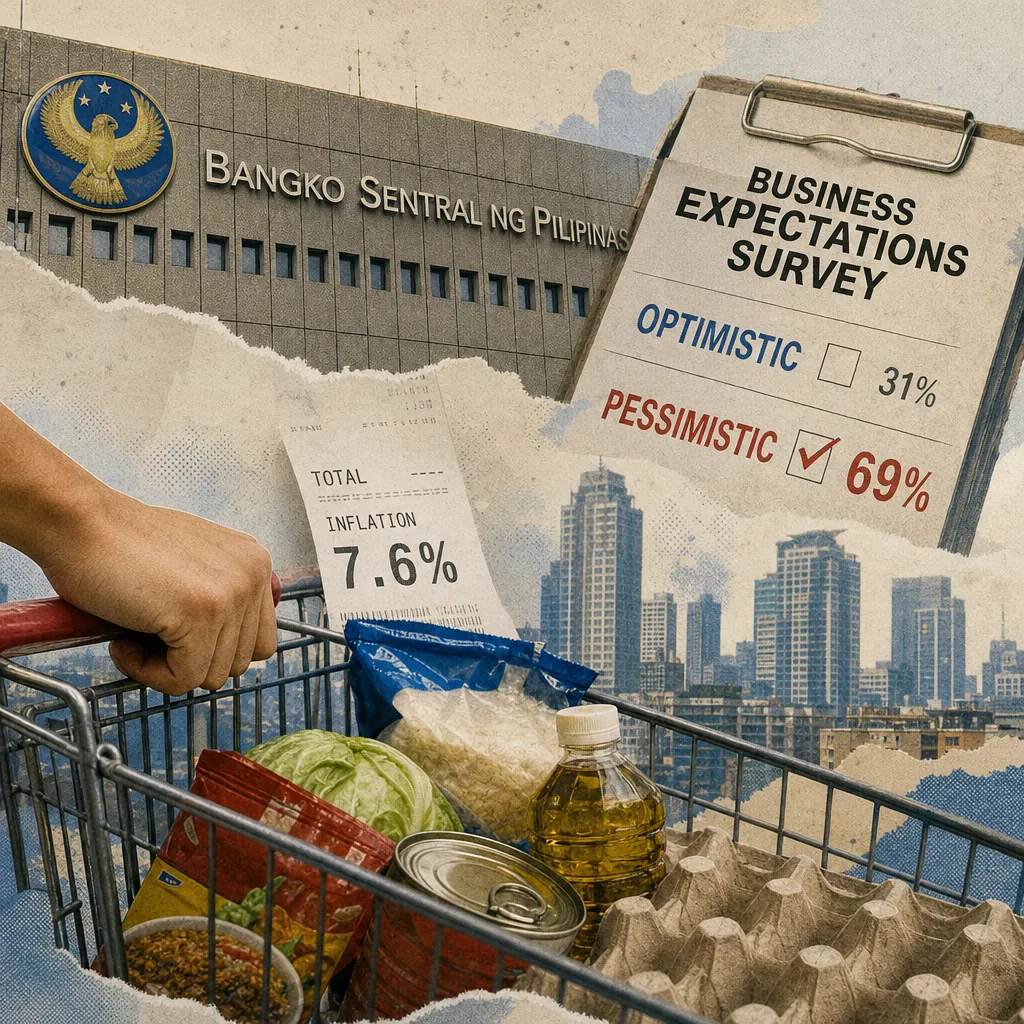
Philippine consumer prices likely rose 7.6 percent in October from a year earlier, the fastest pace since February 2023, according to the median estimate of 19 economists polled by the Inquirer82. That figure sits inside the Bangko Sentral ng Pilipinas' own forecast range of 7.1 to 8.1 percent for the month, and it would mark an acceleration from September's 7.2 percent82. The same day, the central bank reported that its nationwide survey of 515 companies put the business confidence index at -8.4 percent in September, up from -10.9 percent in August but still negative, meaning firms that expect conditions to worsen outnumber those that expect improvement83.
The two releases describe the same problem from opposite ends. Consumers are paying more for food, fuel and transport; businesses are absorbing those costs while watching the peso weaken and geopolitical tensions persist. Companies surveyed by the BSP said they now expect inflation to average 5.7 percent over the next 12 months, up from their previous forecast of 5.4 percent83. That is a meaningful revision: firms are not just reporting current pain, they are planning around the expectation that it continues.
Away from the inflation story, the day's economic coverage touched several pressure points that rarely make front pages but shape how the sector operates. Metro Manila is set to absorb 231,600 square metres of Grade A office space in the fourth quarter of 2026 after construction delays pushed handovers back, a pileup that could push metropolitan vacancy past 20 percent before January86. Stricter bank lending standards are steering younger borrowers toward buy now, pay later services, microloans and digital lenders, with a July reopening of online lending licenses by the Securities and Exchange Commission expected to accelerate that shift89. And a business column argued that the Philippines restored economic activity after the pandemic without rebuilding the productive capacity underneath it, citing an International Monetary Fund finding that labor productivity remained below its pre-pandemic trend and a central bank study showing total factor productivity growth in 2022 ranging from -1.9 percent to 0.8 percent depending on the trend estimate77.
Key themes
- October inflation likely hit 7.6 percent, the fastest in more than three years. The median estimate from 19 economists polled by the Inquirer would exceed September's 7.2 percent and sit well above the government's 3-percent target82. The central bank's own forecast range of 7.1 to 8.1 percent brackets that estimate, so the direction is not in dispute even if the final number moves82.
- Business confidence improved slightly but stayed negative. The BSP's confidence index rose to -8.4 percent from -10.9 percent, a smaller share of pessimists but still a majority-leaning-negative reading across 515 firms83. Companies cited inflation, peso depreciation, Middle East conflict and weather disruptions as reasons for their downbeat outlook83.
- Firms raised their own inflation expectations to 5.7 percent over the next 12 months. That is up from 5.4 percent in the prior survey, and it matters because businesses set prices, wages and investment plans around what they expect rather than what has already happened83.
- Metro Manila faces 231,600 square metres of new Grade A office space in the fourth quarter. Construction slippages left third-quarter handovers at just 16,900 square metres, about 9 percent of what was originally scheduled, so the year-end concentration accounts for roughly 70 percent of the 329,800 square metres projected for all of 202686. Vacancy could exceed 20 percent before January86.
- Stricter bank underwriting is pushing younger borrowers toward fintech lenders. Banks tightened approval standards and collections as inflation raised repayment concerns, while digital platforms use e-commerce and mobile wallet data to reach customers traditional credit bureaus cannot assess89. The SEC's July reopening of online lending licenses could bring more competitors into that space89.
- Philippine labor productivity remains below its pre-pandemic trend. The IMF reported in 2024 that medium-term potential growth was revised down from 6.5 percent before the pandemic to 6.0–6.3 percent, and a 2024 central bank study found total factor productivity growth in 2022 ranging from -1.9 percent to 0.8 percent77. The economy contracted 9.5 percent in 2020 and rebounded 7.6 percent in 2022, but the column argues that rebound measured activity, not transformation77.
- Mental health is being framed as an economic input, not only a welfare concern. A three-part business series opening this week argues that a mentally healthy workforce translates to higher innovation, lower absenteeism and lower turnover, and that the Philippines' growth depends heavily on its young, tech-savvy workforce in the business process outsourcing and service sectors93.
How the narratives stack
Dominant: The inflation forecast and the business confidence survey dominate the day's economic coverage in this set. The 7.6 percent median estimate from 19 economists is the single most consequential number: it sets expectations for the central bank's next policy move, it shapes wage negotiations, and it tells households what to brace for. The BSP survey reinforces it with firm-level evidence that businesses are planning around 5.7 percent inflation over the next year83. Both stories ran in the Inquirer's business section, and together they account for a substantial share of the coverage value in the items reviewed here — the inflation poll alone carried an estimated ₱408,240 in advertising-equivalent value, meaning the cost of buying the same space as paid advertising, and the business sentiment story carried ₱303,9128283. That is a measure of how prominently the stories ran, not of how many people read them.
Counter-narrative: The office supply story complicates the picture of a tight, inflationary economy. Metro Manila is about to absorb a large block of new Grade A office space into a market where tenant demand is already weakening, with negative net absorption recorded86. The fourth-quarter delivery of 231,600 square metres adds about 2.3 percent to the capital region's total office stock in three months86. For landlords and developers, that is a different kind of pressure from inflation: too much space chasing too few tenants, which pushes rents down and vacancy up. The two stories are not contradictory — an economy can have rising consumer prices and a soft commercial property market at the same time — but they point to different parts of the sector feeling different kinds of strain.
Emerging: The shift of credit toward fintech lenders is the clearest emerging pattern in the set. Banks tightening underwriting is a rational response to inflation-driven repayment risk, but it has a second-order effect: borrowers who cannot get bank credit go to buy now, pay later services and digital lenders that use alternative data89. The SEC's July reopening of online lending licenses means more of these lenders will enter the market89. The pattern is not yet a crisis — it is a reallocation of credit — but it changes who can borrow and on what terms, and it puts more consumers into relationships with lenders that are less regulated than banks.
Under-covered: The productivity argument in the business column received far less attention than the inflation numbers, but it addresses the underlying question the other stories raise. If labor productivity is below its pre-pandemic trend and potential growth has been revised down, then inflation and weak business confidence are symptoms of a deeper problem: the economy resumed activity without rebuilding the capacity to grow faster77. The mental health series makes a related point from the labor side, arguing that workforce well-being is a productivity issue rather than only a welfare one93. Neither story drew the coverage of the inflation forecast, but both describe constraints that will outlast the current price cycle.
Platform insights
The day's economic coverage ran through online news outlets, with the Inquirer's business section carrying the inflation poll, the business sentiment survey, the productivity column and the mental health series82837793. Retailnews carried the office supply and fintech credit stories8689. The distribution of coverage value across these items reflects where the monitoring captured them, not a census of where the stories ran.
Key voices and communities
Economists polled by the Inquirer. The 19 economists whose median estimate produced the 7.6 percent figure are the primary voices on the inflation story82. Their consensus matters because it sets the baseline against which the actual October figure, due for release in the coming weeks, will be judged. If the actual number comes in above 7.6 percent, expect calls for a sharper central bank response; if below, expect arguments that the peak has passed.
The Bangko Sentral ng Pilipinas. The central bank appears in two roles in this set: as the institution whose forecast range brackets the inflation estimate, and as the source of the business confidence survey8283. Its next policy meeting is the event that will translate these numbers into action. The BSP's forecast range of 7.1 to 8.1 percent for October is itself a signal that the central bank is not expecting a quick return to target82.
Philippine businesses. The 515 companies surveyed by the BSP are the group whose expectations the confidence index measures83. Their outlook matters beyond sentiment: firms that expect 5.7 percent inflation over the next year are more likely to raise prices, hold back on hiring and delay investment, which can make the expectation self-fulfilling.
Property developers and landlords. The office supply story puts developers in the position of delivering a large block of new space into a weakening market86. The named developments — Yuchengco Centre, Offices at the Galleon, SM North EDSA Tower 5, Southfield Center and Spectrum — are the specific projects that will test whether the market can absorb the supply86.
Fintech lenders and their regulators. The shift of credit toward digital lenders puts the Securities and Exchange Commission in the position of regulating a growing market that it has just reopened to new entrants89. The question is whether alternative-data underwriting reaches borrowers responsibly or simply moves risk to less supervised corners of the credit system.
Narrative streams
Inflation forecast puts October at 7.6 percent, fastest since February 2023
The median estimate of 19 economists polled by the Inquirer puts October inflation at 7.6 percent year-on-year, up from 7.2 percent in September and the fastest pace since February 2023, when inflation reached 8.6 percent82. The projection falls within the BSP's forecast range of 7.1 to 8.1 percent, and both the economists' consensus and the central bank's estimate put inflation well above the government's 3-percent target82. The drivers cited are higher food and oil costs and increased transport fares82.
For a reader outside the industry, the mechanics matter. Inflation measured this way compares the cost of a representative basket of consumer goods in October 2026 with the cost of the same basket in October 2025. A 7.6 percent reading means that basket costs 7.6 percent more than it did a year earlier. The government's 3-percent target is the range the central bank is supposed to keep inflation within over the medium term; a reading more than double that target is the reason the story leads the business pages.
The read for the sector is that borrowing costs are likely to stay high or rise further. The Inquirer report notes that the inflation pressure adds to the case for the central bank to raise interest rates further82. Higher rates affect everyone who borrows — businesses expanding, consumers buying homes or cars, and the government financing its debt. For households already squeezed by food and fuel prices, the combination of high inflation and higher rates is the hardest version of the cycle.
Business confidence improves but stays negative as firms plan for 5.7 percent inflation
The BSP's nationwide survey of 515 companies put the business confidence index at -8.4 percent in September, up from -10.9 percent in August83. The index is constructed so that a negative reading means pessimists outnumber optimists; the improvement means fewer firms are pessimistic, not that most are optimistic. Companies cited persistent inflation, the peso's depreciation, the prolonged conflict in the Middle East and weather-related disruptions to operations as reasons for their downbeat outlook83.
Firms also raised their own inflation expectations to 5.7 percent over the next 12 months, up from 5.4 percent83. That number is worth sitting with. It is lower than the current 7.6 percent forecast, which suggests businesses expect some easing, but it is still nearly double the government's target. Firms that expect 5.7 percent inflation are likely to build that expectation into their pricing, their wage offers and their investment decisions. The central bank watches these expectations closely because they can become self-reinforcing: if everyone plans for higher prices, higher prices become more likely.
The read for the sector is that the improvement in sentiment is too small to change behavior. A move from -10.9 to -8.4 is a narrowing of pessimism, not a return of confidence. Businesses are still more likely to delay expansion than to accelerate it, which feeds back into the productivity problem described below.
Metro Manila office market faces 231,600 square metres of new supply in one quarter
Metro Manila is scheduled to receive 231,600 square metres of Grade A office space in the fourth quarter of 2026, after construction slippages left third-quarter handovers at just 16,900 square metres86. Property data from Savills Philippines shows the fourth-quarter concentration accounts for roughly 70 percent of the 329,800 square metres projected for completion across all of 2026, and developers completed only 9 percent of the 183,400 square metres originally slated for handover between July and September86. Three developments slipped out of the third quarter — Yuchengco Centre, Offices at the Galleon and SM North EDSA Tower 5 — joining Southfield Center and Spectrum in a crowded year-end schedule that adds about 2.3 percent to the capital region's total office stock in three months86.
The supply arrives as tenant demand weakens, with Metro Manila recording negative net absorption86. Negative net absorption means tenants gave back more space than they took up over the period, the opposite of what a healthy office market looks like. The combination of a large supply wave and weakening demand is what puts vacancy on track to exceed 20 percent before January86.
For landlords and developers, the read is that pricing power is shifting toward tenants. A market with vacancy above 20 percent gives companies looking for space more options and more leverage to negotiate rents down or demand fit-out contributions. For developers with projects completing in the fourth quarter, the timing is difficult: the space is already under construction and cannot be held back, but the market it is arriving into is softer than it was when the projects were planned. For the broader economy, a soft office market matters because office leasing has been one of the steadier sources of commercial real estate demand, and weakness there can ripple into construction, property values and local government revenue.
Stricter bank lending pushes younger borrowers toward fintech credit
Banks tightened underwriting and collections as inflation raised concerns about borrowers' ability to repay, according to an October 2026 commentary from AB Capital Securities cited in a Retailnews report89. The result is that younger borrowers are moving toward buy now, pay later services, microloans and digital lenders89. Those platforms rely on alternative data — e-commerce transactions and mobile wallet activity — to approve shoppers that established lenders bypass, because traditional credit bureaus cover only a minority of the population89.
The Securities and Exchange Commission's July reopening of online lending licenses could accelerate the migration by allowing more digital competitors into the market89. More competition could lower prices for borrowers or it could lead to looser lending standards, depending on how the new entrants compete. The report notes that smaller transaction sizes typically accompany this kind of lending, which changes the economics for merchants and lenders alike89.
The read for the sector is that credit access is being redistributed rather than expanded or contracted. Borrowers who can no longer get bank credit are not necessarily going without; they are going to lenders with different underwriting models and different regulatory treatment. That matters for consumer protection, because fintech lenders operate under a different supervisory framework than banks, and for financial stability, because risk that moves outside the banking system is harder for regulators to see. The SEC's decision to reopen licensing is a bet that more competition and more formal oversight of digital lenders is better than leaving the market to informal players.
Productivity below pre-pandemic trend limits how fast the economy can grow
A business column argues that the Philippines restored economic activity after the pandemic without rebuilding the productive capacity underneath it77. The evidence: the International Monetary Fund reported in 2024 that Philippine labor productivity remained below its pre-pandemic trend and revised medium-term potential growth down from 6.5 percent before the pandemic to 6.0–6.3 percent77. A 2024 Bangko Sentral ng Pilipinas study on total factor productivity found that Philippine productivity was below its pre-pandemic level, with estimated total factor productivity growth in 2022 ranging from -1.9 percent to 0.8 percent depending on the trend estimate77. The economy contracted 9.5 percent in 2020 and rebounded 7.6 percent in 202277.
Total factor productivity is the part of economic growth that cannot be explained by adding more workers or more capital. It captures how efficiently an economy uses the resources it has — through technology, management, infrastructure and institutional quality. When total factor productivity growth is near zero or negative, an economy can still grow by adding workers and investment, but it cannot grow faster without those inputs growing too. That is why the IMF's downward revision of potential growth matters: it says the economy's speed limit is lower than it was before the pandemic.
The read for the sector is that the inflation and confidence problems are connected to a longer-term growth constraint. If the economy can only grow at 6.0–6.3 percent without generating inflation, then pushing growth faster through stimulus or easy credit risks overheating rather than building capacity. The column's argument is that the Philippines needs to invest in the things that raise productivity — infrastructure, education, health, institutional reform — rather than simply resuming activity. That is a slower and less visible project than a stimulus program, which is part of why it draws less coverage.
Mental health framed as a productivity issue for the Philippine economy
The first installment of a three-part business series argues that mental health is not only a public health concern or an employee welfare benefit but a driver of national productivity93. The argument rests on the Philippines' demographic profile: growth is fueled heavily by a young, tech-savvy workforce in the business process outsourcing industry and service sectors, making human capital the primary engine of development93. A mentally healthy workforce, the series argues, translates to higher innovation, reduced absenteeism, lower turnover and maximized output across all economic sectors93.
The series picks up from a Management Association of the Philippines general membership meeting, which suggests the business community is already treating the issue as an economic one rather than a purely social one93. The framing matters because it changes who is responsible: if mental health is a productivity issue, then employers and economic policymakers have a stake, not just health agencies.
The read for the sector is that companies in labor-intensive industries, particularly business process outsourcing, face a workforce constraint that is not captured in the usual measures of labor cost. High turnover and absenteeism are expensive, and if they are driven by mental health conditions that employers can address, then investment in workplace mental health is a productivity investment rather than a cost. The series will develop this argument over two more installments, but the opening piece already makes the economic case explicit.
Conversation trajectory
October inflation release (observation window: the next two to three weeks). The 7.6 percent figure is a forecast, not the official number. The actual October inflation data from the Philippine Statistics Authority will settle whether the economists' consensus was right. If the actual figure comes in at or above 7.6 percent, expect the central bank to face louder calls for a rate increase at its next policy meeting. If it comes in below, expect arguments that inflation has peaked. The BSP's forecast range of 7.1 to 8.1 percent gives a clear band to watch82.
Central bank policy meeting (observation window: the next scheduled meeting). The BSP's next rate decision is the event that converts the inflation and confidence data into policy. The business sentiment survey showing firms expecting 5.7 percent inflation over the next year is the kind of evidence that supports a tighter stance83. Watch whether the central bank cites inflation expectations in its statement, because that would signal it is looking past the current number to the risk of expectations becoming entrenched.
Fourth-quarter office completions (observation window: through January 2027). The 231,600 square metres scheduled for delivery in the fourth quarter will either be absorbed or add to vacancy86. Watch the vacancy rate reported by property consultancies at the end of the quarter. A move above 20 percent would confirm the supply pileup is translating into a tenant's market, which would put pressure on rents and on developers with exposure to the Metro Manila office segment.
Fintech lending license applications (observation window: the next two quarters). The SEC's July reopening of online lending licenses will show up in the number of new entrants over the coming months89. Watch whether new licenses go to well-capitalized operators or to smaller players, and whether the SEC issues guidance on alternative-data underwriting. The direction of the credit migration depends on how competitive the new entrants are and how the regulator supervises them.
Trigger events. The October inflation release is the nearest trigger. A reading above 8 percent would put inflation at the top of the central bank's forecast range and likely force a policy response. A reading below 7 percent would suggest the September acceleration was a spike rather than a trend. The central bank's policy meeting is the second trigger. The fourth-quarter office vacancy data is the third. Any of these could shift the narrative from "inflation is high" to "inflation is high and the economy is slowing," which is a harder story for businesses and policymakers alike.
Response guidance
Inflation communications: lead with the basket, not the rate. When discussing the 7.6 percent forecast, explain what it measures — the change in the cost of a representative basket of goods compared with a year earlier — before discussing what it means for interest rates. Households experience inflation through specific prices: rice, fuel, transport fares. A message that acknowledges those specific pressures is more credible than one that recites the headline number.
Business confidence: distinguish improvement from recovery. The move from -10.9 to -8.4 is an improvement in sentiment, but the index is still negative83. Communications that describe the survey as showing "improving confidence" without noting that pessimists still outnumber optimists will read as spin. State both facts and explain what would need to change for the index to turn positive.
Office market: prepare tenants and landlords for a different negotiating environment. With vacancy potentially exceeding 20 percent, tenants have more leverage than they have had in recent years86. Landlords should plan for longer lease-up periods and more concessions. Tenants should review lease terms with an eye to renewal options and flexibility. The message to both sides is that the market is rebalancing, and the terms of that rebalancing will be set in individual negotiations.
Fintech credit: emphasize disclosure and consumer protection. As borrowers move from banks to digital lenders, the risk of confusion about fees, interest rates and repayment terms rises89. Communications from lenders and regulators should be explicit about the total cost of credit, not just the headline interest rate. Borrowers should be told how alternative-data underwriting works and what data is being used to assess them.
Productivity: connect the short-term numbers to the long-term constraint. The inflation and confidence stories are easier to communicate than the productivity story, but they are connected77. When discussing inflation, note that the economy's potential growth rate has been revised down, which limits how fast it can grow without generating price pressure. That framing helps explain why the central bank cannot simply stimulate the economy out of the current slowdown.
Mental health: treat it as a workforce investment with measurable returns. The business case for workplace mental health rests on reduced absenteeism, lower turnover and higher productivity93. Communications should cite those outcomes rather than framing mental health as a welfare cost. Employers in labor-intensive sectors, particularly business process outsourcing, have the clearest incentive to act and the clearest data to measure results.
See the full picture behind today's signals.
This report draws from Media Meter's MediaWatch, our real-time monitoring engine tracking 2,470+ Philippine sources across print, broadcast, digital, and social. Explore how the platform turns raw coverage into decision-grade intelligence, then see how it's configured for teams like yours — whether you're in PR agencies, corporate comms, government, or marketing.
Want more? Browse our Report Library for sector and crisis intelligence, or request a demo and we'll have your brand set up before the call.
Want this kind of intelligence on your brand?
This brief is built on the same MediaWatch methodology that runs continuously across every brand we monitor. See your competitive landscape, Impact Score, and narrative trajectory in a 30-minute demo.