ASEAN Digital Pact Signed as Manila Hosts 49th Summit
The ASEAN Digital Economy Framework Agreement was signed in Manila, setting common rules for digital trade across nearly 680 million consumers. The same summit brought road closures, cash aid for displaced jeepney drivers, and a planned transport strike.
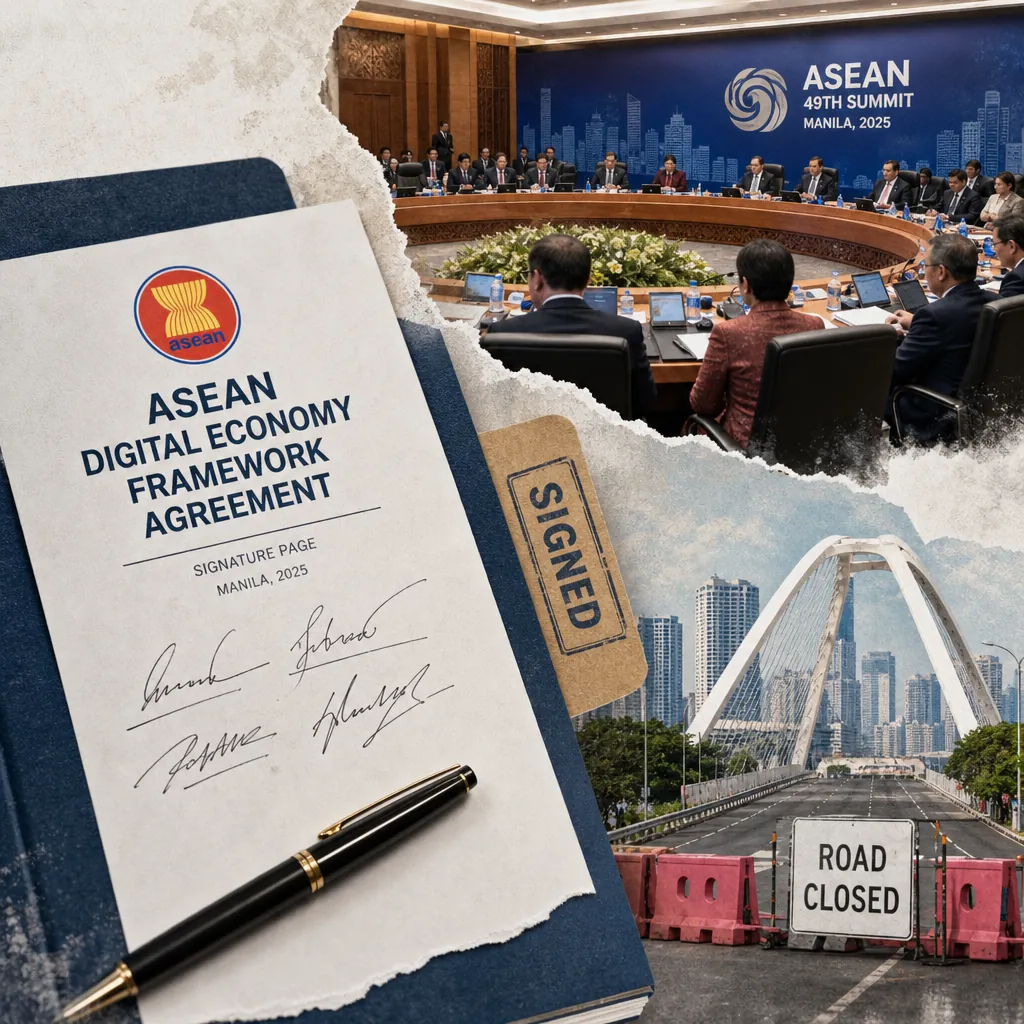
The ASEAN Digital Economy Framework Agreement (DEFA) was signed in Manila on Saturday, November 14, at the 49th ASEAN Summit, with Trade and Industry Secretary Cristina Roque announcing the deal at the ASEAN Business and Investment Summit at the Solaire Resort Grand Ballroom and saying it would be presented to the President the following day8. DEFA is the first region-wide digital economy agreement of its kind, and its stated goal is to double the value of Southeast Asia's digital economy from an estimated US$1 trillion to US$2 trillion by 20301327. Roque put the stakes in plain terms: "We are building a more integrated digital economy for nearly 680 million people, with the potential to double its value from an estimated $1 trillion to $2 trillion by 2030"13.
The agreement has been in negotiation since 2023 and sets common rules for digital trade, electronic payments, data protection and cybersecurity so that businesses can expand across borders without navigating each country's separate rulebook813. For a Philippine micro, small or medium enterprise (MSME) — the term covers the great majority of registered local businesses — the practical change is that selling into another ASEAN market should involve one set of rules rather than eleven. The Philippines made DEFA a priority of its 2026 ASEAN chairship, which it assumed in January13.
The summit also produced stories that had nothing to do with digital trade. The Department of Tourism (DOT) reported about ₱500,000 in souvenir sales on the first day of the ASEAN International Media Center shop, selling coffee, pili nuts and pearl accessories to foreign delegates, with Tourism Secretary Dita Angara-Mathay noting that "it's the first day, and half a million pesos were sold (already) and these are by the delegates alone"33. The Department of Social Welfare and Development (DSWD) handed ₱10,000 in cash assistance to jeepney drivers on the Baclaran-Divisoria route whose trips were disrupted by summit security measures, with spokesperson Assistant Secretary Irene Dumlao saying about 2,500 workers — eatery staff, vendors, sari-sari store owners and drivers — had received aid so far14. And the transport group PISTON announced a one-day strike on November 16, the day the summit formally opens14.
Key themes
- DEFA sets one digital rulebook for a market of nearly 680 million people. The agreement covers e-commerce, electronic payments, data protection and cybersecurity, and its target is to double Southeast Asia's digital economy to US$2 trillion by 2030 from about US$1 trillion today1327.
- The Philippines hosted the signing as ASEAN chair and framed it as an MSME story. Secretary Roque said the deal lets small businesses tap the regional market "with less friction, without navigating the different local rules of trade"8.
- Summit security cost displaced workers income, and government paid part of it back. The DSWD distributed ₱10,000 each to about 2,500 affected workers, including nearly 100 jeepney drivers on one route14.
- A transport strike is set for the summit's opening day. PISTON called a one-day strike on November 16 to press its demands as the 49th ASEAN Summit opens14.
- Philippine startups raised about US$120 million in 2025, against US$4.2 billion in Singapore. Gobi Partners executives cited the figures and said the country needs more venture capital, government-backed investment programs and university-industry links21.
- A regional venture firm put 2026 Philippine startup funding at about US$300 million. Gobi Partners described the year as stronger than 2025 but still behind Singapore and Vietnam24.
- Butuan and the Caraga region are being positioned as a startup hub. The 10th Technology Business Incubators Summit brought the science secretary and local officials together to push homegrown enterprises1.
- The summit's economic agenda reached the souvenir stall and the fuel pump. Delegates bought ₱500,000 of Filipino MSME goods on day one, and fuel prices were projected to fall further the following week334.
How the narratives stack
Dominant. The DEFA signing is the day's lead across the items captured here. It drew coverage from at least four outlets in this set — Inquirer Online, Daily Tribune Online, The Business Manual and Philstar Online — and the framing was consistent: a first-of-its-kind regional digital agreement, signed in Manila, with a US$2 trillion target for 20308132732. The Business Manual described it as "the world's first region-wide digital economy agreement of its kind," signed alongside the 28th ASEAN Economic Community Council Meeting27. Philstar's business column placed the summit in the context of rice prices, fuel costs and job availability, noting that the Philippines had steered ASEAN toward energy and food security priorities at the Cebu summit in May after war in the Middle East sent shocks through global energy markets32. The dominance is a property of this captured set, which is weighted toward Philippine online news; the signing was a regional event and would have drawn coverage well beyond these items.
Counter-narrative. The summit's costs landed on ordinary workers, and the coverage of that is specific. The DSWD's ₱10,000 payments to jeepney drivers, vendors and eatery workers acknowledge that security measures for a diplomatic event cost people a day's income14. PISTON's planned November 16 strike is the sharper edge of the same story: a group of transport workers using the summit's opening day to press its case14. This sits against the summit's own framing of regional integration and investment. Both are true at once: the agreement is designed to expand opportunity over years, and the road closures cost income within days.
Emerging. The Philippine startup funding gap is the story with the longest tail. Gobi Partners Managing Partner Chibo Tang said Filipino startups raised about US$120 million in 2025, compared with US$4.2 billion in Singapore and US$360 million in Vietnam, with Thailand at about US$80 million21. A second report on the same roundtable put 2026 funding at about US$300 million, still behind Singapore and Vietnam24. The firm's prescription — more venture capital funds, government-backed investment programs, and stronger university-industry links — is the same argument being made in Butuan, where the 10th Technology Business Incubators Summit gathered the Department of Science and Technology (DOST), Butuan Mayor Lawrence Fortun, Science Secretary Renato Solidum Jr. and Baguio Mayor Benjamin Magalong to push local ideas into scalable businesses1. Technology business incubators are facilities, usually hosted by universities or government agencies, that give early-stage companies office space, mentoring and small grants. The two stories point the same direction from opposite ends of the country.
Under-covered. The money-mule story in the Manila Times is the one that placed lowest in this set and deserves more attention than it got. The Philippine National Police Anti-Cybercrime Group arrested 67 people in 60 operations against the sale and misuse of ATM cards, online banking profiles and e-wallets in January and February, and police have since filed more than 500 cases under the Anti-Financial Account Scamming Act (AFASA), a law that criminalizes the use of bank accounts and e-wallets to move stolen money20. The column's argument is that the mule account is changing shape: instead of a student renting out a savings account, it increasingly looks like a small business using legitimate operations and QR payment systems to disguise illicit transfers20. That matters directly to the digital-payments expansion DEFA is designed to accelerate, and it drew a single item here.
Platform insights
The monitoring writeup for this window did not accompany the article set, so there is no engagement data — likes, shares, views or comments — to report for any platform. What follows is drawn from the published items only, and is offered as context rather than as a measurement of social response.
- Facebook. The summit's consumer-facing stories are the kind that travel on Facebook: the ₱10,000 aid for jeepney drivers, the PISTON strike announcement, and the souvenir shop's ₱500,000 first day1433. These are shareable because they are concrete and local. No engagement figures for these items are available in the material reviewed.
- X. The DEFA signing is a headline-and-number story — US$2 trillion, 680 million people, 2030 — and those figures are built for short posts13. The Business Manual's framing of the deal as the world's first region-wide digital economy agreement is the line most likely to circulate27.
- Reddit. The startup funding comparison — US$120 million for the Philippines against US$4.2 billion for Singapore — is the kind of figure that draws discussion in Philippine tech and startup communities, where the gap between local and regional funding is a recurring complaint21.
- YouTube. No video content appears in the items reviewed, and no view counts are available. The summit's ceremonial moments and the DEFA signing would be the natural video material, but nothing in this set measures how they performed.
Key voices and communities
The Department of Trade and Industry and Secretary Cristina Roque. Roque is the agreement's principal public voice, and she framed it around scale and access: nearly 680 million consumers, a doubling of the region's digital economy, and easier cross-border trade for small businesses813. Her department's argument is that common rules lower the cost of expanding, which matters most to firms too small to hire lawyers in every market.
Gobi Partners. Managing Partner Chibo Tang and Managing Director Fred Li, who heads the firm's university ventures arm, spoke to The Manila Times at the Cyberport Venture & Capital Forum 2026 in Hong Kong on November 4 and 521. Their framing is comparative and blunt: the Philippines has improved but lags Singapore, Vietnam and now Thailand's neighborhood. Their emphasis on university-industry links connects directly to the incubator summit in Butuan121.
Local government and science agencies in Caraga. Butuan Mayor Lawrence Fortun, DOST Caraga Regional Director Engr. Noel Ajoc, Science Secretary Renato Solidum Jr. and Baguio Mayor Benjamin Magalong made the case that the region's economic future depends on residents building enterprises rather than only adopting outside technology1. Fortun's argument, as reported, is that the city's future "depends on empowering residents to build enterprises rather than merely adopting" imported ones1.
Transport workers and the DSWD. PISTON and the jeepney drivers on the Baclaran-Divisoria route are the counter-voice to the summit's official narrative, and the DSWD's Dumlao is the government's responding voice, acknowledging the disruption and apologizing for it14.
Law enforcement and financial-crime investigators. The PNP Anti-Cybercrime Group and the CIDG are the institutional voices on the enforcement side, and the AFASA caseload — more than 500 — is the measure of how quickly the problem has grown20.
Narrative streams
DEFA creates one digital market rulebook for 680 million people
The agreement's mechanics are the story. DEFA establishes common rules for digital trade, electronic payments, data protection and cybersecurity, and it was signed in Manila during the 28th ASEAN Economic Community Council Meeting1327. The Business Manual quoted Roque saying that "at its core, DEFA provides a common framework for a more seamless, secure, and interconnected ASEAN digital" economy27. The Inquirer's explainer framed the benefit for local MSMEs as the ability to "easily tap the regional market across ASEAN with less friction, without navigating the different local rules of trade"8.
The target — doubling the region's digital economy from US$1 trillion to US$2 trillion by 2030 — is a projection, not a commitment by any single government, and it depends on member states implementing the common rules rather than signing and shelving them13. The agreement has been in the pipeline since 2023, which tells you how long the negotiation took and how much detail sits in the annexes8.
For Philippine technology firms, the immediate change is procedural: a payments company or an e-commerce platform that wants to operate in Vietnam, Thailand or Malaysia should eventually face one set of data and payment rules instead of eleven. For MSMEs, the change is about reach — the ability to sell to buyers in other member states without setting up a local entity or hiring local counsel. The risk sits in implementation: common rules only lower costs if regulators enforce them consistently, and the agreement's own timeline runs to 2030. The read for the sector is that DEFA shifts the competitive question for Philippine digital businesses from "can we operate abroad" to "can we operate abroad before our regional competitors scale into our market."
Summit security costs workers income, and the state pays part of it back
The DSWD's ₱10,000 payments are the most concrete evidence that the summit had a cost for people who were not in the room. Dumlao said about 2,500 workers had received assistance — eatery workers, vendors, sari-sari store owners and jeepney drivers — and that nearly 100 drivers on the Baclaran-Divisoria route were among them14. The department also apologized for the disruption caused by security measures and summit preparations14.
PISTON's response is a one-day transport strike on November 16, timed to the summit's opening, to press its demands14. The group's grievance is not the summit itself but the terms on which transport workers absorb its costs. For the logistics and transport sector, the practical question is whether a one-day strike on a summit day disrupts delegate movements and freight in the capital region, and whether the ₱10,000 payment sets a precedent for compensating workers during large events. The read for the sector is that major-event planning now carries an explicit compensation line for displaced informal workers, and that line will be contested in the next event.
Philippine startup funding trails the region by a wide margin
Gobi Partners' numbers are the sharpest measure of the gap. Tang said Filipino startups raised about US$120 million in 2025, against US$4.2 billion in Singapore, US$360 million in Vietnam and about US$80 million in Thailand21. A second account of the same roundtable put 2026 funding at about US$300 million, still behind Singapore and Vietnam24. The firm's prescription has three parts: more venture capital funds, government-backed investment programs, and stronger links between universities and industry21.
The comparison matters because venture funding is cumulative: startups that raise early attract the talent and follow-on capital that make the next round possible, so a country that raises a fraction of its neighbors' totals falls further behind each year. The 2026 figure of about US$300 million, if accurate, is roughly two and a half times the 2025 total, which is progress from a low base24. The read for the sector is that the Philippine startup ecosystem's constraint is not ideas but the size of the local capital pool, and that government-backed funds and university partnerships are the levers most likely to change it within a few years.
Butuan and Caraga build an incubator network from the ground up
The 10th Technology Business Incubators Summit in Butuan City brought together the DOST, local governments and academic institutions to turn local ideas into scalable businesses and sustainable jobs1. Mayor Fortun and DOST Caraga Regional Director Ajoc made the case that the region's economic future depends on residents building enterprises rather than only adopting outside technology1. The presence of Science Secretary Solidum and Baguio Mayor Magalong signals that the national agency and a city with an established startup reputation are both backing the regional push1.
Technology business incubators are the mechanism: they give early-stage companies subsidized space, mentoring and small grants, usually through a university or a science agency. The model works when the incubator is tied to a local industry — in Caraga's case, agriculture and natural resources — and when graduates can raise follow-on funding. The read for the sector is that regional incubators can produce investable companies, but only if the capital Gobi Partners says is missing reaches them; an incubator without a fund behind it produces pitches, not businesses.
Digital payments expand while money mules adapt to them
The Manila Times column is the most consequential technology story in this set that is not about the summit. Police arrested 67 people in 60 operations against the sale and misuse of ATM cards, online banking profiles and e-wallets in January and February, and have filed more than 500 cases under AFASA20. AFASA criminalizes the use of financial accounts to move stolen money, and the caseload is a measure of how quickly the problem scaled after the law took effect20.
The column's argument is that enforcement is chasing a changing target: the mule account increasingly looks like a small business, using legitimate operations and QR payment systems to disguise transfers, rather than a student renting out a savings account20. Each transfer in the chain is a "hop," and every hop puts distance between the stolen money and its origin20. This matters to the DEFA story because the agreement's promise of seamless cross-border digital payments depends on trust in the payment rails; if mule accounts and QR-based laundering scale with the rails, the cost of that trust falls on banks and payment providers. The read for the sector is that payment providers should expect compliance costs to rise as cross-border digital payments expand, and that the businesses most exposed are the small merchants whose QR codes are the entry point.
Fuel prices fall for a second week while the summit's energy agenda runs in the background
Gasoline prices were projected to fall another ₱3 to ₱4 per liter and diesel ₱4 to ₱5 per liter in the week after the summit, based on the first four days of trading in the Mean of Platts Singapore and foreign exchange averages4. If realized, the two-week reductions would reach as much as ₱20.80 per liter for gasoline and ₱9.10 for diesel, following the ₱16.80-per-liter gasoline and ₱4.10 diesel rollback implemented from November 10 to 164. In Metro Manila, gasoline could fall to as low as ₱57.70 per liter for RON 914.
The rollback comes despite renewed threats to global oil supplies from attacks on Middle East energy infrastructure and shipping routes4. Philstar's business column noted that the Philippines had put energy security at the center of its ASEAN chairmanship precisely because war in the Middle East had sent shocks through global energy markets32. The read for the sector is that the relief is real for transport operators and fuel-dependent businesses, but it is driven by global price movements the Philippines does not control, and the summit's energy-security agenda is the government's attempt to reduce that exposure over time.
Conversation trajectory
The DEFA implementation details, over the next four to six weeks. The agreement has been signed, but the operative question is what each member state does next: which rules take effect first, and whether the Philippines publishes an implementation schedule. Watch for DTI announcements on the domestic ratification and implementation process, and for the first sector-specific guidance on payments and data transfer. The reasoning is that a signed framework with a 2030 target has to produce near-term administrative steps, and those steps are where businesses will first feel the change.
The PISTON strike on November 16, within the next two days. The strike is scheduled for the summit's opening day, which maximizes visibility and disruption. Watch whether the strike proceeds, how many routes are affected, and whether the government responds with additional aid or negotiation. The reasoning is that a one-day strike during a diplomatic event draws attention that a routine strike would not, and the government's response will set the template for compensating workers during future major events.
Philippine startup funding figures for the full year 2026, over the next quarter. Gobi Partners' US$300 million figure for 2026 is a partial-year estimate from a single firm's roundtable. Watch for full-year venture funding data from industry trackers and for any government-backed fund announcements tied to the DEFA implementation. The reasoning is that the gap with Singapore and Vietnam is the sector's central constraint, and the 2026 number will show whether the improvement from 2025 is a trend or a single-year bump.
AFASA enforcement and the money-mule model, over the next two to three months. Police have filed more than 500 cases, and the column argues the mule model is shifting toward small businesses and QR payments20. Watch for new enforcement actions against business-front mules and for any Bangko Sentral ng Pilipinas guidance on merchant QR onboarding. The reasoning is that the enforcement pattern follows the money, and a shift in the mule model will show up in the next round of case filings.
Fuel prices for the week of November 17 to 23, within the next week. The projected cuts are based on four days of trading and could change before the official announcement. Watch the weekly price adjustment and whether the cumulative two-week reduction reaches the projected ₱20.80 per liter for gasoline4. The reasoning is that the projection is explicit and checkable, and a miss would signal that the Middle East supply threats are feeding through faster than expected.
Trigger events. The formal opening of the 49th ASEAN Summit on November 16; the DTI's first post-signing guidance on DEFA; the next Social Weather Stations survey release, given the administration's net satisfaction rating of -4 in the September 21–27 survey29; and the January 17 Philippine Basketball Association draft, which now admits overseas players41.
Response guidance
Explain DEFA in terms of a single transaction. Communications should walk through one concrete example — a Cebu food processor selling to a buyer in Vietnam — and show what changes: one set of payment rules, one data-protection standard, no need for a local entity. The agreement's scale figures are abstract; the transaction is not.
Separate the summit's diplomatic success from its local costs. Acknowledge the road closures and the ₱10,000 payments directly, and explain what the DSWD aid covered and who qualified14. Statements that celebrate the agreement without mentioning the disruption will read as tone-deaf to the workers who absorbed it.
Prepare for the November 16 strike with facts, not reassurance. Publish route-by-route contingency information and avoid characterizing the strike as illegitimate. The government's own aid program is an acknowledgment that the disruption was real14.
Use the startup funding gap as a call to specific action. The US$120 million versus US$4.2 billion comparison is stark, and repeating it without a proposal invites despair21. Pair it with the Gobi Partners prescription — more local venture funds, government-backed investment programs, university-industry links — and with the Butuan incubator model as a working example121.
Treat money-mule prevention as a merchant-onboarding issue. Payment providers and banks should communicate what they check when a small business signs up for a QR code, and why. The AFASA caseload of more than 500 is the reason the checks exist20.
Avoid overstating the fuel relief. The projected cuts are welcome and they are driven by global markets the country does not control4. Frame them as relief within a volatile environment, and point to the summit's energy-security agenda as the structural response32.
Keep the summit's MSME story concrete. The ₱500,000 in first-day souvenir sales is a better illustration of regional integration than any communiqué, because it names products — coffee, pili nuts, pearls — and buyers33. Use it.
Do not treat the administration's satisfaction rating as a summit verdict. The -4 net satisfaction rating was measured September 21–27, before the summit, and it is the second-lowest for the Marcos administration after the record -13 in March 202629. Any statement linking the two should say plainly that the survey predates the event.
See the full picture behind today's signals.
This report draws from Media Meter's MediaWatch, our real-time monitoring engine tracking 2,470+ Philippine sources across print, broadcast, digital, and social. Explore how the platform turns raw coverage into decision-grade intelligence, then see how it's configured for teams like yours — whether you're in PR agencies, corporate comms, government, or marketing.
Want more? Browse our Report Library for sector and crisis intelligence, or request a demo and we'll have your brand set up before the call.
Want this kind of intelligence on your brand?
This brief is built on the same MediaWatch methodology that runs continuously across every brand we monitor. See your competitive landscape, Impact Score, and narrative trajectory in a 30-minute demo.