Meralco Opens Bidding for 900 MW Baseload Supply
Meralco began a competitive tender for 900 megawatts of baseload power starting 2031, while the environment secretary tied renewable energy to national security and the energy department advanced rules for the country's first nuclear procurement.
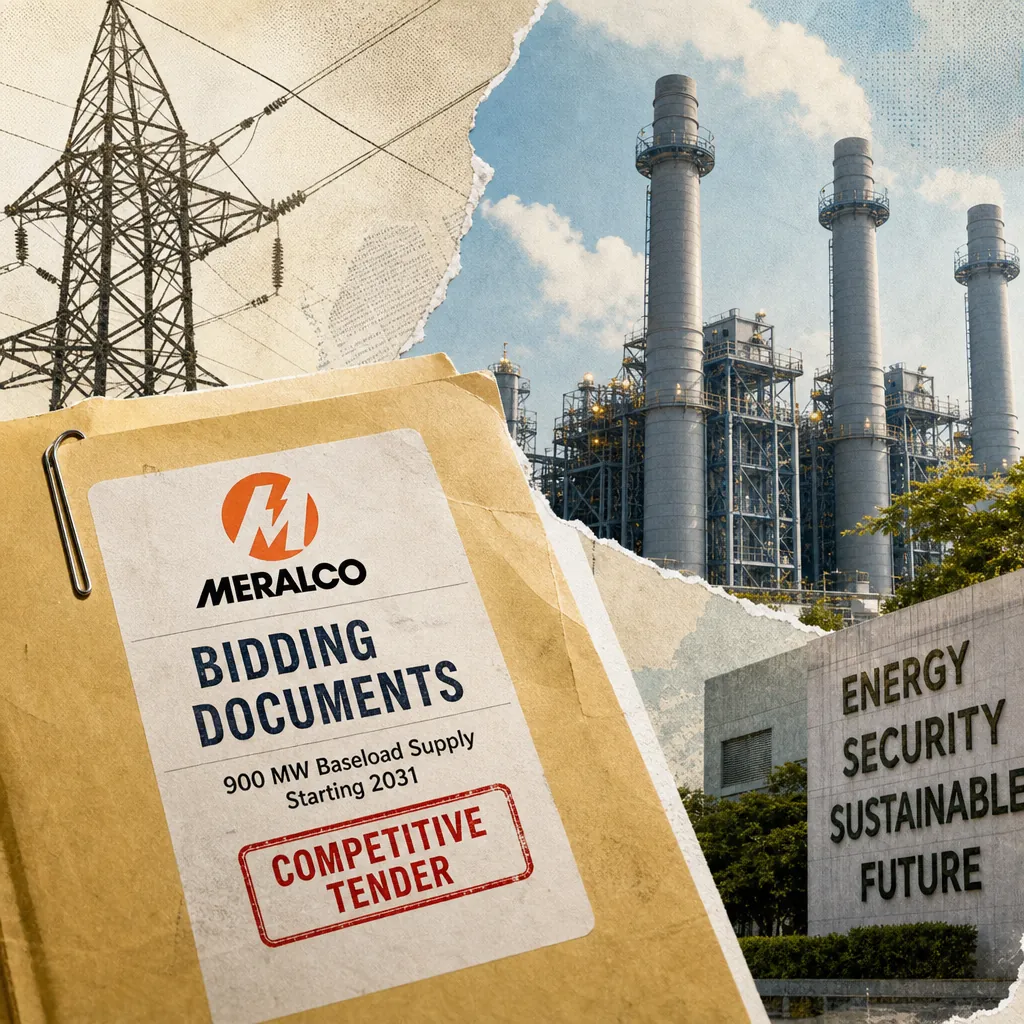
Meralco, the Philippines' largest electricity distributor, opened bidding on Tuesday for 900 megawatts of baseload power supply to begin delivering in 2031, a procurement that will shape what Filipino households and businesses pay for electricity well into the next decade.23 The company said it received a certificate of conformity from the Department of Energy for the terms of reference of the planned power supply agreements, clearing the way for the competitive selection process.70 Generation companies have until Oct. 15 to express interest, a pre-bid conference is set for Nov. 6, and bids are due Dec. 9.23
The tender covers two tranches under 15-year contracts: 600 megawatts starting Feb. 26, 2031, and another 300 megawatts a year later, both subject to approval by the Energy Regulatory Commission, the agency that reviews and approves electricity rates and power contracts.70 It follows a separate auction for 600 megawatts with deliveries scheduled for 2028 and 2029, bringing the total capacity Meralco has put out to bid to 1,500 megawatts.78 Units of San Miguel Global Power Holdings Corp. and Aboitiz Power Corp. are among the firms that have participated in the earlier round.70
Two other energy developments landed the same day. Environment Secretary Juan Miguel Cuna told a high-level reception hosted by Danish green fund manager Copenhagen Infrastructure Partners during New York Climate Week that shifting to renewable power is essential to protecting the country from international supply shocks and geopolitical instability.1 "The world is navigating an era of complex geopolitical change, where the traditional paradigms of national security are rapidly evolving," Cuna said, in a statement the Department of Environment and Natural Resources released Tuesday.1 Separately, the Department of Energy presented revisions to the draft rules governing the competitive procurement of the country's first nuclear generation capacity, with the government targeting an initial 1,200 megawatts by 2032, rising to 2,400 megawatts by 2035 and 4,800 megawatts by 2050.69
Key themes
- Meralco puts 900 MW of long-term supply out to bid. The distributor's competitive selection process will lock in 15-year contracts delivering 600 megawatts from February 2031 and 300 more from February 2032, with expressions of interest due Oct. 15 and bids due Dec. 9.2370
- The environment secretary frames renewables as a security question. Cuna told investors in New York that the traditional paradigms of national security are rapidly evolving, tying the energy transition to protection against supply shocks.1
- Nuclear procurement rules move forward. The Department of Energy is revising the guidelines for tendering the country's first nuclear capacity, with 1,200 megawatts targeted by 2032.69
- Electric mobility infrastructure expands alongside the grid. Movem Electric Inc., the electric mobility arm of Meralco, partnered with Filinvest Malls to support charging at Festival Mall in Muntinlupa City.33
- Unilever Philippines reports progress on cutting its own emissions. The consumer goods maker has run on 100 percent renewable grid electricity since 2019, installed rooftop solar across its facilities, and plans to convert its owned vehicle fleet to hybrid electric by 2030.41
- A super El Niño threatens water and power supply in Western Visayas. The weather bureau warned of a six-month dry period from October through March 2027, with rainfall falling below normal and then way below normal.51
- Steel supply security becomes a regional concern. The National Security Council's director general warned that Southeast Asia's growing steel demand is colliding with vulnerabilities in the region's own steel industry.4020
- The stock market fell as US bond yields held near multi-decade highs. The Philippine Stock Exchange Index dropped 0.87 percent to 5,738.40, with Meralco shares among the decliners.435
How the narratives stack
Dominant. The Meralco tender is the day's most consequential energy story, and it drew the widest coverage in the items reviewed here. It appeared in Inquirer Online, BusinessWorld's corporate pages, and Head Topics, with the BusinessWorld broadsheet version carrying an estimated ₱378,271 in advertising-equivalent value — the notional cost of buying the same column space as paid advertising.237078 The story matters because baseload power — electricity generated around the clock rather than intermittently — sets the floor for what the grid can reliably deliver, and 15-year contracts signed now will determine the generation mix and the price consumers pay through the 2030s and into the 2040s. The deadlines are concrete and near: interest by Oct. 15, pre-bid Nov. 6, bids Dec. 9.23
Counter-narrative. Cuna's New York remarks put a different frame on the same subject. Where the Meralco tender is a procurement story about capacity and price, Cuna's address was about vulnerability — the argument that a country importing fuel is exposed to geopolitical shocks it cannot control.1 The Inquirer Online item carried an estimated ₱412,020 in advertising-equivalent value, the highest of the energy items in this set.1 The two frames are not in conflict: the tender is how the grid gets built, and the security argument is why the government says it should be built a certain way. But they point to different priorities — one toward reliability and cost, the other toward reducing exposure to imported fuel.
Emerging. The nuclear procurement rules are the earliest-stage story of the three. The Department of Energy is still revising a draft circular that will determine how nuclear capacity is competitively procured, priced, and integrated into the grid.69 The government's targets — 1,200 megawatts by 2032, 2,400 by 2035, 4,800 by 2050 — are ambitions rather than commitments, and the rules under revision will determine whether they are achievable. The item ran on Daily Guardian online, a regional outlet, and carried an estimated ₱254,610 in advertising-equivalent value.69 Nuclear power has been the subject of Philippine policy debate since the Bataan Nuclear Power Plant was completed in 1984 and never operated; the current push represents the most concrete step toward reviving the option.
Under-covered. The Western Visayas drought warning appeared in a single regional outlet, Panay News, despite describing a six-month dry period that the weather bureau says will strain water supply, agriculture, and power generation across the region through March 2027.51 The item carried an estimated ₱381,936 in advertising-equivalent value.51 The Philippine Atmospheric, Geophysical and Astronomical Services Administration, the government's weather bureau, expects rainfall to fall below normal in October and November and then deteriorate to way-below-normal levels from December through March.51 El Niño is the warm phase of a recurring climate pattern marked by unusually warm sea-surface temperatures in the central and eastern equatorial Pacific; in the Philippines it generally raises the likelihood of below-normal rainfall, dry spells, and drought.51 A "Super El Niño" is a popular term for an exceptionally strong event. The story placed low in the items reviewed here, but its consequences for farmers, households, and power supply in the region are immediate.
Platform insights
The monitoring writeup for this window did not include social platform data, so this section is limited to what the news coverage itself shows about how the story traveled.
- Regional outlets carried the stories national desks did not. Panay News reported the Western Visayas drought warning, and Daily Guardian online carried the nuclear procurement rules and the agrarian reform items.516972 These are stories with direct consequences for the communities they serve, and they ran where those communities would see them.
- Business broadsheets anchored the corporate and market stories. BusinessWorld carried the Meralco tender, the Colliers property report, the A Brown investment, and the market close, giving the day's business news a consistent home in print.70828151
- Wire and aggregator services spread the Meralco story. Head Topics republished the Meralco tender item, and the same story appeared in Inquirer Online and BusinessWorld, indicating the procurement was treated as a standard business desk item across outlets.782370
Key voices and communities
Meralco and the generation companies. Meralco is the country's largest power distributor, serving millions of customers across Metro Manila and surrounding provinces. Its competitive selection process is the mechanism by which it buys supply; the companies that bid — among them units of San Miguel Global Power and Aboitiz Power — are the country's largest generators.70 What Meralco buys, and at what price, flows through to consumer bills.
The Department of Energy and the Energy Regulatory Commission. The energy department sets the rules for procurement and issued the certificate of conformity that allowed the Meralco tender to proceed.70 The regulatory commission reviews and approves the resulting power supply agreements, giving it final say over whether the contracts take effect.70 The department is also drafting the nuclear procurement rules.69
The Department of Environment and Natural Resources. Secretary Cuna used a New York Climate Week platform to argue that renewable energy is a national security matter, positioning the environment department as a voice in the energy transition debate alongside the energy department.1
The National Security Council. Director General Eduardo Oban Jr. told a Manila forum that steel has become a national security concern because of its role in infrastructure and defense, and warned that the region's growing demand is colliding with supply vulnerabilities.4020 The council's involvement signals that the government is treating industrial supply chains as a security issue, not just an economic one.
The weather bureau and regional communities. PAGASA's drought warning for Western Visayas puts farmers, households, and local governments in the region on notice for a dry period that will affect water and power.51
Narrative streams
Meralco's 900-megawatt tender sets the terms for 2031 supply
Meralco's competitive selection process is the mechanism by which the distributor buys electricity in bulk from generators. Under the rules, the company publishes the terms of reference for the supply it needs, the energy department certifies those terms, and generators bid to fill the requirement.70 The 900 megawatts now out to bid will be delivered under 15-year contracts — 600 megawatts starting Feb. 26, 2031, and 300 more starting Feb. 26, 2032 — subject to the regulatory commission's approval.70 The deadlines are Oct. 15 for expressions of interest, Nov. 6 for the pre-bid conference, and Dec. 9 for bid submissions.23
The procurement follows an earlier auction for 600 megawatts with deliveries in 2028 and 2029, bringing the total capacity Meralco has put out to bid to 1,500 megawatts.78 The company said the process is how it secures sufficient and reliable supply to meet growing electricity demand.23 For consumers, the contracts signed now will determine the generation charge on their bills for years; for generators, the tender is a chance to lock in long-term revenue. The read for the sector is that the country's largest distributor is buying supply for a decade that is still five years away, which means the generation mix for the 2030s is being decided in the last quarter of 2026.
Cuna ties renewable energy to sovereignty and security
Environment Secretary Juan Miguel Cuna used a keynote address at a reception hosted by Copenhagen Infrastructure Partners, a Danish green fund manager, during New York Climate Week to argue that the energy transition is a matter of national security.1 "The world is navigating an era of complex geopolitical change, where the traditional paradigms of national security are rapidly evolving," Cuna said, according to a statement the environment department issued Tuesday.1 The Inquirer Online item carried an estimated ₱412,020 in advertising-equivalent value, the highest among the energy items in this set.1
Cuna's framing places the energy transition in a different category from the procurement story. Where Meralco's tender is about capacity and price, Cuna's argument is about exposure: a country that imports fuel is vulnerable to supply shocks and geopolitical instability it cannot control. The read for the sector is that the government is now making the security case for renewables alongside the climate case, which changes the terms of the debate for generators, investors, and consumers. The context is that the Philippines has long depended on imported coal and oil for a large share of its electricity, leaving it exposed to global price movements and supply disruptions.
Nuclear procurement rules advance toward a 2032 target
The Department of Energy is revising the draft circular that will govern how the country's first nuclear generation capacity is competitively procured, priced, and integrated into the grid.69 DOE Director Patrick T. Aquino presented the revisions during a forum, according to Daily Guardian online.69 The government is targeting an initial 1,200 megawatts of nuclear capacity by 2032, rising to 2,400 megawatts by 2035 and 4,800 megawatts by 2050.69
The rules matter because nuclear projects involve long-term generation costs, major transmission requirements, and strict safety regulation, all of which the procurement framework must address before any project can proceed.69 The read for the sector is that the government is preparing the legal and regulatory groundwork for a nuclear program even though no project has been approved and the technology remains politically contested. The context is that the Philippines completed the Bataan Nuclear Power Plant in 1984 but never operated it, and the current push represents the most concrete step toward reviving nuclear power since then.
Electric mobility infrastructure grows alongside the grid
Movem Electric Inc., the wholly owned electric mobility arm of Meralco, partnered with Filinvest Malls to support the electric vehicle charging experience at Festival Mall in Muntinlupa City.33 The company works with property developers, businesses, and communities to build the infrastructure needed to support electric vehicles, and the partnership brings electric mobility, technology, and sustainable infrastructure together in one location.33 The read for the sector is that the charging network is being built by the same corporate group that distributes the electricity, which gives Meralco a stake in both the supply and the demand side of the transition. The context is that electric vehicle adoption in the Philippines remains small but is growing, and the availability of charging infrastructure is one of the factors that determines how quickly it spreads.
Unilever Philippines reports progress on cutting its own emissions
Unilever Philippines transitioned to 100 percent renewable grid electricity using geothermal energy in 2019 and has since installed rooftop solar panels across its facilities, according to Daily Tribune online.41 The company has electrified some thermal processes using heat pumps and boilers and plans to convert its owned vehicle fleet to 100 percent hybrid electric by 2030.41 In September 2025, it expanded a partnership with First Gen to provide renewable energy to priority sites and suppliers across Metro Manila, Cavite, Laguna, and Batangas, and it is an inaugural member of the Net Zero Carbon Alliance, a cross-sector group promoting decarbonization.41
The read for the sector is that large manufacturers are now reporting on their own emissions reductions as a matter of routine, which puts pressure on suppliers and competitors to do the same. The context is that corporate sustainability reporting in the Philippines has moved from voluntary public relations to a framework used by investors and regulators, and companies that cannot show progress face questions from both.35
A super El Niño threatens water and power in Western Visayas
PAGASA warned that Western Visayas faces a six-month dry period beginning in October, with rainfall expected to fall below normal in October and November and then deteriorate to way-below-normal levels from December 2026 through March 2027.51 The weather bureau said the very strong El Niño threatens water shortages, drought, extreme heat, and mounting pressure on agriculture and power supply.51 The Panay News item carried an estimated ₱381,936 in advertising-equivalent value.51
El Niño is the warm phase of a recurring climate pattern marked by unusually warm sea-surface temperatures in the central and eastern equatorial Pacific; it disrupts normal atmospheric circulation and rainfall patterns, and in the Philippines it generally raises the likelihood of below-normal rainfall, dry spells, and drought.51 A "Super El Niño" is a popular term for an exceptionally strong event. The read for the sector is that the drought will affect the same region's power supply at the same time it affects its farms, because hydroelectric plants depend on rainfall and irrigation depends on reservoirs. The context is that the Philippines experiences an average of 20 typhoons a year in addition to monsoon rains, and the country is simultaneously managing flood risk and drought risk in different regions.15
Steel supply security becomes a regional concern
National Security Council Director General Eduardo Oban Jr. told the second ASEAN Steel Policymaker Conference and the 2026 ASEAN Iron and Steel Forum in Manila that Southeast Asia's growing demand for steel is colliding with vulnerabilities in the region's own steel industry.4020 He called the situation an "ASEAN Steel Paradox" that could expose economic growth and critical infrastructure to supply and security risks.40 Oban cited concerns over illegal steel mills and scrap-based induction furnaces that can affect the quality and safety of steel entering the market, and said the Philippines is proposing a resilient interdependence model to strengthen the region's steel industry.4020
The read for the sector is that the government is treating steel — a basic input for construction, infrastructure, and defense — as a national security concern rather than a purely commercial one, which could lead to tighter standards and more scrutiny of imports. The context is that the Philippines imports a large share of its steel, leaving it exposed to supply disruptions and price movements in global markets.
The stock market fell as US bond yields held near multi-decade highs
The Philippine Stock Exchange Index dropped 0.87 percent, or 50.47 points, to close at 5,738.40 on Tuesday, while the broader all shares index fell 0.62 percent, or 19.89 points, to 3,202.83.4351 Philstocks Financial Inc. said the market followed Wall Street's overnight decline as higher US Treasury yields weighed on equities, and that uncertainty between the United States and Iran and its potential impact on the global oil market also dampened sentiment.43 The 30-year US Treasury bond yield hit 5.6206 percent, its highest since June 2002, and the 10-year yield climbed to 5.293 percent, near its highest since June 2007.5
Rising government bond yields can make riskier assets such as stocks less attractive and may signal that borrowing costs will remain elevated.43 Meralco shares fell 4.09 percent to ₱417.20, the steepest decline among the index's member stocks.51 The read for the sector is that energy companies are exposed to both the cost of borrowing for new projects and the price of imported fuel, and both are moving in directions that raise costs. The context is that the Philippine economy grew 2.3 percent in the second quarter, slower than the 5.4 percent expansion a year earlier and the weakest quarterly performance outside the pandemic period since the fourth quarter of 2009.82
Conversation trajectory
Meralco's bid deadlines will produce a steady stream of news through December. Expressions of interest are due Oct. 15, the pre-bid conference is Nov. 6, and bids are due Dec. 9.23 Each of those dates is a checkable milestone, and the list of companies that express interest will show which generators are competing for the 15-year contracts. Watch for whether the same firms that participated in the earlier 600-megawatt auction bid again.70
The nuclear procurement rules will face scrutiny when the department finalizes the circular. The revisions presented Tuesday are still draft, and the final version will determine how nuclear capacity is priced and integrated into the grid.69 The 2032 target for 1,200 megawatts is ambitious given that no project has been approved, and the rules will show whether the government is preparing for a realistic procurement or a symbolic one.
The Western Visayas drought will intensify through the first quarter of 2027. PAGASA expects conditions to deteriorate from December through March, which means the effects on water supply, agriculture, and power generation will become clearer as the dry period progresses.51 Watch for advisories from the weather bureau, the energy department, and local governments as the situation develops.
The US bond market will continue to influence Philippine equities and borrowing costs. The 30-year Treasury yield is at its highest since 2002, and the 10-year is near its highest since 2007.5 If yields stay elevated, Philippine companies planning long-term projects — including the generators bidding for Meralco's contracts — will face higher financing costs, and the stock market will remain under pressure.43
Trigger events to watch: the Oct. 15 deadline for Meralco bid expressions; the Nov. 6 pre-bid conference; the Dec. 9 bid submission deadline; the energy department's final nuclear procurement circular; PAGASA's monthly rainfall advisories for Western Visayas; and US inflation and labor market data that will shape the Federal Reserve's interest rate path.2369515
Response guidance
For energy companies bidding on the Meralco contracts: prepare for public scrutiny of the fuel source behind any bid. The tender is for baseload supply, which in practice means coal, natural gas, or geothermal, and the environment secretary's New York remarks show the government is making a security argument for renewables.1 Companies that can show a credible transition plan alongside reliable baseload capacity will be better positioned with regulators and the public.
For communicators at Meralco and the energy department: explain what baseload means and why 15-year contracts are signed years in advance. Most consumers do not know that the electricity they use in 2031 is being purchased in 2026, and the gap between procurement and delivery is an opportunity to explain how the grid works.23
For companies with exposure to imported fuel: the environment secretary's framing of renewables as a national security matter is a signal that the government will favor arguments about supply security.1 Companies that can show how their operations reduce exposure to imported fuel — through geothermal, solar, or efficiency — have a stronger case with policymakers.
For regional businesses and local governments in Western Visayas: the drought warning is a planning trigger, not just a news item.51 Water-dependent operations, farms, and power generators should be preparing contingency plans now, before rainfall falls below normal in October and November.
For manufacturers reporting on sustainability: Unilever's disclosure shows that large companies are now expected to report on emissions reductions as a matter of routine.41 Companies that treat sustainability as a public relations exercise rather than an operational framework will face harder questions from investors and regulators.35
For communicators covering the stock market: explain that the Philippine index's decline is tied to US bond yields and oil prices, not to domestic corporate performance.435 The distinction matters because it tells readers whether the news is about Philippine companies or about global financial conditions.
See the full picture behind today's signals.
This report draws from Media Meter's MediaWatch, our real-time monitoring engine tracking 2,470+ Philippine sources across print, broadcast, digital, and social. Explore how the platform turns raw coverage into decision-grade intelligence, then see how it's configured for teams like yours — whether you're in PR agencies, corporate comms, government, or marketing.
Want more? Browse our Report Library for sector and crisis intelligence, or request a demo and we'll have your brand set up before the call.
Want this kind of intelligence on your brand?
This brief is built on the same MediaWatch methodology that runs continuously across every brand we monitor. See your competitive landscape, Impact Score, and narrative trajectory in a 30-minute demo.