Peso hits record low 62.565:$1 as markets slide
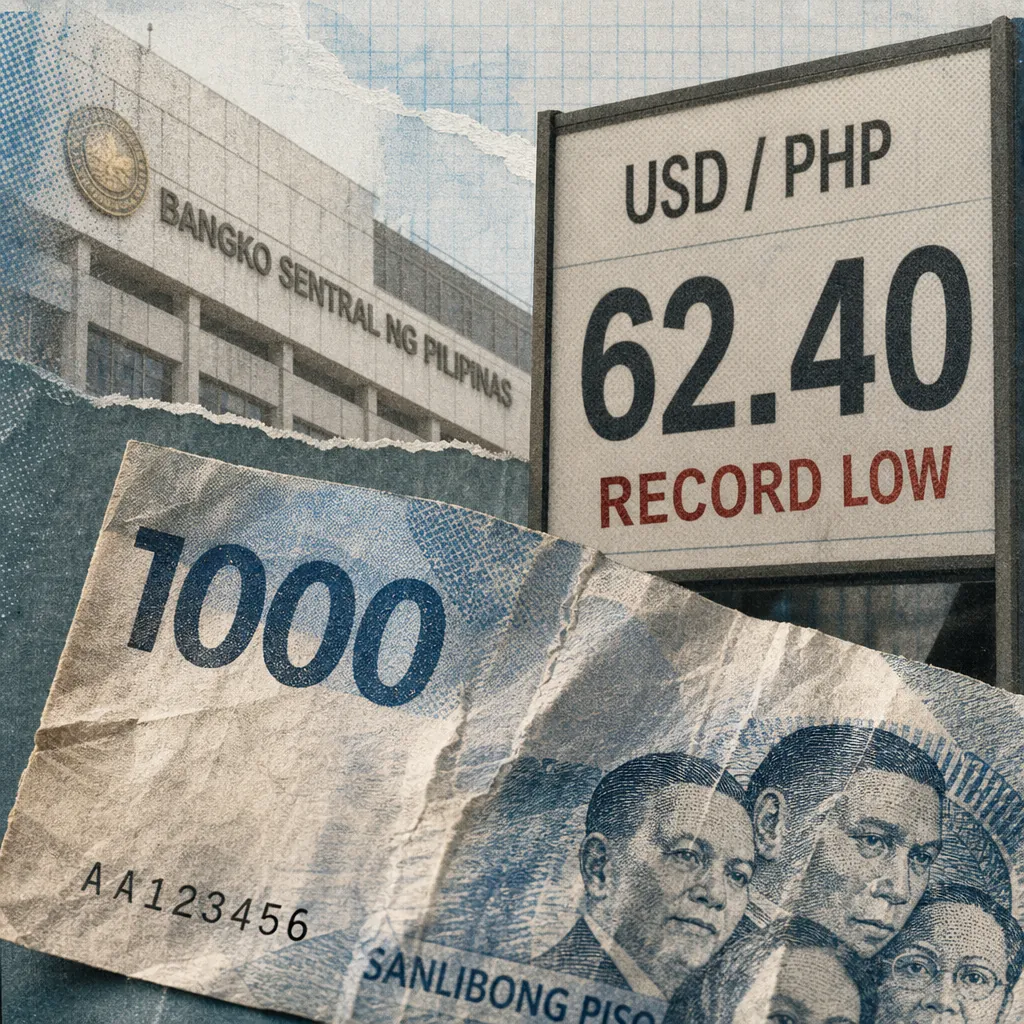
The Philippine peso fell to a new record low of 62.565 per dollar on September 2, marking a fourth straight session of all-time lows amid Middle East tensions and inflation worries. The stock market dipped, and analysts debated the causes, from consumption culture to low incomes.
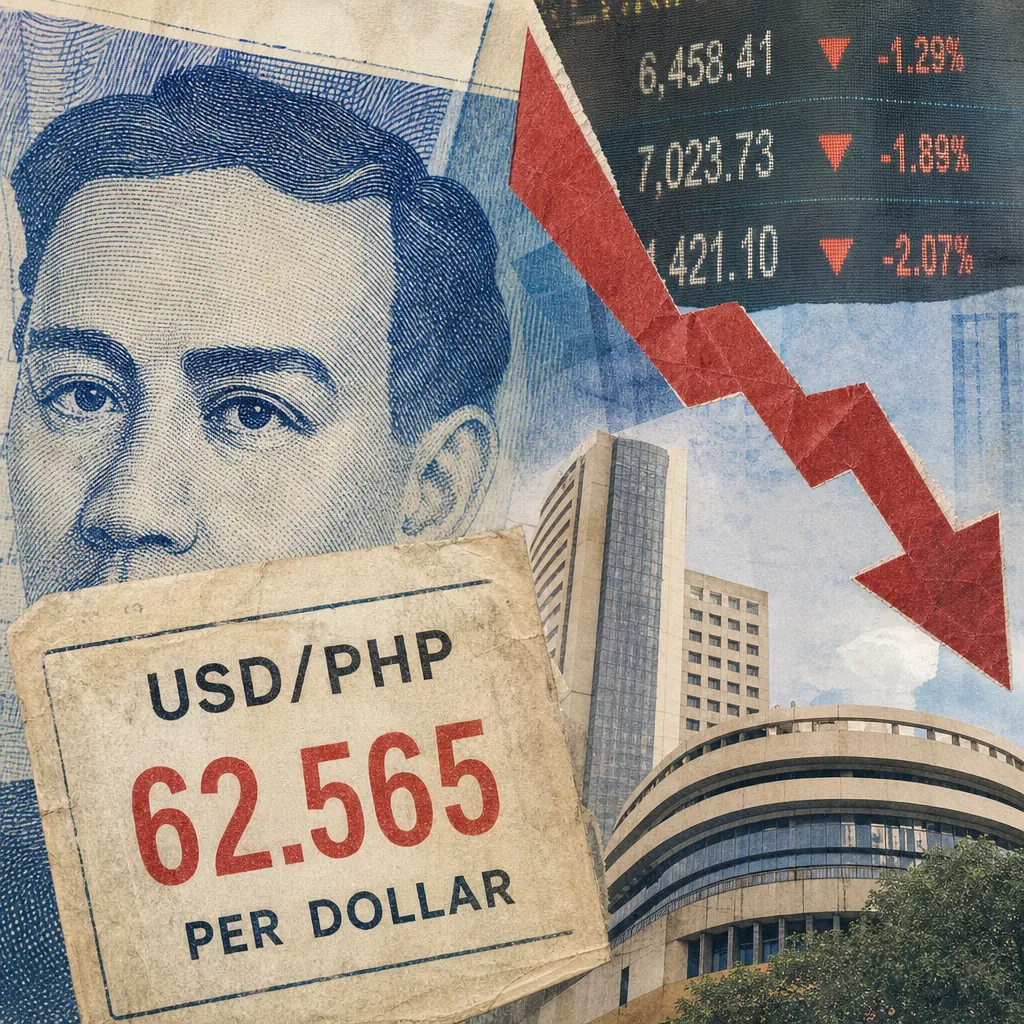
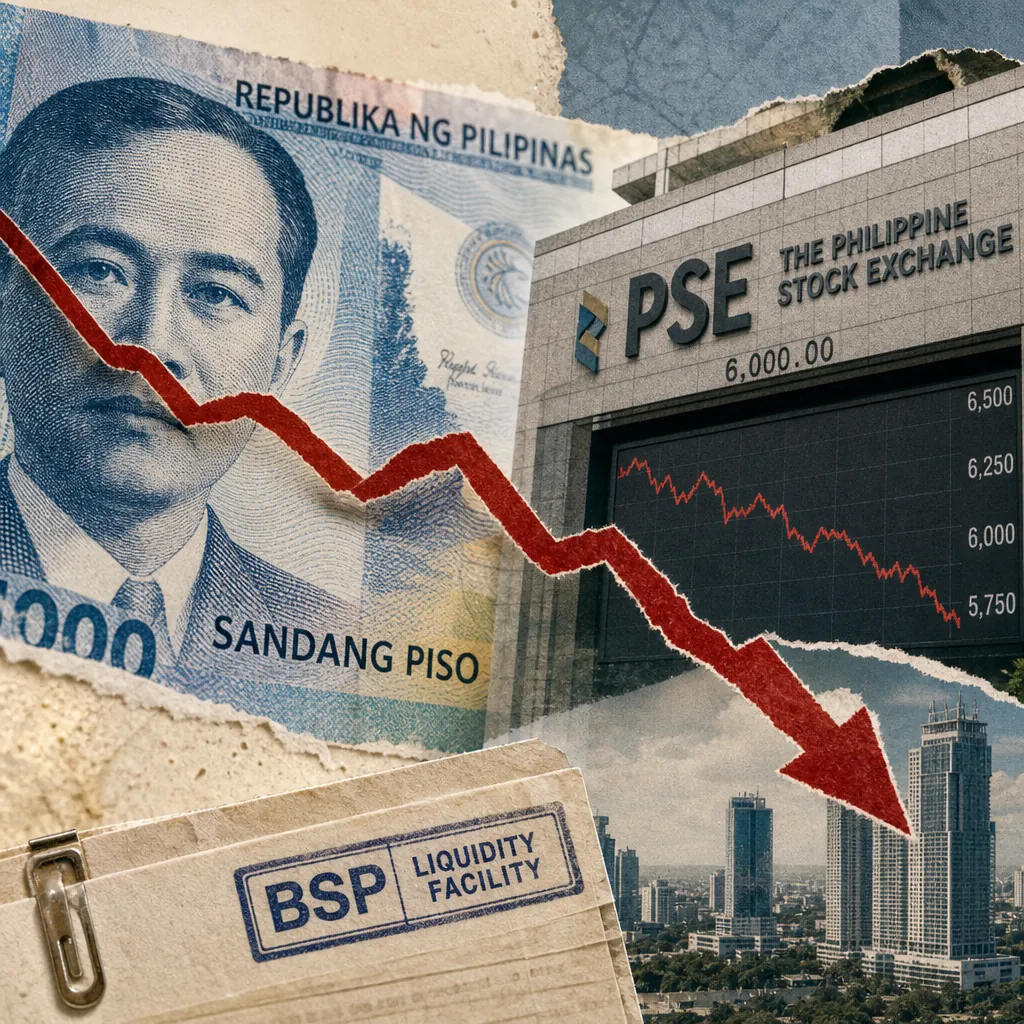
The Philippine peso slid to another record low on Wednesday, September 2, closing at 62.565 to the dollar — a fourth consecutive session of all-time lows — as renewed Middle East conflict, higher oil prices, and expectations of tighter U.S. monetary policy pushed investors toward safe-haven assets 429. The currency weakened 16.5 centavos from its previous close of 62.40, touching an intraday low of 62.69 before paring losses, with trading volume rising to $1.8 billion from $1.3 billion the prior session 429. The Philippine Stock Exchange index (PSEi), the benchmark of the country's main bourse, finally took notice after ignoring Tuesday's peso plunge, shedding 40.66 points or 0.67 percent to close at 6,053.23 2980. The broader All Shares index also fell 10.58 points or 0.31 percent to 3,352.61 2980.
The day's financial news was dominated by the currency's fall and its ripple effects. The government's auction of reissued 20-year Treasury bonds drew a partial award as yields climbed on the same risk-off sentiment, with the Bureau of the Treasury (BTr) borrowing P29.561 billion against a P30-billion target despite total tenders of P36.111 billion 2. The average yield was capped at 7.218 percent to align the award with market sentiment 2. Meanwhile, term deposit yields rose after the central bank's latest policy rate hike, with the seven-day facility fetching higher average yields despite stronger demand 14. Analysts at ANZ Research and other institutions saw scope for one more rate increase before year-end as El Niño threatens food prices and the peso remains under pressure 86.
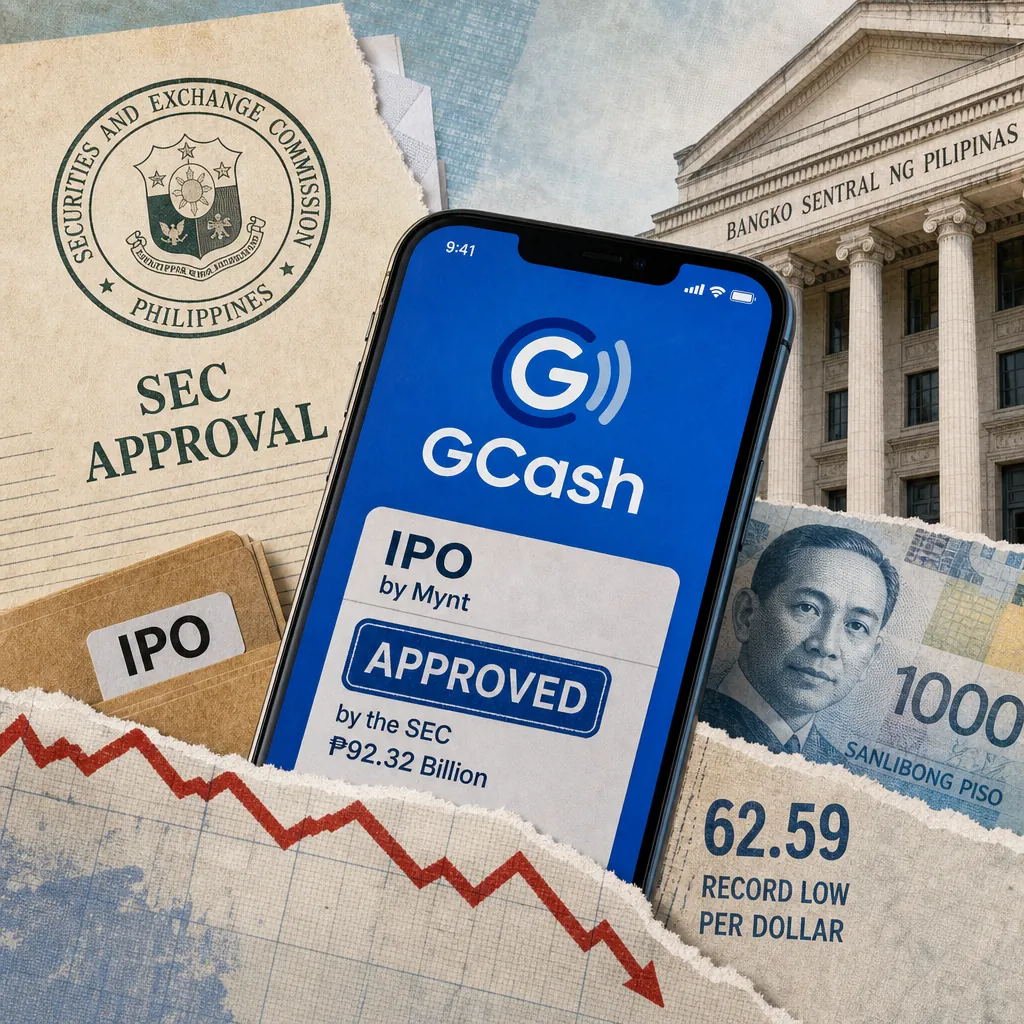
Beyond the currency, the day's coverage spanned corporate earnings, housing finance relief, fintech partnerships, and a notable debate about why Filipinos save so little. The Social Housing Finance Corporation (SHFC) announced a moratorium on monthly housing loan payments for more than 54,000 families affected by heavy monsoon rains and flooding across Luzon, a relief measure representing over P23.4 million in housing assistance 28. Megawide Construction Corp.'s venture into the government's flagship housing program could generate P28.3 billion in incremental revenues over three years, according to a report from First Metro Securities and DBS Bank 12. And the upcoming GCash initial public offering (IPO) — the parent company Mynt is scheduled to conduct an offering from October 6 to 12 that could raise more than P90 billion — may be big enough to prompt local and foreign funds to reshuffle their Philippine stock portfolios 1958.
Key themes
- Peso hits fourth straight record low at 62.565:$1 — The currency weakened 16.5 centavos on September 2 to close at 62.565 per dollar, its fourth consecutive session of all-time lows, driven by Middle East tensions, higher oil prices, and a stronger greenback 429. Trading volume rose to $1.8 billion from $1.3 billion the prior session 4.
- Stock market dips as peso depreciation weighs on sentiment — The Philippine Stock Exchange index fell 40.66 points or 0.67 percent to 6,053.23, giving back part of the previous day's 2.31-percent rebound, as investors grew cautious over the weakening currency 2980.
- Government bond yields climb on risk-off sentiment — The Bureau of the Treasury made a partial award of reissued 20-year bonds, borrowing P29.561 billion against a P30-billion target, with the average yield capped at 7.218 percent 2. Term deposit yields also rose after the central bank's latest rate hike 14.
- Analysts see scope for one more BSP rate hike — With El Niño threatening food prices and the peso under pressure, analysts at ANZ Research and others expect the Bangko Sentral ng Pilipinas (BSP) may need one more increase before year-end, even as the central bank signaled it hopes to pause after three consecutive hikes 86.
- Debate over why Filipinos save little: consumption culture vs. low incomes — BSP Governor Eli Remolona Jr. cited Filipinos' "consumption culture" as one reason the peso sank, but economist Sonny Africa of Ibon Foundation countered that millions of Filipinos consume all their earnings because their incomes are so low they have nothing left to save 20.
- Housing relief for calamity-hit families — The Social Housing Finance Corporation suspended monthly housing loan payments through September 28 for more than 54,000 families across 400 community associations in six provinces and regions affected by heavy monsoon rains, representing over P23.4 million in assistance 28.
- GCash IPO could prompt portfolio reshuffling — The upcoming offering of GCash parent Mynt, scheduled for October 6–12 and targeting more than P90 billion, may lead local and foreign funds to trim existing Philippine stock positions to free up cash to participate 1958.
- Megawide's housing venture seen as major growth engine — The infrastructure firm's participation in the government's Expanded Pambansang Pabahay para sa Pilipino (4PH) Program could generate P28.3 billion in incremental revenues over three years, accounting for 36 percent of revenues by 2028 12.
How the narratives stack
Dominant — Within the captured set, the peso's fall to a new record low dominated the day's financial coverage. Multiple outlets — Inquirer Online, Manila Times Online, Philstar Online, and Head Topics Online — carried the story of the fourth straight session of record lows 429475380. The coverage was broad and consistent, with each outlet reporting the same closing figure of 62.565 and the same 16.5-centavo decline. The peso story also anchored related coverage of government bond auctions, term deposit yields, and analyst forecasts for further rate hikes 21486. This dominance reflects both the significance of a record-low currency for the economy and the breadth of coverage across the monitored outlets.
Counter-narrative — Against the official and market-focused explanation for the peso's weakness — geopolitical tensions, higher oil prices, and a stronger dollar — a counter-narrative emerged questioning whether domestic factors, particularly Filipino consumption habits, were to blame. BSP Governor Eli Remolona Jr. told a Senate hearing that Filipinos have a "consumption culture" and tend to like showing off 20. But economist Sonny Africa of Ibon Foundation pushed back, arguing that "millions of Filipinos consume all their earnings and don't save because their incomes are so low that they don't have anything left to save" 20. This exchange, reported by Inquirer Online, reframed the peso's fall not as a purely external phenomenon but as a symptom of deeper structural issues of low incomes and inequality.
Emerging — A related but distinct narrative concerns the push for financial literacy as a policy response to weak savings and vulnerability to scams. The Securities and Exchange Commission (SEC) is pushing to make financial literacy a mandatory subject in the Philippine high school curriculum and has revamped its SEC Academy with free online courses on personal finance, investing, and spotting investment scams 1071. This builds on earlier legislative efforts by Sen. Sherwin Gatchalian in 2019 and 2022 and a 2023 bill by Cagayan de Oro Rep. Rufus Rodriguez 10. The Manila Times column framing this as "building a financially woke generation" suggests a growing recognition that financial education is a structural fix, not just an individual responsibility 10.
Under-covered — The day's coverage included several stories that received less attention than their significance might warrant. The BSP's report that the Anti-Financial Account Scamming Act (AFASA) had significantly strengthened its ability to combat scams and fraud — particularly through the Consumer Account Protection Office (CAPO) — was reported by Inquirer Online but did not generate the same volume of coverage as the peso story 5. AFASA, a law aimed at cracking down on online scams and financial fraud, represents a meaningful policy tool in the fight against cybercrime, which the FBI reported cost Americans nearly $21 billion in 2025 50. Similarly, the PayMongo-Skyro partnership to enable credit-backed digital payments at QR Ph merchants — a move that could help narrow the gap between digital payment adoption and access to formal credit — received relatively modest coverage 66.
Platform insights
- Facebook — The peso's fall and the debate over consumption culture versus low incomes generated significant discussion on Facebook, where Filipino users shared news articles and commented on the economic impact on their daily lives. The Inquirer's report on the exchange between Remolona and Africa, with its direct quotes in Filipino and English, was particularly shareable, as it touched on a sensitive topic — whether Filipinos are to blame for their own economic struggles 20.
- X (formerly Twitter) — Financial analysts, economists, and market commentators used X to react to the peso's record low in real time, sharing the closing figure and debating the implications for inflation, interest rates, and the broader economy. The platform also saw discussion of the GCash IPO and its potential to reshuffle Philippine stock portfolios, with retail investors weighing whether to participate 19.
- YouTube — Video content on the day's financial news was limited in the captured set, but the SEC's push for financial literacy and its revamped SEC Academy offering free online courses may generate video explainers and tutorials in the coming days 10. The Manila Times column framing financial literacy as building a "financially woke generation" could also inspire creator content aimed at young Filipinos.
- Reddit — While not explicitly captured in the monitoring data, Reddit communities focused on Philippine personal finance and investing likely discussed the peso's fall and its implications for remittances, overseas Filipino workers, and local investors. The debate over consumption culture versus low incomes is a recurring theme in these communities, where users often share personal experiences of struggling to save on modest incomes.
Key voices and communities
- Bangko Sentral ng Pilipinas (BSP) officials — Governor Eli Remolona Jr. and other central bank officials are central voices in the peso narrative. Remolona's Senate testimony, where he cited Filipinos' "consumption culture" as a factor in the peso's weakness, sparked debate and drew a sharp response from economists 20. The BSP's policy decisions — three consecutive rate hikes since April totaling 75 basis points — are closely watched by markets and households alike 86.
- Economists and analysts — Voices from institutions like ANZ Research, OCBC Bank, MUFG, Union Bank, and local brokerages shape the analytical narrative around the peso, inflation, and growth. Their forecasts — such as OCBC's slashed GDP growth outlook of 3.2 percent for 2026 and MUFG's lowered peso forecast of P62.20 per dollar for the third quarter — provide context for the currency's slide 1516. Sonny Africa of Ibon Foundation represents a critical voice challenging official explanations and highlighting structural issues of low incomes 20.
- Government agencies and officials — The Bureau of the Treasury, the Securities and Exchange Commission, and the Social Housing Finance Corporation are key institutional voices. SEC Chairman Francis Lim has stirred controversy in his first year, drawing the ire of powerful business players, according to a Philstar column 79. SHFC President Federico Laxa announced the housing payment moratorium for calamity-hit families 28.
- Corporate executives and business leaders — Ed Francisco of BDO Capital warned that "political noise" is weighing on investor and business confidence, with companies reducing their exposure or staying out of the market 59. April Lynn Tan of COL Financial discussed the potential portfolio reshuffling ahead of the GCash IPO 19. These voices connect the macro-economic narrative to on-the-ground business decisions.
- Financial literacy advocates and educators — The SEC's push to make financial literacy mandatory in high schools, along with earlier legislative efforts by Sen. Sherwin Gatchalian and Rep. Rufus Rodriguez, represents a growing community focused on long-term structural fixes to weak savings and vulnerability to scams 10. The Manila Times column framing this as building a "financially woke generation" captures the aspirational tone of this movement 10.
Narrative streams
Peso's record low: a fourth straight session of decline
The Philippine peso closed at 62.565 to the dollar on Wednesday, September 2, weakening 16.5 centavos from its previous record low of 62.40 set just a day earlier 429. This marked the fourth consecutive trading day of record lows, beginning Thursday when the peso hit 61.888, followed by Friday's 62.265 and Tuesday's 62.40 29. Philippine financial markets were closed Monday for a national holiday 29. The currency touched an intraday low of 62.69 before paring losses, and trading volume rose to $1.8 billion from $1.3 billion in the previous session 4.
The peso's weakness reflects a combination of factors: higher U.S. yields, expectations for tighter U.S. monetary policy, elevated oil prices, geopolitical uncertainty from the Middle East conflict, and seasonal increases in local importations, according to Union Bank Chief Economist Ruben Carlo Asuncion 47. The United States launched airstrikes on Iran on Tuesday, prompting Iranian retaliation, and oil prices rose on Wednesday while the dollar held firm against major currencies 4.
The stock market finally took notice of the peso's slide. The Philippine Stock Exchange index shed 40.66 points, or 0.67 percent, to 6,053.23, giving back part of the previous day's 2.31-percent rebound when bargain-hunters snapped up stocks following a drop below 6,000 2980. Luis Limlingan of Regina Capital said the local index closed lower as the market underwent a correction following Tuesday's strong buying activity, with weakness further driven by the continued depreciation of the peso 80.
Read for the sector: The peso's sustained decline raises the cost of imports, fuels inflation, and pressures the central bank to keep raising interest rates, which in turn raises borrowing costs for businesses and households. For companies with dollar-denominated debt or import-dependent supply chains, the weaker peso directly erodes margins. For the broader economy, the currency's slide complicates the government's growth targets and adds to the challenges facing an already slowing economy.
The consumption culture debate: who's to blame for weak savings?
A sharp exchange between BSP Governor Eli Remolona Jr. and economist Sonny Africa highlighted a deeper debate about the roots of the peso's weakness and the country's low savings rate. During a Senate hearing on whether the peso can still regain its value, Remolona said, "Mahirap sabihin 'to, Senator, pero mayabang tayo. Maano tayo, may consumption culture ang tawag" — "It's a bit difficult to say this, Senator, but we tend to like showing off. We have what you call a consumption culture" 20.
Africa, executive director of Ibon Foundation, a research and advocacy group focused on issues affecting the poor, pushed back sharply. He stressed that "millions of Filipinos consume all their earnings and don't save because their incomes are so low that they don't have anything left to save" 20. The exchange, reported by Inquirer Online, framed the peso's fall not merely as a product of external forces but as a symptom of domestic economic structures.
The debate resonates with broader data on financial vulnerability. A 2024 survey cited by CashKO, the microinsurance subsidiary of insurtech firm RuralNet, found that 87 percent of microfinance borrowers identify typhoons as their primary concern, underscoring the precariousness of many Filipino households [^44](https://minio-s3.media-meter.com/mediameter/uploads/archive/Broadsheet/2026/09/03/Manila Standard/Business/B-4/77.pdf). Cebuana Lhuillier Rural Bank's "Ipon Moves" savings advocacy, which recently won a Bronze Stevie Award, was designed precisely because "for many Filipino families, saving money is easier said than done. Daily expenses often take priority, leaving little to set aside for emergencies or future plans" 52.
Read for the sector: For financial institutions, the debate underscores the need to design products and services that meet Filipinos where they are — acknowledging that many simply do not have surplus income to save. Microinsurance, micro-savings, and financial literacy programs are not just social goods but business opportunities that address a genuine, documented need. The "consumption culture" framing risks alienating the very customers these institutions seek to serve; a more productive approach focuses on expanding incomes and making saving accessible at any scale.
Government borrowing costs rise as risk-off sentiment deepens
The government's auction of reissued 20-year Treasury bonds on Wednesday drew a partial award as yields climbed on broad risk-off sentiment amid the re-escalation of the Middle East conflict 2. The Bureau of the Treasury borrowed P29.561 billion, just short of the P30-billion target, despite total tenders reaching P36.111 billion 2. The reissued papers, which have a remaining life of four years and 10 months, were awarded at an average rate of 7.218 percent, with accepted yields ranging from 7.15 percent to 7.25 percent 2. "The average yield for the security… was capped at 7.218% to align the award with market sentiment," the BTr said 2.
Similarly, the seven-day term deposit facility (TDF) — a tool the central bank uses to manage liquidity in the financial system — fetched higher average yields on Wednesday despite stronger demand 14. Tenders reached P140.675 billion, exceeding the P120 billion auctioned off and the P105.824 billion in bids for the same offer volume in the prior week 14. This translated to a higher bid-to-cover ratio of 1.1723 times, up from 0.8819 in the previous auction 14. Accepted yields for the one-week papers ranged from 4.725 percent to 5.01 percent, wider and higher than the 4.7225 percent to 4.77 percent band the prior week 14.
The rising yields reflect the market's pricing in of further tightening by the BSP, which raised its benchmark rate by 25 basis points to 5 percent on August 27 — its third consecutive hike since April, totaling 75 basis points 86. The central bank has been seeking to contain inflation expectations and prevent supply-driven price increases from spreading to other goods and services 86.
Read for the sector: Higher government borrowing costs translate to a larger debt-service burden for the national government, which already runs a persistent budget deficit averaging P1.5 trillion a year from 2020 to 2025 76. For businesses, rising yields signal tighter financial conditions ahead, as banks pass on higher funding costs to borrowers. The BSP's tightening cycle, while aimed at containing inflation, risks slowing economic growth further — OCBC Bank has already slashed its 2026 GDP growth forecast for the Philippines to 3.2 percent, down from 3.8 percent, citing domestic demand as the "principal drag" 16.
Housing relief and the affordable housing push
The Social Housing Finance Corporation (SHFC), a state-run housing agency, announced a moratorium on monthly housing loan payments to provide financial relief for families affected by heavy monsoon rains and flooding across Luzon 28. The payment freeze, effective through September 28, covers more than 54,000 member-beneficiaries across 400 community associations in Metro Manila, Bulacan, Nueva Ecija, Pampanga, Bataan, and Tarlac 28. The temporary relief represents over P23.4 million in housing assistance, according to SHFC 28. President and CEO Federico Laxa said the moratorium responds to directives from President Ferdinand Marcos Jr. and Housing Secretary Jose Ramon Aliling to deliver immediate relief to calamity-stricken communities 28. "We hope to help our countrymen ease their financial burdens while recovering from this challenge," Laxa said 28. The announcement follows a similar payment suspension implemented last month, which provided P5.3 million in debt relief 28.
Separately, Megawide Construction Corp.'s venture into the government's flagship housing program could generate P28.3 billion in incremental revenues over the next three years, according to a report from First Metro Securities and DBS Bank 12. The estimate covers 16,700 "live-only" units under the Expanded Pambansang Pabahay para sa Pilipino (4PH) Program, the government's initiative to address the country's housing backlog 12. The report expects 4PH to account for 36 percent of Megawide's revenues by 2028 12. Megawide aspires to launch 100,000 affordable housing units over the long term, with the first 50,000 units already identified in its five-year pipeline, including projects across five locations in Cavite 12.
Read for the sector: The housing sector is caught between two forces: the immediate need for relief for calamity-affected families and the long-term opportunity of the government's affordable housing push. For developers like Megawide, the 4PH program represents a significant growth engine, but its success depends on sustained government commitment and the broader economic environment. For financial institutions, the SHFC moratorium highlights the importance of flexible payment structures that can accommodate shocks, while the broader housing push underscores the need for accessible financing mechanisms.
Fintech and digital payments: partnerships and IPOs
The day's coverage included several fintech developments that signal the sector's continued evolution. PayMongo Group partnered with Skyro Lending Inc. to allow businesses to accept credit-backed digital payments 66. Under the partnership, Skyro credit line holders will be able to spend their credit at QR Ph merchants through PayMongo's network, helping expand Filipino businesses' customer base 66. The partnership aims to narrow the gap between the rapid adoption of digital payments and access to formal credit in the Philippines 66. "Skyro has built the credit, and we have built both the places to spend it and the rails to move it," PayMongo CEO said 66.
The upcoming GCash IPO dominated fintech headlines. The offering of GCash parent Mynt, scheduled for October 6–12, could raise more than P90 billion, with listing targeted for October 20 1958. April Lynn Tan, chief equity strategist at COL Financial, said the IPO may be big enough to prompt local and foreign funds to reshuffle their Philippine stock portfolios as they free up cash to participate 19. "Since a large portion of the IPO is expected to be allocated to institutional investors, some local and foreign funds may need to free up cash to participate," Tan said 19. She stressed there was no direct evidence linking preparations for the GCash IPO to last week's market movements 58.
The BSP also reported that the Anti-Financial Account Scamming Act (AFASA) — a law aimed at cracking down on online scams and financial fraud — had significantly strengthened its ability to combat scams and fraud, particularly through the Consumer Account Protection Office (CAPO) 5. Sen. Mark Villar, the law's principal author and sponsor, welcomed the report during an August 17 hearing 5. The law's impact is significant given the scale of cybercrime: the FBI reported Americans lost nearly $21 billion to cyber-enabled crime in 2025, up 26 percent from the year before, with investment fraud causing the biggest financial hit at about $8.65 billion 50.
Read for the sector: The fintech sector is maturing from a focus on payments adoption to a broader ecosystem that includes credit, investment, and security. The PayMongo-Skyro partnership addresses a key gap — the lack of formal credit options for many Filipinos who have embraced digital payments. The GCash IPO, if successful, would be a landmark event that could unlock capital for further fintech innovation and potentially prompt a re-rating of Philippine tech stocks. The AFASA implementation, meanwhile, underscores the importance of consumer protection in maintaining trust in digital financial services.
Political noise and investor confidence
BDO Capital and Investment Corp. president Ed Francisco warned that "political noise" in the country is weighing on investor and business confidence, adding to concerns over slowing economic growth and weakening consumer spending 59. In a television interview, Francisco said the Philippines has underperformed relative to its regional peers, with political turmoil contributing to skittish investor confidence 59. "Despite these gems of outstanding Philippine companies, they're not investing anymore or they're reducing their exposure. And all this political noise is not helping us," he said 59. "Because instead of wanting to invest here, it's giving them an excuse to stay out," he added 59.
The Philippines is currently grappling with several political controversies, including the unresolved flood control scandal from last year and the Vice President facing her second impeachment trial, which has added to friction between the Marcos and Duterte factions 59. House prosecutors are even considering dropping the bribery article against Vice President Sara Duterte to avoid prolonging her impeachment trial [^42](https://minio-s3.media-meter.com/mediameter/uploads/archive/Broadsheet/2026/09/03/Manila Standard/Front Page/A-1/6_mp_procs.pdf).
Read for the sector: Political instability is a tax on economic activity. It discourages investment, weakens the peso, and complicates the government's ability to address structural challenges. For businesses, the uncertainty argues for caution in capital allocation and for building resilience against policy volatility. For communicators, the political noise underscores the importance of clear, factual messaging that distinguishes between political developments and underlying economic fundamentals.
Conversation trajectory
Peso movement (next 1–4 weeks) — The peso's slide shows no immediate sign of reversing. MUFG has revised its forecast to P62.20 per dollar for the third quarter and P62 for the fourth, noting the recent break above P62 was fueled by global factors and domestic vulnerabilities including a widening trade deficit and the threat of a Super El Niño 15. The risk of a breach of the P63 level has been raised 47. Key triggers to watch: the U.S. Federal Reserve's September meeting, where a rate hike is expected 64; any further escalation in the Middle East conflict; and the BSP's next policy decision. If the Fed hikes and the BSP pauses, the peso could come under further pressure.
BSP policy (next 1–3 months) — Analysts at ANZ Research and others see scope for one more BSP rate hike before year-end as El Niño threatens food prices and the peso remains under pressure 86. The BSP has signaled it hopes to pause after three consecutive hikes, but inflation expectations and currency weakness may force its hand. The central bank's next policy meeting and its inflation forecasts will be closely watched. A further hike would raise borrowing costs across the economy, potentially slowing growth further — OCBC has already cut its 2026 GDP forecast to 3.2 percent 16.
GCash IPO (October 6–20) — The offering window is set for October 6–12, with listing targeted for October 20 19. The IPO could raise more than P90 billion and may prompt portfolio reshuffling among institutional investors 19. Its success will be a significant signal for the Philippine fintech sector and the broader equity market. Key triggers: the final offer price, subscription levels, and the market's reception on listing day.
Housing relief and recovery (through September 28) — The SHFC payment moratorium runs through September 28, after which affected families will need to resume payments 28. The agency's ability to manage the relief program and support recovery in calamity-affected areas will be tested. The broader 4PH program's progress — including Megawide's pipeline of 100,000 affordable housing units — will depend on sustained government commitment and the economic environment 12.
Financial literacy push (ongoing) — The SEC's campaign to make financial literacy a mandatory high school subject and its revamped SEC Academy with free online courses represent a long-term effort to address weak savings and vulnerability to scams 10. Legislative efforts dating back to 2019 have yet to succeed, but the current push, combined with the SEC's visible social media presence, may build momentum. Key triggers: any congressional action on financial literacy bills and the SEC's continued public engagement.
Trigger events to watch — The U.S. Federal Reserve's September meeting and any further Middle East escalation could move the peso and global markets. The BSP's next policy decision will signal whether the tightening cycle continues. The GCash IPO's pricing and subscription results in early October will test investor appetite for Philippine fintech. And the SEC's financial literacy campaign may generate further coverage as it gains traction in social media.
Response guidance
Peso and inflation messaging — For financial institutions and businesses communicating about the peso's decline, lead with plain facts about what the currency movement means for customers — import prices, loan costs, remittance values — rather than abstract market commentary. Acknowledge the pressure on household budgets without alarmism. Avoid blaming consumers for economic conditions; the consumption culture debate is politically and socially sensitive, and institutions that engage it risk alienating customers.
Rate hike communications — With analysts expecting a possible further BSP rate hike, financial institutions should prepare clear messaging about how higher rates affect loans, savings, and investment products. Emphasize the central bank's inflation-fighting rationale while acknowledging the burden on borrowers. Provide practical guidance on managing debt and finding higher-yield savings options.
Housing and calamity relief — For agencies and institutions involved in housing finance, highlight concrete relief measures like the SHFC moratorium and communicate eligibility clearly. Pair relief announcements with information about long-term recovery options. For developers in the 4PH program, emphasize the social impact of affordable housing while being transparent about timelines and qualifications.
Fintech and digital payments — For fintech companies, the GCash IPO and the PayMongo-Skyro partnership signal a maturing sector. Communicate the value of digital financial services in expanding access to credit and payments, but pair growth stories with robust consumer protection messaging. The AFASA implementation and the scale of cybercrime losses — nearly $21 billion in the U.S. alone — underscore the importance of security and scam-awareness in building trust 50.
Financial literacy — For institutions supporting the SEC's financial literacy push, position it as a structural solution to weak savings and scam vulnerability, not as a criticism of individual behavior. Use relatable, practical examples — how to budget on a minimum wage, how to spot an investment scam, how to start saving small amounts. Avoid the "consumption culture" framing, which blames individuals for systemic conditions.
Political noise — For businesses navigating political uncertainty, focus communications on operational fundamentals and long-term commitments rather than engaging in political commentary. When political developments affect markets, provide factual context and distinguish between short-term volatility and underlying economic trends. Avoid amplifying political narratives that could further unsettle investors or customers.
See the full picture behind today's signals.
This report draws from Media Meter's MediaWatch, our real-time monitoring engine tracking 2,470+ Philippine sources across print, broadcast, digital, and social. Explore how the platform turns raw coverage into decision-grade intelligence, then see how it's configured for teams like yours — whether you're in PR agencies, corporate comms, government, or marketing.
Want more? Browse our Report Library for sector and crisis intelligence, or request a demo and we'll have your brand set up before the call.
Want this kind of intelligence on your brand?
This brief is built on the same MediaWatch methodology that runs continuously across every brand we monitor. See your competitive landscape, Impact Score, and narrative trajectory in a 30-minute demo.