Philippines Posts Record $6.95B Trade Gap in October
The Philippines recorded its widest monthly trade deficit on record in October as imports rose 50.4 percent and exports crossed $10 billion for the first time. Food prices, fuel rollbacks and holiday spending also ran through the day's coverage.
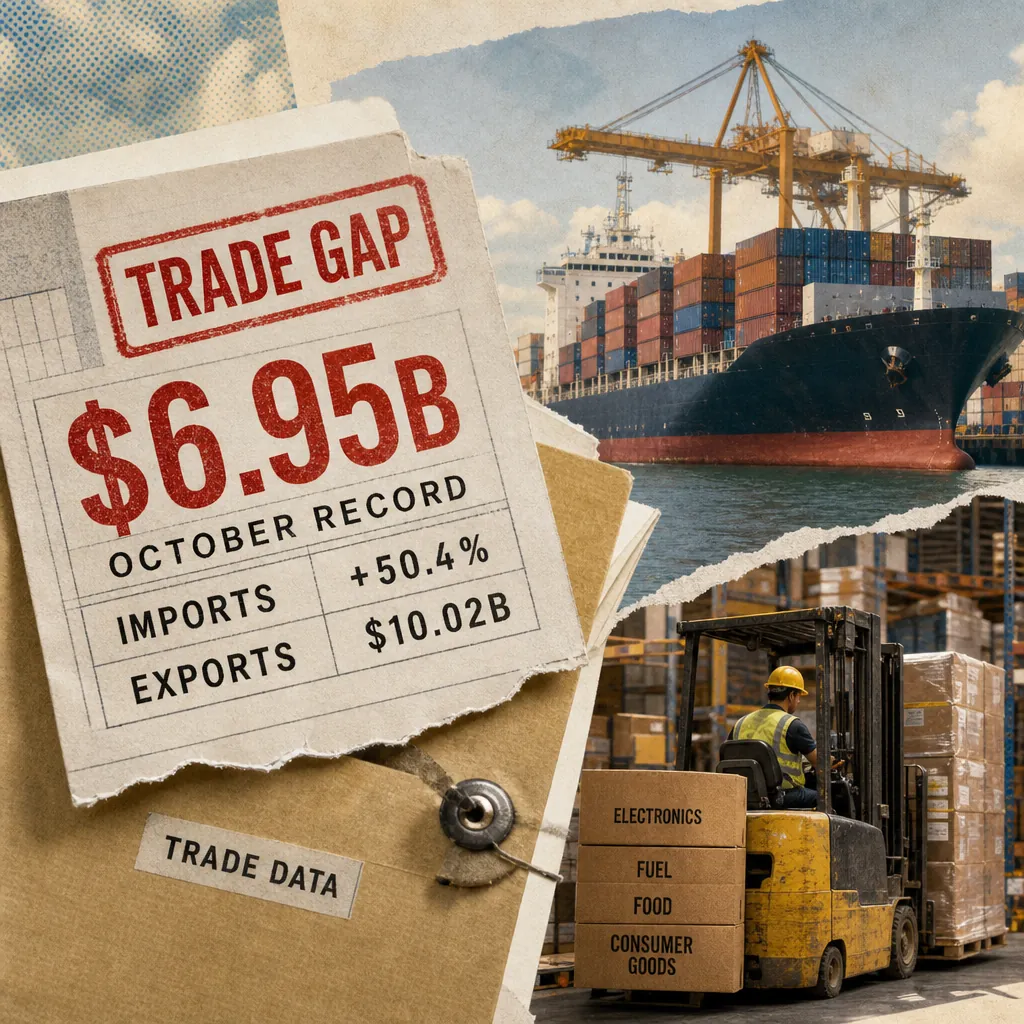
The Philippines bought far more from the world than it sold in October, and the gap between the two set a record. The country's trade deficit reached $6.95 billion for the month, the widest monthly shortfall since the Philippine Statistics Authority (PSA), the government's statistical agency, began tracking trade in 1991 1639. The figure was 65.6 percent larger than the $4.20-billion gap recorded in October 2025 16.
Both sides of the ledger hit all-time highs. Exports totaled $10.57 billion, up 41.8 percent from $7.45 billion a year earlier and the first time monthly shipments crossed the $10-billion mark 4450. Imports climbed faster, rising 50.4 percent to $17.52 billion from $11.65 billion 39. Electronics alone accounted for seven of every ten export dollars in October, a concentration that leaves the export boom tied closely to one industry even as the government courts buyers for other Filipino goods 44.
The record gap drew coverage across several business outlets in the items reviewed here, from The Manila Times and Philstar to BusinessMirror and the regional Daily Guardian, and the Department of Trade and Industry (DTI) used the same data release to cast the export number as proof of manufacturing competitiveness 42. Trade Secretary Ma. Cristina A. Roque said in a statement that the country must "make the most of this opportunity before us: to build on this momentum, attract new investments, diversify our export products and markets, and enable more Filipino enterprises to become part of global value chains" 42.
Key themes
- The trade deficit hit $6.95 billion in October, the widest on record. The gap was 65.6 percent larger than October 2025's $4.20 billion, and the January-to-October shortfall reached $54.38 billion against $41.77 billion in the same period last year 1650.
- Exports crossed $10 billion in a month for the first time. October shipments of $10.57 billion were 41.8 percent above a year earlier, the 22nd straight month of annual growth, and the ten-month total of $84.71 billion already exceeds all of 2025 4244.
- Imports grew faster than exports, at 50.4 percent. The $17.52-billion import bill outpaced the 41.8-percent export gain, which is what produced the record deficit 39.
- Special rice cost P64.19 a kilo in mid-November, still nearly 12 percent above last year. The PSA's regular food price report showed the national average slipping 12 centavos from early November but remaining well above the P57.33 of a year earlier 26.
- Pump prices are set to fall by as much as P3.50 a liter. An oil industry estimate based on Platts Singapore trading and foreign exchange averages put the coming diesel and gasoline rollback at P3.00 to P3.50 per liter, while the Department of Energy (DOE) gave a more conservative P1 to P2 46.
- Cebu set recommended hog and pork prices to protect raisers. Governor Pamela Baricuatro signed Executive Order No. 61 on Nov. 25 after farmgate prices fell to as low as P105 per kilogram of liveweight in some towns 30.
- A House chair threatened a sugar tax on 3-in-1 coffee within three years. Marikina Rep. Miro Quimbo, who chairs the House Committee on Ways and Means, said manufacturers must cut sugar content or see the instant coffee mix folded into the sweetened beverage tax 32.
- The Anti-Red Tape Authority pushed agencies to cut requirements at a two-day convention. About 500 government officials and business leaders met under the theme "COMPETE: Cutting Overregulation and Modernizing Government for a More Competitive Philippines" 33.
How the narratives stack
Dominant. The record trade deficit is the day's biggest economic story in the items reviewed. It carried the most weight across the captured set, appearing in The Manila Times, Philstar, BusinessMirror and the regional Daily Guardian, and it is the rare data release that produced two headlines at once: a record gap and a record export haul 1639424450. The Manila Times' version of the story carried an estimated P722,448 in advertising-equivalent value, the cost of buying the same space as paid advertising, and Philstar's ran at about P493,477 1650. BusinessMirror's import-focused piece was valued at roughly P487,104 39. The dominance is a property of this captured set; the monitoring behind it drew heavily on business and general news sites.
Counter-narrative. The DTI's framing sits against the deficit headline. The agency presented October as evidence of the country's manufacturing competitiveness, noting the 22nd consecutive month of export growth and a ten-month total that already beat 2025's full-year performance 42. Daily Guardian's export story made the same point while flagging the dependence on electronics, which brought in seven of every ten export dollars 44. The two readings rest on the same PSA data: exports are genuinely at a record, and the country is still buying far more than it sells.
Emerging. Food and fuel prices formed a second cluster of consumer-facing stories. The PSA's mid-November price report showed special rice at P64.19 a kilo, cabbage down P12.63 to P138.79 but still 29 percent above last year, galunggong at P239.27, pork belly at P339.48 and red onions at P151.22 26. Separately, an oil industry estimate pointed to a P3.00 to P3.50 per liter rollback in diesel and gasoline, with the DOE offering a P1 to P2 forecast for the first week of December 46. Cebu's price benchmarks for hogs belong to the same cluster: a provincial government stepping in because farmgate prices had fallen to P105 per kilogram of liveweight, with feed accounting for as much as 70 percent of production costs 30.
Under-covered. The methodology behind the government's poverty statistics drew attention in only one item in the set. Daily Guardian's column noted that Western Visayas' family poverty rate fell from 9.8 percent in 2023 to 5.2 percent in 2025, then examined how the PSA sets its poverty line: P14,683 a month for a family of five in the region, covering raw food ingredients only, based on a food-expenditure ratio drawn from household surveys taken between 2000 and 2009 40. The column reported that the PSA itself conceded in 2024 that P64 per person a day was not enough, and that a planned 2021 methodology review remains unfinished 40. The story placed low in the day's coverage; it was not suppressed.
Platform insights
The monitoring writeup for this window did not accompany the article set, so there is no social engagement data to report for the day. The items reviewed are all online news and blog publications, and the conversation they represent ran through news sites rather than social platforms.
Key voices and communities
The Philippine Statistics Authority. The PSA produced both of the day's hard numbers: the October trade data and the mid-November retail price report 162. Its releases set the terms of the coverage, and its methodology also came under scrutiny in the Daily Guardian column on poverty lines 40.
The Department of Trade and Industry. Trade Secretary Ma. Cristina A. Roque framed the export record as a platform for investment and market diversification 42. The DTI's reading competes directly with the deficit headline for how the October data should be understood.
The Department of Energy and oil industry analysts. The DOE's Oil Industry Management Bureau, through director Rino Abad, gave a conservative P1 to P2 per liter rollback forecast, while an industry source using Platts Singapore trading and foreign exchange averages estimated P3.00 to P3.50 46. The gap between the two estimates is itself a signal about how uncertain pump prices are a week out.
Local government units setting prices. Cebu's provincial government moved directly into agricultural pricing with Executive Order No. 61, establishing recommended farmgate prices for piglets at P3,500 to P4,500 each and for pork carcasses 30. The order encourages government institutions and commercial buyers to prioritize locally raised livestock under the province's Buy Local Cebu program.
Legislators on health and tax policy. Rep. Miro Quimbo, as chair of the House Committee on Ways and Means, put 3-in-1 coffee manufacturers on notice with a three-year reformulation deadline before the product faces the sweetened beverage tax 32. The tax, which applies to drinks with added sugar, exempted 3-in-1 coffee when it was introduced because the product is widely consumed by ordinary Filipinos.
Narrative streams
The trade gap reached $6.95 billion as imports outran a record export month
The October trade data produced two records in the same release. Exports of $10.57 billion were the highest monthly total since the PSA began its series in 1991, up 41.8 percent from $7.45 billion a year earlier and extending the annual growth streak to 22 months 1644. Imports of $17.52 billion were also a record, up 50.4 percent from $11.65 billion 39. Because imports grew faster, the deficit widened to $6.95 billion, 65.6 percent above October 2025's $4.20 billion and the largest monthly gap on record 1650.
The composition matters as much as the size. Electronics brought in seven of every ten export dollars in October, so the export record rests heavily on a single industry even as the government pursues free trade agreements and new buyers for other products 44. The DTI expects the Philippines to have concluded, signed or implemented 23 free trade agreements by the end of President Ferdinand Marcos Jr.'s term 44. On the import side, Chinabank Research noted in a commentary that the widening deficit added to depreciation pressures on the peso 39.
For manufacturers and exporters, the October numbers cut two ways. Exporters have a genuine tailwind: ten-month shipments of $84.71 billion are up 20.1 percent from $70.53 billion and already above the full-year 2025 total 42. Importers and consumers face a peso that a wider trade gap tends to weaken, which raises the local cost of imported fuel, food and raw materials. The read for the sector is that the export record is real but narrow, and the deficit is the part of the release that will feed through to prices and the currency.
Rice stayed near P64 a kilo and fuel prices were set to fall
The PSA's mid-November retail price report, covering Nov. 15 to 17, showed special rice at P64.19 per kilogram, down 12 centavos from early November but nearly 12 percent above the P57.33 of a year earlier 26. Among the seven items tracked, cabbage posted the biggest drop from early November, falling P12.63 to P138.79 per kilogram, though it still cost 29 percent more than the P107.62 of a year earlier 2. Galunggong, the round scad that is a staple fish in Filipino households, declined to P239.27 from P241.89 and was cheaper than the P247.86 of mid-November 2025 2. Fresh pork belly edged up to P339.48 from P338.81 in early November but remained about 8 percent cheaper than a year earlier 2. Red onions rose to P151.22 per kilogram while staying significantly cheaper than last year 6.
Fuel moved in the opposite direction from food. An oil industry source, using Platts Singapore trading and foreign exchange averages for the week, estimated a P3.00 to P3.50 per liter rollback in diesel and gasoline for the following week, though the estimate excluded ocean freight and insurance costs 46. The source attributed the decline to expected growth in global oil supply and looser regional supply of gasoline and diesel as China's exports rose 46. The DOE's Rino Abad gave a P1 to P2 per liter forecast for the first week of December, which the report described as the safest estimate 46.
For households, the two reports point in different directions. Rice, the single largest food item in most Filipino budgets, remains nearly 12 percent more expensive than a year ago even after the small November decline. A fuel rollback of even P1 to P2 per liter would ease transport and electricity costs, which feed into the price of nearly everything else. The read for the sector is that food inflation has stopped rising but has not come down, and the relief households get in December will come from fuel rather than from the grocery shelf.
Cebu set hog price benchmarks after farmgate prices fell to P105 a kilo
Cebu Governor Pamela Baricuatro signed Executive Order No. 61 on Nov. 25, establishing recommended farmgate prices for live hogs and pork products under the provincial government's Buy Local Cebu program 30. The order followed reports from local hog raisers that farmgate prices had dropped to as low as P105 per kilogram of liveweight in some local government units, raising concerns about whether hog production remains sustainable 30. Feed accounts for as much as 70 percent of hog production costs, which leaves producers exposed when selling prices fall 30.
Under Section 3 of the order, the recommended farmgate price for newly weaned piglets ranges from P3,500 to P4,500 each, with suggested prices also set for pork carcasses weighing 79 kilograms and above 30. The order encourages government institutions and commercial buyers to prioritize locally raised livestock.
The move sits against the national price picture, where pork belly at P339.48 per kilogram is about 8 percent cheaper than a year earlier 2. Cheaper pork at retail is good for consumers and hard on raisers, and Cebu's order is an attempt to hold a floor under farmgate prices without pushing retail costs back up. The read for the sector is that local governments are now willing to intervene directly in agricultural pricing when farmgate returns fall, which sets a precedent other provinces with strong livestock industries may follow.
A House chair gave 3-in-1 coffee makers three years to cut sugar
Marikina Rep. Miro Quimbo, chair of the House Committee on Ways and Means, said on Friday that 3-in-1 coffee could be subjected to the sweetened beverage tax in three years if manufacturers fail to reduce the sugar content of their products 32. He explained in an online interview that 3-in-1 coffee contains sugar and other caloric ingredients, making it a candidate for inclusion in the tax, and that the product was exempted when the tax was first implemented because it is widely consumed by ordinary Filipinos 32.
The sweetened beverage tax is an excise tax on drinks with added sugar, introduced as a public health measure aimed at reducing consumption linked to diabetes and other conditions. Extending it to 3-in-1 coffee would reach a product sold in sari-sari stores and consumed daily in many low-income households, which is why it was excluded in the first place. Quimbo's proposal gives manufacturers a three-year window to reformulate before the tax applies 32.
For coffee manufacturers, the signal is that reformulation is now a deadline rather than an option. For retailers and consumers, the risk is a price increase on one of the cheapest prepared drinks available if manufacturers do not act. The read for the sector is that the exemption for 3-in-1 coffee is now conditional, and the cost of reformulation will be weighed against the cost of the tax over the next three years.
ARTA pushed agencies to cut requirements at a 500-person convention
The Anti-Red Tape Authority (ARTA), the agency created to enforce the country's ease-of-doing-business law, pushed government agencies to simplify bureaucratic requirements at a two-day convention that opened Thursday at the Crowne Plaza Manila Galleria in Quezon City 33. About 500 government officials, business leaders and development partners attended under the theme "COMPETE: Cutting Overregulation and Modernizing Government for a More Competitive Philippines" 33. ARTA Secretary and Director-General Ernesto Perez told The Manila Times that the reforms are central to improving the business environment by making government transactions faster and more responsive 33.
The convention sits under Republic Act 11032, the Ease of Doing Business and Efficient Government Service Delivery Act of 2018, which sets processing-time limits for government transactions and requires agencies to streamline requirements 33. The law's enforcement has been uneven, and ARTA's push comes as the government tries to attract investment against the backdrop of a record trade deficit and a peso under pressure 39.
For small businesses and investors, the practical test is whether processing times actually fall. The read for the sector is that ARTA is using the competitiveness argument to press agencies on requirements, and businesses will measure the result in days saved at city hall and in permitting offices rather than in convention themes.
Negros Occidental was named the only Philippine entry on a 2027 Asia travel list
Condé Nast Traveller, the US-based luxury and lifestyle travel magazine, named Negros Occidental the only Philippine destination in its Best Places to Go in Asia in 2027, alongside eight other destinations including Armenia, Bangkok, Jaipur, Niigata, Penang, Phú Quốc, Shanghai and Yunnan 34. The magazine released its selection on Nov. 25 and highlighted the province's slow-food culture, heritage ingredients and environmentally sustainable tourism experiences 34. It traced Negros Occidental's transformation from its sugar-producing heritage into a destination with a growing slow-food movement, where farmers, fisherfolk, local producers and chefs promote indigenous ingredients and traditional culinary practices, and specifically featured 7 Hectares, a fish farm 34.
For the province's tourism operators, the listing is free international marketing that reaches the magazine's affluent readership. The read for the sector is that the recognition gives Negros Occidental a positioning distinct from beach destinations, built on food and agriculture, and the test will be whether local operators can convert the attention into bookings for 2027.
Conversation trajectory
The December fuel rollback will be confirmed or contradicted in the first week of December. The DOE's P1 to P2 per liter forecast and the industry estimate of P3.00 to P3.50 diverge sharply, and the actual adjustment will show which reading of global supply was right 46. Watch the weekly price announcement.
November inflation data, due in early December, will show whether the food price plateau held. The mid-November PSA report showed rice nearly 12 percent above last year and cabbage 29 percent higher 2. The next monthly inflation release will show whether those gaps narrowed or widened through the rest of November.
The 3-in-1 coffee reformulation deadline will draw manufacturer responses over the coming months. Rep. Quimbo's three-year window gives manufacturers time to reformulate, and the first signal will be whether major brands announce sugar reduction plans or push back through industry associations 32.
Cebu's hog price benchmarks will be tested at the next round of farmgate trading. The order sets recommended prices, not mandatory ones, and the coming weeks will show whether buyers honor them and whether other provinces follow 30.
The peso's movement will be the channel through which the trade deficit reaches consumers. Chinabank Research linked the wider deficit to depreciation pressure 39. A weaker peso raises the local cost of imported fuel and food, which would work against the fuel rollback and the food price plateau.
Trigger events to watch: the PSA's November inflation release, the DOE's weekly fuel price announcements, the December 10 and January 11 GCash Merry G! draws that will keep holiday spending in the news 28, and the December 20 opening of Hotel101-Niseko, which DoubleDragon is counting on for foreign currency income 36.
Response guidance
On the trade deficit, lead with the export record and then explain the import side. The DTI's framing of October as a competitiveness milestone is accurate on exports, and the deficit is the part that affects prices and the currency. Communicators should present both numbers in the same breath rather than letting one stand alone.
On food prices, avoid claiming relief that the data does not show. Rice remains nearly 12 percent above last year even after the November decline 2. Messaging that describes prices as falling will read as out of touch to households still paying more than they did a year ago.
On fuel, wait for the official adjustment before committing to a figure. The gap between the DOE's P1 to P2 forecast and the industry's P3.00 to P3.50 estimate is wide enough that early messaging could be wrong 46.
On the sugar tax proposal, treat the three-year window as the story. Manufacturers have time to reformulate, and the public interest is in whether sugar content actually falls 32. Communications that focus only on the tax threat miss the health argument behind it.
On local price interventions, watch for copycat measures. Cebu's hog price benchmarks set a precedent for provincial governments stepping into agricultural pricing 30. Businesses buying agricultural products should expect similar orders in other provinces.
On the ARTA convention, measure results in processing times. The convention produced commitments, not outcomes 33. Communicators should track whether agency processing times actually fall before citing the event as progress.
See the full picture behind today's signals.
This report draws from Media Meter's MediaWatch, our real-time monitoring engine tracking 2,470+ Philippine sources across print, broadcast, digital, and social. Explore how the platform turns raw coverage into decision-grade intelligence, then see how it's configured for teams like yours — whether you're in PR agencies, corporate comms, government, or marketing.
Want more? Browse our Report Library for sector and crisis intelligence, or request a demo and we'll have your brand set up before the call.
Want this kind of intelligence on your brand?
This brief is built on the same MediaWatch methodology that runs continuously across every brand we monitor. See your competitive landscape, Impact Score, and narrative trajectory in a 30-minute demo.