Sugar Output Falls 19% as Pests and Costs Hit Farmers
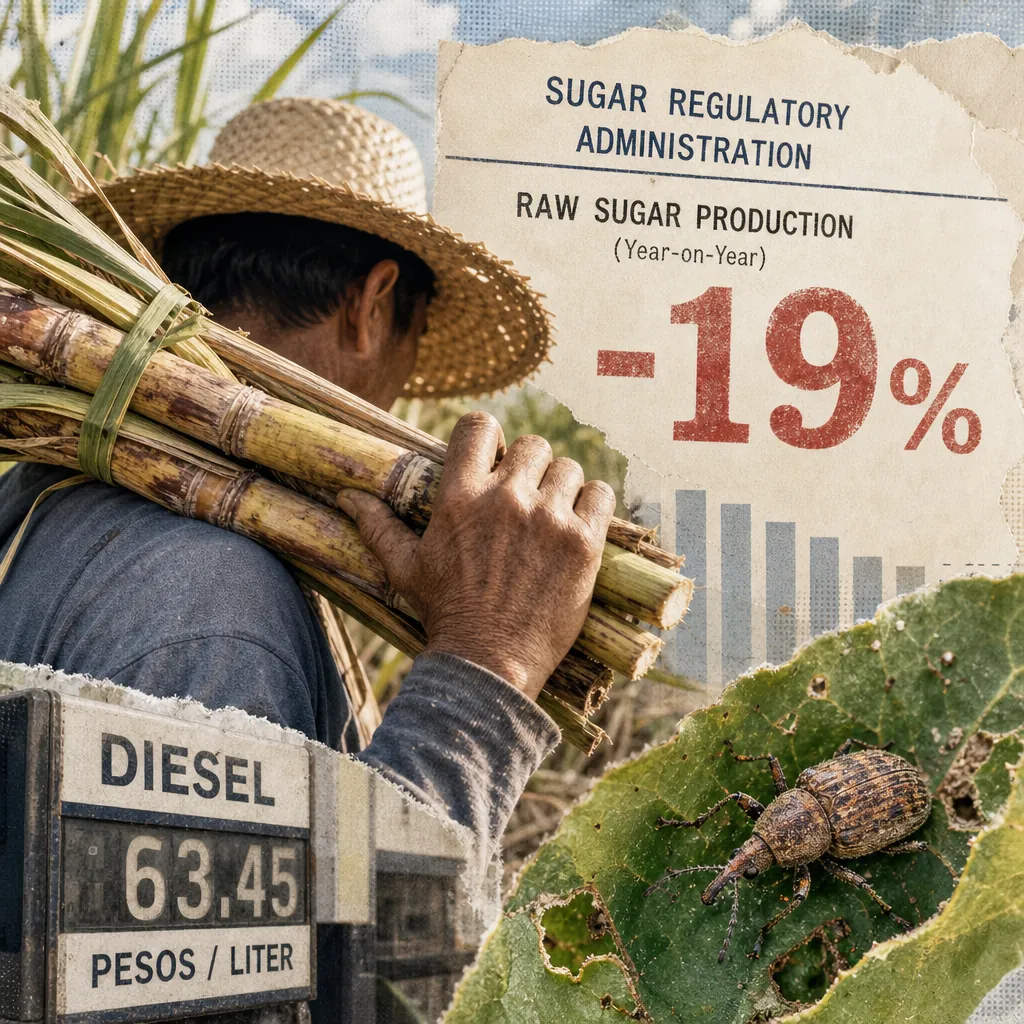
The Sugar Regulatory Administration reported a 19 percent drop in raw sugar production from a year earlier, with pest infestation, El Niño and high fuel costs threatening the 2026-2027 milling season. The same day, Alex Eala's Pasig homecoming drew the President, two cabinet secretaries and front-page coverage across the Manila broadsheets.
The Conversation
Raw sugar production in the Philippines is running 19 percent below where it stood a year ago, Sugar Regulatory Administration (SRA) Administrator Pablo Luis Azcona said in a Viber message on Tuesday, as the 2026-2027 milling season entered its second month8. The SRA is the government agency that sets sugar policy, allocates domestic and export volumes, and tracks production through the season; its board met the same week and warned that low cane tonnage and weak sugar yields, driven by high fuel and farm input costs, El Niño and a persistent insect infestation, could push output below its initial projection of 1.662 million metric tons for the crop year824. The story ran across the business pages of the Manila broadsheets and the regional press in the Visayas, where the sugar industry is concentrated2464.
The same Tuesday, a very different story filled the front pages. Tennis player Alexandra "Alex" Eala, ranked No. 15 in the world by the Women's Tennis Association (WTA), returned to Pasig Central Elementary School, where she first picked up a racket, for a homecoming organized by Milo Philippines and the Department of Education (DepEd)1967. President Ferdinand Marcos Jr. attended, hit a few balls with her, and watched as DepEd named her National Youth Sports Ambassador and Milo gave her its "Gawad Sulo ng Simula at Tagumpay" award6752. More than 1,000 students, teachers and department staff attended, according to DepEd19. The event drew front-page photographs in the Manila Standard and Manila Times, a tabloid sports story in PM, and separate online reports from the Inquirer and Philstar195267.
Across the items captured for this window, the sugar story carried the most consequence for an industry and its workers; the Eala homecoming carried the most column inches. Both are covered below. The rest of the day's items ranged widely — a legislative push to let households generate their own power, a Senate hearing on a US trade announcement, a Davao hospital's caseload of violence against women and children, a DTI crackdown on counterfeit helmets, and a batch of consumer and lifestyle pieces from international wires. The sugar story is the one with the clearest economic stakes for a defined sector, and it leads.
Key themes
- Raw sugar output is down 19 percent year on year, two months into the milling season. The SRA's own industry data, as of Nov. 25, recorded the decline against the same point a year earlier8. The agency has not said whether full-season output will fall below its 1.662 million metric ton projection8.
- A pest infestation could cut sugar content by up to half if it spreads unchecked. The red-striped soft scale insect (RSSI) feeds on sugarcane and reduces the sugar recovered from each stalk; the SRA warned it could reduce sugar content by up to 50 percent8. Agriculture Secretary Francisco Tiu Laurel Jr. said the Department of Agriculture (DA) would help farmers contain the infestation24.
- High fuel and farm input costs are squeezing growers already uncertain about the next planting cycle. The SRA cited fuel and input costs, compounded by the Iran conflict, as reasons farmers may hold back on replanting, which would worsen supply problems in the following crop year2464.
- Negros Occidental carries the economic weight of the decline. The province is the country's leading sugar-producing province, and the DA said the fallout could extend beyond farms and mills because the industry supports thousands of livelihoods and much of the local economy64.
- Alex Eala's homecoming drew the President, two cabinet secretaries and front-page coverage. DepEd named her National Youth Sports Ambassador and Milo Philippines gave her its Gawad Sulo ng Simula at Tagumpay award before more than 1,000 students at Pasig Central Elementary School1967.
- A Parañaque congressman filed a bill to let households generate and store their own power. House Bill No. 11459, part of a proposed "Sariling Kuryente Act," would remove requirements that currently discourage homeowners from installing renewable generation and storage systems, according to Rep. Brian Raymund Yamsuan6.
- The Palace said the Philippines has no agreement to buy all its agricultural and energy needs from the US. Malacañang clarified after President Donald Trump said Marcos had agreed to source 100 percent of those supplies from Washington; the Department of Foreign Affairs told a Senate budget hearing it was caught off guard by the announcement6650.
- A Davao hospital recorded the highest caseload of violence against women and children of any regional medical facility. The Southern Philippines Medical Center's Women and Children Protection Unit documented 1,790 cases from Jan. 1 to Nov. 8, 2026 — 1,350 involving children and 440 involving adult women47.
How the narratives stack
Dominant. The sugar production decline is the dominant story in this set by consequence. It affects a defined industry, a named province, and a crop year already underway. The SRA board's warning was picked up by the Manila Times business desk, the Manila Standard business section, the Inquirer's business site, Panay News, and the Watchmen Daily Journal in Negros8246435. The Manila Standard's business page framed it as the industry bracing for a "difficult 2026-2027 milling season," quoting miller and farmer representative Mitzi Mangwag: "Any drop in sugarcane production is not good for our farmers, who are the backbone of the industry, and not good for our millers as well, especially at a time when they are modernizing."35 The tabloid Saksi Ngayon ran a Filipino-language version on its news pages36. The Eala homecoming is dominant by volume of coverage and by placement — front pages, a tabloid sports spread, and multiple online reports — but its consequence is cultural and promotional rather than economic195267.
Counter-narrative. The Palace's clarification on the US trade announcement pushes back against the impression, created by Trump's own statement, that the Philippines had committed to sourcing all its agricultural and energy requirements from the United States66. The Department of Foreign Affairs (DFA) told a Senate budget hearing, through Senator Erwin Tulfo, that "everyone was taken aback" and that discussions before the announcement had focused only on tariffs50. Business groups had raised concerns about the announcement, and Malacañang said no specific terms had been agreed66. This matters for the sugar story because imported US agricultural products are one of the pressures domestic growers cite when they argue for protection and support.
Emerging. Rep. Yamsuan's House Bill No. 11459 would let households install solar panels and battery storage and generate their own electricity without the power flowing back into the grid, removing requirements that currently make such setups costly or complicated6. Yamsuan said the Philippines now has "the highest residential electricity rates in Southeast Asia, surpassing even Singapore," and called high power bills an added burden on families and businesses6. The bill is at the filing stage; it has not been scheduled for committee deliberation. Separately, Tesla Philippines announced it will open its first Philippine charging location at Festival Mall in Alabang, with four Superchargers and four Destination Chargers10 — a small but concrete signal that electric vehicle infrastructure is arriving in Metro Manila's southern suburbs.
Under-covered. The Southern Philippines Medical Center's 1,790 cases of violence against women and children drew a single online report in this set, despite being the highest caseload of any regional medical facility in the country47. The figure covers Jan. 1 to Nov. 8, 2026, and was published by the Child Protection Network, a group that coordinates hospital-based protection units. The story placed low relative to its subject matter. Also under-covered: the Department of Energy's show cause orders against 259 gasoline stations that failed to implement mandated price rollbacks for three consecutive weeks, reported only in the tabloid Saksi Ngayon37.
Platform insights
- Facebook. The Eala homecoming generated the kind of shareable, feel-good content that performs well on Facebook: photographs of the President and a world-ranked athlete on a school court, a child-friendly setting, and a national-pride frame1952. The Manila Standard's front-page photo caption and the DepEd statement were built for sharing among parents, teachers and sports fans. The sugar story, by contrast, has no comparable visual hook and circulated mainly through news pages and business sections.
- X. The trade clarification and the Senate hearing exchange between Senators Tulfo and Imee Marcos are the kind of procedural, quote-driven politics that travels on X among reporters and policy watchers5066. The sugar numbers — a 19 percent decline, a possible 50 percent loss of sugar content — are the sort of figure that gets quoted and re-quoted in threads by agriculture and commodities accounts.
- Reddit. The household power generation bill and the Tesla charging announcement are the items most likely to draw discussion on Philippine Reddit communities, where electricity costs and electric vehicle practicality are recurring topics610. The bill's premise — that the Philippines has the highest residential electricity rates in Southeast Asia — is a claim that invites comparison and debate.
- YouTube. No video-first item in this set generated measurable engagement. The Eala event and the sugar story both have visual potential — a tennis exhibition, footage of infested cane — but the coverage captured here is text and still photography.
Key voices and communities
Sugar farmers and millers in Negros Occidental. Represented in the coverage by Mitzi Mangwag, a miller and farmer representative, who framed the decline as a threat to both growers and the mills that have invested billions of pesos in modernization35. This group is the most directly affected by the production drop and the most organized voice in the story.
The Sugar Regulatory Administration and the Department of Agriculture. SRA Administrator Azcona and Agriculture Secretary Tiu Laurel Jr. are the government's public faces on the issue. Azcona framed the policy challenge as balancing "sustainable farmgate prices for growers with adequate supply and affordable sugar for households and food manufacturers"24. Tiu Laurel committed government support to contain the RSSI infestation and protect farm incomes24.
The Marcos administration's economic team. The President, the DTI and the Department of Finance appear in the trade clarification and in a meeting with Ayala's ACMobility and BYD on electric vehicles6658. The administration is simultaneously defending its trade record and promoting new energy industries.
Sports and youth communities around Alex Eala. DepEd, Milo Philippines, and the Olympians Hidilyn Diaz and EJ Obiena appeared alongside Eala, positioning her as a grassroots sports ambassador1967. This community drives the day's most widely shared content.
Senators scrutinizing trade and energy policy. Senators Tulfo, Imee Marcos and Robin Padilla used Tuesday's sessions to challenge the government's account of the US trade announcement and its attribution of inflation to the Iran conflict5039. Padilla said he agreed with Senator Panfilo Lacson that the Iran war should not be blamed for Philippine inflation, noting that Vietnam also buys Middle East oil39.
Narrative streams
Raw sugar production falls 19 percent as the milling season enters its second month
The SRA's Nov. 25 industry data recorded raw sugar production 19 percent lower than a year earlier8. The agency has not revised its full-season projection of 1.662 million metric tons, and Azcona did not say whether output would fall below it8. The milling season — the period when harvested cane is crushed and processed into raw sugar — began in the last quarter of 2026 and runs into 2027; the second month is early enough that a decline can still be reversed or compounded depending on weather and pest control.
The causes the SRA cites are cumulative. High fuel prices raise the cost of running farm equipment and hauling cane to mills. High farm input costs — fertilizer, pesticides, labor — reduce the margin on every ton harvested. El Niño, the periodic warming of the Pacific that brings drier conditions to the western Pacific, affects cane growth and yields. And the red-striped soft scale insect, a sap-sucking pest that coats leaves and stems and reduces the plant's vigor, is spreading824. The SRA warned that if RSSI is not contained, it could reduce sugar content by up to 50 percent — meaning the same tonnage of cane would yield half the sugar8.
The DA said it would work with the SRA and other agencies to contain the infestation and protect farm incomes. "We cannot allow our farmers to shoulder these challenges alone," Tiu Laurel said24. The department did not specify the size or timing of the interventions.
The read for the sector: growers in Negros Occidental and elsewhere face a season in which both the volume of cane and the sugar recovered from it are at risk, while the cost of producing each ton rises. If farmers respond by cutting back on replanting, the supply problem extends into the 2027-2028 crop year, and the mills that have invested in modernization face lower utilization. Food manufacturers and households, meanwhile, face the prospect of tighter domestic supply and the import decisions that follow from it. The SRA's balancing act — farmgate prices high enough to keep growers in business, retail sugar affordable enough for households — becomes harder to hold when output is falling.
The Palace walks back a US trade announcement that the DFA says caught it off guard
President Trump said on Saturday that President Marcos had agreed to buy 100 percent of the Philippines' agricultural and energy supplies from the United States66. Malacañang clarified on Tuesday that no such agreement exists and that specific terms have not been agreed66. At a Senate budget hearing the same day, Senator Tulfo, sponsoring the DFA's budget, told Senator Imee Marcos that "everyone was taken aback" by the announcement and that prior discussions had covered only tariffs, with no mention of importing agricultural products50.
The episode matters beyond diplomacy. The Philippines imports a significant share of its agricultural needs, including wheat, dairy and some meat products, and the sugar industry's fortunes are tied to import policy: the SRA decides how much foreign sugar enters the country to fill the gap between domestic production and demand. A blanket commitment to source all agricultural requirements from one country would upend that system and expose domestic growers to competition they have long been protected from. Business groups raised concerns after Trump's statement66.
The read for the sector: agricultural producers, including sugar farmers, now have a clearer picture that no sweeping import commitment has been made, but the episode shows how quickly a statement from a foreign leader can move expectations about Philippine farm policy. The DFA's admission that it was not involved in the discussion that produced the announcement raises questions about coordination inside the government that the Senate is likely to pursue in budget deliberations.
Alex Eala's homecoming draws the President and a new national role
Eala returned to Pasig Central Elementary School on Tuesday as the WTA's No. 15 player, having earlier this year become the first Filipino tennis player to reach the fourth round of Wimbledon19. DepEd named her National Youth Sports Ambassador, and Milo Philippines gave her the Gawad Sulo ng Simula at Tagumpay67. President Marcos joined her on court, served a few balls, and told reporters: "I hope the children will be inspired that even a president who does not know how to play keeps trying to play the sport."52 He also told Eala, "We are not only proud of you, you remind Filipinos to be proud to be Pinoy."52
Eala framed the recognition around grassroots sport. "It's a full circle for me. I really admire what Milo has done for generations. They have built these platforms and pathways for kids to take the first couple of steps, find their way, find out who they are, and find the love and passion for sports," she said, recalling that she won her first tennis trophy at age six in a Milo event38. In Filipino, she told the students: "Kayo talagang mga kabataang Pinoy ang nagsisilbing inspirasyon sa aming mga pambansang atleta. Kayo ang motibasyon namin para lumaban pa 'pag nagco-compete kami sa abroad."40
The coverage was heavy and visual. The Manila Standard ran a front-page photograph captioned "A Taste of Eala" and a news story on A-24142. The Manila Times ran a front-page photo and a sports story43. The tabloid PM ran a Filipino-language sports piece38. The Inquirer and Philstar ran online reports1967. The event also drew Education Secretary Sonny Angara, Pasig Mayor Vico Sotto, and Olympians Hidilyn Diaz and EJ Obiena41.
The read for the sector: DepEd and Milo are using Eala's ranking to push a grassroots sports development message, and the presence of the President and two cabinet secretaries signals that the government wants the association. For sports brands and event organizers, the homecoming establishes a template — school-based, youth-facing, with government endorsement — that is likely to be repeated as Eala's career progresses.
A bill to let households generate their own power
Rep. Yamsuan filed House Bill No. 11459, part of a proposed "Sariling Kuryente Act," to encourage residents to install electric generation and storage systems — solar panels and batteries — that generate power for their own use without feeding it back into the grid6. The bill would remove "unnecessary requirements" that currently discourage such installations, Yamsuan said6. He cited the Philippines' residential electricity rates as the highest in Southeast Asia, surpassing Singapore, and said high power bills are an added burden on families and businesses already facing high prices6.
The bill is at the filing stage. It has not been referred to committee or scheduled for deliberation, and its prospects depend on the House leadership's priorities. The policy idea — distributed generation, where power is produced where it is consumed rather than at central plants and transmitted over long distances — is well established in other countries but has moved slowly in the Philippines because of the way distribution utilities recover costs and the technical requirements for connecting home systems to the grid.
The read for the sector: if the bill advances, it would create a new market for residential solar and battery installers and reduce demand for grid electricity from households that can afford the upfront cost. That, in turn, affects the revenue base of distribution utilities, which recover fixed costs from a shrinking pool of grid customers. The bill's removal of grid-export requirements simplifies installation but also means households cannot sell surplus power back, which limits the economics for systems sized larger than a home's own consumption.
A Davao hospital records the country's highest caseload of violence against women and children
The Southern Philippines Medical Center's Women and Children Protection Unit documented 1,790 cases from Jan. 1 to Nov. 8, 2026 — 1,350 involving children and 440 involving adult women — the highest of any regional medical facility in the country, according to data published by the Child Protection Network47. The unit provides medical, forensic and psychological care to victims, and its caseload is a measure of reported cases, not of underlying prevalence; higher reporting can reflect better access to the unit rather than more violence.
The read for the sector: the figure indicates that Davao City's hospital-based protection unit is handling a volume of cases that exceeds comparable facilities in Metro Manila, which has implications for staffing, funding and referral pathways. For child protection and women's advocacy groups, the number is a case for expanding hospital-based protection units in other regions rather than a verdict on Davao alone.
The Department of Energy issues show cause orders against 259 gasoline stations
The DOE issued show cause orders against 259 gasoline stations that failed to implement mandated fuel price rollbacks for three consecutive weeks, according to the tabloid Saksi Ngayon37. The orders followed on-the-ground inspections after a series of fuel price rollbacks; the DOE found that the stations did not apply the exact reduction the department had set37. Atty. Gabriel B. Corpuz of the DOE's legal services said establishments found in violation could face heavy penalties, including suspension of their Certificate of Compliance (COC), the document that allows a station to operate37. If a COC is suspended, the DOE notifies the local government unit, which decides whether to close the station37. Energy Secretary Sharon Garin said it is unlikely fuel prices will return to pre-war levels37.
The read for the sector: the enforcement action signals that the DOE is monitoring retail compliance with price rollbacks more closely than in past cycles. For oil companies and station operators, the risk is administrative — a suspended COC can shut a station — and the reputational cost of being named among 259 establishments is significant in a market where consumers are sensitive to pump prices.
Conversation trajectory
Sugar production data — next 4 to 6 weeks. The SRA publishes periodic production updates through the milling season. Watch whether the 19 percent year-on-year decline narrows or widens as more cane is crushed, and whether the agency revises its 1.662 million metric ton projection. A revision downward would trigger import planning discussions and likely a new round of coverage in the business press and Negros regional outlets824.
RSSI containment — next 8 to 12 weeks. The DA has committed to support containment but has not specified measures or funding24. Watch for announcements of pesticide subsidies, technical assistance or area-wide control programs. If the infestation spreads beyond Negros Occidental, the story moves from a production problem to a national supply problem.
House Bill No. 11459 — next 3 to 6 months. The bill's referral to the House committee on energy is the next procedural step. Watch for committee hearings, which would bring distribution utilities, solar installers and consumer groups into the same room and generate a new round of coverage6.
US trade clarification — next 2 to 4 weeks. The Senate budget hearings continue, and the DFA's account of the Trump announcement is likely to be revisited. Watch for a formal statement from the US embassy or the Office of the President clarifying what, if anything, was agreed6650.
Eala's grassroots sports role — next 3 to 6 months. DepEd and Milo have positioned Eala as a national youth sports ambassador. Watch for the first concrete program — a school tour, a training clinic, a funding announcement — that turns the title into activity67.
Trigger events. The SRA's next production report; any DA announcement on RSSI funding; the first House committee hearing on HB 11459; a formal US or Philippine statement on the trade talks; and the next WTA ranking update, which will show whether Eala holds at No. 15.
Response guidance
Sugar industry communicators: lead with the farmer, not the tonnage. The 19 percent decline and the 50 percent sugar-content risk are the numbers reporters will use, but the story that resonates is the grower deciding whether to replant. Put farmers and mill workers in front of the camera and let them describe the cost pressures in their own words. Avoid projecting a full-season loss the SRA has not confirmed.
Government agencies: publish the containment plan with dates and amounts. The DA's commitment to help farmers is a statement of intent; the next story will be whether it is funded and delivered. Announce specific measures — subsidized inputs, pest control teams, affected areas — with a timeline. Vague assurances invite follow-up questions in the next milling-season update.
Energy and utility communicators: prepare for the distributed generation debate. House Bill No. 11459 will bring distribution utilities, solar installers and consumer advocates into a public argument about who pays for the grid. Utilities should be ready to explain, in plain terms, how fixed costs are recovered and what happens to non-solar households if wealthier households leave the grid. Solar installers should be ready to explain upfront costs and payback periods without overpromising.
Trade and agriculture communicators: separate what was said from what was agreed. The Palace's clarification is the authoritative account, but the DFA's admission that it was caught off guard will keep the story alive. Any further statement should specify which products are under discussion and which are not, and should avoid blanket language about "all" agricultural or energy requirements.
Sports and youth brands: build the program, not just the photo opportunity. The Eala homecoming generated front-page coverage and goodwill. The next phase needs a concrete grassroots program — school clinics, equipment donations, coaching support — with measurable reach. Without it, the ambassador title becomes a one-day story.
Health and child protection communicators: contextualize the Davao caseload. The 1,790 figure is a count of reported cases at one hospital, not a prevalence estimate. When discussing it, explain what the unit does, why reporting may be higher where services are better, and what resources are needed. Avoid framing the number as a verdict on the city.
All communicators: check price-related claims against the DOE's enforcement record. The DOE's show cause orders against 259 stations show that retail compliance is being monitored. Any communication about fuel prices or rollbacks should be checked against the department's published findings before it goes out.
See the full picture behind today's signals.
This report draws from Media Meter's MediaWatch, our real-time monitoring engine tracking 2,470+ Philippine sources across print, broadcast, digital, and social. Explore how the platform turns raw coverage into decision-grade intelligence, then see how it's configured for teams like yours — whether you're in PR agencies, corporate comms, government, or marketing.
Want more? Browse our Report Library for sector and crisis intelligence, or request a demo and we'll have your brand set up before the call.
Want this kind of intelligence on your brand?
This brief is built on the same MediaWatch methodology that runs continuously across every brand we monitor. See your competitive landscape, Impact Score, and narrative trajectory in a 30-minute demo.