Fuel prices rise as monsoon floods, food safety, poverty dominate
Fuel prices rise again in the Philippines as monsoon floods, food safety concerns, and poverty data dominate the day's conversation. Coverage spans consumer impacts, government responses, and international trade issues.
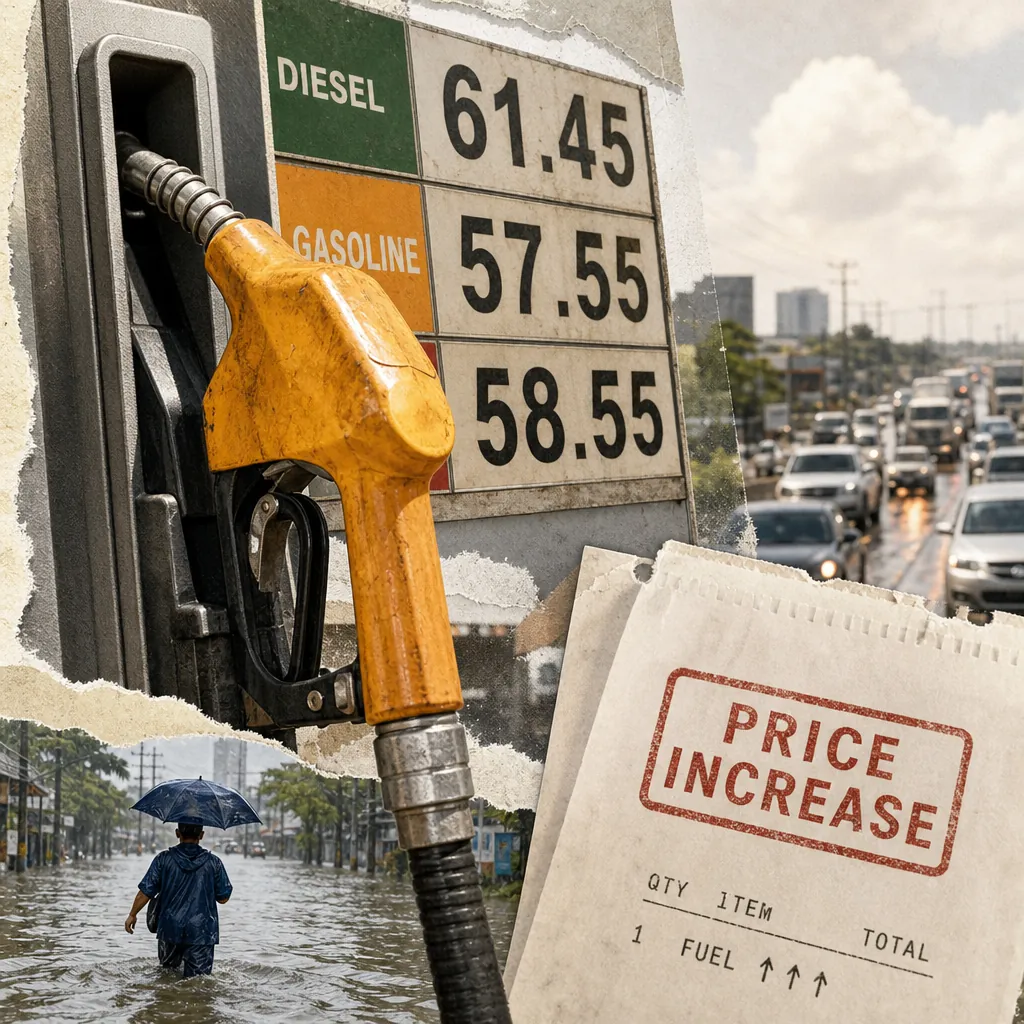
Fuel prices rose again in the Philippines on August 25, with gasoline up by P1.08 per liter, diesel by P2.31, and kerosene by P0.95, according to the Department of Energy (DOE). The increase, effective for the week, follows a period of heavy monsoon rains and flooding that has disrupted daily life across Metro Manila and nearby provinces. Energy Undersecretary Alessandro Sales said the probability of a double-digit increase in the coming weeks is relatively low, attributing current pressures to the ongoing conflict between the United States and Iran, now in its sixth month. The DOE also raised the fuel discount for public utility vehicle operators from P10 to P12 per liter starting August 15, extending the subsidy until September.
Meanwhile, the aftermath of the storms continues to shape public conversation. Zambales imposed a 60-day price freeze on basic necessities after a state of calamity was declared due to the enhanced southwest monsoon and tropical cyclones Luis and Maymay. The freeze, effective August 18 to October 17, prohibits retailers from selling basic necessities above prevailing prices set by the Department of Trade and Industry (DTI), with penalties under the Price Act for violators. In Baguio City, the Baguio Water District reported increased turbidity in several spring sources, including the Buyog and Busol watersheds, prompting closer monitoring and adjustments to water treatment operations. General Manager Salvador Royeca noted that sudden increases in turbidity have become more noticeable in recent years.
On the economic front, Senator Loren Legarda questioned whether the reported decline in poverty incidence to 9.7 percent in 2025, from 15.5 percent in 2023, translates to the real experience of Filipino families. Citing Philippine Statistics Authority (PSA) data, Legarda noted that the number of poor Filipinos declined from 17.54 million in 2023 to 11.08 million in 2025, with about 6.46 million people moving above the official poverty threshold. However, she emphasized that the national poverty threshold for a family of five is approximately P14,634 per month, and questioned whether that amount is truly enough to meet basic needs.
Food safety also drew attention, with a US outbreak linked to alfalfa sprouts sickening at least 55 people across 15 states, including four hospitalizations. The US Centers for Disease Control and Prevention (CDC) said the outbreak involves salmonella and different strains of E. coli, with 26 of 34 interviewed patients reporting eating alfalfa sprouts. In a separate incident, a Chinese mukbang streamer named Zhu revealed she contracted liver flukes after eating raw freshwater fish 14 times in a year, narrowly avoiding cancer. Zhu, who switched to mukbang in July of last year, said she was diagnosed through blood antibody tests and CT scans after standard stool tests failed to detect the parasite eggs.
International trade and tariffs also featured prominently. Iowa corn farmers expressed hope for stronger Philippine demand, particularly for ethanol, as the country focuses on cleaner energy and expected growth in livestock production. Iowa Corn Promotion Board First Vice President Paul Gieselman said American farmers see potential for growth in the Philippine ethanol market, citing the country's desire for sustainably sourced, lower-carbon fuel. Meanwhile, US President Donald Trump's tariff policies drew concern from some Republicans, including Iowa Senate candidate Ashley Hinson, who criticized his plan to lower tariffs on imported ground beef. The tariff tit-for-tat with Canada also evoked comparisons to the Smoot-Hawley Tariff, as featured in the film "Ferris Bueller's Day Off".
In the corporate sphere, Target faced backlash over a children's Halloween costume that resembled racist blackface minstrel imagery, prompting the retailer to remove the product and apologize. The $25 "Kids' Glows under Blacklight Circus Clown Halloween Costume Bodysuit" was part of Target's Hyde and EEK! Boutique collection. Target told Newsweek, "As a company, we know we got this wrong, and we are deeply sorry. The costume is offensive and should never have been part of our assortment".
Other notable stories included Cebu extending its ban on pork imports from Negros Island and other African Swine Fever-affected areas for an additional 45 days, Grab Philippines expanding its GrabCoins rewards program across rides, deliveries, and payments, and Shopee hosting a Brand Protection Bootcamp to strengthen intellectual property protection in e-commerce. The House of Representatives resumed its review of the proposed 2027 national budget, with lawmakers seeking to augment funding for Department of Justice programs after noting massive cuts.
Key themes
- Fuel prices rise again, with diesel up P2.31 per liter — The Department of Energy announced another weekly increase in fuel prices, with gasoline up P1.08, diesel up P2.31, and kerosene up P0.95 per liter, effective August 25. The DOE expects adjustments to remain below P10 per liter in the coming weeks, citing the US-Iran conflict as a key driver.
- Monsoon floods prompt price freeze and water quality concerns — Zambales imposed a 60-day price freeze on basic necessities following a state of calamity declaration. Baguio Water District reported increased turbidity in spring sources due to weeks of continuous rainfall, prompting closer monitoring.
- Poverty decline questioned despite lower incidence rate — Senator Loren Legarda challenged the reported drop in poverty incidence to 9.7 percent in 2025, asking whether the numbers reflect the lived reality of Filipino families. The poverty threshold for a family of five is approximately P14,634 per month.
- Food safety concerns emerge from sprouts outbreak and parasite infection — A US alfalfa sprouts outbreak sickened at least 55 people across 15 states. A Chinese mukbang streamer contracted liver flukes from eating raw freshwater fish, highlighting the risks of raw food consumption.
- Trade tensions and tariffs dominate international coverage — Iowa corn farmers seek stronger Philippine ethanol demand. US President Trump's tariff policies drew criticism from some Republicans, including Iowa Senate candidate Ashley Hinson. The US-Canada tariff dispute evoked Smoot-Hawley comparisons.
- Target faces backlash over offensive Halloween costume — Target removed a children's costume resembling racist blackface imagery and apologized, saying "we know we got this wrong". The incident sparked widespread criticism on social media.
- Government budget review resumes with calls to restore cuts — The House of Representatives resumed deliberations on the 2027 National Expenditure Program, with lawmakers seeking to augment funding for DOJ programs after noting massive cuts. Anti-cybercrime enforcement funding declined by 71 percent under the proposed budget.
- Businesses expand rewards and protection programs — Grab Philippines expanded its GrabCoins rewards program across rides, deliveries, and payments. Shopee hosted a Brand Protection Bootcamp to strengthen intellectual property protection in e-commerce.
How the narratives stack
Dominant — The dominant narrative in the captured set is the combined impact of monsoon floods and rising fuel prices on Filipino consumers. The fuel price hike drew multiple articles across different outlets, with the DOE's announcement and its implications for public utility vehicles receiving particular attention. The flood-related stories, including the price freeze in Zambales and water quality concerns in Baguio, reinforced the theme of weather-related disruption. This narrative dominated because it directly affects daily life for millions of Filipinos, from commuting costs to the price of basic goods.
Counter-narrative — The counter-narrative comes from Senator Loren Legarda's questioning of the poverty decline figures. While the official data shows a significant reduction in poverty incidence, Legarda's challenge introduces skepticism about whether these numbers translate to real improvements in daily life. This narrative counters the positive framing of the poverty statistics with a more critical examination of what the threshold actually means for families.
Emerging — Food safety is an emerging narrative, with the US alfalfa sprouts outbreak and the Chinese streamer's parasite infection drawing attention. These stories, while international, resonate with local concerns about food handling and consumption practices. The sprouts outbreak, involving multiple germs and 15 states, and the mukbang streamer's liver fluke infection both highlight the risks associated with food consumption and preparation.
Under-covered — The Iowa corn farmers' interest in Philippine ethanol demand received relatively limited coverage despite its potential significance for trade relations. The story touches on the Philippines' clean energy goals and the potential for increased ethanol imports, which could have implications for both the agricultural and energy sectors. Within the captured set, this story placed lower than the more immediate consumer concerns of fuel prices and flooding.
Platform insights
- Facebook — Facebook served as a primary platform for sharing news articles and government announcements. The Zambales price freeze and Baguio water quality stories were likely shared widely among local community groups, given their direct impact on residents. The Target costume controversy also generated significant discussion on Facebook, with users sharing screenshots and expressing outrage.
- X (formerly Twitter) — X was active with real-time updates on fuel price changes and flood conditions. The DOE's announcement and the poverty data from the PSA were likely discussed by journalists, economists, and policy advocates. The Target costume backlash also trended on X, with users calling out the retailer for the offensive design.
- YouTube — YouTube hosted video content related to food and travel, including the mukbang streamer's story and the Indonesian street food feature. The streamer's warning about raw fish consumption likely resonated with viewers interested in food content, while the bakso goreng video showcased Indonesian street food culture.
- Reddit — Reddit discussions likely focused on the economic implications of fuel price hikes and the poverty data. Subreddits dedicated to Philippine news and economics may have debated the accuracy of the poverty figures and the effectiveness of government responses to flooding and price increases.
Key voices and communities
- Government officials and agencies — The Department of Energy, Department of Trade and Industry, and Philippine Statistics Authority are central voices, providing official data and policy announcements. Energy Secretary Sharon Garin and Undersecretary Alessandro Sales offered context on fuel prices, while Senator Loren Legarda provided a critical perspective on poverty data.
- Local government units — Provincial and city governments, such as Zambales and Baguio, are key voices in the flood response narrative. Their declarations of calamity, price freezes, and water quality monitoring directly affect residents and businesses.
- Consumer advocates and affected residents — The public, particularly those affected by flooding and fuel price hikes, represent a significant voice. Their experiences with rising costs and weather disruptions shape the conversation around government effectiveness and economic pressure.
- Business and industry representatives — Companies like Grab, Shopee, and Target are voices in the corporate narrative, whether through rewards program expansions, intellectual property protection initiatives, or responses to backlash. Iowa corn farmers also represent agricultural trade interests.
- International media and experts — US outlets covering the sprouts outbreak and tariff disputes, along with Vietnamese media covering the mukbang streamer's story, provide international context. These voices broaden the conversation beyond domestic concerns.
Narrative streams
Fuel price hikes strain consumers as DOE monitors supply
The Department of Energy announced another round of fuel price increases effective August 25, with gasoline up P1.08 per liter, diesel up P2.31, and kerosene up P0.95. This marks another week of rising costs for motorists and public utility vehicle operators. Energy Secretary Sharon Garin assured the public that the increases reflect price pressure, not a shortage of supply, and that the government continues to work with industry to monitor supply levels. Undersecretary Alessandro Sales noted that the probability of a double-digit increase in the coming weeks is relatively low, attributing current pressures to the US-Iran conflict now in its sixth month. The government raised the fuel discount for public utility vehicle operators from P10 to P12 per liter starting August 15, extending the subsidy until September. For consumers, this means continued pressure on transportation costs, which may ripple through the prices of goods and services. The read for the sector is that fuel costs will remain elevated in the near term, affecting both household budgets and business operating expenses.
Monsoon floods trigger price freeze and water quality monitoring
The combined effects of the enhanced southwest monsoon and tropical cyclones Luis and Maymay led to a state of calamity declaration in Zambales, triggering a 60-day price freeze on basic necessities. The freeze, effective August 18 to October 17, prohibits retailers from selling basic necessities above prevailing prices set by the Department of Trade and Industry, with penalties under the Price Act for violators. In Baguio City, the Baguio Water District reported increased turbidity in several spring sources, including the Buyog and Busol watersheds and the Stage 1 and Amliang sources in Tuba, Benguet. General Manager Salvador Royeca said sudden increases in turbidity have become more noticeable in recent years, prompting closer monitoring and adjustments to water treatment operations. These developments highlight the ongoing challenges of weather-related disruption, from ensuring affordable access to basic goods to maintaining water quality. The read for the sector is that local governments and utilities must remain vigilant in responding to the effects of climate change, with implications for infrastructure investment and disaster preparedness.
Poverty decline questioned as senator challenges official figures
Senator Loren Legarda questioned whether the reported decline in poverty incidence to 9.7 percent in 2025, from 15.5 percent in 2023, translates to the real experience of Filipino families. Citing Philippine Statistics Authority data, Legarda noted that the number of poor Filipinos declined from 17.54 million in 2023 to 11.08 million in 2025, with about 6.46 million people moving above the official poverty threshold. However, she emphasized that the national poverty threshold for a family of five is approximately P14,634 per month, and questioned whether that amount is truly enough to meet basic needs. The senator's comments introduce a critical perspective on the official data, suggesting that while the numbers show improvement, the lived reality of many families may still be challenging. The read for the sector is that poverty reduction efforts must be evaluated not just by statistical thresholds but by tangible improvements in quality of life, with implications for social protection programs and economic policy.
Food safety concerns emerge from sprouts outbreak and parasite infection
A US food-poisoning outbreak linked to alfalfa sprouts sickened at least 55 people across 15 states, including four hospitalizations, according to the US Centers for Disease Control and Prevention. The outbreak involves salmonella and different strains of E. coli, with 26 of 34 interviewed patients reporting eating alfalfa sprouts. In a separate incident, a Chinese mukbang streamer named Zhu revealed she contracted liver flukes after eating raw freshwater fish 14 times in a year, narrowly avoiding cancer. Zhu, who switched to mukbang in July of last year, said she was diagnosed through blood antibody tests and CT scans after standard stool tests failed to detect the parasite eggs. These stories highlight the risks associated with food consumption and preparation, from raw sprouts to undercooked fish. The read for the sector is that food safety remains a critical concern, with implications for both public health messaging and food industry practices.
Trade tensions and tariffs shape international coverage
Iowa corn farmers expressed hope for stronger Philippine demand, particularly for ethanol, as the country focuses on cleaner energy and expected growth in livestock production. Iowa Corn Promotion Board First Vice President Paul Gieselman said American farmers see potential for growth in the Philippine ethanol market, citing the country's desire for sustainably sourced, lower-carbon fuel. Meanwhile, US President Trump's tariff policies drew concern from some Republicans, including Iowa Senate candidate Ashley Hinson, who criticized his plan to lower tariffs on imported ground beef. The tariff tit-for-tat with Canada also evoked comparisons to the Smoot-Hawley Tariff, as featured in the film "Ferris Bueller's Day Off". These stories reflect the broader context of international trade and its implications for agricultural markets and consumer prices. The read for the sector is that trade policies and international relations will continue to influence commodity prices and market access, with implications for both producers and consumers.
Target faces backlash over offensive Halloween costume
Target removed a children's Halloween costume resembling racist blackface minstrel imagery after widespread backlash on social media. The $25 "Kids' Glows under Blacklight Circus Clown Halloween Costume Bodysuit" was part of Target's Hyde and EEK! Boutique collection. Target told Newsweek, "As a company, we know we got this wrong, and we are deeply sorry. The costume is offensive and should never have been part of our assortment". The incident highlights the importance of cultural sensitivity in product design and marketing, and the speed at which social media can amplify public criticism. The read for the sector is that retailers must exercise greater care in product development and review processes to avoid offensive or insensitive offerings, with implications for brand reputation and consumer trust.
Government budget review resumes with calls to restore cuts
The House of Representatives resumed deliberations on the 2027 National Expenditure Program, with lawmakers seeking to augment funding for Department of Justice programs after noting massive cuts. Under the proposed budget, funding for anti-cybercrime enforcement declined by 71 percent, for the National Coordination Center against Online Sexual Abuse or Exploitation of Children (OSAEC) and Child Sexual Abuse or Exploitation Materials (CSAEM) by 58 percent, and for anti-trafficking in persons enforcement by 41 percent. House Committee on Appropriations Chairperson Mikaela Suansing expressed surprise at the cuts, given that a measure seeking to tighten the country's child online safety laws is a priority of the Marcos Jr. administration. The deliberations were halted last week because of heavy monsoon rains and floods in Metro Manila and several provinces. The read for the sector is that budget decisions will have significant implications for law enforcement and social protection programs, with potential impacts on public safety and child welfare.
Conversation trajectory
- Fuel prices (next 1–2 weeks) — The DOE expects adjustments to remain below P10 per liter in the coming weeks, but the US-Iran conflict remains a key variable. If the conflict escalates, particularly with disruptions to Middle East ports or pipelines, fuel prices could rise more sharply. Monitor DOE announcements for weekly adjustments and any changes to the fuel subsidy program.
- Flood recovery and price freeze (next 30–60 days) — The Zambales price freeze is effective until October 17, unless lifted earlier. Monitor the DTI's enforcement of the freeze and any reports of violations. The Baguio Water District's monitoring of turbidity levels will continue, with potential implications for water treatment operations and infrastructure investment.
- Poverty data and policy response (next 3–6 months) — Senator Legarda's questioning of the poverty figures may prompt further scrutiny of the PSA's methodology and the adequacy of the poverty threshold. Monitor for any legislative initiatives or policy changes related to social protection programs and poverty reduction efforts.
- Food safety (ongoing) — The US alfalfa sprouts outbreak and the mukbang streamer's parasite infection highlight ongoing food safety concerns. Monitor for any local food safety advisories or recalls, and for public health messaging around safe food handling and consumption practices.
- Trade and tariffs (next 3–6 months) — The US-Canada tariff dispute and Trump's trade policies remain fluid. Monitor for any changes to tariff rates and their impact on agricultural markets and consumer prices. The Iowa corn farmers' interest in Philippine ethanol demand may also develop into concrete trade agreements.
- Budget deliberations (next 2–3 months) — The House of Representatives has set a 53-day timeline to approve the General Appropriations Bill by October. Monitor the deliberations for any restoration of cuts to DOJ programs and other agencies, and for the final budget allocations.
Trigger events — A significant escalation in the US-Iran conflict that disrupts oil supply; a major flood event that overwhelms flood-control infrastructure; a new PSA poverty report or revision of the poverty threshold; a food safety recall or outbreak in the Philippines; a major tariff announcement affecting Philippine exports or imports; the passage of the 2027 national budget.
Response guidance
- Fuel price communication — For companies in the transportation and logistics sector, communicate clearly about how fuel price changes affect pricing and operations. Provide transparent updates on any adjustments to delivery fees or service charges, and highlight efforts to mitigate cost increases through efficiency measures.
- Flood response messaging — For businesses operating in flood-affected areas, emphasize preparedness and customer safety. Communicate any changes to store hours, delivery schedules, or product availability, and highlight support for affected communities through relief efforts or price freezes.
- Poverty and affordability messaging — For consumer-facing brands, acknowledge the financial pressures facing many households. Avoid tone-deaf messaging that ignores economic hardship, and highlight value, affordability, and support for communities.
- Food safety communication — For food businesses, reinforce commitment to food safety and quality. Communicate any certifications, sourcing standards, or handling practices that ensure product safety, and respond promptly to any concerns or incidents.
- Cultural sensitivity in product development — For retailers and brands, review product development and marketing processes to ensure cultural sensitivity and avoid offensive or insensitive offerings. Establish clear review protocols and respond quickly and sincerely to any backlash.
- Trade and tariff updates — For businesses affected by trade policies, monitor tariff changes and communicate their impact on pricing and supply chains. Highlight efforts to diversify sourcing or mitigate cost increases, and engage with policymakers on trade issues.
See the full picture behind today's signals.
This report draws from Media Meter's MediaWatch, our real-time monitoring engine tracking 2,470+ Philippine sources across print, broadcast, digital, and social. Explore how the platform turns raw coverage into decision-grade intelligence, then see how it's configured for teams like yours — whether you're in PR agencies, corporate comms, government, or marketing.
Want more? Browse our Report Library for sector and crisis intelligence, or request a demo and we'll have your brand set up before the call.
Want this kind of intelligence on your brand?
This brief is built on the same MediaWatch methodology that runs continuously across every brand we monitor. See your competitive landscape, Impact Score, and narrative trajectory in a 30-minute demo.