Pork import ban, P180 hog floor set as DA acts
The Department of Agriculture suspended pork imports for 60 days after hog raisers lost an estimated ₱27.9 billion, while a town in Ilocos Sur set a ₱180-per-kilogram minimum farmgate price for live hogs. PBA coverage of the Ginebra–San Miguel Game 5 filled the sports pages.
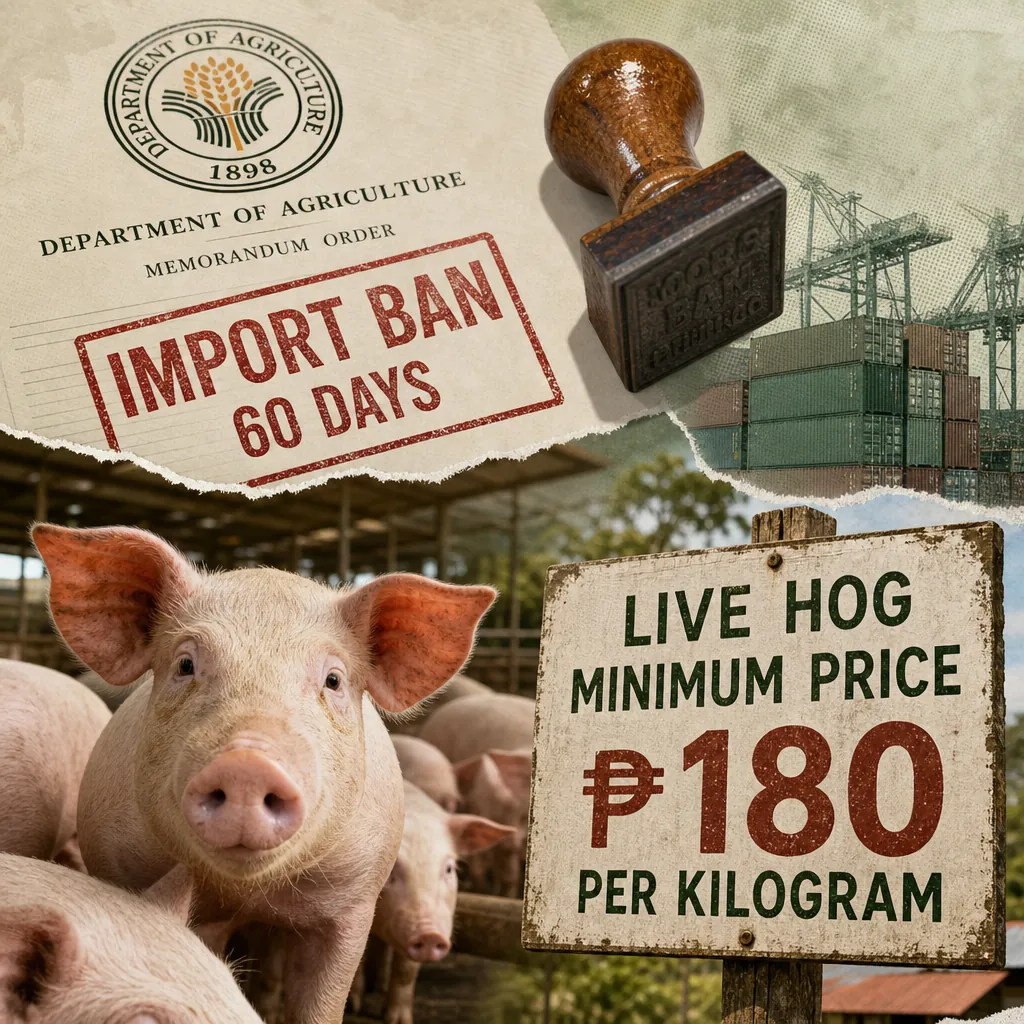
The Department of Agriculture (DA) suspended pork imports for 60 days, a decision announced on Monday, November 9, after the agency estimated that local hog raisers lost ₱27.9 billion in the first seven months of 2026 61. The order, Department Order 33, was issued under Republic Act No. 8800, the Safeguard Measures Act — a law that lets the government temporarily restrict imports when a domestic industry is being hurt by a sudden inflow of foreign goods 61. Agriculture Secretary Francisco P. Tiu Laurel, Jr. said the ban could be extended because the country is oversupplied: the DA estimates current pork inventories can cover 170 days of demand 61.
The same day, the municipal government of Santa in Ilocos Sur set a minimum farmgate price of ₱180 per kilogram for live hogs through Executive Order No. 178, Series of 2026, signed by Mayor Jeremy Jesus "JJ" Bueno III. The order caps the reference price for pork at ₱300 per kilogram, computed from the ₱180 farmgate rate plus up to ₱120 per kilogram for slaughtering, dressing, transportation and handling 1. It follows similar moves elsewhere: Oriental Mindoro has recommended a ₱180 to ₱192 per kilogram farmgate price, and a Quezon legislator has raised concerns about the gap between what raisers earn and what consumers pay 1.
Both developments sit inside a wider run of food-supply and farm-policy stories on November 9. The fishers' group Pambansang Lakas ng Kilusang Mamamalakaya ng Pilipinas (Pamalakaya) warned that the annual three-month closed fishing season, running across several fishing grounds between November and February, could tighten fish supply and push up prices 4. The DA banned poultry imports from Minnesota in the United States after that state confirmed bird flu cases 38. Twenty senators, led by Senate Agriculture Committee Chairman Kiko Pangilinan, urged President Ferdinand Marcos Jr. to declare a state of calamity or a state of imminent disaster in areas expected to be hardest hit by a super El Niño, and to release calamity and quick response funds from the 2026 national budget 40. A sugar industry group asked the Sugar Regulatory Administration to use Philippine Air Force aircraft for a proposed ₱30-million cloud seeding project instead of renting private planes 49.
Key themes
- Pork imports halted for 60 days after ₱27.9 billion in raiser losses. The DA's Department Order 33 suspends imports of fresh and frozen pork cuts, carcasses and edible offal, and the agency says inventories can cover 170 days of demand 61. Imports had climbed to 836,240 metric tons in 2025, up 42 percent from 589,675 metric tons in 2023, and imported pork accounted for 65 percent of supply in the first half of 2026, against 39 percent in 2021 61.
- A Ilocos Sur town sets a ₱180-per-kilogram floor for live hogs. Santa's executive order fixes a uniform liveweight rate with no weight brackets and caps the pork reference price at ₱300 per kilogram 1. It is a local price intervention, not a national one, and it follows similar recommendations in Oriental Mindoro 1.
- The closed fishing season draws a supply warning. Pamalakaya said the ban across the Visayan Sea, Zamboanga Peninsula, Palawan, Balayan Bay in Batangas and Tayabas Bay in Quezon could disrupt production and cut the income of fishing communities 4.
- Bird flu in Minnesota closes a poultry import channel. The DA suspended processing of import clearances for Minnesota poultry and revoked approved clearances, while allowing shipments already in transit that were slaughtered or processed on or before August 18 38.
- Twenty senators push for a pre-emptive calamity declaration ahead of super El Niño. Senate Resolution 765 asks the Department of Budget and Management to make calamity and quick response funds available for farm inputs, irrigation, livestock assistance, crop insurance and food assistance, and asks local price councils to watch for overpricing, profiteering and hoarding 40.
- Sugar groups question a ₱30-million cloud seeding plan. The National Congress of Unions in the Sugar Industry of the Philippines (NACUSIP) wants the Sugar Regulatory Administration to use Philippine Air Force aircraft rather than rent private planes, noting the military recently completed cloud seeding in Negros Occidental 49.
- Exports hit a record month while business registrations grow modestly. Merchandise exports reached a record $9.87 billion in September 2026, up 35.6 percent from $7.28 billion a year earlier, the highest monthly figure since the Philippine Statistics Authority began tracking trade in 1991 57. Business name registrations rose 1.3 percent year on year to 70,244 in October 58.
- The PBA's Ginebra–San Miguel decider filled the sports pages. Game 5 of the Governors' Cup quarterfinals, set for 7:30 p.m. on Tuesday at the Ynares Center in Antipolo, decides the last semifinal slot and a series against defending champion TNT 10.
How the narratives stack
Dominant. The pork import suspension is the day's most consequential agricultural story, and it drew the heaviest coverage in the items reviewed here. BusinessWorld's business pages carried the full detail — the legal basis under the Safeguard Measures Act, the 170-day inventory estimate, the 42 percent rise in imports since 2023 and the jump in import share to 65 percent of supply 61. Philstar's Filipino-language piece led on the ₱27.9-billion loss figure and the 121,000 metric tons of frozen pork in storage 61. The story matters beyond the farm gate: a 60-day halt on imports changes what meat processors, wet-market vendors and institutional buyers can source, and it tests whether domestic production can fill the gap. The DA's own numbers suggest the answer is yes in the short term, since inventories cover 170 days, but the agency also said domestic production met only 65.5 percent of demand in the period it measured 61.
Counter-narrative. The Santa, Ilocos Sur order tells a different story about the same problem. Where the national government restricted imports, a local government set a price floor for live hogs and a ceiling for pork 1. The two approaches can pull in opposite directions: a floor protects raisers from low farmgate prices, while a ceiling protects consumers from high retail prices, and the ₱120-per-kilogram allowance for slaughtering, dressing, transport and handling is the margin that has to absorb both. The order is one municipality's experiment, and its effect on supply will depend on whether traders outside Santa respect it.
Emerging. The El Niño resolution and the closed fishing season warning point to a food-price problem that has not yet arrived. Senate Resolution 765 is a request, not a declaration; it asks the President to act before the drought hits 40. Pamalakaya's warning covers a ban that runs from November to February, so the supply effect would show up in markets over the coming months 4. The Minnesota poultry ban is a narrower, more immediate measure, but it adds to the sense that the DA is managing several import channels at once 38.
Under-covered. The sugar industry's cloud seeding dispute received little attention relative to its cost. NACUSIP's argument is about how the government spends ₱30 million, and its president, Roland de la Cruz, framed it as a question of using existing state resources: "We cannot afford to waste precious government allocations on exorbitant private rentals when taxpayers money already sustains the operations of the Philippine Air Force" 49. A separate Manila Bulletin piece on the sugar industry's competitiveness noted that Thai raw sugar enters Philippine ports at a landed wholesale parity price of ₱1,425 per 50-kilogram bag, or ₱28.50 per kilogram, under the ASEAN Trade in Goods Agreement's 5 percent preferential tariff 59. That price gap is the structural issue behind the cloud seeding debate, and it got less space than the procedural argument.
Platform insights
The day's social conversation, as captured in the monitoring writeup, centered on the pork import ban and the Santa price order, with the PBA decider drawing a separate, sports-focused stream. The writeup did not break engagement down by platform in a way that supports a platform-by-platform comparison, so the observations below are limited to what the material shows.
- Facebook. The pork ban and the Ilocos Sur price order circulated through news-page shares and comment threads, with the ₱180 farmgate figure and the ₱300 pork cap drawing the most discussion. The PBA Game 5 previews also ran heavily on Facebook, where team pages and fan groups shared the "beeracle" framing.
- X. The faster-moving commentary on the DA order appeared on X, where users compared the 60-day ban to previous import suspensions and questioned whether the 170-day inventory estimate was realistic. The senators' El Niño resolution also circulated there, with the calamity-fund request drawing attention.
- Reddit. Discussion threads focused on the mechanics of the price floor — whether a municipal order can bind traders from outside Santa, and whether the ₱120 allowance is enough to cover transport and slaughter costs. The thread on the closed fishing season drew comments from users in fishing provinces about the timing of the ban.
- YouTube. The GMA News video on vegetable and Noche Buena ingredient prices, which quoted the DA saying the increases are normal for the season, drew views from users planning holiday meals 19. The PBA previews also ran as video content on sports channels.
Key voices and communities
Hog raisers and their associations. The DA's ₱27.9-billion loss estimate gives raisers a number to organize around, and the 60-day ban is the first national measure that directly addresses their complaint 61. Their next ask, according to BusinessWorld, is a tariff hike, which would raise the cost of imported pork even after the ban lifts 61.
Local government units setting price floors. Santa's order is the latest in a series of local price interventions, following Oriental Mindoro's recommendation 1. Mayors who set farmgate floors are responding to constituents who sell live hogs below cost, and their orders create a patchwork of local prices that national agencies have to reconcile.
The Senate agriculture bloc. Twenty senators signed Resolution 765, which puts the Senate on record favoring pre-emptive calamity declarations and price monitoring 40. The resolution's lead sponsor, Kiko Pangilinan, chairs the Senate Agriculture Committee, and the breadth of support — 20 of 24 senators — signals that El Niño preparation has become a bipartisan priority.
Fishers' groups. Pamalakaya's warning about the closed fishing season is a recurring annual message, but it lands differently this year because it coincides with the pork ban and the El Niño resolution 4. The group's framing links the ban to household incomes and market prices, not just conservation.
Sugar industry stakeholders. NACUSIP and the Sugar Regulatory Administration are in a dispute over how to fund cloud seeding, and the underlying issue is the competitiveness gap with Thai sugar 4959. The industry's position is that government support should be spent efficiently, since the tariff environment is already exposing local planters to lower-priced imports.
Narrative streams
The DA suspends pork imports for 60 days
The order is the most concrete agricultural policy action of the day. Department Order 33 suspends imports of fresh and frozen pork cuts including ham and pork shoulder, carcasses and edible offal, and it was issued under the Safeguard Measures Act, which allows temporary import restrictions when a domestic industry is being injured 61. The DA's case rests on three numbers: ₱27.9 billion in raiser losses in the first seven months of 2026, imports of 836,240 metric tons in 2025 (up 42 percent from 2023), and an import share of 65 percent of supply in the first half of 2026, up from 39 percent in 2021 61. The agency also said inventories can cover 170 days of demand, which is why Secretary Tiu Laurel said an extension is possible 61.
The read for the sector is that the ban buys hog raisers time but does not change the structural gap. Domestic production met 65.5 percent of demand in the period the DA measured, so even with imports halted, the country depends on local farms for most of its pork 61. Processors and vendors who relied on imported cuts will have to source domestically or draw down frozen stocks, and the 121,000 metric tons in storage is the buffer 61. The raisers' request for a tariff hike, if granted, would raise the price of imports after the ban and give domestic producers a longer margin. The risk is that a prolonged restriction raises retail pork prices just as the holiday season begins, which is the same concern that prompted Santa's price ceiling.
Santa sets a ₱180 farmgate floor and a ₱300 pork cap
The Ilocos Sur order is a local answer to the same problem the DA is addressing nationally. Mayor Bueno's Executive Order No. 178 sets a uniform ₱180-per-kilogram farmgate price for live hogs with no weight brackets, and caps the pork reference price at ₱300 per kilogram based on the farmgate rate plus up to ₱120 for slaughtering, dressing, transportation and handling 1. The municipal government said the measure is meant to protect hog raisers and promote transparent pricing 1.
The read for the sector is that local price floors create a test of coordination. A floor only works if traders inside and outside the municipality follow it, and a ceiling only works if the ₱120 allowance covers actual costs. If the allowance is too thin, vendors absorb the difference or stop buying; if it is too generous, the ceiling does not bind. The order also adds to the patchwork: Oriental Mindoro has recommended ₱180 to ₱192 per kilogram, and a Quezon legislator has flagged the gap between farmgate and retail prices 1. National agencies will have to decide whether to harmonize these local rates or let them stand as experiments.
The closed fishing season and the El Niño resolution point to a food-supply squeeze
Pamalakaya warned that the annual three-month fishing ban, running across the Visayan Sea, Zamboanga Peninsula, Palawan, Balayan Bay and Tayabas Bay between November and February, could trigger an artificial fish shortage and raise market prices 4. The group said the effects run from the earnings of small-scale fishers to the availability and prices of fish in local markets 4. Separately, 20 senators filed Resolution 765 urging President Marcos to declare a state of calamity or imminent disaster in areas expected to be hardest hit by super El Niño, and to make calamity and quick response funds available for farm inputs, irrigation, livestock assistance, crop insurance and food assistance 40. The resolution also asks local price coordination councils to watch for overpricing, profiteering and hoarding 40.
The read for the sector is that the next two quarters will test whether the government's pre-emptive measures work. A calamity declaration unlocks funds faster than ordinary budget processes, but it also signals that the government expects damage. The fishing ban is a conservation measure with a predictable supply cost, and the senators' resolution treats it as part of a broader food-security problem. For fishers and farmers, the question is whether the assistance arrives before the income loss, not after.
The DA bans poultry imports from Minnesota
The poultry ban is a narrower measure than the pork suspension but follows the same logic: a foreign animal-disease outbreak triggers a temporary closure of an import channel. The DA's Department Circular No. 55 covers domestic and wild birds and their products, including poultry meat, day-old chicks, eggs and semen, and the agency suspended processing of sanitary and phytosanitary import clearances and revoked approved clearances for Minnesota 38. Shipments in transit, loaded or accepted at port on or before the order took effect are allowed if the poultry was slaughtered or processed on or before August 18 38.
The read for the sector is that import bans on animal products are becoming a routine tool. The Philippines lifted a poultry ban on Japan earlier, and the Minnesota action shows the DA is willing to close channels quickly when bird flu is confirmed 38. For importers, the risk is stranded shipments and revoked clearances; for consumers, the effect depends on how much of the poultry supply came from Minnesota, which the circular does not quantify.
The PBA decider fills the sports pages
Game 5 of the PBA Governors' Cup quarterfinals between Barangay Ginebra and San Miguel Beer is set for 7:30 p.m. on Tuesday at the Ynares Center in Antipolo, with the winner taking the last semifinal slot and a best-of-five series against defending champion TNT 10. San Miguel forced the decider by winning Games 3 and 4 after trailing 0-2, including a 108-102 win on Friday in which the Beermen erased a 17-point Ginebra lead with a 22-0 run in the third quarter 39. Chris Ross, who had 20 points, six rebounds, nine assists and five steals in Game 4, said: "We haven't done nothing yet; we just evened the series" 10. Ginebra's Jordan Murphy, held to 16 points in Game 4, said the Beermen were "loading up on the ball" and that he needs to "pick my spots a lot more carefully" 3.
The read for the sector is that the series is a scheduling and revenue event as much as a sporting one. The winner faces TNT in a semifinal that begins December 4, after the FIBA World Cup Asian Qualifiers break 10. The coverage in the items reviewed here was heavy across broadsheets, tabloids and online sports desks, with previews, player interviews and analysis running in BusinessWorld, Manila Standard, Daily Tribune, Philstar, Inquirer, Abante Tonite and PM 67685039. The "beeracle" framing refers to San Miguel's 2015-16 Philippine Cup comeback from 0-3 down against Alaska, and a win on Tuesday would make the Beermen only the fourth team in PBA history to overcome a 0-2 deficit in a best-of-five series 50.
Exports and business registrations show modest growth
The export story is the brighter economic signal of the day. Merchandise exports reached a record $9.87 billion in September 2026, up 35.6 percent from $7.28 billion in September 2025, the highest monthly figure since the Philippine Statistics Authority began tracking trade in 1991 57. The Philippine Exporters Confederation Inc. (Philexport) projects full-year exports of about $108 billion, which would beat last year's $84.48 billion 63. The Department of Trade and Industry (DTI) brought more than 300 Filipino exhibitors together at the Philippine Exporters Trade Exposition & Forum 2026 to connect them with international buyers 57.
Business registrations grew more slowly. DTI data show 70,244 registrations in October, up 1.3 percent year on year, with wholesale and retail trade accounting for 35,260 and accommodation and food services for 9,648 58. Calabarzon had the most registrations at 14,144, followed by the National Capital Region at 13,862 and Central Luzon at 10,575 58. The read for the sector is that the export surge is concentrated in electronics, while the registration data show the broader small-business base growing at a modest pace. The DTI's trade fair and expo programs are aimed at converting the export growth into contracts for smaller producers, and the National Trade Fair generated ₱128.85 million in reported sales and prospective deals 58.
Conversation trajectory
Pork prices and the 60-day ban (observation window: 2–4 weeks). The ban took effect this week, and the first test will be whether retail pork prices hold steady through the holiday season. Watch the DA's weekly price monitoring and any announcement of an extension. If frozen stocks draw down faster than expected, the agency may face pressure to lift the ban early.
Santa's price order (observation window: 1–2 weeks). The municipal order's effect will show up in local market prices and in whether traders from neighboring towns comply. Watch for reports of supply shortages in Santa or of hogs being sold outside the municipality to avoid the floor.
El Niño resolution (observation window: 4–8 weeks). Senate Resolution 765 is a request to the President. Watch for a formal declaration, which would unlock calamity funds, and for the Department of Budget and Management's response on fund availability. The resolution's price-monitoring provisions will be tested if food prices rise before the drought's effects are clear.
Closed fishing season (observation window: November–February). The ban runs through the first quarter of 2027. Watch fish prices in markets supplied by the affected fishing grounds, and any government program to compensate fishers for lost income.
PBA Game 5 (observation window: November 10). The result decides the last semifinal slot and sets up a series against TNT beginning December 4. Watch for the winner's injury report and for the league's scheduling around the FIBA World Cup Asian Qualifiers break.
Trigger events. A formal El Niño calamity declaration, a DA announcement on extending the pork ban, a reported bird flu case in another US state, and the PBA semifinal schedule are the events most likely to move these stories.
Response guidance
Pork processors and vendors: communicate sourcing plans. With imports halted for 60 days, buyers will want to know where their pork is coming from. Processors should tell customers whether they are drawing on frozen stocks or shifting to domestic suppliers, and give a realistic timeline for the ban's effect on prices.
Local government units: coordinate price orders with neighbors. Santa's order sets a floor and a ceiling that traders outside the municipality may not follow. Local governments considering similar measures should coordinate with neighboring towns and with the DA to avoid creating arbitrage that undermines the order.
Hog raisers: use the loss figure in policy asks. The DA's ₱27.9-billion estimate is the strongest number raisers have. Associations should present it alongside the import-share data when pushing for a tariff hike, and should be specific about how long a tariff increase would need to run to stabilize farmgate prices.
Fishers' groups: pair the supply warning with a compensation ask. Pamalakaya's warning about the closed fishing season is credible, but it will carry more weight if paired with a specific proposal for income support during the ban. The senators' resolution already includes food assistance, which is a channel fishers can use.
Exporters: prepare for the holiday shipping window. The record September export figure and the Philexport projection give exporters a strong case for capacity support. Companies should confirm shipping schedules before the December peak and document any port delays.
Sports and entertainment communicators: plan around the Game 5 result. The Ginebra–San Miguel series has drawn heavy coverage across broadsheets, tabloids and online sports desks. Brands and media outfits planning around the semifinals should wait for Tuesday's result before committing to team-specific campaigns, since the winner faces TNT on a schedule that includes the FIBA break.
All food-sector communicators: avoid price promises. With the pork ban, the fishing season and the El Niño resolution all in play, food prices are likely to move in the coming weeks. Communicators should avoid promising stable prices and instead explain the factors behind any changes.
See the full picture behind today's signals.
This report draws from Media Meter's MediaWatch, our real-time monitoring engine tracking 2,470+ Philippine sources across print, broadcast, digital, and social. Explore how the platform turns raw coverage into decision-grade intelligence, then see how it's configured for teams like yours — whether you're in PR agencies, corporate comms, government, or marketing.
Want more? Browse our Report Library for sector and crisis intelligence, or request a demo and we'll have your brand set up before the call.
Want this kind of intelligence on your brand?
This brief is built on the same MediaWatch methodology that runs continuously across every brand we monitor. See your competitive landscape, Impact Score, and narrative trajectory in a 30-minute demo.