Philippine Inflation Hits 7.8% as Rice Nears P50 a Kilo
Philippine inflation accelerated to 7.8 percent in October 2026, the fastest since February 2023, with rice averaging P49.87 a kilo and transport costs up 20.1 percent. Coverage also tracks a 60-day pork import ban, a January 2027 opening for electric-vehicle incentives, and a warning that 40 percent of hotel investments could fall through.
The Conversation
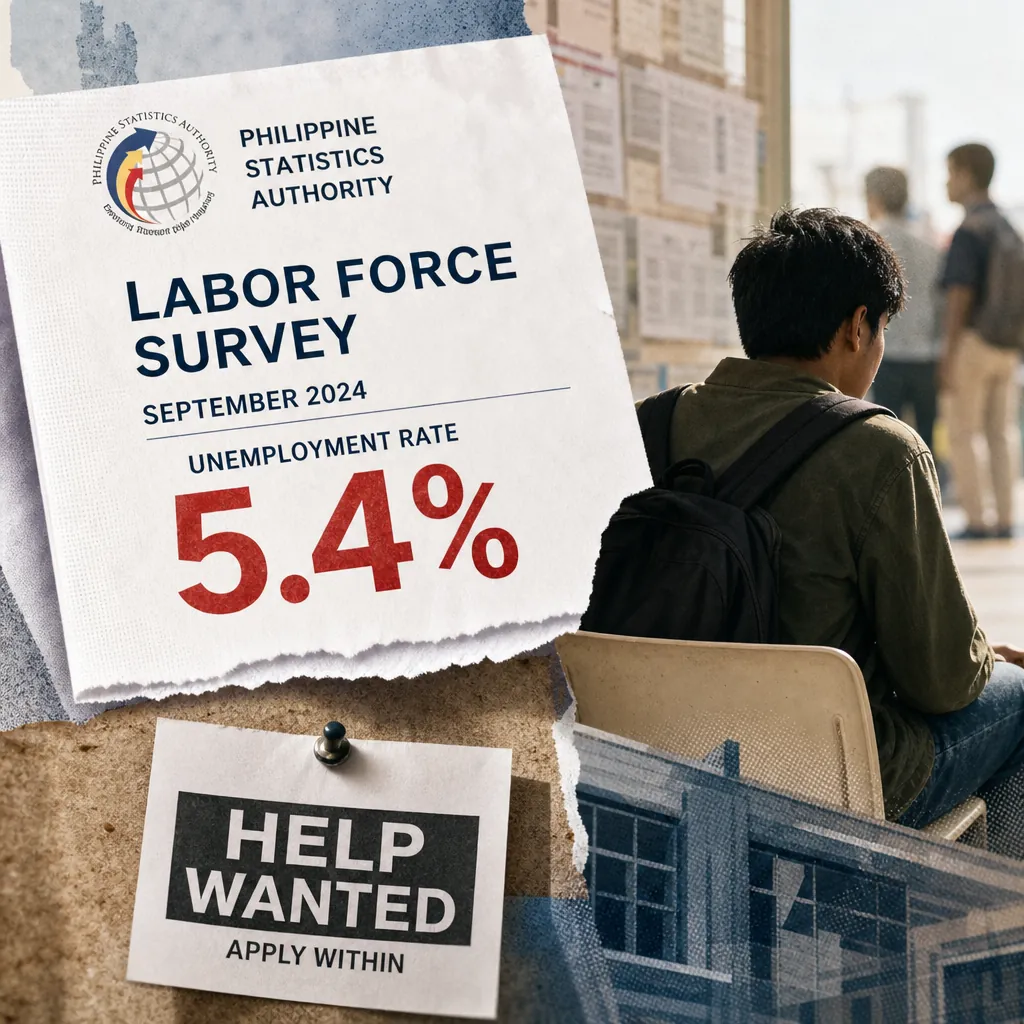
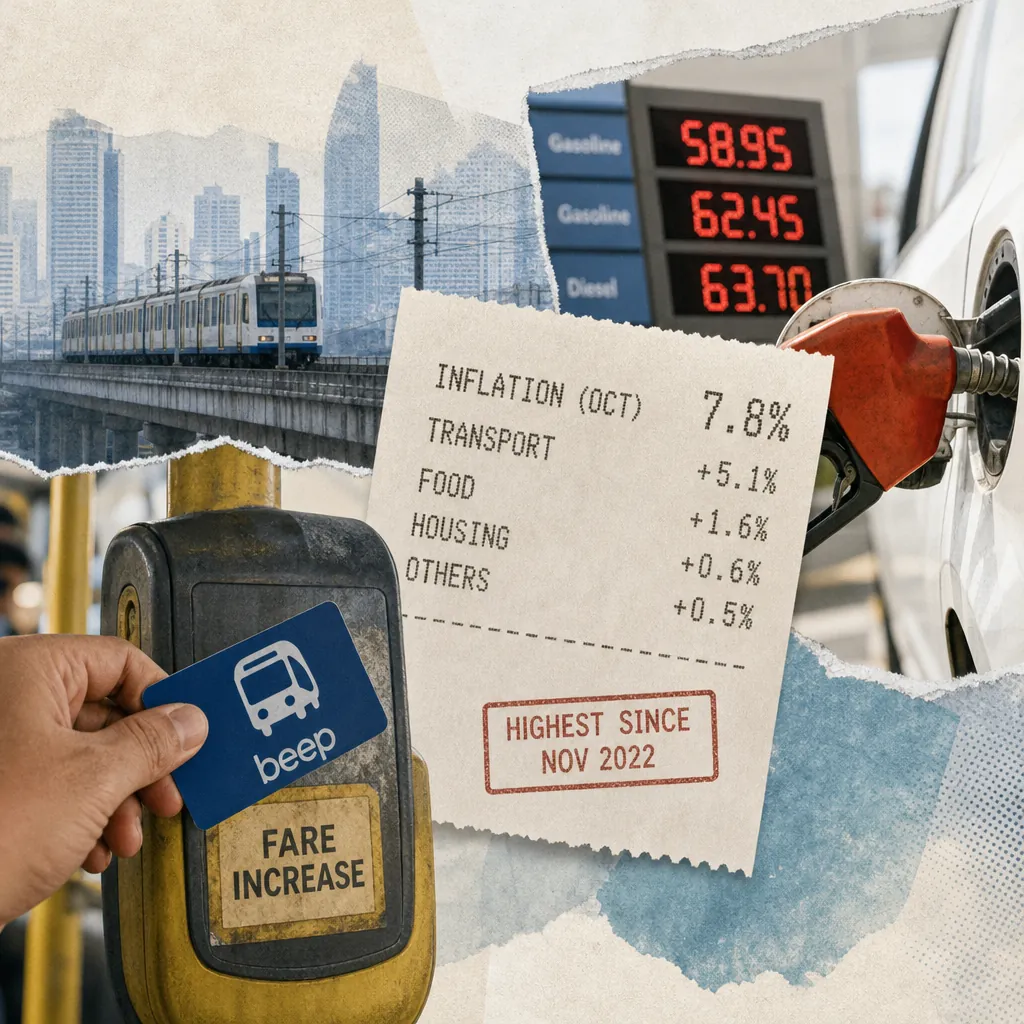
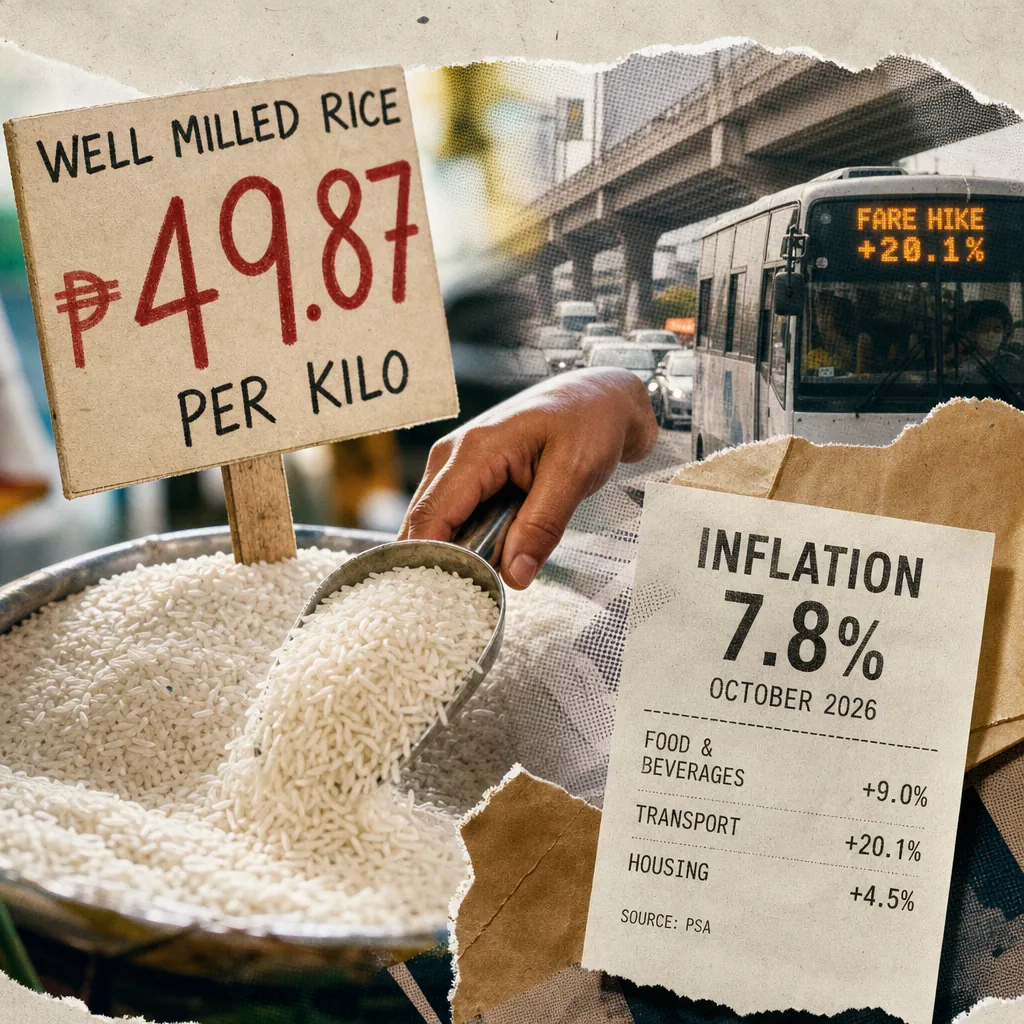
A kilo of local regular milled rice cost P49.87 on average in October 2026, up from P40.16 a year earlier, and the Philippine Statistics Authority (PSA) reported that headline inflation reached 7.8 percent for the month, the fastest pace since February 2023 and up from 7.2 percent in September50. The same release put transport costs 20.1 percent higher than a year earlier, core inflation — which strips out volatile food and energy prices to show the underlying trend — at 5.4 percent, and inflation for the poorest 30 percent of households at 9.5 percent, with food accounting for nearly half of that basket50. Those figures anchored the day's business coverage, and they sit alongside a set of policy decisions that will shape what Filipinos pay at the till and what investors commit to the country over the next year.
The cost-of-living story ran through several of the day's items. A tabloid column questioned whether the "Drink Moderately" and "Drink Responsibly" reminders printed on alcohol advertising and packaging do any measurable good, citing a new study tied to Columbia University's Mailman School of Public Health on the health risks of drinking. A broadsheet business page reported that Monde Nissin Corp., maker of Lucky Me! noodles, is moving into premium noodles to contest Korean and Indonesian brands that now hold roughly P6 billion, or nearly 10 percent by value, of the Philippine noodle market. A Manila Standard business story said as much as 40 percent of potential hotel investments could fall through because of high development costs and uncertainty over government incentives, with Tourism Secretary Ma. Bernardita Angara-Mathay warning that investors hesitate to commit capital without assurances their projects will qualify.
On the policy side, the Department of Agriculture imposed a 60-day ban on imports of several pork products, hams included, after a probe found cheaper shipments were squeezing local raisers' margins; meat processors said the ban would leave them short of raw materials and push up processed-meat prices during the holiday season54. The Department of Trade and Industry (DTI) said applications for the Electric Vehicle Incentive Strategy (Evis) should open by January 2027, with the program's implementing rules targeted for release before the end of November23, and Bataan's provincial government is courting Vietnamese carmaker VinFast to build a plant there49. Business-name registrations with the DTI reached 986,780 in the first 10 months of the year, 6.5 percent more than the 925,994 recorded in the same period of 2025, with new filings making up 86 percent of the total65.
Key themes
- Headline inflation reached 7.8 percent in October, the fastest since February 2023. The PSA figure was up from 7.2 percent in September and from 1.7 percent a year earlier, with rice at P49.87 a kilo against P40.16 twelve months before50.
- The poorest households carried a 9.5 percent inflation rate. Food made up nearly half the basket for the bottom 30 percent, and core inflation at 5.4 percent showed price pressure had spread beyond fuel and food into services50.
- A 60-day pork import ban took effect under the Safeguard Measures Act. Agriculture Secretary Francisco Tiu Laurel Jr. signed Department Order 33 covering fresh, chilled and frozen pork, hams and offals, after a probe found imports were undercutting local raisers; processors warned of stockouts and higher retail prices over the holidays54.
- Electric-vehicle incentives open for applications in January 2027. Trade Undersecretary Ceferino Rodolfo said the Evis implementing rules are in final review, with only technical revisions remaining, and Bataan is pitching itself to VinFast as a manufacturing site2349.
- Hotel investment is at risk from cost and incentive uncertainty. The Tourism department estimates up to 40 percent of potential hotel projects could be abandoned, against a target of 500,000 rooms by 2030.
- Business registrations rose 6.5 percent to 986,780 in ten months. Wholesale and retail trade accounted for 534,286 filings, accommodation and food service 136,149, and Calabarzon logged the most registrations of any region65.
- Monde Nissin moved into premium noodles against Korean and Indonesian brands. The segment is worth about P6 billion, close to a tenth of the market by value, and the company is positioning its entry as cheaper than the imports.
- The peso's purchasing power is the frame for the household story. A Business Mirror column calculated the rice price gap at nearly P10 a kilo and noted that for a household cooking rice twice a day the difference is felt directly50.
How the narratives stack
Dominant. The inflation release dominated the captured business coverage. The 7.8 percent headline, the P49.87 rice price and the 9.5 percent rate for the poorest households appeared in a Business Mirror column that walked through the PSA data line by line50, and the same cost pressures surfaced in the pork ban story, where processors warned of higher retail prices for processed meat during the holidays54, and in the Monde Nissin story, where a local manufacturer is repositioning around a premium segment that imports have captured. Within the items gathered here, the inflation story is the one with the widest consequence: it sets the baseline against which every other price, wage and incentive decision this quarter will be judged.
Counter-narrative. The DTI's business-registration numbers tell a different story from the price data. Registrations rose 6.5 percent year on year to 986,780 in ten months, and 848,694 of those were new business names rather than renewals65. That is a measure of filings, not of survival or profitability, and it does not contradict the inflation figures — but it does show that new enterprises kept forming through a period of rising prices. The concentration in wholesale and retail trade, at 534,286 filings, suggests much of this is small-scale trading rather than capital-intensive enterprise.
Emerging. The electric-vehicle program is the clearest forward-looking story in the set. The Evis implementing rules are due before end of November, applications open in January 2027, and Bataan is already positioning itself for VinFast's plant2349. Nothing has been built yet and VinFast has not chosen a site, so this is a policy pipeline rather than an outcome. The hotel-investment warning belongs here too: the 40 percent figure is an estimate of projects at risk, not projects cancelled.
Under-covered. The alcohol-warning column raised a question that got no follow-up in the captured set: whether the "Drink Moderately" labels on Philippine alcohol advertising and packaging change behaviour at all, and what a new Columbia University-linked study on drinking risks means for a market where alcohol advertising is widespread. It ran as a single opinion piece with no reported data on Philippine consumption or regulatory response.
Platform insights
- Facebook. The day's most-shared political content in the captured set came from a celebrity rather than an institution: actor Dennis Trillo posted screenshots on his Facebook page calling out an event styling business for using a tabloid front page about his wife Jennylyn Mercado's childhood abuse as party decor, asking the supplier to explain the choice in a children's-party theme63. The post is a direct personal appeal to a supplier, and it drew coverage in a regional outlet rather than the business press.
- X. The platform carried the sponsor-pressure story: after a progressive podcast laughed at a joke about the slain conservative influencer Charlie Kirk, a social media user urged followers to boycott Cash App, and the payment platform replied on X that it does not condone violence and was no longer a sponsor48. The sequence shows how quickly a sponsor decision can be forced into public view on the platform where the pressure started.
- Instagram. The Philadelphia bicycle boycott was organized and announced through Instagram, with the group Philly Bike On Your Left posting its call in late October and a flyer following on October 312233. The platform served as the organizing layer for an offline event that then drew counterprotesters, police lines and at least one arrest34.
- YouTube. Eurovision's first Asia edition will be broadcast live on television in participating countries and on YouTube when it runs in Bangkok on November 14, with 11 countries competing including the Philippines44. The event's organizers acknowledged sluggish ticket sales and the absence of India, Japan and China from the lineup.
Key voices and communities
Household budget watchers and the business press. The Business Mirror column translated the PSA release into a household calculation — nearly P10 more per kilo of rice, twice-daily cooking, a 20.1 percent rise in transport costs — and framed the burden as unequal, with the poorest 30 percent at 9.5 percent inflation50. This group sets the terms of the public argument: prices are measured against a household's weekly spend, not against an abstract index.
Agricultural raisers and meat processors. The pork ban put two industry groups on opposite sides of the same policy. Local raisers won protection after a government probe found imports were squeezing their margins; processors said the 60-day restriction would leave them short of raw materials and raise the cost of processed meat for consumers during the holidays54. Both positions are now in front of the Agriculture department.
The Tourism department and hotel investors. Tourism Secretary Angara-Mathay is consolidating business groups' concerns into a single request for more incentives and lower regulatory fees, arguing that investors will not commit capital without knowing whether their projects qualify. The department is working against a 2030 target of 500,000 rooms.
Electric-vehicle manufacturers and local governments. Trade Undersecretary Rodolfo, who also manages the Board of Investments, is the government's point person on Evis and on site selection for VinFast, assessing locations on supply-chain access, port proximity and logistics49. Bataan is competing on its province-wide shift to electric public transport and what the DTI describes as a more straightforward permitting process.
Small business registrants. The 848,694 new business names filed in ten months represent a constituency that the DTI counts but does not describe in detail65. Their concentration in retail trade and food service makes them the group most exposed to the price movements in the inflation release.
Narrative streams
Rice at P49.87 a kilo pushes inflation to 7.8 percent
The PSA's October release put headline inflation at 7.8 percent, up from 7.2 percent in September and from 1.7 percent a year earlier, the fastest pace since February 202350. Rice averaged P49.87 a kilo for local regular milled, against P40.16 in October 2025. Transport costs rose 20.1 percent year on year. Core inflation, which excludes food and energy to isolate the underlying trend, reached 5.4 percent, its highest since September 2023 — a signal that price increases had moved from fuel and food into the rest of the household budget, including restaurant bills, electricity and fares50. For the poorest 30 percent of households, inflation ran at 9.5 percent, with food close to half the basket.
The read for the sector is that consumer-facing businesses should plan for a household sector whose spending is being compressed from several directions at once, and that the bottom third of the market has the least room to absorb further increases. Retailers, food manufacturers and transport operators face a customer base that is trading down; the Monde Nissin move into premium noodles is a bet on the segment above that squeeze, not on the mass market. The government's room to respond is constrained by core inflation at 5.4 percent, which limits how much of the headline number can be dismissed as a food-price spike.
A 60-day pork import ban splits raisers and processors
Agriculture Secretary Francisco Tiu Laurel Jr. signed Department Order 33 under Republic Act 8800, the Safeguard Measures Act — a law that lets the government impose temporary import restrictions when a surge in shipments is found to be injuring domestic producers54. The ban covers fresh, chilled and frozen swine meat including carcasses and half-carcasses, hams and shoulders with bone in, and edible pork offals, and runs for 60 days from issuance. The government probe found that cheaper shipments had squeezed local raisers' margins.
Meat processors objected, saying the restriction would leave them short of raw materials and raise the retail cost of processed meat during the holiday season, when demand peaks54. The read for the sector is that the policy trades protection for raisers against higher input costs for processors and higher shelf prices for consumers, and the timing places that trade-off directly in the Christmas shopping period. Processors that rely on imported pork now face a sourcing problem with a fixed 60-day horizon; retailers should expect processed-meat prices to move before the ban expires.
Electric-vehicle incentives get a January 2027 start date
Trade Undersecretary Ceferino Rodolfo, who also serves as managing head of the Board of Investments, said applications for the Electric Vehicle Incentive Strategy will open in January 2027, with the implementing rules and regulations targeted for release before the end of November23. The remaining revisions are technical rather than fiscal, he said, and will not substantially alter the incentive framework. Evis is the government's program to attract automotive manufacturers and build a domestic electric-vehicle industry rather than importing finished vehicles.
Bataan's provincial government is separately pursuing VinFast Auto Ltd., the Vietnamese electric-vehicle maker, to build a manufacturing facility in the province, citing its shift to electric public transport and infrastructure being developed for electric public utility vehicles49. Rodolfo said the Board of Investments is helping the company assess sites on supply-chain access, port proximity and logistics, and that VinFast has not selected a location. The read for the sector is that the Philippines is now competing for assembly investment on the strength of its incentives and permitting speed, and the January application window gives manufacturers a fixed date to plan against. Nothing is committed yet: the rules are not final and VinFast has made no site decision.
Hotel investment at risk as incentive uncertainty stalls capital
Tourism Secretary Ma. Bernardita Angara-Mathay said as much as 40 percent of potential hotel investments in the Philippines could fall through because of high development costs and uncertainty over government incentives. The department is working with business groups to consolidate their concerns into a united request for additional incentives and lower regulatory fees. "It's hard to put in capital when you don't know if you'll be given incentives," she said. The target is 500,000 rooms by 2030.
The read for the sector is that the constraint on hotel capacity is now the incentive process rather than demand: developers are holding capital until they know whether projects qualify, and the department's response is to negotiate as a bloc with other agencies. For hotels already operating, a slower pipeline means less new competition in the near term; for the tourism target, it means the 2030 room count depends on how quickly the incentive rules are settled.
Business registrations rise 6.5 percent as new firms keep forming
DTI business-name registrations reached 986,780 in the first ten months of 2026, up 6.5 percent from 925,994 in the same period of 202565. New business names made up 848,694 of the total, or 86 percent, with 138,086 renewals. Wholesale and retail trade, including motor vehicle and motorcycle repair and personal and household goods, accounted for 534,286 filings, more than half the total; accommodation and food service followed at 136,149, manufacturing at 54,253 and real estate at 52,597. Calabarzon logged the highest number of registrations of any region.
The read for the sector is that business formation held up through a year of rising prices, but the composition matters more than the total: a registry dominated by small retail and food-service filings describes a economy where new enterprise is concentrated in low-capital, thin-margin activity. Those are precisely the businesses most exposed to the cost pressures in the inflation release, and registration is not a measure of how many survive their first year.
Monde Nissin contests a P6-billion premium noodle segment
Monde Nissin Corp. is expanding its premium noodle offerings to compete with Korean and Indonesian brands that have taken a growing share of the Philippine market. Chief finance officer Jessie Teo said the premium segment is now about P6 billion, or nearly 10 percent of the market by value, and that most premium brands are Korean and Indonesian. "We are responding by coming up with our own premium, a bit more affordable, but still premium," he said. The company began with a stir-fried Jjamppong offering and has introduced limited-time barbecue and chili cheese flavors.
The read for the sector is that the imported-food premium is now large enough for a domestic manufacturer to build a product line against it, and Monde Nissin is competing on price within the premium tier rather than on the mass-market shelf where it already leads. For retailers, that means more premium SKUs from a local supplier at a lower price point than the imports; for the Korean and Indonesian brands, it means their price advantage is the target.
A single column questions alcohol warning labels
A tabloid opinion piece asked whether the "Drink Moderately" and "Drink Responsibly" reminders that have appeared for decades on alcohol advertising, in cinemas, on billboards, online and on packaging actually change how much people drink. The column noted that a single shot or bottle is often not enough for a drinker, and that excessive drinking is linked to health problems, accidents and violence. It cited a new study by researchers associated with Columbia University's Mailman School of Public Health, published this year in the Journal of Studies on Alcohol, that restated the risks of drinking.
The read for the sector is that the effectiveness of responsible-drinking messaging is being questioned in public without any Philippine consumption data attached, which leaves alcohol producers and advertisers defending a label whose measured effect nobody in the captured coverage supplied. The column is one opinion piece, not a regulatory action, but it puts the burden of proof on the industry.
Conversation trajectory
Inflation follow-through — next 4–6 weeks. The November inflation release, due in early December, will show whether the 7.8 percent October figure was a peak or a step. Watch the rice line specifically: if local regular milled holds near P49.87 a kilo, the household story persists into the Christmas period; a decline would ease the pressure on the bottom 30 percent, whose rate stood at 9.5 percent50.
Pork ban expiry — 60 days from issuance. Processors' warnings about stockouts and higher processed-meat prices will be tested over the holiday season54. Watch for processor requests for exemptions or early lifting, and for retail price movements in ham and processed pork before Christmas.
Evis implementing rules — before end of November. The rules are in final interagency review with only technical revisions remaining, and applications open in January 202723. The release of the rules is the checkable event; the incentive levels themselves are the thing manufacturers will read.
VinFast site decision — timing not announced. The Board of Investments is assisting with site assessment on supply-chain, port and logistics criteria, and Bataan is competing on its electric public-transport shift and permitting speed49. A site announcement would be the signal that the EV manufacturing push has converted into committed capital.
Hotel incentive negotiations — through the next budget and policy cycle. The Tourism department is assembling a consolidated business request for more incentives and lower fees. Watch whether the 40 percent at-risk estimate is revised once the request reaches the agencies involved.
ASEAN meetings in Manila — November 14–15 and the following week. The ASEAN Business and Investment Summit and ASEAN Business Awards run November 14 and 15, ahead of the 49th ASEAN Summit and Related Meetings in Manila64. Regional trade and investment signals, including the Canada-ASEAN free trade talks that negotiators are pushing to conclude in Manila this month59, will surface around those dates.
Response guidance
Consumer-facing pricing communications. Lead with the specific item and its price rather than the index. A household that cooks rice twice a day responds to P49.87 a kilo against P40.16 a year ago; a 7.8 percent headline is abstract by comparison50. Where a business is holding prices or absorbing costs, say so with the number and the period it covers.
Processors and retailers during the pork ban. Prepare customers for processed-meat price movement before the holidays rather than after, and state plainly that the 60-day restriction under the Safeguard Measures Act is a government measure with a fixed expiry54. Avoid attributing price increases to the ban alone if other input costs are also moving.
Manufacturers engaging with Evis. Treat the January 2027 application window as the planning date and the November rules release as the document to read23. Communications should describe the program as an application process with criteria, not as an approved incentive, until the rules are published.
Tourism and hospitality operators. The incentive-uncertainty argument is being made collectively through business groups. Operators with project pipelines should route specific concerns through those consolidated channels rather than issuing individual complaints, and should avoid presenting the 40 percent figure as a confirmed loss of investment.
Alcohol and beverage advertisers. The responsible-drinking label is being questioned in public without Philippine consumption evidence attached. Brands that rely on moderation messaging should be ready to describe what the messaging is and is not intended to do, and should not claim behavioural effects the industry has not measured.
Platform practice for consumer brands. Sponsor decisions can be forced into public view within days when a social media campaign targets a payment platform or broadcaster48. Have a named decision-maker and a stated position ready before a pressure campaign reaches the brand, and publish the reasoning when a sponsorship ends.
Small-business support messaging. The DTI registration data describes a wave of new retail and food-service filings65. Banks, payment providers and suppliers serving that segment should frame support around the costs those businesses actually face — input prices, transport, and thin margins — rather than around registration growth as a success metric.
See the full picture behind today's signals.
This report draws from Media Meter's MediaWatch, our real-time monitoring engine tracking 2,470+ Philippine sources across print, broadcast, digital, and social. Explore how the platform turns raw coverage into decision-grade intelligence, then see how it's configured for teams like yours — whether you're in PR agencies, corporate comms, government, or marketing.
Want more? Browse our Report Library for sector and crisis intelligence, or request a demo and we'll have your brand set up before the call.
Want this kind of intelligence on your brand?
This brief is built on the same MediaWatch methodology that runs continuously across every brand we monitor. See your competitive landscape, Impact Score, and narrative trajectory in a 30-minute demo.