El Niño Draws ₱3B Irrigation Ask and Prayers for Rain
The Department of Agriculture seeks more than ₱3 billion for solar irrigation as a strong El Niño threatens farms, while Manila's archbishop orders parishes to pray for rain and Maynilad sets a ₱27.5-billion capital budget for 2027.
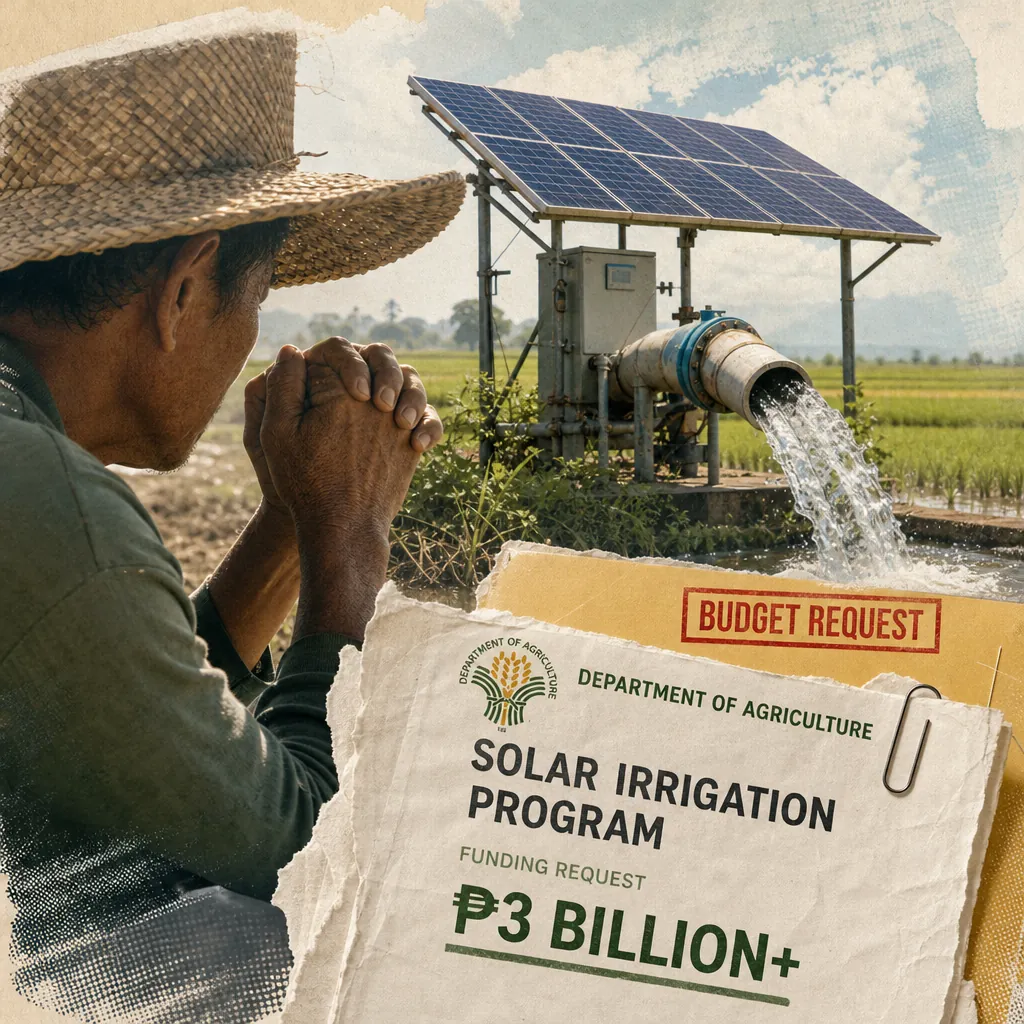
A dry spell that has not yet fully arrived is already moving money and institutions. On Thursday, Nov. 5, the Department of Agriculture (DA) confirmed it is asking for more than ₱3 billion to build and deploy irrigation systems nationwide ahead of a strong El Niño, the periodic warming of the Pacific Ocean that in the Philippines typically means below-normal rainfall, prolonged dry spells and lower farm output.24 The same day, Manila Archbishop Jose Cardinal Advincula ordered every parish in the Archdiocese of Manila to pray for rain starting Sunday, Nov. 8, a step the Catholic Church in the Philippines has historically reserved for grave public emergencies.254 Maynilad Water Services Inc., the private concessionaire serving the western half of Metro Manila, told reporters it expects no hit to revenue or expenses from the heat and will spend ₱27.5 billion on capital projects in 2027.26
The three developments point in the same direction: the country's food and water managers are treating the coming dry season as a planning problem with a deadline, not a forecast to be watched. The DA's request, the archbishop's circular and Maynilad's budget all landed in the same news cycle, and each carries a different kind of weight — a budget ask that must survive congressional scrutiny, a spiritual mobilization that reaches millions of churchgoers weekly, and a corporate capital plan that will shape water service for years.
Key themes
- The DA wants ₱3 billion for solar irrigation before the dry season bites. Agriculture Assistant Secretary Arnel de Mesa, who is also the department's spokesperson, said the money would fund regular and mobile solar-powered irrigation systems to address water shortages in farm areas.24 The department hopes to draw the funds from the Unified Package for Livelihoods, Industry, Food and Transport (Uplift), a whole-of-government program created to cushion the impact of the Middle East crisis. Of the total, ₱2 billion is earmarked for regular solar irrigation projects and ₱1 billion for mobile units.24
- The Archdiocese of Manila has made praying for rain an official liturgical instruction. Cardinal Advincula directed churches to include the Oratio Imperata ad Petendam Pluviam — Latin for "obligatory prayer to ask for rain" — in daily Masses after the Post-Communion Prayer, beginning Sunday, Nov. 8, until further notice.254 In his circular, he said the prayer should also "strengthen our solidarity with the poor and vulnerable communities who may be especially affected by the consequences of drought."54
- Maynilad is budgeting for growth through the El Niño threat. Chief financial officer Ricardo Delos Reyes said the company has "no concerns" that extreme hot weather would affect its financial performance, and that it does not expect revenues or expenses to be affected next year.26 For the first nine months of 2026, Maynilad's net income rose to ₱12.6 billion from ₱11.4 billion in the same period a year earlier, while consolidated revenues grew 3.5 percent to ₱28.6 billion from ₱27.7 billion, on stronger billed volume and a larger customer base.26
- The DA is also asking ₱1 billion to vaccinate small hog farms against African swine fever. De Mesa said the department's 2027 budget request includes about ₱1 billion to buy African swine fever (ASF) vaccines for smallholder and backyard raisers.34 The Bureau of Animal Industry approved the commercial sale of AVAC ASF LIVE in September, making it the first commercially available ASF vaccine in the country; it was developed by AVAC Vietnam Joint Stock Co. and is a live, attenuated, gene-deleted vaccine.34
- Dangerous heat is already forecast for three areas on Friday. The Philippine Atmospheric, Geophysical and Astronomical Services Administration (Pagasa) forecast a heat index of 43 °C in Coron, Palawan, and 42 °C in both Dipolog City and Butuan City for Friday, Nov. 6.20 The heat index measures discomfort based on combined air temperature and humidity; Pagasa classifies 42 °C to 51 °C as "dangerous," a range in which prolonged exposure can cause heat cramps, heat exhaustion and heat stroke.20
- A separate Inquirer column argues that battery storage has changed the case for solar and wind. The Manila Times opinion piece recounts former President Benigno Aquino III's skepticism about renewables — "Paano kung walang araw, paano kung walang hangin" (What if there is no sun or wind?) — and argues that storage technology now answers the intermittency question that once made solar and wind politically vulnerable.21 The column is a signal that the reliability debate around renewable energy is shifting as battery costs fall.
- The DA's irrigation ask is tied to a program built for a different crisis. The Uplift program was designed to address the impact of the Middle East crisis, not El Niño.24 That the DA is routing a drought-response request through it suggests the department is working within existing budget envelopes rather than seeking a new appropriation — a distinction that matters for how quickly the money can actually move.
How the narratives stack
Dominant: The DA's ₱3-billion irrigation request is the most consequential item in this set. It is a concrete, costed government response to a forecast hazard, and it comes with named officials, specific allocations and a funding mechanism.24 The Manila Times column on battery storage and renewables adds an energy-policy dimension to the same underlying question — how the country generates and stores power when the weather turns.21 Together these items dominated the business and national news pages in this captured set, with the DA story carried by Inquirer's business desk and the energy column running in the Manila Times opinion section.
Counter-narrative: The archbishop's prayer circular offers a different register entirely. Where the DA speaks in billions of pesos and solar panels, the Church speaks in liturgy and solidarity.254 The circular does not contradict the government's approach; it addresses the same threat through a moral and spiritual frame that reaches a constituency the DA cannot. The Manila Times carried the circular in its national news section, and the Inquirer ran it on its news site, indicating that editors saw it as a story with broad public interest rather than a niche religious item.254
Emerging: Maynilad's ₱27.5-billion capital plan and its confidence about El Niño's financial impact represent the private-sector read on the same risk.26 The company's position — that it can absorb the drought without revenue or expense damage — is a bet that its network investments will keep supply stable. If the dry season is severe, that bet will be tested, and the company's capital spending will be scrutinized as either prudent preparation or insufficient.
Under-covered: The ASF vaccination request received comparatively little attention in this set, appearing in a single Inquirer business story.34 Yet it addresses a disease that has devastated the country's hog industry in recent years and directly affects the livelihoods of smallholder farmers — the same constituency the irrigation program is meant to protect. The overlap between the two DA requests, both aimed at smallholders and both dependent on 2027 budget approval, is a story that has not yet been told as one story.
Platform insights
- Facebook: The most-shared item in this set was not about El Niño at all. An entire 10-member Sangguniang Kabataan (SK) council in Barangay Banate, Malungon, Sarangani province, announced its resignation in a joint statement posted on its official Facebook page on Tuesday, Nov. 3, citing the postponement of the Barangay and SK Elections (BSKE).3 The post framed the decision in personal terms — the council members said they wanted to "pursue other goals, explore new opportunities, and grow beyond our responsibilities in public service."3 The story was picked up by the Inquirer and ran as a national news item, showing how a single local Facebook post can become a national story when it captures a widely felt frustration.
- X (formerly Twitter): Paraguay's President Santiago Peña announced his resignation in a video posted on X on Thursday, Nov. 5, after the collapse of Ueno Bank froze the deposits of about 3 million customers.6685 The video announcement made X the primary distribution channel for a head-of-state resignation, a pattern that has become more common as leaders bypass traditional media for major announcements. The story was carried by Detikcom and Yahoo News, among others, and the banking crisis it describes — a digital bank that grew to claim about 60 percent of Paraguay's adult population as customers before being ordered into resolution — is a case study in the risks of rapid fintech expansion.85
- Reddit and YouTube: No posts from these platforms appeared in the monitoring writeup for this window. The conversation in this set was carried primarily by news outlets and by Facebook and X posts that news outlets then covered.
Key voices and communities
The Department of Agriculture and its smallholder constituency. De Mesa's briefing set the government's terms for the El Niño response: solar irrigation, mobile units, and a funding request routed through an existing program.24 The DA's framing treats smallholders as the priority — both for irrigation and for ASF vaccination — which positions the department as the primary institutional advocate for the country's smallest farmers.34 How effectively that advocacy translates into appropriated funds will determine whether the framing holds.
The Catholic Church in Manila. Cardinal Advincula's circular is an instruction to priests, catechists and religious educators, but its audience is the millions of Catholics who attend Mass weekly in the capital.254 The Church's decision to pray for rain is a public acknowledgment that the drought threat is serious enough to warrant collective action. The circular's emphasis on solidarity with "the poor and vulnerable communities" positions the Church as a moral voice on climate adaptation, not just a spiritual one.54
Maynilad and the water utility sector. Delos Reyes's briefing was aimed at investors and reporters, and its message was reassurance: the company can handle El Niño.26 The ₱27.5-billion capital budget is the concrete expression of that confidence. For customers, the relevant question is whether the spending translates into reliable supply during the dry months; for regulators, it is whether the utility's planning assumptions are sound.
Pagasa and the heat-index forecasters. Pagasa's Friday forecast put three areas in the "dangerous" heat range, a classification that triggers health warnings and, in some cases, class suspensions.20 The agency's heat-index bulletins have become a daily reference point for schools, local governments and employers during hot months, and its forecasts shape how the public perceives the El Niño threat before the drought itself arrives.
The resigned SK council of Barangay Banate. The 10-member council's Facebook post turned a local decision into a national story about the costs of election postponement.3 Their statement — that they could not "keep postponing their personal and career plans" — gave voice to a frustration that other young officials may share but have not articulated publicly.3
Narrative streams
The DA's ₱3-billion irrigation request routes drought money through a Middle East crisis program
The Department of Agriculture's request for more than ₱3 billion for irrigation is the most specific government response to El Niño in this set. De Mesa said the money would fund "regular and mobile irrigation systems nationwide to help address water shortages in agricultural areas," with ₱2 billion for regular solar irrigation projects and ₱1 billion for mobile solar irrigation systems.24 The department is seeking the funds from the Uplift program, a whole-of-government initiative aimed at addressing the impact of the Middle East crisis.24
The choice of funding vehicle matters. Uplift was not designed for drought response; it was designed to cushion the economic shock of a conflict thousands of miles away. Routing an El Niño request through it suggests the DA is working within existing budget authorities rather than seeking a new line item, which could speed disbursement but also means the irrigation program competes with other Uplift priorities. The request is for 2027, meaning the systems would be deployed after the current dry season — a timing that raises the question of whether the money arrives in time to help with the El Niño now forecast, or whether it prepares for the next one.
Solar irrigation is a practical choice for the Philippines. Many farm areas are off-grid or have unreliable electricity, and solar-powered pumps can operate independently of the power grid. Mobile units can be moved to where the water shortage is most acute. The DA's framing — regular systems for permanent installations, mobile systems for flexible response — reflects a two-track approach that acknowledges both the long-term need for irrigation infrastructure and the short-term need to respond to drought emergencies.
The read for the farm sector: smallholder rice and vegetable growers in rain-fed areas face the most immediate risk from El Niño, and the DA's request is an acknowledgment that their water supply is not secure. Whether the ₱3 billion materializes depends on congressional budget deliberations, and whether it arrives in time depends on procurement speed. Farmers in areas already facing water shortages have little ability to wait for a multi-year budget cycle.
The Archdiocese of Manila makes rain a matter of official prayer
Cardinal Advincula's circular, dated Nov. 5, directs all parishes and communities in the Archdiocese of Manila to include the Oratio Imperata ad Petendam Pluviam in daily Eucharistic celebrations starting Sunday, Nov. 8, following the Post-Communion Prayer, until further notice.254 The archbishop said the prayer should remind the faithful of "the power of united prayer" and strengthen "solidarity with the poor and vulnerable communities who may be especially affected by the consequences of drought."54
The Oratio Imperata is a formal category of prayer in Catholic liturgy — an "obligatory prayer" that a bishop can order for a specific intention. In the Philippines, bishops have ordered such prayers for rain during previous droughts and for other public emergencies. The practice gives the Church a mechanism to respond to a crisis without altering the liturgy itself, and it signals to the faithful that the situation is serious enough to warrant collective supplication.
The circular also encourages priests, catechists, religious educators and people involved in faith formation to "take this opportunity to deepen" understanding of the prayer's meaning.54 That instruction turns the prayer from a ritual into a teaching moment, connecting the drought to the Church's broader social teaching on care for the poor and vulnerable.
The read for the Church and its institutions: the circular positions the Archdiocese as a moral actor in climate adaptation, not just a spiritual one. For parishes, it means an added liturgical element at daily Masses for an indefinite period. For the government, it signals that the Church will be a visible partner in mobilizing public attention around water scarcity — and potentially a critic if the response is seen as inadequate.
Maynilad budgets ₱27.5 billion for 2027 and says El Niño will not dent its finances
Maynilad's briefing on Thursday was a message of confidence. Delos Reyes told reporters the company has "no concerns" that extreme hot weather would affect its financial performance, and that it does not expect revenues or expenses to be affected next year.26 The company reported net income of ₱12.6 billion for the first nine months of 2026, up from ₱11.4 billion in the same period a year earlier, and consolidated revenues of ₱28.6 billion, up 3.5 percent from ₱27.7 billion.26 Billed connections grew 1.5 percent to 1.5 million.26
The ₱27.5-billion capital budget for 2027 is the largest single financial commitment in this set. It covers network fortification — the pipes, treatment plants and storage facilities that determine whether water reaches customers during a drought. The company's confidence rests on the assumption that its network investments will keep supply stable even as demand rises and raw water sources shrink.
That assumption will be tested. El Niño typically reduces rainfall in the Philippines, lowering reservoir levels and river flows. Maynilad draws water from Angat Dam and other sources, and a severe drought could strain supply. The company's financial position gives it room to invest, but capital spending takes time to translate into additional supply. The ₱27.5 billion is a multi-year commitment, not a quick fix.
The read for water consumers and regulators: Maynilad's confidence is a bet that its planning is adequate. If the dry season is severe and supply is disrupted, the company's capital budget will be scrutinized for whether it was spent on the right projects. For customers in the western Metro Manila concession area, the relevant question is whether the spending translates into reliable service during the months when water matters most.
The DA's ₱1-billion ASF vaccine request targets smallholder hog raisers
Separate from the irrigation request, the DA is seeking about ₱1 billion in 2027 funding to buy African swine fever vaccines for smallholder and backyard hog raisers.34 De Mesa said the vaccination program will prioritize smallholders nationwide.34 The Bureau of Animal Industry approved the commercial sale of AVAC ASF LIVE in September, making it the first commercially available ASF vaccine in the Philippines; it is a live, attenuated, gene-deleted vaccine developed by AVAC Vietnam Joint Stock Co.34
African swine fever is a viral disease that is highly lethal to pigs and has no cure. It has devastated hog populations across Asia since 2018, and in the Philippines it has disrupted the pork supply chain and driven up prices. Smallholder and backyard raisers are particularly vulnerable because they often lack the biosecurity measures that commercial farms can afford. A vaccine that can be administered to small herds would be a significant tool for protecting their livelihoods.
The DA's request is for 2027, meaning the vaccination program would begin after the current budget year. The timing reflects the reality that vaccine procurement and distribution take time, and that the department is planning for a sustained campaign rather than an emergency response. The ₱1 billion would cover vaccine purchases, but the program's success will also depend on distribution logistics, cold-chain capacity and farmer acceptance.
The read for the hog sector: smallholder raisers who have lost herds to ASF or who live in areas where the disease is circulating have a direct stake in whether the ₱1 billion is approved and how quickly the vaccine reaches them. Commercial producers, who have more biosecurity capacity, are less dependent on the program but benefit from reduced disease pressure across the industry.
Heat-index forecasts put three areas in the danger zone before the drought arrives
Pagasa's Friday forecast put Coron, Palawan at 43 °C heat index, and Dipolog City and Butuan City at 42 °C — all within the agency's "dangerous" range of 42 °C to 51 °C.20 The heat index combines air temperature and humidity to measure how hot it feels to the human body. At dangerous levels, prolonged exposure can cause heat cramps, heat exhaustion and heat stroke.20
The forecast is a reminder that El Niño's effects are not limited to water shortages. High heat poses direct health risks, particularly for outdoor workers, the elderly and children. Pagasa's heat-index bulletins have become a daily reference for local governments deciding whether to suspend classes and for employers planning outdoor work. The agency's classification system gives the public a simple way to understand the risk: below 27 °C is "not dangerous," 27–32 °C is "caution," 33–41 °C is "extreme caution," and 42–51 °C is "dangerous."20
The read for local governments and employers: areas forecast at dangerous heat levels should prepare for heat-related illness and consider adjusting outdoor schedules. The forecast is for a single day, but it signals the pattern that will likely recur through the dry season.
Battery storage changes the terms of the renewable-energy debate
The Manila Times column on battery storage is the only item in this set that addresses the energy dimension of the El Niño story directly. The column recalls former President Aquino's skepticism about solar and wind — "What if there is no sun or wind?" — and argues that battery storage now provides the answer that was unavailable when the question was first posed.21 The author recounts asking, years ago, whether solar power could be stored for future use and transmitted to areas that lack generation, and receiving only "vague answers."21
The column's argument is that storage technology has advanced to the point where intermittency is no longer a disqualifying weakness for renewables. That matters for the Philippines because the country's power supply is stretched, and because El Niño reduces hydroelectric output at the same time it increases demand for cooling. Solar paired with storage can provide power during the day and into the evening, reducing dependence on fossil fuels and on hydro sources that dry up in El Niño years.
The read for the energy sector: the reliability objection to renewables is weakening as storage costs fall. For policymakers, the question is whether the country's grid and regulatory framework can accommodate more variable generation. For consumers, the benefit depends on whether storage investments translate into lower prices and more reliable supply.
Conversation trajectory
The DA's budget request faces congressional scrutiny in the coming weeks. The 2027 national budget is still being deliberated, and the DA's ₱3-billion irrigation request and ₱1-billion ASF vaccine request will compete with other priorities. Watch for House and Senate budget hearings where these items are taken up. If the requests are cut or delayed, the government's El Niño response will be weaker than the department has planned. Observation window: the next four to six weeks, as the budget moves through Congress.
The Archdiocese's prayer campaign begins Sunday, Nov. 8. The first Masses with the Oratio Imperata will be held that day, and the Church's messaging may intensify if the drought worsens. Watch for statements from other dioceses — if the practice spreads beyond Manila, it would signal that the Church sees the drought as a national concern. Observation window: the next two to four weeks.
Pagasa's heat-index forecasts will continue daily. The agency issues heat-index bulletins regularly, and areas forecast at dangerous levels may see class suspensions or health advisories. Watch for whether the dangerous heat extends beyond the three areas forecast for Friday. Observation window: daily through the dry season.
Maynilad's capital spending will be tested by actual supply conditions. The company's confidence that El Niño will not affect its finances will be tested if reservoir levels drop sharply. Watch for Angat Dam water-level reports and any supply disruptions in the Maynilad concession area. Observation window: the next two to three months, as the dry season peaks.
The ASF vaccine rollout depends on budget approval and procurement. If the ₱1 billion is approved, the DA will need to procure and distribute the vaccine to smallholders. Watch for announcements about vaccination schedules and coverage. Observation window: the first half of 2027.
Trigger events to watch: the formal start of the El Niño dry season as declared by Pagasa; any reduction in water allocation from Angat Dam; congressional action on the DA's budget requests; and the first reports of ASF outbreaks in areas where vaccination has not yet reached.
Response guidance
For agricultural communicators: Lead with the specific numbers — ₱3 billion for irrigation, ₱1 billion for ASF vaccines — and explain what they buy. Farmers need to know whether the programs will reach their areas and when. Avoid framing the requests as certain; they are budget proposals that must be approved. Direct farmers to their local agriculture offices for information on irrigation and vaccination schedules.
For water utilities: Maynilad's confidence is a message that needs to be backed by visible action. Communicate capital projects in terms of what they mean for customers — more reliable supply, better pressure, fewer disruptions — rather than in terms of pesos spent. If supply conditions worsen, be transparent about the reasons and the response.
For Church communicators: The prayer circular is an opportunity to connect faith with action. Encourage parishes to pair the Oratio Imperata with practical information about water conservation and support for vulnerable communities. The circular's emphasis on solidarity with the poor gives parishes a framework for concrete outreach.
For local government communicators: Heat-index forecasts are a public health tool. Use Pagasa's classifications to explain risk in plain terms and to justify decisions about class suspensions and outdoor work. Provide information about hydration, heat illness symptoms and where to seek help.
For energy-sector communicators: The battery-storage story is a chance to explain how renewables plus storage can improve reliability. Avoid overpromising; storage costs are falling but deployment takes time. Focus on specific projects and their contribution to supply.
For all communicators: The El Niño story is a slow-moving emergency. The public's attention will rise and fall with forecasts and visible impacts. Consistent, plain-language communication about what is being done and what people can do themselves is more useful than alarm. Avoid predicting disaster; describe the preparations and the risks they address.
See the full picture behind today's signals.
This report draws from Media Meter's MediaWatch, our real-time monitoring engine tracking 2,470+ Philippine sources across print, broadcast, digital, and social. Explore how the platform turns raw coverage into decision-grade intelligence, then see how it's configured for teams like yours — whether you're in PR agencies, corporate comms, government, or marketing.
Want more? Browse our Report Library for sector and crisis intelligence, or request a demo and we'll have your brand set up before the call.
Want this kind of intelligence on your brand?
This brief is built on the same MediaWatch methodology that runs continuously across every brand we monitor. See your competitive landscape, Impact Score, and narrative trajectory in a 30-minute demo.