Postpaid frustrations and network expansion shape Philippine telco conversation
A snapshot of June 21-22, 2026, covering consumer complaints about Smart and DITO postpaid service failures, billing anxiety, and SMS compatibility issues, alongside Globe and PLDT network expansion announcements and industry commentary on satellite vs. terrestrial connectivity.
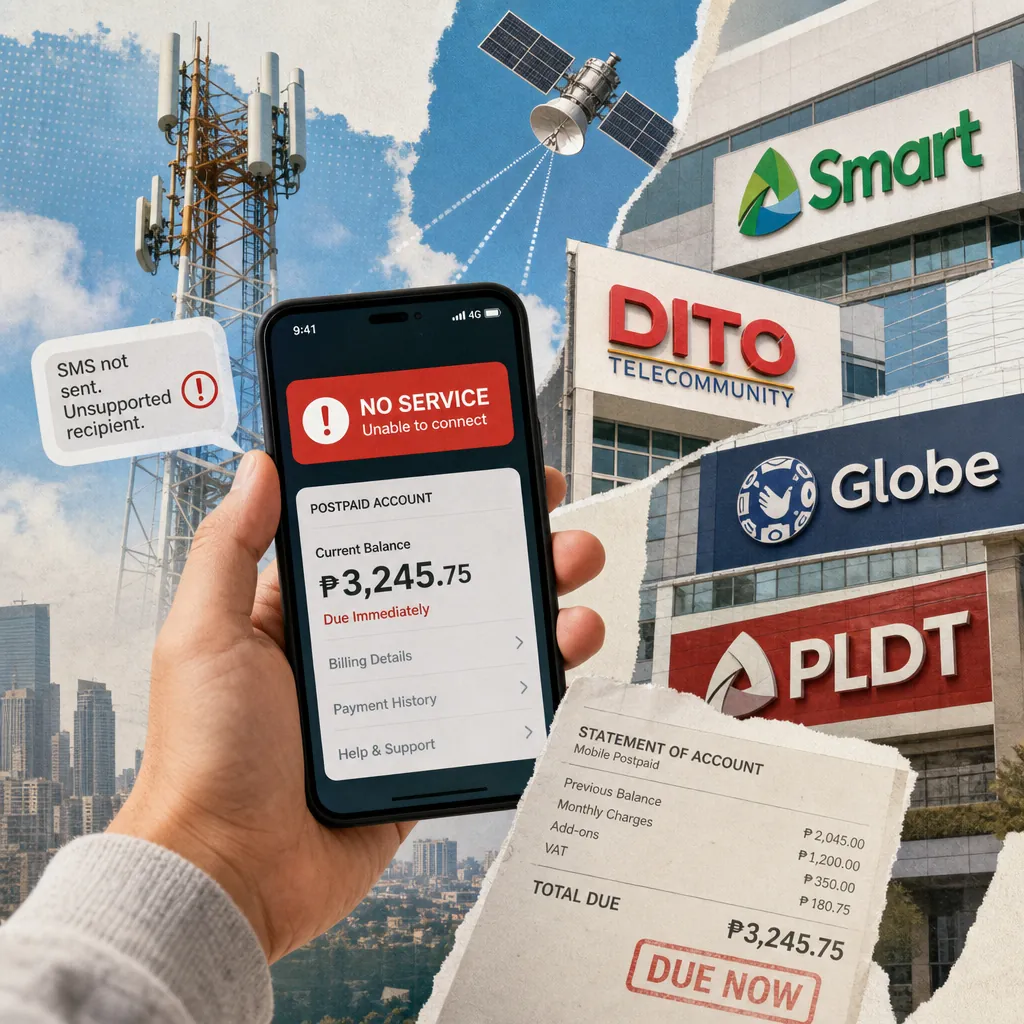
On June 21, 2026, a Sunday, social media conversations around Philippine telecommunications were dominated by a fragmented but interconnected wave of consumer discontent over postpaid service failures, billing confusion, and technical limitations, even as major operators Globe and PLDT announced network expansions and industry leaders weighed in on the role of satellite technology. The most visible complaint came from a Facebook user who posted an emotional plea about a newly acquired postpaid plan that delivered no 5G signal, demanding a refund of ₱1,490 and expressing anxiety about paying monthly for unusable service. The post quickly gained traction with three likes, one share, and 42 comments, indicating significant resonance among others likely facing similar coverage gaps. Almost simultaneously, a Twitter user tagged @LiveSmart with a warning that their area had experienced no service for nearly a week, hinting at a potential network switch—a sentiment that, despite only 32 views, pointed to growing impatience with prolonged outages. By the same day, Reddit users began diving into more nuanced issues: one anonymous poster detailed an unpaid DITO postpaid bill that had ballooned to ₱11,500 after receiving a "free" SIM with a phone purchase in November 2025, expressing fear of being searched at their address. Another Reddit user revealed that their DITO SIM could not receive SMS codes from Interactive Brokers, forcing them to consider buying a Smart SIM instead. Meanwhile, a separate inquiry about using a ₱20,000 credit card limit to avail of a Smart postpaid plan for an iPhone 17 Pro Max on 0% installment reflected ongoing consumer interest in premium postpaid offerings despite the surrounding frustrations.
Conversation snapshot. The day's conversation was fragmented across platforms but centered on postpaid service reliability and billing issues. The Facebook refund plea drew the highest engagement: 3 likes, 1 share, and 42 comments—a high comment count relative to likes, suggesting a community of similarly affected users sharing experiences. The Twitter outage complaint received 32 views and 1 comment, a low reach but a direct escalation to the brand. On Reddit, the unpaid DITO bill post received 0 likes and 0 comments, indicating either low community interest or a niche concern, while the SMS compatibility post received 2 likes and 0 comments. The iPhone plan inquiry also received no engagement, suggesting an unmet need for accessible information. In contrast, the supplementary media showed a more positive industry narrative: Globe opened a new distribution hub in Angono, Rizal, and its CEO advocated for technology-neutral policies, while PLDT activated a new cell site in Palawan and DITO expressed confidence against foreign entrants. These corporate announcements generated news coverage but little direct social media engagement on the day.
Key themes
- Postpaid service coverage and refund demands – The Facebook post set the tone by centering on a new postpaid plan that failed to deliver 5G signal, with the user explicitly linking continued payment to unused service and demanding a ₱1,490 refund. The 42 comments likely amplified similar stories, suggesting that coverage gaps remain a primary pain point for postpaid subscribers. The Twitter complaint about a one-week outage targeted Smart directly, framing switching networks as a logical next step.
- DITO-specific billing confusion and financial risk – The Reddit post about an unpaid DITO bill introduced a darker thread: a user who accepted a free postpaid SIM as a bundle with a phone now faced an ₱11,500 debt they could not afford to pay, and feared law enforcement visits. This evolved from a simple billing question into a warning about predatory or poorly communicated postpaid bundles, where the "free" SIM became an unmanageable liability.
- SMS compatibility and international service barriers – The Interactive Brokers SMS failure post added a technical layer: DITO SIMs unable to receive critical two-factor authentication codes from a global brokerage platform, forcing the user to consider a Smart SIM. This highlights that local coverage is not the only issue—international SMS interoperability affects financial access and digital identity.
- Network expansion and accessibility – Globe opened a new Onsite Distribution Operations (OSDO) hub in Barangay Mahabang Parang, Angono, Rizal, to bring Globe At Home applications, prepaid products, and customer support closer to residents. PLDT's wireless arm Smart fired up a new cell site in San Vicente, Palawan, to support the government's Bayanihan SIM initiative for geographically isolated areas.
- Satellite vs. terrestrial connectivity debate – Globe CEO Carl Cruz stated that "no single technology can connect a nation," advocating for satellite technology to complement rather than replace traditional mobile networks. This came as the Department of Information and Communications Technology (DICT) said foreign telecom players, including a Japan-based company offering both terrestrial and satellite services, are expected to enter the Philippine market this year.
- DITO's confidence against foreign entrants – DITO Telecommunity President Eric Alberto said foreign entrants are unlikely to derail growth plans, noting that "it is easy to get players to resell networks, it is harder to put up new infrastructure." DITO remains on track to achieve its revenue and subscriber targets for 2025.
- GCash IPO as a positive catalyst – Globe shares rose 5.9% week-on-week after its board approved filings related to the proposed initial public offering (IPO) of affiliate Mynt, Inc., the parent company of e-wallet platform GCash. Analysts said the potential IPO served as a positive catalyst for Globe.
- Government digitalization and trade facilitation – The government is accelerating the rollout of the National Single Window (NSW), a trade facilitation platform to curb smuggling and streamline import processing, with full implementation targeted by 2028. The National Tobacco Administration and Bureau of Internal Revenue have been onboarded.
How the narratives stack
Dominant narrative – The dominant narrative from the social media conversation is that postpaid subscribers are increasingly frustrated with service reliability and billing transparency, particularly for Smart and DITO. The emotional language—"nakakatakot po ito" (this is scary), "pwd refund," "almost 1 week na no service"—indicates growing willingness to leave providers entirely. Users are explicitly suggesting network switching as a solution, which will likely accelerate as more share similar stories. The DITO billing fear post also reveals a critical gap in customer onboarding: consumers given SIMs as freebies may not understand postpaid terms, creating future collection and reputation headaches.
Counter-narrative – The corporate announcements from Globe, PLDT, and DITO present a counter-narrative of expansion and confidence. Globe's new hub in Angono and PLDT's new cell site in Palawan demonstrate ongoing investment in infrastructure, particularly for underserved areas. DITO's president downplays the threat of foreign entrants, asserting that building new infrastructure is harder than reselling networks. This narrative suggests that despite consumer complaints, the industry is moving forward with expansion plans.
Emerging narrative – The satellite vs. terrestrial connectivity debate is an emerging narrative that could reshape the competitive landscape. Globe's advocacy for technology-neutral policies and the expected entry of foreign players with satellite capabilities signal a shift toward multi-technology approaches. This narrative is still developing but has the potential to change how connectivity is delivered, especially in remote areas.
Suppressed narrative – The SMS compatibility issue with international financial services is a suppressed narrative that matters but is not getting proportionate attention. The inability of DITO to receive SMS codes from platforms like Interactive Brokers affects a growing segment of digital investors and freelancers. This technical limitation could become a significant competitive disadvantage as digital financial inclusion gains momentum, yet it received only two likes and no comments on Reddit.
Platform insights
Facebook – The emotional refund appeal on June 21 garnered the highest engagement (3 likes, 1 share, 42 comments), showing that direct, personal pleas about postpaid waste resonate strongly in a visual, community-driven space where users can commiserate via comments. The high comment-to-like ratio suggests that the post sparked a discussion among similarly affected users, though the content of those comments is not captured. This platform serves as a space for emotional validation and shared experience.
Twitter – The brief, tag-heavy complaint from @dbyelloww used the platform's direct-to-brand communication style, with low visibility (32 views) but intentional escalation by including @LiveSmart and a link to what appears to be a complaint portal. Twitter serves as an immediate pressure valve for service interruptions, often prompting faster official responses than Facebook. The low view count suggests that this particular complaint did not gain viral traction, but the act of tagging the brand indicates an expectation of a direct response.
Reddit – Three distinct threads on June 21 reveal Reddit's role as a place for detailed, problem-solving discussions—from billing fears to SMS interoperability to credit limit eligibility. The lack of comments on the billing and SMS posts may indicate either low community interest in DITO-specific issues or that these are fringe concerns that later gain traction through cross-referencing. The plan eligibility query shows Reddit's utility for pre-purchase research, even though it received no engagement. Reddit users tend to seek practical advice and technical solutions rather than emotional support.
Key voices and communities
- Frustrated postpaid subscribers – This group spans Facebook and Twitter, articulating strong discontent over purchasing postpaid plans with 5G promises only to encounter prolonged no-signal issues or total service outages. Their posts attract notable engagement, with one Facebook complaint receiving 42 comments and a Twitter mention calling out a telecom provider for a week-long outage. Common themes include demands for refunds, feeling cheated by expensive monthly payments for unusable service, and explicit threats to switch networks. This group directly impacts brand reputation and customer retention.
- Network switchers and cross-platform comparers – These participants actively discuss moving between telcos based on specific technical gaps or service failures, primarily on Reddit and Twitter. Their content often includes practical comparisons, such as one user noting that Smart can receive SMS from financial platforms like Interactive Brokers while DITO cannot, leading to a recommendation to buy a Smart SIM. This group uses rational, problem-solving language focused on functional requirements and treats switching as a practical solution rather than an emotional reaction.
- Billing anxious subscribers – A distinct subset expresses genuine fear over unpaid postpaid bills, worrying about legal consequences such as being "searched" at their address. These posts appear on Reddit with low engagement but high emotional intensity, such as one user detailing a DITO postpaid debt of ₱11,500 from a promotional freebie SIM and pleading for guidance. Their messaging reflects confusion and anxiety about billing processes, including ambiguous contract terms from bundled promotions, and indicates a lack of transparent communication from providers.
- Prospective postpaid plan researchers – A small but focused group on Reddit actively inquires about eligibility for high-end device postpaid plans, such as the iPhone 17 Pro Max. Their posts contain specific questions about credit card limits and 0% installment options, indicating they are in the consideration phase of the purchasing funnel. This group represents potential high-value customers, and their questions reveal gaps in publicly available plan information.
- Industry executives and corporate voices – Globe CEO Carl Cruz, DITO President Eric Alberto, and PLDT COO Menardo Jimenez are key voices shaping the corporate narrative. Cruz advocates for technology-neutral policies and satellite complementarity, Alberto expresses confidence against foreign entrants, and Jimenez highlights the importance of government collaboration for last-mile connectivity. These voices appear in news articles rather than social media, framing the industry's strategic direction.
Narrative streams
Postpaid service failures and refund demands
The most prominent narrative stream on social media centers on postpaid subscribers who feel cheated by service that does not deliver on its promises. A Facebook user's post on June 21 captures this sentiment vividly: "Nakakatakot po ito. Pwd refund po ito? Kasi po nag apply ako ng postpaid plan... wala pong 5G signal... sayang po ang 1,490 monthly." The post's 42 comments suggest a community of users with similar experiences, creating a multiplier effect that amplifies the original complaint. This narrative is not just about inconvenience—it is about financial accountability. The user explicitly demands a refund, framing the monthly payment as wasted money. This represents an escalation from routine "no signal" complaints into claims for compensation, making it essential for providers to create clear refund or plan suspension policies.
On Twitter, the complaint is more direct: "@LiveSmart almost 1week na no service... switch network nalang." The user tags the brand and threatens to leave, using the platform's public nature to pressure a response. The low view count (32) suggests this is a localized issue, but the threat of switching is explicit. Together, these posts indicate that service reliability is a primary driver of churn risk for postpaid subscribers.
DITO billing confusion and financial anxiety
A darker narrative stream emerges from a Reddit user who accepted a "free" DITO postpaid SIM as a bundle with a phone purchase in November 2025 and now faces an unpaid bill of approximately ₱11,500. The user writes: "do i panic? do i have to pay?... i am scared na baka hanapin ako sa address ko." This reveals a critical gap in customer education: consumers given SIMs as freebies may not understand that they are signing up for a recurring obligation. The fear of being "searched" suggests a lack of clarity about legal processes—unpaid bills are civil matters, not criminal ones, but the user's anxiety is real. This narrative stream highlights the need for clearer disclosures on promotional offers and more compassionate collection practices. If left unaddressed, such stories could escalate to regulatory complaints or public shaming campaigns.
SMS compatibility and international service barriers
A technical but significant narrative stream involves DITO's inability to receive SMS codes from international financial platforms. A Reddit user reports that their DITO SIM cannot receive verification codes from Interactive Brokers (IBKR), a global brokerage platform, forcing them to consider buying a Smart SIM. The user asks: "Bumili ba dapat ako ng Smart na sim card?" This highlights that local coverage is not the only issue—international SMS interoperability affects financial access and digital identity. As more Filipinos engage in remote work, online investing, and digital banking, the ability to receive two-factor authentication codes from foreign services becomes critical. DITO's limitation in this area could push users toward multi-SIM setups or full switching to competitors like Smart or Globe. This narrative is still niche but has the potential to grow as digital financial inclusion gains momentum.
Network expansion and last-mile connectivity
In contrast to the consumer complaints, corporate announcements paint a picture of ongoing investment and expansion. Globe opened a new Onsite Distribution Operations (OSDO) hub in Barangay Mahabang Parang, Angono, Rizal, to bring Globe At Home applications, prepaid products, and customer support closer to residents. The hub serves as a customer touchpoint for households, students, remote workers, and small business owners. Globe territory business head Jil De Castro said: "We are expanding affordable internet services to as many households and communities as possible. Through hyper-localized hubs like the one in Angono, we are making broadband applications, prepaid services, and customer support more accessible."
Similarly, PLDT's wireless arm Smart fired up a new cell site in San Vicente, Palawan, to support the government's Bayanihan SIM initiative for geographically isolated and disadvantaged areas. PLDT Chief Operating Officer Menardo Jimenez said: "By bringing fast and reliable mobile connectivity to towns like San Vicente in Palawan, we enable more Filipinos in underserved communities to access opportunities in education, livelihood and innovation." These expansions demonstrate a commitment to last-mile connectivity, but they also highlight the gap between infrastructure investment and the day-to-day service experience of postpaid subscribers in urban areas.
Satellite vs. terrestrial: the technology debate
A strategic narrative stream involves the role of satellite technology in achieving universal connectivity. Globe CEO Carl Cruz stated: "No single technology can connect a nation. The challenge is not deciding which technology wins. The challenge is ensuring every Filipino has access to reliable connectivity wherever they are." Globe advocates for technology-neutral policies that encourage innovation while ensuring all connectivity providers adhere to high standards for reliability, security, consumer protection, and fair competition. This comes as the DICT announced that foreign telecommunications players, including a Japan-based company offering both terrestrial and satellite network services, are expected to enter the Philippine market this year.
DITO President Eric Alberto expressed confidence that foreign entrants are unlikely to derail DITO's growth plans, noting that "it is easy to get players to resell networks, it is harder to put up new infrastructure." This suggests that DITO views its physical infrastructure as a competitive moat against potential new entrants who may rely on satellite or resale models. The debate over satellite vs. terrestrial connectivity is likely to intensify as new players enter the market and as the government pushes for universal connectivity.
GCash IPO and market sentiment
Globe shares rose 5.9% week-on-week after its board approved filings related to the proposed initial public offering (IPO) of affiliate Mynt, Inc., the parent company of e-wallet platform GCash. The stock closed at ₱1,800 per share on June 19, outperforming the services sector's 1.8% increase and the benchmark Philippine Stock Exchange index's (PSEi) 3.8% rise. Analysts said the potential IPO served as a positive catalyst for Globe during the week. This narrative stream connects the telecommunications sector to the broader financial market, highlighting how fintech affiliates can drive parent company valuations.
Conversation trajectory
Based on engagement patterns and content evolution, the Philippine telecommunications postpaid services conversation shows clear signals of developing in ways that impact industry objectives:
- Postpaid commitment frustration driving churn vulnerability – Multiple user complaints center on paying for postpaid plans while experiencing no usable service. The emotional language and explicit switching threats indicate growing willingness to leave providers entirely. Within 4–6 weeks, expect a measurable uptick in postpaid port-out requests, particularly if these coverage gaps remain unaddressed. The next month's postpaid billing cycle (late July 2026) could trigger a spike in renewed billing complaints as users receive statements for services they already flagged as unusable.
- Billing shock from postpaid device plans emerging as a secondary crisis – A user reports an unpaid DITO postpaid bill ballooning to approximately ₱11,500, with clear anxiety about collection practices. Another demands a ₱1,490 refund for unusable service. These monetary figures, shared on public forums, create a template for others in similar situations to articulate their own demands. The trajectory suggests billing disputes will increasingly include threats of regulatory complaints or public shaming campaigns within the next 2–3 billing cycles.
- Cross-network service incompatibility boosting secondary SIM adoption – A DITO subscriber cannot receive SMS verification codes from a major brokerage platform, with the suggested workaround being to purchase a Smart SIM. This highlights a growing pain point where DITO's inability to transact with certain global services pushes users toward multi-SIM setups. Expect sustained growth in "dual SIM" discussions, particularly among investors and freelancers, creating both a threat to DITO's primary SIM ambitions and an opportunity for competitors to market reliability via SMS delivery assurance.
- Flagship device plan inquiries signal high-value segment interest – A user is investigating a Smart postpaid plan for the iPhone 17 Pro Max with a ₱20,000 credit card limit. While this singular post carries low engagement, it reflects a recurring pattern: aspirational postpaid device acquisitions are being publicly vetted for financial feasibility. As new device launches approach (expected late 2026), expect a surge in comparison threads across Reddit and Facebook scrutinizing plan terms, credit requirements, and device availability—a segment where clear policy communication can directly influence conversion.
Key trigger events that will reshape this conversation include: the next month's postpaid billing cycle (late July 2026), where a spike in renewed billing complaints is likely; the launch of the iPhone 17 Pro Max (projected September 2026), which will concentrate conversation around plan comparisons and device installment terms; and any National Telecommunications Commission (NTC) or Department of Information and Communications Technology (DICT) public hearing on service quality standards, which could amplify the "refund demand" narrative if advocacy groups pick up the existing posts as case examples.
Response guidance
For communicators tracking the Philippine telecommunications sector, the following guidance is based on the day's conversation:
Platform approaches:
- Facebook: Deploy proactive service status update posts for affected areas, acknowledging signal issues and offering clear timelines for resolution or alternative solutions like temporary LTE boosts. Assign community managers to respond directly to refund requests with a structured process: escalate via private message, provide a reference number, and outline the standard refund/credit policy for postpaid plans with proven coverage gaps. Use comment threads to share short video tutorials on how to check 5G coverage maps and perform network resets.
- Twitter: Craft brief public acknowledgments of outages for specific areas, including apologies and direct links to service advisory pages or dedicated support handles for real-time updates. Enable a rapid response workflow for tagged complaints, using pre-approved templates that request location details via direct message and assure escalation to technical teams within 15 minutes. Pin a thread summarizing common network issues and resolution steps, updated daily, to reduce repetitive replies.
- Reddit: Establish a verified company presence (e.g., a support account) to regularly monitor and engage in telecom-related subreddits, focusing on posts about billing fears and service compatibility. Provide detailed, non-alarmist responses to unpaid bill concerns: clarify that collection procedures follow legal standards, never involve physical search, and offer payment plans or waivers for periods without usable service. Address SMS problems with financial platforms by explaining known routing limitations and recommending workarounds (e.g., using eSIM or a secondary prepaid SIM for OTPs), while noting that engineers are working on resolving the issue with partners.
Key messages:
- We understand that reliable service is non-negotiable, and we are actively resolving coverage gaps with targeted network upgrades and temporary fixes for affected areas.
- Billing concerns from service outages are treated seriously—refunds, credits, or plan adjustments are available when valid coverage issues are documented through our support channels.
- Compatibility with international financial services is a priority; we are collaborating with platforms to fix SMS delivery and advising customers on interim solutions like eSIM or secondary networks.
- Our postpaid plans offer flexible payment terms and clear coverage maps—we encourage customers to verify signal strength before committing to devices and to use our satisfaction guarantee.
Sensitive topics to navigate:
- Refund vs. credit for unused service: Direct refunds may set a precedent and encourage abuse; instead, offer service credits or plan downgrades while keeping a case-by-case exception path for documented, prolonged outages.
- Debt collection and legal fears: The post about an ₱11,500 unpaid bill expresses genuine anxiety about physical search or arrest. Responses must emphasize that non-payment is a civil matter and that hardship programs are available, but never imply that debt is trivial or can be ignored.
- Network switching remarks: The Twitter post references switching to a competitor. Acknowledge the frustration without disparaging other networks, and frame retention as a commitment to fixing the issue rather than as a defensive position.
See the full picture behind today's signals.
This report draws from Media Meter's MediaWatch, our real-time monitoring engine tracking 2,470+ Philippine sources across print, broadcast, digital, and social. Explore how the platform turns raw coverage into decision-grade intelligence, then see how it's configured for teams like yours — whether you're in PR agencies, corporate comms, government, or marketing.
Want more? Browse our Report Library for sector and crisis intelligence, or request a demo and we'll have your brand set up before the call.
Want this kind of intelligence on your brand?
This brief is built on the same MediaWatch methodology that runs continuously across every brand we monitor. See your competitive landscape, Impact Score, and narrative trajectory in a 30-minute demo.