Razon tops Forbes rich list; farm growth slows
Enrique Razon Jr. tops Forbes' 2026 Philippines 50 Richest list as combined wealth falls; farm output growth slows in Q2; transport fuel discount raised to P12/liter.

The day's business conversation was anchored by two major developments: Enrique Razon Jr. overtaking the Sy siblings to top Forbes' 2026 Philippines 50 Richest list, and the Philippine Statistics Authority reporting slower agricultural growth in the second quarter. These stories dominated the business pages, with Razon's rise drawing extensive coverage across multiple outlets. Meanwhile, the government's decision to raise the fuel discount for public transport drivers to P12 per liter sparked debate, with transport groups demanding more and commentators questioning the fairness of subsidies. The day also saw corporate earnings reports, a new House bill proposing cash aid for minimum wage families, and continued coverage of the US tariff negotiations.
Key themes
- Razon's rise to the top of Forbes' rich list — Enrique Razon Jr. became the Philippines' richest person for the first time, with a net worth of $21.8 billion, nearly double last year's $11.5 billion. His fortune surged on the back of ICTSI's global expansion, making him the biggest gainer in dollar terms.
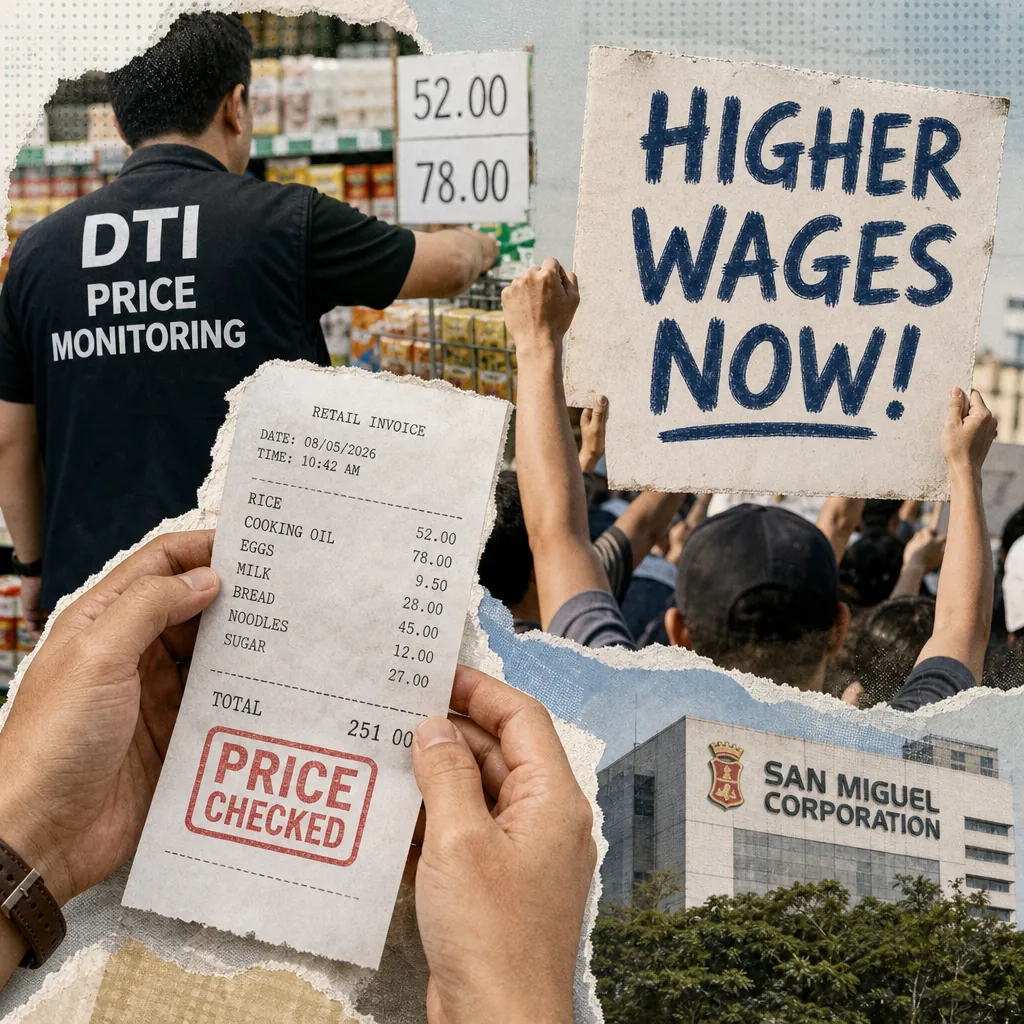
- Combined wealth of the 50 richest falls 8% — The total wealth of the Philippines' 50 richest individuals and families declined to $79 billion from $86 billion, reflecting slower economic growth, elevated inflation, and a weaker peso. Only 14 of the 50 saw their fortunes rise.
- Farm output growth slows to 2.9% in Q2 — The agricultural sector grew at a slower pace in the second quarter compared to the same period last year, though it improved from the first quarter's contraction. The PSA attributed the growth to gains across all subsectors.
- Fuel discount raised to P12 per liter — The government increased the fuel discount for public utility jeepneys and UV Express drivers from P10 to P12 per liter, effective August 15. Transport groups, however, still threatened a three-day strike, saying the aid is insufficient.
- House bill proposes P12,000 yearly subsidy for minimum wage families — Eleven lawmakers filed House Bill 10648, which would provide P1,000 monthly cash aid to minimum wage families outside the 4Ps program, delivered through a digital wallet linked to the national ID system.
- Century Pacific posts 6% income growth despite fuel pressures — The food manufacturer reported higher first-half net income and revenue, but noted that soaring fuel prices squeezed consumers and added to operating costs, prompting cost discipline and measured pricing actions.
- US tariff negotiations target 10% rate — The Philippine government is seeking to reduce the US tariff on Philippine exports from 12.5% to 10%, citing forced labor concerns. Talks with the US Trade Representative are ongoing.
- Food safety outbreaks in the US draw attention — The FDA is investigating multiple foodborne illness outbreaks linked to cyclospora, salmonella, and listeria, affecting products like iceberg lettuce, eggs, and jalapeños. This has implications for food importers and consumers.
How the narratives stack
Dominant — Within the captured set, the Forbes rich list story dominated the business pages, with multiple outlets covering Razon's rise and the decline in combined wealth. The story's prominence reflects its newsworthiness as a measure of the country's economic health and the success of a prominent business figure.
Counter-narrative — The fuel discount increase was met with skepticism and criticism from transport groups, who argued that the P12 per liter discount is not enough amid rising oil prices. This counter-narrative challenges the government's claim that the subsidy provides meaningful relief.
Emerging — The proposed PAMANA Act, which would provide cash subsidies to minimum wage families, represents an emerging policy discussion about expanding social protection beyond the 4Ps program. This could gain traction as a response to inflation and economic hardship.
Suppressed — The slower agricultural growth in Q2 received less attention than the Forbes list, despite its significance for food security and the broader economy. The story's coverage was limited to a few business outlets, possibly because it lacked the drama of a billionaire's rise.
Platform insights
- Facebook — The Forbes rich list story generated significant engagement on Facebook, with users sharing and commenting on the rankings. Posts from news outlets like Inquirer and Philstar drew reactions ranging from admiration for Razon's success to criticism of wealth inequality.
- X (formerly Twitter) — The fuel discount and transport strike threats were hot topics on X, with users debating the adequacy of the subsidy and the government's handling of the transport sector. Hashtags related to the transport strike trended, reflecting public frustration.
- YouTube — The YouTube Works Awards Philippines 2026 highlighted how brands are leveraging the platform for business ROI. Videos about the awards and related campaigns likely drew views from marketers and creators, though specific engagement figures were not provided.
- Reddit — While not explicitly mentioned in the inputs, Reddit's r/AskReddit thread on overhyped foods (included in the article set) suggests that food-related discussions are active on the platform, though this is tangential to the main business conversation.
Key voices and communities
- Business media and analysts — Outlets like BusinessWorld, Philstar, and Inquirer provided detailed coverage of the Forbes list and corporate earnings, offering analysis of the economic factors behind the wealth changes.
- Transport groups — Organizations representing jeepney and UV Express drivers were vocal in demanding higher subsidies and threatening strikes, framing the fuel discount as insufficient.
- Government officials — Acting Transportation Secretary Giovanni Lopez and Executive Secretary Ralph Recto defended the fuel discount increase, while Palace press officer Claire Castro provided updates on US tariff negotiations.
- Consumer advocates and commentators — Columnists and social media users questioned the fairness of subsidies, noting that the middle class often gets left out of government aid programs.
- Corporate executives — CFOs like Chad Manapat of Century Pacific and executives like Mybelle Aragon-GoBio of Robinsons Land shared insights on navigating challenging economic conditions.
Narrative streams
Forbes rich list: Razon's ascent and the shrinking fortunes of the elite
Enrique Razon Jr., chairman of International Container Terminal Services Inc. (ICTSI), topped Forbes' 2026 Philippines 50 Richest list with an estimated net worth of $21.8 billion, up from $11.5 billion last year. This marked the first time Razon claimed the top spot, overtaking the Sy siblings, heirs to the SM Group, whose combined fortune fell to $9.2 billion from $11.8 billion. Forbes attributed Razon's gains to the strong performance of ICTSI's shares, driven by its global port expansion despite geopolitical tensions. The combined wealth of the 50 richest Filipinos declined 8% to $79 billion, reflecting the country's slower economic growth (2.8% in Q1, the slowest since the pandemic), elevated inflation from the Iran conflict, and a weaker peso. Only 14 of the 50 saw their fortunes increase, while 33 declined. This story drew heavy coverage across multiple outlets, with an estimated advertising-equivalent value of over ₱2 million across the captured items, indicating its prominence in the business press.
Agricultural slowdown: A worrying sign for food security
The Philippine Statistics Authority reported that the value of agricultural production grew 2.9% in the second quarter of 2026, down from 6% in the same period last year, though it improved from a 0.3% contraction in the first quarter. The growth was driven by gains across crops, livestock, poultry, and fisheries, but the slowdown suggests that the sector is facing headwinds, possibly due to weather disturbances, rising input costs, and global market conditions. Agriculture Secretary Francisco Tiu Laurel Jr. called the performance "strong" and pointed to government modernization efforts, but the slower growth raises concerns about food prices and rural incomes. This story received substantial coverage in business outlets, with an estimated advertising-equivalent value of over ₱800,000 in the captured set, but it may not have captured the public's attention as much as the Forbes list.
Fuel discount and transport strike: A test of government support
The government raised the fuel discount for public utility jeepneys and UV Express drivers from P10 to P12 per liter, effective August 15, as part of efforts to cushion the impact of rising oil prices. Executive Secretary Ralph Recto said the increase could save drivers up to P1,800 per week. However, transport groups threatened a three-day strike, arguing that the discount is still insufficient. Acting Transportation Secretary Giovanni Lopez acknowledged that fuel discounts alone are not enough and announced that transport groups would be included in the next rollout of cash assistance under the DSWD's Uplift program. This narrative highlights the tension between government aid and the demands of the transport sector, which is struggling with high fuel costs. The coverage of this story was significant, with multiple outlets reporting on the announcement and the reactions, and it drew public debate on social media about the fairness of subsidies.
Corporate earnings: Century Pacific's resilience amid cost pressures
Century Pacific Food Inc. reported a 6% rise in net income to P4.1 billion in the first half of 2026, with revenue up 15% to P45.8 billion. Excluding one-off provisions for earthquake damage, core net income rose 10% and core operating income rose 18%. CFO Chad Manapat noted that soaring fuel prices squeezed consumers and added to operating costs, prompting the company to tighten spending and implement "measured pricing action well below inflation" to keep goods affordable. This earnings report illustrates how companies are navigating a challenging environment of high input costs and weak consumer purchasing power. The story was covered by BusinessWorld and other outlets, with an estimated advertising-equivalent value of over ₱200,000 in the captured set.
US tariff negotiations: Seeking relief for exporters
The Philippine government is negotiating with the US to reduce the 12.5% tariff on Philippine exports, which is linked to forced labor concerns, to at least 10%. Palace press officer Claire Castro said the target is based on information provided to the government, and talks with the US Trade Representative are ongoing. The government has submitted a joint administrative order from the DTI, DOLE, and DOF to Washington. This tariff, if reduced, would provide relief to Philippine exporters, particularly in sectors like agriculture and manufacturing. The story drew moderate coverage, with an estimated advertising-equivalent value of over ₱300,000 in the captured set, and is significant for its potential impact on trade and employment.
Proposed PAMANA Act: Expanding social protection
Eleven lawmakers filed House Bill 10648, the Pambansang Agapay sa Pamilya at Maliliit na Negosyo (PAMANA) Act, which would provide P1,000 monthly or P12,000 yearly subsidy to minimum wage families outside the 4Ps program. The subsidy would be deposited through a digital wallet linked to the Philippine Identification System (PhilSys). The bill defines eligible families as those headed by a minimum wage earner and registered with relevant agencies. This proposal aims to extend government support to families who are not covered by the existing conditional cash transfer program, addressing a gap in social protection. The story was covered by United News, with an estimated advertising-equivalent value of over ₱200,000 in the captured set, and could become a significant policy discussion in the coming months.
Conversation trajectory
- Over the next 1-2 weeks: Expect continued coverage of the Forbes rich list, with reactions from business leaders and economists. The transport strike threat may materialize, leading to further government negotiations and potential disruptions. Watch for updates on the US tariff negotiations, as any progress could boost market sentiment.
- Over the next 1-3 months: The PAMANA Act will likely undergo committee hearings, generating debate on its feasibility and funding. Agricultural output data for the third quarter will be released, providing a clearer picture of the sector's trajectory. Corporate earnings reports for the second quarter will continue to reveal how companies are coping with cost pressures.
- Trigger events: A transport strike would be a major trigger, affecting commuters and drawing widespread attention. A breakthrough or breakdown in US tariff talks would also be significant. Additionally, any major weather disturbance could impact agricultural output and food prices, shaping the narrative around food security.
Response guidance
- For businesses: In this environment of rising costs and cautious consumers, emphasize value and affordability in communications. Highlight cost-management efforts and any measures to keep prices stable. Be transparent about challenges while projecting resilience.
- For government agencies: When announcing subsidies or aid, proactively address concerns about sufficiency and fairness. Use clear, data-backed messaging to explain the rationale and expected impact. Engage with transport groups and other stakeholders to manage expectations and avoid strikes.
- For industry associations: Use the Forbes list and economic data to advocate for policies that support business growth, such as tariff reductions and infrastructure investment. Frame messages around job creation and economic resilience.
- For communicators: Monitor social media sentiment on fuel subsidies and wealth inequality, as these topics can quickly become contentious. Prepare holding statements for potential crises, such as transport strikes or food safety scares. Leverage positive stories like corporate earnings and innovation showcases to balance negative narratives.
See the full picture behind today's signals.
This report draws from Media Meter's MediaWatch, our real-time monitoring engine tracking 2,470+ Philippine sources across print, broadcast, digital, and social. Explore how the platform turns raw coverage into decision-grade intelligence, then see how it's configured for teams like yours — whether you're in PR agencies, corporate comms, government, or marketing.
Want more? Browse our Report Library for sector and crisis intelligence, or request a demo and we'll have your brand set up before the call.
Want this kind of intelligence on your brand?
This brief is built on the same MediaWatch methodology that runs continuously across every brand we monitor. See your competitive landscape, Impact Score, and narrative trajectory in a 30-minute demo.