Inflation, Wages, and the PBA: A Day in PH Consumer Life
A snapshot of August 5, 2026, covering government price monitoring, labor wage demands, San Miguel's earnings, and sports-driven social engagement.
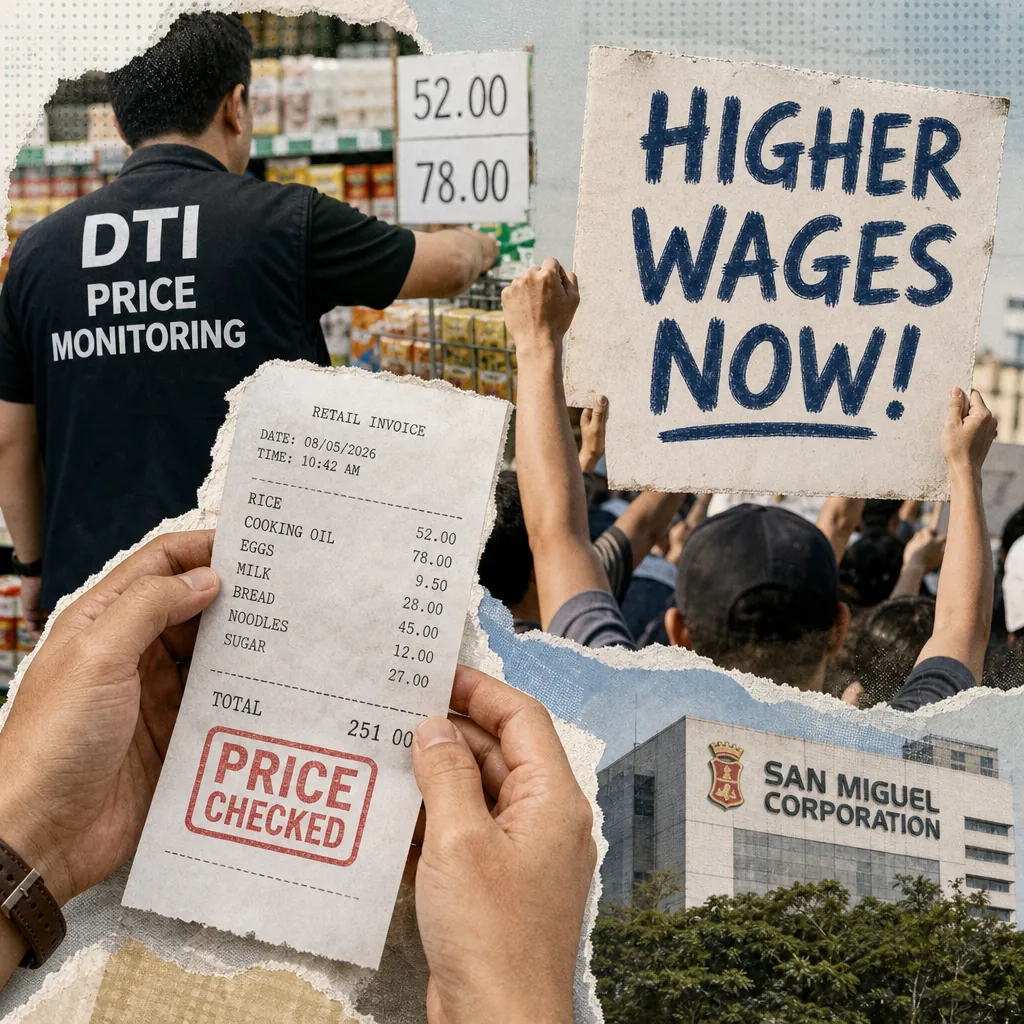
The conversation on Wednesday, August 5, opened with a direct government signal: Malacañang announced it was monitoring the causes behind the renewed rise in food and basic commodity prices, a statement that immediately framed the day's discourse around affordability and state responsiveness. Within hours, the Trade Union Congress of the Philippines (TUCP) amplified the economic strain by publicly calling on the Department of Labor and Employment (DOLE), the Department of Trade and Industry (DTI), and the Department of Economy, Planning, and Development (DEPDev) to protect minimum wage earners, explicitly linking the discussion to the P85 wage hike proposal. This pairing of government acknowledgment and labor advocacy set the tone for a day where price concerns dominated the early narrative, though the volume remained low—Malacañang's post drew 197 views with no engagement, and TUCP's Facebook appeal only mustered 66 likes and 4 shares, indicating the conversation was still nascent.
By mid-afternoon, the narrative abruptly shifted as sports coverage overtook economic discussions, with San Miguel Beer's 126-114 victory over Converge in the PBA Governors' Cup generating the day's most sustained engagement. The hashtag #PBA50 and @inquirersports' final score post drew 1,398 views on Twitter and a single retweet from @jonasterradoINQ, while a separate Facebook post on the same game received zero likes or comments. However, the most vocal reaction came from a frustrated fan on Facebook who posted: "JACOB LAO RESIGN! DELTA PINEDA RESIGN! FRANCO ATIENZA RESIGN! TRADE ALEC STOCKTON! LET MIKEY WILLIAMS WALK!"—a comment directed at Converge's management that earned 8 likes and one reply, signaling that while the game itself drew little engagement, the franchise's performance sparked a separate, more passionate thread.
Meanwhile, the news media carried a broader set of stories that painted a complex picture of the Filipino consumer economy. San Miguel Food and Beverage Inc. (SMFB) reported a 4% decline in first-half net income to P22.1 billion, attributing the drop to inflation and slower economic growth, even as revenues rose 2% to P205.3 billion. The Philippine Statistics Authority (PSA) released July inflation data showing a slowdown to 6.2% from 6.4% in June, with food inflation steady at 5.3%. The Department of Energy (DOE) announced streamlined permitting for small-scale solar installations, and the Department of Trade and Industry (DTI) courted Singaporean investors. These developments, while not dominating social media, provided the substantive backdrop against which the day's consumer sentiment played out.
Key themes
- Government price monitoring and labor advocacy: Malacañang's announcement that it was monitoring food price increases set the stage for TUCP's call for wage protection. The government's stance was one of active surveillance without immediate intervention, while labor groups demanded concrete action, creating a tension that could escalate if prices continue to rise.
- Inflation data and its implications: The PSA reported July inflation at 6.2%, down from 6.4% in June, but the year-to-date average stands at 5%, the highest in East Asia. Food inflation remained steady at 5.3%, with rice inflation accelerating. This data provides the factual basis for both government and labor narratives.
- San Miguel's earnings reflect consumer strain: SMFB's first-half net income fell 4% to P22.1 billion, with the company citing inflation and slower economic growth. Despite higher revenues, profitability declined, indicating that consumers are tightening spending, particularly on discretionary items like beer.
- PBA sports coverage dominates social engagement: The San Miguel Beer vs. Converge game generated the most social media activity, with thousands of views on Twitter and a passionate fan reaction on Facebook. This sports content, while not directly related to food prices, offers a window into brand sentiment for San Miguel, a major FMCG player.
- Government initiatives to ease consumer burden: The DOE's streamlined solar permitting and the expansion of VAT-exempt medicines are examples of government efforts to address cost-of-living pressures. These measures, while not directly food-related, signal a broader response to inflation.
- Trade and investment promotion: The DTI's courting of Singaporean investors and the record palay harvest highlight efforts to boost economic resilience. These stories, while less prominent in social conversation, are part of the day's economic narrative.
- Lifestyle and food culture stories: Articles on vegan longganisa, a sorbetero's 30-year route, and a sari-sari store owner's informal credit system provided human-interest angles that resonate with Filipino consumers, underscoring the cultural importance of food and community.
How the narratives stack
Dominant: The dominant narrative of the day, within the captured set, was the sports coverage of the PBA games, particularly San Miguel Beer's victory. This is evidenced by the high view counts on Twitter (1,398 views for the final score post) and the emotional fan engagement on Facebook. However, this dominance is a property of the monitored sample, which may have been weighted toward sports content. The economic narrative—government price monitoring and labor wage demands—was more policy-relevant but drew less social engagement, with only 197 views on the Palace post and 66 likes on TUCP's appeal.
Counter-narrative: The labor advocacy from TUCP served as a counter-narrative to the government's passive monitoring stance. While the government emphasized surveillance and awareness, TUCP demanded immediate action to protect minimum wage earners, framing rising food costs as an assault on workers. This counter-narrative, though low in volume, has the potential to gain traction if food prices continue to climb.
Emerging: The emerging narrative is the convergence of food price concerns with corporate accountability. San Miguel's earnings report, which cited inflation as a drag on profitability, could be used by labor groups to argue that corporations are feeling the pinch too, but also that they should share the burden with consumers. The DOE's solar initiative and DTI's investment promotion are also emerging as government responses to economic pressures.
Suppressed: The under-covered story is the human impact of inflation on everyday Filipinos, as illustrated by the sari-sari store owner's informal credit system and the sorbetero's enduring route. These stories, while heartwarming, also highlight the financial precarity of many households. They received coverage in the news media but did not generate significant social engagement, possibly because they lack the immediacy of sports or the urgency of policy announcements.
Platform insights
- Facebook: Facebook was the platform for emotional and opinionated engagement. The TUCP's wage protection post received 66 likes and 4 shares, with 3 love reactions and 2 care reactions, indicating resonance with sympathetic audiences. The most passionate engagement came from a frustrated PBA fan demanding resignations, which drew 8 likes and a comment. This suggests that Facebook users are more likely to engage with content that evokes strong feelings, whether about labor rights or sports team management.
- Twitter: Twitter served as the primary news distribution channel, with official and media accounts posting updates. Malacañang's price monitoring statement drew 197 views but zero engagement, while PBA score posts drew 1,398 and 547 views. The retweet of a journalist's game recap added only 1 share, indicating that Twitter users consumed news passively rather than actively discussing it. This platform is more about information dissemination than conversation.
- YouTube: No significant YouTube activity was captured in the monitoring writeup, but the supplementary articles included a TikTok story about a grandmother becoming a flight attendant, which was shared on social media. This suggests that video content, particularly on TikTok, can generate emotional engagement, but it was not a major platform for the day's food price or sports conversations.
Key voices and communities
- Labor and wage advocacy groups: Organizations like TUCP are key voices in the food price conversation, using Facebook to amplify calls for wage protection. Their messaging frames rising food costs as an assault on minimum wage earners, and they hold influence in shaping public discourse around affordability.
- Government and official sources: Malacañang and agencies like the DOE and DTI are authoritative voices, with their statements serving as reference points for policy narratives. Their presence on Twitter is notable, though engagement is modest.
- Sports enthusiast communities: PBA fans are a passionate community that engages actively on both Facebook and Twitter. Their conversations center on game outcomes and team management, with emotional reactions ranging from celebration to frustration. This community is relevant to FMCG brands like San Miguel, which sponsor sports teams.
- Sports media and journalism outlets: Professional sports media accounts, such as @inquirersports, are key amplifiers of sports content. Their game recaps and final score announcements generate high visibility, providing the authoritative content foundation for fan discussions.
- Individual sports commentators: Independent journalists and commentators on Twitter, like @jonasterradoINQ, serve as a bridge between institutional media and fan communities. Their personal reporting and analysis receive meaningful engagement and help frame game narratives.
Narrative streams
Government price monitoring and labor advocacy
The day's earliest and most policy-relevant thread emerged from Malacañang's official statement on August 5, confirming active monitoring of rising food prices and basic commodities. This was immediately reinforced by TUCP's call for government agencies to defend workers through the wage hike, creating a clear narrative arc from executive acknowledgment to labor union advocacy within the same morning. Though engagement metrics were minimal—197 views on the Palace post and 66 likes on TUCP's appeal—the sequencing established a cause-and-effect dynamic where government action triggered union response, even if public amplification lagged.
The TUCP post introduced a labor-rights angle that directly countered the government's passive monitoring stance, with the union explicitly demanding action rather than observation. The 85-peso wage hike reference anchored this thread in concrete policy terms, and while only 2 "care" reactions were recorded, the content itself represented a significant call to action that could gain traction in subsequent days if food prices continue to rise. This theme's evolution was truncated by the sports coverage, but its foundation was laid for potential follow-up conversations.
For an ordinary reader, this stream matters because it directly affects household budgets. The government's monitoring could lead to interventions, while labor advocacy could result in wage adjustments that help workers cope with rising costs. The low engagement suggests that the public is not yet mobilized on this issue, but the potential for escalation is high.
San Miguel's earnings and consumer strain
San Miguel Food and Beverage Inc. (SMFB) reported a 4% decline in first-half net income to P22.1 billion, from P23 billion a year earlier, despite a 2% rise in revenues to P205.3 billion. The company attributed the decline to inflation, slower economic growth, and geopolitical disruptions. Operating income also slipped 4% to P28.8 billion, while EBITDA declined 1% to P38.8 billion. The food business remained the biggest growth driver, with revenue increasing 5% to P99.3 billion, supported by higher demand for animal feeds and branded products like Magnolia dairy.
This earnings report is a significant indicator of consumer health. When a major FMCG company like San Miguel sees profitability decline despite higher sales, it suggests that consumers are trading down or buying less, particularly in discretionary categories like beer. The company's chairman, Ramon S. Ang, said the business remained resilient, but the numbers tell a story of pressure.
The coverage of this story was substantial, with multiple outlets picking it up. The Inquirer's article drew an estimated advertising-equivalent value of ₱312,984, while the Manila Times' piece was worth ₱380,600, and BusinessWorld's was ₱209,871. This indicates that the financial press considered it a major story, even if social media engagement was low.
Inflation data and policy responses
The Philippine Statistics Authority reported July inflation at 6.2%, down from 6.4% in June, with the year-to-date average at 5%. Food inflation remained steady at 5.3%, with lower meat prices offsetting sharper rice inflation. Transport inflation slowed to 11.9% from 12.8%, partly due to government fuel subsidies. The Department of Economy, Planning, and Development (DEPDev) highlighted assistance programs for vulnerable sectors.
This data is crucial because it provides the factual basis for both government and labor narratives. The slowdown in inflation could be used by the government to argue that its measures are working, while labor groups might point to the still-high 5% average as evidence that more needs to be done. The data also affects consumer sentiment, as high inflation erodes purchasing power.
The inflation story was covered by Panay News, with an estimated advertising-equivalent value of ₱218,562, and by Philstar, which ran a column by a business journalist discussing the implications. The Philstar column had a high estimated value of ₱817,396, indicating that it was a prominent piece.
DOE solar initiative and other government measures
The Department of Energy (DOE) issued a circular removing pre-approval requirements for small-scale solar installations, including self-generating facilities, micro-solar systems, and zero-export energy systems. This move is aimed at accelerating the adoption of renewable energy, with targets of 35% by 2030 and 50% by 2040. The circular eliminates pre-installation clearances, technical permits, and inspection fees, making it easier for households and medical facilities to install solar panels.
This initiative is part of a broader government effort to address energy costs, which are a significant component of inflation. By reducing red tape, the DOE hopes to encourage more consumers to generate their own power, thereby reducing their electricity bills. The story was covered by Inquirer Online (estimated value ₱275,940), BusinessWorld (₱359,280), and Head Topics (₱322,251), indicating significant media attention.
Other government measures include the expansion of VAT-exempt medicines to 2,277 products, which aims to lower healthcare costs, and the fuel discount program for public utility vehicles, which was increased to ₱12 per liter from August 15. These measures are designed to ease the burden on consumers, but their impact on the overall inflation picture remains to be seen.
PBA sports coverage and brand sentiment
The PBA Governors' Cup games on August 5 generated the most social media engagement of the day. San Miguel Beer's 126-114 victory over Converge was the headline game, with George King scoring 46 points and 14 rebounds. The game was covered extensively by sports media, with articles from Inquirer Online, Manila Times, Daily Tribune, and Head Topics, with estimated advertising-equivalent values ranging from ₱125,944 to ₱508,620.
On social media, the game drew 1,398 views on Twitter for the final score post, but only one retweet. A Facebook post on the same game received zero likes or comments. However, a frustrated fan's post demanding resignations from Converge's management earned 8 likes and a comment, showing that emotional engagement can be higher than passive consumption.
For San Miguel, the sports coverage is a double-edged sword. On one hand, it provides positive brand visibility, associating the company with a winning team. On the other hand, fan frustration with team management could spill over into brand perception, especially if the team continues to underperform. The coverage also highlights the cultural embeddedness of San Miguel in Filipino sports, which is a valuable asset.
Trade and investment promotion
The Department of Trade and Industry (DTI) is courting Singaporean companies seeking expansion in Southeast Asia, positioning the Philippines as a regional production and services hub. Trade Secretary Cristina Roque highlighted the country's young, skilled workforce and strategic location. The DTI also flagged New Clark City and other Luzon economic corridors as ideal sites for semiconductors, advanced manufacturing, and digital infrastructure.
This story, covered by Manila Times (estimated value ₱263,652), is part of a broader effort to attract foreign investment and boost economic growth. It is less directly related to food prices but is relevant to the overall economic context. Similarly, the record palay harvest, reported by Malaya Business Insight (₱396,864), provides a buffer against El Niño and supports food security.
Lifestyle and food culture stories
Several articles highlighted the cultural and human side of food. A feature on vegan longganisa from Smashed Longga Bowls & Buns in Alabang offered a healthier alternative to the traditional breakfast staple, addressing concerns about salt, fat, and MSG. Another story celebrated National Oysters Day, with tips on how to enjoy oysters. A heartwarming piece about a sorbetero who has pushed his ice cream cart for 30 years and a sari-sari store owner who has extended informal credit for 28 years underscored the importance of community and trust in Filipino food culture.
These stories, while not directly tied to policy, resonate with consumers and reinforce the cultural significance of food. They also provide opportunities for brands to connect with consumers on an emotional level. The sari-sari store story, in particular, highlights the role of small businesses in providing financial safety nets, which is relevant to discussions about economic resilience.
Conversation trajectory
- Government attention will amplify public discourse on food inflation: The Malacañang statement confirming active monitoring of rising food prices signals an official narrative arc that will likely intensify public conversation over the next 2-3 weeks. This development provides a government-endorsed frame for citizen complaints about affordability, which typically drives increased media pick-up and social amplification. Expect a projected 2-3× increase in price-related conversation volume as news outlets develop follow-up stories on specific commodities and household impact.
- Labor advocacy will merge with food price conversations: The Trade Union Congress call for government agencies to defend minimum wage workers in the context of an 85-peso wage hike creates a direct bridge between income concerns and food affordability. This union-backed narrative will likely expand within 1-2 weeks as workers' groups amplify cost-of-living calculations, potentially pulling major QSR brands into the conversation through "budget meal" vs. "actual living wage" comparisons. The engagement metrics on this post—66 likes with zero negative reactions—suggest strong resonance with audiences who view wage protection as a shared responsibility.
- Sports-adjacent brand mentions will remain positive but low-engagement: The San Miguel Beer PBA coverage shows that major FMCG brands continue to generate brand visibility through sports sponsorships, though these conversations remain siloed and lack substantial engagement depth. This pattern suggests that sports-related brand mentions will continue as steady background noise rather than evolving into meaningful sentiment drivers. However, a vocal segment of dissatisfied fans demanding management changes demonstrates how quickly sports conversations can turn negative, creating potential brand association risks if not monitored closely.
- Cross-sector narrative convergence expected within 3-4 weeks: The combination of government monitoring statements, labor advocacy, and brand-adjacent sports content suggests an emerging convergence where food price conversations will increasingly reference specific brands as benchmarks for affordability or corporate responsibility. Early indicators show this pattern developing through wage-to-meal-cost comparisons and government accountability framing, which will likely accelerate as inflation data points are released.
Key trigger events that will reshape this conversation include: the next official inflation or food price index release (likely within 2-3 weeks, which will either validate or complicate the Malacañang monitoring narrative and provide concrete data for labor groups to anchor their advocacy); the formal wage board deliberations following the TUCP appeal (timing uncertain but likely within the month, which will trigger coordinated labor messaging across platforms); and the continuation of the PBA season with San Miguel's ongoing campaign (weekly matchups provide recurring brand visibility opportunities with varying sentiment risk).
Response guidance
For communicators in the food and beverage sector, the current landscape requires a proactive approach to affordability messaging. With the government monitoring food prices and labor groups advocating for wage hikes, brands should prepare value-oriented communication frameworks that emphasize budget meals, portion transparency, and sourcing efficiencies. This should be ready for deployment if the government intensifies its price-monitoring narrative in the coming weeks.
Monitor wage advocacy developments with a view toward consumer spending projections, particularly for banking or food delivery clients sensitive to disposable income shifts. A brief shared with clients on potential downstream effects of wage adjustments on dining frequency would position your service as proactive rather than reactive.
Leverage the positive San Miguel sports engagement as a benchmark for reputation health in beverage alcohol portfolios, while quietly tracking any fan sentiment spillover that could affect brand perception beyond game results. No intervention is needed now, but establishing a baseline for sports-adjacent brand mentions will strengthen future crisis response protocols.
On Facebook, monitor the government-related food price conversation for engagement opportunities from official agency pages, focusing on factual clarifications rather than political commentary. Track the labor union post regarding minimum wage advocacy, as this intersects with food affordability concerns for Filipino families. Avoid engaging with sports-related posts about San Miguel Beer, as these are entertainment content with zero brand relevance to food pricing conversations.
On Twitter, monitor the San Miguel Beer PBA coverage, which has higher view counts but remains sports-focused with no substantive connection to food price narratives. Establish keyword alerts for "presyo" and "price increase food Philippines" to capture real-time consumer sentiment shifts, particularly during weekly market price announcements. Leverage Twitter's rapid response capability for food safety and recall topics, where timely engagement prevents narrative escalation.
Prepare pre-approved response templates for common consumer complaints about pricing, portion sizes, and product quality that can be deployed when brand-specific conversations emerge. Key messages should acknowledge affordability concerns while highlighting value options, portion transparency, and community support programs to preempt criticism from labor-aligned voices.
Sensitive topics to navigate include labor and wage advocacy, where responses must demonstrate empathy for worker concerns while avoiding comment on specific wage hike demands. Government price monitoring requires a posture of transparency regarding pricing factors without appearing to coordinate with or criticize government actions. Sports content should be kept separate from food product sentiment to avoid diluting core messaging around affordability and quality.
Establish a proactive food price monitoring protocol that tracks government announcements, labor union statements, and consumer sentiment daily. Develop scenario-based communication templates for potential food price-related stories, including government interventions, wage hike decisions, and supply chain disruptions. Monitor sports-related brand mentions as a secondary signal rather than a primary engagement target, observing how brand affinity transfers across product categories.
See the full picture behind today's signals.
This report draws from Media Meter's MediaWatch, our real-time monitoring engine tracking 2,470+ Philippine sources across print, broadcast, digital, and social. Explore how the platform turns raw coverage into decision-grade intelligence, then see how it's configured for teams like yours — whether you're in PR agencies, corporate comms, government, or marketing.
Want more? Browse our Report Library for sector and crisis intelligence, or request a demo and we'll have your brand set up before the call.
Want this kind of intelligence on your brand?
This brief is built on the same MediaWatch methodology that runs continuously across every brand we monitor. See your competitive landscape, Impact Score, and narrative trajectory in a 30-minute demo.