Sara Duterte Trial Turns to P319M China Funds
The impeachment trial of Vice President Sara Duterte heard testimony that a firm linked to her husband received P319.33 million from China-based companies, while Philippine stocks fell 1.15 percent after September inflation hit 7.2 percent.
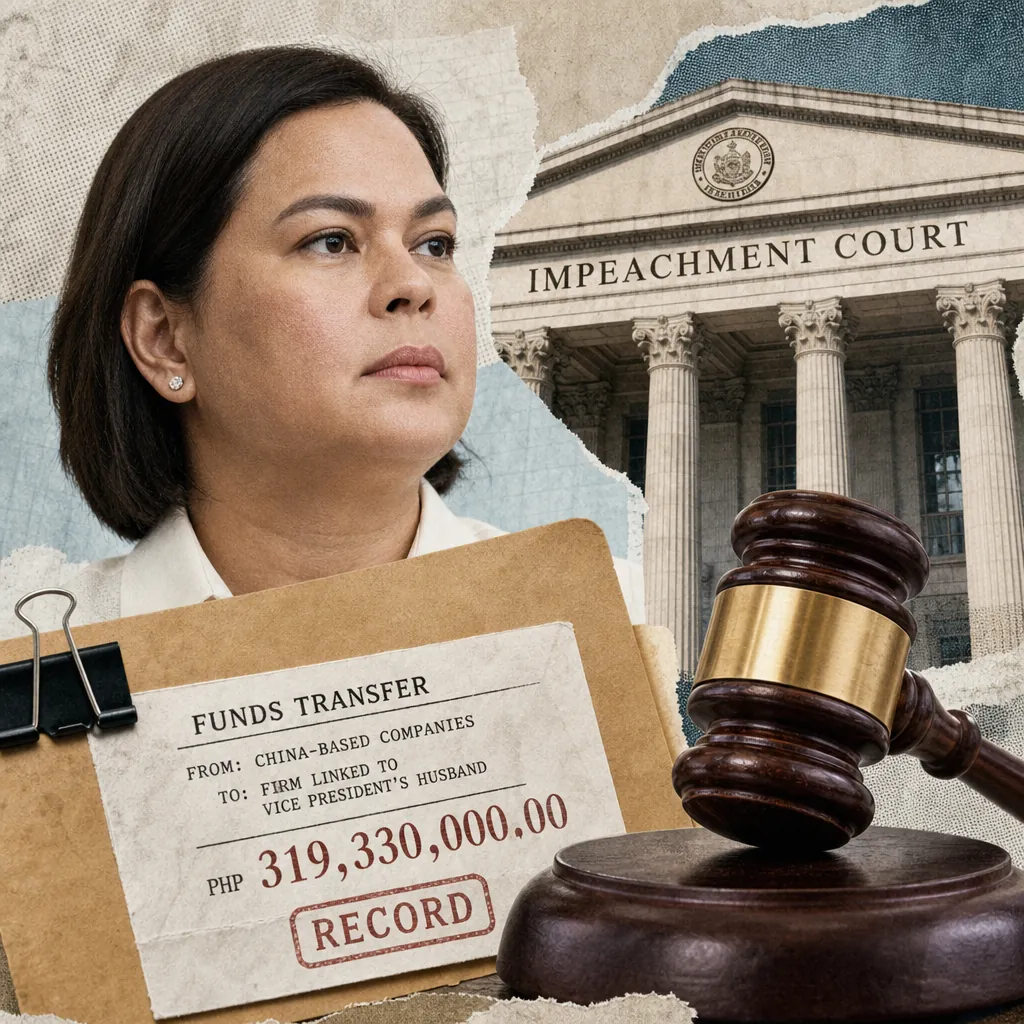
The 34th day of Vice President Sara Duterte's impeachment trial produced the day's most consequential development: Senator-Judge Risa Hontiveros told the court that Chinese state-owned enterprises were among the companies that remitted P319.33 million to Cale88 Foods Corp., a Davao-based banana-chip maker linked to Duterte's husband, lawyer Manases Carpio4655. The disclosure came as Anti-Money Laundering Council (AMLC) Executive Director Ronel Buenaventura returned for a second day of testimony, and as House prosecution spokesperson Lanao del Sur Rep. Zia Alonto Adiong told reporters the issues against the Vice President had moved beyond a failure to declare assets in her Statement of Assets, Liabilities, and Net Worth (SALN) and now amounted to a national security concern1.
Across the items captured for this window, the Duterte trial accounted for the heaviest concentration of coverage. The Manila Times' report on Hontiveros' disclosure carried an estimated advertising-equivalent value of ₱991,636 — the highest single-item figure in the set — followed by the Inquirer's report on the same testimony at ₱579,5364146. The Inquirer's story on the prosecution's defense of its evidence against former President Rodrigo Duterte before the International Criminal Court (ICC) carried ₱400,68020. The trial coverage was not confined to any one outlet: the Philippine Daily Inquirer, Manila Times, Daily Tribune, News Watch Philippines, Head Topics, Bulgar, and INQUIRER PLUS all carried versions of the day's proceedings.
The day's second major thread was economic. The Philippine Statistics Authority reported that headline inflation accelerated to 7.2 percent in September from 6.1 percent in August — the fastest pace since March 2023, when inflation also reached 7.2 percent1865. The benchmark Philippine Stock Exchange Index (PSEi) fell 66.09 points, or 1.15 percent, to close at 5,677.12, its intraday low, with all six sectoral indices declining1831. The peso's continued weakness and the prospect of higher-for-longer interest rates weighed on sentiment, and PLDT Inc. postponed the planned P24.2-billion listing of its data center arm, VITRO Inc., citing rising rates and the worsening economic outlook66.
Key themes
- Chinese state firms linked to P319.33 million in remittances to Duterte-connected company. Senator-Judge Risa Hontiveros told the impeachment court that some of the Chinese firms that sent funds to Cale88 Foods Corp. are state-owned enterprises, and that her office had separately examined the companies identified in AMLC records4655. AMLC Executive Director Ronel Buenaventura testified that the remittances went to Cale88, not directly to Duterte or Carpio, and that it was not established whether the funds came from the Chinese government41.
- AMLC figures and SALN declarations cannot be reconciled, presiding officer says. Senate President Chiz Escudero, presiding over the impeachment court, tested the reported transactions against Duterte's SALNs from her years as a Davao City official through her vice presidency, using hypothetical calculations. For 2022 to 2025, Escudero noted the couple had ₱424.18 million in transactions that could not be matched to declared assets35.
- Prosecution says issues have escalated to a national security concern. House prosecution spokesperson Rep. Zia Alonto Adiong described the AMLC confirmation of China-to-Cale88 transactions as "worrisome" and said the matter had gone beyond a SALN non-declaration1. Think tank Stratbase Institute backed the National Security Council's move to investigate the inflows over potential foreign interference42.
- September inflation hits 7.2 percent, fastest in 3.5 years. The Philippine Statistics Authority reported headline inflation accelerated to 7.2 percent in September from 6.1 percent in August, the fastest since March 20231865. The figure was close to the upper end of the Bangko Sentral ng Pilipinas' forecast range of 6.4 to 7.4 percent31.
- PSEi falls 1.15 percent as inflation and weak peso weigh on sentiment. The benchmark index dropped 66.09 points to 5,677.12, with mining and oil leading losses at 2.38 percent, followed by industrials at 1.81 percent and property at 1.52 percent18. RCBC chief economist Michael Ricafort said the faster-than-expected inflation could lead to more rate hikes from the Bangko Sentral ng Pilipinas and higher borrowing costs for listed companies65.
- PLDT defers VITRO data center listing to 2027. The telco giant suspended its plan to list VITRO Inc. as a real estate investment trust, blaming rising interest rates and the worsening economic health. The IPO would have raised up to P24.2 billion and marked the country's first listing for a data center operator66.
- PEZA investment approvals surge 92 percent to P297.14 billion. The Philippine Economic Zone Authority said its board approved P297.14 billion in investments from January to September, nearly double the P154.70 billion cleared in the same period last year, putting it close to its P300-billion annual target868. The approvals cover 222 projects expected to generate $8.95 billion in exports and create 33,331 direct jobs8.
- Four Filipina CEOs make Fortune's Most Powerful Women in Asia list. Mynt President and CEO Martha Sazon ranked highest among the Philippine contingent at No. 35, followed by Land Bank's Lynette Ortiz at No. 77, Megaworld's Lourdes Gutierrez-Alfonso at No. 87, and UnionBank's Ana Maria Aboitiz-Delgado at No. 98767. Sazon leads the company that runs GCash, which is preparing to list on the Philippine Stock Exchange on Oct. 20 in an IPO expected to raise about P61 billion7.
How the narratives stack
Dominant: The Duterte impeachment trial's focus on Chinese money flows dominated the day's coverage in the captured set. The Manila Times' report on Hontiveros' disclosure carried the highest estimated advertising-equivalent value of any single item at ₱991,636, and the Inquirer's version of the same testimony carried ₱579,5364146. The story advanced on multiple fronts: Hontiveros' claim that Chinese state-owned enterprises were among the remitters, Buenaventura's testimony that the AMLC's tabulations reflected reported transactions and were not conclusive proof of unexplained wealth, and Escudero's examination of the gap between the couple's reported transactions and Duterte's SALNs354146. The prosecution's separate filing before the ICC, defending the volume of its evidence against former President Rodrigo Duterte as necessary to show the drug war was "widespread and systematic," added a second legal front20.
Counter-narrative: The defense maintained that Cale88 has no ties to the Chinese government, and Buenaventura himself testified that the remittances went to Cale88 rather than directly to Duterte or Carpio, and that it was not established whether the funds came from the Chinese government4142. The AMLC executive director also said the tabulations were not conclusive proof of Duterte's cash holdings, wealth, or alleged ill-gotten wealth41. This counter-narrative did not displace the dominant story but qualified its most sweeping claims.
Emerging: The economic story built through the day as inflation data, the stock market decline, and PLDT's deferred listing reinforced one another. The 7.2 percent September inflation print was the fastest in 3.5 years, and analysts linked it directly to the PSEi's 1.15 percent fall and to the prospect of further rate hikes3165. PLDT's decision to postpone the VITRO listing to 2027 — explicitly blaming rising interest rates and the worsening economic health — gave the macro story a concrete corporate consequence66. Separately, PEZA's P297.14 billion in investment approvals, up 92 percent from the same period last year, offered a counterweight: commitments to build factories, offices, and logistics facilities are still rising even as financial markets sour868.
Under-covered: Several stories in the captured set drew little or no follow-on coverage. The Bureau of Customs' destruction of five containers of smuggled cigarettes in Pampanga and disposal of seven vans of forfeited goods in Laguna proceeded amid heightened scrutiny over its handling of contraband, with the Ombudsman criticizing the agency's delayed submission of information for investigations457. Senator Francis Pangilinan's support for hog raisers' call to raise farmgate prices to P210 per kilo and tighten pork import controls received limited attention5. Megawide Construction Corp.'s P12.8-billion in new contracts for two government housing projects under the Expanded Pambansang Pabahay Para sa Pilipino (4PH) Program — covering 8,300 units — was reported by two outlets but did not generate broader discussion915. Rep. Francisco Matugas' renewed call for a National Land Use law, made as state weather forecasters warned of flash floods and landslides, also placed low16.
Platform insights
Facebook: The impeachment trial's most shareable moments circulated on Facebook, where Senator-Judge Risa Hontiveros' disclosure about Chinese state-owned enterprises and the AMLC testimony were clipped and reposted by news pages and political commentators. The platform's role was primarily distributive: the day's legal proceedings were translated into short video clips and quote cards that traveled further than the full reports. The Philippine Commission on Women's call for a rapid referral pathway to address violence against women in politics also circulated on Facebook, where the agency's page carried the announcement43.
X: The platform carried real-time commentary from journalists and legal observers following the impeachment trial, with users posting excerpts from the AMLC testimony and the SALN reconciliation figures as they emerged. The 7.2 percent inflation print and the PSEi's 1.15 percent decline also generated discussion among market watchers, who linked the two in short threads. The platform's speed made it the first place many users encountered the day's figures, though the character limit meant context was often thin.
Reddit: Discussion on Philippine subreddits focused on the mechanics of the impeachment process and the AMLC's role, with users asking how the council's records are compiled and what they can and cannot prove. The distinction between reported transactions and conclusive proof of wealth — which Buenaventura emphasized in his testimony — was a recurring point of clarification41. The stock market decline and PLDT's deferred listing also drew threads from users tracking their own investments.
YouTube: The day's trial proceedings and press briefings were uploaded in full and in clip form, with the AMLC testimony and the prosecution's press briefing drawing the most views. The platform served as an archive for users who wanted to watch the proceedings rather than read summaries, and the longer format allowed the full context of Escudero's hypothetical calculations to be seen35.
Key voices and communities
Senator-judges and the impeachment court. Senator-Judge Risa Hontiveros drove the day's most significant disclosure, telling the court that Chinese state-owned enterprises were among the companies that remitted P319.33 million to Cale88 Foods Corp.46. Senate President Chiz Escudero, presiding over the court, conducted the SALN reconciliation examination, testing the AMLC's figures against Duterte's declared assets35. Their framing centered on the source and scale of the funds and the gap between reported transactions and declared wealth.
The Anti-Money Laundering Council. Executive Director Ronel Buenaventura testified for a second day, confirming the P319.33 million in remittances to Cale88 while cautioning that the AMLC's tabulations reflected reported transactions and were not conclusive proof of Duterte's cash holdings, wealth, or alleged ill-gotten wealth41. His testimony set the evidentiary boundaries of the day's disclosures.
The House prosecution. Spokesperson Rep. Zia Alonto Adiong told reporters the issues against the Vice President had escalated to a national security concern, describing the AMLC confirmation of China-to-Cale88 transactions as "worrisome"1. The prosecution's framing moved the story from a financial disclosure matter to a question of foreign interference.
Think tanks and civil society. Stratbase Institute President Victor Andres "Dindo" Manhit backed the National Security Council's investigation into the Chinese inflows, framing the issue as potential foreign interference42. The Philippine Commission on Women, meanwhile, called for a rapid referral pathway to address violence against women in politics during a House committee hearing on two bills seeking to define and penalize the offense43.
Market analysts and economic commentators. RCBC chief economist Michael Ricafort linked the PSEi's decline to the faster-than-expected inflation and the prospect of further rate hikes65. Ron Acoba, chief investment strategist at Trading Edge, said persistent high long-term yields suggested markets remained concerned about inflation, fiscal pressures, and the prospect that interest rates could stay elevated longer31. Their commentary translated the day's data into expectations for borrowing costs and corporate decisions.
Narrative streams
Chinese state firms sent P319.33 million to firm linked to Duterte's husband
Senator-Judge Risa Hontiveros told the impeachment court on Tuesday that large Chinese state-owned enterprises were among the companies that remitted P319.33 million to Cale88 Foods Corp., a Davao-based manufacturer and exporter of banana chips4655. Hontiveros said her office had separately examined the companies identified in AMLC records and found that some of the firms that remitted funds were state-owned46. The disclosure came during the 34th day of the trial, as the court examined the source of funds flowing through the company and Duterte's alleged unexplained wealth55.
AMLC Executive Director Ronel Buenaventura, testifying for a second day, confirmed the remittances went to Cale88 but said he could not answer whether the agency was examining the Chinese companies because the documents submitted to the Senate impeachment court were limited to records covered by its subpoena, including AMLC summary reports, financial investigation reports, and confidential information-sharing documents46. He also testified that the remittances went to Cale88, not directly to Duterte or Carpio, and that it was not established whether the funds came from the Chinese government41. Carpio was previously identified as an incorporator, stockholder, and board member of Cale8841.
The read for the sector: the testimony shifts the impeachment case from a question of asset disclosure to a question of foreign money flows, and it puts the National Security Council and the AMLC in the position of having to determine whether the funds came from private Chinese firms or from the Chinese state. For the defense, the distinction matters: the defense counsel maintained that Cale88 has no ties to the Chinese government42. For the prosecution, the scale of the remittances — P319.33 million — and the state-owned status of some remitters are the point46.
AMLC figures and SALN declarations cannot be reconciled
Senate President Chiz Escudero, presiding over the impeachment court, tested the AMLC's reported transactions against Duterte's SALNs from her years as a Davao City official through her vice presidency, using several hypothetical calculations to see how the figures could be reconciled35. For 2022 to 2025, Escudero noted the couple had ₱424.18 million in transactions that could not be matched to declared assets35. The examination followed Buenaventura's second day of testimony, during which the AMLC executive director said the tabulations reflected reported transactions and were not conclusive proof of Duterte's cash holdings, wealth, or alleged ill-gotten wealth41.
The read for the sector: the SALN is a public disclosure document that requires government officials to declare their assets, liabilities, and net worth annually. The gap between reported transactions and declared assets is the prosecution's central evidentiary thread, but the AMLC's caveat — that its records show reported transactions, not proven wealth — sets the boundary of what the figures can establish. For the impeachment court, the question is whether the gap is evidence of unexplained wealth or an artifact of how transactions are reported and compiled.
Prosecution says issues have escalated to a national security concern
House prosecution spokesperson Rep. Zia Alonto Adiong told reporters after Tuesday's trial that the issues against Vice President Duterte had gone beyond a mere non-declaration in her SALN and had escalated to a national security concern1. He described the AMLC confirmation of financial transactions from accounts in China to Cale88 Foods Corporation — a company owned by Duterte's husband, Manases Carpio — as "worrisome"1. Hontiveros had earlier said the Chinese companies that sent funds had links to state-owned corporations and the Chinese Communist Party1.
Stratbase Institute President Victor Andres "Dindo" Manhit backed the National Security Council's move to look into the allegations, framing the issue as potential foreign interference42. The defense counsel maintained that Cale88 has no ties to the Chinese government42.
The read for the sector: the national security framing raises the stakes of the impeachment case beyond the question of whether Duterte should be removed from office. If the funds are found to have come from Chinese state-linked entities, the case becomes a question of foreign influence over a Philippine official. For the National Security Council, the investigation would require determining the ownership and control of the Chinese remitters — a task that AMLC records alone may not resolve, as Buenaventura's testimony indicated4146.
September inflation hits 7.2 percent, fastest in 3.5 years
The Philippine Statistics Authority reported that headline inflation accelerated to 7.2 percent in September from 6.1 percent in August, the fastest pace since March 2023, when inflation also reached 7.2 percent1865. The figure was close to the upper end of the Bangko Sentral ng Pilipinas' forecast range of 6.4 to 7.4 percent31. The Bangko Sentral ng Pilipinas is the country's central bank, responsible for monetary policy and price stability; its forecast range is the band within which it expects inflation to fall, and a reading near the top of that band signals that price pressures are stronger than the bank had anticipated.
The PSEi fell 66.09 points, or 1.15 percent, to close at 5,677.12, its intraday low, with all six sectoral indices declining18. Mining and oil led the losses at 2.38 percent, followed by industrials at 1.81 percent and property at 1.52 percent18. RCBC chief economist Michael Ricafort said the faster-than-expected inflation could lead to more rate hikes from the Bangko Sentral ng Pilipinas to better manage inflation and inflation expectations, as well as to higher borrowing costs for some listed companies65. Ron Acoba of Trading Edge said persistent high long-term yields suggested markets remained concerned about inflation, fiscal pressures, and the prospect that interest rates could stay elevated longer31.
The read for the sector: for households, a 7.2 percent inflation rate means the cost of goods and services is rising faster than at any point in 3.5 years, eroding purchasing power. For businesses, the prospect of further rate hikes raises the cost of borrowing and makes long-term investment decisions harder. PLDT's decision to postpone the VITRO listing to 2027 — explicitly blaming rising interest rates and the worsening economic health — is the clearest corporate consequence of the day's data66. The VITRO IPO would have raised up to P24.2 billion and marked the country's first listing for a data center operator66.
PEZA investment approvals surge 92 percent to P297.14 billion
The Philippine Economic Zone Authority said its board approved P297.14 billion in investments from January to September, nearly double the P154.70 billion cleared in the same period last year, putting it close to its P300-billion annual target868. The Philippine Economic Zone Authority is a government agency that manages special economic zones — designated areas where businesses receive tax incentives and other benefits to encourage investment, manufacturing, and exports. The approvals cover 222 new and expansion projects, which if realized are expected to generate $8.95 billion in exports and create 33,331 direct jobs8. Thirty-nine big-ticket projects worth a combined P271.33 billion comprise the bulk8.
Manufacturing accounted for 39 of the 222 projects, followed by ecozone development at 34, information technology-business process management at 34, facilities at 23, logistics at 18, domestic market at 17, tourism at 4, and utilities at 38. One hundred eighty-five are in Luzon, 25 in the Visayas, and 12 in Mindanao8. The top foreign investment sources are Taiwan, the Netherlands, South Korea, Singapore, and Indonesia8.
The read for the sector: the surge in investment pledges is a forward-looking indicator — the projects are commitments, not yet built factories or hired workers. If realized, they would add export capacity and jobs, but the gap between approval and operation is where the risk sits. The diversity of foreign sources — Taiwan, the Netherlands, South Korea, Singapore, and Indonesia — suggests the Philippines is drawing investment from a broader set of economies than in previous years8.
Four Filipina CEOs make Fortune's Most Powerful Women in Asia list
Four Filipino women executives were named among Fortune's 100 Most Powerful Women in Asia for 2026, with Mynt President and CEO Martha Sazon ranking highest among the Philippine contingent at No. 35, up two spots from No. 37 last year767. Land Bank of the Philippines President and CEO Lynette Ortiz ranked 77th, followed by Megaworld President and CEO Lourdes T. Gutierrez-Alfonso at 87th and UnionBank President and CEO Ana Maria Aboitiz Delgado at 98th7.
Sazon leads the company that runs GCash, the country's largest fintech platform, which is preparing to list on the Philippine Stock Exchange on Oct. 20 through an initial public offering expected to raise about P61 billion7. The offering is on track to become the country's largest IPO, with cornerstone commitments from global investors including BlackRock, T. Rowe Price, and the International Finance Corp.7. Fortune highlighted GCash's roughly 41.5 million monthly users48. For Ortiz, the magazine cited Landbank's P44-billion net income in 2025 and P32.6-billion dividend declaration this year48. Gutierrez-Alfonso's profile traced her career from joining Megaworld in 1990 to taking its top post in June 202448. Delgado became UnionBank chief in January 202548.
The read for the sector: the recognition comes as GCash prepares for its stock market debut, which would make it the country's largest listed company by IPO size and give the platform a new set of public-market investors to answer to. For the other three executives, the list placement is a signal of the scale of the institutions they run — Land Bank is a state-owned bank, Megaworld is a major property developer, and UnionBank is one of the country's largest commercial banks. The four represent financial technology, government banking, real estate, and commercial banking7.
Megawide secures P12.8 billion in government housing contracts
Megawide Construction Corp. secured P12.8 billion worth of new contracts in September for two housing developments under the government's Expanded Pambansang Pabahay Para sa Pilipino (4PH) Program, bringing its 4PH portfolio to nearly 20,000 units915. The 4PH program is a government initiative to build affordable housing units for Filipino families, with the government providing subsidies and financing to make units affordable to low- and middle-income buyers. The new contracts cover the P6.9-billion 4PH Nocal Residences in North Caloocan, which will have 3,800 units, and the P5.9-billion 4PH Sumi Residences in Imus, Cavite, with 4,500 units915. Both developments are set to begin construction before the end of the year and aim to complete by December 202815.
Megawide Chairman and CEO Edgar Saavedra said the company's long-term growth plan includes building 100,000 4PH housing units over the next five to seven years, with contract award, topping-off, and turnover of units as the three critical milestones9. The additions bring Megawide's total order book to P48 billion as of end-June, moving toward its P60-billion year-end target15.
The read for the sector: the contracts give Megawide a multi-year pipeline of government-backed construction work, which is less exposed to the private residential market's cycles. For the government, the pace of construction is the test of whether the 4PH program can deliver units at the scale promised. The program's success depends on financing — the government's ability to subsidize units and buyers' ability to pay — and on developers' capacity to build at the promised pace.
Bureau of Customs steps up anti-smuggling drive amid scrutiny
The Bureau of Customs destroyed five containers of smuggled cigarettes in Pampanga and disposed of seven more vans of forfeited goods in Laguna, in operations involving the Philippine Coast Guard and the National Tobacco Administration4. The Bureau of Customs is the government agency responsible for collecting import duties and preventing smuggling; the National Tobacco Administration regulates the tobacco industry. The five containers of cigarettes were destroyed at a disposal facility in Porac, Pampanga4. The Bureau of Customs did not release an official valuation of the shipment, although similar seizures have been estimated at tens of millions of pesos4.
Ombudsman Jesus Crispin "Boying" Remulla criticized the Bureau of Customs for what he described as a lack of cooperation and delays in providing information needed for investigations and the filing of cases against smugglers57. He said delayed data submission and incomplete documentation could lead to cases being dismissed, and that the Ombudsman had met with the Bureau of Customs and the Department of Justice to address the problem57. Several Bureau of Customs personnel were recently implicated in separate operations in Bulacan involving frozen chicken meat and smuggled cigarettes57. Senator JV Ejercito had earlier called on Customs Commissioner Ariel Nepomuceno to intensify the cleanup of the agency, particularly the Customs Intelligence and Investigation Service57.
The read for the sector: the destruction of seized goods is the visible end of the enforcement chain, but the Ombudsman's criticism points to a bottleneck earlier in the process — the documentation and information-sharing that determines whether cases can be filed and won. For the Bureau of Customs, the challenge is not only seizing contraband but building cases that survive legal scrutiny. The involvement of Bureau of Customs personnel in the Bulacan operations adds an internal integrity dimension to the agency's anti-smuggling campaign57.
Senator Pangilinan backs higher hog farmgate prices
Senator Francis Pangilinan expressed support for hog raisers' call for higher farmgate prices and tighter controls on pork imports5. A group of local hog raisers urged President Ferdinand Marcos Jr. and the Department of Agriculture to raise the farmgate price of liveweight hogs to P210 per kilo and increase tariffs on imported pork5. The farmgate price is the price paid to farmers at the farm, before transport, processing, and retail markups. Pangilinan, who chairs the Senate Committee on Agriculture, Food, and Agrarian Reform, said the government should protect local producers from unsustainable prices while keeping pork affordable for consumers5.
"We fully support the call of our hog raisers to raise the farmgate price. It is unfair that they spend so much to raise pigs but receive such a low selling price," Pangilinan said in a statement5. "If hog raisers operate at a loss, they will eventually stop. If piggeries close and local production declines, imports will increase further and pork products will become even more expensive. That is why the fight for a fair farmgate price"5.
The read for the sector: the hog industry's call for higher farmgate prices and import controls sets up a tension between producers and consumers. Higher farmgate prices would help hog raisers recover costs, but they could also raise retail pork prices at a time when inflation is already at 7.2 percent18. The government's decision on tariffs and price supports will determine which side bears the adjustment.
Lawmaker renews call for National Land Use law as floods threaten
Surigao del Norte 1st District Rep. Francisco "Lalo" Matugas renewed his call for a strengthened National Land Use law, pointing to recurring threats from floods and landslides as evidence of the need for a comprehensive policy that takes disaster risks into account in deciding where communities and major developments should be located16. Matugas, chairman of the House Special Committee on Land Use, made the call as state weather forecasters warned of possible flash floods and landslides due to heavy rains affecting parts of the Visayas and Mindanao16.
"Every time communities are threatened by floods or landslides, we are reminded that land use is also a matter of public safety," Matugas said in a statement16. "We cannot prevent typhoons and heavy rains, but we can make better decisions about where we build homes, roads, schools, businesses and other critical infrastructure"16. The proposed National Land Use Act would establish a legal framework for land use planning, which currently is governed by a patchwork of local ordinances and national laws without a single coordinating policy.
The read for the sector: the absence of a National Land Use law means decisions about where to build are made without a consistent national framework for assessing disaster risk. For communities in flood- and landslide-prone areas, the consequence is that development can proceed in hazardous locations. For developers and local governments, a national law would add a layer of planning requirements but could also reduce the uncertainty that comes from inconsistent local rules.
Other developments in the captured set
President Ferdinand Marcos Jr. is undertaking a five-day working visit to Singapore from Oct. 7 to 11, upon the invitation of Prime Minister Lawrence Wong, to discuss expanding bilateral ties, promote the Philippines to investors, and align ASEAN priorities60. The visit includes watching the Formula One Singapore Grand Prix, though Malacañang stopped short of confirming whether Marcos would attend the race21. Foreign Affairs Assistant Secretary Analyn Ratonel said the visit comes ahead of the turnover of the ASEAN chairship to Singapore27.
Global Electric Transport (GET) aims to triple its electric bus fleet by year-end, deploying units on public routes and corporate shuttles40. GET operates the Community Organized Managed Electric Transport (Comet), a China-made electric minibus used for its public "Love Bus" service and shuttle operations for multinational companies40. About 110 Comet buses currently ply Philippine roads, and the company has ordered 100 units for delivery in early November40.
KABAN Boracay is expanding its food and beverage portfolio ahead of its grand launch on Oct. 11, bringing Korean restaurant Chung Dam and Japanese dining brand Umi Matsu to its Station 0 complex58. Golden TW Realty & Development Corp., developer of KABAN, signed the agreement with KABAN president and CEO Kevin Wong and RVD president and CEO Jangsik Yun58.
Xiaomi Philippines will bring back its Xiaomi POP Run on Oct. 24, with runners competing in 5K and 10K categories at Parqal in Aseana City51. The fourth edition of the run, organized with RunRio, will feature the REDMI Note 17 Series51.
Puregold Price Club's Hakot Relay 2026 Southern Luzon Leg drew more than 4,000 runners in Imus, Cavite, who carried groceries they won along the route to the finish line53.
Conversation trajectory
The impeachment trial's next sessions (observation window: the coming week). The AMLC's testimony has concluded, but the prosecution's case continues. The next scheduled trial days will determine whether the court takes up the Chinese state-owned enterprise question directly or whether it remains a matter for the National Security Council's separate investigation4246. Watch for whether the defense presents its own witnesses on the Cale88 transactions and whether the AMLC is asked to produce additional records on the Chinese remitters.
Inflation and monetary policy (observation window: the next Bangko Sentral ng Pilipinas policy meeting). The 7.2 percent September inflation print was close to the upper end of the central bank's forecast range31. RCBC's Michael Ricafort said the figure could lead to more rate hikes65. The next policy meeting will show whether the central bank acts on that expectation. Watch for the October inflation print, due in early November, and for any signal from the central bank on its rate path.
PLDT's VITRO listing (observation window: 2027). PLDT postponed the P24.2-billion VITRO IPO to 2027, citing rising interest rates and the worsening economic health66. The deferral removes what would have been the country's first data center listing from the 2026 calendar. Watch for whether other companies follow PLDT in deferring listings, and for whether the economic conditions PLDT cited improve enough to revive the plan.
GCash's stock market debut (observation window: Oct. 20). Mynt's IPO is scheduled for Oct. 20 and aims to raise about P61 billion7. The listing would be the country's largest IPO and would give GCash a new set of public-market investors. Watch for the final offer price and for whether the broader market decline affects demand.
PEZA's investment target (observation window: end of 2026). PEZA has approved P297.14 billion in investments through September, close to its P300-billion target8. The remaining months will determine whether it exceeds the target. Watch for the fourth-quarter approvals and for whether the projects approved earlier in the year move toward construction.
Trigger events. The next impeachment trial session; the Bangko Sentral ng Pilipinas policy meeting; the October inflation release; the GCash IPO on Oct. 20; the National Security Council's investigation into the Chinese inflows; and the Ombudsman's follow-up on the Bureau of Customs' documentation delays57.
Response guidance
On the impeachment trial coverage: Avoid treating the AMLC's reported transactions as proven wealth. Buenaventura's testimony was explicit that the tabulations reflected reported transactions and were not conclusive proof of Duterte's cash holdings, wealth, or alleged ill-gotten wealth41. Communicators should distinguish between what the AMLC confirmed — the remittances to Cale88 — and what remains unestablished — whether the funds came from the Chinese government41. The national security framing is the prosecution's characterization, not a finding1.
On the Chinese state-owned enterprise question: The distinction between private Chinese firms and state-owned enterprises is the crux of the foreign interference question46. Hontiveros said her office separately examined the companies and found some were state-owned; Buenaventura said the AMLC could not answer whether it was examining the Chinese companies because its submitted documents were limited to records covered by the Senate subpoena46. Communicators should be precise about who has established what.
On inflation and interest rates: The 7.2 percent September inflation rate is the fastest in 3.5 years65. For businesses, the relevant question is whether the central bank raises rates further and what that does to borrowing costs. PLDT's deferred listing is the clearest example of a corporate decision driven by rate expectations66. Communicators should frame inflation data in terms of what it means for costs, not just the headline number.
On the hog industry: The call for a P210-per-kilo farmgate price and higher pork tariffs sets up a producer-versus-consumer tension5. Pangilinan's argument is that if hog raisers operate at a loss, local production declines and imports increase, making pork more expensive in the long run5. Communicators should present both sides: the cost pressures on hog raisers and the inflation pressures on consumers.
On the Bureau of Customs: The Ombudsman's criticism of delayed information-sharing is a process issue, not a seizure issue57. The agency's destruction of seized goods is visible, but the documentation bottleneck determines whether cases can be filed and won57. Communicators should focus on the enforcement chain from seizure to case filing, not just the seizure itself.
On the National Land Use law: The absence of a national framework means land use decisions are made without consistent disaster-risk criteria16. Matugas' call is for a law that would require disaster risk to be considered in deciding where communities and infrastructure are located16. Communicators should connect the policy question to the concrete risks — floods and landslides — that prompted the call16.
On the Fortune list and GCash IPO: The recognition of four Filipina CEOs comes as GCash prepares for its Oct. 20 listing7. Communicators should treat the list placement and the IPO as separate stories: the list is a recognition of individual executives, while the IPO is a capital-raising event that will test public-market demand for the country's largest fintech platform7.
On the PEZA investment surge: The P297.14 billion in approved investments is a forward-looking figure — commitments, not yet built factories or hired workers8. Communicators should be clear about the gap between approval and operation, and about the sectors and locations where the investments are concentrated8.
See the full picture behind today's signals.
This report draws from Media Meter's MediaWatch, our real-time monitoring engine tracking 2,470+ Philippine sources across print, broadcast, digital, and social. Explore how the platform turns raw coverage into decision-grade intelligence, then see how it's configured for teams like yours — whether you're in PR agencies, corporate comms, government, or marketing.
Want more? Browse our Report Library for sector and crisis intelligence, or request a demo and we'll have your brand set up before the call.
Want this kind of intelligence on your brand?
This brief is built on the same MediaWatch methodology that runs continuously across every brand we monitor. See your competitive landscape, Impact Score, and narrative trajectory in a 30-minute demo.