Senate Delays 2027 Budget Report to Nov 23 for Tighter Audit
The Senate Finance Committee pushed its 2027 budget sponsorship to November 23 to audit thousands of infrastructure insertions, while the Ombudsman announced intensified lifestyle checks on revenue and customs officials over unreceipted collections from businesses.
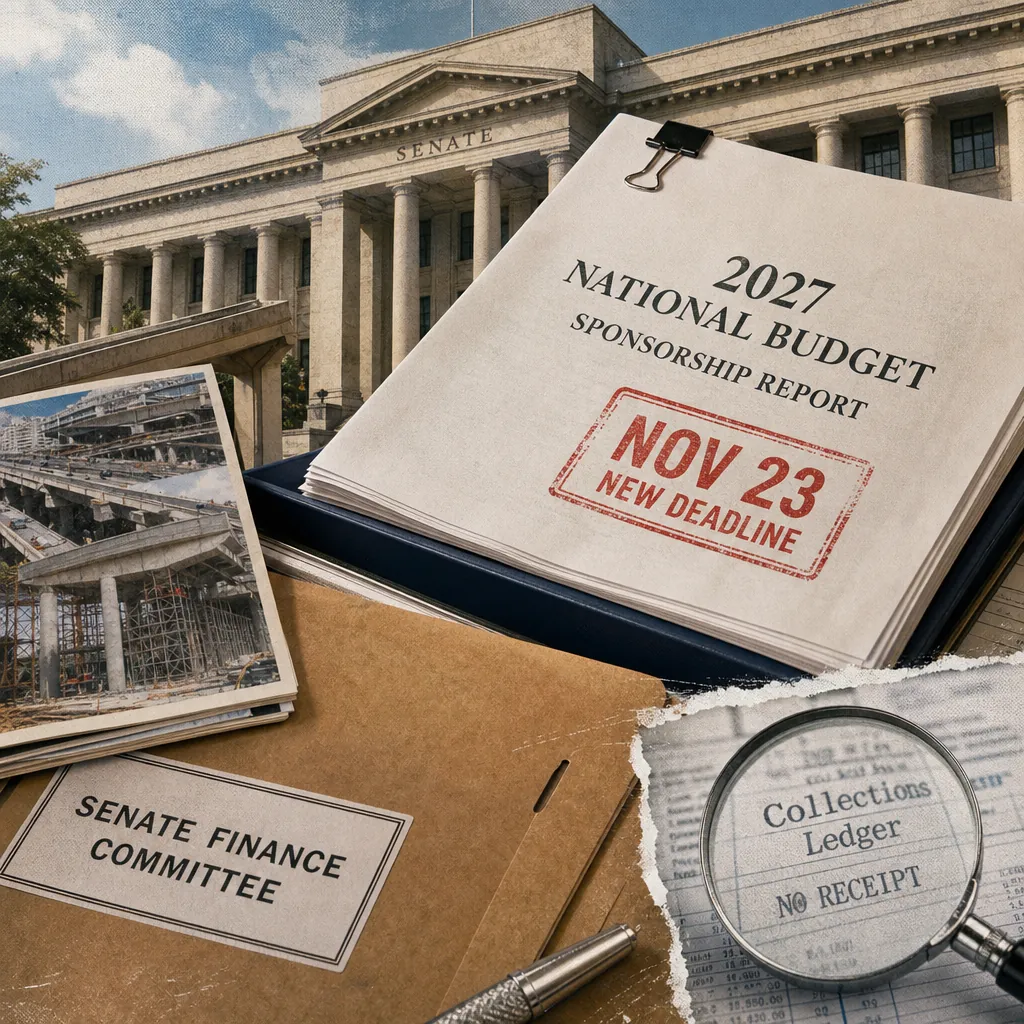
Senate Finance Committee chair JV Ejercito has moved the sponsorship of the 2027 national budget committee report from November 11 to November 23, buying his office twelve more days to go through 6,271 infrastructure projects inserted into the House-transmitted spending bill.1823 The delay is the day's most consequential development in the items reviewed here: it sets the clock for whether the Philippines enters 2027 on a new budget or on a reenacted one, and it puts thousands of locally inserted public works projects under line-by-line scrutiny before any of them is funded.
Ejercito described the work in a DZMM radio interview on Friday. "We are going line by line through every entry, every project. It is really difficult because you have to inspect and scrutinize each one," he said.18 Under the stricter standards his panel has adopted, each project must now carry a program of works, a certificate of implementability, geo-tagged coordinates, and approval from the regional or provincial development council. His office has hired eight additional staff to finish the verification.23 Senate President Sherwin Gatchalian, speaking to radio dwIZ on Saturday, said plenary debates will begin November 23 and the Senate aims to pass its version of the General Appropriations Bill by December 17, after five to eight days of floor debates. He said the chamber wants to avoid a repeat of last year, when the 2026 budget was ratified only on December 29.2852
The same day, Ombudsman Jesus Crispin "Boying" Remulla told a town hall dialogue with the Philippine Chamber of Commerce and Industry that his office will intensify lifestyle checks on officials of the Bureau of Internal Revenue and the Bureau of Customs, following reports that some collectors take more from businesses than the law allows and issue no receipt for the excess.1 "Let us make this clear, there is no legitimate payment to the government that has no receipt. Every peso paid to the government should have a rec—" Remulla said, according to the Inquirer's account.1 The two agencies collect the taxes and duties that fund roads, schools, and other public works, which is why the Ombudsman framed the checks around them.
Both stories sit inside a wider run of coverage in this set about how public money is raised, spent, and accounted for. A Senate committee chaired by Francis "Chiz" Escudero reported that it had acted on all 67 bills and resolutions referred to it since September last year, a zero-backlog record it attributed to scheduling discipline.49 The Office of the Ombudsman also figured in two local stories: a mayor in Rosario, Cavite was preventively suspended over alleged casino gambling, and a mayor in Luisiana, Laguna faced a dismissal order, with supporters of both holding prayer rallies.3026 A Social Weather Stations survey put the Marcos administration's net satisfaction rating at -4, its second-lowest on record.40 And an editorial in The Philippine Star asked what counts as a "modest" lifestyle under the 1989 Code of Conduct and Ethical Standards for Public Officials and Employees, known as Republic Act 6713, as the impeachment trial of Vice President Sara Duterte examined her husband's expenditures.38
Key themes
- Senate budget report moved to November 23 for a line-by-line audit of 6,271 projects. The Finance Committee delayed its sponsorship by twelve days to verify documentation on infrastructure insertions in the House bill, with plenary debates to follow immediately.1823
- Every project must now carry a program of works, a certificate of implementability, geo-tagged coordinates, and council approval. The new vetting standard applies to both House insertions and agency requests, and Ejercito's office hired eight additional staff to process them.23
- The Senate targets December 17 for its version of the 2027 budget. Senate President Gatchalian said five to eight days of plenary debates will begin November 23, with senators working through the December 2 Pasay Day holiday to stay on schedule.2852
- The Ombudsman will intensify lifestyle checks on BIR and BOC officials. Remulla said his office has received reports of collectors taking more than the law allows from businesses without issuing receipts, and he stressed that no legitimate government payment lacks one.1
- The Marcos administration's net satisfaction rating fell to -4 in the September SWS survey. That is down from +1 in the second quarter and the second-lowest reading for this administration after -13 in March 2026, with the steepest decline in Metro Manila.40
- Two local executives faced Ombudsman actions, and their supporters rallied. The mayor of Rosario, Cavite was preventively suspended over alleged casino gambling, and the mayor of Luisiana, Laguna faced a dismissal order; residents held prayer rallies for both.3026
- A Senate housing committee reported zero backlog on 67 measures. Senator Escudero's Committee on Urban Planning, Housing and Resettlement said it had acted on every bill and resolution referred to it since September last year, including proposals on solar home systems for socialized housing beneficiaries.49
- An editorial pressed for a legal definition of "modest lives" under RA 6713. The Philippine Star argued the phrase needs a working definition tied to legitimate income as the Duterte impeachment trial examines spending by the Vice President's husband.38
How the narratives stack
Dominant. The budget timetable and the Ombudsman's lifestyle checks carried the most weight in this set, and they are connected: both concern whether public money is documented and accounted for. The budget story ran in at least four separate items across the Inquirer, The Manila Times, One News, and Philstar, each with a slightly different emphasis — the 6,271 figure and the November 20 report target in the Inquirer, the November 23 sponsorship and the new documentary requirements in The Manila Times, the December 17 ratification target in One News and Philstar.18232852 The Ombudsman story ran in a single Inquirer item but carried the day's most quotable line and a direct address to the business community.1 Within the captured set, the budget story is dominant by item count; the Ombudsman story is dominant by consequence for the agencies that collect most government revenue.
Counter-narrative. The SWS survey offers a different reading of the same government: whatever the Senate and Ombudsman do about documentation, public satisfaction with the administration has slipped to -4, with 42 percent of 1,599 adult respondents dissatisfied against 38 percent satisfied and 18 percent neutral.40 The survey was conducted September 21 to 27, before the budget hearings and the Ombudsman's announcement, so it measures the mood the current scrutiny is operating against rather than a reaction to it. The administration's strongest ratings in the same survey came on basic education in public schools (+61) and on improving health care, which suggests the dissatisfaction is concentrated in other areas.40
Emerging. The local Ombudsman cases — Rosario and Luisiana — show how these national accountability stories land on the ground. In Rosario, thousands of residents in white T-shirts gathered at the town plaza on Friday evening for a vigil in support of Mayor Jose Voltaire Ricafrente, who was suspended without pay on November 12 over alleged involvement in gambling activities at a casino in Bacolod City in March 2026, pending administrative charges of grave misconduct and conduct prejudicial to the best interest of the service.30 In Luisiana, supporters held a prayer rally along the national highway on Saturday morning under the theme "One Town, One Prayer: Holding on to Faith, Trusting in Justice," after the Department of the Interior and Local Government served a dismissal order on Mayor Jomapher Uy Alvarez over a complaint filed by a former mayor concerning a solicitation letter for municipal employees' Christmas.26 Both stories are small in the set but show that Ombudsman actions generate organized public response, not quiet compliance.
Suppressed. No story in this set was actively kept down. The under-covered item is the Senate housing committee's zero-backlog record: it ran in a single Cebu-datelined Philstar item and received no follow-up, even though the measures it covers — a Solar Home Systems Financing Program for socialized housing beneficiaries, improved delivery of socialized housing, and protections for informal settler families through local housing boards — connect directly to the budget debate now underway.49 Housing is one of the largest line items in any national budget, and the committee's output is the legislative groundwork for what the Senate will debate after November 23.
Platform insights
The items in this set are online news articles; no social-media monitoring writeup accompanied them, so there is no engagement data — likes, shares, views, or comments — to report for any platform. What the set does show is how the stories were distributed across online outlets and how repetition shaped the day's agenda.
- Online news portals. The budget story reached readers through at least four outlets — Inquirer Online, The Manila Times Online, One News, and Philstar Online — each carrying a different slice of the same announcement.18232852 The repetition across portals is what made the November 23 date the day's lead: a reader who follows any two of these outlets would have seen the delay reported twice with different details.
- Radio-derived reporting. Two of the day's key quotes — Ejercito's "line by line" remark and Gatchalian's schedule — originated in radio interviews, on DZMM and dwIZ respectively, and were then written up by online desks.1828 Radio remains where Philippine officials make scheduling news, and the online write-ups are how it travels.
- Community and local outlets. The Rosario and Luisiana rallies were carried by Head Topics and The Manila Times, and the Carmona fire that killed a one-year-old was reported in Filipino by both Bulgar Online and Philstar's Pilipino Star Ngayon.26301654 Local stories in this set reached national readers mainly through aggregation and syndication rather than original national reporting.
- Opinion and analysis. The Philippine Star editorial on "modest lives" and the Manila Bulletin column on the Michelin Guide are the set's two opinion pieces, and both take up questions the news stories raise — what counts as lavish spending by a public official, and whether third-party validation of Philippine dining is worth public money.3837
Key voices and communities
The Senate Finance Committee. Chaired by JV Ejercito, the panel is the gatekeeper for the 2027 budget. Its framing is procedural — documentation, geo-tagging, council approval — but the effect is political: projects that cannot produce paperwork lose funding. Ejercito's "line by line" remark is the clearest statement of intent in the set.18
The Senate leadership. Senate President Sherwin Gatchalian is managing the calendar, and his comments to dwIZ set the December 17 target and the willingness to work through holidays.2852 His framing is about avoiding last year's December 29 ratification, which he presents as a failure of scheduling rather than of substance.
The Office of the Ombudsman. Ombudsman Remulla's town hall with the Philippine Chamber of Commerce and Industry put the business community in the room for an anti-corruption announcement. His framing — "there is no legitimate payment to the government that has no receipt" — is aimed at collectors and at the businesses that pay them.1
Local supporters of suspended mayors. The rallies in Rosario and Luisiana represent a constituency that treats Ombudsman actions as political rather than legal. The Rosario supporter who asked not to be named said the vigil "serves as a collective voice for citizens who wish to preserve peace, unity and the continued progress of our beloved town."30 These groups matter because they can turn a suspension order into a local political fight.
The Philippine Chamber of Commerce and Industry. The business group hosted Remulla's dialogue, and its members are the ones who report paying fees beyond what the law allows. The chamber's presence gives the Ombudsman's announcement an audience with direct experience of the problem.1
Narrative streams
The Senate buys twelve days to audit 6,271 infrastructure insertions
The House-transmitted General Appropriations Bill contains 6,271 infrastructure projects introduced after the executive's original budget proposal, and Ejercito's office is auditing every one of them.18 The new requirements are specific: a program of works, a certificate of implementability, geo-tagged coordinates, and approval from the regional or provincial development council. Projects without complete documentation and proof of readiness will be stripped of funding.1823 The committee report's sponsorship, originally set for November 11, now moves to November 23, and plenary debates begin the same day.23
The context matters for readers outside the budget process. The General Appropriations Bill is the House's version of the national budget; the Senate then produces its own version, and a bicameral conference committee reconciles the two before the President signs it. "Insertions" are projects added to the executive's proposal by legislators, and they are the perennial flashpoint in Philippine budget politics because they are where local priorities and political favors mix. The new documentary standards are an attempt to make insertions prove their readiness before they get money. Geo-tagged coordinates, for instance, mean a project's location must be pinned to actual satellite coordinates, which makes it harder to fund a road that does not exist or a school in the wrong barangay.
The read for the sector: contractors and local government units that expect funding for inserted projects now have days, not weeks, to produce paperwork that many of them may not have prepared. The eight additional staff Ejercito hired will process thousands of entries in twelve days, which means the practical filter may be documentation speed rather than project merit. Agencies that submitted complete requirements early are advantaged; those that did not may see projects dropped regardless of need.23
The Senate sets a December 17 target and plans to work through holidays
Gatchalian told dwIZ that the Senate will hold five to eight days of plenary budget debates beginning November 23, aiming to pass its version of the 2027 budget by December 17.2852 Because the Senate adjourns for Bonifacio Day on November 30, senators will work on December 2, Pasay Day, to stay on schedule. "So far, we're on track. In fact, we can have it approved before the Senate adjourns," Gatchalian said.52 He framed the target against last year's experience, when the 2026 budget was ratified only on December 29, leaving agencies to operate on a reenacted budget — the previous year's spending levels — until the new one took effect.
A reenacted budget is not a shutdown; it lets the government keep spending at last year's levels. But it freezes new programs, delays salary adjustments and capital outlays, and forces agencies to postpone projects until the new budget is signed. Avoiding it is why the December 17 target matters beyond the Senate's internal calendar. The Senate also held marathon impeachment hearings last week, which Gatchalian cited as the reason the chamber needs to focus on legislative duties now.28
The read for the sector: national agencies and their suppliers should plan for a budget that may be signed in the final days of December, which compresses the window for obligating funds before the fiscal year closes. A December 17 Senate passage leaves roughly two weeks for bicameral reconciliation and presidential signature, a tight but workable schedule if no disagreements emerge between the House and Senate versions.
The Ombudsman targets unreceipted collections at BIR and BOC
Remulla's announcement at the Philippine Chamber of Commerce and Industry town hall on Friday was specific about the problem: "we have been receiving reports that there are some collectors who take from businesses more than what is allowed by law, and this excess has no receipt."1 The Ombudsman said lifestyle checks — investigations that compare an official's assets and spending against their declared income — will be intensified on officials of the Bureau of Internal Revenue and the Bureau of Customs. He noted that the two agencies are entrusted with collecting the public funds used for roads, schools, and other government projects.1
Lifestyle checks are a legal tool under the Ombudsman's mandate: if an official's spending far exceeds their salary and declared assets, that gap can be evidence of unexplained wealth. The announcement follows a pattern of Ombudsman attention to revenue agencies, and it comes as the impeachment trial of Vice President Sara Duterte has put the question of unexplained wealth at the center of national debate. The Philippine Star editorial in this set makes the connection explicit, asking what constitutes a "modest" lifestyle under RA 6713, the 1989 law that requires public officials to "lead modest lives" and uphold public interest over personal interest.38 The editorial notes that "modest" and "lavish" are relative to a person's income status, and that for legal purposes the definition should rest on legitimate sources of income.38
The read for the sector: businesses that have been paying fees beyond the legal schedule now have a reason to report them, and collectors have a reason to stop asking. The Ombudsman's framing puts the burden on the receipt: if a payment has no receipt, it is not a legitimate payment, and the business that made it has no proof it went to the government. For tax and customs officials, the lifestyle check means their declared assets and spending will be compared against their salaries, and the gap is the exposure.
Local mayors face Ombudsman orders and their towns rally
Two local executives in this set are on the receiving end of Ombudsman actions, and in both cases their supporters organized publicly. In Rosario, Cavite, Mayor Jose Voltaire Ricafrente was preventively suspended without pay on November 12 over alleged involvement in gambling activities at a casino in Bacolod City in March 2026. The Ombudsman's six-page order directed the immediate suspension pending resolution of administrative charges for grave misconduct and conduct prejudicial to the best interest of the service.30 On Friday evening, thousands of residents in white T-shirts gathered at the town plaza for a vigil rally. "More than just a gathering, this vigil rally serves as a collective voice for citizens who wish to preserve peace, unity and the continued progress of our beloved town," a supporter who requested anonymity said.30
In Luisiana, Laguna, Mayor Jomapher Uy Alvarez faces a dismissal order from the Ombudsman, served by Department of the Interior and Local Government Calabarzon regional director Ariel Iglesias, in connection with a complaint filed by former mayor Ernesto Rondilla over a solicitation letter signed by Alvarez for municipal employees' Christmas.26 Supporters held a prayer rally along the national highway on Saturday morning under the theme "One Town, One Prayer: Holding on to Faith, Trusting in Justice," calling for truth, justice, and hope.26
A preventive suspension is not a finding of guilt; it removes an official from office while administrative charges are resolved, on the theory that staying in office could let them influence the investigation. A dismissal order is more serious and can be appealed. The rallies matter because they show that in both towns, a significant share of residents read the Ombudsman's action as a political move rather than a legal one. The read for the sector: local government units facing Ombudsman orders should expect organized public response, and the national agencies that serve those orders — the DILG in particular — become part of the local political story whether they intend to or not.
Public satisfaction with the administration falls to -4
The Social Weather Stations survey conducted September 21 to 27 among 1,599 adult respondents nationwide found the Marcos administration's net satisfaction rating at -4, down from +1 in the second quarter and the second-lowest for this administration after -13 in March 2026.40 Net satisfaction is the percentage satisfied minus the percentage dissatisfied; 38 percent said they were satisfied, 18 percent neutral, and 42 percent dissatisfied. The steepest decline was in Metro Manila, where the rating fell to -21 from -11. It also fell in Balance Luzon to +7 from +13 and in the Visayas to -2 from +3, while staying at -17 in Mindanao.40 The administration's strongest program ratings were for basic education in public schools (+61) and improving health care.40
The survey predates the budget hearings and the Ombudsman's announcement, so it measures the public mood the current accountability push is operating against. The read for the sector: agencies that depend on public cooperation — tax collection, customs, local government — are asking for compliance at a moment when satisfaction with the administration is negative in the capital and in Mindanao. The Ombudsman's message that every peso paid to government should have a receipt is easier to hear when the public already doubts that payments are properly accounted for.
A Senate housing committee reports zero backlog on 67 measures
Senator Francis "Chiz" Escudero's Committee on Urban Planning, Housing and Resettlement has acted on all 67 bills and resolutions referred to it since he assumed the chairmanship in September last year, the committee said.49 At a public hearing on November 10, it took up measures to expand access to affordable housing, improve socialized housing delivery, protect informal settler families, and promote sustainable housing. Among the proposals were a Solar Home Systems Financing Program for socialized housing beneficiaries, improved delivery of socialized housing programs, and a sustainable housing program for personnel of state universities and colleges. The panel also considered measures to protect informal settler families through local housing boards.49
Zero backlog is a procedural claim, not a policy outcome: it means every measure referred to the committee has been acted on, not that every measure has passed. But it matters for the budget debate because housing is one of the largest categories of public spending, and the committee's output is the legislative groundwork for what the Senate will consider after November 23. The read for the sector: housing advocates and socialized housing beneficiaries have a committee that is moving measures quickly, which means the proposals most likely to advance are the ones with the clearest financing mechanisms — like the solar home systems program, which attaches a specific technology and financing structure to socialized housing.
Conversation trajectory
November 20: Ejercito's target date for a report on the infrastructure audit. Ejercito said his office is eyeing a November 20 report on the 6,271 projects.18 Watch whether the report is released publicly and whether it names projects or only counts them. A report that names projects will generate local news in every district with a dropped insertion; a report that only counts them will keep the story at the national level. Observation window: one week.
November 23: Senate plenary budget debates begin. The Senate Finance Committee's sponsorship and the start of floor debates fall on the same day.2328 Watch the first two days of debate for which senators defend which insertions. The debates will show whether the new documentary standards are applied uniformly or selectively. Observation window: November 23–25.
December 17: Senate target for passing its version of the 2027 budget. Gatchalian's target leaves about two weeks for bicameral reconciliation and presidential signature before the year ends.2852 Watch whether the Senate meets the date and whether the bicameral committee produces a final budget before December 31. A missed date raises the probability of a reenacted budget, which would freeze new programs at 2026 levels. Observation window: December 17–31.
Ongoing: Ombudsman lifestyle checks on BIR and BOC. Remulla's announcement did not include a timetable or a list of officials under review.1 Watch for the first suspension or charge against a revenue or customs official, which would show the checks are producing cases rather than announcements. Observation window: four to six weeks.
Trigger events. A public release of the infrastructure audit report, a Senate floor clash over a specific insertion, a budget ratification before December 31, and the first Ombudsman case against a BIR or BOC official are the four events that would move these stories from process to consequence.
Response guidance
Budget-dependent contractors and suppliers: prepare documentation now. Companies with projects in the House bill should confirm that each has a program of works, a certificate of implementability, geo-tagged coordinates, and council approval on file with the implementing agency. Projects missing any of these are exposed to removal in the Senate's line-by-line review, and the window before the November 23 sponsorship is short.1823
Businesses that pay taxes and customs duties: keep every receipt and report demands for unreceipted payments. The Ombudsman's standard is that no legitimate government payment lacks a receipt.1 Businesses asked for payments beyond the legal schedule should document the request and report it, because the lifestyle checks will look for patterns of excess collection, and a business that paid without a receipt has no record to support its side.
Local government units facing Ombudsman orders: separate the legal process from the public response. Preventive suspension and dismissal orders are legal actions with appeal routes; public rallies are political events. Officials should communicate the procedural status of their case — what was filed, what is pending, what the appeal window is — rather than treating the order as a final judgment or as purely political.3026
Agencies preparing for a possible reenacted budget: identify which programs would freeze. If the budget is not signed by December 31, spending continues at 2026 levels and new programs cannot start. Agencies should identify which of their 2027 initiatives depend on new appropriations and communicate the consequences of a delay in plain terms to the communities they serve.2852
Communicators addressing public satisfaction: lead with program performance, not with process. The SWS survey shows the administration's strongest ratings on basic education and health care and its weakest in Metro Manila and Mindanao.40 Messages about budget reform and anti-corruption checks are process stories; they land better when tied to the services the public already rates highly.
Housing advocates: track the committee's measures into the budget. The Senate housing committee has acted on 67 measures, including a solar home systems financing program for socialized housing beneficiaries.49 Advocates should watch whether any of these measures are funded in the 2027 budget debates beginning November 23, because a committee approval without an appropriation does not build a house.
See the full picture behind today's signals.
This report draws from Media Meter's MediaWatch, our real-time monitoring engine tracking 2,470+ Philippine sources across print, broadcast, digital, and social. Explore how the platform turns raw coverage into decision-grade intelligence, then see how it's configured for teams like yours — whether you're in PR agencies, corporate comms, government, or marketing.
Want more? Browse our Report Library for sector and crisis intelligence, or request a demo and we'll have your brand set up before the call.
Want this kind of intelligence on your brand?
This brief is built on the same MediaWatch methodology that runs continuously across every brand we monitor. See your competitive landscape, Impact Score, and narrative trajectory in a 30-minute demo.